Disclosure: airfryerkitchensupply.com is reader-supported. When you buy through links on our site, we may earn an affiliate commission at no extra cost to you.
Where to buy
Every linked pick in this guide is sold on Amazon, and the listing page is where you should confirm the two details that matter most at this age: the exact dimensions and the fiber content on the care label. Toddler blankets are sized all over the map — a 30 x 40 inch blanket and a 50 x 60 inch blanket are both sold as ‘toddler blankets’ — so measure against your child’s crib or toddler bed rather than trusting the category name. Check price on Amazon at the moment you buy, because colorways of the same blanket routinely sit in different price bands.
- Burt’s Bees Baby Organic Cotton Reversible Blanket — check price on Amazon
- CLoucl 100% Cotton Muslin Crib Comforter and Quilt — check price on Amazon
- HOMRITAR Minky Baby Blanket with Dotted Backing, Dinosaurs — check price on Amazon
- CARUILI Toddler Blanket 50 x 60 Inches, Minky with Dotted Backing — check price on Amazon
- HardNok Muslin Baby Blanket, Organic Cotton Blend — check price on Amazon
- Bleu La La Organic Cotton Pointelle Knit Baby Quilt Blanket — check price on Amazon
If you are shopping for the best blankets for 18 month old toddlers, the first thing to understand is that this age is a genuine transition point, not just a bigger version of the newborn stage. At eighteen months most children can safely sleep with a blanket — pediatric safe-sleep guidance treats the first birthday as the point where a light blanket in the sleep space becomes acceptable — but the blanket that was perfect for swaddle-and-stroller duty is usually too small, too thin, or too precious to survive what a toddler actually does with it. An eighteen-month-old drags a blanket across floors, sleeps on top of it as often as under it, uses it as a cape, a picnic mat, and a comfort object, and will absolutely protest if the favorite one is in the wash.
The second thing to know is what to avoid. Weighted blankets are heavily marketed to parents of restless toddlers, but they are not appropriate at this age: the added weight is designed for much older children, and no toddler needs several pounds of glass beads on their chest to sleep. Oversized adult throws are the other trap — a big plush throw pools on the floor of a crib, tangles around legs during the night, and is miserable to launder. The sweet spot for this age is a blanket roughly 30 x 40 inches for crib and stroller use, or up to about 50 x 60 inches if your child has moved to a toddler bed and you want coverage that still works at age three.
One more piece of context before the picks: eighteen months is also peak daycare and travel age, so the blanket you choose will be judged in more places than the crib. It will be napped on at childcare, dragged through airports, spread on grass, and used as an emergency changing surface more than once. Durability and washability are therefore not secondary virtues at this age — they are the product. Every pick below was chosen to survive that wider job description, not just to look soft in a nursery photograph.
This guide picks six blankets that fit the eighteen-month reality: big enough to matter, light enough to be safe and portable, washable enough to survive weekly laundry, and soft in the ways toddlers actually judge softness — against the cheek, clutched in a fist, and rubbed between fingers at bedtime. Each one was verified against the manufacturer’s Amazon listing before it earned a link here.
In this guide
Quick Picks
Best Overall: Burt’s Bees Baby Organic Cotton Reversible Blanket — A quilted organic cotton blanket in the classic 30 x 40 inch crib size, reversible so one blanket gives you two looks, and built by a brand that publishes its fiber content plainly.
Best for the Toddler Bed Transition: CLoucl 100% Cotton Muslin Crib Comforter and Quilt — A larger 41 x 48 inch all-cotton muslin comforter that covers a toddler bed properly and reads as a real quilt rather than a baby blanket.
Best Comfort-Object Blanket: HOMRITAR Minky Baby Blanket with Dotted Backing, Dinosaurs — A double-layer minky blanket with the raised-dot backing toddlers rub to fall asleep, in a dinosaur print that reads playful rather than babyish.
Best Oversized Pick: CARUILI Toddler Blanket 50 x 60 Inches, Minky with Dotted Backing — The dotted-minky idea scaled up to a true 50 x 60 inch throw, big enough for a toddler bed, a reading chair, and a parent sitting underneath it during story time.
Best Breathable for Warm Sleepers: HardNok Muslin Baby Blanket, Organic Cotton Blend — A 43 x 43 inch six-layer jacquard muslin blanket that somehow stays light and airy — the warm-sleeper answer in this lineup.
Best Heirloom Knit: Bleu La La Organic Cotton Pointelle Knit Baby Quilt Blanket — A pointelle-knit organic cotton quilt blanket in oatmeal, with the openwork stitch detail that makes a blanket worth photographing and keeping.
How These Picks Were Chosen
We started from the fabrics toddlers live with best. Cotton and cotton muslin lead the list because they breathe, wash without drama, and do not build the static crackle that makes some synthetic plush blankets annoying in dry winter bedrooms. Minky polyester earns two places because its dotted, nubby texture is the single most common ‘lovey’ surface toddlers attach to, and attachment matters: a blanket a child loves is a blanket that settles them at nap time. Knit cotton takes the final slot for families who want one heirloom-grade blanket rather than a rotation of cheap ones.
Size was the second filter. Every pick is at least 30 x 40 inches, which covers an eighteen-month-old from chest to toes with drape to spare, and the two larger picks are included deliberately for toddler beds and for children at the tall end of the growth chart. Anything marketed as a ‘receiving blanket’ under 30 inches was cut — those are newborn tools, and an eighteen-month-old kicks out of them in minutes.
A note on what did not make the cut, because the exclusions teach the criteria: weighted toddler blankets were excluded on safety grounds, blankets with glued or buttoned embellishments were excluded on durability and safety grounds, and anything under 30 inches in both dimensions was excluded as a newborn product wearing a toddler label. Adult throws in disguise — blankets over 60 inches marketed down to toddlers — were also cut, because excess fabric is the one variable parents consistently underestimate.
The third filter was laundry reality. Toddlers produce a steady stream of milk spills, diaper leaks, and mystery stains, so every pick here is machine washable, and we favored blankets that tolerate a dryer over line-dry-only pieces. Finally, we checked construction: binding or stitching that survives repeated washing, no glued embellishments a toddler can worry loose, and no loose long-pile fibers. Picks that could not be confirmed on Amazon during verification are covered without a link, with no purchase link, rather than linked on a guess.
The 6 Best Blankets for an 18-Month-Old

Burt’s Bees Baby Organic Cotton Reversible Blanket — Best Overall
This is the blanket we would hand to a parent who wants one dependable answer. The Burt’s Bees Baby reversible blanket is quilted organic cotton with a polyester fill, sized 30 x 40 inches, which is the workhorse dimension for a crib, a stroller, and a car seat at eighteen months. The quilting matters more than it sounds: it keeps the fill evenly distributed through dozens of washes instead of letting it migrate into one lumpy corner, which is how cheaper quilted blankets die.
Strengths
- Organic cotton shell against the skin, with the fiber content stated plainly on the listing
- Quilted construction keeps fill even wash after wash
- Reversible design stretches one blanket across two nursery looks
Trade-offs
- 30 x 40 inches will be outgrown as a sole bed blanket once a tall three-year-old stretches out
- Polyester fill makes it warmer than a pure muslin layer in summer
- Quilted cotton takes longer to dry than a single-layer blanket
Key specs: 30 x 40 inches; organic cotton shell, polyester fill; quilted, reversible
For an eighteen-month-old, this blanket sits in the warmth middle ground that covers most of the year: substantial enough for a cool nursery in spring and autumn, and easily layered over a sleep sack in winter or swapped for muslin in a heat wave. The hand feel is smooth rather than plush, which some toddlers prefer — children who stroke a flat surface to self-soothe tend to take to quilted cotton faster than to high-pile fleece. Because it is the blanket most likely to become the daily driver, buy two if your child attaches to it; the rotation problem at this age is real, and a missing favorite at bedtime is a crisis entirely out of proportion to the object. The reversible print also earns its keep in photos and in the stroller, where the blanket is on public display far more than parents expect. It is also the easiest blanket in this guide to hand down: the construction and the neutral styling both survive a second child without looking tired.
Check on Amazon — check the current price on Amazon before you buy, and confirm the size and colorway on the listing.
Best for: most families who want one reliable crib and stroller blanket / Not suited for: hot sleepers in un-air-conditioned summer bedrooms
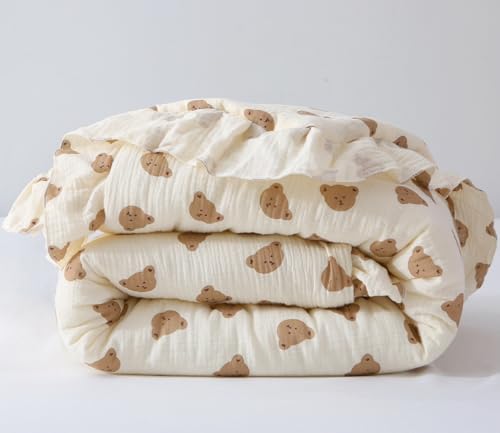
CLoucl 100% Cotton Muslin Crib Comforter and Quilt — Best for the Toddler Bed Transition
When a child moves from crib to toddler bed — which for many families happens not long after eighteen months — the 30 x 40 blankets suddenly look like napkins. The CLoucl muslin comforter is sized 41 x 48 inches, which drapes a toddler bed with genuine overhang, and it is cotton muslin inside and out rather than a synthetic shell over mystery fill. It reads visually as a child’s first real quilt, which matters to toddlers who are suddenly very interested in having a ‘big’ bed like everyone else’s.
Strengths
- 41 x 48 inch size actually covers a toddler bed
- All-cotton muslin construction breathes in both directions of the year
- Reversible, so the bed can be remade with a fresh face between washes
Trade-offs
- Too bulky for a stroller or diaper bag — this is a bed blanket
- Muslin wrinkles readily and looks rumpled straight from the dryer
- Lighter warmth than a filled synthetic comforter in midwinter
Key specs: 41 x 48 inches; 100% cotton muslin; reversible
Muslin’s open weave is the reason this comforter works across seasons: it traps enough air to warm a toddler in a cool room, yet vents when the room heats up, so the child is less likely to kick it off at 2 a.m. and wake cold at 4. The size also extends its working life — where a 30 x 40 blanket is finished by age three, a 41 x 48 quilt still serves a four-year-old, which makes it the better value for families buying once. Wash it on a gentle cycle and expect the muslin to soften noticeably over the first few washes; new muslin can feel slightly crisp, and that is normal rather than a defect. For the crib months that remain, fold it rather than draping it, since the extra fabric is more than an eighteen-month-old needs in a crib. Parents furnishing a toddler room on a budget should note the cost-per-year math here: a blanket that serves from eighteen months to age four or five is cheaper in the end than two successive smaller blankets.
Check on Amazon — check the current price on Amazon before you buy, and confirm the size and colorway on the listing.
Best for: children moving to a toddler bed, and parents buying once for ages 18 months to 4 years / Not suited for: stroller and travel use

HOMRITAR Minky Baby Blanket with Dotted Backing, Dinosaurs — Best Comfort-Object Blanket
Some blankets are bedding and some are emotional infrastructure. The HOMRITAR minky blanket is built for the second job: one side is a smooth printed minky with a multicolor dinosaur pattern, and the other is the dotted minky texture that a remarkable number of toddlers use as a self-soothing surface, working the little raised dots between their fingers as they wind down. At 30 x 40 inches it is sized for laps, strollers, and crib corners rather than full bed coverage.
Strengths
- Dotted minky backing is a proven self-soothing texture at this age
- Double-layer construction feels substantial without being heavy
- Print holds up visually even after heavy washing
Trade-offs
- Polyester minky sleeps warmer than cotton — not a summer-night blanket
- 30 x 40 inches is a lovey size, not a bed-covering size
- Minky can hold onto odors if it is not washed promptly after spills
Key specs: 30 x 40 inches; double-layer minky polyester, dotted backing
The honest way to evaluate this blanket is as a comfort object first and a blanket second. Eighteen months is peak attachment age, and the blanket a child chooses becomes non-negotiable at bedtime, in the car, and at daycare drop-off. The dinosaur print helps here in an unexpected way: it looks like a big-kid blanket rather than a baby blanket, so toddlers who are beginning to reject ‘baby’ things still claim it proudly. If your child adopts it, buy the duplicate immediately and rotate them so both wear evenly — replacing a lost, discontinued lovey is a special kind of parental misery. Warmth-wise, treat it as a nap and layering blanket: over pajamas in a cool room it is plenty, but in summer it belongs at the foot of the bed rather than over the child. Daycare teachers quietly favor blankets like this one, because a child who can self-soothe with a familiar texture settles faster in a room full of other toddlers — a benefit that never appears on a product page.
Check on Amazon — check the current price on Amazon before you buy, and confirm the size and colorway on the listing.
Best for: toddlers who self-soothe by touch and need a durable lovey / Not suited for: warm bedrooms or families avoiding synthetics

CARUILI Toddler Blanket 50 x 60 Inches, Minky with Dotted Backing — Best Oversized Pick
The CARUILI is what happens when the lovey grows up. It keeps the minky-and-dots formula toddlers love but stretches it to 50 x 60 inches — a genuine throw size that covers a toddler bed end to end, wraps a child on a couch, or covers both a parent and a toddler during bedtime stories. For tall toddlers who have been kicking out of standard blankets, this is the size correction.
Strengths
- 50 x 60 inch size ends the outgrown-blanket problem for years
- Same dotted backing texture as smaller minky loveys, so it can succeed a beloved smaller blanket
- Generous enough for shared couch and story-time use
Trade-offs
- Too much fabric for a crib — reserve it for toddler beds and supervised lounging
- Heavier to launder and slower to dry than a 30 x 40 blanket
- Minky warmth is overkill in summer
Key specs: 50 x 60 inches; minky with dotted backing
Oversizing has one real hazard at this age, and it is worth stating plainly: a 50 x 60 blanket does not belong loose in a crib with an eighteen-month-old, because the excess fabric pools and tangles. Used where it belongs — on a toddler bed, on the floor for play, on a chair for stories — it is the most versatile blanket in this guide. It also solves a quieter problem: siblings. A blanket this size gets shared on the couch without a territorial dispute, and it transitions to a child’s first twin bed as a top layer without looking undersized. Expect it to become the household’s default sick-day blanket, draped over a small miserable person on the sofa, and wash it accordingly — promptly, and on its own the first few times to keep lint off everything else. It also earns a place in the living room permanently: once the toddler years pass, a 50 x 60 minky throw simply becomes the couch blanket, which is a longer service life than any other pick here can claim.
Check on Amazon — check the current price on Amazon before you buy, and confirm the size and colorway on the listing.
Best for: tall toddlers, toddler beds, and shared story-time duty / Not suited for: cribs or compact stroller storage

HardNok Muslin Baby Blanket, Organic Cotton Blend — Best Breathable for Warm Sleepers
The HardNok blanket is built from six layers of muslin in an organic cotton blend, woven in a jacquard pattern at 43 x 43 inches. Six layers sounds like a winter blanket, but muslin layers are mostly air, and the result is a blanket with real drape and presence that still breathes — the combination warm sleepers need. It arrives in a curated gift box, which is a small thing, but it makes this the easiest pick to send directly to another family.
Strengths
- Six-layer muslin breathes far better than its substance suggests
- 43 x 43 inch square works as blanket, play mat, and stroller shade
- Jacquard weave looks considered rather than purely functional
Trade-offs
- Square shape drapes a rectangular toddler bed less neatly than a rectangular blanket
- Muslin snags on rough Velcro and unfinished wood — keep it away from both
- Lighter than a filled quilt on genuinely cold nights
Key specs: 43 x 43 inches; organic cotton blend muslin, 6-layer jacquard weave
Temperature regulation is the under-discussed skill a toddler blanket needs. Eighteen-month-olds cannot adjust their own covers intelligently — they kick everything off, then wake cold and furious — so a blanket that moderates rather than maximizes warmth produces longer sleep. That is exactly the HardNok’s lane: it takes the edge off a cool room without creating the sweaty wakefulness a plush blanket causes in a warm one. The square format also earns points outside the bedroom. Spread on the floor it is a clean play surface for a child who still mouths everything; over a stroller it is shade that does not cook the occupant. It softens with washing in the way good muslin does, becoming the blanket that lives in the car because it does five jobs adequately instead of one job perfectly. For families in genuinely hot climates, this may be the only blanket on the list that stays on the bed twelve months a year rather than rotating into a closet each spring.
Check on Amazon — check the current price on Amazon before you buy, and confirm the size and colorway on the listing.
Best for: warm sleepers, warm climates, and multi-use duty beyond the bed / Not suited for: cold nurseries as the only layer

Bleu La La Organic Cotton Pointelle Knit Baby Quilt Blanket — Best Heirloom Knit
Every lineup needs one blanket bought with the heart, and this is it. The Bleu La La pointelle knit is organic cotton worked in a delicate openwork stitch, in a neutral oatmeal that goes with every nursery ever painted. It is the blanket that appears in the photos, gets folded over the crib rail during the day, and ends up in the keepsake box when the toddler years are over.
Strengths
- Pointelle knit has genuine heirloom character the printed blankets cannot match
- Organic cotton with a breathable openwork stitch
- Neutral colorway survives changes of nursery decor and siblings of any sex
Trade-offs
- Openwork stitch is more delicate — this is not the drag-across-the-playground blanket
- Knit stretches if hung wet; dry it flat or folded over a rail
- Costs sit in the premium tier for the category
Key specs: Organic cotton; pointelle knit; oatmeal colorway
Practical parents should still understand the case for one beautiful blanket. At eighteen months a child is photographed constantly, visited by grandparents, and taken to family events wrapped in whatever was grabbed — having one blanket that elevates all of that has real, if unquantifiable, value. The pointelle stitch is not purely decorative either: the openwork makes this a genuinely breathable knit, suitable for a sleeping toddler in a mild room in a way a dense cable knit is not. Treat it as the good blanket rather than the only blanket. Pair it with one of the workhorse picks above for daily abuse, keep the Bleu La La for the bed, the stroller on outings, and the photos, and it will still look presentable when a sibling arrives — which is more than can be said for any minky print. If you are buying it as a gift, pair it with a note that it is the blanket for the bed and the photographs — the parents will understand the assignment, and the blanket will still be beautiful at the child’s fifth birthday.
Check on Amazon — check the current price on Amazon before you buy, and confirm the size and colorway on the listing.
Best for: gifts, photos, and families who want one keepsake-grade blanket / Not suited for: daily drag-around lovey duty
Comparison Table
| Pick | Badge | Key spec | Best for |
|---|---|---|---|
| Burt’s Bees Baby Organic Cotton Reversible Blanket | Best Overall | 30 x 40 in, organic cotton quilted | most families who want one reliable crib and stroller blanket |
| CLoucl 100% Cotton Muslin Crib Comforter and Quilt | Best for the Toddler Bed Transition | 41 x 48 in, all-cotton muslin | children moving to a toddler bed, and parents buying once for ages 18 months to 4 years |
| HOMRITAR Minky Baby Blanket with Dotted Backing, Dinosaurs | Best Comfort-Object Blanket | 30 x 40 in, double-layer dotted minky | toddlers who self-soothe by touch and need a durable lovey |
| CARUILI Toddler Blanket 50 x 60 Inches, Minky with Dotted Backing | Best Oversized Pick | 50 x 60 in, oversized minky throw | tall toddlers, toddler beds, and shared story-time duty |
| HardNok Muslin Baby Blanket, Organic Cotton Blend | Best Breathable for Warm Sleepers | 43 x 43 in, 6-layer muslin | warm sleepers, warm climates, and multi-use duty beyond the bed |
| Bleu La La Organic Cotton Pointelle Knit Baby Quilt Blanket | Best Heirloom Knit | Organic cotton pointelle knit | gifts, photos, and families who want one keepsake-grade blanket |
How to Choose a Blanket for an 18-Month-Old
Start with the sleep space, because it decides the size. In a crib, an eighteen-month-old needs coverage without excess: 30 x 40 inches covers the child and tucks nowhere, which is what you want — no folding, no bunching, no fabric mountains at the foot of the crib. On a toddler bed, go bigger: 40 x 50 up to 50 x 60 inches gives drape over the sides and room to grow. Buying a crib-size blanket for a child who will be in a toddler bed within six months is the most common sizing mistake at this age, and it is why the transition-size picks in this guide exist.
Next, match fabric to your child’s thermostat. Cotton and muslin are the default recommendation because they breathe, wash hard, and feel neutral against skin in every season. Minky and fleece earn their place as comfort textures and cold-room layers, but they sleep warm and should not be the only blanket in a hot climate or a warm sleeper’s bed. Knits sit between the two: warmer than muslin, cooler than plush, and the most fragile of the three. A two-blanket system — one breathable, one cozy — covers the whole year in most homes and costs less than chasing one perfect all-season blanket.
Finally, judge the blanket by its fifth wash, not its first. Toddlers are filthy in ways that defy prediction, and this blanket will be washed weekly at minimum. Quilted stitching should be dense enough that fill cannot shift; binding should be stitched, not glued; prints should be dyed or woven rather than surface-painted. If the care label says hand wash only, believe it, and put the blanket back — at eighteen months, a hand-wash blanket is a blanket that will simply stop being washed, and everyone in the house will know it.
Blanket Safety at 18 Months: What Actually Matters
The first birthday is the widely used threshold after which a light blanket in the crib is considered acceptable, and at eighteen months the remaining rules are about weight and excess rather than presence. Keep the blanket light — a toddler should be able to kick it off and push it away without effort. Keep it appropriately sized, because the risk that remains is entanglement in pooled fabric, which is a big-blanket problem, not a blanket problem. And keep weighted blankets out of the toddler bed entirely: they are marketed aggressively for sleep, but the weight guidance behind them assumes a much larger, older child.
Attachments deserve a check too. Buttons, glued appliqués, ribbon loops, and long fringe all become projects for busy toddler fingers at 3 a.m., and anything that can be worried loose should not be in the sleep space. The picks in this guide are appliqué-free for exactly this reason. Once a week, run a hand over seams and binding while the blanket is in the laundry pile; a seam that is starting to open is a two-minute fix now and a destroyed favorite blanket later.
How Long Each Blanket Type Actually Lasts
Parents reasonably ask whether a toddler blanket is a one-year purchase or a five-year one, and the honest answer depends on fabric more than on brand. Quilted cotton blankets like the Burt’s Bees pick typically serve three to four years of weekly washing before the fill begins to thin at the edges; they usually retire because the child outgrows the size, not because the blanket fails. Muslin lasts even longer in pure durability terms — the weave tightens and softens rather than wearing out — but a muslin blanket’s lightness means older children eventually demand something with more presence, so its service life ends by preference rather than by damage.
Minky is the opposite case: the fabric itself is nearly indestructible, but the attachment it creates means its working life is measured in emotional years, and a beloved minky lovey may be carried daily until kindergarten and then abruptly retired to a shelf. Plan for that arc rather than against it — the duplicate-rotation strategy in the how-to section below exists precisely because a minky favorite cannot be replaced mid-childhood with a fresh one; toddlers can tell the difference instantly, by texture and by smell.
Knits are the fragile entry. A pointelle or cable knit treated gently — washed in a mesh bag, dried flat, kept out of the sandbox — lasts indefinitely as a keepsake, but the same blanket in daily drag-around service will snag and stretch within a year. This is why the guide pairs the knit with workhorse picks rather than presenting it as a standalone solution: longevity at this age is a property of the rotation, not of any single blanket.
Reading Warmth Without a TOG Rating
Unlike sleep sacks, toddler blankets almost never carry a standardized warmth rating, so parents are left comparing words like ‘cozy’ and ‘plush’ that mean nothing measurable. Use this field method instead. Hold the blanket up to a window: if you can see light clearly through the weave, it is a warm-weather layer, whatever the marketing says. If the fabric blocks light but you can blow through it with effort, it is a mid-season blanket — the category most eighteen-month-olds need most of the year. If you cannot blow through it at all, it is a winter layer, and it should be used with a cooler room rather than warmer pajamas, because toddlers cannot regulate the combination themselves.
Then check the room, not the blanket. A nursery that sits between roughly 68 and 72 degrees Fahrenheit at night suits a mid-weight blanket over standard pajamas. Colder rooms call for the blanket plus a sleep sack rather than a heavier blanket, because layering lets you adjust at midnight without waking the child fully. Warmer rooms call for muslin or nothing — and ‘nothing’ is a legitimate answer in a heat wave; a toddler who kicks every cover off in July is giving you accurate thermal feedback, not misbehaving.
Finally, feel the child’s chest or the back of the neck in the first week with any new blanket, about an hour after they fall asleep. Warm and dry means the system is right. Sweaty means step down a layer; cool to the touch means step up. This ten-second check calibrates a blanket to your actual house faster than any chart, and it is worth repeating whenever the season turns.
How to Introduce a Blanket to an 18-Month-Old’s Sleep Routine
A blanket fails at this age less often for warmth reasons than for acceptance reasons: toddlers are conservative creatures, and a new object in the bed can be rejected on principle. Introduce it like a professional:
- Start outside the bed. Let the blanket live on the couch and the play floor for two or three days first, so it picks up the smells of home and becomes a familiar object rather than a bedtime intruder.
- Add it at nap time before night time. Naps are lower-stakes; a blanket accepted at noon is usually accepted at midnight within the week.
- Lay it over the legs, not the chest. Most toddlers at this age sleep hot from the core and cool from the feet; a blanket over the lower body is accepted by children who kick a full covering straight off.
- Keep the sleep sack if you use one. A blanket and a wearable blanket coexist fine at this age, and removing a working sleep system to force the new blanket usually backfires.
- Wash the duplicate in the same load. If the blanket becomes the chosen lovey, buy the second one immediately and rotate them through the same washes so both smell and feel identical when the emergency swap happens.
Expect the process to take about a week. A blanket that is still being thrown out of the crib after ten days is not a discipline problem — it is information that the fabric, weight, or size is wrong for this particular child, and the fix is a different blanket, not persistence.
Common Buying Mistakes
Buying a weighted blanket for a toddler. The marketing aimed at exhausted parents is relentless, but weighted blankets are sized and weighted for older children. At eighteen months the correct weight for a sleep blanket is ‘as light as possible while still warm,’ and every pick in this guide meets that standard by being unweighted.
Buying newborn sizes out of habit. Receiving blankets and 30-inch swaddle squares were perfect a year ago. An eighteen-month-old is roughly twice that blanket’s intended occupant. If the product name says ‘receiving’ or ‘swaddle,’ it is the wrong purchase for this age, however soft it feels.
Choosing long-pile plush for a crib. Deep plush and faux-fur blankets shed fibers, sleep extremely hot, and are miserable to wash. Save high-pile textures for supervised couch time and choose smooth or short-texture fabrics for the sleep space.
Buying exactly one of the favorite. The single most predictable toddler-blanket disaster is the beloved blanket meeting a stomach bug the night before a trip. The moment a blanket becomes the chosen one, the duplicate purchase is not optional spending — it is insurance.
Overdressing the bed to compensate for a cold house. Parents who keep a chilly nursery often respond with the heaviest blanket they can find, and the toddler responds by sweating, kicking it off, and waking colder than before. Warm the system in layers — pajamas, a sleep sack if you use one, then a mid-weight blanket — so each layer can be adjusted independently instead of betting everything on one thick blanket.
Judging by the first touch in the store. New blankets are finished with softeners that wash out within three laundry cycles. Judge a fabric by its type and weave — cotton muslin, quilted cotton, minky — not by the showroom hand-feel, which is temporary by design.
Final Recommendation
For most families, the Burt’s Bees Baby reversible quilted blanket is the right first purchase: organic cotton, honestly sized, and built to be washed without ceremony. If your child is about to move to a toddler bed, skip ahead to the CLoucl muslin comforter and buy a blanket that will still fit in two years. Warm sleepers and warm climates point to the HardNok six-layer muslin, while toddlers who need a tactile lovey to settle will claim either the HOMRITAR dinosaur minky or, in the larger size, the CARUILI. The Bleu La La pointelle knit is the gift and keepsake pick — buy it alongside a workhorse, not instead of one.
Whatever you choose, buy the size for the bed your child will be in at age two and a half, keep the weight light, and get the duplicate the moment a favorite emerges. Those three decisions matter more than any brand name on this page, and they will still be the right decisions when this blanket is eventually folded away into the keepsake box.
Keep exploring the same cluster: Best Baby Blankets Organic Best Baby Throw Blankets Best Baby Stroller Blankets Best Bags For Blankets Best Baby Car Seat Blankets
Frequently Asked Questions
When can a baby sleep with a blanket?
The commonly used threshold is the first birthday; before that, wearable blankets are the standard recommendation because loose bedding in an infant crib is a suffocation risk. At eighteen months a light, appropriately sized blanket is a normal part of the sleep space, provided it is unweighted and the child can push it away easily.
What size blanket does an 18-month-old need?
For a crib, 30 x 40 inches covers an eighteen-month-old fully without excess fabric pooling. For a toddler bed, look at 40 x 50 to 50 x 60 inches so the blanket drapes the sides and still fits at age three and beyond.
Are weighted blankets safe for toddlers?
They are not recommended at this age. Weighted blankets are designed around a proportion of an older child’s body weight, and no eighteen-month-old needs added weight to sleep. Choose the lightest blanket that keeps your child comfortable instead.
Which fabric is best for a toddler who sleeps hot?
Cotton muslin is the strongest choice: its open weave vents heat while still taking the chill off the room. Multi-layer muslin, like the six-layer HardNok in this guide, adds drape and a sense of coverage without trapping heat the way polyester plush does.
How many blankets should I buy?
Two of the favorite is the working rule: one in use, one in the wash or ready for the inevitable middle-of-the-night swap. A third, different-texture blanket for the car or stroller is a reasonable addition but not a necessity.
Can an 18-month-old use a regular throw blanket from the couch?
A small, light throw is not automatically a problem at this age, but most adult throws fail the toddler tests: they are oversized for a crib, often made from high-pile or loosely woven fabrics that shed, and heavy enough that a small child cannot kick them off easily. A blanket sized and built for toddlers, like the picks in this guide, is the better tool for the sleep space; save the couch throw for supervised snuggling.
How should I wash a toddler blanket?
Machine wash warm with a mild detergent and skip fabric softener, which coats fibers and reduces both absorbency and the natural softness of cotton and muslin. Tumble dry low for most fabrics; dry knits flat or folded over a rail so the stitch does not stretch under its own wet weight.


