Disclosure: airfryerkitchensupply.com is reader-supported. When you buy through links on our site, we may earn an affiliate commission at no extra cost to you.
Where to buy
Every set in this guide to the best sheet sets you can buy is sold through Amazon and was verified against the live Amazon catalogue before it earned a place here — “you can buy” is a promise we checked, not a figure of speech. Start with the Bedsure Queen Sheet Set for the all-round answer, or the Bedsure Deep Pocket Set if your mattress is tall. We never print product prices — they change too often to stay honest — so use the check-price links throughout.
The Best Sheet Sets You Can Buy: Six Sets That Cover Every Kind of Sleeper
The best sheet sets you can buy are not the ones with the most extravagant thread-count claims; they are the ones matched to how you actually sleep. Sheets are the most intimate textile in the house — your skin’s whole environment for a third of your life — and the market’s noise (four-digit thread counts, miracle fibres, hotel-this and luxury-that) mostly obscures a simple set of decisions: fibre, weave, pocket depth, and how the set behaves in the wash. The six sets in this guide were chosen to make those decisions concrete. Between them they cover the cooling microfiber all-rounder, the value benchmark, honest cotton sateen, bamboo-derived rayon for hot sleepers, a genuine deep-pocket solution for tall mattresses, and flannel for winter.
Two brands dominate the list, and that is an honest reflection of the current market rather than a failure of imagination: Bedsure and Mellanni have spent years at the top of the accessible sheet market because their sets are consistently made, honestly described and easy to buy in every standard size. Every pick here is a queen set — the most common bed size — and each is sold in the other standard sizes through the same listings. Rather than padding the guide with obscure names, we verified the sets people can actually buy, in stock, from makers who will still exist when you want a second set to match.
Every set below was cross-checked against its manufacturer’s Amazon listing, and only listing-confirmed sets carry buying links. Where a listing verified a pocket depth, fibre or dimension, it appears in the spec box; where it did not, we left the box out rather than repeat catalogue folklore.
A word about how to buy once you have chosen. Sheets are a textile you judge by sleeping, not by reading, so favour listings with straightforward returns and give a new set three nights and one wash before verdict — cotton in particular changes character after its first laundry, arriving crisper than it will live. Buy the second set only after the first has passed that test, and buy it in the same colour while the dye lot is current if matching matters to you. None of this is complicated, but it is the difference between a linen cupboard that works as a system and a pile of almost-right sets accumulated one hopeful purchase at a time.
In this guide
Quick Picks
- Best Overall: Bedsure Queen Sheet Set, 4 Pieces — soft, breathable, cooling microfiber with a deep pocket and easy care. Check the current price on Amazon
- Best Value: Mellanni Iconic 4-Piece Bed Sheet Set — the benchmark budget set with a 16-inch deep pocket. Check the current price on Amazon
- Best Cotton: Mellanni 400TC Cotton Sateen Sheets — smooth 100% cotton sateen with a 15-inch fitted pocket. Check the current price on Amazon
- Best for Hot Sleepers: Bedsure PureWoven Bamboo-Derived Rayon Sheets — silky, breathable cooling sheets with a 16-inch deep pocket. Check the current price on Amazon
- Best Deep Pocket: Bedsure Deep Pocket Queen Sheets Set — fits mattresses up to 21 inches thick, moisture-wicking and secure. Check the current price on Amazon
- Best for Winter: Mellanni Cotton Flannel Sheet Set — double-brushed cotton flannel with a deep pocket up to 16 inches. Check the current price on Amazon
How These Picks Were Chosen
Availability was the first filter, in keeping with the search’s promise: every set had to be a current, verifiable Amazon listing in standard sizes, from a maker with a track record — the sheet sets you can buy today and buy again next year. Second was fibre honesty. Each pick declares its material plainly in its listing — microfiber, cotton sateen, bamboo-derived rayon, cotton flannel — and we cut sets whose fibre claims dissolved under reading (the infamous unnamed “luxury fabric” problem). Third was fit engineering: stated pocket depths were checked against the mattress reality of modern beds, where toppers have pushed typical depths well past the old standard.
Fourth was wash behaviour, because sheets are the most-laundered textile in the home and a set that pills, twists or fades by the tenth wash is a set you will replace within the year. We favoured constructions with reputations for surviving the laundry — easy-care microfiber, sateen that softens rather than thins, flannel brushed on both sides. Fifth was the sleeper spread: the six picks deliberately span hot sleepers, cold sleepers, tall mattresses and tight budgets, because a sheet guide that only serves one kind of bed serves few readers. Thread count, notably, was not a criterion — beyond a sane threshold it predicts price far better than it predicts sleep.
We also checked the unglamorous details that listings reveal and buyers overlook: whether the fitted sheet’s elastic runs all the way around or only at the corners, whether pillowcases close with an envelope flap, whether the flat sheet is generously sized. None of these makes a headline, and all of them are felt nightly. The sets that survived this filter are not the most exotic sheets on Amazon; they are the ones with the fewest ways to annoy you, which at 7 a.m. on laundry day is the highest praise a sheet can earn.
The 6 Best Sheet Sets You Can Buy

Bedsure Queen Sheet Set, 4 Pieces — Best Overall
The Bedsure set is the sheet set equivalent of a reliable recommendation you can give without caveats: a 4-piece queen set in a soft, breathable microfiber its listing describes as cooling, with a deep pocket, fade- and shrink-resistant easy care, and an embossed design that keeps it from looking as plain as it is practical. It suits the widest range of sleepers — average temperatures, average mattresses, households that wash hot and often. It does not suit fibre purists who want natural materials on principle; for them, the cotton and bamboo picks below exist.
Strengths
- Balanced microfiber: soft, breathable and genuinely easy care — wash, dry, remake the bed.
- Deep pocket fit covers most modern mattress-and-topper combinations without corner wrestling.
- Fade- and shrink-resistant positioning suits the frequent, practical laundry rhythm of family life.
Trade-offs
- Microfiber is a synthetic feel — smooth and soft, but distinct from cotton’s crisper hand.
- Very hot sleepers should step up to the bamboo-derived set for maximum cooling.
- Embossed design is subtle; buyers wanting a bold patterned bed should look at prints instead.
- Fabric: Microfiber (GentleSoft)
- Pieces: 4 (fitted, flat, 2 pillowcases)
- Fit: Deep pocket
What makes this set the overall pick is the absence of failure modes. It does not demand gentle washing, it does not punish a tall mattress, it does not sleep noticeably hot or cold, and its softness arrives on night one rather than after a month of breaking in. In a category where every fibre has a constituency and a complaint, the Bedsure’s constituency is simply “people who want good sheets and then want to stop thinking about sheets.” Buy two sets — one on the bed, one in the wash — and the sheet question is closed for years. That closure is what most buyers are actually shopping for.
Best for: most beds, most sleepers, most households / Not suited for: natural-fibre purists or extreme hot sleepers


Mellanni Iconic 4-Piece Bed Sheet Set — Best Value
The Mellanni Iconic is the set that defined the modern value tier: a 4-piece set with a 16-inch deep pocket, a brushed microfiber feel, and a listing that leans on lab-tested breathability and colour-fastness rather than thread-count theatre. It suits budget-led buyers equipping whole households — first apartments, guest rooms, kids’ beds, rental properties — where several sets must be bought at once and every one must simply work. It does not suit buyers chasing a natural fibre or a luxury hand-feel; its virtues are consistency and price discipline.
Strengths
- The benchmark value set: proven construction at the tier where whole-house equipping is affordable.
- 16-inch deep pocket handles most mattresses with toppers.
- Easy-care microfiber that stays smooth and bright through frequent washing, per its listing.
Trade-offs
- Microfiber feel, with the same synthetic character noted for the Bedsure.
- Lightweight hand — buyers who love a heavy, crisp cotton sheet will find it insubstantial.
- At this tier, colour range is the luxury; construction upgrades live further up the list.
- Fabric: Microfiber
- Pieces: 4
- Fit: 16-inch deep pocket
Value picks earn their badge by what happens in month six, and the Iconic’s reputation rests on boring excellence: elastic that still grips, seams that hold, colours that stay. Mellanni built its name on this set because households bought it for one bed, then quietly re-bought it for every bed — the surest market signal a sheet can earn. If you are furnishing from zero, the rational strategy is here: Iconics on every bed now, and upgrade the master bed later to cotton or bamboo when you know your own fibre preference. Few purchases in the home repay that sequencing as reliably.
Best for: equipping multiple beds on a budget / Not suited for: natural-fibre seekers or luxury hand-feel hunters

Mellanni 400TC Cotton Sateen Sheets — Best Cotton
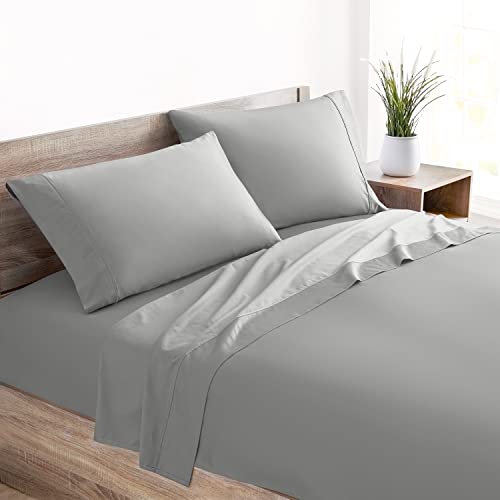
For buyers who want cotton and mean it, this Mellanni set is the honest article: 100% cotton in a sateen weave at a stated 400 thread count, with a 15-inch fitted pocket and full queen dimensions in its listing. It suits cotton loyalists — sleepers who find microfiber’s feel subtly wrong and want the breathable, smooth, slightly cool hand of real cotton. It does not suit the wrinkle-averse: cotton sateen creases, and loving it means accepting the lived-in look or ironing, and most cotton people make their peace with the former.
Strengths
- Genuine 100% cotton with a sateen weave — smooth, breathable, naturally temperature-balancing.
- Stated dimensions and pocket depth in the listing: a 15-inch fitted pocket, full-size flat sheet.
- Cotton softens with washing over years rather than degrading.
Trade-offs
- Wrinkles are part of the cotton contract, sateen included.
- Costs more than the microfiber picks and asks slightly more care — cooler washes preserve it best.
- 15-inch pocket is adequate for most beds but tall topper stacks should choose the 21-inch Bedsure.
- Fabric: 100% cotton sateen, 400TC
- Pieces: 4
- Fit: 15-inch fitted pocket
Sateen is the weave that gives cotton its slight sheen and its smooth, draping hand — distinct from percale’s crisp matte finish — and at 400 thread count this set sits in the honest middle of cotton quality, where the fibres are good and the weave is tight without the inflated numbers that signal marketing rather than cloth. Cotton’s deeper virtue is thermal honesty: it neither traps heat like a synthetic can nor feels clammy, and across seasons it simply behaves. If your sheet history is a trail of microfiber sets that felt fine and never felt right, this is the set that explains what you were missing.
Best for: cotton loyalists and balanced-temperature sleepers / Not suited for: wrinkle perfectionists or the tallest mattress stacks
Bedsure PureWoven Bamboo-Derived Rayon Sheets — Best for Hot Sleepers
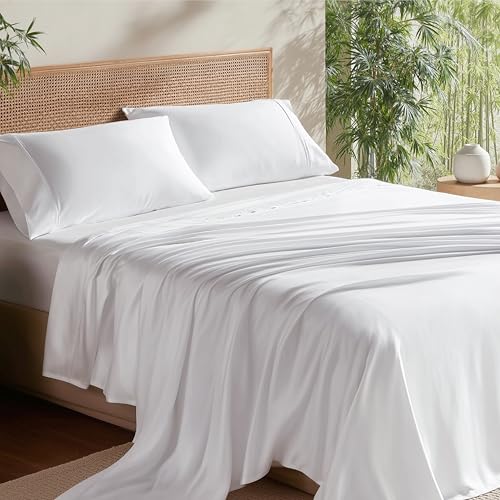
The PureWoven set is spun from rayon derived from bamboo, and its listing promises what hot sleepers shop for: cooling, breathable, silky-soft sheets with a 16-inch deep pocket and an OEKO-TEX credential. It suits warm sleepers, warm climates and anyone whose current sheets are the reason they wake at 3 a.m. It does not suit buyers who prefer a crisp, structured sheet — rayon drapes like water, which is its luxury and its personality — nor the rough-and-tumble laundry habits that microfiber forgives.
Strengths
- Bamboo-derived rayon is the coolest-feeling fibre in this guide — silky and breathable against hot skin.
- 16-inch deep pocket keeps the drapey fabric anchored on modern mattresses.
- OEKO-TEX credential stated in the listing for the textile’s tested safety.
Trade-offs
- Rayon asks for gentler washing than microfiber or cotton to keep its silkiness.
- The fluid drape can feel slippery to sleepers who like a sheet with body.
- Premium tier among these picks — cooling is the feature being bought.
- Fabric: Rayon derived from bamboo
- Pieces: 4
- Fit: 16-inch deep pocket
Hot sleeping is a materials problem before it is a thermostat problem, and this set is the materials answer. Rayon from bamboo wicks and breathes in a way that feels cool on first contact and stays comfortable as the night warms — the difference sleepers describe as “the sheets stopped fighting me.” The PureWoven’s job in this guide is to be the deliberate upgrade for the sleeper who has already tried cotton and microfiber and still runs hot. Treat it a little kindly in the wash and it returns the favour nightly. Paired with a breathable mattress setup, it is the closest thing to a cooling system that a sheet set can be.
Best for: hot sleepers and warm climates / Not suited for: crisp-sheet lovers or harsh laundry routines

Bedsure Deep Pocket Queen Sheets Set — Best Deep Pocket
This Bedsure set exists to solve one infuriating problem completely: it fits mattresses up to 21 inches thick. Its GentleSoft fabric is positioned as moisture-wicking, soft and cooling, with an easy, secure fit as the headline. It suits owners of tall mattresses — pillow-tops, thick hybrids, mattress-plus-topper stacks — whose current fitted sheets pop corners at 2 a.m. It does not suit standard-depth mattresses, where 21 inches of pocket becomes excess fabric that bunches and wanders; fit is a match, not a maximum.
Strengths
- Genuine 21-inch capacity — among the deepest honest pockets in the category.
- Secure fit engineering aimed at staying on restless sleepers’ beds.
- Moisture-wicking, cooling positioning adds hot-sleeper manners to the fit solution.
Trade-offs
- Too much pocket for a slim mattress: the surplus fabric has to go somewhere, and it goes into wrinkles.
- Microfiber character, as with the other Bedsure picks.
- Measure before buying — this set rewards the tape measure and punishes guessing.
- Fabric: Microfiber (GentleSoft)
- Fit: Mattresses up to 21 inches thick
- Pieces: Sheet set with pillowcases
Corner pop-off is the sheet failure everyone recognises and few guides address head-on: the fitted sheet that fits at bedtime and has migrated by morning, because its pocket was shallower than the mattress it was stretched over. The fix is not stronger elastic alone; it is enough fabric to wrap the mattress with material to spare, tucked and gripped rather than strained. This set provides exactly that for the tall-bed era — measure your mattress including any topper, and if the number lands anywhere near the high teens, this is your pick and the standard sets in this guide are not. Fit solved, the rest of the set is Bedsure’s familiar easy-care competence.
Best for: tall mattresses, pillow-tops and topper stacks / Not suited for: standard or slim mattresses

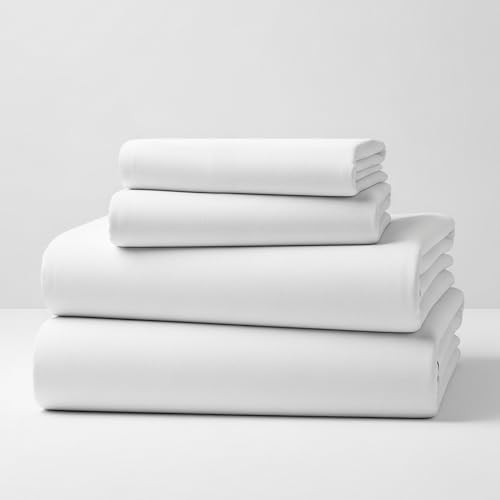
Mellanni Cotton Flannel Sheet Set — Best for Winter
Flannel is the seasonal specialist, and Mellanni’s set does it in real cotton: double-brushed for softness, with a deep pocket up to 16 inches, in a 4-piece queen set. It suits cold sleepers, cold houses and anyone whose winter bed currently involves a chilly first minute that ruins the mood. It does not suit summer, warm sleepers, or warm climates in any month — flannel’s warmth is total, and that is the point and the limit.
Strengths
- Double-brushed cotton flannel: warmth you feel the second you get in, no cold-sheet shock.
- Cotton base keeps it breathable within its warmth — cosy rather than sweaty for cold sleepers.
- Deep pocket up to 16 inches fits winter’s mattress-plus-topper stacks.
Trade-offs
- A half-year product in most climates — budget for it as the winter set, not the only set.
- Flannel pills if washed harshly; gentle cycles keep the brushed surface at its best.
- Too warm for hot sleepers even in winter — know your sleeper type.
- Fabric: Cotton flannel, double brushed
- Pieces: 4
- Fit: Deep pocket up to 16 inches
Every cold-climate household eventually learns the two-set system: a breathable set for the warm months and flannel for the cold ones, rotated with the clocks. This Mellanni is the winter half of that system done properly — cotton flannel’s brushed nap traps a layer of still air that makes the bed feel pre-warmed, and because the base fibre is cotton it does so without the clamminess of synthetic fleece sheets. It also extends the life of your main set by resting it half the year. If your winters are real, this is not an indulgence purchase; it is the difference between dreading bed and looking forward to it for five months a year.
Best for: cold sleepers and cold-climate winters / Not suited for: warm sleepers, warm climates, summer

Comparison Table
| Pick | Badge | Key spec | Best for |
|---|---|---|---|
| Bedsure Queen Sheet Set | Best Overall | Cooling microfiber, deep pocket, 4pc | Most beds and sleepers |
| Mellanni Iconic Sheet Set | Best Value | Microfiber, 16 in pocket, 4pc | Equipping multiple beds |
| Mellanni 400TC Cotton Sateen | Best Cotton | 100% cotton sateen, 15 in pocket | Cotton loyalists |
| Bedsure PureWoven Bamboo Rayon | Best for Hot Sleepers | Bamboo-derived rayon, 16 in pocket | Hot sleepers, warm climates |
| Bedsure Deep Pocket Set | Best Deep Pocket | Fits mattresses up to 21 in | Tall mattresses and toppers |
| Mellanni Cotton Flannel Set | Best for Winter | Double-brushed cotton flannel | Cold sleepers, winter |
How to Choose a Sheet Set
Measure your mattress before anything else — its full depth including any topper — because pocket fit is the decision that cannot be fudged. A fitted sheet needs a pocket at least an inch or two deeper than the mattress to wrap and grip; less and it pops corners, far more and it bunches. Standard modern beds land in the 12–16 inch world served by most picks here; genuinely tall stacks need the 21-inch Bedsure. Write the number down; it eliminates half the catalogue instantly and prevents the most common sheet return.
Fibre is the second decision, and it should be made by temperature and touch, not by thread count. Hot sleeper: bamboo-derived rayon first, cotton second. Cold sleeper: flannel in winter, cotton or microfiber otherwise. Skin that dislikes synthetics: cotton, full stop. Laundry-led household that washes everything hot and often: microfiber’s forgiveness is a genuine feature. Weave refines the choice within cotton — sateen for smooth drape, percale if you prefer crisp and matte (not represented here, but the sateen pick will tell you which direction your taste runs).
Finally, buy in systems. Two sets per bed — one on, one in the wash — is the minimum viable rotation, and a seasonal second system (flannel for winter) extends the life of both. Check what a “set” contains before comparing: the standard four pieces are fitted sheet, flat sheet and two pillowcases (one in twin sizes), and a suspiciously cheap set sometimes quietly omits pieces. Envelope-closure pillowcases keep pillows inside through restless nights; small detail, nightly gratitude.
How to Wash Sheets So They Last: A Routine by Fibre
Wash new sheets before the first night — it removes manufacturing finishes and, for cotton, begins the softening that makes the set yours. Then settle into a weekly rhythm; sheets accumulate more skin, oil and life than any other laundry, and weekly washing is hygiene, not fussiness. Sort by fibre more than by colour. Microfiber tolerates warm water and standard drying and asks only that you skip fabric softener, which coats its fibres and dulls the very softness and wicking you bought. Cotton sateen prefers warm-not-hot water and a prompt exit from the dryer to limit wrinkles and preserve the weave. Bamboo-derived rayon wants the gentlest handling here — cool water, mild detergent, low heat — and repays it by keeping its silk. Flannel wants a gentle cycle to protect its brushed nap, and a lint-aware approach: wash flannel with flannel, not with towels that will roughen it.
Two universal rules close the routine. Do not overload the machine — sheets need room to move or they emerge twisted and half-washed, and fitted sheets will ball themselves around everything else in protest. And rotate sets evenly rather than running a favourite into the ground; textiles age by cycles, and rotation is how a two-set system lasts twice as long as two sets used in sequence. Follow this and the picks in this guide will look and feel right for years, not months.
One more habit separates sheet-keepers from sheet-replacers: make the bed loosely rather than hospital-tight. Constant hard tension on the same corners is a slow elastic killer, and a bed that breathes during the day dries the night’s moisture instead of storing it in the fibres.
Thread Count, Demystified in One Section
Thread count is the number of threads woven into one square inch of fabric, and for decades it was marketed as a simple quality dial: higher, better. The honest version is narrower. Within a sane range — roughly 200 to 500 for cotton — thread count tells you something real about density and smoothness, and the 400TC sateen in this guide sits in that honest band. Beyond it, numbers are commonly inflated by counting multi-ply yarns as multiple threads, producing four-digit claims that describe arithmetic rather than cloth. A 1,200TC sheet is not three times better than a 400TC sheet; it is frequently worse, woven from short fibres twisted together to reach the number, and it will pill and tire accordingly.
What actually predicts a cotton sheet’s quality is fibre length (long-staple cotton makes smoother, stronger yarn), weave, and finishing — none of which fit on a banner. For microfiber and rayon, thread count does not even apply in the same way, which is why those listings talk about softness, breathability and construction instead. The practical rule: let thread count confirm a cotton choice, never make one. Your skin will judge the sheet by fibre and weave within one night; it has never once judged it by a number on a packet.
Sateen, Percale and Microfiber: The Hand-Feel Guide
Sheets are bought by specifications and judged by skin, so here is the translation. Sateen — the Mellanni cotton’s weave — exposes more thread surface, which gives it a smooth, slightly lustrous hand and a gentle drape across the body. It feels like the luxury-hotel sheet of popular imagination and suits sleepers who like their bedding to slide a little. Percale, sateen’s great rival, is a plain matte weave with a crisp, cool hand — the freshly-ironed-shirt of sheets. It is not represented among this guide’s six, but knowing it exists helps cotton shoppers locate their taste: if sateen’s smoothness ever reads as slippery to you, percale is your direction. Microfiber is not a weave but a fibre — finely split polyester, brushed for softness — and its hand is plush, warm-neutral and uniform, without cotton’s crispness or temperature swing. Its fans describe it as cosy; its critics describe it as synthetic, and both are describing the same surface honestly.
The practical way to use this: decide by the first ten seconds of getting into bed. If you love the cool slide of a hotel sheet, sateen. If you love a crisp, fresh, almost papery coolness, percale (and cotton generally). If you love immediate soft, warm neutrality with zero break-in, microfiber. If you love silkiness that feels actively cool, bamboo rayon. Your hands already know your answer; the guide’s job is to attach the right product name to it.
Guest Rooms, Kids’ Beds and Rentals: Where the Value Logic Changes
Not every bed in a household deserves the same sheet strategy. The master bed earns the fibre you love, because you sleep there two thousand hours a year. Guest beds earn durability and neutrality: guests sleep a few nights, notice cleanliness and smoothness, and never learn your fibre philosophy — which is why the Mellanni Iconic, washed a hundred times and still presentable, is the professional choice for spare rooms and why hosts from Airbnb operators to grandparents converge on exactly this class of set. White or light neutrals dominate guest logic for a reason beyond taste: they can be washed hot, they show cleanliness honestly, and a replacement set matches without a colour hunt.
Kids’ beds argue for the same value tier with an extra weight on wash frequency and corner discipline — children are harder on elastic and more likely to turn a fitted sheet into a fort component. Buy the Iconic-class sets in duplicate and rotate without sentiment. Rentals and furnished properties complete the pattern: standardise on one set in one colour across every bed, keep sealed spares, and the whole linen question becomes a stock check rather than a shopping trip. The premium fibres in this guide are for the beds you sleep in; the value picks are how you run every other bed like a professional.
When to Replace Sheets: Reading the Signs Honestly
Sheets rarely die dramatically; they fade into mediocrity, and most households sleep on mediocre sheets for years because the decline is gradual. The readable signs are these. The fitted sheet’s elastic relaxes until corners slip even on a correctly sized pocket — elastic fatigue is the most common true end-of-life. The fabric thins in the centre, where bodies actually lie, until it feels papery against the heel. Pilling spreads beyond the first-wash fuzz into a permanent roughness your palm can map. Colours grey or yellow in a way washing no longer reverses. And the subjective sign that summarises all of them: the bed stops feeling like a pleasure to get into.
Lifespan varies by fibre and care. Quality microfiber sets commonly serve two to three years of weekly washing before elastic and surface tire together. Cotton sateen, washed kindly, can serve longer and often retires to the guest bed for a second career rather than the bin. Rayon’s life depends almost entirely on wash gentleness. The economical pattern this suggests: buy the master bed’s sets well, demote them as they age, and let the value tier absorb the household’s roughest duty from the start. When a set finally leaves service, it leaves as rags and drop cloths — a sheet’s third career, and the proper end of an honest textile.
The Flat Sheet and the Pillowcase: Small Pieces, Nightly Consequences
Buying guides obsess over the fitted sheet and forget the two pieces your skin touches most. The flat sheet is the layer between you and your blanket or duvet, and its hand-feel is the bed’s first impression — which is why fibre choice matters more here than anywhere: the bamboo rayon’s cool slide and the sateen’s smooth drape are flat-sheet experiences. Households that skip the flat sheet for a washable duvet cover are making a legitimate choice, but if you use one, size it generously; a flat sheet that barely tucks becomes a nightly wrestling partner. The pillowcase is the other intimate: envelope closures keep the pillow from escaping mid-night, and the case’s fabric is what your face actually sleeps on — hot sleepers should note that a cooling sheet set’s pillowcases do as much for their comfort as the sheets themselves.
Both pieces also carry the set’s replacement logic. Pillowcases tire fastest — face oils, hair products, weekly hot washes — and a set often dies case-first. Smart buyers pick sets whose makers sell matching standalone pillowcases, extending the whole set’s life by refreshing its weakest piece. It is a small, unglamorous consideration at purchase time and the difference, two years in, between a set that soldiers on and a set replaced over two tired rectangles of cloth.
Fit Edge Cases: Adjustable Beds, Split Kings and Toppers That Change Everything
Standard advice assumes a standard bed, and a growing minority of beds are not standard. Adjustable bases flex the mattress, and flexing is a fitted sheet’s enemy: the sheet must have enough pocket depth and elastic travel to stay seated while the head of the bed rises and falls daily. Deep pocket sets — the 16-inch class and above — cope far better than standard pockets, and a sheet that pops on a flat bed will pop twice as fast on an adjustable one. If your base moves, buy depth first and fibre second. Split king beds are two twin XL mattresses wearing one bed’s clothes; they need twin XL fitted sheets (two) with a king flat sheet and cases, a configuration the big makers here support through their size ranges — check the listing’s size menu rather than assuming a “split king set” label.
Toppers are the quieter fit-breaker. A two- or three-inch topper added to a fourteen-inch mattress creates a seventeen-inch stack that eats standard pockets whole, and it also changes the sheet’s job — the topper’s own cover plus the sheet must both stay put. Measure after the topper goes on, not before, and if a topper is in your near future, buy the deeper pocket now. The general principle closes the section: in sheet buying, the tape measure is mightier than the brand name, and every fit failure in this guide’s mistakes list traces back to someone skipping a thirty-second measurement.
Common Buying Mistakes
- Guessing the mattress depth. The number-one sheet failure is a pocket too shallow for the mattress-plus-topper. Measure, then buy.
- Chasing thread count. Four-digit counts are marketing arithmetic. Fibre quality and weave decide how a sheet sleeps and lasts.
- Buying one set per bed. A single set means laundry-day bedmaking at midnight. Two per bed is the working minimum.
- Ignoring the set contents. Confirm the pieces — fitted, flat, pillowcases — before comparing sets that look similar.
- Washing everything the same way. Rayon in a hot harsh wash and flannel with the towels are how good sheets die young. Sort by fibre.
- Matching the fibre to the photograph, not the sleeper. The prettiest set in the listing is wrong if it sleeps hot for a hot sleeper. Temperature first, looks second.
Final Recommendation
For most beds, buy the Bedsure Queen Sheet Set — two of them — and be done. Choose the Mellanni Iconic when equipping several beds on a budget, the Mellanni cotton sateen if your skin insists on cotton, and the Bedsure bamboo-derived set if you sleep hot. Measure first: tall mattresses belong to the Bedsure 21-inch deep pocket set, and cold winters belong to the Mellanni flannel. For the rest of the bed, see Best Bed Sheets, Best Cotton Sheets, Best Cooling Sheets, Best Deep Pocket Sheets, Best Flannel Sheets and Best Bamboo Sheets.
Frequently Asked Questions
What is the best sheet material overall?
There is no single winner — there is a winner per sleeper. Cotton sateen is the balanced default for feel and breathability. Bamboo-derived rayon wins for hot sleepers. Quality microfiber wins for easy care and value. Flannel wins winter. The best set in this guide is the one matched to your temperature and laundry life, which is why the guide is organised by sleeper type rather than by a single podium.
How deep should fitted sheet pockets be?
At least one to two inches deeper than your mattress including any topper, so the sheet wraps under with grip to spare. Measure the full stack — mattress plus topper plus protector — and match it: standard picks here cover the mid-teens, and the Bedsure deep pocket set covers up to 21 inches for genuinely tall beds.
How many sheet sets should I own per bed?
Two is the working minimum — one on the bed, one clean in reserve — and three is comfortable if laundry is weekly. Cold climates benefit from a seasonal split: a breathable set for warm months and flannel for winter, each resting half the year and lasting longer for it.
Do bamboo sheets really sleep cooler?
Bamboo-derived rayon feels cool to the touch and breathes and wicks well, which is why hot sleepers consistently prefer it. It is not air conditioning — room temperature and your mattress still matter — but within what a sheet can control, it is the coolest option in this guide.
Why do my fitted sheets keep popping off the corners?
Almost always because the pocket is shallower than the mattress stack it is stretched over, so the elastic lives under constant strain and a restless night wins. Measure the stack and buy the pocket depth that exceeds it — the 21-inch deep pocket set exists for exactly this complaint.
How often should sheets be washed?
Weekly is the standard worth keeping — sheets collect skin cells, oils and sweat nightly, and a weekly wash keeps both hygiene and fabric in good shape. Wash by fibre: microfiber forgivingly, cotton warmly, rayon gently, flannel on a soft cycle. Always wash a new set before its first night.
Are expensive sheet sets worth it?
Worth it when the money buys a fibre you will genuinely feel — real cotton sateen, bamboo-derived rayon — in a construction that survives washing. Not worth it when the money buys thread-count arithmetic or a brand story on the same microfiber. The picks here are arranged so each step up the tiers buys a palpable difference; if you cannot feel the difference in the first ten seconds in bed, it was not a difference worth paying for.
What sheets do hotels use, and should I copy them?
Hotels typically use crisp cotton or cotton-blend percale in white — chosen for hot washing, bleach tolerance and a fresh look across hundreds of cycles, not for ultimate softness. Copy the logic, not the exact sheet: if your priority is a fresh, crisp, easy-laundering bed, cotton in white is the hotel answer. If your priority is softness or cooling, the sateen and bamboo picks here will suit your home better than a hotel’s laundry-driven choice suits its rooms.
Do sheets get softer over time?
Cotton does — noticeably across its first dozen washes, as fibres relax and the weave settles, which is why a cotton set should be judged after a wash rather than out of the packet. Microfiber arrives at its final softness immediately and holds it. Bamboo rayon keeps its silk if washed gently and loses it if abused. Flannel’s brushed surface is softest early and asks gentle cycles to stay that way.
Should I buy sheets in white or colours?
White washes hottest, shows cleanliness honestly and never clashes — the professional and guest-room choice, and the easiest to replace singly. Colours and prints make a bedroom feel designed and hide minor staining better between washes, but they fade on their own schedules and replacements may not match older dye lots. Many households run white for the working sets and one coloured set for the look — a system that gets both virtues.
What is the difference between a sheet set and buying pieces separately?
A set guarantees matching fabric, colour and fit across fitted sheet, flat sheet and pillowcases, at a lower combined cost than the same pieces bought individually. Buying separately makes sense only when one piece has a special requirement — an extra-deep fitted sheet for a tall mattress, say — while the rest of the bed is standard. For most beds, the set is the rational unit, which is why this guide recommends in sets.