Disclosure: airfryerkitchensupply.com is reader-supported. When you buy through links on our site, we may earn an affiliate commission at no extra cost to you.
Where to buy
Every quilt in this guide to the best selling handmade quilts is sold through Amazon and was verified against the live Amazon catalogue before it earned a place here. Start with the Ridhi Handmade Block Print Cotton Quilt for a finished, bed-ready handmade quilt, or the Vintage Kantha Quilt if one-of-a-kind is the whole point. We never print product prices — they change too often to stay honest — so use the check-price links throughout.
The Best Selling Handmade Quilts: What “Handmade” Honestly Means Here
The best selling handmade quilts on Amazon cluster around a few living traditions rather than the lone-quilter stereotype, and understanding that makes shopping for them far more satisfying. The largest family is the Indian kantha: layers of cotton cloth joined by rows of hand running-stitch, often from recycled saris, each piece genuinely one of a kind. Beside it sits hand block printing — wooden blocks, hand-pressed patterns, quilts finished by hand — and hand-cut patchwork, where hundreds of individual patches are assembled into a whole no machine line would bother to imitate. These are the handmade quilts buyers actually seek out and buy in numbers, and they are the families this guide draws from.
Two honest notes. First, “best selling” in handmade goods cannot mean what it means for factory products: a one-of-a-kind vintage kantha does not have unit sales in the usual sense, and listings come and go as individual pieces sell. We have therefore chosen the styles and makers whose handmade quilts are consistently sought after and currently verifiable, rather than pretending to a sales chart that cannot exist for unique pieces. Second, handmade means variation. Colours shift slightly between pieces, stitching is human rather than laser-straight, and a vintage sari quilt carries the gentle irregularities of cloth with a previous life. Buyers who want identical, machined perfection should buy a factory quilt — this guide is for the people who consider the variation the value.
Every quilt below was cross-checked against its seller’s Amazon listing, and only listing-confirmed quilts carry buying links. Where a listing verified a size, fabric or construction detail, it appears in the spec box; where it did not, we left the box out rather than invent specifications for a handmade object.
Tiers in this category behave differently from factory bedding. The money tracks labour and provenance — hours of stitching, the rarity of good vintage cloth, the count of patches — rather than brand marketing. A throw sits at the accessible end, full bed quilts in the middle, and large vintage pieces at the top, and at every level the honest question is the same: how much handwork, in what tradition, in what condition. Judge by those three and the prices explain themselves.
In this guide
Quick Picks
- Best Overall: Ridhi Handmade Block Print 100% Cotton Quilt, King 96 x 106 in — hand block printed, reversible, lightweight cotton. Check the current price on Amazon
- Best Patchwork Set: meadow park Cotton Real Patchwork Embroidery Quilt Set, 3-Piece — 376 hand cut patches in washed cotton with embroidery. Check the current price on Amazon
- Best One-of-a-Kind: Vintage Kantha Quilt, Super King 108 x 90 in — hand-stitched from recycled sari cotton, reversible, no two alike. Check the current price on Amazon
- Best Traditional Kantha: King Size Kantha Indian Quilt, Indigo — hand stitched, handblock printed, bohemian traditional bedspread. Check the current price on Amazon
- Best Throw Size: Marubhumi Handmade Cotton Patchwork Kantha Quilt — hand stitched patchwork in a sofa-and-bed throw format. Check the current price on Amazon
- Best Layering Quilt: RAJORA ENT Handmade Vintage Kantha Quilt, 3-Layer — reversible patchwork gudari blanket for bed or couch. Check the current price on Amazon
How These Picks Were Chosen
Handmade credibility came first. Each pick had to show its handwork in its own listing — hand block printing, hand stitching, hand-cut patches, hand quilting — rather than wearing “handmade style” as a mood. We read for the specific claims: kantha’s running stitch, block printing’s carved-block process, patchwork counted in individual patches. Vague listings that said “handmade” and described a factory product were cut. Second was material honesty: cotton dominates this category for good reason, and every pick here is cotton in its layers, which suits the light-to-medium warmth these quilts provide.
Third was usability as bedding, not just beauty as a textile. A handmade quilt still has to cover a bed, drape without fighting, and survive washing; picks were favoured when their listings addressed size clearly and their construction — stitched layers rather than glued or fragile assemblies — promised a working life. Fourth was the one-of-a-kind factor handled honestly: for vintage kantha, the listing photographs represent a style and palette, and the piece you receive will be its own — we chose sellers whose listings frame that expectation clearly rather than burying it. Finally, every pick had to be a current, API-verifiable listing, because handmade stock turns over and yesterday’s perfect quilt is today’s dead link.
A note on the phrase “best selling” itself, since this guide takes it seriously enough to qualify it. For factory bedding, best-selling is a sales rank. For handmade quilts — where the flagship products are literally unique objects — the meaningful equivalent is sustained demand for a style: the kantha bedspreads, block print quilts and real patchwork sets that buyers return to, gift and search for by name, season after season. That is the standard applied here. Every family in this guide has that staying power; every individual listing was live and verified at the time of writing; and if a unique piece has sold by the time you read this, its siblings in the same tradition are the honest substitutes, which is why the guide teaches the traditions and not just the links.
The 6 Best Selling Handmade Quilts

Ridhi Handmade Block Print 100% Cotton Quilt, King — Best Overall
The Ridhi is the most complete bed quilt in this guide: a king-size 96 x 106 inch quilt in 100% cotton, hand block printed with a floral design, reversible, and light enough to serve as a summer quilt or a winter layer. It suits buyers who want the handmade character — the slight, human irregularity of a hand-pressed print — in a quilt that behaves like proper bedding: full size, two looks, easy care rhythm. It does not suit buyers hunting the raw, one-of-a-kind vintage experience; this is a made-by-hand new quilt, consistent from piece to piece in a way kantha deliberately is not.
Strengths
- Hand block printing gives each quilt genuine hand-made character with bed-ready consistency.
- Full king dimensions with a reversible design — two bedroom looks in one quilt.
- 100% cotton, lightweight and breathable: a true all-season layer.
Trade-offs
- Hand-printed variation exists but is subtle — buyers wanting dramatic uniqueness should look at vintage kantha.
- Lightweight cotton warmth is a layer’s warmth, not a winter duvet’s.
- Block print palettes are traditional; ultra-modern bedrooms may find them romantic rather than minimal.
- Fabric: 100% cotton
- Size: King, 96 x 106 inches
- Craft: Hand block print, reversible
Block printing is the friendliest introduction to handmade bedding because it keeps the maker’s hand visible without asking the buyer to manage a fragile antique. Each motif on this quilt was pressed by a person holding a carved wooden block, and if you look closely you can find the tiny registration shifts that prove it — the quality factory printing spends money trying to fake. The Ridhi’s scale is its other virtue: genuine king coverage is rare in handmade listings, which skew small, and a quilt that actually drapes a king bed with overhang is a quilt that gets used nightly rather than folded decoratively at the foot. For most buyers entering this category, this is the quilt to start with.
Best for: a primary handmade bed quilt with full coverage / Not suited for: one-of-a-kind hunters or cold-room sole-layer use

meadow park Cotton Real Patchwork Embroidery Quilt Set, 3-Piece — Best Patchwork Set
The meadow park set is patchwork done the slow way: 376 hand cut patches, per its listing, assembled in 100% washed cotton with embroidery and allover quilting, sold as a 3-piece set. It suits buyers who want the full patchwork tradition — many fabrics, one harmony — with the practical completeness of a set rather than a single textile. It does not suit minimalists; patchwork is by definition a celebration of pattern, and this set commits to it.
Strengths
- Real patchwork construction from hundreds of hand cut patches — not a printed imitation of patchwork.
- Washed cotton softness from day one, with embroidery adding hand-finished detail.
- A coordinated 3-piece set solves the sham-matching problem in one purchase.
Trade-offs
- Printed “patchwork-look” quilts are cheaper; you are paying for actual patches and the labour they represent.
- Busy, traditional styling will not sit quietly in a stark modern room.
- Patchwork seams mean many joins — inspect and wash gently at first, as with any heirloom construction.
- Fabric: 100% washed cotton
- Construction: Real patchwork, 376 hand cut patches, embroidery
- Format: 3-piece quilt set
The distinction this set embodies — real patchwork versus patchwork print — is the single most important literacy in quilt shopping. A printed quilt photographs identically and costs a fraction as much, because it is one sheet of fabric wearing a picture of labour. The meadow park set is the labour itself: hundreds of pieces, cut, joined, embroidered and quilted. You feel the difference in the drape, which falls in soft sections rather than as one uniform sheet, and you see it at the seams, where patterns meet with human precision. If the patchwork tradition is what drew you to handmade quilts, this set is the guide’s most faithful representative of it.
Best for: patchwork traditionalists wanting a complete set / Not suited for: minimalists or buyers content with patchwork prints

Vintage Kantha Quilt, Super King 108 x 90 in — Best One-of-a-Kind
This is the kantha experience at full scale: a super king 108 x 90 inch quilt, hand-stitched from recycled sari cotton, reversible, and — by the nature of its making — one of a kind. It suits buyers who want a textile with a past: cloth that lived as saris, layered and reborn under rows of running stitch into a bedspread no one else owns. It does not suit buyers who need to know exactly which colours will arrive; with vintage kantha you choose a palette family and a maker, and the specific piece is a discovery.
Strengths
- Genuinely unique — recycled sari layers guarantee no duplicate exists.
- Hand kantha stitching throughout: the defining craft of the category, at super king scale.
- Reversible, with a different character on each face — two quilts in one object.
Trade-offs
- Vintage cloth can carry small marks or repairs from its first life; that is provenance, but not everyone wants it.
- Exact colours and patterns vary from the photographs — flexibility is the price of uniqueness.
- Lightweight layers: a bedspread and summer quilt, layered in winter.
- Fabric: Recycled sari cotton
- Size: Super king, 108 x 90 inches
- Craft: Hand-stitched kantha, reversible
Kantha is among the oldest quilting traditions in the world — Bengali women layering worn cloth and stitching it into new warmth with a simple running stitch that becomes, across thousands of repetitions, a rippling texture no machine convincingly copies. A vintage sari kantha carries that tradition twice over: the stitching is handmade, and the cloth itself is rescued material, prints and colours from garments that had a first life in another wardrobe. Spread across a bed it reads as art that happens to be bedding. Buy it the way you would buy a vintage anything — for character, with tolerance — and it will be the most talked-about textile in your house.
Best for: one-of-a-kind seekers and bohemian bedrooms / Not suited for: exact-match buyers or anyone wanting pristine uniformity
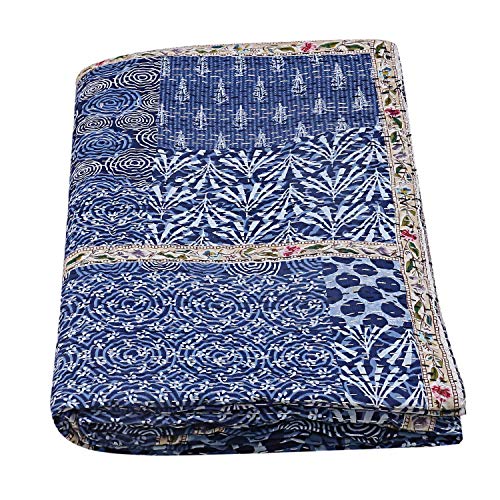
King Size Kantha Indian Quilt, Indigo — Best Traditional Kantha
Where the vintage pick is a discovery, this indigo kantha is a tradition executed to order: a king-size quilt, hand stitched and handblock printed in the classic indigo palette, made as a decorative bedspread in the ethnic Indian style. It suits buyers who love the kantha form but want a coherent, chosen colour story — indigo and white, endlessly liveable — rather than a vintage lottery. It does not suit buyers after the recycled-cloth narrative; this is new cloth worked by traditional hands.
Strengths
- Hand stitched kantha quilting with handblock printing — both crafts in one piece.
- Indigo palette is the most versatile in the category: pairs with white, wood, linen, everything.
- King bedspread scale with a consistent, chosen design.
Trade-offs
- Indigo dyes can crock or fade softly with early washes — wash separately and cool at first.
- Kantha weight is light; plan layers for cold weather.
- Traditional styling is a commitment to the bohemian register.
- Fabric: Cotton
- Size: King
- Craft: Hand stitched kantha, handblock print, indigo
Indigo is kantha’s signature colour for a reason beyond beauty: it is one of the oldest dye traditions in India, and its soft fading over years of washing is considered part of the cloth’s life rather than damage. This quilt leans into that heritage with handblock printing under the hand stitching, so the surface carries two layers of handwork — the printed motif and the stitched ripple over it. As a bedspread it solves a real decorating problem: a full king of pattern and texture that still reads calm, because indigo and white never shout. If your taste runs to the traditional end of handmade and your bedroom needs one textile to organise around, this is the pick.
Best for: traditional kantha lovers wanting a chosen palette / Not suited for: recycled-vintage seekers or cold-room sole layers

Marubhumi Handmade Cotton Patchwork Kantha Quilt — Best Throw Size
The Marubhumi combines two crafts in a smaller format: handmade cotton patchwork joined with hand kantha stitching, sized as a bedspread-and-throw that lives as happily on a sofa as across a bed’s foot. It suits buyers who want handmade character in daily, movable form — the quilt that migrates from couch to reading chair to guest bed — and gift-givers, for whom a throw is the safest handmade format. It does not suit buyers needing full bed coverage; that is the king picks’ job.
Strengths
- Patchwork plus kantha stitching: two hand crafts in one textile.
- Throw scale is the most versatile format in the home — sofa, chair, foot of bed, travel.
- Multicolour patchwork brings the bohemian palette in a manageable dose.
Trade-offs
- Not a full-coverage bed quilt for larger beds.
- Patchwork colour mixes vary — expect the family of colours, not a swatch match.
- Lightweight kantha warmth, as across this category.
- Fabric: Cotton
- Craft: Handmade patchwork, hand stitched kantha
- Format: Throw / twin bedspread
Throws are where handmade quilts earn their daily keep. A king quilt is a commitment to a bed’s whole look; a throw is an accent that can be deployed, moved and lent — to a guest, to a chilly evening on the porch, to a child building a fort of unreasonable ambition. The Marubhumi’s patchwork construction suits that itinerant life: many colours go with many rooms, and the kantha stitching gives the surface a texture that reads handmade at arm’s length, which is where throws are actually seen. As an entry into the category — or as the gift that introduces someone else to it — this is the lowest-risk, highest-use pick in the guide.
Best for: sofas, reading chairs, gifts and category newcomers / Not suited for: full king or queen bed coverage

RAJORA ENT Handmade Vintage Kantha Quilt, 3-Layer — Best Layering Quilt
The RAJORA ENT gudari is a 3-layer cotton kantha in the vintage patchwork style — reversible, bohemian, built to be used as a bed cover, couch throw or the middle layer in a winter stack. It suits practical buyers who want vintage kantha character in the most flexible format, and layering strategists who build bed warmth from several light pieces rather than one heavy duvet. It does not suit buyers wanting a pristine, single statement quilt; the gudari’s charm is its patchwork informality.
Strengths
- Three cotton layers give it slightly more body than the lightest kanthas — a better drape and layer.
- Reversible patchwork: two distinct looks, both bohemian.
- Format flexibility — bed, couch, layer, picnic-weight versatility.
Trade-offs
- Vintage patchwork variation applies: colours and prints will be their own combination.
- Still a light quilt by duvet standards; winter use means stacking.
- Gudari informality suits relaxed rooms, not tailored ones.
- Fabric: Cotton, 3 layers
- Craft: Handmade vintage kantha (gudari)
- Format: Reversible bed cover / throw
Layering is how much of the world actually sleeps warm — several light, washable pieces adjusted nightly — and a 3-layer kantha is the ideal citizen of such a bed. Alone, it is a summer cover with texture. Over a sheet in autumn, it is enough. Under a duvet in winter, it adds the handmade surface the bed shows during the day. The RAJORA’s vintage patchwork makes it the hardest-working kind of pretty: a textile you do not have to be careful with, whose beauty survives being used as a couch blanket, a car blanket and a garden-evening wrap. If your household’s textiles must earn their place by versatility, end the search here.
Best for: layering beds and hard-working household textiles / Not suited for: tailored bedrooms or sole-layer winter warmth
Comparison Table
| Pick | Badge | Key spec | Best for |
|---|---|---|---|
| Ridhi Handmade Block Print Quilt | Best Overall | 100% cotton, king 96 x 106 in, reversible | Primary handmade bed quilt |
| meadow park Real Patchwork Quilt Set | Best Patchwork Set | 376 hand cut patches, washed cotton, 3-piece | Patchwork traditionalists |
| Vintage Kantha Quilt Super King | Best One-of-a-Kind | Recycled sari cotton, 108 x 90 in, hand-stitched | Unique textile seekers |
| King Kantha Indian Quilt Indigo | Best Traditional Kantha | Hand stitched + handblock, indigo, king | Chosen-palette traditional style |
| Marubhumi Patchwork Kantha Quilt | Best Throw Size | Handmade patchwork kantha, throw format | Sofas, chairs, gifts |
| RAJORA ENT Vintage Kantha 3-Layer | Best Layering Quilt | 3-layer cotton gudari, reversible | Layered beds, versatile use |
How to Choose a Handmade Quilt
Start by choosing your tradition, because the traditions deliver different objects. Block print gives you a new, consistent quilt with visible handwork — the Ridhi pattern. Patchwork gives you assembled multiplicity, many fabrics harmonised by labour — the meadow park pattern. Kantha gives you stitched layers and, in its vintage form, true uniqueness — the pattern of the remaining picks. Decide which story you want on your bed before you compare individual listings, because cross-tradition comparison by size and price alone misses the entire point of handmade.
Then be honest about variation tolerance. It is a spectrum: the Ridhi varies subtly, the indigo kantha varies in shade and fade, the vintage kanthas vary in everything except quality of making. Place yourself truthfully on that spectrum. A buyer who will be annoyed by a patch that differs from the photograph should not buy vintage kantha, however beautiful it looks — and a buyer who craves the unrepeatable should not settle for the consistency of new block print. Most disappointed handmade buyers are not victims of bad quilts; they are victims of a mismatch between their tolerance and the tradition they chose.
Size and warmth close the decision. Handmade listings skew smaller than factory ones, so read dimensions literally and measure your bed’s drop: a quilt that barely reaches the mattress edges reads as a mistake, while a throw used as a throw is perfect at any size. For warmth, calibrate expectations — cotton kantha and block print quilts are light-to-medium layers, glorious in summer and as components in winter, but not substitutes for a winter duvet in a cold room. Buy the handmade quilt for its craft and surface; engineer the bed’s warmth around it with layers.
How to Wash and Care for a Handmade Quilt
The first wash sets the tone. Wash a new handmade quilt separately, cool, on a gentle cycle — first washes release loose dye, especially from indigo and saturated sari prints, and a colour-catcher sheet in the load is cheap insurance. Use a mild detergent and skip bleach and harsh stain treatments entirely; handmade cotton rewards gentleness with decades of life and punishes aggression at its seams and dyes. Vintage kantha deserves the most respect here: the cloth has already lived one life, so machine washing should be gentle and infrequent, with spot cleaning and airing doing the weekly work.
Drying is where quilts are won and lost. Tumble drying on low is acceptable for sturdy new cotton quilts like the block print and patchwork set, and it restores loft pleasantly. Line drying in shade is the connoisseur’s choice for kantha and indigo — sunlight is a dye’s enemy, and shade-drying preserves the palette you bought. Whichever route you take, store quilts folded loosely in cotton, not sealed plastic, so the fibres breathe; refold along different lines a few times a year so creases do not set into the hand stitching. A handmade quilt cared for this way is not a delicate object — cotton kantha in India serves for generations — it is simply an object that asks you to wash like you mean it to last.
Kantha, Block Print and Patchwork: Three Crafts, Three Characters
Kantha is stitch-defined: rows of running stitch through layered cloth, creating a gently rippled surface that is soft, light and endlessly touchable. Its beauty is textural and its warmth modest. A kantha quilt is the one you reach for on a summer night and the one guests ask about, because the stitching reads as handwriting across the whole cloth. Block print is motif-defined: carved wooden blocks, dipped in dye and pressed by hand, building patterns whose tiny imperfections certify their origin. Its beauty is graphic — pattern at room scale — and its quilts are the most bed-like of the three families, sized and finished as proper bedding.
Patchwork is assembly-defined: many fabrics, cut and joined, the harmony imposed by the maker’s eye across hundreds of pieces. Its beauty is abundance — colour and print in conversation — and its quilts carry the strongest folk tradition in Western bedrooms as well as Indian ones. Choosing among the three is choosing which kind of handwriting you want to live with: the stitch, the stamp, or the seam. Many households end with one of each across different rooms, which is not indecision; it is collecting in the oldest sense, one honest textile at a time.
Buying Vintage Kantha Wisely: Lots, Grades and Red Flags
Vintage kantha shopping has its own marketplace dialect, and learning it prevents the category’s common disappointments. Listings divide into single pieces — one quilt, photographed as itself or as a representative of a small batch — and wholesale lots, bundles of several quilts sold together at a per-piece tier that tempts resellers and decorators. Lots are legitimate for the trade, but a home buyer usually wants one chosen quilt, not five surprises; if a price looks implausibly low for a king kantha, check whether you are reading a lot listing or a per-piece price within one. This guide’s vintage picks are single-piece listings for exactly that reason.
Grades matter too. Vintage sari cloth ranges from carefully selected, softly worn pieces in harmonious colours to genuinely tired cloth with thin patches and repairs. Good sellers describe condition honestly and photograph backs as well as fronts — remember that a kantha is reversible, so the back is half the product. Red flags include stock photographs repeated across many sellers, dimensions that shift between the title and the description, and the word “kantha” attached to a printed polyester throw. The craft has a look and a hand-feel — layered cotton, visible running stitch, soft drape — and a listing that cannot show the stitching up close is a listing to leave. Buy from sellers who show the work; the work is the product.
Styling a Handmade Quilt: Making the Bedroom Agree With It
A handmade quilt is the loudest textile in most bedrooms, and styling around it is an exercise in giving it the stage. The reliable formula is a quiet base: plain sheets in white or a soft neutral, minimal competing pattern elsewhere, and the quilt as the single patterned surface. Block print and indigo kantha reward this treatment most, because their motifs read clearly at room scale. Patchwork wants even more restraint around it — solid curtains, unpatterned cushions — since the quilt itself contains a dozen patterns in conversation. The mistake is doubling down: patterned quilt, patterned cushions, patterned rug, until the room becomes an argument.
Placement offers more range than buyers use. A king quilt folded at the foot of a larger bed works as a runner with the bed’s main cover plain beneath. A throw-size kantha over a sofa arm is the classic bohemian living-room note, and the same piece rotates to the reading chair in winter. Because these quilts are reversible, you own two looks: the vivid face for summer, the calmer reverse when the room wants quiet. And because they are light, they layer over a duvet without the bed looking swollen — the handmade surface on a modern bed system is exactly how these textiles live in most real homes, tradition on top, engineering underneath.
Handmade vs Factory Quilts: What the Money Actually Buys
A factory quilt and a handmade quilt at the same size can sit at surprisingly similar tiers, which raises the fair question of what the handmade premium purchases. It does not purchase warmth per weight — modern factory fills win that contest easily. It does not purchase uniformity, durability guarantees or easy replacement if you spill paint on it. What it purchases is three things no factory sells. First, surface: hand stitching, hand printing and hand assembly produce textures and irregularities that read, at a glance and at a touch, as made-by-a-person — and rooms feel different under them. Second, story: a vintage kantha’s cloth had a first life; a block print’s motifs were pressed one by one; these are objects with biographies, and for many buyers that is the entire point of owning textiles beyond the purely functional.
Third, and least discussed, it purchases a different ageing curve. Factory quilts tend to look perfect, then suddenly tired — a seam fails, a fill clumps, and the object is done. Handmade cotton quilts age gradually and repairably: a loose stitch can be re-stitched, a faded indigo is considered character, a worn patchwork square can be patched in the same spirit it was made. Households that keep things — that mend, hand down and accumulate — get more years from handmade textiles than the price comparison suggests. Households that prefer everything pristine and replaceable should buy the factory quilt without a flicker of guilt, and this guide’s honesty about variation is there to steer them kindly away.
Sizing a Handmade Quilt: Dimensions Translated Into Decisions
Handmade quilt sizes confuse buyers because the listings mix bed names, throw language and raw dimensions from different traditions. The reliable method is to ignore the name and work from the two numbers. Measure your mattress top, then decide how much drop you want over each side and the foot. For a quilt used as the bed’s main cover, most people are happy when it falls at least a hand’s breadth past the mattress edge on both sides; less than that reads as a blanket borrowed from a smaller bed. For a quilt used as a top layer or foot-of-bed piece, coverage matters less than proportion — it should span the bed’s width with a little authority, even if it does not cover the pillows.
Apply that to this guide’s formats. The Ridhi at 96 x 106 inches is a true king cover and a generous, luxurious queen cover with deep drop — often the best choice for a queen bed precisely because handmade quilts run small. The vintage kantha at 108 x 90 inches covers a king as a bedspread with its long side across. The indigo kantha in king sizing behaves as its name promises. The Marubhumi and RAJORA throws are not failed bed quilts; they are correct at throw scale, covering a lap, a sofa seat or the foot of any bed. When a listing gives only a bed name with no dimensions, treat that as a reason to message the seller or move on — in handmade, the numbers are the size, and the names are marketing.
Mending a Handmade Quilt: Small Repairs That Extend Its Life
Handmade quilts invite repair in a way factory bedding does not, and learning three small skills covers nearly everything that will ever go wrong. The first is the running stitch itself — the kantha stitch is literally a line of even, in-and-out stitches, and re-securing a loose section of quilting is an evening’s work with a needle and matching cotton thread, no machine required. Work from the back where you can, follow the existing stitch rhythm, and knot discreetly at the ends. The second is the patch: when a patchwork square or a worn area of vintage cloth thins, applique a small piece of similar cotton over it with tiny stitches around its edge. In the patchwork and kantha traditions a visible, honest mend is not damage — it is the next chapter of the cloth, and many treasured quilts carry generations of them.
The third skill is prevention disguised as habit: rotate the quilt’s orientation so the same edge does not always take the foot-of-bed abrasion, keep it out of prolonged direct sun when it is off the bed, and catch small problems — a lifting seam, a thinning fold line — while they are still small. A factory quilt gives you no such options; when it fails, it fails completely. A handmade quilt fails gradually, locally and repairably, which is the deepest reason these textiles become heirlooms while their factory contemporaries become landfill.
Keep a small mending kit with the quilt — needles, a few colours of cotton thread, and a palm-sized piece of plain cotton for patches — and repairs become ten-minute habits instead of someday projects.
Common Buying Mistakes
- Expecting factory uniformity. Variation is the signature of handwork. If identical and perfect is the requirement, buy a factory quilt.
- Confusing patchwork print with patchwork. A printed picture of patches is not patchwork. Read listings for construction — pieces, seams, hand cutting — not photographs.
- Buying vintage kantha for an exact colour match. You choose a palette family; the piece itself is a discovery. Buyers who need certainty should choose new block print or indigo kantha.
- Under-sizing. Handmade listings run smaller than factory norms. Measure your bed and the quilt’s stated dimensions, including the drop you want.
- Washing aggressively. Hot water, bleach and harsh cycles attack hand dyes and stitching. Cool, gentle, separate first washes keep a handmade quilt young.
- Expecting duvet warmth. Cotton handmade quilts are light-to-medium layers. Plan the bed’s warmth as a system and let the quilt be its beautiful surface.
Final Recommendation
Start with the Ridhi block print quilt if you want one handmade quilt that simply works as a bed’s main covering. Choose the meadow park patchwork set for the full patchwork tradition in a complete set, the vintage sari kantha for a genuinely one-of-a-kind textile, or the indigo kantha for traditional craft in a chosen palette. Add the Marubhumi throw for the sofa and the RAJORA 3-layer kantha as the hardest-working layer in the house. For more bedding craft, see Best Quilts, Best Kantha Quilts, Best Patchwork Quilts, Best Cotton Quilts, Best Quilt Sets and Best Bohemian Bedding.
Frequently Asked Questions
Are handmade quilts warm enough for winter?
As a sole layer in a cold room, generally no — cotton kantha, block print and patchwork quilts are light-to-medium weight. Their winter role is as the top layer over a duvet or as part of a layered bed, where they add surface, texture and moderate warmth. In summer they are often the only layer a bed needs.
How can I tell if a quilt is really handmade?
Look for process claims you can verify in the object: visible running stitch in kantha, slight registration variation in block print, real seams between patches in patchwork. Listings that describe the craft specifically — hand cut patches, hand stitching, hand block printing — and show close-up texture photographs are making checkable claims; listings that say only “handmade style” are describing a photograph.
Will my vintage kantha quilt look exactly like the photos?
No — and that is the nature of the object. Vintage kantha is made from recycled saris, so each piece is unique; photographs show the palette and style family your quilt will come from. If exact matching matters, choose a new handmade quilt like the block print or indigo kantha, where pieces are consistent.
How do I wash a kantha quilt without damaging it?
Cool water, gentle cycle, mild detergent, washed separately at first because dyes — especially indigo and deep sari colours — can release colour early on. Dry in shade where possible. Vintage pieces should be washed gently and not too often; airing and spot cleaning handle most of the routine.
What size handmade quilt do I need for a queen bed?
Measure for drape, not just coverage: you want the quilt to cover the mattress top and fall over the sides. Many handmade listings run smaller than factory queen sizes, so read the stated dimensions literally — a king-size handmade quilt, like the Ridhi, is often the right answer for a queen bed that wants a generous drop.
Are handmade quilts a good gift?
They are among the best textile gifts, because the handwork makes them feel chosen rather than purchased. Throws like the Marubhumi are the safest format — no bed-size knowledge required. For a bed quilt, confirm the bed size and the recipient’s tolerance for variation first; a one-of-a-kind vintage kantha delights the right person and puzzles the wrong one.
Do handmade quilts shrink or fade?
Cotton can shrink slightly in a first hot wash — one more reason for the cool, gentle routine this guide recommends. Fading depends on dye: indigo softens gradually and attractively, deep sari prints mellow, and shade-drying slows all of it. A handmade quilt’s palette evolving slowly over years is part of the ownership experience, not a defect arriving early.
Can I use a handmade quilt every day, or is it decorative?
Every day — that is what they were invented for. Kantha quilts in particular come from a utilitarian tradition of daily bedding, and cotton block print and patchwork quilts are working textiles. Rotate two if you wash frequently, keep the wash gentle, and a handmade quilt will out-serve most decorative factory bedding while looking better doing it.
What is a gudari quilt?
Gudari is a regional name for the layered, hand-stitched quilt of the kantha family — cloth layers joined by running stitch, often patchwork, used as a bed cover, throw or wrap. The RAJORA pick in this guide is a gudari: expect the same light warmth, reversible character and handmade variation as kantha, because it is the same craft wearing its local name.
How long does a handmade quilt last?
With the gentle washing routine in this guide, a cotton handmade quilt is measured in decades, not seasons — kantha and patchwork quilts are routinely handed down. The lifespan advantage comes from repairability: individual stitches, seams and patches can be renewed as they wear, so the quilt ages gradually instead of failing all at once like a bonded factory product.


