Disclosure: airfryerkitchensupply.com is reader-supported. When you buy through links on our site, we may earn an affiliate commission at no extra cost to you.
Where to buy
Drain protectors are small, cheap and annoyingly easy to buy wrong — the fit against your tub’s drain flange decides everything. Every pick below was confirmed against the live catalogue; measure your drain opening before ordering, and prefer listings that state pop-up compatibility if your tub has a pop-up stopper.
- LEKEYE Drain Hair Catcher for Pop-Up & Regular Drains — Check the current price on Amazon
- LEKEYE Tub Stopper — Pop-Up Drain Stopper with Strainer — Check the current price on Amazon
- Hibbent 3-in-1 Metal Bathtub Drain Stopper — Check the current price on Amazon
- TubShroom Ultra Revolutionary Bath Tub Drain Protector (Stainless Steel) — Check the current price on Amazon
- zaa Shower Drain Hair Catcher — Collapsible Pop-Up Drain Hair Catcher — Check the current price on Amazon
- coamanug Bathtub Stopper — Pop-Up Tub Stopper with Strainer — Check the current price on Amazon
Looking for the best hair catcher pop up drain protector for bathtubs usually starts the same way: a slow drain, a plumber’s quote, and the realisation that the hair causing it was preventable. The awkward part is the pop-up. Many tubs seal with a pop-up stopper that rises and falls in the drain, and a hair catcher that ignores that mechanism either will not sit flat, will not let the stopper move, or will catch hair beautifully while making the tub impossible to drain. This guide compares six protectors that work with — or sensibly around — pop-up tub drains.
The six below split into three honest strategies: catchers designed to sit over pop-up and regular drains alike, pop-up stoppers with built-in strainer baskets that replace your existing stopper entirely, and in-drain mushroom-style catchers for tubs whose pop-up has been removed. Every linked model was verified against the live Amazon catalogue before publication.
Whichever strategy you choose, the goal is the same: hair stopped at the drain, water flowing freely, and a catcher you can empty in seconds without tools. Judge each pick below against your actual drain — flange diameter, stopper type, and whether anyone in the house takes baths (stoppers matter) or only showers (they matter less).
In this guide
Quick Picks
LEKEYE Drain Hair Catcher for Pop-Up & Regular Drains — Best Overall — check price on Amazon
A patented cover designed explicitly for both pop-up and regular drains — the safest first buy for a pop-up tub.
LEKEYE Tub Stopper — Pop-Up Drain Stopper with Strainer — Best Stopper Replacement — check price on Amazon
Replaces your tub stopper with a pop-up unit whose built-in strainer catches hair as water drains.
Hibbent 3-in-1 Metal Bathtub Drain Stopper — Best Metal Build — check price on Amazon
A universal metal pop-up stopper with a removable hair-catcher basket — the durable, finish-friendly replacement option.
TubShroom Ultra Revolutionary Bath Tub Drain Protector (Stainless Steel) — Best In-Drain Catcher — check price on Amazon
The famous mushroom that sits inside the drain and wraps hair around its centre post — for tubs used shower-style without the stopper.
zaa Shower Drain Hair Catcher — Collapsible Pop-Up Drain Hair Catcher — Best Budget — check price on Amazon
A collapsible silicone pop-up-style catcher that presses down to seal and pops up to strain — the flexible, low-cost experiment.
coamanug Bathtub Stopper — Pop-Up Tub Stopper with Strainer — Best Plug-and-Strain Combo — check price on Amazon
A pop-up tub stopper with an integrated strainer that plugs for baths and filters while draining.
How These Picks Were Chosen
Candidates were drawn from live listings whose titles explicitly address pop-up drains, tub stoppers or bathtub hair catching, then sorted by mechanism so the guide compares strategies rather than six identical silicone discs. Models that only fit shower floor drains were excluded — a tub drain is a different fitting.
We weighted three ownership factors: whether the catcher preserves the tub’s ability to hold a bath, how the hair is removed (lift-and-wipe beats dig-and-pick), and whether the part that touches water is stainless, silicone or coated metal, since bathroom metal finishes live or die by corrosion resistance.
The 6 Best Hair Catcher Pop-Up Drain Protectors for Bathtubs
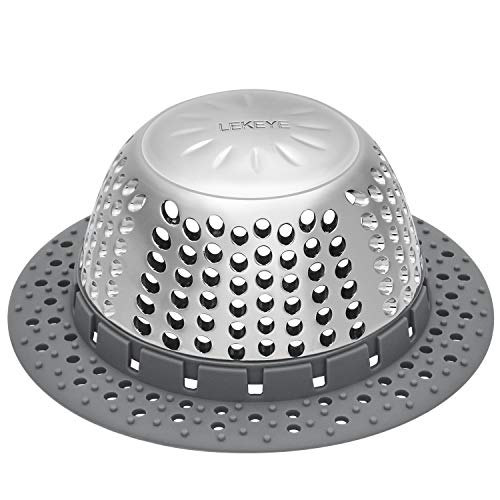
LEKEYE Drain Hair Catcher for Pop-Up & Regular Drains — Best Overall
This LEKEYE exists for exactly the tub this search describes: its domed cover sits over a pop-up stopper, lets the stopper keep working beneath it, and traps hair around its edge before strands reach the pipe. If you do not want to remove or replace any plumbing, start here.
Strengths
- Designed for pop-up and regular drains alike — no stopper removal
- Cover format keeps the tub’s bath-holding function intact
- Hair collects around the edge where it lifts away in one motion
Trade-offs
- A cover adds a visible dome in the tub — minimalists may prefer in-drain styles
- Must be sized to your flange; measure before ordering
- Like all surface catchers, it needs a quick wipe every few showers
| Detail | What to know |
|---|---|
| Type | Over-drain cover |
| Compatibility | Pop-up and regular tub drains (per listing) |
| Install | Drop-on, no tools |
| Cleaning | Lift and wipe |
The engineering problem with pop-up tubs is clearance: the stopper travels up and down inside the drain throat, so anything inserted into the drain fights it. LEKEYE’s answer is to stay out of the throat entirely and govern the surface instead. Hair washes toward the drain, meets the cover’s edge, and stops there; water passes under and through. In practice the dome also stops the stopper from being the hair’s first snag point, which is where the worst tangles form.
Emptying is the daily reality check, and a surface cover wins it: lift, wipe the ring of hair into the bin, replace. Ten seconds, no reaching into the drain, no tools. For households with long hair, that ease is the difference between a catcher that gets used and one that gets removed and forgotten.
Best for: Pop-up tub owners who want zero plumbing changes / Not suited for: Anyone who wants an invisible in-drain solution
Check on Amazon — check the current price on Amazon before you decide, because configurations and finishes change.

LEKEYE Tub Stopper — Pop-Up Drain Stopper with Strainer — Best Stopper Replacement
If your existing pop-up stopper is tired, leaky or ugly, replacing it with a stopper that has a strainer inside kills two problems with one part. This LEKEYE unit pops up and seals like a normal stopper, and its strainer basket intercepts hair on the way down.
Strengths
- One part does both jobs: stopper and hair catcher
- Pop-up action preserves baths exactly as before
- Strainer lifts out for emptying without tools
Trade-offs
- Replacement means removing the old stopper — a small DIY step
- Must match your drain’s thread/flange style; verify fit first
- Basket capacity is modest; heavy-shedding households empty it often
| Detail | What to know |
|---|---|
| Type | Pop-up stopper with strainer |
| Function | Seals for baths, strains while draining |
| Install | Replaces existing stopper |
| Cleaning | Lift basket and empty |
Integration is this pick’s argument. A separate catcher is one more object in the tub; a strainer-stopper disappears into the drain’s normal operation — press to seal for a bath, press to pop and drain, and the hair stays in the basket instead of the trap. Owners upgrading a worn stopper get the hair protection effectively free.
The fit question is the whole game: tub drains vary in thread and flange, so confirm compatibility against the listing’s stated sizes before ordering, and keep the old stopper until the new one has sealed and drained through a full bath test. That caution aside, this is the tidiest long-term answer for a pop-up tub.
Best for: Tubs whose stopper needs replacing anyway / Not suited for: Renters who cannot modify fixtures
Check on Amazon — check the current price on Amazon before you decide, because configurations and finishes change.

Hibbent 3-in-1 Metal Bathtub Drain Stopper — Best Metal Build
Metal is the right answer when a bathroom’s fixtures are metal and a plastic stopper would look like an apology. Hibbent’s 3-in-1 design works as stopper, strainer and hair catcher, with a removable basket for cleaning, and its universal positioning suits the common North American tub drains.
Strengths
- Metal construction matches real fixtures and resists bathroom wear
- Removable basket makes emptying a lift-and-rinse job
- 3-in-1 function: seals baths, strains drainage, catches hair
Trade-offs
- Universal fits most — not all — drains; measure flange and depth
- Metal costs and weighs more than silicone alternatives
- Finish care: wipe dry to keep it looking new in hard-water homes
| Detail | What to know |
|---|---|
| Type | Universal pop-up stopper |
| Material | Metal |
| Basket | Removable hair catcher |
| Install | Drop-in replacement for compatible drains |
Where the LEKEYE stopper above is the value-integrated play, the Hibbent is the materials play. In a renovated bathroom with brushed or chrome fittings, a metal stopper keeps the drain looking like part of the design rather than an accessory, and metal’s weight helps it seat and seal with a satisfying solidity.
The removable basket is the detail that decides daily satisfaction: hair lifts out with the basket instead of being fished from a fixed strainer. Rinse, replace, done. For households that have abandoned catchers before because cleaning them was disgusting, this mechanism is the fix.
Best for: Renovated baths wanting a metal fixture-grade stopper / Not suited for: Unusual or oversized drain flanges
Check on Amazon — check the current price on Amazon before you decide, because configurations and finishes change.

TubShroom Ultra Revolutionary Bath Tub Drain Protector (Stainless Steel) — Best In-Drain Catcher
TubShroom’s design hides inside the drain: water flows through, hair wraps around the central cylinder where it stays out of sight and out of the pipes. The stainless Ultra version suits tubs where the pop-up stopper has been removed or is left open — most shower-over-tub households, honestly.
Strengths
- Invisible in use — nothing sits on the tub floor
- Hair wraps neatly around the post; pulls out in one clump
- Stainless build shrugs off bathroom chemicals and rust concerns
Trade-offs
- Occupies the drain throat — incompatible with a working pop-up stopper in place
- Does not seal the tub; bath-takers need a separate stopper
- Needs the right drain diameter; measure the opening first
| Detail | What to know |
|---|---|
| Type | In-drain mushroom catcher |
| Material | Stainless steel |
| Fit | Standard tub drain openings (confirm diameter) |
| Cleaning | Pull out, wipe off hair, replace |
The TubShroom earned its fame honestly: it is the catcher people keep using because emptying it is weirdly satisfying and the drain simply stops clogging. The stainless Ultra removes the original’s plastic feel and any worry about mildew staining the catcher itself.
Be clear about its one condition, though: it lives where a pop-up stopper’s mechanism wants to be. Tubs that keep a functioning pop-up should take the LEKEYE cover or a replacement stopper-strainer from this list; tubs converted to shower duty, or whose stopper is long gone, are TubShroom territory and it serves them superbly.
Best for: Shower-over-tub homes without a working pop-up / Not suited for: Tubs that must hold bath water with the same fitting
Check on Amazon — check the current price on Amazon before you decide, because configurations and finishes change.
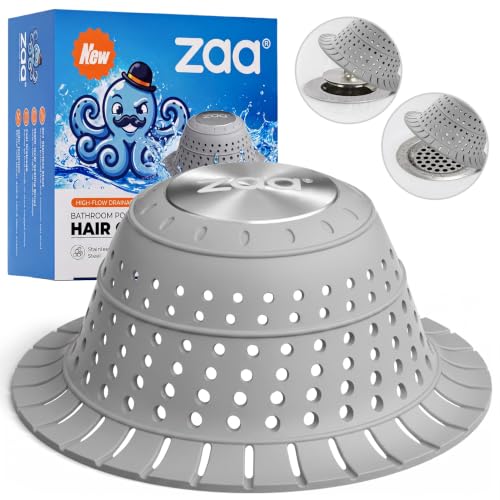
zaa Shower Drain Hair Catcher — Collapsible Pop-Up Drain Hair Catcher — Best Budget
zaa’s collapsible design is the renter’s and the undecided’s friend: it drops over the drain, presses flat to hold water, and pops up to strain while draining, all in soft silicone that cannot scratch the tub. It works across tubs and even sinks, which makes it a good first try before committing to a fitted stopper.
Strengths
- Collapsible pop-up action both seals and strains
- Soft silicone — no scratching, no rust, easy to rinse clean
- Versatile across tubs and sinks while you learn your drain
Trade-offs
- Universal silicone fits are less precise than fitted metal stoppers
- Seal quality varies with flange shape; test with a bath before trusting it
- Silicone can discolour over time in hard water
| Detail | What to know |
|---|---|
| Type | Collapsible pop-up catcher/stopper |
| Material | Silicone |
| Install | Drop-on, no tools |
| Use | Bathtub and sink drains |
Think of this as the diagnostic tool of the group: for the cost of a coffee you learn whether a surface pop-up approach suits your drain and your habits, without touching the plumbing. Many households stop right here because it works well enough — the seal holds a bath, the strainer catches the hair, and replacement in a year or two is painless.
Its limits are the limits of all universal soft parts: an odd-shaped flange may break the seal, and determined bath-fillers should test before a long soak. But as a first line of defence against a clogging tub, it is the easiest yes in this guide.
Best for: Renters and first-time catcher buyers / Not suited for: Precision-fit or fixture-matching installations
Check on Amazon — check the current price on Amazon before you decide, because configurations and finishes change.
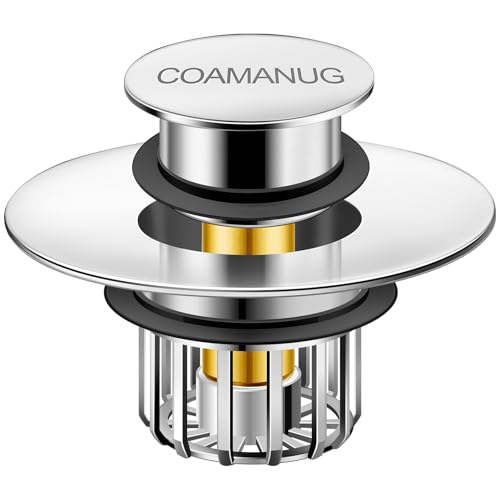
coamanug Bathtub Stopper — Pop-Up Tub Stopper with Strainer — Best Plug-and-Strain Combo
This coamanug unit follows the same integrated philosophy as the LEKEYE stopper — replace the plug, gain the strainer — and suits buyers who want that combination in a widely available, simple format. Press to plug for a bath; the strainer guards the drain whenever water flows out.
Strengths
- Integrated stopper and strainer — nothing extra in the tub
- Pop-up action familiar to anyone with a standard tub
- Keeps hair out of the trap where clogs actually form
Trade-offs
- Fit depends on your drain’s dimensions — verify before ordering
- Strainer needs regular lifting to stay free-flowing
- A newer brand name; inspect on arrival and test the seal promptly
| Detail | What to know |
|---|---|
| Type | Pop-up stopper with strainer |
| Function | Plug + drain protection |
| Install | Replaces existing stopper on compatible drains |
| Cleaning | Lift and clear the strainer |
Between this and the LEKEYE stopper, the decision is about the specific fit and finish your drain wants; the concept is identical and sound. A stopper-strainer protects the pipe at the exact point hair enters it, which is why plumbers quietly approve of the category: prevention at the flange beats chemicals at the clog.
As with every replacement stopper here, the ritual is measure, order, test the seal with a full tub before the return window closes. Pass that test and you have the most invisible solution in this guide — protection that is simply part of the drain.
Best for: Pop-up tubs wanting an integrated replacement / Not suited for: Non-standard drain sizes
Check on Amazon — check the current price on Amazon before you decide, because configurations and finishes change.
Comparison Table
| Pick | Badge | Key spec | Best for |
|---|---|---|---|
| LEKEYE Drain Hair Catcher for Pop-Up & Regular Drains | Best Overall | Cover for pop-up & regular drains | Pop-up tub owners who want zero plumbing changes |
| LEKEYE Tub Stopper — Pop-Up Drain Stopper with Strainer | Best Stopper Replacement | Pop-up stopper + built-in strainer | Tubs whose stopper needs replacing anyway |
| Hibbent 3-in-1 Metal Bathtub Drain Stopper | Best Metal Build | Metal universal pop-up stopper, removable basket | Renovated baths wanting a metal fixture-grade stopper |
| TubShroom Ultra Revolutionary Bath Tub Drain Protector (Stainless Steel) | Best In-Drain Catcher | Stainless in-drain mushroom catcher | Shower-over-tub homes without a working pop-up |
| zaa Shower Drain Hair Catcher — Collapsible Pop-Up Drain Hair Catcher | Best Budget | Collapsible silicone pop-up catcher | Renters and first-time catcher buyers |
| coamanug Bathtub Stopper — Pop-Up Tub Stopper with Strainer | Best Plug-and-Strain Combo | Pop-up stopper with integrated strainer | Pop-up tubs wanting an integrated replacement |
First, Identify Your Drain: Pop-Up, Lift-and-Turn, or Bare
Everything in this category depends on what is in your drain today. A pop-up (toe-touch or push) stopper rises and seals from inside the drain; a lift-and-turn stopper screws and rotates on a central post; and many shower-converted tubs have a bare open drain. Press your stopper: if it springs, it is a pop-up and your choices are covers that sit above it or replacement pop-ups with strainers. If it twists, covers still work, but in-drain mushrooms may fight the post. Bare drains accept anything, including the TubShroom.
Measure the drain opening’s diameter while you are there, and note the flange style. Thirty seconds with a tape measure eliminates ninety percent of returns in this category — every pick in this guide states its intended fit in its listing, and your measurement is the key that unlocks the right one.
Covers, Replacement Stoppers and In-Drain Catchers Compared
Covers (like the LEKEYE) change nothing about your plumbing, preserve the existing stopper, and empty fastest — at the cost of a visible dome in the tub. Replacement stopper-strainers (LEKEYE stopper, Hibbent, coamanug) are invisible in use and protect the drain permanently, but demand a correct fit and a small removal job. In-drain catchers (TubShroom) hide completely and excel in shower duty, but they occupy the throat a pop-up mechanism needs and cannot seal a bath.
There is no universal winner — there is a winner per tub. Baths taken weekly argue for covers or stopper replacements; shower-only tubs argue for in-drain or cover simplicity; renovators should default to a metal stopper-strainer and be done for a decade.
Why Hair Clogs Form Below the Catcher, Not at It
A tub drains slowly weeks before it blocks, because hair that passes the flange snags on the trap’s rough interior and the stopper linkage, collecting soap into a mat. By the time water stands in the tub, the mat is mature. A catcher at the flange starves that process entirely — which is why even a modest silicone cover outperforms the strongest drain cleaner used after the fact.
This is also why emptying frequency matters more than catcher sophistication. A simple cover wiped every few showers keeps one hundred percent of hair out; a brilliant strainer emptied monthly lets fine strands slip past a full basket. Choose the catcher whose cleaning motion you will actually perform.
How to Choose the Best Hair Catcher for a Pop-Up Tub
Confirm the stopper type, measure the opening, then pick your strategy: cover for zero-modification, stopper-strainer for permanence, in-drain for shower-only invisibility. Check the listing’s stated compatibility against your measurement, favour stainless or silicone where water sits, and keep the packaging until you have run one full bath-and-drain cycle through the new setup.
Households with very long hair or multiple shedding members should bias toward the largest basket or easiest wipe in the category — capacity and cleaning speed, not exotic materials, decide long-term satisfaction here.
How to Install and Maintain a Tub Drain Hair Catcher
Every pick in this guide installs in minutes; the maintenance rhythm below is what keeps the drain fast for years.
- Clean the drain area first: remove the old hair from the flange with a gloved hand or a drain zip tool so the new catcher starts from a clear pipe.
- For a cover: centre it over the drain, run the shower, and confirm water flows freely and the cover does not drift; adjust until it sits stable.
- For a replacement stopper: unscrew or lift out the old stopper per its type, clean the flange, seat the new unit, and test the seal by filling the tub partway and watching the level for ten minutes.
- For an in-drain catcher: push it into the opening until it seats snugly at its designed depth, then run water to confirm drainage speed is unchanged.
- Empty on rhythm, not on symptoms: surface covers every few showers, baskets weekly in long-hair households — hair lifts away in one piece when caught early.
- Rinse the catcher itself monthly and check silicone for tears or metal for finish wear; a worn catcher replaced early never becomes a clog.
- If drainage ever slows despite the catcher, clear the trap promptly — the catcher protects going forward but cannot dissolve an existing mat.
Five minutes of setup and seconds per week of emptying: that is the entire cost of never meeting your tub’s hair mat in person. It is the best trade in home maintenance.
Common Buying Mistakes
Buying a shower-drain catcher for a tub
Flat shower-floor catchers do not fit tub flanges or pop-up mechanisms. The listings differ by a few words and a completely different shape — confirm the product says bathtub and pop-up where relevant.
Inserting an in-drain catcher against a working pop-up
The mushroom and the pop-up mechanism want the same space. Forcing both ends with a stuck stopper or a floating catcher. Match the strategy to the drain you have.
Never emptying the catcher
A full catcher is a dam, not a filter: water slows, hair works around the edges, and the clog forms anyway. Emptying little and often is the whole system.
Skipping the seal test on a replacement stopper
A stopper that drains a bath overnight wastes water and goodwill. Fill, wait, watch the level — ten minutes of testing inside the return window beats a damp surprise later.
Reaching for chemical cleaner first
Caustic cleaners attack finishes and pipe joints and only bore a hole through a hair mat rather than removing it. Mechanical prevention (a catcher) plus mechanical clearing (a zip tool) solves the actual problem.
Final Recommendation
For the tub this search describes — a working pop-up — the LEKEYE cover is the safest first buy: no plumbing touched, stopper preserved, hair stopped. If your stopper is due for replacement anyway, make it a strainer model: the metal Hibbent for fixture-grade permanence, the LEKEYE or coamanug stoppers for integrated value. Shower-only tubs should take the stainless TubShroom and forget drains exist.
Whichever you choose, measure first and empty often. A ten-dollar catcher maintained beats a plumber’s visit every single time — and your pipes, which never asked for the hair, will quietly agree.
Best Stone Bathroom Sinks Best Bathroom Vanities Reviews Best Bathroom Sinks For Remodel Best Small Storage Shelves For Bathroom
The Anatomy of a Tub Clog, and Why Prevention Wins
A tub clog is not an event; it is an accumulation with a long, invisible childhood. Every shower sends a few dozen hairs down the drain. Most pass through. The ones that matter snag on microscopic roughness inside the trap, on the stopper’s linkage, on the crossbars of the drain flange itself. Each snagged hair becomes a net, and the net collects soap residue, skin cells and conditioner into a mat that grows from the pipe wall inward. Drainage slows so gradually that households recalibrate their sense of normal — the tub has ‘always’ drained a little slowly — until the day the mat closes and the water simply stays.
This is why the economics of prevention are so lopsided. A catcher at the flange intercepts hairs at the one moment they are easy to remove: before they enter the pipe, while they are still a loose collection on a surface you can reach. Every alternative intervenes later and worse. Chemical cleaners bore a temporary channel through the mat and attack finishes and joints on the way. Snakes and zip tools work honestly but require the clog to exist first. Plumbers work best of all and bill accordingly. The catcher is the only intervention that makes the problem never happen, which is why this guide treats a ten-dollar part with complete seriousness.
It also explains the maintenance rhythm preached throughout: a catcher emptied often is a perfect system, because hair removed weekly never becomes a mat at all. The technology is trivial; the habit is the product.
Pop-Up Mechanisms Explained: Toe-Touch, Push, Lift-and-Turn
Pop-up is a family name, not a single mechanism, and knowing yours refines your catcher choice. The toe-touch stopper springs up and down when pressed with a toe or finger, driven by a spring cartridge in the drain. The push-style (also called click-clack) works identically by hand pressure. Both travel vertically inside the drain throat, which is why surface covers and replacement stoppers suit them and in-drain mushrooms do not: the throat is occupied territory.
Lift-and-turn stoppers rotate on a central post and lift slightly to drain. The post changes the geometry for covers — a well-designed cover still sits over it — and rules out in-drain devices entirely, since the post anchors in the throat. Trip-lever drains, the older style with a lever on the overflow plate, hide their stopper deep in the pipework; the drain opening itself is bare, which makes these tubs the most catcher-friendly of all: covers, baskets and mushrooms all fit an unoccupied opening.
Identifying yours takes one press and one look. Press: springy means pop-up. Twist: lift-and-turn. Lever on the wall plate and an open drain: trip-lever. With that single fact and a diameter measurement, every pick in this guide sorts itself into fits or does-not-fit without guesswork.
Materials in the Wet Zone: Stainless, Silicone, Coated Metal
A drain catcher lives in the harshest small environment in the home: constant water, soap chemistry, temperature swings and neglect. Materials answer that environment differently. Stainless steel is the aristocrat — immune to rust, unbothered by cleaners, heavy enough to sit where it is put — and it is why the TubShroom Ultra and the better stopper-strainers earn their keep over years. Its one demand is a wipe in hard-water homes to keep mineral film from dulling the finish.
Silicone is the democrat: cheap, soft, scratch-proof against tub enamel and acrylic, and available in the collapsible designs that double as plugs. It discolours slowly in hard water and can tear at thin edges after a year or two of service, which its price forgives — a silicone catcher is a consumable that happens to last, and replacing it annually is a legitimate strategy rather than a failure.
Coated and plated metals occupy the middle: they match fixture finishes beautifully on day one, and their longevity depends entirely on the coating’s integrity. A chip becomes a rust bloom’s front door. In a guest bath they age gracefully; in the family’s daily tub, stainless or silicone is the more honest assignment. Choose the material for the tub’s workload and the catcher stops being a recurring purchase decision.
Hair Catchers for Different Households: a Field Guide
The long-hair household is the category’s defining user, and its rule is capacity plus cadence: a cover or basket emptied every two or three showers never lets the mat start. Multi-member households should bias to the largest, fastest-emptying design they will tolerate visually — usually a cover like the LEKEYE — because the emptying will be done by whoever showers last and notices, which means it must take ten seconds and zero resolve.
Households with shedding pets bathed in the tub face a different volume problem: pet hair arrives in storm quantities on bath day. The winning move there is a two-stage defence — brush the dog before the bath, then let a high-capacity basket or cover take the remainder — and an immediate emptying afterwards, because a full catcher left overnight becomes the clog it exists to prevent.
Rental households should default to the no-modification picks: covers and collapsible silicone. They protect the pipes (and the deposit) without touching a fixture the landlord owns. Owners renovating a bathroom should do the opposite and build the solution into the drain itself with a metal stopper-strainer, closing the question for a decade in a single purchase.
What Plumbers Actually Recommend (and Sell)
Ask a plumber what to put in a tub drain and the answer is boringly consistent: a mechanical barrier, emptied often, and no routine chemicals. The reasoning is professional self-interest inverted — plumbers make their money from clogs, and they still recommend prevention, because they also see what chemical cleaners do to older pipe joints and finishes over years of use. The barrier they picture is exactly this guide’s category: a cover, basket or strainer-stopper at the flange, doing its work where human hands can service it in seconds.
The second half of the professional consensus is about the clog that already exists: clear it mechanically, with a zip tool or a snake, rather than dissolving it. A dissolved mat leaves residue that seeds the next mat faster; a mechanically cleared pipe, protected by a catcher from that day forward, is the closest thing plumbing offers to a permanent fix. This guide’s how-to sequence is built in that order for a reason.
Catcher Hygiene: Keeping the Cure From Becoming the Problem
A hair catcher lives wet and warm, which makes it a surface that needs its own small hygiene routine — not because it is dangerous, but because a neglected catcher develops the soap film and mildew that make owners abandon it. The routine is proportionate: the same wipe that removes the hair removes most of the film, and a monthly rinse with ordinary bathroom cleaner restores any of this guide’s picks to as-new. Stainless and silicone tolerate this indefinitely; coated metals prefer the gentler end of the cleaner shelf.
The abandonment cycle is the real enemy — catcher gets unpleasant, catcher gets removed ‘temporarily’, drain clogs by spring. Designing against it is a selection criterion, not a cleaning tip: choose the catcher whose emptying motion you find least objectionable, because that is the one still in the drain in year two. For most people that is a lift-and-wipe cover; for the tidy-minded, a basket that lifts the hair out in one contained piece.
Apartments, Dorms and Other People’s Plumbing
Shared and rented bathrooms add a social layer to the drain question: the clog is communal, the responsibility is nobody’s, and the landlord’s plumber is slow. A removable cover catcher is the perfect citizen in this environment — it modifies nothing, it can be installed by whoever cares first, and it leaves with its owner at the end of the lease. The collapsible silicone pick in this guide is practically designed for the dorm-and-rental circuit: cheap, universal, and indifferent to strange flanges.
Households sharing one tub across many heads of hair should also agree the emptying norm out loud — every few showers, by whoever notices — because an unowned catcher in a shared bath fills silently until it becomes the dam everyone blames. Ten seconds of norm-setting at installation is the cheapest household diplomacy in this entire guide.
When the Problem Is Not Hair
Honesty requires the differential diagnosis: not every slow tub is a hair story. Soap and grease build-up narrows pipes in hard-water homes even where hair is scarce; a failing or misadjusted stopper mechanism can throttle drainage while looking open; and older homes can have venting or slope problems that no flange accessory will touch. The catcher test is diagnostic as well as preventive — install one, clear the existing pipe mechanically, and if drainage still lags within weeks, the problem lives deeper and deserves a professional’s camera rather than another accessory.
That boundary stated, the base rates remain overwhelming: in a household with hair and a tub, hair is the clog, and the flange is the place to stop it. The picks in this guide cover that central case completely, at prices that make the experiment trivial against even one service call.
A Note on Children, Bath Toys and the Drain
Households bathing small children gain a second benefit from a good cover or stopper-strainer that rarely appears in listings: the drain stops being interesting. A covered flange cannot swallow toy parts, cannot trap curious fingers against a linkage, and presents a smooth, boring surface to a toddler conducting bath-time research. The stopper-strainer picks add the further virtue of sealing reliably when small bathers need the water to stay put longer than their attention does.
The corresponding duty is inspection: in a child’s tub, check the catcher as part of the bath routine itself, since bath-day shedding and toy-adjacent debris arrive together. It is a five-second habit in a room where habits are already the operating system.
The Ten-Second Habit That Replaces the Plumber
Strip this entire guide to its essence and one sentence remains: hair removed at the surface, often, never becomes a clog. Everything else — materials, mechanisms, brands — is optimisation of that sentence. The household that adopts the ten-second wipe as a shower’s closing ritual, like rinsing the basin or hanging the towel, has effectively opted out of tub clogs as a category of home expense. The catcher is simply the tool that makes the ritual possible, and the best catcher in this guide is the one whose ritual your household will actually keep. Choose it, install it this week, and let your drain become the most boring, reliable corner of your plumbing — which is the highest praise plumbing ever earns.
A Word for the Stainless Skeptics
Some buyers hesitate at the metal picks here, picturing rust. The hesitation is reasonable for coated metals and misplaced for stainless steel, whose chromium oxide surface is precisely why it dominates professional kitchens and marine hardware alike: it does not rust in bathroom conditions, full stop. What hard water can do is film it — a dull mineral haze that a vinegar-free descaling wipe removes in seconds and that has nothing to do with corrosion. If a metal catcher ever shows orange, it was not stainless, and the listing misled you; the picks in this guide were selected from listings that name their material plainly, which is the same honesty test applied to every category in this programme.
If You Buy Only One Thing From This Page
Then buy the LEKEYE cover, unless your stopper is already failing — in which case buy the Hibbent if your drain fits it, or the LEKEYE stopper if it does not. That decision tree covers the overwhelming majority of pop-up tubs, costs less than a single bottle of premium drain cleaner across a year, and converts the most annoying recurring chore in bathroom maintenance into a ten-second habit. The remaining picks exist for the tubs and households the tree does not fit: the shower-converted, the renters, the renovators. But the centre holds, and the centre is a cover over a pop-up drain, emptied often, in a tub that never clogs. Everything else in these thousands of words is commentary on that sentence.
And If Your Drain Defeats Every Pick Here
A small minority of tubs — oversized vintage flanges, corroded fittings, stoppers seized by decades of mineral — will defeat every accessory in this guide, and they deserve a straight answer rather than a seventh product. That answer is a plumber’s hour: a professional can replace the drain assembly itself with a modern pop-up whose strainer options are endless, converting an unfixable flange into the most standard fitting in the industry. It is the most expensive recommendation on this page and, for those tubs, the only honest one — after which the cheapest pick in this guide will serve for years.
Frequently Asked Questions
Will a hair catcher work with my pop-up drain?
Yes, with the right type: covers designed for pop-up drains sit over the stopper and let it work, and replacement pop-up stoppers with built-in strainers swap in directly. In-drain mushroom catchers are the exception — they occupy the space the pop-up mechanism needs.
Do these catchers stop the tub from holding a bath?
Covers and stopper-strainers preserve baths completely. In-drain catchers like the TubShroom do not seal the drain, so bath-takers should choose a cover or a stopper model, or keep a separate simple plug.
How often should I empty a tub hair catcher?
Surface covers: every few showers, a ten-second wipe. Strainer baskets: weekly in long-hair households, less often otherwise. The rule is to empty before hair builds a mat — early hair lifts off in one clean piece.
What size hair catcher do I need?
Measure your drain opening’s diameter and compare it to the listing’s stated fit. Tub drains cluster around standard sizes, but flanges vary enough that measuring is the difference between a fit and a return.
Can a hair catcher fix an already slow drain?
No — a catcher prevents new hair from entering but cannot remove an existing clog. Clear the current blockage mechanically first, then install the catcher so you never clear it again.
Are metal or silicone catchers better?
Metal (especially stainless) wins on durability and fixture looks; silicone wins on price, scratch-safety and universal fit. Both catch hair equally when emptied on schedule — choose by your drain and your taste.


