Disclosure: airfryerkitchensupply.com is reader-supported. When you buy through links on our site, we may earn an affiliate commission at no extra cost to you.
Where to buy
Start with the picks that carry a verified Amazon listing below — each one was matched against the Amazon catalogue before it earned a link in this guide to the best dorm room alarm clocks for heavy sleepers. Use the links in the Quick Picks, the individual reviews, the comparison table and the final recommendation to check price on Amazon for the exact size, colour or configuration you want, because options inside one listing can differ a lot. Picks marked as unlinked are described honestly without a link: in this session there was no confident API match for that exact item, so we would rather explain it in words than send you to the wrong product.
- Sonic Bomb Dual Alarm Clock with Bed Shaker — Best Overall for Heavy Sleepers: Check on Amazon
- ANJANK Extra Loud Alarm Clock with Wireless Bed Shaker — Best Wireless Shaker: Check on Amazon
- uscce Loud Dual Alarm Clock with Powerful Adjustable Bed Shaker — Best Adjustable Shaker: Check on Amazon
- JALL Sunrise Alarm Clock with FM Radio — Best Light-Based Wake: Check on Amazon
- Peakeep Battery Operated Digital Alarm Clock, Big Numbers — Best Portable / Battery Pick: Check on Amazon
- DreamSky Small Digital Alarm Clock with USB Charging Port — Best Compact Basic: Check on Amazon
Introduction
The best dorm room alarm clocks for heavy sleepers have to solve two problems that pull in opposite directions: wake a person who sleeps through ordinary alarms — sometimes through several of them — and do it in a room shared with a roommate who did not choose an 8 a.m. lecture and will not forgive a siren at dawn. That tension is why this guide leads with bed shakers: a vibrating pad under the mattress or pillow wakes the sleeper by touch, silently, while a merely loud clock wages war on the whole room. The six clocks here were all verified, and they divide into shaker systems, extra-loud clocks for single rooms, and gentler light-based options for heavy sleepers whose problem is darkness rather than depth.
Dorm reality adds its own specifications. Space is a nightstand the size of a paperback, or no nightstand at all. Power outlets are scarce and contested. The clock will be knocked to the floor, unplugged by a vacuum, and reset by outages — so battery backup is not a luxury feature here, it is the difference between waking and not. And the alarm must be set by a tired student at midnight, in the dark, without a manual: controls that fail that test fail entirely.
Heavy sleeping itself varies, and this guide respects the differences. Some students sleep through sound but wake to vibration instantly; some need light as much as noise; some simply need an alarm loud and insistent enough to defeat the snooze habit. Each review names which sleeper its clock suits, because the wrong technology at full volume is still the wrong alarm — a fact many dorm rooms learn at 6 a.m. on behalf of the whole corridor.
In this guide
Quick Picks
1. Sonic Bomb Dual Alarm Clock with Bed Shaker — Best Overall for Heavy Sleepers. The category’s reference product: a dual alarm clock with a bed shaker and an extra-loud alarm, with battery backup — maximum waking power, usable silently or at full volume.
Check on Amazon — check price on Amazon.
2. ANJANK Extra Loud Alarm Clock with Wireless Bed Shaker — Best Wireless Shaker. A wireless bed shaker system with dual alarms, light wake-up, a full-range dimmer and USB charging — the modern, cord-free version of the shaker idea.
Check on Amazon — check price on Amazon.
3. uscce Loud Dual Alarm Clock with Powerful Adjustable Bed Shaker — Best Adjustable Shaker. A loud dual alarm whose bed shaker is adjustable in strength, with easy setting, a full dimmer and battery backup — tuning for sleepers between ordinary and extreme.
Check on Amazon — check price on Amazon.
4. JALL Sunrise Alarm Clock with FM Radio — Best Light-Based Wake. A sunrise-simulation clock that brightens gradually before the alarm, with sounds, radio and a night light — for heavy sleepers whose enemy is the dark morning itself.
Check on Amazon — check price on Amazon.
5. Peakeep Battery Operated Digital Alarm Clock, Big Numbers — Best Portable / Battery Pick. A cordless, battery-operated clock with big numbers, auto-dimming and an adjustable loud alarm — freedom from the dorm’s outlet wars, with volume for heavy sleepers.
Check on Amazon — check price on Amazon.
6. DreamSky Small Digital Alarm Clock with USB Charging Port — Best Compact Basic. A small clock with big numbers, a dimmer, adjustable volume and a USB charging port — the compact all-rounder for heavy-ish sleepers and tiny nightstands.
Check on Amazon — check price on Amazon.
How These Picks Were Chosen
Verification came first: each clock was matched through Amazon result, and its returned title had to confirm the feature its review claims — a bed shaker in the title for the shaker picks, an explicit loud or heavy-sleeper positioning for the loud picks, sunrise simulation for the light pick. Clocks with no heavy-sleeper credentials, however pretty, were excluded; a dorm heavy sleeper does not need a nicer version of the thing that already fails them.
Ranking followed dorm logic. Silent waking power came first — shakers before sirens — because the roommate constraint is the one most buyers underestimate until the first complaint. Reliability came second: battery backup, dual alarms for class schedules, and settings that survive an unplugging. Usability in the dark came third, then the secondary features dorm life actually uses — dimmers that go fully dark for sleep, USB charging in outlet-starved rooms, and displays readable without glasses.
The 6 Best Dorm Room Alarm Clocks for Heavy Sleepers

1. Sonic Bomb Dual Alarm Clock with Bed Shaker — Best Overall for Heavy Sleepers
The Sonic Bomb is the clock other heavy-sleeper clocks are measured against, and its dorm logic is perfect: two independent waking systems in one unit. The bed shaker — a vibrating pad that slides under the mattress or pillow — delivers a wake-up that is impossible to sleep through for most people and completely silent to everyone else, which in a shared dorm room is not a feature but a peace treaty. The extra-loud alarm stands behind it for single rooms, days when the shaker is not enough, or students who set both: shake first, sound as the backstop.
Dual alarms map onto real student life — the 8 a.m. days and the 10 a.m. days get their own settings instead of a nightly reprogramming ritual — and battery backup guards the whole system against the dorm’s unreliable power habits. Set it up as the guide below describes, with the shaker positioned where it will actually be felt and the sound level agreed with your roommate before it is ever needed, and this is the clock that ends the oversleeping era.
Strengths
- The bed shaker wakes by touch, so a shared room’s other sleeper hears nothing
- Dual alarms suit class schedules with different start times across the week
- Battery backup protects the alarm through outages and accidental unplugging
Trade-offs
- At full volume it is a corridor event — in shared rooms, shaker-only is the social contract
- The shaker cord and pad are one more thing to pack and position
- Utilitarian design — it looks like equipment, because it is
Key specs: Dual alarms; bed shaker included; extra-loud alarm; battery backup
Best for: genuine heavy sleepers in dorms — shaker mode for shared rooms, full volume for singles / Not suited for: light sleepers and the very price-sensitive — this is specialised equipment, not a basic clock
Check on Amazon — check price on Amazon.

2. ANJANK Extra Loud Alarm Clock with Wireless Bed Shaker — Best Wireless Shaker
ANJANK takes the shaker concept and removes its one annoyance: the cord. A wireless vibrating pad charges when it can and lives under the pillow untethered, which in a lofted dorm bed — where every cord is a small engineering project — is a genuine daily improvement. Around that core it builds the most complete dorm feature set in this guide: dual alarms, a light wake-up that brightens as the alarm approaches, a dimmer that runs the full range down to genuinely dark, eight alarm sounds and a USB port for the phone that every outlet-starved student needs charged by morning.
The trade is responsibility. A wireless shaker is a battery device, and a heavy sleeper who lets it run flat has bought a very pretty ordinary clock. The routine that makes it work is simple — charge it on the same rhythm as something you already charge — and the guide’s setup section builds that habit in. Students who know they will not keep that rhythm should take the corded Sonic Bomb and its zero-maintenance pad. Students who will, get the tidiest heavy-sleeper system here.
Strengths
- Wireless shaker removes the cord that dorm beds tangle and trip on
- Full-range dimmer goes properly dark for sleep, rare at this tier
- Light wake-up plus vibration attacks heavy sleep from two senses
Trade-offs
- The wireless shaker needs charging discipline — a dead shaker is no shaker
- More features means more setup than the set-and-forget Sonic Bomb
- Night-light colours are charming but optional to the core job
Key specs: Wireless bed shaker; dual alarm; light wake-up; 0-100% dimmer; USB charger; 8 sounds
Best for: heavy sleepers who hate cords and want light as part of the wake-up / Not suited for: students who will forget to charge a wireless shaker — a corded pad never needs charging
Check on Amazon — check price on Amazon.
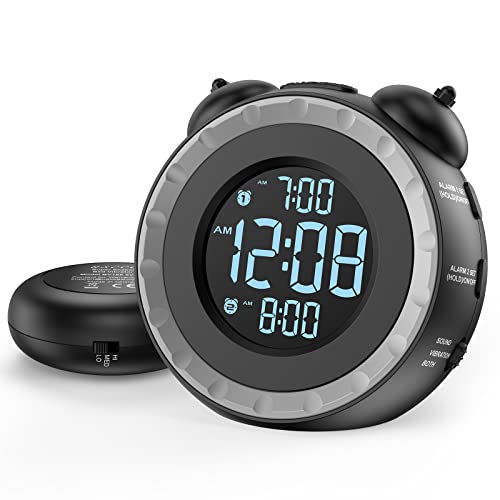
3. uscce Loud Dual Alarm Clock with Powerful Adjustable Bed Shaker — Best Adjustable Shaker
Not every heavy sleeper needs maximum force; some need the right force. The uscce’s adjustable shaker is its reason to exist: start at a moderate vibration, and only climb if the first week proves it necessary. That tuning matters for two reasons — a shaker stronger than needed trains you to sleep through surplus, and a violent pad can migrate out from under a pillow across the night. Set correctly, an adjustable pad sits at the precise level where waking is reliable and the experience is merely firm, and the clock’s loud dual alarm waits behind it as escalation for exam weeks and early flights home.
The supporting specification is dorm-literate: easy setting that a tired student can manage by feel, a dimmer that reaches fully dark, and battery backup. It lacks the ANJANK’s wireless elegance and the Sonic Bomb’s legend status, but for the large middle of heavy sleepers — too deep for ordinary clocks, not extreme enough to need the maximum — it may be the most precisely right tool in this guide.
Strengths
- Adjustable vibration lets you find the minimum strength that reliably wakes you
- Easy-to-set controls respect the midnight, lights-out reality of dorm life
- Battery backup and a full-range dimmer complete the dorm essentials
Trade-offs
- Corded shaker, with the usual routing minor hassle
- Loud alarm still needs a roommate agreement in shared rooms
- Mid-tier finish — functional rather than beautiful
Key specs: Adjustable-strength bed shaker; dual alarm; 0-100% dimmer; battery backup; easy-set
Best for: heavy sleepers who find fixed shakers too weak or too violent and want to dial in / Not suited for: students wanting wireless freedom — this shaker is a corded, adjustable one
Check on Amazon — check price on Amazon.

4. JALL Sunrise Alarm Clock with FM Radio — Best Light-Based Wake
Some heavy sleeping is really dark-room sleeping: in a windowless dorm room or a northern winter, the body’s dawn signal never arrives, and a sudden alarm assaults a brain that believes it is 3 a.m. The JALL attacks that specific problem by simulating the missing sunrise — light building gradually before the alarm sound, so waking is a slope rather than a cliff. For light-responsive sleepers it is transformative, and for roommates it is the kindest technology in this guide: light under one sleeper’s eyelids disturbs nobody else’s.
Know its boundary honestly. It has no shaker, and a sleeper who defeats both light and moderate sound needs vibration — buy a shaker pick and do not hope. Its secondary talents are real dorm value, though: a white-noise machine for sleeping through corridor noise, a radio and Bluetooth speaker, and a night light, all in one small footprint. As the gentle end of this guide, it serves the heavy sleeper whose depth is about darkness, and it serves them better than volume ever would.
Strengths
- Gradual light can lift a sleeper toward waking before any sound begins
- Doubles as a sound machine and speaker — three devices on a tiny dorm nightstand
- Gentlest wake in the guide for the sleeper and the roommate alike
Trade-offs
- No shaker — a truly deep, sound-and-light-proof sleeper will defeat it
- Light works best in genuinely dark rooms; blackout-curtained summers reduce its edge
- Its many features reward ten minutes of setup most students will postpone
Key specs: Sunrise simulation; 25 sounds; FM radio; Bluetooth speaker; 17-colour night light
Best for: heavy sleepers in dark rooms and winter terms, especially light-responsive sleepers / Not suited for: sleepers who sleep through light entirely and need vibration — take a shaker pick
Check on Amazon — check price on Amazon.

5. Peakeep Battery Operated Digital Alarm Clock, Big Numbers — Best Portable / Battery Pick
The Peakeep solves the dorm’s dumbest problem: there is no outlet where the clock needs to be. Battery-operated and cordless, it sits on a loft-bed shelf, a desk corner or a windowsill — wherever its big, auto-dimming numbers can be seen and its adjustable loud alarm can be heard — without a cable negotiation with the room’s two contested sockets. For the heavy sleeper whose depth is moderate, that placement freedom plus real volume is enough, and its simplicity is a virtue at midnight: there is almost nothing to misconfigure.
Its ceiling should be respected. Sound alone, however loud, is the wake-up some deep sleepers demonstrably sleep through — if a phone alarm at full volume beside the pillow has failed you repeatedly, a louder version of the same sense is a gamble, and the shaker picks are the honest answer. As the flexible, portable, second-alarm or travel clock — and as the primary clock for the moderately heavy sleeper — the Peakeep earns its place and its batteries.
Strengths
- Cordless battery operation ends the outlet negotiation entirely
- Big, auto-dimming display reads across a dark room without lighting it up
- Adjustable volume reaches heavy-sleeper levels without a shaker’s hardware
Trade-offs
- Batteries are a consumable — keep spares, because a dead clock is a missed lecture
- No shaker: its ceiling is loud sound, and some sleepers sleep above that ceiling
- Cordless means it can wander — give it a fixed home on the desk or shelf
Key specs: Battery operated, cordless; large display; auto dimming; adjustable loud volume
Best for: students with no free outlet near the bed, loft beds, and travel between dorm and home / Not suited for: the deepest sleepers, who need a shaker’s physical wake rather than sound alone
Check on Amazon — check price on Amazon.

6. DreamSky Small Digital Alarm Clock with USB Charging Port — Best Compact Basic
The DreamSky is the honest baseline of this guide: a small, clear, well-mannered clock with the three features dorm life actually uses daily — big readable numbers, a dimmer that respects sleep, and a USB port that charges the phone from the clock’s own outlet, doubling a scarce socket. Its adjustable volume reaches properly loud, which is sufficient for the large group of students called heavy sleepers who really mean that a phone alarm across the room, on a soft setting, does not wake them.
It is included with its limit stated in its own review rather than discovered at 8 a.m.: there is no shaker, and a sleeper who has slept through loud sound repeatedly should not buy a refinement of loud sound. For mild heavy sleepers, for guest and home beds, and as the reliable second clock in a shaker user’s room — redundancy is a virtue this guide preaches — the DreamSky is the compact, sensible purchase.
Strengths
- USB charging port gives the phone a home in an outlet-starved room
- Compact footprint fits the smallest dorm surfaces
- Dimmer and adjustable volume cover the roommate basics well
Trade-offs
- No bed shaker — the defining heavy-sleeper tool is absent
- Single-purpose simplicity means no dual-alarm depth for complex schedules
- Its loud is dorm-loud, not Sonic Bomb loud
Key specs: Compact; large numbers; brightness dimmer; adjustable alarm volume; USB charging port
Best for: students whose heavy sleeping is mild, and anyone whose nightstand is measured in inches / Not suited for: true heavy sleepers — no shaker, and volume alone may not be enough
Check on Amazon — check price on Amazon.
Comparison Table
| Pick | Badge | Key spec | Best for |
|---|---|---|---|
| Sonic Bomb Dual Alarm Clock with Bed Shaker | Best Overall for Heavy Sleepers | Shaker + loud, dual alarm, backup | genuine heavy sleepers in dorms — shaker mode for shared rooms, full volume for singles |
| ANJANK Extra Loud Alarm Clock with Wireless Bed Shaker | Best Wireless Shaker | Wireless shaker, dimmer, USB | heavy sleepers who hate cords and want light as part of the wake-up |
| uscce Loud Dual Alarm Clock with Powerful Adjustable Bed Shaker | Best Adjustable Shaker | Adjustable shaker, dual, backup | heavy sleepers who find fixed shakers too weak or too violent and want to dial in |
| JALL Sunrise Alarm Clock with FM Radio | Best Light-Based Wake | Sunrise light, sounds, radio | heavy sleepers in dark rooms and winter terms, especially light-responsive sleepers |
| Peakeep Battery Operated Digital Alarm Clock, Big Numbers | Best Portable / Battery Pick | Cordless, big display, loud | students with no free outlet near the bed, loft beds, and travel between dorm and home |
| DreamSky Small Digital Alarm Clock with USB Charging Port | Best Compact Basic | Compact, USB charge, dimmer | students whose heavy sleeping is mild, and anyone whose nightstand is measured in inches |
The table’s deciding column is waking method. Shakers — Sonic Bomb, ANJANK, uscce — wake by touch and are the only silent full-power option for shared rooms. Light, from the JALL, suits dark-room sleepers. Sound alone, from the Peakeep and DreamSky, suits moderate heavy sleepers and tight spaces. Choose the method that matches the sleeper’s proven depth first; every other feature is a tiebreaker.
How to Choose a Dorm Alarm Clock for a Heavy Sleeper
Shaker, sound or light: matching the technology to the sleeper
Diagnose before you buy, using evidence you already have. If phone alarms at full volume beside the bed have failed repeatedly, the problem is not volume — it is that sound is the wrong sense, and a bed shaker’s vibration is the answer; that sleeper should buy from the guide’s first three picks and stop auditioning louder clocks. If alarms work when they are loud and close but fail when soft or distant, sound is viable and placement plus volume — the Peakeep or DreamSky, properly positioned — may genuinely solve it.
Light is the third diagnosis: the sleeper who wakes easily on bright summer mornings and terribly in dark winter ones is light-responsive, and a sunrise clock treats the cause rather than the symptom. Many heavy sleepers are combinations — which is why the strongest dorm systems layer two senses, shaker plus sound or light plus shaker, so that the failure of one layer does not mean a missed morning. The ANJANK, with vibration and light in one unit, is this guide’s ready-made layer cake.
The roommate protocol: waking up without declaring war
A shared dorm room runs on a simple treaty: your alarm is your problem, and the moment it becomes your roommate’s alarm, you owe them. Bed shakers honour the treaty perfectly — full waking power, zero sound — which is why they lead this guide despite loud clocks being cheaper. Where sound is used, the treaty has terms: agree the alarm time pattern early in term, keep the volume at the minimum that works, place the clock where its sound reaches you before the room, and never, ever let an alarm ring on in an empty room while you are in the shower. That last offence ends friendships faster than any other dorm behaviour.
Snoozing is the treaty’s most common breach. A heavy sleeper’s five snoozes are five alarms for the roommate. The structural fix is to make the first alarm the real one — shaker set, feet on floor, clock out of arm’s reach — and to treat the snooze button as a feature that exists for single rooms. Roommates who watch you build that system will forgive the occasional early exam-week siren; roommates who endure a term of snooze concerts will not, and they will be right.
Placement and power: the engineering of not oversleeping
A shaker pad works where it is felt: under the pillow for most sleepers, under the mattress at chest level for those who find pillow vibration migrates or feels harsh. Test it awake — lie down, trigger it, and confirm it would wake you — rather than discovering its position at 6 a.m. Corded pads need their cable routed where a loft bed’s ladder and a roommate’s feet will not find it; wireless pads need a charging home that is not the bed itself. The clock unit belongs out of arm’s reach in every case: an alarm you can silence from the pillow will be silenced from the pillow, by a version of you that cannot be trusted.
Power is the other silent failure. Dorm outlets get unplugged for vacuums, chargers and kettles; breakers trip; cables work loose in loft-bed frames. Battery backup — present on the Sonic Bomb and uscce — is therefore a core specification, and battery-operated clocks like the Peakeep sidestep the problem entirely at the cost of battery discipline. Whatever you buy, check it is alive as part of the night routine: alarm set, backup confirmed, shaker in place. Ten seconds nightly is the whole insurance premium.
Building the habit: the first two weeks decide the year
No clock defeats a 3 a.m. bedtime before an 8 a.m. lecture indefinitely; the technology in this guide buys reliability, not immunity from arithmetic. Use the first two weeks of term to set the system while the stakes are low: fix a wake time and keep it within an hour even on free days, because a body clock trained on weekdays is the silent partner every alarm needs. Set dual alarms to the schedule’s real pattern rather than reprogramming nightly, and let the shaker or light do its work at a consistent hour until waking starts to precede it — the sign the system and the sleeper have synchronised.
When a morning is genuinely critical — an exam, a flight, a job interview — layer deliberately: shaker plus loud alarm plus a phone alarm across the room, and tell your roommate the night before, because a warned roommate forgives what a surprised one does not. Redundancy feels excessive exactly until the morning it saves a semester. That is the spirit of this whole category: heavy sleepers do not need a harsher alarm, they need a system with no single point of failure.
What Heavy Sleeping Actually Is — and What a Clock Can and Cannot Do
Heavy sleeping is not laziness, and this guide’s recommendations are built on that respect. Sleep depth varies by person, by sleep stage at the moment the alarm fires, and — powerfully — by sleep debt: a student carrying a week of short nights will sleep through alarms that would wake them rested, because the brain prioritises deep sleep it has been denied. Alarm clocks operate at the end of that chain. The best of them, the shakers and layered systems here, reliably interrupt even deep sleep; none of them can repay the debt that made the sleep deep, which is why the guide pairs every hardware recommendation with the unglamorous advice of a consistent wake time and a defensible bedtime.
Two boundaries deserve stating plainly. A student who sleeps through shaker-strength alarms regularly, or who is unrousably groggy for hours despite adequate time in bed, has a question for a doctor or sleep clinic rather than for a shopping guide — excessive sleep depth can have treatable causes. And no alarm purchase should be made for a medical purpose, such as waking to medication, without advice from the clinician involved. Within those boundaries, the systems in this guide are the strongest tools the consumer market offers, and for the overwhelming majority of dorm heavy sleepers, they are enough to turn mornings from a recurring emergency into a routine.
Beyond the Clock: The Dorm Morning System That Makes Any Alarm Work Better
Every clock in this guide performs better inside a morning system, and the system costs nothing. Its first element is light in the room itself: curtains opened by the first riser, or a lamp on a timer for the darkest months, so that waking happens into a bright room rather than a cave the brain wants to keep sleeping in. Its second element is a reason placed across the room — the kettle, the gym bag by the door, coursework on the desk — because a heavy sleeper who must stand for the alarm and finds the day already started at their feet is far less likely to return to bed than one whose only morning object is the pillow.
The third element is the evening before, which decides more mornings than any alarm. A consistent lights-out that protects seven to eight hours before the wake time, a phone that charges away from the bed — the USB ports on several clocks here exist partly to make that exile painless — and the ten-second alarm check as the last act of the night. Students describe this as becoming a morning person; it is actually becoming a system person, which is more reliable, because systems do not depend on motivation at 6 a.m.
None of this diminishes the hardware — the shaker under the pillow remains the single most effective purchase a dorm heavy sleeper can make. It reframes it: the clock is the trigger, the system is the mechanism, and the roommate treaty is the social contract that lets both operate. Build all three in the first fortnight of term, while the habit is cheap, and the rest of the year’s mornings will run on rails that a louder alarm alone could never lay.
Travel, Home Weekends and the Alarm That Follows You
A dorm alarm system gets tested by movement: weekends home, reading weeks elsewhere, the summer sublet, the year-abroad term. The clocks in this guide travel unequally, and the difference matters to students whose lives are mobile. Battery-operated simplicity like the Peakeep moves anywhere on earth and wakes on any continent’s nightstand without an adapter thought; a cordless-shaker system like the ANJANK travels nearly as well, its pad in a wash bag, its clock in a rucksack pocket. The corded flagships — Sonic Bomb and uscce — travel too, but as luggage decisions rather than afterthoughts, and many students end up running a two-clock life: the serious system installed in the dorm, the portable standing duty everywhere else.
Home weekends expose a subtler point: the family home is where the heavy sleeper’s reputation was made, and a student who returns with a working system changes a household story. Parents who spent a decade performing the human alarm service notice the shaker under the pillow doing it silently, and the student’s independence — the actual product being bought in this whole category — becomes visible at the breakfast table. Buy the clock for the dorm, by all means; do not be surprised when its largest effect is on how the whole family understands the sleeper.
For the year-abroad or placement term, prioritise the clock whose power story survives the destination: battery operation first, USB charging second, and mains-dependent systems only where the voltage and the plug are known quantities. The alarm that wakes you in a foreign dorm at the start of the biggest term of your life is not the place for an adapter experiment. Pack the proven, portable layer of your system, reinstall the full system when you return, and let your mornings be the one part of the adventure that is entirely, reliably boring.
Parents, Partners and the People Who Used to Be the Alarm
Behind most dorm heavy sleepers stands a person who spent years as the backup alarm — a parent who knocked, called and eventually dragged a teenager upright, and who now lies awake in another town wondering whether a lecture is being slept through. This guide’s systems are, in part, a gift to that person: a shaker under a pillow in a dorm room retires the family wake-up service more completely than any reassurance can. If you are that parent buying the clock, buy the system rather than the siren — the Sonic Bomb or the ANJANK — and resist the follow-up calls; the technology’s whole point is that the sleeper now owns the morning.
Partners inherit the same role later, in first flats and shared beds, which is why the shaker skills learned in a dorm outlast the dorm. A graduate who can wake silently, on time, without disturbing the person beside them carries a domestic superpower into adult life — and carries it, usually, in the same clock, since the picks in this guide are built to survive the journey from hall of residence to first home. Buy it once, buy the silent one, and let everyone in the sleeper’s life sleep better for it.
How to Set Up a Dorm Alarm System That Actually Wakes You
A heavy-sleeper dorm system is set up once, tested awake, and then run as a nightly ten-second ritual. This sequence builds it in the right order — technology first, placement second, habit last — because each layer depends on the one before it.
- Choose your primary sense honestly: shaker if loud sound has failed you, light if dark mornings are your pattern, loud sound if placement and volume were the real problem.
- Position the shaker pad under the pillow or mattress at chest level, route its cord safely, and test it while lying awake until the strength setting reliably startles you.
- Place the clock unit out of arm’s reach — across the desk or on a shelf — so silencing it requires standing up.
- Set dual alarms to your week’s real pattern (early days and late days) instead of reprogramming every night.
- Confirm the power story: plug secured, battery backup fitted or batteries fresh, and the display dimmed to your sleep setting.
- Agree the system with your roommate in daylight: expected times, sound level if any, and the rule that alarms never ring in an empty room.
- For the first week, add a phone alarm across the room as a temporary backstop; remove it only after five consecutive clean wakes.
- Make the nightly check a ritual: alarm on, shaker in place, clock alive — ten seconds, every night, no exceptions for tiredness.
After two weeks, review honestly: if you are waking on the first alarm, the system is tuned and the backstops can relax. If you are still defeating it, change the sense, not just the volume — move from sound to shaker, or add light — because repeating a failed method louder is the definition of the problem this guide exists to end.
Common Buying Mistakes
Buying a louder clock when sound was never the answer. Repeatedly sleeping through full-volume phone alarms is diagnostic: the sense is wrong, not the decibels. Buy the shaker.
Keeping the clock within arm’s reach. A half-asleep hand will silence any alarm it can reach and remember nothing. Distance is the cheapest reliability feature in this guide — the clock goes where standing up is required.
Snoozing through a shared room’s patience. Every snooze is an alarm for your roommate too. Set the real time, make the first alarm the waking one, and keep the treaty.
Letting a wireless shaker or battery clock die quietly. Charge and battery discipline is part of the system. A dead shaker discovered at 6 a.m. is a planning failure from the night before — build the check into the nightly ritual.
Skipping the awake test. An untested shaker position or sound level is a hypothesis, not an alarm. Lie down, trigger it, adjust it — five minutes in daylight that protect every morning after.
Relying on one alarm for the one morning that matters. Exams and flights deserve layers: shaker, loud alarm, phone across the room, roommate warned. Redundancy is not paranoia when the cost of failure is a semester.
Final Recommendation
True heavy sleepers in shared rooms should buy the Sonic Bomb and run it shaker-first: it is the reference system for a reason, silent to the roommate and close to undeniable to the sleeper. Students who want that power without the cord should take the ANJANK and keep its wireless shaker charged; those between ordinary and extreme will find the uscce’s adjustable shaker the most precisely tunable. Dark-room sleepers belong to the JALL’s sunrise, the outlet-starved to the cordless Peakeep, and mild heavy sleepers on tiny nightstands to the DreamSky — with the honest caveat, stated in its review, that sound alone has a ceiling.
Whichever clock you choose, build the system around it: out of arm’s reach, tested awake, checked nightly, and agreed with your roommate. Use the links to check price on Amazon, order before term starts rather than after the first missed lecture, and give the setup its two weeks to synchronise with your sleep. The goal is not a louder morning — it is a boring one, repeated all year.
Quick links to every pick, to check price on Amazon one last time before you decide: Sonic Bomb Dual Alarm Clock with Bed Shaker. ANJANK Extra Loud Alarm Clock with Wireless Bed Shaker. uscce Loud Dual Alarm Clock with Powerful Adjustable Bed Shaker. JALL Sunrise Alarm Clock with FM Radio. Peakeep Battery Operated Digital Alarm Clock, Big Numbers. DreamSky Small Digital Alarm Clock with USB Charging Port.
Best Dorm Room Alarm Clocks For Heavy Sleepers Best Alarm Clocks For Heavy Sleepers Best Loud Alarm Clocks Best Vibrating Alarm Clocks Best Sunrise Alarm Clocks
Frequently Asked Questions
Will a bed shaker wake my roommate?
No — that is its purpose. The pad vibrates under your pillow or mattress and wakes you by touch while producing no meaningful sound for the room. It is the standard solution for shared dorm rooms and for sleepers who share a bed at home.
What if I sleep through the shaker too?
First, reposition and retest it awake — a pad that has migrated or sits at a low setting is the usual culprit, and adjustable models like the uscce exist for tuning. Layer sound behind the shaker as a backstop. If correctly set shaker-strength alarms regularly fail, speak to a doctor, because that level of sleep depth deserves a medical look.
Do I need battery backup in a dorm?
Yes. Dorm power is interrupted by unplugging, tripped breakers and loose loft-bed cables more often than home power. Battery backup, or a battery-operated clock like the Peakeep, keeps the alarm alive through all of it.
Are sunrise clocks enough for heavy sleepers?
For light-responsive sleepers — those whose heavy sleeping tracks dark mornings — they can be the best solution in this guide. For sleepers who defeat sound and sleep in bright rooms, light alone is not enough; choose a shaker system instead.
How loud should a dorm alarm be?
As quiet as reliably wakes you, and no louder — in a shared room that usually means a shaker doing the work and sound as a modest backstop, agreed with your roommate. Maximum volume as a default is a treaty violation, not a strategy.
Should I set multiple alarms?
Set dual alarms for different class days if your clock supports it, and layer different senses — shaker plus sound — for critical mornings. Avoid chains of snooze-spaced alarms, which train you to sleep through the early ones and wake the whole room with all of them.

