Disclosure: airfryerkitchensupply.com is reader-supported. When you buy through links on our site, we may earn an affiliate commission at no extra cost to you.
Where to buy
Start with the picks that carry a verified Amazon listing below — each one was matched against the Amazon catalogue before it earned a link in this guide to the best quilts for cribs. Use the links in the Quick Picks, the individual reviews, the comparison table and the final recommendation to check price on Amazon for the exact size, colour or configuration you want, because options inside one listing can differ a lot. Picks marked as unlinked are described honestly without a link: in this session there was no confident API match for that exact item, so we would rather explain it in words than send you to the wrong product.
- Burt’s Bees Baby Organic Cotton Reversible Quilted Blanket 30 x 40 — Best Overall: Check on Amazon
- Bleu La La Organic Cotton Heritage Knit Baby Quilt Blanket — Best Heirloom Gift: Check on Amazon
- Stephan Baby Heirloom-Quality Pieced Crib Quilt, Denim Dot — Best Traditional Pieced Quilt: Check on Amazon
- CLoucl 100% Cotton Muslin Crib Comforter / Quilt 41 x 48 — Best All-Cotton Muslin: Check on Amazon
- HardNok Muslin Baby Blanket, Organic Cotton Blend, Cacao Stripe 43 x 43 — Best Lightweight Layer: Check on Amazon
- Moonsea Toddler Comforter, Grey Star Print 39 x 47 — Best Toddler Transition: Check on Amazon
Introduction
Finding the best quilts for cribs starts with a safety fact that honest guides should say first: a quilt is not sleep bedding for a young infant. Safe-sleep guidance is consistent — a baby under twelve months should sleep on a firm, flat mattress with a fitted sheet and nothing loose in the crib. So the quilts worth buying in this category earn their place in three other jobs: supervised tummy time and floor play, a stroller or car-seat layer on outings, and the toddler transition after the first birthday, when a light quilt in the crib becomes a reasonable, parent-supervised choice. Judged on those jobs, the differences between quilts are real and worth understanding.
This guide compares six verified quilts and quilt-style blankets across the materials parents actually choose between — quilted organic cotton, knit heirloom styles, layered muslin and down-alternative toddler comforters. Size matters more than most listings admit: a true crib quilt is usually around thirty by forty inches up to roughly forty-one by forty-eight, big enough to cover a toddler or a play mat, small enough not to pool dangerously. Weight matters too. A quilt that is lovely for a photo can be too warm for a heated nursery, and a feather-light muslin layer can be exactly right for summer and useless in January.
We also weighted washability heavily, because a crib quilt that cannot survive frequent washing will not survive real life with a baby. Spit-up, leaky bottles and tummy-time accidents mean this item goes in the machine often, so stitching quality, fabric that does not pill into roughness, and construction that does not bunch after washing all counted in the ranking. Every pick below was matched before it received a link, and the safety framing in each review is specific to that quilt’s weight and size rather than copied boilerplate.
In this guide
Quick Picks
1. Burt’s Bees Baby Organic Cotton Reversible Quilted Blanket 30 x 40 — Best Overall. A quilted organic-cotton blanket in the classic thirty-by-forty crib size, reversible, breathable and built for the tummy-time, stroller and toddler jobs a quilt should actually do.
Check on Amazon — check price on Amazon.
2. Bleu La La Organic Cotton Heritage Knit Baby Quilt Blanket — Best Heirloom Gift. A textured heritage-knit organic cotton quilt that photographs beautifully, feels substantial in hand, and is bought as often for the gift table as for the nursery.
Check on Amazon — check price on Amazon.
3. Stephan Baby Heirloom-Quality Pieced Crib Quilt, Denim Dot — Best Traditional Pieced Quilt. A properly pieced, heirloom-style crib quilt in a denim-dot design — the closest thing in this set to the handmade quilts grandparents remember.
Check on Amazon — check price on Amazon.
4. CLoucl 100% Cotton Muslin Crib Comforter / Quilt 41 x 48 — Best All-Cotton Muslin. A larger forty-one-by-forty-eight all-cotton muslin quilt, reversible and machine washable, sized generously for the toddler stage.
Check on Amazon — check price on Amazon.
5. HardNok Muslin Baby Blanket, Organic Cotton Blend, Cacao Stripe 43 x 43 — Best Lightweight Layer. A six-layer jacquard muslin square in a gender-neutral cacao stripe — the lightest, most packable quilt-style layer in this guide.
Check on Amazon — check price on Amazon.
6. Moonsea Toddler Comforter, Grey Star Print 39 x 47 — Best Toddler Transition. A down-alternative quilted toddler comforter at thirty-nine by forty-seven inches, with a grey star print toddlers actually like keeping on the bed.
Check on Amazon — check price on Amazon.
How These Picks Were Chosen
Each candidate was checked in three passes. First, identity: the product was searched by brand and model connection, and only a listing whose returned title matched the quilt we intended to describe earned a link. Second, suitability: we read the verified title and listing details for size, face fabric and fill, and rejected quilts sized for twin beds, quilts with loose embellishments a baby could work free, and heavy comforter sets bundled with bumpers or pillows that have no place in a crib. Third, role fit: every surviving quilt had to be best at something specific — tummy time, heirloom gifting, warm-weather layering, the toddler bed — rather than generically nice.
We deliberately kept the set small and honest. Six picks cover the realistic buying decisions in this category; padding the list with near-duplicates of the same muslin blanket under different brand names would not help a parent choose. Where a style is missing — for example a true hand-quilted artisan piece — that is because no listing could be verified confidently in this session, and the guide says so instead of inventing one. Prices are never printed here because they move; use the links to check price on Amazon for the exact colourway you want.
The 6 Best Quilts for Cribs

1. Burt’s Bees Baby Organic Cotton Reversible Quilted Blanket 30 x 40 — Best Overall
This is the quilt we would hand to a first-time parent who asked for one sensible recommendation. The face is organic cotton, the quilting keeps the polyester fill evenly distributed so it does not clump into cold spots after washing, and the thirty-by-forty size is the honest centre of this category: large enough to lie under a baby for tummy time with room to roll, small enough to fold into a stroller without trailing. The reversible design is not a gimmick — one side inevitably becomes the photo side and the other becomes the everyday side, and both look intentional.
Used correctly, it shines in the supervised roles. On a play mat it adds a thin, even padding layer over hard floors. In a stroller it tucks without excess fabric near the wheels. After the first birthday, it works as the light crib layer many toddlers actually keep on, unlike heavier comforters they kick off. It is not a winter-weight quilt for a cold house, and parents in unheated nurseries should pair the toddler stage with appropriate sleep clothing rather than stacking extra blankets. Wash it before first use, wash it often after, and it holds its softness better than most quilts at its tier.
Strengths
- Organic cotton face that stays soft through repeated washing
- True crib-quilt proportions that do not pool or bunch on a play mat
- Reversible design gives two nursery looks for one purchase
Trade-offs
- Polyester fill, so purists wanting an all-cotton quilt should look at the knit picks
- Mid-weight — warm enough for most nurseries, light for a cold room in winter
- Prints are gentle and neutral, which will not suit a bold, themed nursery
Key specs: 30 x 40 in; organic cotton face; quilted with polyester fill; reversible
Best for: parents who want one versatile, washable quilt for tummy time, stroller and the toddler transition / Not suited for: anyone wanting a large toddler-bed cover — this is crib-sized, not twin-sized
Check on Amazon — check price on Amazon.

2. Bleu La La Organic Cotton Heritage Knit Baby Quilt Blanket — Best Heirloom Gift
Knit quilts occupy a different emotional and practical register from flat quilted blankets. The Heritage Knit has a visible, textured stitch that traps a little air in its structure, so it feels warm for its weight without any synthetic fill, and the organic cotton is soft in the way that makes adults rub it between their fingers at a shower. As a supervised tummy-time surface it is slightly springy; as a stroller layer it drapes rather than slides; as a toddler quilt it reads as a real blanket rather than a baby product, which extends its useful life in the room.
The trade-offs are care and vulnerability. A knit is not the quilt to throw in with jeans and zips — wash it in a gentle cycle, ideally in a laundry bag, and keep it away from velcro, which pulls loops. It also costs more than the flat quilts here, and that premium buys texture and keepsake value, not extra safety or warmth per ounce. Buy it when the gift or the keepsake matters; buy the Burt’s Bees quilt when pure workhorse value matters. Both judgements are respectable, and this guide will not pretend otherwise.
Strengths
- Knit texture gives warmth without a filled, puffy construction
- Organic cotton throughout, including the feel against skin
- Looks and feels like a keepsake rather than a commodity blanket
Trade-offs
- Knit loops can catch on velcro tabs and jewellery if handled carelessly
- Usually a premium-tier purchase compared with flat quilts
- Texture holds crumbs and lint more than a smooth weave
Key specs: Organic cotton knit; textured heritage stitch; baby quilt size — confirm dimensions on listing
Best for: baby-shower gifting and parents who want a keepsake-quality knit quilt / Not suited for: heavy daily washing rotation — knit texture deserves gentler handling than a flat quilted blanket
Check on Amazon — check price on Amazon.

3. Stephan Baby Heirloom-Quality Pieced Crib Quilt, Denim Dot — Best Traditional Pieced Quilt
Most patchwork baby quilts sold today are a single printed panel pretending to be pieced. This Stephan Baby quilt is the real construction: separate pieces joined into the quilt, which gives it the slight irregularity, drape and longevity people mean when they say heirloom. The Denim Dot design is deliberately unthemed — no characters to outgrow, no trend to date it — so it can move from the nursery wall or tummy-time mat to a toddler bed and then into a memory box without looking like a fad purchase.
Practical expectations should be set honestly. Pieced seams reward a gentle wash cycle and punish being wrung or overloaded, so this is a rotate-it quilt rather than the only quilt you own. Its weight sits in the middle of this set: right for spring and autumn layering and for air-conditioned summers, paired with lighter clothing in warm rooms. For a christening, naming ceremony or grandparent gift where the object itself carries meaning, this is the pick that will still be kept in twenty years, long after printed panels have been donated.
Strengths
- Genuine pieced construction rather than a printed patchwork imitation
- Denim-dot palette ages gracefully from nursery to toddler room
- Heirloom positioning backed by a baby-gift brand with a long track record
Trade-offs
- Pieced seams are more delicate than a single-panel quilt
- Design range is narrow — this is one classic look, not a print library
- Not the lightest option for summer stroller use
Key specs: Pieced construction; Denim Dot design; crib quilt sizing — confirm dimensions on listing
Best for: families who want a traditional pieced quilt with a timeless, non-themed look / Not suited for: parents who need the absolute easiest-care option — pieced seams prefer gentler washing
Check on Amazon — check price on Amazon.
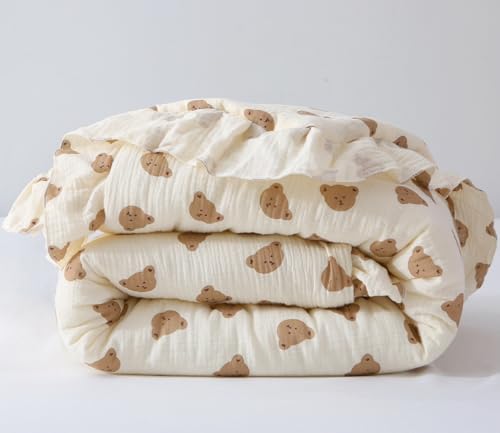
4. CLoucl 100% Cotton Muslin Crib Comforter / Quilt 41 x 48 — Best All-Cotton Muslin
Muslin earns its following honestly: the open, crinkled cotton weave breathes in warm rooms, gets softer with washing instead of rougher, and contains no fill that can shift or clump. CLoucl’s version is cut at forty-one by forty-eight inches, which changes its best use. Folded in half it makes a well-padded tummy-time mat; opened fully it is a genuine toddler quilt that still covers a wriggling two-year-old, and it works as a picnic or floor quilt long after the crib is gone. The reversible design gives a second colourway for the other side of the room’s mood.
Choose it with eyes open about warmth. An all-muslin quilt is a three-season layer in most homes and a summer layer in cold ones; it will not replace a filled quilt in a chilly January nursery, where the right answer is warmer sleep clothing plus a moderate room temperature, not a pile of blankets. Its other virtue is laundry simplicity — it washes and dries faster than filled quilts, which matters in the high-rotation reality of toddler life. For cotton purists, this is the most defensible pick in the set.
Strengths
- Cotton muslin through and through — no polyester fill
- Larger format covers a toddler properly and doubles as a floor quilt
- Muslin softens noticeably with every wash
Trade-offs
- Muslin is breathable, so it is the coolest — not warmest — quilt here
- Larger size is more fabric to wash and dry
- Wrinkled, relaxed muslin look is a style some nurseries will not want
Key specs: 41 x 48 in; 100% cotton muslin; reversible; machine washable
Best for: toddler beds and parents who want cotton inside and out with no synthetic fill / Not suited for: newborn tummy time on its own — its generous size folds and bunches under small babies unless folded deliberately
Check on Amazon — check price on Amazon.

5. HardNok Muslin Baby Blanket, Organic Cotton Blend, Cacao Stripe 43 x 43 — Best Lightweight Layer
Think of the HardNok as the quilt for families who run warm. Six layers of muslin jacquard give it more substance than a swaddle — it lies flat for tummy time instead of skating around, and it drapes over a stroller without the bulk of a filled quilt — while staying fundamentally breathable. The forty-three-inch square is a versatile geometry: folded into quarters it is a changing-pad cover or a burp shield, folded once it is a pram layer, opened it is a summer toddler cover. The cacao stripe is the kind of neutral that works in nurseries designed before the baby’s arrival and in gift situations where tastes are unknown.
Its limits are the flip side of its virtues. In a cold room it is not enough on its own for the toddler stage, and its square cut leaves feet uncovered sooner than the rectangular CLoucl as a child grows. It also asks for the usual muslin respect in the wash — it will soften beautifully, but sharp zips and rough loads can pull its open weave. For travel, warm climates and high-frequency washing, though, nothing else in this set packs, dries and re-deploys as quickly.
Strengths
- Six muslin layers give body without synthetic fill
- Square format folds small for a diaper bag or stroller basket
- Neutral stripe suits almost any nursery and photographs softly
Trade-offs
- Lightest warmth in the set by design
- Square shape covers a toddler less completely than a rectangular quilt
- Muslin texture shows pulls more readily than a tight weave
Key specs: 43 x 43 in; organic cotton blend muslin; 6-layer jacquard weave
Best for: warm climates, travel and parents who layer lightly and wash constantly / Not suited for: cold nurseries as the only toddler cover — six layers of muslin is still muslin
Check on Amazon — check price on Amazon.

6. Moonsea Toddler Comforter, Grey Star Print 39 x 47 — Best Toddler Transition
Every quilt before this one earns its keep mainly outside sleep for the first year. The Moonsea is unapologetically for the stage after that: a quilted down-alternative comforter sized thirty-nine by forty-seven for a toddler in a crib-converted bed or toddler bed, warm enough for cooler rooms where muslin leaves a child kicking covers on and off all night. The grey star print does real work here — toddlers cooperate with bedding they like, and a print pitched at them, in a palette that does not fight the room, is a practical feature, not decoration.
Hold two boundaries firmly. First, timing: this comforter belongs to the toddler stage, introduced when your paediatric guidance and your own judgement say loose bedding is appropriate for your child — not in a young infant’s crib. Second, temperature: down-alternative fill is the warmest option in this guide, so in heated or warm-climate rooms it can overshoot; dress the child lightly under it and keep the room at a comfortable sleeping temperature. Within those boundaries, it is the most bed-like, grown-up quilt in the set, and the one most likely to be dragged to the sofa for story time as well.
Strengths
- Down-alternative fill gives the warmest sleep-stage option in this set
- Size is cut for toddlers rather than newborns, so it stays useful longer
- Playful print encourages toddlers to accept the bedtime layer
Trade-offs
- Warmest pick here — too warm for hot rooms and summer nights
- Synthetic fill, so cotton purists should choose the muslin or knit picks
- Print is charming but more themed than the neutral picks
Key specs: 39 x 47 in; down-alternative fill; quilted; grey star print
Best for: the post-first-birthday crib and toddler-bed stage, especially in cooler rooms / Not suited for: infants under twelve months — this is a toddler comforter, not newborn bedding
Check on Amazon — check price on Amazon.
Comparison Table
| Pick | Badge | Key spec | Best for |
|---|---|---|---|
| Burt’s Bees Baby Organic Cotton Reversible Quilted Blanket 30 x 40 | Best Overall | 30×40, organic cotton, reversible | parents who want one versatile, washable quilt for tummy time, stroller and the toddler transition |
| Bleu La La Organic Cotton Heritage Knit Baby Quilt Blanket | Best Heirloom Gift | Organic cotton knit, heirloom texture | baby-shower gifting and parents who want a keepsake-quality knit quilt |
| Stephan Baby Heirloom-Quality Pieced Crib Quilt, Denim Dot | Best Traditional Pieced Quilt | Pieced heirloom style, Denim Dot | families who want a traditional pieced quilt with a timeless, non-themed look |
| CLoucl 100% Cotton Muslin Crib Comforter / Quilt 41 x 48 | Best All-Cotton Muslin | 41×48, all-cotton muslin, reversible | toddler beds and parents who want cotton inside and out with no synthetic fill |
| HardNok Muslin Baby Blanket, Organic Cotton Blend, Cacao Stripe 43 x 43 | Best Lightweight Layer | 43×43, 6-layer muslin, jacquard | warm climates, travel and parents who layer lightly and wash constantly |
| Moonsea Toddler Comforter, Grey Star Print 39 x 47 | Best Toddler Transition | 39×47, down-alternative, star print | the post-first-birthday crib and toddler-bed stage, especially in cooler rooms |
Read the table by job, not by rank. The first five picks are primarily supervised-use and transitional quilts — tummy time, stroller, floor play, gifts — with toddler sleep use arriving later; the Moonsea is primarily a toddler-stage comforter. Size is the second filter: thirty-by-forty quilts are crib-proportioned, while the forty-plus-inch muslin and comforter picks are really toddler tools that also serve earlier when folded. Material is the third filter, and it decides both warmth and laundry behaviour: muslin breathes and dries fast, knit insulates through texture, filled quilts insulate most and wash heaviest.
How to Choose a Crib Quilt Safely
Start with age and role, not with the prettiest print
The single most consequential decision in this category is matching the quilt to the child’s age and the job it will do this month. For a baby under twelve months, the crib itself should stay bare for sleep — fitted sheet, firm mattress, nothing loose — so a quilt bought for a newborn is really bought for supervised tummy time, floor play, stroller walks and photographs, with crib use arriving at the toddler stage. That reframing changes what good means: a newborn-stage quilt should lie flat, wash relentlessly and be sized for a play mat, while a toddler-stage quilt should cover a longer body and provide the warmth the room actually needs.
Parents who buy with the toddler stage only in mind often end up with a comforter that is useless for the first year and a bare play-mat problem in the meantime. Parents who buy only for the newborn stage end up rebuying at eighteen months. The efficient pattern, reflected in this guide’s picks, is one workhorse quilt that serves supervised use now and light toddler use later, plus — only if your rooms run cold — one warmer toddler comforter when that stage actually arrives.
Fabric: cotton face, muslin layers, knit texture and fills explained
Cotton-faced quilted blankets like the Burt’s Bees pick are the default for a reason: a smooth woven face resists pilling, slides over a play mat without gripping, and tolerates hot, frequent washing. Muslin trades smoothness for breathability — its open weave vents heat, softens with age and dries fastest, which is why both muslin picks suit warm homes and high laundry rotation. Knit quilts insulate through loops of yarn rather than a fill layer; they feel substantial, photograph with depth, and need the gentlest handling of the three.
Fills deserve a plain explanation. Polyester and down-alternative fills provide the most warmth per layer and keep their loft through washing, but they breathe least and take longest to dry. An all-cotton or muslin construction breathes best and dries fastest but insulates least. There is no universally best answer — there is only the match between your nursery’s real temperature across seasons and the construction you choose. When a listing hides its fill or face fabric behind vague words like premium softness, treat that as a reason to choose a competitor that states its materials plainly.
Size, weight and the numbers that actually matter
Crib quilts cluster between thirty-by-forty and roughly forty-two-by-fifty inches, and the difference is functional. The smaller format is a mat and stroller tool that happens to fit a crib; the larger format is a toddler cover that can be folded down for earlier use. Measure your stroller’s seat and your play space before choosing, because a quilt that overhangs a stroller into the wheels is a daily annoyance, while one too small for a rolling baby’s mat defeats its purpose.
Weight is rarely listed honestly, so judge by construction: single-layer muslin squares are lightest, six-layer muslin and knit quilts sit in the middle, and filled comforters are heaviest. Then sanity-check against your home: a warm, well-heated nursery needs less quilt than product photos suggest, and overheating a sleeping toddler is a more common error than under-covering one. When in doubt, choose the lighter quilt and adjust the child’s sleep clothing, which is easier to fine-tune than a blanket a toddler can tangle in.
Care, safety checks and buying with a clear head
Before first use, wash any crib quilt separately and inspect it: seams should be closed, quilting stitches even, and there should be no loose threads long enough to wrap a finger, no buttons, bows or appliqué that can work free. Repeat that thirty-second inspection monthly, because the wash cycle that keeps a quilt hygienic is also what loosens weak stitching. Retire or repair a quilt with a torn seam rather than returning it to a toddler bed with fill exposed.
Finally, buy for the rotation you will really run. One quilt in constant use spends half its life in the laundry basket, so two mid-priced quilts usually serve a family better than one precious quilt — one in use, one clean. That is also why this guide ranks a washable workhorse first and keepsake knits second: both are legitimate purchases, but they solve different problems, and confusing them is how families end up hand-washing a heirloom at midnight.
Crib Quilts and Safe Sleep: The Full Picture
Because this category sits next to infant sleep, it deserves one clear, unhurried explanation rather than a footnote. The bare-crib rule for the first year — back to sleep, firm flat mattress, fitted sheet, no loose blankets, quilts, pillows or bumpers — exists because soft, loose items can cover a young baby’s face or create pockets of rebreathed air, and young infants cannot reliably move them away. A quilt in the nursery is not a violation of that rule; a quilt in a sleeping young infant’s crib is. Kept in its proper roles — supervised floor time, stroller, travel, decor over a chair — a quilt is a safe, useful, even developmentally helpful object, giving a baby a defined, slightly padded surface for the tummy time that builds neck and shoulder strength.
After the first birthday the picture changes gradually, not overnight. Toddlers can move bedding, call out, and regulate their position, and paediatric guidance relaxes accordingly — which is why this guide introduces sleep use at the toddler stage, at naps first, with a light quilt matched to the room’s temperature. Parents of premature babies or children with medical conditions should follow their own clinician’s timeline rather than a shopping guide’s, and any parent who is unsure should simply wait: there is no developmental prize for introducing a crib quilt early, and the supervised uses in this guide fill the first year completely.
A final word on quilts marketed as crib sets. Bundles that package a quilt with bumpers, pillows or plush toys are selling a photograph, not a sleep environment. If you fall for a set’s quilt, buy it for the quilt’s supervised and toddler uses and store or donate the soft accessories rather than installing the whole photograph in a newborn’s crib. The picks in this guide are sold as individual quilts or blankets precisely so that no part of your purchase pressures you toward an unsafe setup.
What a Crib Quilt Costs Over Its Real Life
Judged per year of use rather than per purchase, the economics of this category favour the versatile middle. A workhorse quilt bought for tummy time typically serves four to six years — mat, stroller, toddler cover, sofa throw, car blanket — which makes even a mid-priced organic option inexpensive per year, while a novelty quilt bought for one photograph and outgrown in a season is expensive at any price. This is why the guide ranks construction and size ahead of prints: the quilt that survives is the quilt whose fabric tolerates washing, whose size fits successive jobs, and whose look does not date.
There are two legitimate exceptions. A keepsake knit or pieced quilt is not bought per year of use but per decade of keeping, and its value is sentimental rather than utilitarian — a fair purchase when made knowingly, as with the Bleu La La and Stephan Baby picks. And a household expecting twins, or a second child soon after the first, should weight durability even higher, because a good quilt handed down doubles its service life without doubling its cost. In both cases the arithmetic still rewards buying the well-made version once over the flimsy version twice.
Quilts Beyond the Crib: Getting Five Years From One Purchase
The families who get the most from a crib quilt are the ones who plan its second and third lives at the moment of purchase. After the toddler-bed stage, a sound quilt moves naturally to the reading corner or the end of a single bed, then to the car for journeys and picnics, and finally — if its construction was honest — into storage as the keepsake it may already have become. Each transition favours the qualities this guide ranked first: a size that is generous without being bedding-sized, a design that is not licensed, themed or dated, and stitching that survives the washing all those lives involve. A quilt bought as a photograph prop fails the second transition; a quilt bought as a textile passes all of them.
That long view also reframes the gift question. A quilt given at a birth is one of the few gifts that can still be in daily use when the child starts school, and the givers who understand that choose the knit and pieced heirloom picks or the organic workhorse over the novelty print of the season. If you are buying for your own child, the same logic applies with the volume turned down: you are not buying for the nursery in the photograph, you are buying for the floor, the stroller, the toddler bed, the sofa and the car, in that order. Choose the quilt whose fabric, size and look survive that whole itinerary, and the purchase will feel wiser every year it stays in the house.
One last practical habit completes the picture: photograph the quilt’s label and keep a note of its materials and care instructions with your household records. Labels fade and detach across years of washing, and the day you need to know whether a quilt can be tumble-dried, bleached or repaired with a matching cotton is always the day the label becomes unreadable. Thirty seconds with a phone camera at purchase is the cheapest preservation a keepsake ever gets.
How to Use a Crib Quilt Safely at Each Age
A crib quilt has a life in stages, and using it well means knowing which stage you are in. The routine below follows the sequence most families actually live: floor and tummy time first, stroller and travel second, toddler bedding last.
- Wash the quilt before first use on a gentle cycle, dry it fully, and inspect seams, stitching and edges for loose threads or weak spots.
- For tummy time, lay the quilt flat over a firm floor or play mat, smoothing folds so the baby works on an even surface, and stay within arm’s reach throughout.
- For stroller use, fold the quilt to the seat’s width, keep fabric clear of wheels and harness buckles, and re-check that the harness still fastens snugly over the layer.
- For travel, roll rather than fold a muslin or knit quilt to save space, and keep a clean spare in the diaper bag during the high-mess months.
- At the toddler stage, introduce the quilt at naps first, in a room at a comfortable temperature, with light sleep clothing underneath.
- Wash frequently — after illness, after spills, and on a regular rotation — and dry completely before storage to prevent musty odours.
- Re-inspect monthly for torn seams, thinning patches or loose threads, and repair or retire the quilt before damage reaches the fill.
Two habits extend a quilt’s life more than any product choice: drying it fully every time, since damp-stored cotton develops odour that no amount of rewashing fully removes, and rotating two quilts so neither is washed to death in a single season. Kept that way, the workhorse quilts in this guide routinely outlast the crib itself and move on to dens, reading corners and car journeys.
Common Buying Mistakes
Buying a quilt as sleep bedding for a young infant. This is the dangerous mistake in the category. Loose bedding in a crib during the first year conflicts with established safe-sleep guidance. Buy the quilt for supervised uses first and let crib use wait for the toddler stage.
Choosing by print alone. A character print a toddler outgrows in a season, on a quilt too small or too warm for the room, is a wasted purchase. Decide age role, size and fabric first; let print be the tiebreaker between quilts that already fit.
Assuming bigger is always better. Oversized quilts bunch on play mats, trail into stroller wheels and overwhelm a toddler bed. Match the format to the job — crib-proportioned for mats and strollers, larger only when the toddler stage is the real target.
Ignoring the fill disclosure. Listings that will not state their face fabric and fill plainly are asking you to guess at warmth, washing behaviour and longevity. Every pick in this guide states its construction; hold other listings to the same standard.
Owning exactly one quilt. Babies generate laundry at a pace that guarantees your only quilt will be wet when you need it. A two-quilt rotation of mid-priced pieces beats one premium quilt in both convenience and total lifespan.
Skipping the seam inspection after washing. The wash cycle is what loosens weak stitching. A monthly thirty-second check for loose threads and opening seams catches damage while it is a repair, not after fill escapes into a toddler’s bed.
Final Recommendation
If you buy one quilt from this guide, buy the Burt’s Bees Baby reversible quilt: it is the most versatile size, the easiest care and the most honest all-rounder for the supervised first year and the light toddler stage beyond it. Gift-givers and keepsake hunters should choose the Bleu La La Heritage Knit or the Stephan Baby pieced quilt, in that order. Warm homes and cotton purists are best served by the CLoucl muslin for the toddler stage and the HardNok six-layer muslin for travel and layering, while cooler rooms at the toddler stage are exactly what the Moonsea down-alternative comforter exists for.
Whichever you choose, keep the sequence this guide opened with: bare crib for infant sleep, quilt for supervised life, toddler bedding when the stage arrives. A quilt bought and used in that order is not a compromise — it is several good products in one, which is why the category endures. Use the links above to check price on Amazon for the colourway you want, and consider buying your second rotation quilt at the same time while the matching options are in front of you.
Quick links to every pick, to check price on Amazon one last time before you decide: Burt’s Bees Baby Organic Cotton Reversible Quilted Blanket 30 x 40. Bleu La La Organic Cotton Heritage Knit Baby Quilt Blanket. Stephan Baby Heirloom-Quality Pieced Crib Quilt, Denim Dot. CLoucl 100% Cotton Muslin Crib Comforter / Quilt 41 x 48. HardNok Muslin Baby Blanket, Organic Cotton Blend, Cacao Stripe 43 x 43. Moonsea Toddler Comforter, Grey Star Print 39 x 47.
Best Quilts For Cribs Best Baby Blankets Best Crib Sheets Best Quilts For Toddlers Best Baby Quilts
Frequently Asked Questions
Can a baby sleep under a quilt in the crib?
Not during the first year. Safe-sleep guidance keeps the infant crib bare — firm mattress, fitted sheet, no loose bedding. Quilts in this guide are for supervised tummy time, stroller and floor use first, and become crib bedding at the toddler stage when parents introduce them deliberately, usually starting at naps.
What size is a standard crib quilt?
Most fall between thirty by forty inches and about forty-two by fifty. The smaller end suits play mats and strollers; the larger end covers a toddler. A standard crib mattress is twenty-eight by fifty-two inches, so even the larger quilts are covers, not fitted bedding.
Muslin, knit or filled — which is warmest?
Filled quilts, including down-alternative comforters, insulate most. Knit quilts sit in the middle, warming through their textured loops. Muslin breathes most and insulates least, which makes it the right choice for warm rooms and summer, and the wrong sole cover for a cold nursery in winter.
How often should a crib quilt be washed?
On a regular rotation — weekly for a quilt in daily floor or stroller use is a sensible rhythm, plus immediately after spills, sickness or accidents. Wash gently, dry fully, and inspect seams afterwards. Owning two quilts makes this rhythm realistic instead of aspirational.
Are organic cotton quilts worth it?
They are worth it when the face fabric touches skin for hours daily and when you value certified fibres and gentler processing — the Burt’s Bees and Bleu La La picks are the organic options here. They are not automatically warmer or more durable than good conventional cotton, so buy organic for its actual benefits, not as a proxy for quality.
When can my toddler start using the Moonsea-style comforter?
At the toddler stage — after the first birthday at the earliest, and when your child sleeps in a crib converted or a toddler bed and can move bedding freely. Introduce it at naps, keep the room comfortably cool, dress the child lightly underneath, and stop if the comforter consistently ends up over the child’s head or tangled, which means waiting a little longer.


