Disclosure: airfryerkitchensupply.com is reader-supported. When you buy through links on our site, we may earn an affiliate commission at no extra cost to you.
Where to buy
Every pick in this guide to the best bath tub mats for bath tub safety was verified against a live Amazon listing before it earned a link, so each name below takes you to the exact mat described. A tub mat is a safety device first and a bathroom accessory second: before you order, measure the flat floor of your tub (not the rim-to-rim length), confirm your tub surface is smooth rather than textured or refinished, and check price on Amazon, because mat prices move and the right size matters more than a small price difference.
GORILLA GRIP Bath Tub Shower Mat · Vive Non-Slip Bath Mat with Suction Cups · GORILLA GRIP Bath Tub Shower Mat · Vive Oval Bathtub Mat (Gray) · UNEEDE Kids Bathtub Mat Non Slip · Vannokor Baby Bath Mat for Tub
Why a Mat Is the Cheapest Safety Upgrade in the Bathroom
The best bath tub mats for bath tub safety solve a problem that is easy to underestimate until the first slip: a wet enamel, acrylic, or fiberglass tub floor is one of the lowest-friction surfaces in any home, and it gets worse the moment soap, shampoo, conditioner, or bath oil enters the picture. Standing up from a soak, stepping in with wet feet, turning to reach the taps — these are the moments when a foot skates, and they happen in the seconds when you are least braced for it. A proper tub mat attacks the problem from both sides at once. Underneath, dozens or hundreds of suction cups lock the mat to the tub floor so it cannot surf away under your weight. On top, a textured or cushioned surface gives wet skin something to grip. Neither half works alone: a textured mat that slides is a sled, and a firmly stuck mat with a slick top is a false promise.
This guide is specifically about mats that go inside the tub for safety — not the absorbent rugs that sit on the bathroom floor outside it, which solve a different problem. Every pick below is an in-tub mat with a suction-cup underside, chosen for grip strength, coverage, drainage, and how realistically it survives months of daily showers, soap scum, and cleaning. We also separate the picks by who they protect: a mat that is ideal for an adult who showers standing may be wrong for a toddler learning to sit up in the bath, and a senior who lowers into the tub needs surface texture and coverage in different places than a teenager who just wants to not skate around. Read the verdict lines; they are written to steer you to the right mat, not just a good one.
In this guide
Quick Picks
Best Overall: GORILLA GRIP Bath Tub Shower Mat, Stronger Hold, 35×16 (Grey Opaque) — 35 x 16 in, suction cups with drain holes, machine washable. Check the current price on Amazon.
Best for Seniors and Balance Support: Vive Non-Slip Bath Mat with Suction Cups, 28 x 16 — 28 x 16 in, textured rubber surface, patented grip pattern. Check the current price on Amazon.
Best Clear Mat That Disappears Visually: GORILLA GRIP Bath Tub Shower Mat, 35×16 (Clear) — 35 x 16 in, clear finish, drain holes, machine washable. Check the current price on Amazon.
Best for Small and Curved Tubs: Vive Oval Bathtub Mat (Gray) — Oval profile, strong rubber suction cup grip. Check the current price on Amazon.
Best for Toddlers: UNEEDE Kids Bathtub Mat Non Slip, Frog Design, 30×18 — 30 x 18 in, 100+ suction cups, 50+ drainage holes, soft rubber. Check the current price on Amazon.
Best Extra-Long Coverage: Vannokor Baby Bath Mat for Tub, Extra Long 40 x 16 (Whale) — 40 x 16 in, drain holes and suction cups, machine washable. Check the current price on Amazon.
How These Picks Were Chosen
We started from the mechanics of a slip rather than from marketing categories. First, hold: the mat has to stay put on a smooth tub floor under a shifting, soapy adult, so we prioritized dense suction-cup arrays and designs where the cups ring the edges and fill the field, not just a few cups at the corners. Second, top-side traction: bare wet feet need texture — raised patterns, rubberized finishes, or cushioned surfaces that deform slightly under the heel. Third, drainage: a mat that traps a sheet of soapy water on top of itself recreates the hazard it was bought to remove, so drain holes and channels scored heavily. Fourth, hygiene: in-tub mats live in the dampest corner of the house, so machine washability and materials that rinse clean mattered. Fifth, fit: standard tubs, small tubs, curved tubs, and kids’ tubs need different footprints, so the six picks span sizes and shapes rather than six versions of the same rectangle. Finally, every product had to be confirmed as a real, current Amazon listing; anything we could not verify was left out rather than guessed at.
The 6 Best Bath Tub Mats for Bath Tub Safety

GORILLA GRIP Bath Tub Shower Mat, Stronger Hold, 35×16 (Grey Opaque) — Best Overall
This is the mat to buy if you do not want to think about the decision again. The 35-by-16-inch footprint covers the working area of a standard tub — the zone where you actually stand, pivot, and sit — and the suction array underneath is the brand’s stronger-hold design, which grips smooth enamel and acrylic with the kind of resistance you feel when you try to peel it up for cleaning. The top surface is soft underfoot without being spongy, so balance feels planted rather than wobbly, and the drain holes keep shower water moving instead of pooling around your ankles. It suits the widest range of households: adults who shower standing, anyone recovering steadiness after an injury, and grandparents who want the tub safer before the grandkids visit.
Strengths
- Stronger-hold suction array grips smooth tub floors tenaciously
- Full 35-inch length covers the real standing and sitting zone
- Machine washable, so the hygiene routine is realistic
Trade-offs
- Grey opaque finish shows soap film sooner than clear versions
- Must be stuck down before the tub gets wet — it will not seat properly on a flooded floor
- Not suitable for textured or refinished tub surfaces, like almost all suction mats
As a daily-driver safety mat it gets the fundamentals right in the right order: hold first, drainage second, comfort third. The length matters more than people expect. Shorter mats leave the area near the drain — exactly where you stand to turn the water on and off — uncovered, and that uncovered patch is where slips start. Here the coverage runs through the danger zone. Over months of use the routine is simple: lift it after the last shower of the day when you can, rinse it during a weekly bathroom clean, and run it through the wash when it starts to feel filmed. Households that skip that routine with any mat end up blaming the mat for a maintenance problem.
Best for: buyers who want best overall coverage in a standard tub / Not suited for: textured or refinished tub floors. Check on Amazon — check price on Amazon.

Vive Non-Slip Bath Mat with Suction Cups, 28 x 16 — Best for Seniors and Balance Support
Vive designs for the care market, and it shows in the priorities here: the emphasis is on a textured top that gives unsteady feet maximum feedback and a grip pattern underneath intended to prevent the slow creep that cheaper mats develop over a long shower. At 28 by 16 inches it is a little shorter than our top pick, which actually suits many seniors better — the mat sits in the entry and standing zone of the tub, and its edges are easier to reach and re-seat from a seated position on a tub bench. The rubber construction feels firmer and more supportive than cushioned foam-style mats, which matters if a spongy surface makes you feel less stable rather than more.
Strengths
- Textured surface gives high-feedback footing for unsteady users
- Firm rubber feel reads as stable rather than spongy
- Sized for the entry zone and pairs well with a shower bench
Trade-offs
- Shorter coverage leaves the far end of a long tub bare
- Firm surface is less kind to bare knees and seated bathers
- Rubber smell on first opening takes a day or two to air out
Choose this one when the user’s core problem is confidence: the feeling that the floor cannot be trusted. The texture communicates grip to the soles in a way smooth mats do not, and that feedback loop — foot feels texture, brain relaxes, gait steadies — is a real part of fall prevention. It is also a sensible pick for post-surgery households, where a physical therapist has said the word ‘non-slip’ out loud and meant it. Pair it with a grab bar rather than treating the mat as the whole solution; a mat stops feet sliding, a bar catches you if you sway, and the two together cover the two different ways people actually fall in tubs.
Best for: buyers who want best for seniors and balance support coverage in a standard tub / Not suited for: textured or refinished tub floors. Check on Amazon — check price on Amazon.

GORILLA GRIP Bath Tub Shower Mat, 35×16 (Clear) — Best Clear Mat That Disappears Visually
Some bathrooms are also design statements, and a grey or white slab in the middle of a handsome tub is not what the owner pictured. This clear version of the Gorilla Grip mat lays down the same 35-by-16 coverage and suction-and-drain-hole architecture in a finish that visually recedes against white and light-colored tubs, so the safety upgrade does not announce itself. The trade is purely practical: clear mats show the state of the tub floor beneath them, which is either a useful cleaning prompt or a minor annoyance depending on your temperament.
Strengths
- Clear finish keeps a light tub looking clean and uncluttered
- Same full-length coverage and drain-hole layout as the opaque version
- Machine washable for a realistic cleaning routine
Trade-offs
- Shows trapped moisture and the tub floor through the mat
- Clear material can look cloudy over time if cleaning lapses
- Same smooth-surface-only limitation as all suction mats
Functionally this is the overall pick in a different outfit, and the honest reason to choose it is that a safety device you dislike looking at is a safety device that gets ‘forgotten’ in the linen closet. If the clear finish is what makes the mat a permanent resident of your tub rather than a guest, it is the right buy. It works particularly well in guest bathrooms and in the design-led primary baths of newer homes, where the tub is visible through glass or from the doorway. Just commit to the lift-and-rinse habit, because transparency is unforgiving about what grows in the dark under a mat that never moves.
Best for: buyers who want best clear mat that disappears visually coverage in a standard tub / Not suited for: textured or refinished tub floors. Check on Amazon — check price on Amazon.

Vive Oval Bathtub Mat (Gray) — Best for Small and Curved Tubs
Not every tub is a rectangle with a flat floor. Older cast-iron tubs curve up at the ends, small apartment tubs are short, and some modern soaking tubs have a distinctly oval basin — and a rectangular mat in a curved tub lifts at the corners, breaks suction, and becomes a trip lip instead of a safety device. The oval profile of this Vive mat follows curved floors, seating fully where rectangles bridge and flap. The rubber suction grip underneath is strong, and the surface texture is the same high-feedback style as its rectangular sibling.
Strengths
- Oval shape seats fully on curved and small tub floors
- Strong suction grip with no lifted, flapping corners
- Compact footprint suits apartment and older cast-iron tubs
Trade-offs
- Less total coverage than a full-length rectangle
- Gray is the working color — no clear option
- Oval leaves the corners of a standard rectangular tub uncovered
Fit is a safety feature, and this is the pick that proves it. A mat that only grips in the middle because its corners float is worse than a smaller mat that grips everywhere, because the floating edge is exactly what a wet toe catches during entry. If your tub is a vintage clawfoot, a curved alcove tub in an older home, or a compact unit in a small rental, measure the flat-ish floor area and compare it honestly with this footprint before defaulting to a big rectangle. Bathrooms in old houses are where tub mats earn their keep most — the tubs are deep, the sides are high, and the climb in and out is the riskiest part of the bath.
Best for: buyers who want best for small and curved tubs coverage in a standard tub / Not suited for: textured or refinished tub floors. Check on Amazon — check price on Amazon.

UNEEDE Kids Bathtub Mat Non Slip, Frog Design, 30×18 — Best for Toddlers
Bathing a toddler changes the safety brief completely. The child sits, kneels, stands without warning, and treats the tub as a playground, while the parent leans over the rim with wet hands. This UNEEDE mat is built for that chaos: a soft rubber surface that is gentle on small knees and bottoms, more than a hundred suction cups so a wriggling child cannot bunch it up, and a dense field of drainage holes so bathwater does not pond under a seated baby. The frog design is not decoration for its own sake — a mat a toddler likes is a mat that stays in the tub.
Strengths
- 100+ suction cups resist bunching under an active toddler
- Soft rubber surface is gentle on knees and seated babies
- 50+ drainage holes keep bathwater from pooling under the child
Trade-offs
- 30-inch length will not cover a full adult standing zone
- Playful design is wrong for a shared adult bathroom aesthetic
- Needs the same lift-and-dry routine to stay fresh between baths
The detail that matters most is the drainage. A seated child sits in whatever water the mat traps, and a mat without real drainage turns the bath into a shallow, soapy puddle with the child parked in it. Here the water keeps moving to the drain. The softness matters too: babies and toddlers spend the bath seated or on all fours, and a hard textured adult mat is genuinely uncomfortable for them, which shortens baths and makes the whole routine a fight. For households bathing kids daily, treat this as the kids’ mat and keep a full-length adult mat for the grown-ups’ shower — swapping takes seconds and both jobs get done properly.
Best for: buyers who want best for toddlers coverage in a standard tub / Not suited for: textured or refinished tub floors. Check on Amazon — check price on Amazon.
Vannokor Baby Bath Mat for Tub, Extra Long 40 x 16 (Whale) — Best Extra-Long Coverage
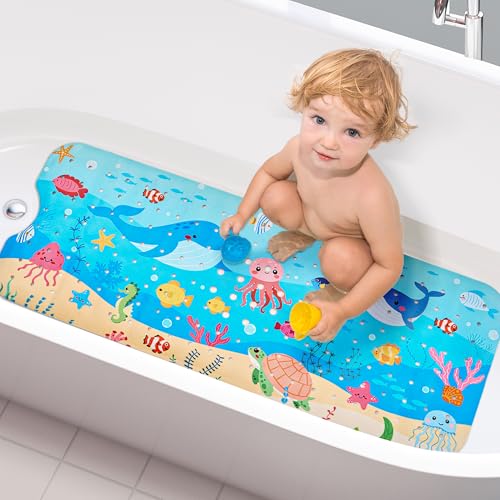
Standard mats stop at 35 inches, and in a long tub that leaves a slick tail of uncovered floor at the far end — precisely where a child migrates during a bath, or where an adult stands to use a handheld shower. This Vannokor mat runs a full 40 inches, covering the working length of a standard tub end to end. The whale design aims it at family bathrooms and kids’ baths, and the combination of suction cups and drain holes follows the same proven pattern as the rest of the list: grip below, drainage above, machine washable when bath time leaves it filmed with bubble bath.
Strengths
- 40-inch length covers long tubs end to end
- Suction cups plus drain holes in the proven combination
- Machine washable after bubble-bath duty
Trade-offs
- Whale motif is a family-bathroom look, not a spa look
- At 40 inches it is bulky to hang and store
- Too long for genuinely small tubs — measure first
Length is the whole argument, and for the right tub it is decisive. Bathing two kids at once, bathing a child who treats the tub as a swimming pool, or showering in a long vintage tub all push the user past the end of a standard mat, and the step from mat to bare enamel mid-shower is a classic slip moment. If your tub floor measures close to 40 inches of usable length, this is the mat that removes that step entirely. If your tub is standard, the 35-inch picks above will sit flatter and store easier — buy the length your tub actually has, not the longest mat on the list.
Best for: buyers who want best extra-long coverage coverage in a standard tub / Not suited for: textured or refinished tub floors. Check on Amazon — check price on Amazon.
Comparison Table
| Pick | Badge | Key spec | Best for |
|---|---|---|---|
| GORILLA GRIP Bath Tub Shower Mat | Best Overall | 35 x 16 in, suction cups with drain holes, machine washable | Best Overall |
| Vive Non-Slip Bath Mat with Suction Cups | Best for Seniors and Balance Support | 28 x 16 in, textured rubber surface, patented grip pattern | Best for Seniors and Balance Support |
| GORILLA GRIP Bath Tub Shower Mat | Best Clear Mat That Disappears Visually | 35 x 16 in, clear finish, drain holes, machine washable | Best Clear Mat That Disappears Visually |
| Vive Oval Bathtub Mat (Gray) | Best for Small and Curved Tubs | Oval profile, strong rubber suction cup grip | Best for Small and Curved Tubs |
| UNEEDE Kids Bathtub Mat Non Slip | Best for Toddlers | 30 x 18 in, 100+ suction cups, 50+ drainage holes, soft rubber | Best for Toddlers |
| Vannokor Baby Bath Mat for Tub | Best Extra-Long Coverage | 40 x 16 in, drain holes and suction cups, machine washable | Best Extra-Long Coverage |
How to Choose a Bath Tub Mat That Actually Prevents Slips
Start with your tub surface, not the mat. Suction cups need a smooth, non-porous floor: glazed enamel, standard acrylic, and fiberglass all work. Textured anti-slip tub floors, refinished or reglazed tubs, and tiled shower floors defeat suction almost completely — on those surfaces no mat in this guide will hold, and the honest solution is adhesive anti-slip treads or a refinishing decision, not a stronger mat. Run your palm over the tub floor; if it feels grainy, stop shopping for suction mats.
Measure the floor, not the tub. Catalog tub sizes describe the rim. The mat has to fit the flat floor between the curves, which on a standard 60-inch tub is roughly 40 inches long and 15 to 17 wide — and less on curved or vintage tubs. A mat that rides up the curved end breaks suction at the edge and creates a lip. When in doubt, size down: a fully seated smaller mat out-grips a larger mat with floating corners every time.
Count the ways water escapes. Drain holes are not a cosmetic feature. A mat without them traps a film of soapy water on its own surface and underneath it — on top, that film is a lubricant; underneath, it is a mildew farm. Look for holes distributed across the field of the mat, not just a decorative ring at the edges, and check that the hole pattern aligns roughly with your drain position so water has somewhere to go.
Match the mat to the bather. Standing adults need length through the pivot zone and firm texture. Seated bathers — seniors, anyone bathing with a bench, small children — need softness and coverage where hips and knees land, plus drainage so they are not sitting in trapped water. Toddlers need cups in numbers large enough that an actively wriggling child cannot dislodge the mat. There is no single best mat; there is a best mat per bather, which is why this guide splits its picks by user rather than ranking one design six times.
How to Install and Maintain a Tub Mat So It Keeps Working
Installation takes one minute and determines whether the mat works at all. Clean the tub floor first — soap film is the enemy of suction — then run a shallow layer of water into the tub, lay the mat in position, and press down firmly across its whole surface, working from the center outward, so each cup expels its air and seats. Step on it in dry conditions and shift your weight; a properly seated mat does not creep. Never try to stick a suction mat onto an already flooded, soapy floor mid-shower and expect it to hold.
Maintenance is where most mats succeed or fail over months. After the day’s last bath or shower, peel the mat up and hang it over the tub edge or a rail so both sides dry; a mat left face-down in a damp tub will grow mildew underneath within weeks, whatever the material claims. Rinse it during your weekly bathroom clean, and machine wash it on a gentle cycle when it feels filmed — all six picks here are machine washable for exactly this reason. Inspect the cups monthly: cups that have flattened or torn no longer seal, and a mat with failing cups should be replaced, not trusted.
Common Buying Mistakes
Buying a floor rug for inside the tub. Absorbent bathroom rugs and in-tub safety mats look similar in photos and do opposite jobs. A rug inside a tub absorbs water, floats, and slides. If the listing does not mention suction cups, it does not belong in the tub.
Assuming suction works on any surface. Textured and refinished tubs are the number one cause of ‘this mat doesn’t stick’ disappointment. Check your surface first; it decides the product category, not the brand.
Buying the longest mat regardless of fit. Oversized mats ride up the tub’s curved ends, break their seal, and add a trip edge. Measure the flat floor and fit the mat to it.
Leaving the mat down permanently. A mat that never comes up traps moisture and grows mildew, then gets blamed for it. The lift-and-dry habit is part of the product; buy a machine-washable mat so the habit stays easy.
Treating a mat as the whole safety plan. A mat stops feet from sliding. It does nothing for balance loss, dizziness, or a weak grip on a high tub wall. For seniors and anyone unsteady, pair the mat with a properly anchored grab bar and treat the two as one system.
Final Recommendation
For most households the GORILLA GRIP Stronger Hold 35×16 is the default buy: full working-zone coverage, the strongest grip in this guide, and a cleaning routine you will actually keep. If the bather is a senior or anyone whose confidence in the tub is the real problem, choose the Vive 28×16 for its firmer, higher-feedback surface — and add a grab bar. Design-led bathrooms should take the clear Gorilla Grip so the mat stays in the tub instead of the closet. Curved and vintage tubs need the Vive Oval, toddlers need the UNEEDE, and long tubs need the 40-inch Vannokor. Whichever you choose, seat it on a clean floor, lift it daily, and wash it when it films over — the mat does the gripping, but the routine keeps it able to, month after month, in the room where a single slip carries the highest cost in the house.
Related guides in this series: Best Bath Mats For Not Slipping · Best Absolutely Non-slip Bathroom Rugs For Elderly · Best Bath Tub Mats For Bath Tub Safety · Best 72 Bathtubs · Best Acrylic Freestanding Bathtubs
What Tub Mats Are Made Of — and Why It Changes How They Grip
Three materials dominate this category, and they behave differently enough that the material choice is a real decision, not a footnote. Natural and synthetic rubber mats — the Vive picks and the UNEEDE toddler mat on this list — are the traditional safety material: dense, heavy enough to stay where they are put, and naturally tacky against both the tub floor and wet skin. Rubber gives the highest-feedback footing, which is why care-market brands build senior mats from it. The costs are a faint rubber smell when new, more weight to lift and hang daily, and a surface that shows its age sooner if it is left soaking in bathwater rather than dried.
PVC and vinyl mats — the Gorilla Grip designs here — are lighter, more flexible, and usually the easiest to machine wash and hang, which is why they dominate the family-bathroom end of the market. Their grip comes from the suction array and the molded surface pattern rather than from the material’s own tackiness, so the quality of the cup design matters more: a cheap PVC mat with sparse, shallow cups is the classic product that slides on day one. The better designs compensate with cup counts in the hundreds and drain holes that keep the contact patch dry. A third group, TPE and foam-cushioned mats, trades some grip for comfort under seated bathers; they suit long soaks but are rarely the best choice when standing balance is the concern. Match material to the bather first — rubber for maximum standing traction and senior confidence, well-designed PVC for family convenience and easy washing, cushioned materials for seated comfort — and brand second.
Safety by Bather: One Tub, Four Different Risk Profiles
Seniors and anyone with balance concerns face the highest-stakes version of the problem, and their mat should be chosen like equipment, not décor. Priorities: the strongest available hold, a firm high-texture surface that tells the feet exactly where they are, and coverage of the entry zone where the step-over happens, because most tub falls occur during entry and exit rather than mid-shower. A mat is only one layer — a fixed grab bar at entry height, a handheld shower that allows seated bathing, and good lighting complete the system. If the bather uses a shower bench, the mat must extend under the bench’s feet and the standing patch in front of it.
Children invert the priorities. Kids sit, kneel, and launch themselves; the risks are bunching (a mat a child can dislodge becomes a toy and then a hazard), trapped water under a seated baby, and hard textures on small skin. Dense cup counts, soft rubber, playful designs that make the mat a fixture rather than an intrusion, and serious drainage are the toddler brief — which is why two of our six picks are child-specific rather than small versions of adult mats.
Adults showering in shared or rental bathrooms need the boring virtues: full coverage of the pivot zone, a mat that seats in seconds on a clean floor, machine washability because shared bathrooms film up faster, and a look that housemates will tolerate leaving in place. The clear Gorilla Grip exists for exactly this politics of the shared bathroom — safety equipment that nobody objects to is safety equipment that stays installed.
Anyone bathing in an old house should measure before assuming the standard sizes apply. Vintage cast-iron tubs are deeper, higher-sided, and more curved than modern alcove tubs, and many have worn enamel that is slicker than any modern surface. The entry step is higher, the floor curves sooner, and the drain often sits where a standard mat’s edge wants to be. Oval and shorter mats, honestly fitted, outperform long rectangles in these tubs — and old-house bathers are, statistically, the people who need the grip most.
The Two-Minute Test: Checking a Mat You Already Own
If a mat is already in your tub, you do not need a laboratory to judge it. Run the shower for a minute so the floor is wet and a little soapy, then stand on the mat and deliberately shift your weight side to side and heel to toe, holding the wall or a bar. A working mat does not creep, skate, or let an edge curl up to meet your toe. Then kneel and try to slide the mat sideways with both hands: cups that release with a firm push will also release under a stumbling adult. Finally, lift a corner and look underneath. Slimy film, pink or black spotting, or cups that have gone flat and glossy mean the mat is at the end of its honest life regardless of how the top looks. This test takes two minutes, costs nothing, and is worth repeating every few months — a mat’s grip declines gradually, and gradual decline is exactly what people fail to notice until the day it matters.
Tub Mat, Adhesive Treads, or a New Anti-Slip Coating? Choosing the Right Fix
A suction mat is the best answer for most tubs, but it is worth knowing the alternatives and the situations where each one wins, because the wrong category choice is behind most disappointing purchases in this space. Adhesive anti-slip treads — textured strips or shapes that bond permanently to the tub floor — are the correct solution for textured and refinished tubs where suction cannot work, and for owners who know they will never lift and dry a mat. Their costs are permanence and hygiene: adhesive edges collect grime, removal can mark the finish, and the coverage is fixed the day you install it. Professional anti-slip coatings and reglazing go further, rebuilding the floor’s texture itself; they make sense during a renovation or when a tub is being refinished anyway, but they are a contractor decision with a contractor price, not a weekend purchase.
The suction mat wins on reversibility, coverage, and comfort. It can be removed for a deep clean of the tub itself — something adhesive solutions never allow — it cushions the floor for seated bathers, and it can move between tubs, which matters in rentals where permanent modification is off the table. Its one non-negotiable condition is the smooth floor. So the decision tree is short: smooth tub floor and a household willing to lift the mat daily, choose a mat from this list; textured or refinished floor, choose adhesive treads; tub already scheduled for refinishing, ask the refinisher about anti-slip texture in the new finish and use a mat in the meantime only if the current surface still takes suction.
One more alternative deserves an honest mention: the shower-only household that never takes baths sometimes asks whether a mat is needed at all in a modern acrylic shower-tub with a factory-textured floor. Factory texture does add grip when it is clean — and quietly loses it as soap film and body oils fill the texture over months. If your textured floor still passes the two-minute test above with genuinely planted footing, a mat is optional; the first time the floor feels uncertain, the texture has filmed over, and the choice becomes a deep clean or a mat on the smooth sections. Judge by the test, not by how the floor looks.
Building the Rest of the Safety System Around the Mat
A mat handles the floor. Falls, however, are whole-body events, and the households that take tub safety seriously treat the mat as the first layer of a small system rather than a complete answer. The second layer is something to hold: a permanently anchored grab bar at the entry wall, positioned where a hand naturally reaches during the step-over — not a suction-cup bar, which shares the smooth-surface limitation of mats and can release under a real load, and not the tub rim or a towel rail, neither of which is built for body weight. The third layer is control of the water itself: a handheld shower head lets an unsteady bather sit on a bench and still bathe fully, which removes most standing time from the equation entirely, and a thermostatic or clearly marked single-lever control removes the lunge-and-adjust moment at the taps.
The fourth layer is what happens outside the tub. The step out, onto a hard floor, with wet feet and possibly lowered blood pressure after a hot soak, is statistically as dangerous as anything inside. An absorbent, rubber-backed bath rug on the floor — the outside-the-tub cousin of everything discussed here — plus a clear path to a seat or a counter to steady against, closes the loop. None of this needs to happen in one purchase. The sensible order is mat first (it is cheap, instant, and reversible), grab bar second (it needs proper anchoring into studs or blocking), then the handheld shower and the floor rug as the bathroom allows. What matters is understanding which layer you are buying when you buy a mat: floor grip, done well — and a prompt to finish the system around the bather who needs it.
Frequently Asked Questions
Do suction-cup tub mats work on textured tub floors?
No — and this is the most important fit question in the category. Suction cups need a smooth, sealed surface to hold vacuum. Textured anti-slip floors, refinished tubs, and tile break the seal. On those surfaces, use adhesive anti-slip treads instead of any mat in this guide.
How often should a tub mat be cleaned?
Lift and hang it to dry after the last bath or shower of the day, rinse it during the weekly bathroom clean, and machine wash it whenever a soap film builds up — typically every few weeks in a busy household. All six picks here are machine washable.
What size mat fits a standard tub?
Most standard 60-inch tubs have about 40 inches of flat floor. A 35×16 mat covers the standing and sitting zone well; a 40×16 mat covers the floor nearly end to end. Measure the flat floor between the curves rather than trusting the tub’s nominal size.
Are tub mats safe for babies and toddlers?
Yes, with the right design: soft rubber, very dense suction cups so the mat cannot bunch, and plenty of drainage holes so the child is not sitting in trapped water. The UNEEDE and Vannokor picks are built to exactly that brief.
Can a tub mat damage the tub finish?
On standard enamel, acrylic, and fiberglass, a clean mat used normally will not damage the finish. Damage stories almost always trace back to grit trapped under a mat that was never lifted — another reason the daily lift-and-rinse habit matters.
When should a tub mat be replaced?
When suction cups flatten, tear, or stop sealing; when the mat creeps during a shower despite being seated on a clean floor; or when mildew staining survives a wash cycle. A safety mat that no longer grips is decoration, and should be treated as expired.
Can I use a tub mat in a shower stall instead?
Only if the stall floor is smooth and the mat fits its flat area without riding up the edges — many stall floors are textured or tiled, which defeats suction, and a square stall usually needs a square mat rather than a long tub rectangle. If your stall floor is textured, adhesive treads are the right product. If it is smooth fiberglass, a mat sized honestly to the flat floor works well; measure before ordering, because a mat folded up a stall wall is a trip hazard, not a safety device.
Why does my new mat slide even though it has suction cups?
Almost always one of three causes: the tub floor had soap film on it when the mat was seated, the mat was pressed down after the floor was already flooded, or the floor is textured or refinished and cannot hold vacuum at all. Clean the floor, seat the mat on a damp-but-not-flooded surface by pressing from the center outward, and test it before stepping in. If it still slides on a clean, smooth floor, the cups themselves are the problem and the mat should go back.