Disclosure: airfryerkitchensupply.com is reader-supported. When you buy through links on our site, we may earn an affiliate commission at no extra cost to you.
Where to buy
Every sink below is a true rectangle undermount — it fixes beneath the counter so the top surface runs uninterrupted to the basin edge — and each model was cross-checked against Amazon’s catalog data before it earned a link. Use the Check on Amazon buttons to confirm the exact model and dimensions in the listing title against your counter cutout and cabinet width. Undermount sinks are unforgiving of wrong sizes: a basin wider than the cabinet interior, or a cutout that does not match the template, cannot be trimmed into fitting.
- KOHLER Caxton Rectangle Undermount Bathroom Sink, White (20000-0) — Check price on Amazon
- TOTO Large Rectangular Undermount Bathroom Sink with CEFIONTECT (LT540G#01) — Check price on Amazon
- KOHLER Ladena Rectangular Undermount Bathroom Sink (2214-0) — Check price on Amazon
- KOHLER Verticyl Rectangular Undermount Bathroom Sink (2882-0) — Check price on Amazon
- 20 Inch Undermount Bathroom Sink, Rectangle, White Ceramic with Overflow — Check price on Amazon
- 16 Inch Undermount Bathroom Sink, Small Rectangle with Overflow — Check price on Amazon
The best rectangle undermount bathroom sinks earn their place in a renovation the moment you wipe the counter. With the basin mounted beneath the stone or quartz, there is no rim to catch toothpaste, no silicone lip to discolour, and nowhere for water to hide — the counter sweeps straight into the bowl. The rectangle shape completes the modern bathroom’s geometry: it matches the vanity’s lines, gives a wider washing zone than an oval of the same footprint, and its flat walls make the basin feel larger than its dimensions. It is the sink format that contemporary bathrooms are designed around, and the one whose buying details are easiest to get wrong.
The details that matter are not the ones in the photographs. Interior bowl size versus exterior flange size decides whether the sink fits your cabinet. The overflow decides whether a forgotten tap floods the floor or drains safely. The glaze decides whether the basin still looks clean in year five. And the maker’s name decides whether a replacement, a matching second sink, or a warranty conversation exists in year ten. This guide sorts six verified rectangle undermounts by exactly those criteria: two from Kohler’s long-running lines, a Toto with its specialist glaze, a modern squared design, and two value sizes — including a compact for small vanities — all confirmed against the manufacturers’ catalog data.
One warning before the picks: an undermount sink is a system with its countertop. It needs a solid-surface top — stone, quartz or solid composite — with a finished cutout; it does not mount under laminate with a raw particleboard core, and it should be installed with the counter, not as an afterthought beneath one. Buy the sink and the top as one decision, and the rest of this guide is about choosing well inside it.
Finally, a note on what this guide is not: it is not a list of the most photographed sinks on the internet. Every pick is a current, orderable basin whose dimensions were confirmed in the manufacturer’s own catalog data during this batch’s verification — because a sink, more than most purchases, is a commitment measured in decades, and decades should not be founded on a lifestyle photograph.
In this guide
Quick Picks
KOHLER Caxton Rectangle Undermount Bathroom Sink, White (20000-0) — Best Overall: The default rectangle undermount: Kohler’s Caxton at the standard 20-inch size, with an overflow and the deepest support network in the category. Check price on Amazon
TOTO Large Rectangular Undermount Bathroom Sink with CEFIONTECT (LT540G#01) — Best Glaze: The Toto upgrade: a slightly larger rectangle with CEFIONTECT, the specialist glaze engineered to keep waste and grime from bonding to the surface. Check price on Amazon
KOHLER Ladena Rectangular Undermount Bathroom Sink (2214-0) — Best Curved Bottom: The Ladena softens the rectangle: a curved bowl bottom that drains eagerly and feels less boxy, in a 20-7/8 inch Kohler vitreous china body. Check price on Amazon
KOHLER Verticyl Rectangular Undermount Bathroom Sink (2882-0) — Best Modern Design: The designer’s rectangle: Verticyl’s crisp, squared geometry for contemporary vanities — the sink that looks like the render. Check price on Amazon
20 Inch Undermount Bathroom Sink, Rectangle, White Ceramic with Overflow — Best Value: The honest value route: a full-size 20-inch ceramic rectangle with overflow at the accessible end of the market — the rental and budget-renovation pick. Check price on Amazon
16 Inch Undermount Bathroom Sink, Small Rectangle with Overflow — Best for Small Vanities: The compact answer: a true rectangle undermount at 16-inch class for narrow vanities and cloakrooms where the standard 20-inch basin cannot go. Check price on Amazon
How These Picks Were Chosen
We shortlisted only genuine rectangle undermount basins — no vessels, no drop-ins wearing undermount language — and verified each model against Amazon’s catalog data, so the dimensions and model numbers in this guide are the ones on the listing you will open. That verification matters more in sinks than in almost any category, because basins are sold in families of near-identical sizes and a two-inch difference hides inside the same product photograph.
Within the list we weighted bowl geometry first: a rectangle undermount lives or dies by its interior — flat floor for standing bottles and razors, wall slope that sheds water to the drain, corners tight enough to look modern but radiused enough to clean. Overflow presence was the second filter; every pick here includes one, because a bathroom basin without an overflow is a flood with a timer. Third came glaze and maker support: vitreous china from Kohler and Toto carries decades of parts and consistency behind it, while the value picks were admitted only where their verified specifications — ceramic construction, overflow, standard dimensions — matched the job honestly.
We excluded oval undermounts (a different guide), integrated tops, and any rectangle basin whose listing could not confirm its mounting type. What remains is a list a renovator can order from with a tape measure and a clear conscience.
The 6 Best Rectangle Undermount Bathroom Sinks

KOHLER Caxton Rectangle Undermount Bathroom Sink, White (20000-0) — Best Overall
The Caxton is the rectangle undermount that bathroom designers specify when nobody wants to think about sinks — and that is a compliment earned over years of unremarkable, perfect service. At 20-1/4 by 15-11/16 inches it is the standard footprint for a single vanity, its vitreous china body carries Kohler’s consistent glaze, and the overflow is built in, as it should be. The bowl geometry is the sensible middle of the rectangle world: flat enough to stand a bottle, sloped enough to drain cleanly, with corners that read modern without becoming dirt traps.
It suits the majority of renovations — single vanities in family bathrooms, pairs in doubles, guest bathrooms that need to look designed rather than assembled. The unglamorous superpower is the name: Caxton parts, Caxton consistency between a pair, and a model number (20000-0) that any plumber or supplier recognises instantly. Choose the colour deliberately — the same model exists in other finishes in the range, and a double vanity wants two sinks from the same production family, ordered together.
Strengths
- Standard size fits the widest range of vanities and cutouts
- Vitreous china with a consistent, durable glaze
- Overflow included; model recognised by every plumber
Trade-offs
- Conservative styling — modernists may prefer the Verticyl
- White shows every dye and toothpaste mark until wiped
- Countertop and installation costs sit on top of the basin price
| Detail | What to know |
|---|---|
| Dimensions | 20-1/4 L x 15-11/16 W inches |
| Model | KOHLER 20000-0 Caxton |
| Drain | Overflow drain included, per the verified listing title |
Buy the Caxton when the sink is not the room’s statement — which is most bathrooms, most of the time. It disappears into the counter, cleans without technique, and will still be orderable when a tap needs replacing in a decade. Renovators doing two bathrooms should note the quiet economy here: the same sink in both rooms means one set of spares, one cleaning routine, and a house that feels designed by one hand.
Best for: Most single and double vanities, mainstream renovations / Not suited for: Design-led bathrooms wanting a sharper silhouette

TOTO Large Rectangular Undermount Bathroom Sink with CEFIONTECT (LT540G#01) — Best Glaze
Toto’s argument is a surface. CEFIONTECT is the maker’s specialist glaze — an exceptionally smooth ceramic finish designed so that waste, toothpaste and mineral film have less to grip, which in daily terms means the basin rinses cleaner and stays visibly cleaner between proper cleans. On a white undermount in a family bathroom, that is not marketing garnish; it is the difference between a sink that looks new at year five and one that carries a permanent tide mark. At 21-1/4 by 14-3/8 inches the LT540G is also a touch larger than the standard footprint, which suits generous single vanities and primary bathrooms.
It suits buyers who keep a bathroom to a high standard and would rather the materials help, households in hard-water areas where film builds fastest, and anyone pairing the sink with a Toto toilet for a matched suite. The cautions are care-based: specialist glazes ask for non-abrasive cleaning — the soft cloth and ordinary cleaner routine — because scouring pads damage the very smoothness you paid for. Treat it as the listing intends and it repays the discipline weekly.
Strengths
- CEFIONTECT glaze resists grime bonding and rinses cleaner
- Slightly larger basin suits primary bathrooms
- Toto build consistency for matched-suite renovations
Trade-offs
- Premium position within this category
- Glaze needs non-abrasive cleaning to stay at its best
- Check cabinet clearance — the larger footprint is not universal
| Detail | What to know |
|---|---|
| Dimensions | 21-1/4 x 14-3/8 inches |
| Model | TOTO LT540G#01 |
| Glaze | CEFIONTECT, Cotton White, per the verified listing title |
Between this and the Caxton, the decision is philosophical: the Kohler is the category’s dependable standard, the Toto is the same idea with a better surface and a slightly bigger bowl. Bathrooms that get heavy daily use — family mornings, teenage cosmetics, hard water — tilt Toto. Bathrooms bought on a tighter budget with a pair to purchase tilt Caxton, twice. Neither answer is wrong, and this guide’s badges exist to make that fork in the road a deliberate one.
Best for: Primary bathrooms, hard-water homes, high cleaning standards / Not suited for: Abrasive-cleaner households or tight budgets buying pairs
KOHLER Ladena Rectangular Undermount Bathroom Sink (2214-0) — Best Curved Bottom
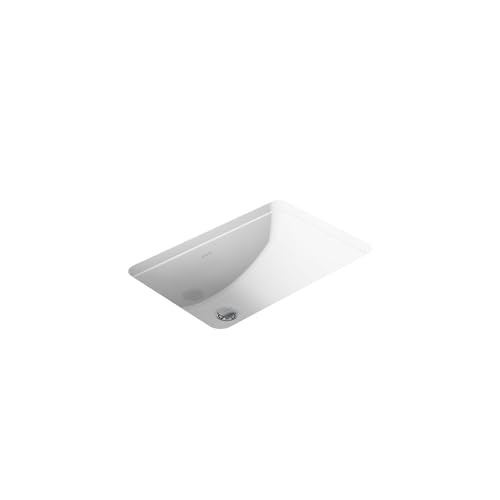
Not everyone wants the full architectural rectangle, and the Ladena is Kohler’s answer for them: a rectangular footprint and undermount cleanliness, but with a curved bottom that changes the basin’s character. The curve sheds water to the drain with real enthusiasm — no flat-floor puddling at the edges — and it softens the look for bathrooms that mix modern fixtures with traditional bones. At 20-7/8 by 14-3/8 it sits in the same standard territory as the Caxton, with the same vitreous china dependability behind it.
It suits transitional bathrooms, renovators who found pure rectangles stark in the showroom, and anyone whose cleaning routine is a rinse rather than a scrub — a curved bowl has no corners to detail. What it gives up is the flat floor: bottles and razors stand less happily than in the Caxton, and the modernists will call its softness indecision. Both camps are right about their own bathrooms. The Ladena is for the ones who want the undermount hygiene without the geometric sermon.
Strengths
- Curved bottom drains fully — no corner puddles
- Softer look suits transitional and traditional-modern mixes
- Kohler vitreous china and model support
Trade-offs
- No flat floor for standing bottles in the basin
- Less architectural than squared rivals
- Standard size still needs cutout verification
| Detail | What to know |
|---|---|
| Dimensions | 20-7/8 W x 14-3/8 L inches |
| Model | KOHLER 2214-0 Ladena |
| Design | Curved bottom, per the verified listing title |
The Ladena also comes in a larger sibling size in the same line, which makes it a flexible family for houses with two different vanity widths. Choose it when the bathroom’s other shapes — an arched mirror, a traditional tap — ask the sink to meet them halfway. It is the rectangle undermount for people who like the idea and flinch at the execution, and there are more of those bathrooms than design magazines admit.
Best for: Transitional bathrooms and rinse-clean routines / Not suited for: Purist modern schemes or in-basin storage habits

KOHLER Verticyl Rectangular Undermount Bathroom Sink (2882-0) — Best Modern Design
The Verticyl is the rectangle undermount as architects draw it: straight walls, tight geometry, a basin that reads as a deliberate void cut into the counter. At 19-3/4 inches it is fractionally more compact than the Caxton, which helps it into modern vanities whose drawers crowd the bowl space, and its squared profile pairs with the angular taps and slab-front cabinetry of a contemporary scheme in a way the softer basins cannot. This is the sink for the bathroom that has a mood board.
It suits design-led renovations, powder rooms that function as small statements, and double vanities in a strict modern idiom. The honest trade is cleaning geometry: squared interior corners ask for a brush’s attention where a curved bowl asks for a rinse, and the Verticyl owner accepts that as the price of the line. Kohler’s vitreous china and the model’s long production run keep the practical side respectable — this is a design pick with a dependable spine, not a fragile boutique piece.
Strengths
- Sharpest contemporary geometry in the category
- Slightly compact footprint helps drawer-crowded vanities
- Kohler construction behind the design
Trade-offs
- Squared corners need a brush, not just a rinse
- Design premium over the Caxton
- Less forgiving of traditional taps and mirrors
| Detail | What to know |
|---|---|
| Size | 19-3/4 inch rectangular undermount |
| Model | KOHLER 2882-0 Verticyl |
| Material | Vitreous china, White |
Buy the Verticyl as part of a scheme, not as an isolated upgrade: its lines want the angular tap, the slab drawer fronts and the frameless mirror to complete the sentence. In that company it is the most convincing sink in this guide. Dropped into a traditional bathroom as a lone modern gesture, it argues with everything around it — and even a very good sink loses an argument with an entire room.
Best for: Contemporary and design-led bathrooms / Not suited for: Traditional schemes or rinse-only cleaners

20 Inch Undermount Bathroom Sink, Rectangle, White Ceramic with Overflow — Best Value
Not every bathroom justifies a branded basin, and this 20-inch ceramic rectangle is the pick for the ones that do not: rentals being brought up to standard, budget renovations, second bathrooms and house flips where the money belongs in the countertop and the taps. Its verified specification covers the essentials without apology — rectangular ceramic basin at 19.7 by 15.7 inches, undermount fitting, overflow included — which is the complete functional brief of the category at a value position.
It suits landlords, flippers and renovators whose bathrooms are competent rather than precious. What the value tier asks in return is verification on delivery: check the glaze for pinholes, the rim for flatness — an undermount rim must sit flush against the counter’s underside — and the overflow’s casting, and use the returns window without sentiment if any of them fail. A good unit of this model is indistinguishable in daily use from basins costing far more; the discipline is in refusing a bad one.
Strengths
- Full standard size with overflow at a value position
- Ceramic construction, straightforward specification
- Ideal for rentals, flips and second bathrooms
Trade-offs
- Inspect glaze and rim flatness on delivery
- Maker support network is thinner than Kohler or Toto
- Finish consistency varies more between units
| Detail | What to know |
|---|---|
| Dimensions | 19.7 x 15.7 inches (20-inch class) |
| Material | White ceramic |
| Drain | Overflow included, per the verified listing title |
The value logic is strongest in pairs and multiples: a flipper fitting three bathrooms saves meaningfully here without giving the future owners anything to complain about, provided each unit passes inspection. Buy it with the inspection mindset and it is the sharpest purchase in this guide; buy it casually for a forever bathroom and the branded picks above are the wiser money.
Best for: Rentals, flips, budget and multi-bathroom projects / Not suited for: Forever-home primary bathrooms

16 Inch Undermount Bathroom Sink, Small Rectangle with Overflow — Best for Small Vanities
Small vanities are where rectangle undermounts usually surrender — the standard basins simply do not fit a 24-inch or narrow-depth vanity — and this 16-inch class model exists so they do not have to. At 15.70 by 11.69 inches it keeps the format’s whole argument in miniature: undermount hygiene, rectangular geometry, an overflow for safety, in a white ceramic body that fits the cabinets cloakrooms and compact en-suites actually contain.
It suits narrow vanities, cloakrooms, small en-suites and any refit where the cabinet interior — not the counter — is the binding constraint. Accept the physics with open eyes: this is a hand-washing and teeth-brushing basin, not a face-immersing one, and its splash zone needs a tap with a modest flow and the right reach so water lands in the bowl rather than on the counter. Paired correctly, it gives a tiny bathroom the finished, rimless look that usually belongs to big ones, which is a disproportionate upgrade for the smallest room in the house.
Strengths
- True undermount rectangle at a genuinely compact size
- Overflow included even at this scale
- White ceramic matches standard fittings and taps
Trade-offs
- Hand-washing scale — no face washing heroics
- Tap reach and flow must be matched carefully
- Check cabinet interior width before ordering
| Detail | What to know |
|---|---|
| Dimensions | 15.70 x 11.69 inches (16-inch class) |
| Material | White ceramic |
| Drain | Overflow included, per the verified listing title |
Compact basins live or die on the tap pairing, so treat the two as one purchase: a short-reach, moderate-flow tap aimed at the drain. Get that right and this little sink performs with a neatness that surprises everyone who uses the cloakroom. It closes this guide as proof of the format’s range — from the Toto’s primary-bathroom presence to a 16-inch basin under a cloakroom counter, the rectangle undermount scales.
Best for: Narrow vanities, cloakrooms and compact en-suites / Not suited for: Main family bathrooms
Comparison Table
| Pick | Badge | Key spec | Best for |
|---|---|---|---|
| KOHLER Caxton Rectangle Undermount Bathroom Sink, White (20000-0) | {p[“badge”]} | {p[“keyspec”]} | {p[“bestfor”]} |
| TOTO Large Rectangular Undermount Bathroom Sink with CEFIONTECT (LT540G#01) | {p[“badge”]} | {p[“keyspec”]} | {p[“bestfor”]} |
| KOHLER Ladena Rectangular Undermount Bathroom Sink (2214-0) | {p[“badge”]} | {p[“keyspec”]} | {p[“bestfor”]} |
| KOHLER Verticyl Rectangular Undermount Bathroom Sink (2882-0) | {p[“badge”]} | {p[“keyspec”]} | {p[“bestfor”]} |
| 20 Inch Undermount Bathroom Sink, Rectangle, White Ceramic with Overflow | {p[“badge”]} | {p[“keyspec”]} | {p[“bestfor”]} |
| 16 Inch Undermount Bathroom Sink, Small Rectangle with Overflow | {p[“badge”]} | {p[“keyspec”]} | {p[“bestfor”]} |
How to Choose a Rectangle Undermount Bathroom Sink
Start inside the cabinet, not on the counter. An undermount basin hangs below the top, so its exterior — flange included — must clear the cabinet’s interior width and any drawer boxes, with room for the mounting clips. Measure the cabinet’s inside width, subtract clearance, and only then shop exterior dimensions. Next, separate the two sizes every listing mixes: exterior size decides fit, interior bowl size decides use. A basin can share an exterior with a rival and offer a noticeably smaller bowl if its walls are thick or its slopes are lazy; for a family basin, interior width in the mid-teens of inches is where comfort begins.
Then confirm the non-negotiables. Overflow: present, always — it is the difference between a forgotten tap and a flooded floor. Counter compatibility: undermounts need stone, quartz or solid-surface tops with a polished cutout edge, because the cut edge is visible and touched daily; laminate over particleboard is not a suitable partner. Faucet position: deck-mounted taps need counter depth behind the basin, wall-mounted taps need their spout reach matched to the bowl, and in both cases the water should land near the drain, not on the back wall of the basin where it splashes.
Finally, buy the pair together for a double vanity — same model, same order — because glaze is a batch product and two sinks bought months apart can differ by a shade only visible once both are under the same light. That single habit prevents the most quietly maddening outcome in bathroom renovation.
Undermount Installation: What the Sink Asks of the Counter and Cabinet
An undermount sink is installed as a sandwich: the basin’s rim is sealed and clipped or bonded to the underside of the counter, the counter sits on the cabinet, and the plumbing connects through the cabinet’s back or floor. Each layer imposes a requirement. The counter’s cutout must match the basin’s template — every pick here is a standard enough size that fabricators know it, but the template, not the headline dimension, is what gets cut, so the sink or its exact template should reach the fabricator before the stone is cut, never after. The cabinet must carry the combined load and still house its drawers: deep U-shaped top drawers exist precisely to wrap around a basin and its trap, and a vanity whose top drawer is full-depth is a vanity whose sink choice is already constrained.
The seal is the maintenance story. A continuous bead of quality sanitary silicone between rim and counter is what keeps the undermount joint from becoming a hidden damp trap; done properly it lasts for years and is invisible, done badly it is the one place this otherwise hygienic format can harbour grime. Professional installation is worth its fee for most renovators — not because the task is mysterious, but because the stone, the seal and the alignment must all be right on the same afternoon, and only one of them can be redone cheaply.
The True Cost of an Undermount Sink
Budget for the system, not the basin. The sink itself is often the smallest line in its own installation: the counter with its polished cutout, the fabricator’s templating, the tap and waste set, and the mounting labour all ride along. That arithmetic explains the value pick’s real territory — a rental or flip where the counter is already budgeted and the basin just needs to be competent — and it explains why the branded basins justify themselves in forever bathrooms: when the surrounding work costs what it costs, saving a little on the one component you touch twice a day for a decade is the renovation’s falsest economy. Decide the tier by how long the bathroom must serve, and the sink choice makes itself.
Rectangle vs Oval Undermounts: An Honest Comparison
The oval undermount is the rectangle’s only real rival, and it keeps two genuine advantages: its curved bowl has no corners to clean, and its shape forgives a slightly misjudged tap position by guiding water home. The rectangle counters with a larger usable floor in the same footprint — bottles stand, razors rest, a basin of water for a proper shave behaves — plus the geometric agreement with modern vanities, slab counters and angular taps that most current renovations are built on. In a double vanity, rectangles also sit more comfortably side by side within standard widths.
The deciding question is the bathroom’s own language. If the room speaks in curves — arched mirrors, rounded taps, traditional cabinetry — the oval, or the curved-bottom Ladena in this guide, speaks it back. If the room is built from straight lines, the rectangle is not a fashion choice but a grammatical one. Either way, the undermount hygiene both formats share matters more than the shape dispute, which is why this guide spends its length on fit, overflow and glaze rather than on shape evangelism.
Vitreous China, Fireclay and Ceramic: Sink Materials Decoded
Most undermount basins in this guide are vitreous china — a ceramic body fired with a glass-like glaze until the two are effectively one material — and it dominates the category for good reasons: it is hard, non-porous at the surface, colourfast, and tolerant of every ordinary bathroom chemical. When a value listing says simply ‘ceramic’, it is usually describing the same family with less precision about the firing and glaze, which is why this guide’s value pick carries an inspection-on-delivery instruction rather than a materials warning: a well-made ceramic basin and a vitreous china one are cousins, and the difference shows in consistency between units more than in any single unit’s first year.
Fireclay — fired at higher temperatures, thicker, the farmhouse-sink material — appears in bathroom undermounts occasionally and buys a denser body at a heavier weight and price; stainless steel and stone-resin basins exist at the design edges and trade the china virtues for their own. For the mainstream renovation the china family is the answer, and the meaningful choice inside it is not the body but the glaze: standard glazes from the major makers are excellent, specialist glazes like Toto’s CEFIONTECT are measurably slicker against grime, and unbranded glazes are a lottery the delivery inspection exists to settle. Buy the body once; live with the glaze daily.
Matching Taps, Wastes and Accessories to an Undermount Basin
An undermount basin is bought alone and used as a set, and the set’s harmony is decided by three companions. The tap first: its reach must land water near the drain, its height must clear the basin’s splash pattern, and if it is deck-mounted, the counter behind the basin must have the depth to host it — a dimension narrow vanities sometimes steal for drawers. The waste second: the basin’s drain hole is standard, but the waste’s finish should match the tap’s, and if the basin has an overflow, the waste must be a slotted type that lets the overflow channel drain — an unslotted waste in an overflow basin quietly disables the safety feature you bought.
Third, the bottle trap beneath: in an open or floating vanity the trap is visible furniture and deserves the finished, matching version; inside a closed cabinet it merely needs to fit around the drawers. None of this is exotic, but all of it is cheaper decided on one order than discovered across three deliveries — which is the same lesson the sink itself teaches, applied one level down.
Double Vanities: Fitting Two Rectangle Undermounts Well
A double vanity multiplies every decision in this guide by two and adds one of its own: spacing. Two standard basins need a vanity wide enough that two adults can stand at them simultaneously without a hip-check ballet — in practice that means the generous widths, and it means checking the centre-to-centre distance the counter fabricator will cut, because sinks placed at the vanity’s outer thirds feel luxurious while sinks crowded toward the middle feel like a compromise wearing a premium costume. The cabinet beneath must also repeat its trick twice: two basins, two traps, and drawer boxes that dodge both, which is why double vanities so often use false top drawers with real storage below.
Buy the pair in one order, as the choosing section insists, and extend the same discipline to the taps and wastes: two of everything, from the same ranges, fitted by the same hands on the same day. A double vanity is a symmetry machine, and every small asymmetry — a shade of glaze, a degree of tap lean — is visible at a glance across a shared mirror. Get it right and the double undermount setup is the most satisfying format in this entire category; the guide’s Caxton and Toto picks are its natural citizens.
How to Measure for a Rectangle Undermount Sink
Five measurements, in order. One: cabinet interior width and depth, taken inside the box at the height where the basin will hang — this caps the sink’s exterior, flange included. Two: counter run and depth, and the distance from the counter’s front edge to where the basin’s centre should sit, which is usually aligned with the mirror and the user’s standing position, not simply the cabinet’s middle. Three: the tap arrangement — deck or wall — and its reach, checked against the intended bowl so the stream lands near the drain. Four: the plumbing — waste position from the back wall and from the floor, and the supplies — because the trap must meet the basin’s drain without fighting drawer boxes. Five: for a double, the centre-to-centre distance between the two basins, checked against elbow room: two sinks squeezed at minimum spacing serve two people worse than one generous sink serves one.
Write the numbers on the listing before you order — literally, side by side — and if any pair disagrees, believe the tape, not the photograph. Sinks are heavy, fragile freight; the cost of a wrong one is measured in weeks, not just money. Measured properly, an undermount arrives, the fabricator cuts to its template, and the whole question closes in a day.
Keep the worksheet. Tape your five measurements to the listing printout and keep both with the house paperwork: the next owner, the next plumber and the you of ten years who needs a matching waste or a second basin will all be grateful. Bathroom renovations scatter their documentation like no other project, and the undermount — hidden by design — is the component whose model number is hardest to recover once the counter is on. The Caxton and Toto model numbers in this guide are printed in their review headings for exactly that reason; copy yours into the worksheet before the silicone sets.
Common Buying Mistakes
Shopping by exterior size alone. The flange must fit the cabinet and the bowl must fit your life. Two different measurements, both required, neither a substitute for the other.
Cutting the counter before the sink arrives. Fabricators cut to the template of the actual unit. A basin swapped after cutting is a basin that may not match the hole.
Mounting under laminate. Undermounts need stone, quartz or solid surface with a finished cut edge. A raw-core laminate cutout swells, stains and fails.
Skipping the overflow. It is a small casting detail that prevents the category’s only catastrophic accident. Every pick here has one; keep it that way in your own shortlist.
Pairing a wall tap with the wrong reach. A spout that lands water on the basin’s back wall splashes every single use. Match reach to bowl before either is fixed.
Buying double-vanity sinks in separate orders. Glaze varies by batch. A matched pair is one order, one delivery, one less shade difference to stare at for a decade.
Losing the model number. Once installed, an undermount shows no badge. Record the model and keep the template with the house documents — future you, ordering a matching second basin, will be spared a forensic exercise.
Final Recommendation
The centre of this category is strong, so start there: the KOHLER Caxton is the best rectangle undermount bathroom sink for most renovations — standard size, dependable glaze, universal support. Step up to the TOTO LT540G when surface science and a larger bowl justify the premium, choose the Ladena when the room wants its rectangle softened, and the Verticyl when the design is unapologetically modern. Budget and multi-bathroom projects are honestly served by the 20-inch value ceramic, and small vanities finally get their own answer in the 16-inch compact.
Measure the cabinet interior before anything else, confirm the model and dimensions on the listing, and check the current price on Amazon from the review above. An undermount sink is bought once per renovation and used twice a day for a decade — the hour with the tape measure is the best-spent hour in the whole bathroom.
And one last reassurance for renovators hesitating at the format itself: the undermount’s reputation for fussiness belongs to its installation week, not its ownership decade. Once sealed beneath a proper counter, these basins ask for nothing but the cleaning you would give any sink — less, in fact, than the rimmed kind — and they return a cleaner counter, an easier wipe-down and a calmer, more deliberate room every single day of that decade — which is, in the end, the entire reason the format exists and the reason it keeps winning renovations.
Related guides in this programme: Best Undermount Bathroom Sinks · Best Bathroom Sinks · Best Premade Bathroom Vanities · Best Vessel Bathroom Sinks
Frequently Asked Questions
Are rectangle undermount sinks hard to clean?
Easier than the drop-in they usually replace: there is no rim or lip above the counter, so the whole surface wipes straight into the bowl. The rectangle’s interior corners ask for a brush occasionally where an oval would need only a rinse — a fair trade for the larger flat floor. The one joint that matters is the sealed seam beneath the counter; installed properly, it stays clean and invisible for years.
What countertop can an undermount sink be fitted to?
Stone, quartz and solid-surface counters with a finished, polished cutout edge. The cut edge is exposed — you see and touch it daily — and the material must tolerate water at the joint indefinitely. Laminate over a particleboard core is not suitable: the exposed core swells and fails. If your renovation uses laminate, choose a drop-in or integrated top instead and keep the undermount for the next counter.
What size undermount sink fits a 36-inch vanity?
Work from the cabinet interior, not the vanity’s headline width: the basin’s exterior, including its flange, must clear the inside of the box with room for clips. In practice a 36-inch vanity typically accepts basins in the standard 20-inch class covered in this guide, while narrow or drawer-heavy cabinets may need the compact class. Measure the interior, compare it with the listing’s exterior dimensions, and let that arithmetic — not the vanity’s marketing width — decide.
Do I need an overflow in a bathroom sink?
Yes. The overflow is the channel that carries water away when the basin fills with the plug in or the drain blocked — the forgotten-tap scenario that happens in every household eventually. It costs nothing in daily use and prevents the one genuinely expensive accident a sink can cause. Every pick in this guide includes one, and any basin you consider outside this list should be held to the same standard.
Can I install an undermount sink myself?
A confident DIY renovator with the counter already cut to the template can: the basin is sealed and clipped to the counter’s underside, then plumbed as usual. The unforgiving parts are the stone cutting — which belongs to the fabricator — and the seal, which must be continuous and correct the first time. Most owners sensibly have the fabricator or plumber mount the basin during counter installation, and this guide recommends that unless your skills are proven.
Why are Kohler and Toto sinks more expensive than value brands?
You are paying for glaze consistency across a pair, tight dimensional tolerances that make fabricators’ lives easier, and a support network — parts, matching models, warranty — that exists in ten years’ time. A value ceramic that passes a careful delivery inspection performs the same daily function, which is why this guide includes one honestly. The premium is insurance and consistency, not a different category of washing.
Does an undermount sink reduce usable bowl space?
The basin hangs below the counter, so the bowl itself is the same size as its dimensions say — what changes is the cabinet: the basin and its trap occupy the top of the vanity, which is why undermount vanities use U-shaped top drawers or a false drawer front at the top. Plan storage around that reality and nothing is lost that a drop-in would not also have taken; the plumbing lives in the same space either way.