Disclosure: airfryerkitchensupply.com is reader-supported. When you buy through links on our site, we may earn an affiliate commission at no extra cost to you.
Where to buy
Every slipper below was confirmed against Amazon’s catalog data before inclusion, and each link points to the exact model reviewed. Slipper sizing varies by brand, and support slippers often come in specific sizes and widths — check the listing’s size guidance rather than assuming your shoe size transfers directly.
- Vionic Men’s Gustavo Slipper, Charcoal Grey Suede — Check the current price on Amazon
- Orthofeet Asheville Orthopedic Men’s House Slippers — Check the current price on Amazon
- KuaiLu Men’s Slippers Arch Support Suede Plush Clogs — Check the current price on Amazon
- ONCAI Men’s Slippers Arch Support House Shoes — Check the current price on Amazon
- Men’s Orthopedic Slippers with Arch Support, Fuzzy Wool-Like Lining Loafers — Check the current price on Amazon
- VALSOLE Orthopedic Slippers, Arch Support House Shoes — Check the current price on Amazon
The best arch support slippers mens ranges exist because of a simple arithmetic most men never do: the hours. A man who works from home, or who simply changes into slippers at the door, can spend more waking hours in slippers than in shoes — on hard kitchen tile, hardwood, and concrete — in a flat foam sock of a slipper that gives his feet nothing to stand on. Ordinary house slippers are built as softness delivery devices: plush in, plush out, a sole that compresses to paper within a season. Support slippers are built on a different premise — that a slipper is footwear, and footwear should have a shaped footbed: a defined arch contour, a heel cup that keeps the foot seated, and an outsole with enough structure that the support you feel in week one is still there in month six. This guide compared the men’s support-slipper market on exactly those terms: footbed design first, materials and warmth second, and the fit details — widths, adjustability, indoor-outdoor soles — that decide whether a man actually wears the things.
A note on language, because this category’s marketing needs translating. These are comfort products. A well-shaped footbed can make long hours on hard floors noticeably more comfortable, and men with tired, aching feet at day’s end are the audience — but no slipper diagnoses or treats a medical condition, and this guide makes no such claim for any pick. What it does claim, and what the reviews below argue pick by pick, is that support geometry is real, that it differs measurably between a contoured orthotic-style footbed and a flat foam pad, and that the difference is worth paying for in proportion to the hours your feet spend in slippers. Six models earned a place: two from the established orthopedic-footwear names, and four value-tier contenders that bring genuine arch contouring to friendlier prices.
In this guide
Quick Picks
- Best Overall: Vionic Men’s Gustavo — a suede mule on Vionic’s orthotic-style contoured footbed, the support benchmark of the category. Check price on Amazon
- Best Orthopedic Fit: Orthofeet Asheville — adjustable, wide-friendly, hands-free slip-on design from a dedicated orthopedic footwear maker. Check price on Amazon
- Best Warm Clog: KuaiLu Men’s Arch Support Slippers — suede clog with plush fluff lining over a supportive footbed. Check price on Amazon
- Best Cozy Memory Foam Plus Support: ONCAI Men’s Arch Support Slippers — winter-warm house shoes pairing memory foam cushioning with an arch-support design. Check price on Amazon
- Best Warm Loafer Style: Men’s Orthopedic Slippers, Wool-Like Lining — a fuzzy-lined loafer silhouette with an orthotic-style arch design. Check price on Amazon
- Best Value for Heavier Men: VALSOLE Orthopedic Slippers — arch-support house shoes built with heavier wearers and all-day standing in mind. Check price on Amazon
How These Picks Were Chosen
All six slippers were verified against Amazon’s catalog, so model names and configurations come from the listings themselves. Selection then applied the support test in a strict order. Footbed geometry came first and was non-negotiable: a pick had to offer a genuinely contoured footbed — visible arch rise, heel cupping, a shaped rather than flat profile — because a flat memory-foam pad with the words “arch support” printed on the box is the category’s most common fiction, and several popular models were excluded for exactly that reason. Sole structure came second: the outsole must be firm enough to preserve the footbed’s shape under load and durable enough for the door-to-mailbox trips slippers actually make.
Fit came third, in the dimensions men’s feet actually vary: width availability, adjustability for high insteps and end-of-day swelling, and sizing honesty, since support only works when the arch of the footbed lands under the arch of the foot — a half-size error moves the contour to the wrong postcode. Warmth and materials were weighed as the fourth axis, split by season and house: suede and plush for winter houses, lighter constructions where slippers are worn year-round. Finally, every pick was framed as what it is — a comfort product. Men whose foot pain is persistent, worsening, or one-sided need a clinician, not a buying guide, and this guide’s job is the honest one before that line: matching supportive, well-built slippers to the men whose feet are simply tired of standing on nothing.
The 6 Best Arch Support Slippers for Men

Vionic Men’s Gustavo Slipper, Charcoal Grey Suede — Best Overall
The Gustavo is what the category looks like when a genuine orthotic-footwear brand builds a house slipper. Vionic’s whole identity is the contoured footbed — a shaped insole with a defined arch and deep heel cup, developed from podiatrist-designed orthotic geometry — and the Gustavo wraps it in a suede mule upper handsome enough that it reads as a loafer rather than a medical device. The slip-on mule form is the right call for a support slipper: nothing to tie, nothing to crush at the heel, and the footbed does the holding. In charcoal suede it is also the pick a man can answer the door in without the small embarrassment lesser slippers carry.
Strengths
- The benchmark contoured footbed: real arch rise and heel cupping from a brand whose reputation is built on exactly this.
- Suede upper with a loafer’s silhouette — support that does not look like equipment.
- Structured outsole preserves the footbed’s geometry and handles outdoor errands without complaint.
Trade-offs
- Premium tier — the footbed engineering is the price, and it is visibly more than the value picks.
- The contoured footbed feels firm at first to men coming from plush slippers; allow a break-in of short wears.
- Mule style means no heel enclosure — men who want a fully closed back should take the Orthofeet or a clog pick.
The break-in point deserves emphasis because it decides satisfaction: a supportive footbed is supposed to feel present. Men who wear the Gustavo for an hour a day across the first week almost universally convert; men who expect a cloud on day one sometimes return the best slipper in this guide for a softer, worse one. If your feet spend real hours on hard floors, this is the support standard to measure the rest against. It is also the pick whose ownership costs stay honest over time: a suede upper that can be brushed back to presentable, an outsole that does not peel or polish smooth in a season, and a footbed whose shape at month twelve still resembles the one that justified the price — the three places where cheaper slippers quietly refund their savings.
Best for: men wanting the most credible orthotic-style support in a handsome suede mule. / Not suited for: plush-cloud seekers, or men wanting a closed heel. Check the current price on Amazon

Orthofeet Asheville Orthopedic Men’s House Slippers — Best Orthopedic Fit
Orthofeet builds footwear for feet that other brands’ size charts forget, and the Asheville applies that philosophy to a house slipper: an adjustable, slip-on design with a faux-fur lining, offered in wide sizing, with a hands-free entry that does not ask the wearer to bend and wrestle a heel. The support story is the brand’s orthopedic footbed system, and the fit story is the differentiator — adjustability accommodates high insteps, swelling that changes across the day, and the thick socks of a cold house, while the wide option serves feet that standard slippers squeeze into misery by evening.
Strengths
- Adjustable fit and wide sizing — the most accommodating slipper in this guide.
- Hands-free slip-on entry suits men with limited bending or balance concerns.
- Orthopedic footbed design from a maker whose entire line is built around supportive fit.
Trade-offs
- The look is functional-orthopedic rather than stylish; it prioritizes feet over appearances, openly.
- Premium-tier pricing alongside the Vionic.
- Faux-fur warmth makes it a cold-season and cold-house slipper more than a summer one.
The Asheville is the recommendation when fit itself has been the problem — when a man has tried slippers and found them narrow, shallow, or impossible to get on without sitting down and using both hands. In households where slippers are worn by someone whose feet swell, whose width is real, or whose mornings are stiff, those practicalities are not features on a list; they are the difference between slippers worn and slippers abandoned in the closet.
Best for: wide feet, high insteps, swelling, and anyone needing easy hands-free entry. / Not suited for: style-first buyers or warm-climate minimal wear. Check the current price on Amazon

KuaiLu Men’s Slippers Arch Support Suede Plush Clogs — Best Warm Clog
The KuaiLu takes the clog form — closed toe, open back, step in and go — and builds it the way a winter support slipper should be: a suede upper, a plush fluff lining for cold floors and colder mornings, and an orthopedic-style arch-support footbed under it all, finished with a sole rated for indoor-outdoor use. The clog shape has a support advantage nobody markets: its roomy toe box and structured body keep the foot positioned over the footbed’s contour instead of sliding around inside a soft sack, so the arch support stays where it was designed to be.
Strengths
- Suede-and-plush warmth over a genuinely contoured support footbed — the winter specification done right.
- Clog structure keeps the foot seated on the arch contour and gives toes room.
- Indoor-outdoor sole handles the wood pile, the mailbox, and the garage without a shoe change.
Trade-offs
- Warm means warm: in a heated house in summer, the plush lining is too much slipper.
- Value-brand sizing can run idiosyncratic — read the listing’s size guidance carefully.
- The clog’s open back is easy entry but not secure for stairs at speed; it is a house shoe, not an athlete.
For the man whose house has cold floors and whose feet want both warmth and something to stand on, the KuaiLu is the guide’s most complete winter answer at a value tier. It is also the natural gift pick of the six — the slipper a family buys the father who would never buy support footwear for himself, in a form he will actually wear from the first cold morning.
Best for: cold houses, winter wear, and men wanting clog ease with real arch contour. / Not suited for: warm climates or summer wear. Check the current price on Amazon

ONCAI Men’s Slippers Arch Support House Shoes — Best Cozy Memory Foam Plus Support
ONCAI’s entry makes the case for the hybrid footbed: memory foam’s initial plushness layered over an arch-support structure, so the foot is cushioned and contoured rather than forced to choose. This matters because the support category’s honest weakness is first impressions — firm orthotic footbeds ask for a break-in that some men refuse — and a foam-topped support footbed lowers that barrier while keeping the geometry underneath. The ONCAI wraps it in a winter-cozy house-shoe build aimed at indoor-outdoor wear, in the black, go-with-everything register.
Strengths
- Memory foam comfort over arch-support structure — the easiest transition from ordinary slippers.
- Cozy winter build suits cold floors and evening wear.
- Value tier makes it the low-risk first support slipper.
Trade-offs
- Memory foam compresses over time; its support is the structure beneath, and heavy daily wear will test the foam first.
- The arch contour is moderate next to the Vionic’s — a gentler support for gentler needs.
- Warm construction limits summer use, like the other winter picks.
Choose the ONCAI when the man in question is support-curious but plush-committed — the slipper most likely to be worn on day one and still worn on day ninety, which is the only metric that turns support from a purchase into a habit. For all-day standing on hard floors at the highest loads, the firmer picks above it hold their geometry longer; for the ordinary evening-and-weekend wear pattern, the hybrid is the sweet spot.
Best for: men transitioning from plush slippers who want cushion and contour together. / Not suited for: maximum firm support, or the heaviest all-day loads. Check the current price on Amazon

Men’s Orthopedic Slippers with Arch Support, Fuzzy Wool-Like Lining Loafers — Best Warm Loafer Style
This loafer-style entry pairs the guide’s warmest brief — a fuzzy wool-like lining throughout — with an orthotic-style arch-support design, in a closed loafer silhouette that stays on the foot more securely than mules and clogs. The loafer form is the traditionalist’s choice: it looks like the house shoe men have worn for generations, it encloses the heel for a steadier step on stairs, and with the lining turned up to full winter, it is the slipper for the coldest houses and the men who feel the cold in their feet first.
Strengths
- Full fuzzy lining and a closed loafer shape — the warmest, most secure-fitting style here.
- Arch-support footbed design under a classic, unremarkable-in-a-good-way silhouette.
- Heel enclosure suits stairs and men who dislike the mule’s openness.
Trade-offs
- A lesser-known brand: fit and finish are honest value-tier rather than Vionic polish.
- Maximum warmth is a seasonal commitment — this is a winter slipper, decisively.
- Closed construction means sizing must be right; there is no strap to forgive an error.
Buy it for the man whose requirements read: warm, closed, supportive, normal-looking. In a cold-climate house it may be the most-worn footwear he owns by February, and its support design means those hours are spent standing on a shaped footbed rather than in a heated sock with a sole attached.
Best for: cold houses, stair-worried men, and traditional loafer-style preference. / Not suited for: warm seasons, or buyers needing adjustable fit. Check the current price on Amazon
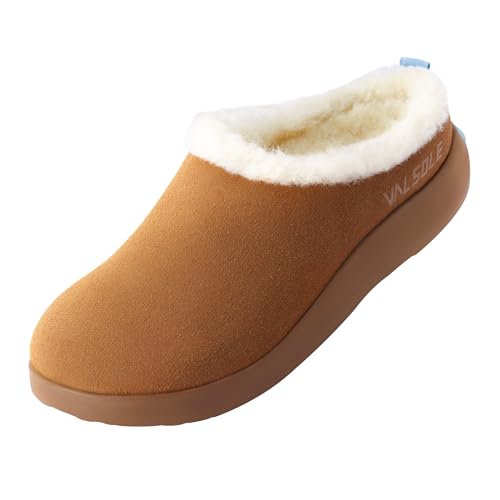
VALSOLE Orthopedic Slippers, Arch Support House Shoes — Best Value for Heavier Men
VALSOLE builds its slippers around a load case the rest of the category under-serves: heavier wearers, whose weight compresses ordinary footbeds flat and whose hours on hard floors punish the shortcut. Its orthopedic arch-support house shoes are positioned for substantial builds and all-day wear, with a structured footbed intended to keep its contour under real load, in a unisex design sold across men’s sizing. The value proposition is durability of support — a footbed that still has an arch in it at month six is worth more than a softer one that became a pancake by month two, and heavier men learn that arithmetic faster than anyone.
Strengths
- Support structure specced for heavier wearers and long daily hours.
- Value tier — the most accessible route to a load-worthy contoured footbed.
- House-shoe practicality: slip-on, indoor-outdoor sole, easy care.
Trade-offs
- Firmer feel is the design, not a flaw — plush seekers should take the ONCAI instead.
- Brand and finish are value-class; the money is in the footbed, not the trimmings.
- Unisex design language is plain; style-led buyers have better-looking picks above.
If you are a bigger man whose slippers have always died young and flat, the VALSOLE is the pick written for you — support that respects the load, at a price that respects the experiment. It is also a sensible second pair for any household: the workshop, basement, and garage pair that takes the abuse the good suede Vionics should not.
Best for: heavier men and long hours on hard floors, at a value tier. / Not suited for: men wanting plush softness or premium materials. Check the current price on Amazon
Comparison Table
| Pick | Badge | Key spec | Best for |
|---|---|---|---|
| Vionic Men’s Gustavo | Best Overall | Suede mule, orthotic-style contoured footbed | Benchmark support, handsome look |
| Orthofeet Asheville | Best Orthopedic Fit | Adjustable, wide sizing, hands-free entry | Wide feet, swelling, easy on/off |
| KuaiLu Arch Support Clogs | Best Warm Clog | Suede clog, plush lining, support footbed | Cold floors, winter wear |
| ONCAI Arch Support Slippers | Best Cozy Hybrid | Memory foam over arch-support structure | Transition from plush slippers |
| Orthopedic Loafers, Wool-Like Lining | Best Warm Loafer Style | Closed loafer, fuzzy lining, arch design | Warmth plus heel enclosure |
| VALSOLE Orthopedic Slippers | Best Value for Heavier Men | Structured arch support built for load | Heavier wearers, all-day hours |
How to Choose Arch Support Slippers That Will Actually Support
Learn to see a footbed, because the category is sold in words and worn in geometry. A supportive slipper’s insole, pressed with your thumb before first wear, should resist at the arch — there is a built rise there, shaped like the arch it is meant to meet — and the heel should sit in a visible cup rather than on a flat plain. Flex the slipper: a support sole bends at the forefoot and stays comparatively rigid through the midfoot, because a sole that folds in half at the arch cannot hold an arch contour under your weight. If a listing’s photos show a flat, featureless insole, believe the photo over the headline; the picks in this guide were chosen because their designs show their work.
Sizing is a support specification, not a comfort preference. The footbed’s arch rise must land under your arch, which means your size must be right — not approximately right — and your heel must seat in the cup without the toes crowding the front, because a foot slid forward in an oversized slipper puts the contour under the midfoot’s wrong neighborhood. Men between sizes in a mule or clog usually do better with the fit that seats the heel correctly and lets the toes be free, and men with wide feet should start with the wide and adjustable picks rather than hoping a standard slipper stretches into mercy. It will not; it will just hurt in a new place.
Then match construction to your house and habits. Hard floors argue for structure and against thin soles, however plush the lining. Cold floors add insulation to the brief — the plush-lined picks. Men who fetch mail, take out bins, and step into the garage need the indoor-outdoor outsoles every pick here carries, and should still treat slippers as slippers: a season of outdoor wear will spend any footbed faster. Finally, set the expectation that support feels different, deliberately: a contoured footbed announces itself for the first days. Judge any pick in this guide at the end of week two, worn in gradually lengthening sessions — that is when the comparison with your old flat slippers becomes honest.
One last fit test belongs in this section because it takes ten seconds and settles arguments that reviews cannot: stand in the slippers on your hardest floor, in the evening when your feet are at their largest, and walk the length of the house twice. Your heel should stay seated without gripping with your toes, the arch rise should feel like a handshake rather than a pebble, and nothing should rub, pinch, or slide. A support slipper that passes the evening test on the hard floor will pass everywhere else in the house; one that fails it in the first minute will fail it more eloquently at hour three, and the return window is the right place for that discovery to happen.
How to Break In and Care for Support Slippers
Break-in is a protocol, not a hope. Wear a new support slipper for an hour on the first day, two on the second, and build across the first week or two — especially with the firmer footbeds like the Vionic and VALSOLE — because feet accustomed to flat foam need time to accept being held in a shaped position, and men who go all-day on day one sometimes blame the slipper for an adjustment their feet were always going to make. Alternate with your old slippers during the transition without guilt; the goal is a habit, not a test of character. By the end of the second week, most men report the sensation inverting: the support disappears from notice, and the old flat slippers are the ones that feel wrong.
Care is simple and mostly about moisture and compression. Air slippers out between wears — two pairs in rotation, even a good pair plus a value pair, will each outlast a single pair worn daily, because foam and footbed materials recover their shape in the rest days. Keep plush linings fresh with the maker’s cleaning guidance and a full dry before re-wearing; never cook a support footbed in a hot dryer, since heat is the enemy of shaped foams and adhesives alike. Inspect the outsole seasonally: when the tread at the heel is worn smooth, traction goes before support does, and a slipper that slides on a kitchen floor has failed its first job regardless of its arch. Retire by that inspection, not by the calendar.
Common Buying Mistakes
- Believing the words instead of the geometry. “Arch support” on a flat foam insole is a label, not a feature. Look for a visible, shaped contour.
- Buying the wrong size for a contoured footbed. Support must land under your arch. A half-size error relocates it somewhere useless.
- Judging support slippers on day one. A shaped footbed needs a graduated break-in. The two-week verdict is the honest one.
- Expecting a slipper to be a treatment. These are comfort products. Persistent, worsening, or one-sided foot pain belongs in front of a clinician.
- Wearing one pair daily until it dies. Rotation rests the footbed materials and doubles useful life. Two pairs are an economy, not an indulgence — and the second pair need not match the first in tier: a premium pair for the long evening hours and a value pair for the workshop, basement, and morning errands is the combination many households in this category settle into, because it puts the best support where the most standing happens and lets the cheaper footbed absorb the abuse that would otherwise age the good one early.
- Buying for the season you are not in. A plush-lined winter slipper bought in a July sale is still a winter slipper in July. Match the lining to the house and the season you will actually wear it in, or the support will spend the summer in the closet, supporting nothing.
- Sizing wide feet into standard slippers. Width is fit, and fit is support. Start with the wide and adjustable models if your feet need them.
Hard Floors: the Hidden Variable Behind Tired Feet at Home
It is worth understanding why home is where feet tire, because it explains why this category exists at all. Modern houses are floored in materials chosen for everything except feet: hardwood, laminate, tile, polished concrete — beautiful, durable, and essentially rigid. Outdoors and at work, a man’s shoes mediate between his feet and the ground with engineered midsoles; at home, tradition says he downgrades to the thinnest footwear he owns at exactly the place where he stands longest in one spot — the kitchen. Standing is the load case that matters: walking distributes force across the stride, but standing at a counter concentrates it, hour after hour, through the heel and the arch’s supporting structures. A flat slipper contributes nothing to that equation. A contoured footbed contributes the two things standing asks for — it spreads load across the whole foot rather than the heel and ball alone, and it supports the arch in its loaded position instead of letting it rest at full stretch on a hard, flat plane.
This is also why the guide weighted sole structure so heavily. On carpet, almost any slipper feels adequate, because the floor itself is doing the cushioning. On tile, the slipper is the entire suspension system, and the difference between the picks above and a novelty plush slipper is the difference between standing on a shaped platform and standing on a folded towel. Men who work from home should audit their floors before their slippers: the harder and more extensive the hard flooring, the further up this guide’s support ranking their purchase should sit — and the more the two-pair rotation stops being a luxury and becomes maintenance for the only feet they have.
Mule, Clog, or Loafer: Choosing the Shape Around the Support
The six picks divide into three shapes, and the shape is a lifestyle decision layered over the support decision. The mule — the Vionic’s form — is the fastest on and off and the coolest to wear, and it asks the most of the footbed, since nothing but contour and friction keeps it on; a good mule wearer shuffles slightly and does not run for trains in them. The clog adds a closed toe and a more structured body: warmer, more protective against stubbed toes and dropped cans, and better at holding the foot’s position over the arch — the KuaiLu’s quiet structural advantage. The loafer encloses the heel entirely, which makes it the steadiest on stairs and the warmest in its lined versions, at the cost of the slowest entry and the least forgiveness in sizing. None of the three shapes supports better in principle; each supports differently in a real house, on real stairs, with a real man’s patience at the door. Choose the shape you will wear a hundred times a day without thinking, because a support slipper’s benefits compound per wear — and a pair that annoys its owner into bare feet has a support value of exactly zero, whatever its footbed cost.
Support Slippers as Gifts: Getting It Right for a Man Who Would Never Buy Them
A large share of these slippers are bought by someone other than the wearer, because the men who most need support footwear are often the least likely to shop for it — the father who has worn the same flattened slippers for a decade, the husband whose feet ache every evening and whose solution is to sit down. Gifting support slippers well requires solving two problems the wearer would solve for himself if he were shopping: size and shape. Size is the critical one, since a contoured footbed in the wrong size is worse than a flat slipper in the right one; borrow the number from his current shoes, not his current slippers, which have stretched into unreliability, and prefer the retailers’ size guidance for the specific model, since the value brands here size idiosyncratically. Shape is the tactful one: choose the form he already wears — a mule for a mule man, a clog for a clog man — because a gift that changes two habits at once (new support, new shape) usually changes neither.
The break-in protocol should travel with the gift, ideally as a sentence rather than a lecture: wear them an hour a day the first week. Gift-givers who skip that sentence sometimes watch a good slipper get rejected on day one for feeling “too hard,” when what it felt was correct. The winter picks — the KuaiLu and the wool-lined loafer — are the natural holiday gifts of the six, warm enough to feel generous and supportive enough to be quietly useful by January. And if the recipient’s feet are wide or his entry needs to be hands-free, the Orthofeet’s adjustability makes it the safest gift of all, because it forgives the giver’s sizing uncertainty the way no fixed slipper can.
What Support Slippers Cannot Do: an Honest Boundary
This guide has argued for these products seriously, so it owes the reader the boundary stated as seriously. A contoured footbed improves the mechanics of standing and walking around a house; it does not correct anatomy, rehabilitate an injury, or substitute for footwear chosen for a diagnosed condition. Men whose work puts them on concrete for full shifts need work footwear designed for it, with these slippers as the recovery hours’ comfort, not the shift’s equipment. Men with diabetes or circulation conditions should choose any footwear, slippers included, with their clinician’s guidance, because fit and pressure points carry medical weight for them that no buying guide should improvise around. And any man whose foot pain is new, one-sided, worsening, or accompanied by swelling or numbness should skip this category’s checkout button and book the appointment instead. The slippers in this guide are excellent at their actual job — making the hours at home kinder to ordinary, tired feet. Keeping that job description honest is what makes the recommendation worth trusting.
Reading a Slipper Listing: Support Claims, Translated
Because this category’s vocabulary is marketing-led, the last skill worth passing on is how the listings behind this guide were audited — so you can audit the next pair yourself. Start at the insole photograph: if the listing never shows the footbed’s surface, assume it is flat, because brands with a real contour photograph it from three angles. The words “orthopedic” and “orthotic-style” describe a design lineage — a footbed shaped on orthotic principles — and are meaningful only when the geometry is visible to back them. “Memory foam” describes a cushioning material, not a support structure; it can top a supportive footbed, as in the ONCAI, but alone it is a pillow, and pillows do not hold arches. Weight claims deserve the same translation: a slipper specced for heavier wearers, like the VALSOLE, is making a statement about how long its footbed keeps its shape under load, which is the durability axis that actually separates this category’s honest products from its soft ones.
Two specification habits complete the audit. Check the outsole’s description for indoor-outdoor intent and tread, because a support slipper that cannot leave the kitchen is a part-time product at a full-time price. And read the sizing guidance as part of the product: brands that publish detailed fit notes — who should size up, how their widths run — are telling you they expect their footbed to be fitted, which is the expectation of a company that believes its contour works. The six picks in this guide passed that audit against their verified catalog data. Any slipper you consider beyond them should be asked the same questions, in the same order: show me the footbed, show me the sole, show me the sizing honesty.
Final Recommendation
For the man who wants the category’s standard, the Vionic Gustavo is the buy: a real contoured footbed in a suede mule he will not be embarrassed to own. When fit is the hard part — width, swelling, hands-free entry — the Orthofeet Asheville is the most accommodating slipper here. Cold houses split by style: the KuaiLu clog for easy step-in warmth, the wool-lined loafer for a closed, secure fit. The ONCAI is the gentlest bridge from plush slippers to supported ones, and the VALSOLE is the value pick that respects heavier loads and longer hours. Whichever you choose, size it precisely, break it in gradually, and judge it at two weeks — support is a relationship between a foot and a footbed, and like most relationships worth having, it rewards a fair introduction.
Related guides in this series: Best Affordable House Slippers For Women, Best Allday Comfort Slippers, Best American Made Slippers
Related guides
- Best Men's Slippers For Hard Floors With Arch Support
- Best Arch Support Slippers For People With Achondroplasia
- Best Slippers With Backs For Arch Support
- Best Indoor Mens Sheep Slippers
Frequently Asked Questions
Do arch support slippers really feel different from regular slippers?
Yes — immediately, and that is the point. A contoured footbed has a shaped rise that meets your arch and a cup that seats your heel, where a regular slipper is a flat pad. The sensation is “present” rather than plush for the first days, then becomes unnoticeable as your feet adapt across a week or two of gradually lengthening wear. If a so-called support slipper feels identical to a flat one, its support is a label, not a structure.
How long does the break-in period take?
Plan on one to two weeks of graduated wear: an hour the first day, building daily. Firmer footbeds like the Vionic’s ask the full protocol; foam-topped hybrids like the ONCAI ask less. Skipping the break-in and going all-day immediately is the most common reason men wrongly conclude that support slippers are uncomfortable.
Can I wear arch support slippers all day at home?
That is what they are built for, and the use case this guide optimized for — the work-from-home and at-home hours on hard floors where ordinary slippers give your feet nothing. Rotate two pairs if you can, both for footbed recovery and hygiene, and treat persistent pain as a signal for professional advice rather than a reason to buy a firmer slipper.
Are these slippers a treatment for foot pain?
No. They are comfort products with supportive geometry, and this guide recommends them for the everyday comfort of men whose feet tire on hard floors. They do not diagnose or treat plantar fasciitis or any other condition, whatever category marketing implies. Pain that persists, worsens, or affects one foot deserves a clinician’s examination.
What size should I order if I am between sizes?
Prioritize heel seating and arch placement: your heel should sit fully in the cup and the footbed’s rise should meet your arch without your toes pressing the front. In open-back styles, that usually means the size that seats the heel correctly even if the toes have room. In closed loafers, allow a thumb’s width at the toes. When a wide option exists and your feet are wide, take it — width errors cannot be broken in.
Can I wear support slippers outdoors?
For the errands slippers actually run — mailbox, bins, garage, a quick step onto the patio — yes: every pick here carries an indoor-outdoor outsole built for exactly that. What they are not is walking shoes; a dog walk around the block or a day of errands in slippers will spend the footbed and outsole at a rate the house never would, and a mule or clog’s open back is not secure footwear for distance. Treat outdoor use as incidental and the slippers will last; treat them as shoes and you will be replacing them like shoes, at slipper durability.
Should I wear socks with support slippers?
Either way works, and the footbed does not care — the contour meets the arch through a normal sock without losing its effect. Socks add warmth in the unlined picks, extend the interval between liner cleanings, and help men whose feet run warm manage moisture in the plush winter models. Barefoot wear gives the most direct feel of the footbed during break-in, which some men prefer while they are learning the sensation. Choose by season and comfort; the support is in the structure, not the interface.
Why do my feet ache at home even though I am “resting”?
Because home is rarely rest for feet. Cooking, cleaning, laundry, children, projects — the at-home hours are standing hours, usually on the hardest floors in the building, in the least supportive footwear owned. Men often notice the paradox that their feet feel better after a day in proper shoes than after a day “off” at home, and the footwear downgrade is the explanation. That is the entire premise of this guide: the slipper is not a trivial purchase but the shoe of the house, and it should be built like one.
How long will a pair of support slippers last?
With rotation and indoor-dominant use, expect a well-built pair to hold its support through a long season of daily wear and beyond; worn daily without rest, footbed materials compress faster and the support fades sooner. Judge retirement by the outsole’s traction and the footbed’s shape — when the arch rise has flattened to a pad, the slipper has become the thing you replaced, whatever its upper looks like.


