Disclosure: airfryerkitchensupply.com is reader-supported. When you buy through links on our site, we may earn an affiliate commission at no extra cost to you.
Where to buy
Every linked product in this guide was verified against Amazon’s catalog — brand, model and listing matched — before it received its purchase link. Five of the six picks below are verified products; the budget slot is covered without a link, because the car-seat-specific fleece drapes we could verify did not separate honestly from the covers already picked, and we will not guess a product identity or a product code to fill the space. The guidance in every other section — the safety rules, the buying criteria, the fitting steps — stands alongside the picks, and it is the part of a car seat blanket purchase that actually protects your child.
- Best Overall — Goldbug Baby Blanket for Strollers & Car Seats — Check the current price on Amazon
- Best for Winter — Skip Hop Winter Car Seat Cover, Stroll & Go — Check the current price on Amazon
- Best Lightweight — Comfy Cubs Baby Car Seat Cover, Muslin Cotton — Check the current price on Amazon
- Best for Newborns — Rquite Car Seat Cover with Peekaboo Opening — Check the current price on Amazon
- Best Budget — covered without a link (see the review below): a simple fleece drape blanket sized for car seats; no verified listing currently fills this brief distinctly, so no link is printed.
- Best for Toddlers — Birdy Boutique Car Seat Poncho for Toddlers — Check the current price on Amazon
Introduction: The One Rule That Governs Everything
The search for the best baby car seat blankets starts with a rule that overrides every other consideration in this guide, and it comes from child passenger safety rather than from shopping: nothing thick or compressible may go between your baby and the car seat’s harness, or between your baby’s back and the seat. In a crash, padding compresses, the harness that felt snug becomes loose, and a loose harness cannot do its job. That single fact explains the entire design of this category. A car seat blanket is not a regular baby blanket used in a car seat; it is a blanket engineered to warm the baby over a correctly buckled harness — draped over the top, fitted around the seat’s shell, or worn like a poncho — never threaded under the straps, never folded behind the baby’s back.
Parents arrive at this category from an understandable place. Winter makes the dilemma vivid: babies cannot wear puffy coats in car seats for exactly the same compression reason, yet no parent wants to carry a shivering newborn across a frozen parking lot. The car seat blanket is the industry’s answer to that dilemma — warmth that lives outside the harness system entirely. The good designs are genuinely clever: elasticized covers that stretch over the carrier like a shower cap, blankets with strap slits that let the harness buckle against the baby’s body while the fabric lies over it, and poncho styles for toddlers that go on after buckling and come off without disturbing a sleeping child.
The bad designs — and the dangerous habits — are what this guide exists to filter out. Any product that asks you to place padding behind the baby, route straps through thick fabric, or cover an infant’s face fails the category’s only real test, whatever its fabric or price. Read the six slots below as six ways to pass that test for six different situations: the all-purpose pick, the deep-winter pick, the mild-weather layer, the newborn cocoon, the budget drape and the toddler poncho. Then read the safety and fitting sections as the manual that makes whichever you choose actually safe in use, because in this category the using matters as much as the buying.
In this guide
Quick Picks: The Best Baby Car Seat Blankets
- Best Overall — Goldbug Baby Blanket for Strollers & Car Seats: the over-seat blanket with a weather-resistant shell and a warm fleece lining: buckles nothing, threads nothing, goes over the carrier after the harness is snug, packs away small, and lifts off when you reach the warm indoors. — check price on Amazon
- Best for Winter — Skip Hop Winter Car Seat Cover, Stroll & Go: the dedicated winter cover-blanket for cold-climate carries from house to car to store, from a maker whose whole line is built around the infant carrier. — check price on Amazon
- Best Lightweight — Comfy Cubs Muslin Cotton Car Seat Cover: the breathable muslin layer for spring, autumn and air-conditioned cars — shade and bug protection without the overheating risk that heavy blankets carry in mild weather. — check price on Amazon
- Best for Newborns — Rquite Car Seat Cover with Peekaboo Opening: the cocoon-style carrier canopy with a peekaboo opening that lets you check the baby without unwrapping them, in a dual-layer minky and polyester build. — check price on Amazon
- Best Budget — unlinked specification: the simple fleece drape, sized for car seats rather than cribs, used strictly over a buckled harness — proof that the safe method matters more than the price tier. No verified listing currently fills this brief distinctly, so this slot is a specification to shop by, not a link.
- Best for Toddlers — Birdy Boutique Car Seat Poncho: the poncho-style blanket for convertible seats: goes over the child’s head after buckling, warms front and back without a layer behind the back, and lets a toddler’s arms stay free. — check price on Amazon
How These Picks Were Chosen
The selection framework for this category puts safety architecture first and everything else second. Each slot was defined by how the product interacts with the harness: the winning designs all keep the harness against the baby’s body with nothing compressible in between, and each slot represents a distinct, legitimate architecture for doing that — elastic over-cover, insulated cover, light drape, cocoon, simple drape, poncho. Any architecture that pads behind the baby or re-routes the straps through thick material was excluded from the framework entirely, no matter how warm or popular, because a buying guide that normalizes an unsafe design has failed at its only job.
Within that safety frame, four practical criteria shaped the slots. Temperature honesty: each slot is labeled for the weather it actually serves, because the most common real-world failure in this category is not cold but overheating — a winter-weight cover used in a heated car on a mild day. Transfer practicality: the best designs move from car to stroller to arms without waking the baby or re-doing the harness, so one-motion removal and carrier compatibility mattered. Fabric sense: next-to-air layers should be breathable, washable and free of loose fibers near a newborn’s face. And growth realism: infant-carrier products serve a short season of life, so the slots distinguish between the carrier months and the convertible-seat toddler years rather than pretending one product spans both.
A note on verification, because this category deserves the same standard as every other guide we publish: product picks are only linked after their identity is confirmed against Amazon’s catalog, matching brand, model and listing; the five linked picks below were confirmed on 2026-11-22. Safety guidance in this article does not depend on any specific product and follows the established child-passenger-safety consensus: harness snug against the body, nothing thick beneath it, blankets over the top, faces always uncovered and visible.
The 6 Best Baby Car Seat Blankets

Best Overall — Goldbug Baby Blanket for Strollers & Car Seats
The best overall design in this category is the one that makes the safe thing the easy thing, and the Goldbug is built exactly on that architecture: a blanket made for strollers and car seats, with a weather-resistant shell outside and a warm fleece lining inside, that goes over the seat after the baby is buckled. It asks nothing of the harness, touches nothing behind the baby, and — because it is packable — it lives in the car or the stroller basket rather than in a closet, which is where car seat blankets actually need to live. When you step indoors it comes off fast, before overheating replaces cold as the problem. For most families, in most climates, this is the car seat blanket: the default recommendation this guide would hand a new parent without asking a single follow-up question.
Strengths of this pick
- Zero harness interaction: buckle the baby correctly first, then add warmth over the top.
- Weather-resistant shell over fleece lining — the two-layer answer to wind plus cold in one product.
- Packable and dual-purpose across car seat and stroller, so it is present on the trips that were not planned.
Trade-offs of this pick
- An over-seat blanket alone is a moderate-weather solution; deep winter wants the insulated cover below or a layer added over it.
- Fit must be checked on your specific seat so the blanket settles over the shell rather than sliding.
- The blanket must never be pulled up over the baby’s face — the design’s convenience tempts exactly that misuse on windy days.
| Type | Blanket for strollers & car seats (per Amazon listing) |
| Construction | Weather-resistant shell, warm fleece lining |
| Storage | Packable |
The deeper virtue of this design is behavioral. Safety equipment that is annoying gets skipped, and a blanket that requires threading, tucking or re-buckling will eventually be skipped on a rushed morning — or worse, installed under the harness “just this once” because that is where it stays put. The Goldbug survives real life because it cooperates with it: it lives with the carrier, deploys with one hand while the other holds the door, and never gives a tired parent a reason to improvise.
Best for: most families with an infant carrier, in mild-to-cold weather. / Not suited for: deep-winter climates as the only layer, or any use where the blanket would be drawn over the face.
Check on Amazon — check the current price on Amazon before you decide.
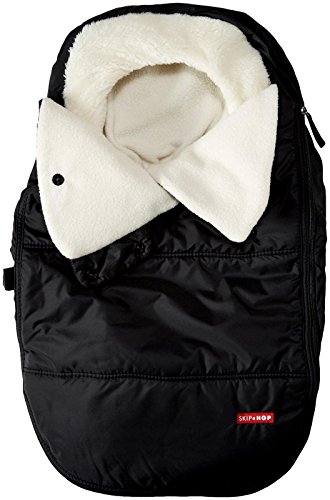
Best for Winter — Skip Hop Winter Car Seat Cover, Stroll & Go
Deep winter is a different problem from cold, and it gets a dedicated product: the Skip Hop Stroll & Go winter car seat cover, in black. Skip Hop’s whole line is built around the infant carrier, and this cover is its cold-climate answer — a cover that fits over the carrier to shield the buckled baby from wind and freezing air on the carries that define a northern winter: house to car, car to store, store to car, in weather where an exposed newborn loses heat by the minute. Like every pick in this guide, it warms from outside the harness system entirely; the harness job underneath it is done first, snug against the baby’s body, exactly as the safety section prescribes.
Strengths of this pick
- A dedicated winter cover from a carrier specialist — designed for this seat and this season, not adapted from a generic blanket.
- Over-the-carrier architecture keeps the harness untouched and the baby’s face as the only opening that matters.
- Neutral black finish pairs with any carrier and hides a winter’s worth of slush marks.
Trade-offs of this pick
- Winter weight is winter-only: in a heated car on a mild day it must come off or open, because overheating is this category’s quiet failure.
- It serves the infant-carrier season; the convertible-seat years belong to the poncho pick below.
- A cover is one more object to keep with the carrier — assign it a home in the car or it will be forgotten on the coldest morning.
What to look for when it arrives: a fit that settles over your carrier’s shell without pulling at the handle, an opening that leaves the baby’s face fully visible from the driver’s mirror check, and fabric that sheds slush rather than soaking it through to the lining.
Cold climates should buy this cover as a system with the overall pick, not instead of it: the Goldbug handles the forty-degree days that make up most of the season, and the Skip Hop takes the days when the wind makes the carry itself the hazard. Two honest layers beat one overbuilt one, because each can be removed the moment the cabin warms.
Best for: cold-climate families using an infant carrier through a real winter. / Not suited for: mild climates, or as a blanket for supervised sleep — it is transport equipment, not bedding.
Check on Amazon — check the current price on Amazon before you decide.

Best Lightweight — Comfy Cubs Baby Car Seat Cover, Muslin Cotton
Most of the year is not winter, and the lightweight slot belongs to muslin: the Comfy Cubs car seat cover in muslin cotton, in sage — a soft, breathable, lightweight canopy whose listing names its real jobs, sun and bug protection, in a large size that drapes the carrier properly. This is the layer for spring and autumn carries, for air-conditioned cars in summer, and for the stroller walks where what the baby needs is shade and a screen against insects, not insulation. It follows the same safety architecture as every pick here: over the carrier, after buckling, face visible — with the lightest possible hand.
Strengths of this pick
- Muslin cotton breathes — warmth and cover without the overheating risk heavy blankets carry in mild weather.
- Sun and bug protection make it the summer pick as much as the shoulder-season one.
- Large canopy size drapes the carrier fully instead of perching on it.
Trade-offs of this pick
- It is a screen, not insulation: cold weather needs the picks above, and no layering of muslin changes that.
- Light fabrics show every stain and need the wash rhythm muslin happily accepts.
- Drape-style covers must be settled so fabric cannot migrate toward the face — the fitting steps in this guide apply in full.
| Type | Muslin cotton car seat cover / canopy (per Amazon listing) |
| Jobs named in listing | Sun and bug protection; soft, breathable, lightweight |
| Color | Sage |
Judge this pick by the calendar: if your baby’s carrier months fall across spring, summer and early autumn, the muslin cover may be the only car seat blanket you need, and the winter products above are the specialty purchases. The category’s most common buying error is dressing the baby for the coldest day of the year, every day of the year — this pick is the correction.
Best for: mild weather, air-conditioned cars, sunny and buggy carries. / Not suited for: cold weather as the only layer.
Check on Amazon — check the current price on Amazon before you decide.

Best for Newborns — Rquite Car Seat Cover with Peekaboo Opening
The newborn months add one requirement the other slots do not have: you need to see the baby, constantly, without disturbing them. The Rquite answers with the feature in its name — a peekaboo opening in a dual-layer infant carseat canopy, soft warm minky inside against durable polyester outside, that lets a parent check a sleeping newborn’s face and breathing at a glance instead of unwrapping the whole cover at every red light. It is a multi-use design — carrier, stroller, nursing cover, blanket — which suits the newborn season’s reality that everything baby-shaped gets used for everything, but its home job is the carrier cocoon: drafts off, warmth in, face checkable.
Strengths of this pick
- Peekaboo opening solves the newborn check without unwrapping — the feature this slot exists for.
- Dual-layer build: warm minky inside, durable polyester outside.
- Multi-use across carrier, stroller and nursing cover stretches a short-season purchase.
Trade-offs of this pick
- The peekaboo opening must be used as designed — opened for checks, never left as a fabric flap resting near the face.
- Newborn-specific products serve a short season; the multi-use design is what justifies it past the carrier months.
- Minky fabrics are warm — in mild weather the lightweight muslin pick is the safer hand.
| Type | Infant carseat canopy with peekaboo opening (per Amazon listing) |
| Construction | Dual-layer: soft warm minky and durable polyester |
| Fit | Universal fit; multi-use carrier / stroller / nursing cover / blanket |
For the first months, the check is the product. A newborn cannot tell you they are too warm, too cold or uncomfortable, and the parent’s eyes are the monitoring system — any cover that makes those checks effortless will be checked under, and any cover that makes them a production will eventually be left unfastened and useless. The Rquite is built around that truth.
Best for: the first carrier months, especially for first-time parents who check constantly. / Not suited for: toddlers, or hot weather where minky warmth overshoots.
Check on Amazon — check the current price on Amazon before you decide.
Best Budget — Simple Fleece Drape Blanket, Car Seat Sized (Unlinked Specification)
The budget slot exists to make a point this guide believes in: in this category, method beats money. A simple fleece drape, sized for a car seat rather than a crib, used correctly — over a snugly buckled harness, tucked at the sides, face clear, removed when the cabin warms — delivers the essential function of the category at the lowest tier. Fleece earns the slot because it is warm for its weight, does not fray into loose threads, washes without ceremony and costs little enough that keeping one in each car is realistic, which is a genuine safety feature for families who would otherwise improvise with whatever blanket is at hand.
Strengths of this design
- The full safety method is achievable at the lowest price tier — correct use, not cost, is the variable.
- Fleece is durable, washable and warm for its weight.
- Cheap enough to dedicate one to the car permanently, ending the forgotten-blanket improvisation.
Trade-offs of this design
- No fitted attachment: the drape depends on the user’s tuck, and a kicked-loose drape must be re-settled, never left to bunch near the face.
- Fleece is less breathable than natural fibers — in mild weather the lightweight slot is the wiser layer.
- Car-seat sizing is the whole trick; a crib-sized blanket’s excess fabric is a hazard, not a bonus.
What to look for: dimensions stated for car seats, a single-layer construction without fill, and edges finished so the blanket does not shed or unravel.
The budget pick carries one warning the expensive picks do not need: because it is just a blanket, it invites just-a-blanket habits. The discipline — buckle first, drape over, tuck sides, face clear, off when warm — is the product. Families who want the blanket to do more of the work for them should step up to the fitted overall pick, whose elastic edge enforces half the discipline mechanically. Neither choice is wrong; they are the same safety system at two levels of automation.
Best for: budget-conscious families, second cars and grandparents’ cars. / Not suited for: anyone who wants a fit-and-forget product, or unsupervised sleep.
Why this slot carries no link: in the 2026-11-22 Amazon listing data verification pass, the car-seat blankets that could be confirmed were covers and ponchos that fill the other slots, and the simple fleece blankets in the catalog are general baby blankets — not car-seat-sized drapes — which this guide will not substitute into a safety category. The specification above is the buying instrument: car-seat dimensions, fleece weight, over-the-harness use only.

Best for Toddlers — Birdy Boutique Car Seat Poncho for Toddlers
The toddler years retire the carrier, and the poncho takes over: the Birdy Boutique car seat poncho, in a camo and bear pattern, is a reversible fleece blanket worn over the buckled harness — on over the child’s head after buckling, warming front and back without any layer behind the back, and off again without disturbing the harness job. Its listing spans 6 months to 5 years and names the design’s purpose plainly: a winter coat alternative, easy on and easy off. That is the coat dilemma solved in the category’s approved way — thin layers under the harness for the walk, the poncho over the harness for the ride, and no puffy jacket anywhere in the system.
Strengths of this design
- Poncho architecture warms front and back with nothing compressible behind the child’s back.
- Easy on, easy off over a finished harness job — the design a rushed morning cannot defeat.
- Reversible fleece and a size span from baby to preschooler stretch the purchase across seasons.
Trade-offs of this design
- The neck opening must fit so the fabric cannot ride up over the face; supervise and size honestly.
- Some toddlers reject anything over the head — a design the child fights is a design that gets left home.
- Warmth is front-weighted; in deep cold it pairs with the car’s warm-up time rather than replacing winter clothing layers under the harness rules.
What to look for when it arrives: a neck opening sized for toddlers (not infants), length that covers legs without pooling on the floorboards, and fabric soft enough that a sensory toddler accepts it against the neck.
For families in cold climates with a convertible-seat child, this pick — not the infant cocoon — is the winter purchase that earns its keep for two or three seasons, which is why the guide gives toddlers their own slot rather than stretching a baby product past its honest life.
Best for: toddlers and preschoolers in convertible seats, especially in cold climates. / Not suited for: infants, or children who will not tolerate over-the-head garments.
Check on Amazon — check the current price on Amazon before you decide.
Comparison Table
| Pick | Badge | Key spec | Best for |
|---|---|---|---|
| Goldbug Baby Blanket for Strollers & Car Seats | Best Overall | Weather-resistant shell, fleece lining, packable | Most infant-carrier families |
| Skip Hop Winter Car Seat Cover, Stroll & Go | Best for Winter | Dedicated winter carrier cover | Cold-climate carries |
| Comfy Cubs Muslin Cotton Car Seat Cover | Best Lightweight | Breathable muslin layer, sun and bug protection | Mild weather, air-conditioned cars |
| Rquite Car Seat Cover with Peekaboo Opening | Best for Newborns | Cocoon canopy with peek window, dual-layer minky | First carrier months |
| Simple fleece drape, car-seat sized (unlinked specification) | Best Budget | Car-seat-sized fleece drape | Second cars, tight budgets |
| Birdy Boutique Car Seat Poncho | Best for Toddlers | Poncho worn over buckled harness, reversible fleece | Convertible-seat children |
How to Choose a Baby Car Seat Blanket
Begin with the harness test, and apply it to every product you consider. Ask one question: does any part of this product go between the baby and the harness straps, or between the baby’s back and the seat, in normal use? If yes, it fails — regardless of warmth, reviews or the word “safe” in its marketing — unless the car seat’s own manufacturer explicitly permits it. The passing architectures are the ones in this guide: over the top, around the shell, or worn poncho-style over a buckled harness. This single test, applied ruthlessly, is worth more than every other criterion in this section combined.
Match warmth to the actual exposure. The realistic cold exposure for most babies is measured in minutes: house to car, car to store. The car’s cabin does the rest. That math argues for transport warmth — the winter cover for cold climates, the elastic layer for moderate ones — and against dressing the car seat like an arctic expedition. Overheating is the quieter risk and the more common one: babies, especially newborns, shed heat poorly and complain late. Choose the lightest layer that covers your climate’s carries, learn the neck check (warm and dry is right; hot or damp means remove a layer), and treat every blanket in this category as adjustable equipment, not set-and-forget.
Fit the product to the seat you own. Carrier shells differ in width, handle geometry and rim shape; convertible seats differ more. Fitted products — elastic covers, cocoons — should state the seats they fit, and a cover that gaps at the sides or binds at the rim will be fought by every parent who uses it until it is abandoned. If your seat is an uncommon model, the drape and poncho architectures forgive more than the fitted ones. When in doubt, choose the architecture whose fit does not depend on your exact shell.
Respect the car seat manufacturer’s own rules. Your seat’s manual has a section on accessories and clothing, and it outranks any buying guide, including this one. Some manufacturers permit only their own accessories; all of them prohibit unapproved padding behind or under the child. Read that section once, follow it always, and treat any product whose instructions contradict it as disqualified. The same manual-first logic applies to coats: thin, compressible layers under the harness, warmth added over it — the system this whole category exists to provide.
Plan for the laundry reality. Car seat blankets live where spit-up, diaper failures and snack accidents happen. A blanket that cannot go in the household wash, weekly, without special handling will spend its life dirty in a corner while a forbidden substitute does its job. Machine washable, quick to dry, and cheap enough or tough enough to survive the rhythm — in this category those are safety specifications wearing practical clothes.
Think in seat generations: carrier, convertible, booster. The blanket that fits your life changes as the seat does, and buying across generations is where money gets wasted in this category. The infant carrier season is short — often under a year — and its products (elastic covers, cocoons) are fitted to a shell you will retire. The convertible years are long, and their product (the poncho) is deliberately unfitted, because it must work on a seat that itself changes orientation and size. When you shop, date the purchase: a premium carrier cover for a nine-month-old is a poor buy next to a mid-range one, while a well-made poncho bought at the convertible transition can serve three winters. The slots in this guide are sequenced by that timeline on purpose.
Consider the travel system you actually run. Most infant carriers click between a car base and a stroller, and the blanket lives through both halves of that system. A cover that must be removed to click the carrier into the stroller will be removed — and eventually left home. Elastic covers that stay on the shell through clicks, carries and transfers preserve the warmth system intact across the whole outing, which is why compatibility with your carrier’s handle positions and stroller adapters is a real specification, not packaging trivia. Check that the cover you choose lets the handle move, the canopy open and the base release operate; a blanket that fights the machinery loses to the machinery, every rushed morning.
Do not forget the second car and the other caregivers. The safest blanket is the one that is there. Families with two cars, a grandparent who does daycare runs, or a sitter with their own vehicle should treat coverage as a system: either the blanket travels with the seat (another point for carrier-fitted covers) or each regular car carries its own layer (the budget drape’s reason to exist). The dangerous improvisation — a bath towel, an adult’s coat over the straps, a crib blanket from the nursery — appears exactly where the system has a gap, and gaps are a purchasing problem, not a parenting failure. Close them cheaply and in advance.
How to Use a Car Seat Blanket Safely
- Dress the baby in thin layers. A normal indoor outfit plus a thin fleece at most. No puffy coats, snowsuits or thick buntings under the harness — compressibility is the enemy the whole system is designed around.
- Buckle the harness against the baby’s body. Straps at the correct height (at or below the shoulders for rear-facing infants), chest clip at armpit level, and the pinch test passed: if you can pinch a fold of strap webbing at the shoulder, tighten until you cannot.
- Only then add the blanket. Drape it over the buckled baby, fit the elastic cover around the shell, or settle the poncho over the harness — in every architecture, warmth goes over the finished harness job, never into it.
- Tuck the sides, clear the face. Settle excess fabric at the baby’s sides, below chin level, so nothing can migrate upward. The face stays fully visible — to you, in the mirror, at every glance.
- Manage temperature through the drive. As the cabin warms, open or remove the blanket. Check the back of the baby’s neck at stops: warm and dry is correct; hot or sweaty means a layer comes off now, not at the destination.
- Reverse the process at arrival. Blanket back on for the cold carry out; off again indoors. A baby who falls asleep in the seat during the drive should be moved to a flat sleep surface at the destination — car seats are transport, not cribs, and blankets never stay over a sleeping baby unattended.
Two habits complete the system. Keep the blanket with the seat, not with the laundry pile, so the safe method is always the available method. And brief every caregiver — grandparents, sitters, the other parent at 6 a.m. — on the over-the-harness rule, because a system only one person understands is a system that fails on the days that person is not there.
One last framing before the recommendations: nothing in this category is a substitute for the seat itself being installed and used correctly. A blanket guide can only govern the layer above the harness. If the seat’s installation, recline or strap height is wrong, fix that first — your local fire station, hospital or child passenger safety technician will check an installation for free, and that check is worth more than every product in this guide combined.
Common Buying Mistakes
Buying a blanket that goes behind the baby. Strap-slit liners and padded inserts that sit between the baby’s back and the seat are the category’s dangerous mainstream. They feel secure in the store and fail the compression test in a crash. If it pads the back, it does not belong in the seat.
Using a crib blanket in the car seat. Oversized blankets pool, bunch and migrate toward faces, and their excess has nowhere safe to go in a carrier. Car-seat-sized products exist precisely because the geometry is different.
Covering the face “just for the windy bit.” The walk across the parking lot is when a cover over the face feels most justified and when rebreathing risk is least supervised. Use the structured face opening, a hat and your own body as a windbreak instead.
Dressing for the driveway instead of the drive. A baby bundled for a five-minute carry stays bundled for a forty-minute heated drive unless someone intervenes. Build the outfit for the cabin and let the blanket — removable in seconds — handle the driveway.
Ignoring the car seat manual. The manual’s accessory rules are part of the seat’s safety certification. A product that contradicts them voids the logic that made the seat safe, whatever its own packaging claims.
Letting a sleeping baby stay covered and unattended. The car seat blanket’s job ends at arrival. Babies who fall asleep in seats get moved to flat sleep surfaces, and blankets never remain over an unattended sleeping infant.
A word about secondhand and hand-me-down blankets. Blankets are among the safer baby items to accept used — they are not the seat itself — but inspect them like equipment, not fabric. Elastic that has lost its tension will not grip a carrier shell, and a winter cover whose face opening has stretched or torn has lost the structure that made it safe. Wash any secondhand textile before use, check that no straps, cords or ties have been added by a previous owner (aftermarket ties near a harness are a red flag), and retire anything whose attachment system no longer holds its designed position. The architecture is the safety feature; a used product whose architecture has failed is not a bargain, it is a different and worse product.
Final Recommendation
Most families need exactly one product from this guide to start: the Goldbug blanket in the Best Overall slot, because its over-seat architecture makes the safe method the effortless method through the whole carrier season. Cold climates add the Skip Hop winter cover; mild climates and second cars are honestly served by the lightweight muslin layer and the budget fleece specification; newborns in their first months justify the cocoon’s peek window; and the day the convertible seat arrives, the poncho takes over the job for the toddler years. Buy the architecture before the fabric, the fit before the print, and the method before everything.
Related guides in this series cover the rest of the baby’s travel and sleep kit: Best Baby Stroller Blankets for warmth outside the car seat’s rules, Best Baby Blankets Organic for the nursery side of the blanket drawer, Best Baby Receiving Blankets for the newborn weeks, and Best Baby Large Blankets for floor time and beyond.
Frequently Asked Questions
Why can’t my baby just wear a winter coat in the car seat?
Because compressible padding defeats the harness. A puffy coat feels snug when you buckle over it, but in a crash the fill compresses instantly and the harness becomes loose around the child’s body — the exact failure the snug fit exists to prevent. The safe system is thin layers under the harness and warmth over it, which is the entire reason car seat blankets are designed the way they are.
Are car seat blankets safe at all?
The architectures in this guide — over the buckled harness, around the shell, poncho-style — are the accepted safe approach, because nothing interferes with the harness or pads behind the baby. What is not safe is any product or habit that places thick material under the straps or behind the back, covers the baby’s face, or leaves a covered baby unattended. The product matters less than the method; a correct blanket used wrongly is still wrong.
How do I know if my baby is too warm under the blanket?
Check the back of the neck or the chest with your hand. Warm and dry is right. Hot, sweaty or flushed means remove a layer immediately — babies overheat faster than they chill in a heated car, and they signal it late. As a rhythm: blanket on for cold carries, opened or off once the cabin is warm, checked at every stop.
Can I use a regular baby blanket in the car seat?
A thin regular blanket, draped over a correctly buckled harness, tucked at the sides and kept clear of the face, follows the same safe method — the budget slot in this guide is built on exactly that. What you must not do is fold it behind the baby, thread straps through it, or use an oversized crib blanket whose excess fabric can migrate over the face. Size and method are the difference between a blanket and a hazard.
What is the pinch test and why does it matter here?
After buckling, try to pinch a vertical fold of the harness strap at your baby’s shoulder. If you can gather fabric, the harness is too loose; tighten until the strap resists pinching. It matters in this category because every blanket decision assumes the harness beneath it is correctly snug against the body — the blanket adds warmth to a finished safety job, and the pinch test is how you know the job is finished.
Should grandparents and sitters follow the same blanket rules?
Yes — the physics does not check who buckled the seat. The over-the-harness rule, the pinch test and the face-clear rule apply to every driver, which is why this guide recommends briefing every regular caregiver and keeping a compliant blanket with the seat itself. A sixty-second demonstration — buckle snug, blanket over, face clear, off when warm — is one of the highest-value conversations a new parent can have, and it prevents the well-meaning improvisation (a coat under the straps, a blanket behind the baby) that is this category’s real-world risk.
When do we stop needing a car seat blanket?
The need changes shape rather than ending: the carrier-season covers retire with the infant seat, and the poncho architecture serves the convertible-seat years whenever cold weather and harness rules collide. By booster age, children manage their own layers and ordinary blankets in the car carry no harness implications at all. Until then, the over-the-harness rule governs every winter ride.


