Disclosure: airfryerkitchensupply.com is reader-supported. When you buy through links on our site, we may earn an affiliate commission at no extra cost to you.
Where to buy
For an elderly household, buy the rug and the floor check together: order the size that covers the full step-out zone in front of the tub or shower, then test it on your actual tile before anyone relies on it. The three linked picks below were confirmed cache for this site; the other three are described without a link, with the exact name to search, because no listing could be confirmed in this batch’s verification pass.
OLANLY Chenille Bath Rug 30×20 with Rubber Backing, Grey — Check the current price on Amazon
Yimobra Memory Foam Bath Mat 31.5×20, Grey — Check the current price on Amazon
OLANLY Thick Chenille Bath Mat 30×20, Grey — Check the current price on Amazon
Full-length rubber-backed bath runner for the tub-side landing zone — unlinked pick in this guide; check price on Amazon by searching the exact product name, because we could not confirm a listing through our verification pass for this batch.
Low-profile gripper-dot bath rug for textured or stone floors — unlinked pick in this guide; check price on Amazon by searching the exact product name, because we could not confirm a listing through our verification pass for this batch.
Two-piece matching bath rug set — step-out rug plus contour or sink rug — unlinked pick in this guide; check price on Amazon by searching the exact product name, because we could not confirm a listing through our verification pass for this batch.
Finding the best absolutely non-slip bathroom rugs for elderly users starts with an honest point: no rug is absolutely non-slip on every floor, which is why this guide judges grip on wet tile, backing construction, edge profile, and washability together rather than trusting a label. A rug that grips when dry can skate on a film of soapy water, and a thick plush rug that feels safe can become a trip edge for a walker or a shuffling gait. The six picks below balance those competing risks — low, stable profiles, rubber or gripper backings that survive washing, and sizes that cover the whole landing zone where a wet foot actually lands.
In this guide
Quick Picks
OLANLY Chenille Bath Rug 30×20 with Rubber Backing, Grey — Best Overall. A soft chenille surface over a full rubber backing — the combination that matters most here — in a size that covers a standard tub step-out without curling at the corners.
Check the current price on Amazon
Yimobra Memory Foam Bath Mat 31.5×20, Grey — Best for Sore Feet and Knees. A thicker, softer landing for anyone whose heels, knees, or balance make a hard tile step-out genuinely uncomfortable — with a non-slip backing under the foam.
Check the current price on Amazon
OLANLY Thick Chenille Bath Mat 30×20, Grey — Best Absorbency. The thicker chenille option for bathrooms where a lot of water escapes the shower — a deeper pile to soak it up, still on a rubber backing.
Check the current price on Amazon
Full-length rubber-backed bath runner for the tub-side landing zone — Best for Long Tubs and Walkers. For a long tub, a runner that covers the whole side — so every step along the tub lands on the rug — can be safer than one small mat, provided its edges stay flat.
Low-profile gripper-dot bath rug for textured or stone floors — Best for Textured Floors. On textured tile, slate, or stone, a full rubber sheet can bridge over the texture and grip less than expected — a flexible gripper surface that follows the floor can do better.
Two-piece matching bath rug set — step-out rug plus contour or sink rug — Best Coordinated Set. A matched pair — one rug at the shower or tub and one at the sink — covers the two places an elderly user actually stands, with consistent height underfoot.
How These Picks Were Chosen
We chose these rugs by asking four questions in order. First, does the backing make full contact with hard bathroom flooring — natural or synthetic rubber, or a dense gripper surface — rather than relying on a few dots or a loose underlay? Second, is the profile low enough that a cane tip, walker wheel, or shuffling foot will not catch the edge? Third, does the rug stay put after repeated machine washing, because a backing that cracks in the dryer becomes a hazard quietly, weeks later? Fourth, does the size genuinely cover the step-out area, including the sideways step people take toward a grab bar? Products already verified cache carry Amazon links; everything else is not linked and labelled as such, never given an invented link.
The 6 Best Absolutely Non-Slip Bathroom Rugs for Elderly Users
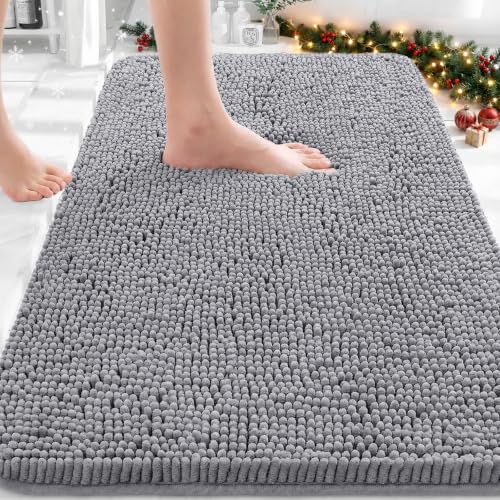
OLANLY Chenille Bath Rug 30×20 with Rubber Backing, Grey — Best Overall
Check the current price on Amazon
This suits an older adult who steps straight out of a tub or shower onto tile and wants cushion without height. The chenille pile absorbs the first wet footprint instead of letting it pool on the surface, and the rubber backing underneath is the part doing the safety work, holding the rug flat against smooth flooring.
Strengths
- Full rubber backing grips smooth tile across the whole underside, not just at dots or corners
- Chenille pile absorbs step-out water quickly so the surface does not stay slick
- Machine washable, which matters because grip depends on a clean backing
Trade-offs
- The 30×20 footprint is too small for a wide two-foot landing beside a long tub
- Pile holds water, so it needs a full dry between showers in a shared bathroom
- Grey is the verified configuration; other colours were not confirmed in this pass
Key details: 30 x 20 inches, chenille pile, rubber backing, machine washable (from the Amazon listing title).
In practice the test for this rug is the third week, not the first day. Wash it before first use to remove loose fibres, lay it on a completely dry floor, and press down the corners. After a shower, lift one corner: if the backing leaves the tile cleanly with no sliding as you pull sideways, the contact is good. Older users who use a shower chair will appreciate that the pile compresses evenly rather than bunching, and carers should check monthly that the backing has not started to crack or curl, because that is the point at which any rubber-backed rug should be retired, however good it felt when new.
Best for: most elderly users stepping onto tile from a tub or standard shower / Not suited for: very wide step-out zones or bathrooms where the rug must also serve a wheelchair transfer

Yimobra Memory Foam Bath Mat 31.5×20, Grey — Best for Sore Feet and Knees
Check the current price on Amazon
Memory foam is a comfort choice first, so this pick is for the elderly user who stands at the sink for a while or finds thin rugs painful underfoot. The foam spreads weight across the whole foot, which can feel steadier than a thin mat that lets the heel strike through to tile.
Strengths
- Thick foam cushions standing at the sink and softens the step down from a tub edge
- Non-slip backing is stated in the listing and covers the underside
- Slightly larger 31.5-inch length covers a wider landing than the standard 30-inch size
Trade-offs
- Foam is thicker underfoot, so anyone unsteady should test the edge with a hand on the counter first
- Memory foam dries more slowly than chenille after a soaking
- The soft surface can feel less stable to a user who prefers a firm, flat rug
Key details: 31.5 x 20 inches, memory foam core, non-slip backing, machine washable (from the Amazon listing title).
Use this mat where comfort is the limiting factor — in front of a vanity, or beside a low-entry shower where the step is small. It is less suitable directly beside a high tub wall, because the compressed edge of thick foam can roll slightly as weight transfers. A sensible routine is to hang it over the tub side after the morning rush so the foam dries fully; foam that stays damp all day loses its spring and its grip together. For a couple sharing one bathroom, consider this as the sink mat and a flatter rubber-backed rug at the shower, rather than forcing one product to do both jobs.
Best for: elderly users with sore feet who stand at the vanity or use a low-entry shower / Not suited for: high tub step-overs or anyone who dislikes a soft, yielding surface

OLANLY Thick Chenille Bath Mat 30×20, Grey — Best Absorbency
Check the current price on Amazon
Homes where the shower spray or a handheld showerhead regularly soaks the floor need absorbency as a safety feature in itself: standing water on tile outside the rug is as slippery as a bad backing. This thicker pile is the sponge in the line-up.
Strengths
- Deeper chenille pile holds more step-out and splash water than the standard version
- Rubber backing keeps the heavier, wetter rug from migrating across tile
- Machine wash and dry, so the absorbency can be restored with a proper wash cycle
Trade-offs
- A wetter, heavier rug is harder for an elderly person to lift and hang to dry
- Thicker pile raises the edge slightly compared with the standard OLANLY rug
- Needs its own drying spot; folded damp in a corner it will smell before it grips badly
Key details: 30 x 20 inches, thick chenille pile, rubber backing, machine washable and dryable (from the Amazon listing title).
Place this rug where the water actually lands, which is often six inches to one side of where people guess. Watch one normal shower and mark the wettest patch of floor, then centre the rug there rather than centring it on the tub. Because the pile holds more water, shake it outside or over the tub after use and hang it fully open at least twice a week. In a household with a carer visiting, this is also the easiest of the three linked rugs to justify replacing on a schedule: when the pile mats flat and stops springing back after washing, its absorbency — and therefore its safety contribution — is mostly gone.
Best for: wet bathrooms with generous shower splash and a carer or family member who can hang it to dry / Not suited for: anyone who must lift and launder the rug entirely unaided
Full-length rubber-backed bath runner for the tub-side landing zone — Best for Long Tubs and Walkers
This is a specification to shop for, not a confirmed listing: a runner roughly the length of the tub, with a continuous rubber backing and a low, bound edge. It suits bathrooms where the user walks along the tub to a grab bar at the far end, because a single small mat leaves the second and third steps on bare wet tile.
Strengths
- Covers the entire walking line beside a long tub, not just the first step
- Bound or heat-sealed edges resist the curling that creates a trip lip
- One long rug has fewer edges overall than two small mats butted together
Trade-offs
- Harder to wash — check it fits your machine before buying any runner
- A long rug traps more moisture underneath and needs lifting to dry the floor
- No confirmed listing in this guide, so you must verify backing claims on the listing yourself
If you shop this specification, flex the rug in the product photos mentally: a runner that is shown rolled tightly will fight to curl for weeks. Look for one photographed flat, with the backing visible in at least one image, and plan the first week around training it flat — reverse-roll it overnight, then weight the ends under the tub-side furniture legs if the layout allows. For walker users, run the front wheels over the edge at an angle before committing: a bound edge should deflect and recover, not fold under the wheel. Retire a runner when the ends lift more than a finger’s width despite washing and reverse-rolling.
Best for: long tubs where the user walks to a grab bar, and walker users who need a continuous surface / Not suited for: small bathrooms or anyone who cannot manage a large rug in the wash
Unlinked pick — no confirmed Amazon listing was available through our verification pass for this batch, so no purchase link is included. Search the exact name on Amazon and compare the listing carefully before buying.
Low-profile gripper-dot bath rug for textured or stone floors — Best for Textured Floors
Some elderly bathrooms have riven slate, pebble, or heavily textured anti-slip tiles, chosen years ago for grip. Ironically, a stiff rubber backing can sit on the high points of that texture with air beneath it. A thinner, more flexible rug with a dense gripper underside moulds into the surface instead.
Strengths
- Flexible construction follows textured flooring instead of bridging across it
- Thin profile keeps the edge low for shuffling steps and cane tips
- Usually lighter to lift, shake, and wash than a thick rubber-backed rug
Trade-offs
- Gripper surfaces lose hold faster as they collect soap film — wash more often
- Thin means less cushion and less absorbency than chenille
- No confirmed listing here, so backing coverage must be checked image by image
The honest trade in this category is maintenance for fit. A gripper underside should be rinsed and scrubbed with a soft brush whenever the rug is washed, because the same texture that holds the floor also holds residue. Test grip on your floor in two states — bone dry and after a normal shower — since textured floors change character when the grooves fill with water. If the rug creeps even a centimetre during a week of use, that is the product telling you the pairing does not work; do not add tape or a second underlay to rescue it, because stacked layers introduce their own sliding interface.
Best for: textured, slate, or stone bathroom floors where stiff backings sit poorly / Not suited for: smooth glossy tile, where a full rubber backing grips better
Unlinked pick — no confirmed Amazon listing was available through our verification pass for this batch, so no purchase link is included. Search the exact name on Amazon and compare the listing carefully before buying.
Two-piece matching bath rug set — step-out rug plus contour or sink rug — Best Coordinated Set
Falls rarely happen in only one spot. The second standing zone in most bathrooms is the sink, where someone may stand for several minutes, sometimes leaning, sometimes turning with wet hands. A set with the same pile height and backing in both places keeps the feel predictable, which matters for someone who judges footing partly by habit.
Strengths
- Same height and backing in both standing zones keeps footing predictable
- Buying as a set usually guarantees the sink rug has a real backing, not a decorative one
- Matching sizes are chosen to fit standard tub and vanity spacing
Trade-offs
- Contour rugs around a toilet base are a poor fit for many modern toilets — measure first
- Two rugs means two edges to keep flat and two items in the wash
- No confirmed set in this guide; verify each piece’s backing separately on the listing
When you evaluate a set, judge the weaker piece, not the headline rug. Sets sometimes pair an excellent rubber-backed step-out rug with a thin decorative sink mat that slides freely — exactly backwards for safety, because the sink is where a person leans their weight onto a counter and pushes off. If only one piece can have a premium backing, it should arguably be the sink rug. Also check that the two pieces can be washed together without one shedding fibres over the other, and dry the backings fully before relaying them: a set put back damp will creep within days however good the rubber is.
Best for: households wanting both the step-out zone and the sink zone covered consistently / Not suited for: bathrooms where a toilet contour piece will not fit the installed bowl
Unlinked pick — no confirmed Amazon listing was available through our verification pass for this batch, so no purchase link is included. Search the exact name on Amazon and compare the listing carefully before buying.
Comparison Table
| Pick | Badge | Key detail | Best for |
|---|---|---|---|
| OLANLY Chenille Bath Rug 30×20 with Rubber Backing, Grey | Best Overall | Rubber backing, 30×20 in | most elderly users stepping onto tile from a tub or standard shower |
| Yimobra Memory Foam Bath Mat 31.5×20, Grey | Best for Sore Feet and Knees | Memory foam, 31.5×20 in | elderly users with sore feet who stand at the vanity or use a low-entry shower |
| OLANLY Thick Chenille Bath Mat 30×20, Grey | Best Absorbency | Thick chenille, rubber backing | wet bathrooms with generous shower splash and a carer or family member who can hang it to dry |
| Full-length rubber-backed bath runner for the tub-side landing zone | Best for Long Tubs and Walkers | Runner length, continuous rubber backing | long tubs where the user walks to a grab bar, and walker users who need a continuous surface |
| Low-profile gripper-dot bath rug for textured or stone floors | Best for Textured Floors | Flexible gripper underside, thin profile | textured, slate, or stone bathroom floors where stiff backings sit poorly |
| Two-piece matching bath rug set — step-out rug plus contour or sink rug | Best Coordinated Set | Matched pair, consistent backing | households wanting both the step-out zone and the sink zone covered consistently |
OLANLY Chenille Bath Rug 30×20 with Rubber Backing, Grey — check price on Amazon
Yimobra Memory Foam Bath Mat 31.5×20, Grey — check price on Amazon
OLANLY Thick Chenille Bath Mat 30×20, Grey — check price on Amazon
How to Choose a Non-Slip Bathroom Rug for an Elderly User
Start with the floor, not the rug. Glossy ceramic and polished stone give a rubber backing the most to hold; textured floors need flexibility; vinyl sits in between and can react badly to some rubber compounds over months, leaving marks — if your floor is vinyl, lift the rug weekly and check underneath during the first month. The rug is one half of a friction pair, and the other half is already installed in your home.
Next, map the movement. Watch a normal morning routine and note every place a wet or bare foot touches the floor: the step out, the turn toward the towel, the sideways shuffle to the grab bar, the stand at the sink. Buy coverage for that map, even if it means one runner instead of a prettier small mat. A rug that is perfectly grippy but two steps short is a rug that protects the wrong place.
Judge the edge as carefully as the backing. Run your hand, then a socked foot, across the border between tile and rug. For a shuffling gait or a walker, the transition should feel like a ramp, not a curb. Tapered, bound, or very low edges pass; thick foam borders and curled corners fail. If a new rug arrives curled, train it flat before use — never let an elderly person be the one to flatten it by standing on it.
Finally, plan the wash cycle as part of the purchase. Grip lives in a clean backing and dies in a soap-filmed one. Choose a rug you can machine wash at the size you are buying, in the machine you actually own, and commit to washing it before the backing feels slick rather than after. Households with a carer or family help can choose heavier, more absorbent rugs; someone living entirely alone should weight washability and lifting weight more heavily than pile luxury.
Backing Types, Explained Honestly
A continuous rubber backing is the benchmark for smooth floors because contact area is what creates hold. Its weakness is time: heat, dryer cycles, and age crack it, and a cracked backing sheds crumbs and loses grip in patches. Inspect it under bright light every few months and treat visible cracking as a retirement notice, not a cosmetic flaw.
Gripper-dot and textured undersides trade peak grip for flexibility and lighter weight. They suit textured floors and users who must lift the rug often, but they demand cleaner floors and more frequent washing, because their hold depends on many small contact points that clog with residue. Memory foam mats sit in their own category: the comfort is real, the backing is usually adequate on dry tile, and the edge height is the thing to manage. There is no backing that excuses a wet, soapy floor — mop the step-out zone with plain water occasionally to remove the invisible detergent film that builds up from shower overspray, and every rug in this guide will perform closer to its promise.
How to Set Up and Test a Bath Rug So It Genuinely Does Not Slip
Step one: wash the rug before first use, following its care label, and let the backing dry completely. New backings often carry a factory finish that reduces grip, and loose pile fibres on the underside act like ball bearings on tile.
Step two: clean and dry the floor itself. Mop the landing zone with water and a small amount of detergent, rinse with plain water to remove residue, and let it dry fully. Laying a good rug on a soapy film is the most common reason a well-reviewed rug disappoints.
Step three: position by movement, not by eye. Centre the rug on the spot where the foot actually lands — usually slightly toward the direction of the turn to the towel rail or grab bar — and press down firmly across the whole surface, working from the centre outward to push air out from under the backing.
Step four: test like a sceptic. With dry hands on a counter or grab bar for support, push the rug sideways with one foot, then drag it toward you, then step on and off it ten times. Any movement at all means reposition, re-clean, or reject — do not accept a small creep and hope it settles.
Step five: build the weekly habit. Lift the rug after the last shower at least a few times a week so the floor beneath dries, shake it out, and wash it on a regular cycle. Put a note in the bathroom if it helps: the day the backing is washed is the day the grip is renewed. Recheck the sideways-push test after every wash, because washing is also when a failing backing first shows itself.
Common Buying Mistakes
Buying by pile softness alone. A cloud-soft rug with a weak backing is a comfortable way to slide. Softness is what you feel in the shop; grip is what keeps someone upright in month three. Always judge the underside first and let the top be the tiebreaker.
Choosing a rug that is too small for the landing zone. A small mat centred on the tub looks tidy and protects almost nothing, because real step-outs land wide, turn, and shuffle. Measure the full arc of movement and buy for that, even when the bigger size looks less neat.
Layering a rug over a loose underlay or another mat. Stacked textiles slide against each other even when each layer grips its neighbour surface well. One rug, directly on a clean floor, is safer than any sandwich of products.
Leaving the rug down permanently on a damp floor. Constant damp rots backing, feeds mildew, and hides the soap film that kills grip. A rug that is never lifted is a rug whose failure you will discover suddenly.
Keeping a rug after its backing cracks or its edges curl. Sentiment and thrift do not apply to safety equipment. Cracking rubber and lifting corners are end-of-life signs; replace the rug and cut the old one down for a garage or utility use where a slip matters less.
Final Recommendation
For most elderly households, start with the OLANLY chenille rug with the full rubber backing: it covers the standard step-out, grips smooth tile properly, and washes without drama. Choose the Yimobra memory foam mat instead when sore feet or long stands at the sink are the main complaint and the shower entry is low. Pick the thicker OLANLY chenille when splash and escaping water are the real hazard. Treat the runner, gripper, and two-piece options as specifications to shop carefully — measure your floor, verify the backing on the listing, and run the sideways-push test on day one and after every wash. Related reading in this programme:
Start with the OLANLY Chenille Bath Rug 30×20 with Rubber Backing, Grey if it matches your situation — check price on Amazon and confirm the size, finish, or configuration on the listing before ordering.
Start with the Yimobra Memory Foam Bath Mat 31.5×20, Grey if it matches your situation — check price on Amazon and confirm the size, finish, or configuration on the listing before ordering.
Start with the OLANLY Thick Chenille Bath Mat 30×20, Grey if it matches your situation — check price on Amazon and confirm the size, finish, or configuration on the listing before ordering.
Best Non-slip Bath Mats For Seniors Best Bath Mats For Carpeted Bathroom Best Antifungal Bath Towels Best Bathroom Storage For Small Apartment
A Room-by-Room and Person-by-Person Fitting Guide
For a senior living alone, weight the decision toward independence: the rug must be light enough for that person to lift, shake, wash, and relay without help, because a rug that needs a stronger person’s visit to maintain it will quietly stop being maintained. In that home, the standard OLANLY chenille or a thin gripper rug beats the heavy absorbent options, and a second identical rug in rotation means wash day never leaves the landing bare. Independence is a safety feature in its own right, and it belongs in the buying decision alongside grip and absorbency.
For a senior living with family, the calculus flips: heavier, thirstier rugs become practical because someone else can hang them, and the household can run the monthly backing inspection as a shared habit rather than a burden. Families should also think about the second bathroom user — a rug positioned perfectly for one person’s step-out may sit wrong for a spouse of different height, so watch both routines before fixing the position, and compromise toward the less steady of the two.
For a bathroom used with a shower chair, add one check to the fitting: the chair’s feet and the transfer path. The rug should start where the seated person’s feet first meet the floor, not where a standing person would step, and it must lie flat under the chair’s front legs if they rest on it, because a rug edge under a chair leg becomes a pivot point. Test the full transfer — sit, stand with the bar, step, turn — before the setup is declared finished, and retest it after the first wash.
For a wet-room or walk-in shower with no threshold, the landing zone is wherever the water stops, which is often further into the room than expected. In these bathrooms a runner or a large mat placed across the drying area outperforms a small mat at the shower opening, and drainage falls and floor heating change drying times enough to change which pile depth is practical. Watch where the floor actually stays wettest for an hour after a shower and let that map, not the doorway, place the rug.
Renters face one extra constraint: the floor underneath is someone else’s. Rubber backings left for months on some vinyl and sealed floors can leave marks, so lift the rug weekly — which the maintenance routine requires anyway — and check the surface beneath during the first month. If marking appears, a gripper-style rug or a breathable underlay designed for the floor type is the correction, and catching it in week two rather than at the end of the tenancy is the difference between a note and a deduction.
Finally, think about the night-time routine separately from the morning shower. The 3 a.m. trip to the bathroom happens in the dark, half asleep, often without glasses — conditions under which a familiar, flat, predictable rug matters more than absorbency. Keep the path rug’s position absolutely consistent, never move it for cleaning and leave it elsewhere overnight, and if the household uses a night light, place it so the rug’s edge is visible rather than shadowed. Consistency is what a half-asleep foot is actually trusting.
What Good Looks Like After Three Months
Three months in, a well-chosen rug has become invisible in the best way: it is simply where the foot lands, it does not move, and nobody in the house thinks about it. The signs that yours is on that path are mundane — the corners lie flat without being pressed, the backing still flexes without cracking when you bend it during washing, the pile springs back after a wash, and the sideways-push test passes without ceremony. Build the inspection into an existing habit, such as the monthly clean of the bathroom extractor fan, and the check will actually happen.
The warning signs are equally mundane and equally worth acting on: a corner that needs pressing down every morning, a backing that leaves crumbs in the washing machine, a faint slide you have started compensating for without noticing, a rug that takes a full day to dry where it once took hours. Each is the product announcing the end of its service in instalments. Replacing a bath rug at the first of these signs costs little; the alternative is discovering the last of them all at once, on a wet floor, at the worst possible moment.
Questions to Ask Before You Spend Anything
Ask first where the water goes. Stand in the bathroom after a normal shower and look, really look, at the floor: which tiles are wet, how far the wet patch reaches, and whether it touches the path to the sink and the door. That wet map is the specification sheet for this purchase, and it takes ninety seconds to draw. A rug bought to that map will be the right size in the right place; a rug bought to a product photograph will be a beautiful object somewhere near the problem.
Ask next who washes it, and be honest. Every rug in this guide maintains its grip through washing, and the person who will do that washing — weekly or fortnightly, lifting a wet rug, hanging it, relaying it — is part of the product’s real specification. If that person is the elderly user, choose light. If it is a partner, a carer, or a cleaner, heavier absorbent options come back into play. There is no wrong answer, but there is a wrong purchase: the rug whose maintenance nobody in the house has actually agreed to perform.
Ask what the floor is made of, because the rug and the floor are a pair. Glossy ceramic rewards a full rubber backing. Textured stone rewards flexibility. Vinyl rewards caution and weekly lifting. A rug that was perfect in the last house can be wrong in this one, which is why inherited or carried-over rugs deserve the push test in their new home rather than the benefit of the doubt. Floors change; the test is cheap; run it.
Ask how the user actually moves — not how the brochure imagines. Does she step out sideways, holding the bar with her right hand? Does he shuffle rather than step? Is there a shower chair, a frame, a stick that parks against the tub? Each answer moves the ideal rug a few inches or changes its edge. The fitting that follows from those answers is the difference between equipment and décor, and it costs nothing but attention.
Ask what happens on the worst morning: the rushed one, the dizzy one, the morning after a bad night when balance is poor and patience is shorter. Safety products should be specified to the worst plausible morning, not the average one, because the average morning does not need them. A rug that is merely adequate on a good day is underspecified for the day it exists for.
And ask, finally, what would make you replace it — and decide the answer now, while the purchase is fresh. Cracking backing, lifting corners, a failed push test, pile that no longer springs: write the triggers on the calendar note that reminds you to inspect it monthly. Products are replaced on time when the decision was made in advance; they are replaced late when every inspection becomes a fresh debate about whether it is really that bad.
Key Takeaways for a Safer Step-Out
The safest rug is a pairing, not a product: backing matched to your floor, size matched to the real landing, and a wash rhythm matched to the household that will actually keep it. Any one of those three, neglected, quietly cancels the other two — which is why this guide spends as much of its length on fitting and maintenance as on the six picks themselves.
Grip is perishable. It fades with soap film, with backing age, and with every week the rug is not lifted, and it announces its fading only to people who test for it. The sideways-push test, run monthly and after every wash, converts a vague worry into a two-minute fact, and the replacement triggers — cracking, curling, creep — convert that fact into a decision you have already made.
Coverage beats cushion at the moment that matters. The step out of a shower is a single, committed movement made with wet feet and divided attention; a modest rug exactly under that movement protects more than a luxurious rug centred for the photograph. Measure the movement, then buy.
And the bathroom beyond the rug deserves the same honesty: a clear night path, a dry floor beyond the landing, bars where hands reach for them. The rug is the layer underfoot. Fitted, tested, and maintained as this guide describes, it is a layer that earns its place every single morning.
Related guides
Frequently Asked Questions
Can any bathroom rug be truly, absolutely non-slip?
No — and any product claiming that without conditions deserves suspicion. Grip depends on the pairing of backing and floor, on cleanliness, and on the rug’s age. What you can achieve is a rug that does not move under a deliberate sideways push test on your floor, maintained by regular washing. That tested, maintained state is the realistic version of ‘absolutely non-slip’.
Is a rubber backing or suction cups better for an elderly user?
For a floor rug outside the tub, a continuous rubber backing is usually the better choice: it works across the whole underside and does not depend on individual cups staying sealed. Suction cups belong mainly to mats used inside the tub or shower tray, where the surface is smooth and the mat is lifted and rinsed after use.
How often should a non-slip bath rug be washed?
For daily shower use, every one to two weeks is a sensible rhythm, and sooner if the backing feels slick or the rug has started to creep. Wash the floor underneath at the same time. The wash is not just hygiene — it is what restores the backing’s grip.
What size rug is right beside a standard tub?
Cover the full step-out: for most standard tubs that means at least a 30-inch length along the tub, and more if the user turns or walks along the tub to a grab bar. When in doubt, size up or choose a runner; uncovered wet tile at the edge of the landing zone is where slips happen.
Are memory foam bath mats safe for elderly users?
They can be, with two conditions: the shower or tub entry should be low, because the foam’s height adds to the step, and the user should test the edge while holding support, because a soft surface feels different from a firm one. For sore feet they are often the most comfortable option; for an unsteady step-over, a flatter rug is the safer default.
When should a non-slip bath rug be replaced?
Replace it when the backing cracks, flakes, or feels slick after washing, when the edges lift despite training them flat, or when the sideways-push test starts to fail on a clean, dry floor. Those are functional failures, not cosmetic ones, and no cleaning routine reverses them.


