Disclosure: airfryerkitchensupply.com is reader-supported. When you buy through links on our site, we may earn an affiliate commission at no extra cost to you.
Where to buy
Under-sink organisers are sold through Amazon and home stores. Every linked pick below was verified against Amazon’s catalogue data for this site; use the links to check price on Amazon and confirm the exact dimensions and pack count — in this category, the difference between fitting around your trap and not fitting is measured in centimetres.
- REALINN L-Shaped 2-Tier Pull-Out Under Sink Organizer (2-Pack) — check price on Amazon
- GeeBom Double Slide-Out Metal Shelf Organizer (2-Pack) — check price on Amazon
- Madoalker 2-Pack Under Sink Organizer With Pull-Out Drawer — check price on Amazon
- Sevenblue 2-Tier Height-Adjustable Under Sink Organizer (2-Pack) — check price on Amazon
- Delamu 2-Tier Bathroom Under Sink Organizer With Movable Dividers (2-Pack) — check price on Amazon
- DEKAVA Sliding Basket Under Sink Organizer (2-Pack) — check price on Amazon
The best under cabinet bathroom storage solves a specific, universal problem: the vanity cabinet is the darkest, dampest, most plumbing-obstructed cupboard in the home, and into it goes everything from daily toiletries to cleaning chemicals. Without a system, it becomes a cave where bottles migrate backwards and multiply. The six organisers below impose six different kinds of order — an L-shaped frame that wraps the plumbing, shelves that slide out to meet you, a tool-free starter system, adjustable tiers for tall bottles, dividers for the small-item chaos, and open baskets for households that store by sight.
One truth governs the whole category, and the reviews will keep returning to it: access beats capacity. A cabinet organiser that holds thirty items you cannot reach loses to one that holds twenty you can. That is why sliding drawers and pull-out shelves dominate this list, why the plumbing-shaped frame takes the top spot, and why every pick is judged first on what the back row feels like on a tired morning — not on how much the photograph suggests it holds.
In this guide
Quick Picks
REALINN L-Shaped 2-Tier Pull-Out Under Sink Organizer (2-Pack) — Best Overall. An L-shaped metal frame that wraps around the trap and pipes, with a sliding lower drawer — storage designed for the cabinet as it actually is. — Check on Amazon
GeeBom Double Slide-Out Metal Shelf Organizer (2-Pack) — Best Slide-Out Shelves. Two tiers of metal shelving where the shelves themselves slide — full access to both levels without removing the front row. — Check on Amazon
Madoalker 2-Pack Under Sink Organizer With Pull-Out Drawer — Best Value, Tool-Free. A two-tier organiser with a pull-out drawer that assembles without tools — the fastest route from cabinet chaos to a system. — Check on Amazon
Sevenblue 2-Tier Height-Adjustable Under Sink Organizer (2-Pack) — Best Adjustable Fit. Tier heights that adjust to your bottles instead of the other way round, in an extra-large format for generous cabinets. — Check on Amazon
Delamu 2-Tier Bathroom Under Sink Organizer With Movable Dividers (2-Pack) — Best for Toiletries and Small Items. Two tiers with movable dividers and pull-out access, tuned for the small-item chaos of medicines, cosmetics and daily toiletries. — Check on Amazon
DEKAVA Sliding Basket Under Sink Organizer (2-Pack) — Best Basket Style. Open sliding baskets on two tiers — the airy, see-everything style for households that store by visibility. — Check on Amazon
How These Picks Were Chosen
We chose these organisers against the under-sink cabinet as it actually exists. First, plumbing realism: the trap and supply lines occupy the centre of nearly every vanity cabinet, so designs that wrap, straddle or adjust around them scored ahead of rectangles that pretend the space is empty. Every pick’s review states its plumbing assumption plainly, because the correct first step in this category is measuring your own trap’s position — a step the mistakes section will nag you about again.
Second, retrieval. Sliding drawers, pull-out shelves and baskets on rails were weighted over fixed shelves at every tier, because the back third of a deep cabinet is where products go to expire. Third, material honesty for a damp postcode: metal frames and wipe-clean baskets ahead of anything absorbent, with load ratings considered where makers state them. Fourth, pack logic — most of these picks are sold in pairs, because the standard problem is a double vanity or two bathrooms, and a matched system in both places is worth more than a hero unit in one.
Every linked product was cross-checked against Amazon’s catalogue through this site’s product data feed, matching brand, format and pack before a link was included. Prices are never printed here — check price on Amazon when you buy, after you have measured your cabinet’s width, depth, door swing and trap position. In this category, the tape measure is not a preliminary; it is the purchase.
The 6 Best Under-Cabinet Bathroom Storage Organisers
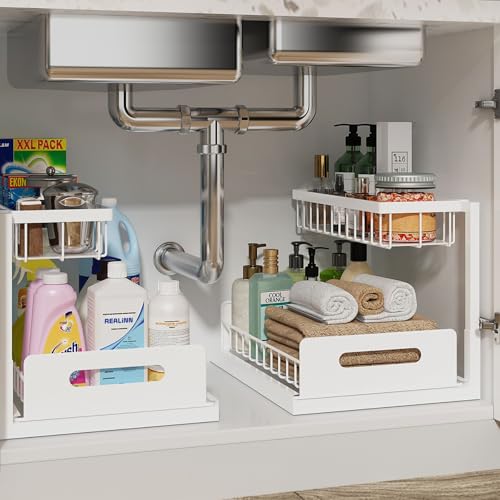
REALINN L-Shaped 2-Tier Pull-Out Under Sink Organizer (2-Pack) — Best Overall
Every under-sink cabinet has the same geography problem: a trap and two supply lines occupy the centre, the doors open onto a dark cave, and bottles migrate to the back until they are archaeological. The REALINN’s L-shaped frame is the first design decision that respects that geography. One side rises in two tiers for tall bottles; the other side steps around the plumbing. Add a sliding drawer below and the cabinet’s contents stop being a dig — the back row slides out into the light, which is where under-sink storage either works or does not.
The build is metal and rated for real weight, which matters more than it sounds. Under-sink loads are dense — full shampoo bottles, cleaning refills, a hairdryer’s worth of tools — and plastic shelves that bow in month two teach households to stop trusting the system. A frame that holds its shape keeps the tiers honest, the drawer sliding, and the whole arrangement boring in the way good storage should be. Sold as a pair, it covers a wide double vanity or two standard cabinets in one purchase.
Measure before you buy: trap position, cabinet width and door swing. With those confirmed, this is the organiser that turns the worst cabinet in the bathroom into a working one — and the benchmark the rest of this list is judged against.
Strengths
- The L-shape is the whole idea: the tall side hosts bottles, the cut-out side respects the plumbing, and no capacity is wasted pretending the pipes are not there
- The sliding drawer ends the kneel-and-reach archaeology of under-sink cabinets — the back row comes to you
- Metal frame and a serious weight rating mean it stores real bottles, not just cotton pads
Trade-offs
- You must measure your trap’s position before ordering; an L-shape fits most layouts, not every eccentric one
- Two units assume a standard-to-wide cabinet; a very small vanity may only take one
- Assembly is required — simple, but not zero
| Detail | What to know |
|---|---|
| Shape | L-shaped frame that leaves room for the trap and supply lines |
| Tiers | Two tiers with a sliding lower drawer |
| Build | Metal construction; 2-pack for one wide or two standard cabinets |
Best for: most bathroom vanity cabinets, where plumbing eats the middle and everything else fights for the edges / Not suited for: very narrow pedestal-adjacent cabinets, or anyone wanting a single tall unit rather than a pair
Check on Amazon to check the current price on Amazon and confirm the exact configuration before you order.

GeeBom Double Slide-Out Metal Shelf Organizer (2-Pack) — Best Slide-Out Shelves
The GeeBom’s answer to the dark-cabinet problem is motion: both of its metal tiers slide out, so the cabinet effectively comes to you in sections. That sounds like a small difference from a sliding bottom drawer, and in daily use it is not. The top tier is where tall bottles live, and in fixed organisers those bottles at the back are the ones that fossilise. Here the whole shelf glides forward, the back bottle is as available as the front, and the cabinet’s full depth — usually a third of its volume — rejoins the household.
Metal construction suits the under-sink climate. This is the cabinet of slow drips, shampoo runoff and the occasional trap weep, and a shelf that wipes clean and cannot swell, stain or harbour mildew in its joints is the right material for the postcode. The white finish makes the interior visibly brighter, which is a real feature in a cabinet whose other problem is darkness: you store better in a space you can see into.
Plan the layout around your plumbing before ordering — the rectangular rack needs its footprint clear, so measure the trap’s sweep and the supply lines’ positions. Where the footprint fits, the GeeBom pair delivers the most complete access of any pick here: two cabinets, or one wide one, fully retrievable in both tiers.
Strengths
- Sliding both tiers, not just the bottom one, means tall bottles at the back of the top shelf are reachable too
- Metal shelves wipe clean — the under-sink world of drips and leaks is unkind to absorbent materials
- A matched pair keeps a double vanity symmetrical and doubles the system in a second bathroom
Trade-offs
- Rectangular footprint does not wrap plumbing the way the L-shaped pick does; layout planning matters
- Slide mechanisms want a level cabinet floor to run true
- White finish shows every drip until wiped — the price of seeing the dirt is cleaning it
| Detail | What to know |
|---|---|
| Tiers | Two tiers, both sliding out |
| Build | Metal shelf construction |
| Pack | Two units — wide cabinet or two rooms |
Best for: bathrooms where the under-sink cabinet is deep and the back half has been a write-off for years / Not suited for: cabinets with unusual plumbing intrusions that a rectangular rack cannot straddle — measure the trap zone
Check on Amazon to check the current price on Amazon and confirm the exact configuration before you order.

Madoalker 2-Pack Under Sink Organizer With Pull-Out Drawer — Best Value, Tool-Free
The Madoalker understands its buyer: someone standing in front of an open vanity cabinet, tonight, wanting it sorted without a project. It assembles without tools — the pieces slot and clip by hand — stands in two tiers with a pull-out drawer beneath, and immediately converts the cabinet from a cave into a shallow, reachable system. For renters, students, first flats and guest bathrooms, that speed and reversibility are not budget compromises; they are the correct specification.
The design spends its money where it matters. The drawer solves the access problem, the upper tier doubles the bottle line, and the footprint is sized for the standard cabinet and the standard contents — cleaning supplies under one sink, toiletries under another, with a second unit in the pack for exactly that split. What it does not buy is the metal frames’ load headroom, so load it as intended: bottles and supplies, not a dumbbell collection of bulk refills stacked three deep.
Choose it when the alternative is another year of chaos, or when the cabinet is not yours to modify. It is the organiser most likely to be installed the day it arrives — and an installed good organiser beats a perfect one still in its box every single week.
Strengths
- Tool-free assembly is a genuine feature in a rental or a first home: up in minutes, out without a trace when you move
- The pull-out drawer covers the essential access problem — the back row — at the friendliest tier in this list
- A 2-pack at this level lets you organise the bathroom and still have one for the kitchen sink
Trade-offs
- Frame materials are lighter than the metal picks; respect the load it is designed for
- Fixed tier heights mean very tall bottles may still live outside the system
- Black finish hides drips so well you must remember to wipe it — out of sight works both ways
| Detail | What to know |
|---|---|
| Assembly | Tool-free — clips and slots together by hand |
| Tiers | Two tiers with a pull-out drawer below |
| Fit | Sized for cleaning supplies and toiletries in standard cabinets |
Best for: renters, first bathrooms and anyone who wants the cabinet fixed this evening without a screwdriver / Not suited for: heavy-load storage of many full-size bottles, where the metal-framed picks are stronger
Check on Amazon to check the current price on Amazon and confirm the exact configuration before you order.
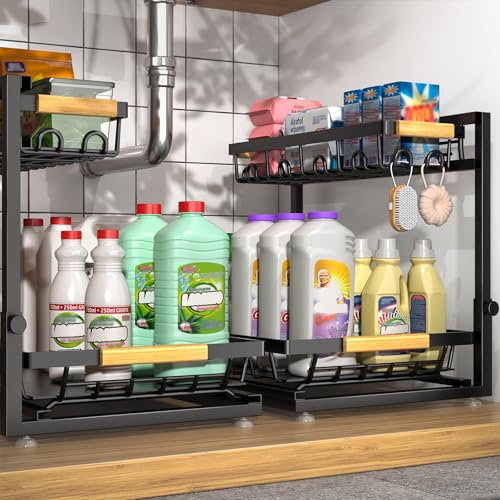
Sevenblue 2-Tier Height-Adjustable Under Sink Organizer (2-Pack) — Best Adjustable Fit
Fixed-height organisers carry a hidden assumption: that your bottles are the height the designer guessed. The Sevenblue drops the assumption. Its tiers adjust, so the lower level can stand tall enough for pump bottles and cleaning sprays standing upright — no lying them down, no decanting, no exile to the counter — while the upper tier drops to exactly the clearance your trap allows. In cabinets with eccentric plumbing, that adjustability is the difference between using eighty percent of the volume and using all of it.
The format is extra-large and proud of it, aimed at the wide cabinets under double vanities where standard organisers rattle around in a sea of wasted floor. Two units in the pack let a big cabinet be zoned — hers, his, cleaning, spares — or split between bathroom and kitchen. The brown shelf finish is warm and specific; in the right bathroom it looks deliberate, and buyers with chrome-and-white schemes should check the photos with honest eyes.
Buy it when your cabinet or your bottles have defeated fixed organisers before. The configuration takes ten thoughtful minutes, repaid every time a tall bottle stands where it belongs instead of migrating to the counter — which is where under-sink systems are ultimately judged: by how empty the counter stays.
Strengths
- Adjustable height is the difference between an organiser that fits your cabinet and one that fits a catalogue’s cabinet
- Tall pump bottles and spray heads stand upright on the lower tier instead of lying down or living on the counter
- Extra-large shelves suit the wide double vanity whose cabinet swallows standard organisers and still looks empty
Trade-offs
- Adjustability adds setup time — you are configuring, not just placing
- The big footprint demands a big cabinet; measure width and depth honestly
- Brown finish is a specific look that will not suit every bathroom’s palette
| Detail | What to know |
|---|---|
| Adjustment | Tier height adjusts to fit bottle heights and plumbing |
| Size | Extra-large shelf format for wide cabinets |
| Pack | Two units included |
Best for: cabinets with tall bottles, awkward traps or non-standard interiors that fixed-height organisers waste / Not suited for: small vanities, where the extra-large footprint is simply too much furniture
Check on Amazon to check the current price on Amazon and confirm the exact configuration before you order.

Delamu 2-Tier Bathroom Under Sink Organizer With Movable Dividers (2-Pack) — Best for Toiletries and Small Items
Bathroom under-sink chaos comes in two species. The first is bottles, and the slide-out picks handle it. The second is worse: the small-item stratum — medicines, nail tools, cotton supplies, hair accessories, the tube that must be findable at midnight — all settling into one archaeological layer. The Delamu is built for that species. Its two tiers carry movable dividers, so the cabinet gains neighbourhoods: medicines here, daily toiletries there, spares at the back, each zone visible at a pull and stable because the dividers hold the borders.
The pull-out access matters as much for small things as for bottles — more, in fact, because small items migrate backwards fastest. The units are compact and stackable, which opens the smaller cabinets and the medicine-cabinet overflow that the big frames cannot serve, and the pair in the pack makes the system repeatable: the same zones, in the same places, in the family bathroom and the ensuite, so the household’s memory of where things live works in both rooms.
Pair it with a bottle solution if your cabinet holds both worlds — a Delamu for the small chaos beside a REALINN or GeeBom for the tall one is the complete under-sink answer. Alone, it is the best pick here for the toiletry-heavy bathroom whose problem was never space, only order.
Strengths
- Dividers are the feature small items have been begging for: medicines, cosmetics and tools stop migrating into one tangled stratum
- Compact units fit the smaller vanity cabinets the big metal frames cannot enter
- A pair lets you run identical systems in two bathrooms — or his and hers zones in one cabinet
Trade-offs
- Divider systems reward a tidy temperament; the determinedly chaotic will defeat any zoning eventually
- Capacity per unit is modest — this is organisation, not bulk warehousing
- Plastic construction prefers sensible loads over the heaviest refill bottles
| Detail | What to know |
|---|---|
| Dividers | Movable dividers to zone small items |
| Access | Pull-out design for cabinet-depth retrieval |
| Format | Stackable, compact two-tier units, sold as a pair |
Best for: the toiletry and medicine end of bathroom storage — many small items that must stay separated and findable / Not suited for: bulk cleaning-supply storage, where the metal slide-out picks carry more and slide further
Check on Amazon to check the current price on Amazon and confirm the exact configuration before you order.

DEKAVA Sliding Basket Under Sink Organizer (2-Pack) — Best Basket Style
There are two philosophies of storage: hide it beautifully, or see it instantly. The DEKAVA is the second philosophy, in sliding baskets. Every item sits visible in an open basket that glides out, so the under-sink cabinet stops being a place things disappear into. For the household member who does the finding — the plasters, the spare toothpaste, the particular bottle — that visibility is worth more than any finish, and the open design ventilates a cabinet whose climate is otherwise a swamp.
Baskets also forgive the under-sink reality of drips. A leak or a wet bottle in a closed drawer marinates; in an open basket it is seen at the next glance and wiped in seconds, and the basket itself rinses clean under a tap. The two-tier sliding arrangement keeps the access honest — the lower basket comes out to you rather than demanding the kneel-and-grope — and the pair covers a wide cabinet or two rooms in the same, repeatable system.
Its limits are the philosophy’s limits: tiny loose items escape baskets, and the look is workshop-honest rather than boutique. Households that store in bottles, tubes and boxes — most bathrooms — will find it the fastest, freshest system here. Households of small wandering objects should take the Delamu’s dividers, or run both, as the final pick in this list so often ends up recommending.
Strengths
- Open baskets are the most honest storage: nothing hides, nothing is forgotten at the back of a closed drawer, and spills are visible before they become archaeology
- Baskets lift the ventilation game — damp-prone items and cloths dry instead of stewing
- Sliding access plus visibility makes this the fastest system to use with wet hands and no patience
Trade-offs
- Small and narrow items can tip or slip through basket spacing — corral them in a pouch or choose the Delamu
- Baskets flex under very heavy point loads more than solid metal shelves
- The utilitarian look suits working bathrooms better than showcase ones
| Detail | What to know |
|---|---|
| Design | Open baskets on sliding rails, two tiers |
| Visibility | See-through storage — contents readable at a glance |
| Pack | Two units for one wide or two standard cabinets |
Best for: buyers who think visually and want every item visible at a glance, in a ventilated, easy-clean format / Not suited for: anyone storing items that roll, tip or escape through basket gaps — small loose objects need the divider pick instead
Check on Amazon to check the current price on Amazon and confirm the exact configuration before you order.
Comparison Table
| Pick | Badge | Key spec | Best for |
|---|---|---|---|
| REALINN L-Shaped 2-Tier Pull-Out Under Sink Organizer (2-Pack) | Best Overall | L-shaped 2-tier metal frame; sliding drawer; rated to 50 lb class; sold as a 2-pack | most bathroom vanity cabinets, where plumbing eats the middle and everything else fights for the edges |
| GeeBom Double Slide-Out Metal Shelf Organizer (2-Pack) | Best Slide-Out Shelves | 2-tier metal rack; double slide-out shelves; 2-pack; white finish | bathrooms where the under-sink cabinet is deep and the back half has been a write-off for years |
| Madoalker 2-Pack Under Sink Organizer With Pull-Out Drawer | Best Value, Tool-Free | 2-tier frame; pull-out lower drawer; tool-free assembly; 2-pack | renters, first bathrooms and anyone who wants the cabinet fixed this evening without a screwdriver |
| Sevenblue 2-Tier Height-Adjustable Under Sink Organizer (2-Pack) | Best Adjustable Fit | 2-tier design with adjustable tier height; extra-large shelf format; 2-pack | cabinets with tall bottles, awkward traps or non-standard interiors that fixed-height organisers waste |
| Delamu 2-Tier Bathroom Under Sink Organizer With Movable Dividers (2-Pack) | Best for Toiletries and Small Items | 2-tier organiser; movable dividers; pull-out design; stackable; 2-pack | the toiletry and medicine end of bathroom storage — many small items that must stay separated and findable |
| DEKAVA Sliding Basket Under Sink Organizer (2-Pack) | Best Basket Style | 2-tier sliding basket drawers; open basket design; 2-pack | buyers who think visually and want every item visible at a glance, in a ventilated, easy-clean format |
The table compresses six philosophies into four columns, so read it by problem, not by rank. Plumbing in the way points to the L-shape or the adjustable tiers. A deep, dark cabinet points to slide-out access. Small-item chaos points to dividers; bottle chaos, to the metal frames; a visual household, to baskets; a rented cabinet, to the tool-free pick. Many real cabinets hold two problems at once, and the honest answer — stated in several reviews — is a pair of complementary systems rather than one organiser asked to be everything. And if your cabinet defeats every category at once — narrow, plumbed eccentrically, and shallow — take that as information rather than failure: some cabinets honestly serve best with a single sliding basket and an edited collection, while the overflow moves to a wall cabinet or an over-toilet unit. The goal was never to maximise what one cupboard swallows; it is to make the daily items reachable, the cleaning supplies corralled and the trap visible. An organiser that achieves those three in a difficult cabinet has done the whole job completely, whatever its tier count or its price.
How to Choose Under-Cabinet Bathroom Storage
Measure the cabinet like a surveyor, not a guesser. You need the interior width and depth, the height from floor to the underside of the basin, the position and sweep of the trap, where the supply lines and valves sit, and how far the doors open. Write them down. Most failed organiser purchases are not bad products; they are good products ordered against imagined dimensions, defeated by a trap that sits two inches left of where the photograph assumed. The picks above each state their plumbing assumption so your measurements have something to answer.
Decide what the cabinet is for, because bathroom under-sinks serve two different masters. Cleaning storage wants height for spray bottles, strength for refill containers, and wipe-clean materials. Toiletry storage wants division, visibility and gentle access for small daily things. A cabinet asked to do both should be zoned deliberately — a bottle system on one side, a divider system on the other — rather than filled with one organiser that serves neither master well. The reviews are written to be combined in exactly that way.
Finally, privilege retrieval over capacity in every close call. A two-tier system whose lower drawer slides fully out will be used happily for years; a three-tier fixed tower that technically holds more will be cursed monthly and quietly bypassed, its contents migrating back to the counter. The counter, in the end, is the scoreboard: the right under-cabinet system is the one that keeps it empty.
Working Around Plumbing: The Geometry Every Buyer Must Solve
The trap is the cabinet’s immovable tenant. It drops from the basin, bends towards the wall, and claims a vertical column and a horizontal sweep that no organiser can occupy. Supply lines and shut-off valves claim two smaller territories beside it. What remains is an L or a U of usable space, and the entire design field of under-sink storage is a set of answers to that shape: the L-frame wraps it, the adjustable organiser steps over or beside it, the narrow units flank it, and the naive rectangle collides with it.
Your job is to learn your own geometry before ordering. Kneel down with a torch and a tape: how far does the trap hang below the basin, how far forward does its bend reach, and are the valves where a shelf’s back corner wants to be? Five minutes of this reconnaissance converts the product dimensions in these reviews from abstractions into a yes or a no. It also reveals the cabinet’s other secrets — the slow drip to fix first, the lost items to rescue, the true floor condition your new system will sit on.
A word for pedestal and wall-hung basins: they have no cabinet, and this category is not for them — their storage answer is a different article entirely. And for cabinets with a drawer-shaped false front and a shallow basin, measure the real interior, not the door’s promise. Under-sink storage rewards the households that measure once, honestly, and punishes everyone else with returns.
What Belongs Under the Bathroom Sink — and What Does Not
A working system starts with eviction. Under the bathroom sink belong: daily and weekly toiletries in active rotation, cleaning supplies for that bathroom, spare consumables in ones and twos, and the hair tools that live where they are used. Under it do not belong: medicines that children can reach in an unlocked low cabinet (they want a higher, drier home), bulk back-stock beyond a spare or two, anything ruined by damp, and the museum of half-used products every household accumulates. The organiser cannot fix a collection problem; it can only organise a collection that has been edited.
Damp deserves its own rule. The under-sink cabinet is the most leak-prone volume in the home, so store nothing there that water would destroy, keep the trap’s joints visible rather than buried behind boxes — a leak spotted in week one is a wipe; spotted in month six, it is a cabinet floor — and favour organisers that lift contents off the floor on a frame or a lower tier. Every pick here does that by design, which is one more reason the category’s answer is a raised, open system rather than a prettier box on the floor.
Edit first, measure second, buy third, in that order, and the system you install will still make sense in a year. Households that reverse the order — buying the organiser as a substitute for deciding — own beautiful organisers full of the same chaos, arranged in tiers.
Keeping an Under-Sink System Working: The Quarterly Reset
Even the best system drifts. Bottles finish and their replacements are a different shape; a new product joins without an old one leaving; the cleaning supplies breed. The countermeasure is a quarterly reset that takes ten minutes: slide everything out — which is why you bought sliding access — wipe the cabinet floor and check the trap joints while it is empty, evict the dead and the duplicated, and re-zone what remains. A system maintained quarterly never needs reorganising; a system never maintained needs it by spring, whatever it cost.
The reset is also where the organiser earns its design. Fixed shelves make the reset a kneeling excavation, so it does not happen; drawers and baskets make it a standing, two-handed sort, so it does. When you choose between the picks above, you are really choosing how your future resets feel — and households keep the habits that feel easy. Buy the access you will actually use, and the order you install this month will still be the order you live with next year.
Two Bathrooms, One System: Why Matched Storage Changes Habits
There is a quiet argument for standardising on one organiser family across a home’s bathrooms, and it is about memory rather than tidiness. When the family bathroom and the ensuite run the same zones in the same places — daily items top-front, spares low-back, cleaning together on the plumbing side — nobody has to remember two systems. A guest can find the plasters; a teenager can find the toothpaste in either room; the person restocking can carry one mental map. Matched pairs, which most of these picks are sold as, exist because manufacturers have watched households behave exactly this way.
Standardising also disciplines buying. A defined zone has a defined capacity, and when the spares zone is full, the household has its answer about whether another bulk purchase is storage or hoarding. The organiser becomes a quiet budget tool: it makes the collection’s true size visible, in both bathrooms, in the same units. None of this requires the premium picks — the tool-free pair standardises a rental just as well — it requires only that the second bathroom not be an afterthought with a different, lesser system that nobody learns.
If your home has the classic arrangement — one hard-working family bathroom and one smaller ensuite or guest bath — the practical pattern is the main system where the traffic is, its twin where the guests are, and the same quarterly reset applied to both on the same morning. Ten extra minutes, two cabinets that behave identically, and a household that stops losing small things in dark cupboards altogether.
How to Measure and Install Under-Cabinet Storage That Fits First Time
Installation in this category is minutes of work preceded by the measuring that decides everything. Do the steps in order and the organiser will fit the first time.
- Empty the cabinet completely. Wipe the floor, check the trap and supply joints for drips, and fix any leak before storage goes back in.
- Measure the interior: width, depth, floor-to-basin height, and the trap’s position — how far it hangs down and how far its bend reaches forward.
- Note the door swing and any centre stile; a sliding drawer needs its full travel clear of both.
- Sketch the cabinet’s usable zones around the plumbing and match them to the organiser’s footprint and plumbing assumption before ordering.
- Assemble the unit outside the cabinet where you can see what you are doing, then set it in place and test every drawer and shelf for full, smooth travel.
- Load by zone — daily items front and top, spares behind and below, cleaning supplies together — and leave the trap’s joints visible, not buried.
Live with the system for a fortnight before judging it, then make one adjustment pass: the item you reached for daily that lives at the back moves forward; the zone that overflowed trades with the zone that did not. Storage systems converge after one honest adjustment — and then, with a quarterly reset, they stay converged.
Common Buying Mistakes
Ordering before measuring the trap. It is the category’s defining error. The trap’s position is the cabinet’s constitution; an organiser that ignores it is furniture for a different room.
Buying capacity instead of access. A fixed three-tier tower that holds more and retrieves worse will be bypassed within a month, and its contents will migrate to the counter it was bought to clear.
Storing medicines low and reachable. An under-sink cabinet is at toddler height and rarely locked. Medicines belong higher and drier; use this space for the supplies that cannot harm.
Burying the trap behind boxes. The one joint most likely to leak in the bathroom should stay visible. A drip spotted early is a wipe; a drip spotted late is a cabinet floor and a plumber.
Skipping the edit. Organising an unedited collection just gives chaos a structure. Evict the dead, the duplicated and the damp-ruined first — then measure, then buy.
Final Recommendation
Most vanity cabinets should start with the REALINN L-shaped organiser: it is the design that respects the plumbing, retrieves the back row, and carries real weight. Deep cabinets that need full access in both tiers point to the GeeBom; tall bottles and eccentric cabinets, to the Sevenblue’s adjustable tiers; small-item chaos, to the Delamu’s dividers; visual households, to the DEKAVA baskets; and renters who want it done tonight, to the tool-free Madoalker. Combined in pairs, they cover every cabinet this article has met.
Measure your trap, edit the collection, buy the access — in that order — and the worst cupboard in the bathroom becomes one of the best-run. The neighbouring guides below cover the storage above the counter, for the households whose tidying has momentum.
A final encouragement for the household that has attempted this cabinet before and watched the order collapse: the collapse was almost certainly a design failure, not a character failure. Fixed shelves in a dark, plumbed cave defeat tidy people reliably. Give the same people a frame that fits the pipes and a drawer that brings the back row into the light, and the order mostly keeps itself, with the quarterly reset as light housekeeping rather than archaeology. Judge the picks above by that standard — not by how much they hold on day one, but by whether a normal, busy household will still be living happily inside their system on day three hundred. That is the only test under-sink storage has ever really had.
Best Bathroom Storage Cabinets Best Over Toilet Storage Best Shower Caddies Best Bathroom Organizers Best Medicine Cabinet Organizers
Frequently Asked Questions
How do I measure my under-sink cabinet for an organiser?
Measure the interior width, depth and the height from the cabinet floor to the underside of the basin. Then measure the plumbing: how low the trap hangs and how far forward its bend reaches, plus where the supply valves sit. Sketch those obstacles — the right organiser is the one whose footprint and cut-outs match your sketch, which is why the reviews state each design’s plumbing assumption.
What is the best style of under-sink organiser for a bathroom?
For most vanity cabinets, a two-tier design with a sliding lower drawer, in a shape that works around the trap — the L-shaped pick leads this list for exactly that reason. Deep cabinets benefit from shelves that slide in both tiers; toiletry-heavy cabinets from dividers; and visual households from open baskets. The best style is the one matched to your cabinet’s geometry and your contents’ shape.
Can under-sink organisers handle the plumbing in any cabinet?
Most standard layouts, yes — traps sit in predictable places and the better designs are shaped around them. Eccentric plumbing, very low traps and cabinets with centre stiles can defeat specific models, which is why measuring comes first. Adjustable-height organisers solve the widest range of awkward cabinets; L-shaped frames solve the commonest layout most elegantly.
What should I not store under the bathroom sink?
Medicines within children’s reach, anything water would destroy, and bulk back-stock beyond a spare or two. The cabinet is low, damp-prone and rarely locked. Keep the trap’s joints visible rather than buried, store active supplies and cleaning products there, and give medicines a higher, drier, safer home.
Are two-pack organisers worth it?
In this category, usually yes. The standard situations — a double vanity, or a bathroom and an ensuite with matching cabinets — both want the same system twice, and a matched pair costs less than two singles while making the household’s storage habits identical in both rooms. If you truly have one small cabinet, several picks here work happily as a single unit with a spare for the kitchen sink.
How do I stop an under-sink cabinet smelling damp?
Fix any trap drip first, then keep contents raised on a frame or tier rather than sitting on the cabinet floor, and choose wipe-clean metal or basket designs over absorbent materials. A quarterly empty-and-wipe reset — easy with sliding access — keeps the cabinet fresh, and leaving the doors open for an hour after a steamy shower helps more than any scented product.


