Disclosure: airfryerkitchensupply.com is reader-supported. When you buy through links on our site, we may earn an affiliate commission at no extra cost to you.
Where to buy
Bath mats are sold through Amazon, home stores and the makers’ own sites. Every linked pick below was verified against Amazon’s catalogue data for this site; use the links to check price on Amazon and confirm the exact size and colour, because most of these rugs come in several footprints and the wrong one changes everything.
- Gorilla Grip Chenille Bath Rug, 24 x 17 in — check price on Amazon
- OLANLY Thick Memory Foam Bath Rug, 30 x 20 in — check price on Amazon
- Gorilla Grip Memory Foam Bath Rug, 36 x 24 in — check price on Amazon
- OLANLY Microfiber Bath Rug, 30 x 20 in — check price on Amazon
- Gorilla Grip Chenille Bath Rug, 36 x 24 in — check price on Amazon
- Gorilla Grip Bath Tub and Shower Mat, 35 x 16 in — check price on Amazon
The best bathroom bath mats do three unglamorous jobs brilliantly: they catch the water that leaves the shower or tub with you, they stay exactly where you put them while your feet are wet, and they survive being washed again and again without falling apart or growing the smell. Everything else — softness, colour, the little lift a good mat gives a tired bathroom — is a bonus on top of those three. The six picks below were chosen against that standard, and they split by material and mission: grippy chenille rugs for everyday floors, memory foam for feet that stand and ache, fast-drying microfiber for family traffic, and one in-tub liner for the surface where slips actually happen.
A note on the category’s confusion before the reviews: ‘bath mat’ means both the rug on the floor and the liner inside the tub, and most households need one of each. Five picks here are floor rugs, compared on pile, backing, size and drying speed. The sixth is the in-tub safety mat, included because a roundup of bath mats that ignores the tub itself would be protecting the floor and forgetting the person. Buy the floor rug for your routine and the liner for your safety, and judge each by its own job.
In this guide
Quick Picks
Gorilla Grip Chenille Bath Rug, 24 x 17 in — Best Overall. Dense chenille that drinks water fast, on a genuinely grippy rubber backing — the floor mat most bathrooms actually need. — Check on Amazon
OLANLY Thick Memory Foam Bath Rug, 30 x 20 in — Best Cushioned Comfort. Thick memory foam under a soft, quick-drying surface — the mat for people who stand at the vanity and feel it in their feet. — Check on Amazon
Gorilla Grip Memory Foam Bath Rug, 36 x 24 in — Best Large Mat. A big velvet-surfaced memory foam mat with grip dots — coverage and cushioning for double vanities and wide tub fronts. — Check on Amazon
OLANLY Microfiber Bath Rug, 30 x 20 in — Best Quick-Drying. Plush microfiber on a rubber backing, made to dry fast — the pick for busy family bathrooms that never fully rest. — Check on Amazon
Gorilla Grip Chenille Bath Rug, 36 x 24 in — Best for Double Vanities. The flagship chenille in the wide format: one grippy, absorbent rug spanning a double sink instead of two small mats at war. — Check on Amazon
Gorilla Grip Bath Tub and Shower Mat, 35 x 16 in — Best In-Tub Safety Mat. The other kind of bath mat: a long suction-cup liner for inside the tub, with drain holes and a soft surface — grip where slips actually happen. — Check on Amazon
How These Picks Were Chosen
We chose these mats the way a bathroom tests them. First, backing: a mat that travels on wet tile fails its core purpose, so full rubber backings and serious grip systems scored ahead of sprayed-on coatings and bare fabric undersides. Second, water behaviour — not just absorption, but the full cycle of absorbing, drying before the next use, and washing without the pile matting or the backing cracking. A mat that is still damp at bedtime is a mildew project, whatever its first-week softness promised.
Third, sizing honesty. Mats are sold in a thicket of near-identical dimensions, and a two-inch difference decides whether a rug covers a stance zone or bunches at a door. Each pick below is recommended in a specific size for a specific footprint, and the reviews say who should size up or down. Fourth, materials you can verify: recognised textile-safety certification where it exists, construction that matches the maker’s description, and brands with a track record in this exact category rather than a marketplace listing that will vanish by spring.
Every linked product was cross-checked against Amazon’s catalogue through this site’s product data feed, matching brand, material and dimensions before a link was included. Prices are never printed here — check price on Amazon at purchase, and measure your floor and door clearance before you fall for any size, including the ones recommended below.
The 6 Best Bathroom Bath Mats

Gorilla Grip Chenille Bath Rug, 24 x 17 in — Best Overall
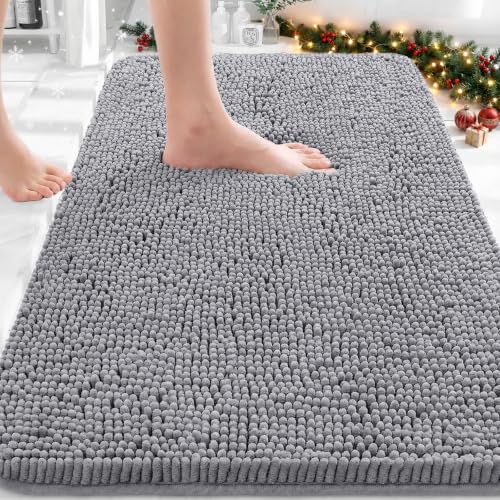
A bath mat has three jobs — catch the water, stay put, and survive the wash — and this Gorilla Grip chenille rug is the pick that does all three without drama. The pile is dense enough to pull water off feet in a couple of steps, the rubber backing is the real article rather than a sprayed-on suggestion of grip, and the whole thing goes through the machine when bathroom reality catches up with it. In the standard 24 by 17 size it covers the exact rectangle where a person stands at a single sink or steps out of a shower, which is why it outsells fancier mats year after year.
The certification on the materials is worth a sentence in a room where bare feet and children are involved: the rug is made to a recognised textile-safety standard, which is more than the anonymous bargain mats can say. Underfoot it feels plush without the slow, soggy recovery of deep-pile cotton, and it dries between morning and evening use in a ventilated bathroom — a small thing that separates a mat that smells fresh from one that develops the familiar bathroom funk.
Buy it as the default mat for a main bathroom and buy two if you rotate laundry weekly, because a mat in the wash is a wet floor. Step up to the larger Gorilla Grip sizes below for double vanities, and look to the memory-foam picks if your knees and feet want cushioning more than they want quick drying. As an all-rounder at a sane price tier, this is the mat to beat.
Strengths
- The rubber backing actually grips — the mat stays where you put it instead of skating across tile when you step out wet
- Chenille pile absorbs drips and splashes quickly and dries faster than thick cotton loops
- Compact standard size fits the landing zone in front of most sinks and tubs without bunching at the door
Trade-offs
- Chenille is comfortable but not cushioned — standing at the sink for long grooming sessions is firmer than on foam
- The smaller footprint leaves big splash zones around a tub partly uncovered
- Rubber backings prefer gentle washing and air drying to live their longest life
| Detail | What to know |
|---|---|
| Material | Chenille pile with rubber grip backing |
| Size | 24 x 17 in — standard single-sink footprint |
| Care | Machine washable |
Best for: most single-vanity bathrooms that need one dependable, washable, stay-put mat / Not suited for: anyone wanting deep cushioning underfoot, or a runner length for a double vanity
Check on Amazon to check the current price on Amazon and confirm the exact configuration before you order.

OLANLY Thick Memory Foam Bath Rug, 30 x 20 in — Best Cushioned Comfort
Memory foam changes what a bath mat is for. A flat rug manages water; a foam rug manages water and the person standing on it. The OLANLY’s thick core takes the ache out of long vanity sessions — skincare routines, shaving, supervising children’s bath time from a kneeling position beside the tub — and on winter tile the insulation alone justifies it: stepping out of a hot shower onto foam instead of cold ceramic is a small daily luxury that never gets old.
The design is smarter than the first generation of foam mats, which drank water into the core and stayed damp for days. Here the absorbent surface pile does the drinking and is made to dry quickly, while the foam provides structure beneath. The non-slip backing keeps the thicker mat planted, which matters more as mats get plusher — a soft mat that slides is worse than a firm one that does not. In the 30 by 20 size it spans a full standing zone without runner bulk.
Care is the contract you sign: wash gently, dry thoroughly, and never leave it folded damp in a laundry basket. Households willing to keep that bargain get the most comfortable mat in this roundup. If your bathroom has no ventilation and everything stays damp, choose the chenille picks instead — foam rewards aired bathrooms and punishes steamy ones.
Strengths
- The foam core is genuinely kind to feet, knees and backs during long sink-side routines
- Surface pile absorbs step-out water while the foam below keeps the mat feeling dry longer than flat rugs
- Larger 30 x 20 footprint covers the full stance zone in front of a vanity or tub
Trade-offs
- Memory foam mats must dry fully between washes or they hold moisture in the core
- Foam compresses over years of use — expect comfort to soften gradually, not fail suddenly
- The plush thickness can catch on low-clearance bathroom doors; measure the swing
| Detail | What to know |
|---|---|
| Core | Thick memory foam cushioning |
| Surface | Soft absorbent pile, quick-drying |
| Size | 30 x 20 in — generous single-vanity coverage |
Best for: anyone who stands at the sink for long routines, older users who want softness underfoot, and cold-tile bathrooms / Not suited for: households that hang-dry nothing and wash hot — foam prefers gentler care
Check on Amazon to check the current price on Amazon and confirm the exact configuration before you order.

Gorilla Grip Memory Foam Bath Rug, 36 x 24 in — Best Large Mat
Size is a feature. The wettest square footage in most bathrooms is the wide strip in front of a double vanity or along a tub, and covering it with two small mats leaves a cold, wet seam exactly where people stand. This 36 by 24 Gorilla Grip foam rug covers the zone in one piece, with a velvet-soft surface over real memory foam, so two people can share a morning routine on one warm, dry, cushioned landing.
The grip-dot underside is a deliberate design choice worth understanding. A full rubber sheet grips hardest but makes a mat of this size stiff and slow to wash; dots trade a little absolute grip for flexibility and easier laundering, while still keeping the mat honest on tile. On smooth stone or polished floors, test it wet on day one — if your floor is unusually slick, the full-rubber chenille pick above is the safer anchor and this one can serve the tub side instead.
Choose it when the bathroom is big enough to deserve it and the routine is shared. It is the mat couples fight least about: wide, warm, soft, and washable. Just confirm your door clearance — at this size and thickness, the mat and a low door occasionally disagree, and it is better to know before the first wash than after.
Strengths
- One mat covers what two standard mats cover, with no gap in the middle where feet actually land
- Velvet surface feels warmer and softer than chenille, and sheds water off its pile quickly
- Grip dots keep the large mat planted while letting it flex and wash more easily than a full rubber back
Trade-offs
- Large mats take longer to dry after washing — plan a spare or a dry day
- Grip dots grip less absolutely than Gorilla Grip’s full rubber backing on the chenille rug
- The graphite palette suits modern bathrooms; traditional rooms may find fewer matching colours
| Detail | What to know |
|---|---|
| Surface | Soft velvet-finish pile over memory foam |
| Underside | Durable grip dots rather than a full rubber sheet |
| Size | 36 x 24 in — the largest footprint in this roundup |
Best for: double vanities, wide tub aprons and anyone who wants one large cushioned landing zone / Not suited for: small bathrooms where a 36-inch mat will swallow the floor and fight the door
Check on Amazon to check the current price on Amazon and confirm the exact configuration before you order.

OLANLY Microfiber Bath Rug, 30 x 20 in — Best Quick-Drying
In a family bathroom the mat’s hardest job is not the first shower of the day; it is the fourth. Cotton is still soggy, foam is still damp, and the floor gets wet anyway. Microfiber is the material that keeps up: it absorbs the step-out water, then gives it up to the air faster than the natural fibres, so the mat a teenager uses at seven is respectable again for a parent at eight. This OLANLY builds that material into a plush 30 by 20 rug with a proper rubber backing, at a price tier that makes owning two unremarkable.
That two-mat rotation is the real recommendation here. One microfiber rug is good; two, alternating wash and wear, keep a busy bathroom permanently dry-floored without anyone thinking about it. The pile is soft enough for bare feet and children, the backing keeps it from travelling, and the whole thing tolerates the frequent washing that family bathrooms demand better than delicate constructions do.
It is not the luxury pick — there is no foam to sink into, and the pile will not look new as long as the chenille flagship. Judge it as infrastructure: the mat that makes a shared bathroom work every day, in humidity that defeats slower-drying rivals. For guest bathrooms and gentle use, spend on plushness; for the family front line, spend on drying speed.
Strengths
- Microfiber drinks water quickly and releases it quickly — the mat is ready again for the next shower in the queue
- Rubber backing keeps a lighter mat planted where sprayed-grip mats wander
- Machine washing and fast drying make a two-mat rotation painless
Trade-offs
- Microfiber pile flattens faster under daily traffic than dense chenille
- No foam core, so long standing sessions are comfortable rather than cushioned
- Light construction can curl at corners if washed hot or dried hard — follow the care label
| Detail | What to know |
|---|---|
| Material | Microfiber pile with rubber backing |
| Behaviour | Absorbs fast and dries faster than cotton or foam equivalents |
| Size | 30 x 20 in standard-plus footprint |
Best for: high-traffic family bathrooms, back-to-back showers and humid rooms where mats must dry between uses / Not suited for: buyers wanting deep foam cushioning or a heavy, luxury-weight rug
Check on Amazon to check the current price on Amazon and confirm the exact configuration before you order.

Gorilla Grip Chenille Bath Rug, 36 x 24 in — Best for Double Vanities
Everything said about the smaller Gorilla Grip chenille applies here at double width — and width changes the experience more than the specification suggests. A double vanity with two small mats is a small daily untidiness: mats drift, gap, and leave the middle stile wet. One 36 by 24 rug restores order. The chenille drinks from both basins’ splash zones, the full rubber back holds the whole span in place, and the bathroom simply looks finished in a way paired mats never achieve.
Chenille is the right pile for this job. Foam at this width dries slowly and washes heavily; cotton stays damp under double duty. Chenille’s synthetic pile absorbs fast, dries faster, and shrugs off the twice-daily traffic of a shared bathroom. The certified materials matter in a family room, and the grey palette hides the honest wear of a working bathroom better than pale colours do.
Measure before you buy: the rug should span the vanity’s stance zone without reaching the door swing or the toilet base, and your washing machine should swallow it comfortably. Where it fits, it is the tidiest solution in this roundup — the rare bathroom purchase that visibly improves the room every single morning while quietly doing the unglamorous work of keeping two people’s water off the floor.
Strengths
- Full rubber backing at this size means the wide mat stays exactly where the morning routine needs it
- Chenille absorbs the combined splash of two sinks and still dries between uses
- One rug looks calmer and tidier than a pair of small mats drifting apart
Trade-offs
- At this size it is a laundry commitment — check your machine’s capacity before buying
- No cushioning layer; long shared routines are comfortable, not plush
- Wide mats show a traffic lane over time; rotating end-for-end evens the wear
| Detail | What to know |
|---|---|
| Material | Chenille pile, full rubber grip backing |
| Size | 36 x 24 in — spans a double vanity stance zone |
| Care | Machine washable; air drying extends backing life |
Best for: double-vanity bathrooms that want one continuous, stay-put mat with fast drying / Not suited for: anyone who wants foam cushioning, or whose door swing cannot clear a larger rug
Check on Amazon to check the current price on Amazon and confirm the exact configuration before you order.

Gorilla Grip Bath Tub and Shower Mat, 35 x 16 in — Best In-Tub Safety Mat
Every other pick in this roundup manages water on the floor. This one manages the more dangerous surface: the inside of the tub, where wet porcelain, soap film and a shifting centre of gravity combine. The Gorilla Grip tub liner runs 35 inches — most of a standard tub — with suction cups across its underside and drain holes across its surface, so a bather, a child or an older parent steps onto grip at every point of the shower or bath, not just in one careful spot.
Two habits decide whether in-tub mats work. First, the mat must be washed: soap and skin oils coat suction cups until they quietly stop sealing, and a mat that slides inside a tub is worse than none. This one is machine washable, which removes the excuse. Second, it should be lifted and hung over the tub edge after use so both sides dry; left flat and wet, any mat grows the film that defeats it. Build those two habits and the liner becomes invisible infrastructure — noticed only on the day you shower somewhere without one.
Pair it with any floor rug above rather than choosing between them: the liner guards the tub, the rug guards the step-out, and together they cover the full wet journey. For households with young children, ageing parents or a freshly refinished slick tub, this is the highest-value safety purchase in the bathroom — and the one most often forgotten until after the first slip.
Strengths
- Covers nearly the whole tub floor, so feet land on grip wherever they step — not on a small island of mat
- Drain holes let water escape instead of pooling underfoot, and the surface stays soft rather than abrasive
- Machine washable, which in-tub mats must be: soap film and mildew are the enemies of grip
Trade-offs
- Suction cups need a smooth tub surface; heavily textured or refinished tubs may not seal
- It must be lifted and hung regularly or the underside grows slimy and stops gripping
- Clear styling is functional, not decorative — it will not warm up a bathroom’s look
| Detail | What to know |
|---|---|
| Fit | 35 x 16 in — covers most of a standard tub floor |
| Grip | Suction cups across the underside |
| Care | Machine washable; hang to dry between uses |
Best for: households with children, older bathers or anyone whose tub floor is slick — safety inside the tub, paired with a floor rug outside it / Not suited for: textured tubs where suction cups cannot seal, and anyone looking for a cushioned floor rug — this lives in the tub
Check on Amazon to check the current price on Amazon and confirm the exact configuration before you order.
Comparison Table
| Pick | Badge | Key spec | Best for |
|---|---|---|---|
| Gorilla Grip Chenille Bath Rug, 24 x 17 in | Best Overall | Absorbent chenille pile; strong rubber grip backing; OEKO-TEX certified materials | most single-vanity bathrooms that need one dependable, washable, stay-put mat |
| OLANLY Thick Memory Foam Bath Rug, 30 x 20 in | Best Cushioned Comfort | Thick memory foam core; absorbent quick-dry surface; non-slip backing; 30 x 20 in | anyone who stands at the sink for long routines, older users who want softness underfoot, and cold-tile bathrooms |
| Gorilla Grip Memory Foam Bath Rug, 36 x 24 in | Best Large Mat | Memory foam with velvet surface; grip-dot underside; 36 x 24 in large format | double vanities, wide tub aprons and anyone who wants one large cushioned landing zone |
| OLANLY Microfiber Bath Rug, 30 x 20 in | Best Quick-Drying | Microfiber pile; quick-drying build; rubber non-slip backing; 30 x 20 in | high-traffic family bathrooms, back-to-back showers and humid rooms where mats must dry between uses |
| Gorilla Grip Chenille Bath Rug, 36 x 24 in | Best for Double Vanities | Chenille pile; strong rubber grip backing; OEKO-TEX certified; 36 x 24 in wide format | double-vanity bathrooms that want one continuous, stay-put mat with fast drying |
| Gorilla Grip Bath Tub and Shower Mat, 35 x 16 in | Best In-Tub Safety Mat | Suction-cup underside; drain holes throughout; 35 x 16 in full-length tub coverage | households with children, older bathers or anyone whose tub floor is slick — safety inside the tub, paired with a floor rug outside it |
The pattern in the table is material logic, not ranking. Chenille is the all-rounder: absorbent, grippy, quick to dry. Memory foam trades drying speed for comfort. Microfiber trades plushness for the fastest dry in the list. The in-tub liner is not comparable to the rugs at all — it does a different, more important job. Most households end up with a chenille or foam rug as the main mat, a microfiber as the wash-day spare, and the liner in the tub permanently, which is why this roundup is built as a kit rather than a contest. If you are furnishing a bathroom from empty, buy in the order the water flows: the in-tub liner first, because safety outranks comfort; the main floor rug second, sized to the stance you measured; and the quick-drying spare third, the week the first laundry cycle leaves the floor bare. That sequence, dull as it sounds, is the difference between a bathroom that merely looks equipped and one that actually works on a wet Tuesday morning.
How to Choose a Bathroom Bath Mat
Start with the stance zone, not the catalogue. Stand where you actually stand — in front of the sink, at the tub’s edge — and measure that rectangle, including where your partner stands if the vanity is shared. Buy the mat that covers the zone in one piece; two undersized mats cost more, look worse and leave the wettest strip uncovered. Then check the door: swing it over the intended spot and confirm clearance, because a thick foam mat and a low door are a daily argument you will lose.
Choose the pile for your bathroom’s ventilation. A bathroom with a good extractor fan or a window can dry anything, and foam’s comfort is yours to enjoy. A windowless, steamy bathroom punishes slow materials — there, chenille and microfiber earn their keep by drying between uses, and thick cotton becomes a liability. Be honest about the room you have, not the room in the listing photos, and let drying speed outrank softness wherever moisture lingers.
Finally, judge the backing in person on day one. Put the mat on your actual floor, wet your feet, and step on it with intent. A backing that creeps on your tile will creep forever. Rubber backings grip hardest; grip dots flex and wash easier; sprayed coatings are the first thing to check and the first thing to fail. The five minutes spent testing beats a season of straightening a wandering mat with your toe every morning.
Bath Mat Materials, Explained Without the Marketing
Chenille is a synthetic pile with short, dense tufts. It absorbs quickly, dries quickly, washes well and feels plush for its thin profile — the sensible default, which is why it takes three of the six spots here in two brands’ executions. Its weakness is cushioning: the pile comforts the surface of the foot but does nothing for the joints behind it. Microfiber is finer and lighter still, the fastest drinker and fastest dryer of the group, at the cost of pile that flattens sooner under traffic. It is the family-bathroom material.
Memory foam is a different construction entirely: a cushioning core with an absorbent skin. It is the only material that helps people who stand — the long skincare routine, the parent kneeling at the tub, the older user whose feet feel every tile. Its cost is moisture management: the core must dry fully, washes must be gentle, and steamy bathrooms shorten its happy life. Cotton, the traditional material, appears in none of the top picks for a practical reason: it absorbs beautifully and then stays wet for hours, growing heavy and stale in exactly the rooms where mats work hardest. Where cotton wins on feel, synthetics win the week.
Sizing a Bath Mat for Every Bathroom Layout
A single vanity wants a mat around 30 by 20 inches or the compact 24 by 17 for tight rooms — enough for a full stance with dry margins, not so much that it swallows a small floor. The mistake is buying by the room’s size rather than the stance: a big bathroom with a single sink still needs only the stance covered, and oversizing a mat into the door swing or the toilet base creates bunching and hygiene problems at the edges.
Double vanities want one wide rug — 36 inches and up — for the reasons the wide picks above describe: no seam, no drift, one wash. Tub fronts want length along the tub’s long edge for the step-out and the kneeling parent alike. And small bathrooms want honesty: sometimes the correct mat is the compact chenille, hung over the tub edge to dry in a room where floor space and airflow are both scarce. Measure the stance, the swing and the tub edge, in that order, and the right size usually names itself.
Keeping a Bath Mat Fresh: The Washing Routine That Works
Mats fail by neglect more than by quality. The routine that keeps any of these picks fresh is simple: shake the mat outside weekly, wash it on the maker’s cycle — gentle for foam and rubber backings, warmer for microfiber — and dry it completely before it goes back down, air-drying rubber-backed rugs to protect the grip layer. A mat returned damp to a damp floor begins the mildew cycle the same day, and no material, however technical, outruns that arithmetic.
Rotation is the other half of freshness. Two mats alternating means each dries fully between tours and washes at half the frequency per mat, and the bathroom is never bare-floored on laundry day. This is why the value picks in this roundup matter: a second OLANLY or the microfiber spare costs little and doubles the working life of the primary mat. Replace any mat — whatever the brand — when the backing cracks, the pile stays flat after washing, or a washed mat still smells. Those are end-of-life signs, not cleaning failures.
What About Stone Mats and Other Alternatives?
Stone bath mats — slabs of diatomaceous earth that wick water off feet and dry almost instantly — are the fashionable alternative, and they solve a real problem: nothing dries faster, and there is nothing to launder. Understand the trade before switching. A stone mat does not absorb a puddle; it disperses a thin film of water and evaporates it, so a heavy splash zone overwhelms it. It is hard and cold underfoot, it can crack if dropped or set on an uneven floor, and it needs periodic sanding to refresh its surface. In a minimalist, well-ventilated bathroom with light water exposure it is elegant. In a family bathroom with children cannonballing out of the tub, the rugs above are the honest tool.
Heated and towel-style alternatives sit at the other extremes. A folded bath towel on the floor — the hotel habit — absorbs well and launders perfectly, but slides dangerously and looks like laundry, not furnishing; if you use one, put a grippy rug beneath it. Bamboo duckboards drain beautifully and suit spa-style and outdoor-adjacent bathrooms, but they catch nothing: the water goes through to the floor, which must then be mopped or drained. Each alternative optimises one variable. The reason chenille, foam and microfiber dominate this roundup is that they balance all of them — absorption, grip, drying, washing and comfort — in a single object that asks almost nothing of you.
Whichever family you choose, keep the safety test identical: wet feet, deliberate step, on your own floor. Materials marketing survives everything except that ten-second experiment, and it is the experiment your household will repeat, unthinkingly, thousands of times. Buy the mat that passes it in the size that covers your stance, from the material family your bathroom’s ventilation can keep fresh, and the category becomes what it should be — a solved problem you stop thinking about.
How to Place and Care for a Bath Mat So It Lasts
Five minutes of placement and a simple care rhythm separate a mat that serves for years from one that disappoints by spring.
- Start with a clean, dry floor. A new mat on a dusty or damp floor grips the dust, not the tile, and starts life sliding.
- Position the mat over the stance zone — centred on the sink or along the tub edge — with margins from the door swing and the toilet base.
- Press the mat down across its whole surface, especially the corners, so the backing makes full contact before the first shower.
- Test it wet on day one: step on and off with wet feet and a deliberate push. If it creeps on your floor, exchange the backing type now, not after a fall.
- Hang the mat over the tub edge or a rail after heavy use in steamy bathrooms; airflow underneath is the cheapest freshness there is.
- Wash on the maker’s cycle, dry completely before replacing, and rotate with a spare if your household showers back-to-back.
Re-test the grip monthly with the same wet-foot push. Backings age quietly, and the monthly test is how you learn a mat is retiring before it announces itself during a hurried, soapy step-out. When grip fades or the backing cracks, replace the mat — it has done its service, and the floor is not the place to economise on the next one.
Common Buying Mistakes
Buying one beautiful mat instead of two working ones. A single mat spends its life damp or in the wash. Two mid-priced mats in rotation stay fresher, last longer in total, and keep the floor covered every day.
Sizing by the room instead of the stance. Oversized mats bunch at doors and toilet bases; undersized ones leave the wettest strip bare. Measure where feet actually land.
Leaving the mat flat and wet in a steamy bathroom. That is the mildew recipe, whatever the material. Hang it, air it, or choose the fastest-drying pile your routine can support.
Ignoring the in-tub surface. Floor rugs do nothing for the slip that happens inside the tub. If anyone in the house is young, old or unsteady, the liner is the first purchase, not an afterthought.
Washing rubber backings hot and tumble-drying them hard. Heat is what cracks grip layers. Gentle cycles and air drying are the difference between a two-year mat and a five-year mat.
Final Recommendation
Most bathrooms should start with the Gorilla Grip chenille in the size that fits their vanity — it is the dependable default this category revolves around. Feet that ache at the sink should choose the OLANLY memory foam; wide double vanities, the large Gorilla Grip foam or the wide chenille; family bathrooms in a hurry, the OLANLY microfiber, ideally as a pair. And every household with a tub should add the Gorilla Grip in-tub liner, because it protects the one surface the rugs cannot reach.
Buy the kit in that order — floor first, tub always, spare when budget allows — and keep the washing routine boring. A bath mat is a small purchase that touches every day; chosen by stance, material and backing rather than by colour alone, it quietly makes the whole bathroom feel better run. The guides below cover the neighbouring sizes and materials if your layout is unusual.
One last practical tip before you order: buy the mat and its spare in the same transaction whenever the budget allows, in the same size and, if you like the look, the same colour. Bathroom ranges are revised constantly, and the buyer who returns a year later for an identical second mat often finds the shade changed or the size discontinued. A matched pair bought together rotates invisibly, wears evenly, and turns laundry day into a non-event. It is a small, unglamorous strategy — exactly like the product itself — and it is how the best-kept bathrooms quietly stay that way.
Best Bath Mats For Tile Floors Best Memory Foam Bath Mats Best Bath Rugs For Double Vanity Best Non Slip Bath Mats Best Bath Mats For Kids
Frequently Asked Questions
What is the best material for a bath mat?
For most bathrooms, chenille: it absorbs well, dries fast, grips with a rubber backing and survives frequent washing. Memory foam is better if you stand for long periods and your bathroom ventilates well enough to dry it. Microfiber dries fastest and suits busy family bathrooms. Cotton feels lovely and dries slowest, which is why it misses the top spots here.
How big should a bath mat be?
Big enough to cover your full stance in one piece — roughly 30 by 20 inches for a single vanity, 36 inches or wider for a double, and the length of the tub edge for a tub front. Measure the stance zone and the door swing before ordering; those two measurements decide more than any style choice.
How often should you wash a bath mat?
In a working family bathroom, weekly is a sane rhythm; in a light-use guest bathroom, every few weeks. Wash sooner whenever the mat stays damp, looks flat, or smells after drying. Always dry it completely before putting it back, and air-dry rubber-backed mats to protect the grip.
Do I need a mat inside the tub as well?
If anyone in the household is a child, an older adult, or unsteady — or your tub floor is smooth and soapy — yes. In-tub liners with suction cups guard the surface where slips actually happen. They need a smooth tub to seal, regular washing to keep gripping, and hanging to dry between uses.
Why does my bath mat slide, and how do I stop it?
Sliding means the backing is not gripping your floor: it may be a light sprayed coating, dust or moisture under the mat, or a backing aged past its grip. Clean and dry the floor, press the mat down fully, and test it wet. If it still creeps, replace it with a full rubber-backed rug — grip is the one feature not worth compromising on.
When should a bath mat be replaced?
When the backing cracks or flakes, when the pile stays flat and dull after a wash, when it slides despite a clean floor, or when a washed mat still smells. Those signs mean the materials are finished; no cleaning routine reverses them, and a mat is inexpensive next to a fall.