Disclosure: airfryerkitchensupply.com is reader-supported. When you buy through links on our site, we may earn an affiliate commission at no extra cost to you.
Where to buy
A bathroom sink is a measure-twice purchase — it must fit a cutout, a vanity, and a faucet that already exist or are being bought to match — so buy where dimensions are stated precisely and returns are survivable: Amazon. All six sinks below were confirmed against live Amazon listings through our product-verification pass, and every one is a white rectangular ceramic undermount sink, because that is what this search honestly is: the clean-lined rectangle that disappears under a stone or solid-surface counter and lets the counter be the design. Start with the DeerValley 21 x 15 Undermount Sink for a generous standard, the DeerValley 18 x 13 for the classic vanity size, and the 16 Inch Undermount Sink when the vanity is small. Check the current price on Amazon from each product page, and confirm interior and exterior dimensions against your cutout before ordering — the sections below explain exactly how.
Introduction: why the white rectangle won the bathroom
Walk into any well-designed bathroom built in the last twenty years and the sink is probably this sink: a white rectangular basin, mounted under the counter, its rim invisible, its geometry calm. People searching for the best bathroom sinks white rectangular are usually mid-renovation or mid-repair, and they have already decided the two things that matter most — the cleanability of an undermount (no rim to catch grime, counter wipes straight into the bowl) and the discipline of the rectangle (more usable basin floor than an oval of the same footprint, and a shape that agrees with modern vanities, mirrors, and tile). What remains is the part that goes wrong in practice: sizing. Bathroom sinks are specified in two sizes at once — the exterior the counter must be cut for, and the interior your hands actually use — and listings, templates, and vanities disagree just often enough to fill review sections with beautiful sinks that did not fit. This guide verifies six real white rectangular undermount sinks across the size range, explains the measurements that decide fit, and covers installation and care honestly, including the countertop materials undermounts require and the faucet reach nobody thinks about until the water lands on the back edge.
In this guide
Quick Picks
- DeerValley Undermount Bathroom Sink, 21 x 15 in, White Rectangle — Badge: Best Overall. A generous rectangular basin with built-in overflow and splash-conscious depth for primary bathrooms.
- DeerValley Undermount Bathroom Sink, 18 x 13 in, White Rectangle — Badge: Best Standard Size. The classic vanity footprint in the same well-finished ceramic line.
- KARAMAG Rectangle Undermount Sink, Vitreous Ceramic, 18.3 x 13 in, Pure White — Badge: Best Value. A durable vitreous ceramic lavatory sink at an honest tier.
- Hugsleek Undermount Bathroom Sink Rectangle, 18 x 13 in Bowl, White Porcelain Ceramic — Badge: Best Porcelain Alternative. Another well-sized 18-inch-class rectangle with clear interior/exterior specifications.
- ADA Compliant Rectangle Undermount Bathroom Sink, 20 x 15 in, White Ceramic, with Overflow — Badge: Best for Accessibility. A larger, shallower-profile rectangle specified to ADA requirements.
- 16 Inch Undermount Bathroom Sink, White Ceramic Rectangle, with Overflow — Badge: Best for Small Vanities. The compact rectangle for powder rooms and narrow vanities.
How These Picks Were Chosen
Every pick had to be verifiably what the keyword says: white, rectangular, ceramic, and a bathroom lavatory sink — no kitchen sinks in costume, no vessel bowls riding the keyword. Dimensions had to be stated by the maker, with interior and exterior figures distinguishable, because fit is the whole purchase. Overflow channels were weighted heavily: an overflow is the small slot near the top of the bowl that drains to the drain when a tap is left running against a closed stopper, and in family bathrooms it is the difference between a scare and a flood. Ceramic type mattered — vitreous ceramic and glazed porcelain are the durable, stain-resistant standards for this category — as did basin depth, since a rectangle’s flat floor splashes differently than an oval’s curve. Finally, the lineup was built across the size ladder a real renovation meets: 16-inch compacts for powder rooms, 18-inch standards for the common vanity, 20- and 21-inch basins for primary bathrooms and accessibility, so that whichever cutout you are filling, one verified answer is waiting.
The 6 Best White Rectangular Bathroom Sinks
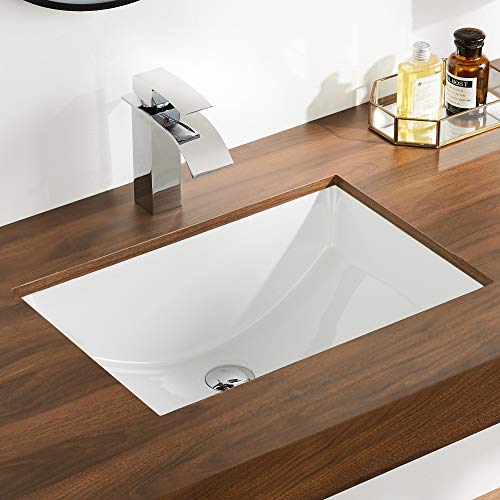
1. DeerValley Undermount Bathroom Sink, 21 x 15 in — Best Overall
The 21 x 15 is the rectangle at its most useful: wide enough for two hands and a face wash without elbow negotiation, deep enough in DeerValley’s splash-conscious profiling to keep the counter dry, and finished in a clean white ceramic with a built-in overflow. In a primary bathroom on a 24-inch-deep vanity, this is the basin that disappears into the routine — big, calm, easy to wipe, and proportioned to a modern faucet. It suits primary bathrooms, shared vanities, and anyone replacing a small oval with the rectangle they actually wanted. Check the current price on Amazon for the DeerValley 21 x 15.
Strengths
- The most usable basin area of the standard-size picks — a true primary-bathroom rectangle.
- Built-in overflow and a standard drain opening that plays well with common pop-up drains.
- Glazed ceramic surface that resists staining and wipes clean under the undermount’s rim-free edge.
Trade-offs
- Needs the vanity and counter depth to match: confirm front-to-back clearance before ordering.
- Undermount installation requires a suitable countertop — stone, quartz, or solid surface, not laminate with a raw cut edge.
- Its size makes it a two-hand lift and a careful set; plan the installation accordingly.
The DeerValley’s virtue is proportion. Rectangles fail when they are too shallow (splash) or too narrow (a glorified trough), and this basin’s width-to-depth balance is the one that behaves in daily use — water lands in the bowl, the flat floor gives glasses and razors a stable rest, and the whole thing reads as architecture rather than appliance. If your vanity can take it, this is the default buy.
Best for: primary bathrooms and generous vanities wanting the definitive white rectangle / Not suited for: narrow vanities, laminate counters, or drop-in replacements. Check the current price on Amazon.

2. DeerValley Undermount Bathroom Sink, 18 x 13 in — Best Standard Size
The 18 x 13 is the size the industry quietly standardized around: it fits the common 21-inch-deep vanity with room for faucet deck and backsplash, serves a single user completely, and pairs with the widest range of counters and templates. This DeerValley version brings the same ceramic finish and overflow as its bigger sibling in the footprint most renovations actually have. It suits the standard hall bathroom, the single vanity, and the like-for-like rectangle replacement. Check the current price on Amazon for the DeerValley 18 x 13.
Strengths
- The classic footprint: maximum compatibility with vanities, counters, and faucet placements.
- Same glazed finish and overflow provision as the larger DeerValley.
- A balanced basin — large enough for real use, small enough for standard cabinets.
Trade-offs
- Shared-bathroom couples will feel the difference versus the 21-inch basin at the morning peak.
- As with all undermounts, the counter material and cutout must be right before it arrives.
- Rectangular flatness means water sheets toward the drain rather than swirling — a character trait, not a flaw.
Most bathrooms are not primary suites, and this sink is the honest answer for most bathrooms. It is the size that lets a renovation keep its vanity, its plumbing rough-in, and its budget, while still delivering the undermount rectangle’s clean lines and wipe-straight-in cleaning. When the tape measure says 18 inches, do not argue with it — buy this class and spend the savings on the faucet.
Best for: standard vanities, hall bathrooms, and like-for-like replacements / Not suited for: couples sharing one basin at peak hour or oversized vanities it would underfill. Check the current price on Amazon.

3. KARAMAG Rectangle Undermount Sink, 18.3 x 13 in — Best Value
The KARAMAG makes the value case in the right material: vitreous ceramic — the fired, glass-surfaced ceramic that has been the sanitaryware standard for a century because it is hard, non-porous, and stubbornly white. At 18.3 x 13 inches it sits in the same standard class as the DeerValley 18, giving budget renovations and rental-grade upgrades a sink that will not stain, craze, or yellow its way into a second replacement. It suits cost-conscious remodels that refuse to compromise the material. Check the current price on Amazon for the KARAMAG Rectangle Undermount Sink.
Strengths
- Vitreous ceramic: the durable, stain-resistant, genuinely white standard material.
- Standard-class dimensions with broad vanity compatibility.
- Value tier that still buys the right material rather than a lesser one.
Trade-offs
- Value positioning means plainer packaging and template support — measure from the physical sink before the counter is cut.
- As ever, confirm overflow configuration against your drain assembly choice.
- The aesthetic is clean and standard rather than design-led.
There is a category of renovation purchase where the smart money goes quiet: nobody photographs the sink’s brand, but everybody lives with its surface for a decade. Vitreous ceramic at a value tier is exactly that purchase. The KARAMAG’s promise is not excitement; it is that in ten years the basin will still be white, smooth, and unremarkable — which is everything a bathroom sink should be.
Best for: budget renovations and rentals that still demand real vitreous ceramic / Not suited for: buyers wanting design-led detailing or hand-holding templates. Check the current price on Amazon.

4. Hugsleek Undermount Bathroom Sink Rectangle, 18 x 13 in Bowl — Best Porcelain Alternative
The Hugsleek earns its slot on specification clarity: it states its interior bowl size (18 x 13 inches) distinctly, which is the number your hands care about, in a white porcelain ceramic undermount format. Having two verified, well-specified options in the standard class matters because availability and small dimension differences decide real purchases — a half-inch of exterior difference can be the difference between fitting an existing cutout and recutting a counter. It suits renovators matching an existing template and anyone who shops by interior dimensions first. Check the current price on Amazon for the Hugsleek Undermount Sink.
Strengths
- Clear interior/exterior specification — the numbers that decide fit, stated plainly.
- White porcelain ceramic with the smooth, cleanable glaze the category expects.
- Standard-class size with undermount cleanliness and rectangle utility.
Trade-offs
- Still requires the physical sink or its template in hand before any counter is cut — as does every pick here.
- Confirm the exterior dimension against your existing cutout; “18-inch class” spans several real sizes.
- A straightforward design that competes on specification rather than styling.
Think of the Hugsleek as the standard class’s second opinion. When the DeerValley 18 is out of stock, or its exterior is a fraction wide for your cutout, this is the verified alternative that keeps the renovation on schedule without dropping to an unknown. Renovations are logistics as much as design, and depth on the bench is a feature.
Best for: matching existing cutouts and spec-first shoppers in the standard class / Not suited for: buyers who want the largest basin or a design statement. Check the current price on Amazon.

5. ADA Compliant Rectangle Undermount Bathroom Sink, 20 x 15 in — Best for Accessibility
Accessibility is a dimension, not a label, and this 20 x 15 white ceramic rectangle is specified to ADA requirements — the shallower bowl profile and knee-clearance-friendly geometry that let a wheelchair user, a child on a stool, or anyone with limited reach use the basin comfortably. The larger footprint also serves multigenerational bathrooms where the same sink must work for a tall adult and a seated user. It suits accessible renovations, aging-in-place upgrades, and commercial-style restrooms at home. Check the current price on Amazon for the ADA Compliant Undermount Sink.
Strengths
- Specified to ADA requirements — accessibility designed in, not approximated.
- Generous 20 x 15 footprint with an overflow channel included.
- White ceramic rectangle that matches the rest of this guide aesthetically, so accessible need not look institutional.
Trade-offs
- The shallower profile splashes more readily with a high-arc faucet; pair it with a measured faucet reach and moderate flow.
- True accessibility depends on the whole installation — vanity height, knee clearance, faucet levers — not the sink alone.
- Larger cutout requirements than the standard class; verify the vanity can take it.
The quiet achievement of this sink is that it looks like the others. Aging-in-place design succeeds when the bathroom reads as a bathroom rather than a clinic, and a white rectangular ceramic basin that happens to meet accessibility geometry is exactly that success. Buy it for the dimensions, install it with the clearances, and the room serves everyone who enters it.
Best for: accessible and multigenerational bathrooms, aging-in-place renovations / Not suited for: deep-basin preferences or vanities too small for its cutout. Check the current price on Amazon.

6. 16 Inch Undermount Bathroom Sink, White Ceramic Rectangle — Best for Small Vanities
Powder rooms and narrow vanities are where rectangles go to be compromised — and where this 16-inch undermount refuses to compromise them. At roughly 15.7 x 11.7 inches of bowl, it gives a small vanity the same rim-free, wipe-in cleanliness and rectangular utility as its big siblings, with an overflow included, in white ceramic. It suits powder rooms, small ensuites, and RV-adjacent or closet-conversion bathrooms where every inch is argued over. Check the current price on Amazon for the 16 Inch Undermount Sink.
Strengths
- A true undermount rectangle scaled honestly for small vanities and powder rooms.
- Overflow included — a feature small sinks sometimes skip and should not.
- White ceramic that matches standard fixtures, so the small room still reads as designed.
Trade-offs
- The basin is for handwashing and light duty; face-washing is a splash-managed exercise.
- Faucet reach must be chosen carefully — short-reach faucets keep water in a small bowl.
- Not a primary-bathroom basin; asking it to be one ends in daily annoyance.
Small bathrooms punish pretending. A compact sink that admits its job — hands, teeth, a quick rinse — and does it in the same clean rectangle language as the rest of the house is worth more than a mid-size basin crammed into a vanity it bullies. If your tape measure says small, this is the verified way to make small feel intentional.
Best for: powder rooms, narrow vanities, and small ensuites / Not suited for: primary bathrooms or enthusiastic face-washers. Check the current price on Amazon.
Comparison Table
| Pick | Badge | Key spec | Best for |
|---|---|---|---|
| DeerValley 21 x 15 | Best Overall | White ceramic rectangle, overflow, standard drain | Primary bathrooms |
| DeerValley 18 x 13 | Best Standard Size | White ceramic rectangle, overflow | Standard vanities |
| KARAMAG 18.3 x 13 | Best Value | Vitreous ceramic, pure white | Budget renovations |
| Hugsleek 18 x 13 Bowl | Best Porcelain Alternative | Porcelain ceramic, clear interior spec | Matching existing cutouts |
| ADA Compliant 20 x 15 | Best for Accessibility | White ceramic, ADA spec, overflow | Accessible bathrooms |
| 16 Inch Undermount | Best for Small Vanities | White ceramic rectangle, overflow | Powder rooms |
White Rectangular Sinks by Bathroom
The primary ensuite. This is the 21-inch class’s home turf. Two basins on a double vanity or one generous DeerValley 21 x 15 on a single: the primary bathroom is used at the day’s two peaks by the household’s most invested users, and basin area is the luxury that registers daily. Pair with a faucet whose reach suits the deeper basin and a pop-up drain matched to the overflow.
The family hall bathroom. The 18-inch standard class, chosen for durability and overflow discipline — the DeerValley 18 or the KARAMAG — because this sink will meet toothpaste in geological quantities, taps left running, and objects dropped from height. Vitreous ceramic’s hardness is not a spec here; it is the whole argument.
The powder room. The 16-inch undermount, a short-reach faucet, and a design that admits the room’s purpose. Guests judge powder rooms disproportionately, and a clean white rectangle under a nice counter reads as intentional rather than small. Spend the savings from the compact sink on the faucet and the mirror, where guests actually look.
The accessible or multigenerational bathroom. The ADA 20 x 15, installed with true knee clearance, a vanity at the right height, and lever faucets — the sink is one component of a system, and this guide’s pick is the component that keeps the system looking like a designed bathroom rather than a facility.
The rental or flip. The KARAMAG calculus: vitreous ceramic at a value tier, standard dimensions that any future repair can match, and a white rectangle that photographs as “renovated” in a listing. Rentals punish exotic dimensions for decades; standard is a strategy, not a compromise.
Care and Cleaning: Keeping White Ceramic White
Glazed ceramic’s care is a short course in not doing things. Daily: a rinse and a wipe, which the undermount’s rim-free edge makes a ten-second job — this is the maintenance the design was bought for. Weekly: a non-abrasive cleaner or a paste of baking soda for the waterline and drain surround, where soap film and toothpaste actually accumulate. Never: abrasive powders, scouring pads, or steel wool, which do not scratch the glaze in one use but dull it across a year, and a dulled glaze stains where a glossy one shrugged. Hard water is the white sink’s true opponent — its mineral film yellows a basin’s corners slowly — and the counter is boring: wipe the basin dry when you remember, descale gently with a vinegar solution when the film appears, and the glaze underneath is still the white you bought. Metal marks from razors and cans lift with a gentle ceramic-safe cleaner rather than force. Treat the basin this way and a ceramic sink’s service life is measured in decades, which is why it remains the material of record for this category while trendier materials cycle through.
How to Choose a White Rectangular Bathroom Sink
Measure three times, in this order. First, the vanity: its depth sets the sink’s maximum front-to-back exterior — a standard 21-inch-deep vanity comfortably hosts the 18-inch class and, with care, the 21-inch class — and its interior cabinet width must clear the bowl plus mounting hardware, with room for the faucet’s supply lines and the drain. Second, the cutout: if a counter already exists, measure the opening itself, not the old sink, and compare against the new sink’s exterior and its template; if the counter is being fabricated, the sink (or its exact template) must be in the fabricator’s hands before cutting, never after. Third, the faucet: its spout reach must land water inside the bowl’s working area — rectangles, with their flat floors and defined geometry, punish a short-reach faucet by landing the stream against the back slope, splashing the user and the counter. Then the specification checks: overflow or no overflow (choose overflow for family bathrooms), drain opening size matched to your pop-up or grid drain, and ceramic type — vitreous or glazed porcelain for a surface that stays white and unstained. Only after the tape measure is satisfied should taste enter: all six picks here are the same calm white rectangle, differing in size and specification, which is exactly how this category should be bought.
Undermount, drop-in, and vessel: why this guide is undermount
The white rectangular keyword resolves overwhelmingly to undermounts in the real market, and for good reasons: the rim-free edge is the easiest sink surround in the world to clean, the counter reads as one continuous surface, and the rectangle’s geometry is fully expressed. The trade is commitment — undermounts need a water-safe counter material (stone, quartz, solid surface; a laminate counter’s raw cut edge will drink water and swell), a proper mounting system of clips, rails, or adhesive-plus-support specified for the sink’s weight full of water, and a fabricator’s cutout. Drop-in rectangles forgive more and suit laminate, at the cost of the rim that catches grime. Vessel rectangles sit on top as sculpture and ask tall users to stoop and short users to reach. If your counter is laminate or your renovation is a weekend swap, a drop-in is the honest alternative; for the full white-rectangle effect this search promises, undermount is the form, and all six picks deliver it.
Depth, splash, and the flat-floor character of rectangles
A rectangle’s flat basin floor is its utility — cups sit stable, the floor drains in a sheet — and its splash physics differ from an oval’s: water from the faucet hits a flatter target and rebounds more vertically, which is why basin depth and faucet height must be chosen as a pair. Deeper basins (within the standard class) forgive taller faucets; shallower basins, including the ADA profile, want moderate faucet height and reach that lands the stream near the drain. If your household includes an enthusiastic child, weight depth higher in your choice; if it includes a seated user, the ADA geometry already balanced this for you.
How to Install an Undermount Bathroom Sink (Overview)
Undermount installation is a job many competent DIYers do and every step of which rewards patience; when in doubt, a plumber or countertop installer earns their fee at the sealing step alone. The sequence: dry-fit everything first — sink to cutout, faucet to counter, drain to sink — because adjustments are free before adhesive and impossible after. Confirm the countertop’s underside is clean and the cutout edge is sealed if the material requires it. Apply the specified mounting system: typically a bead of sanitary silicone at the rim as a seal (not the sole support), plus mechanical clips, brackets, or a support frame that carries the sink’s working weight. Set the sink evenly, check the reveal around the cutout is uniform, and let the seal cure fully before plumbing. Connect the drain assembly — matching the overflow configuration: an overflow sink needs a drain with an overflow channel, a mismatch here is a leak with a delay fuse — then the trap and supplies, and test in stages: fill the basin and hold, run the tap and watch every joint, fill to the overflow and confirm it drains through the drain body rather than around it. Finish with the faucet’s aerator flow checked against the basin: the stream should land in the bowl’s working area at full pressure without splashing the back slope. A final bead of silicone where specified, a full cure before first use, and the sink disappears into the counter for a decade of invisible service.
Double Vanities and Pairing: Two Rectangles, One System
The double vanity is where the white rectangle does its finest work — two calm basins, one continuous counter, symmetry that makes a primary bathroom feel composed — and where sizing discipline pays double. Both sinks must be the same model bought at the same time, because ceramic whites vary subtly between production runs and two “identical” sinks bought a year apart can disagree in a way the eye catches every morning. Spacing follows the same logic as singles, doubled: each basin centered on its user’s standing position, each faucet’s reach verified against its own basin, and enough counter between the two that two people’s elbows and toiletries are not in negotiation. Plumbing is the hidden half: two undermounts mean two traps and two supply sets inside one cabinet, so confirm the cabinet’s interior — drawers especially — clears both bowls before the counter is cut, because a U-shaped drawer that clears one sink may not clear two. The standard class (the DeerValley 18 or its alternatives) is the usual double-vanity answer precisely because the 21-inch class, doubled, demands a vanity width many rooms do not have. Measure the room’s total width honestly, divide it by two real users, and let that arithmetic choose the basin size — a pair of well-fitted 18s serves a couple better than a pair of 21s performing a daily elbow war.
Faucets, Drains, and Hardware: The Supporting Cast
A sink is bought once and its hardware is used ten thousand times, so choose the supporting cast with the same care. The faucet’s spout reach is the critical dimension — measure from the faucet’s mounting center to the spout’s outlet and aim the stream at the basin’s working area, roughly its middle third — and its height should clear the basin’s rim by enough for hands and a cup, without rising so far above a shallow basin that splash becomes the morning routine. Single-hole, centerset, and widespread configurations must match the counter’s drilling or the wall-mount plan; decide before fabrication, not at the install. The drain is the second marriage: pop-up drains suit overflow sinks and modern faucets, grid drains suit vessel-style aesthetics and never fully close — a real consideration if anyone in the house soaks anything in the basin — and the drain’s finish should match the faucet’s, because the eye reads them as one object. Supply lines and a quality trap finish the set invisibly. None of this is glamorous, and all of it is permanent: the households that love their white rectangle in year five are the ones that measured the faucet’s reach in week one.
Common Buying Mistakes
- Ordering by interior size alone (or exterior alone). Both numbers decide fit — the cutout reads the exterior, your hands read the interior. Compare both, every time.
- Cutting the counter before the sink arrives. Templates drift and listings round. The physical sink or its exact template precedes the saw, always.
- Mounting an undermount under laminate. A raw laminate cut edge drinks water and swells. Undermounts belong under stone, quartz, or solid surface.
- Mismatching the drain to the overflow. An overflow sink with a non-overflow drain leaks by design. Buy the drain that matches the sink’s configuration.
- Ignoring faucet reach. A short spout over a deep rectangle lands water on the back slope and splashes every user, every day, for years.
- Skipping the overflow in a family bathroom. A closed stopper and a running tap is a when, not an if, in a house with children. The overflow is the cheapest flood insurance in the renovation.
Ordering Checklist: The Five Minutes Before You Click
Run this list with the listing open and a tape measure in reach. One: the sink’s exterior dimensions fit your vanity’s depth and the cutout you have or will have cut — not approximately, but with the mounting overlap the maker specifies. Two: the interior dimensions are the basin you actually want to use every day. Three: the overflow configuration is confirmed, and the matching drain is in the same order. Four: the faucet’s spout reach has been checked against this basin’s geometry, and its mounting style matches your counter’s drilling. Five: the countertop material is undermount-appropriate, and if it is being fabricated, the fabricator will have this sink’s template before cutting. Five checks, five minutes — and the difference between a sink that arrives as a solution and a sink that arrives as a second project. Every pick in this guide rewards that five minutes; none of them can survive its absence.
Final Recommendation
For a primary bathroom, buy the DeerValley 21 x 15 and enjoy the rectangle at full size. For the standard vanity, the DeerValley 18 x 13 is the default, with the Hugsleek as the verified alternative when dimensions or availability argue, and the KARAMAG when value leads but vitreous ceramic is non-negotiable. Accessible renovations should take the ADA Compliant 20 x 15 and design the clearances around it; powder rooms, the 16 inch undermount. Whatever the tape measure decides, let it decide — in this category, fit is beauty. For the vanity side of the same renovation in this program, see Best 18 Inch Bathroom Vanities.
Rectangular vs Oval: An Honest Postscript
Since every pick here is a rectangle, fairness demands the oval’s closing argument. An oval basin of the same exterior size gives up usable floor — its curves cut the corners your cups and razors would have used — but it gains two things: a softer visual line in traditional bathrooms, and gentler splash behavior, since its curved walls deflect the faucet’s stream in a spiral rather than a rebound. If your bathroom’s language is traditional, your users are splash-prone children, or your vanity is a piece of furniture whose top argues for curves, an oval is a legitimate choice and this guide’s rectangle discipline — measure both dimensions, match the drain to the overflow, verify the faucet’s reach — transfers to it intact. But for the modern bathroom, the shared vanity, the wipe-straight-in cleaning routine, and the maximum basin from a given cutout, the rectangle remains the rational default, which is why the market, the keyword, and this guide all converged on it. Choose the shape your room and your users argue for; then buy it with the same measuring rigor either way.
What a Good Installation Looks Like a Year Later
The verdict on a sink is delivered slowly. A year after a good installation, the silicone line is still clean and unbroken, the reveal around the cutout is still even, the basin’s glaze is still glossy because nothing abrasive ever touched it, and — the truest sign — nobody in the household thinks about the sink at all. It has become part of the room’s background competence, like a door that closes properly. A year after a careless one, the evidence is equally quiet and opposite: a darkening seam where water found the counter’s edge, a drain that weeps into the cabinet’s floor, a faucet whose stream has splashed the back slope ten thousand times. Every one of those outcomes was decided in the measuring and mounting hours, not in the shopping minutes. That is the final argument of this guide: the six verified sinks above are all good enough to disappear for a decade, provided the tape measure, the template, the matching drain, and the faucet’s reach were given their due. Do those four things and the white rectangle will repay you the way the best renovation purchases do — by never asking for your attention again.
Frequently Asked Questions
What size bathroom sink is standard?
The common undermount rectangle class is around 18 x 13 inches of bowl, fitting standard 21-inch-deep vanities. Primary bathrooms often step up to 20–21 inch widths, and powder rooms step down to 16-inch-class basins. Always confirm both interior and exterior dimensions against your vanity and cutout.
Can I install an undermount sink with a laminate countertop?
It is not recommended: the cut edge of laminate is vulnerable to water, and undermounts expose that edge directly above the basin. Choose stone, quartz, or solid surface for an undermount, or choose a drop-in sink if the laminate counter stays.
Do I need an overflow in a bathroom sink?
In family and shared bathrooms, yes — it is inexpensive insurance against a tap left running against a closed stopper. All six picks in this guide include overflow provisions; just be sure your drain assembly is the overflow type to match.
Is ceramic or porcelain better for a bathroom sink?
They are close cousins and both are right answers: vitreous ceramic and glazed porcelain both give a hard, non-porous, stain-resistant white surface that cleans easily and lasts for decades. What matters more is glaze quality and honest construction, which is why this guide sticks to verified makers in both materials.
How do I stop a rectangular sink from splashing?
Match the faucet to the basin: the spout’s reach should land the stream in the bowl’s working area, its height should suit the basin’s depth, and an aerator that keeps the stream coherent reduces rebound off the rectangle’s flat floor. Deeper basins forgive more; shallower and ADA-profile basins want a more careful faucet pairing.
How do I measure my existing cutout for a replacement undermount sink?
Measure the opening in the counter itself — length and width at the top, in several places, since cutouts are not always perfectly rectangular — and note the corner radius. Then compare against the candidate sink’s exterior dimensions and its template: the sink’s rim must overlap the opening’s edge all the way around with enough bearing for the mounting system, and the bowl must clear the cabinet below. When the numbers are close, the physical sink or its exact template settles what the tape measure cannot.
What countertop materials work with undermount bathroom sinks?
Natural stone, engineered quartz, and solid-surface materials are the standard partners: their cut edges are water-safe and they carry the sink’s mounted weight properly. Tile counters can work with careful edge sealing but complicate the reveal; laminate is the material to avoid for the moisture reasons covered in this guide. If a new counter is part of the project, choose the sink first and have the fabricator cut to its template.
Are white ceramic sinks hard to keep clean?
They are among the easiest fixtures in the house: the glazed surface resists staining, the undermount format lets you wipe the counter straight into the bowl, and a non-abrasive cleaner handles the weekly waterline. The two disciplines that matter are avoiding abrasive pads that dull the glaze over time and wiping up hard-water film before it builds — both are minutes per week, not chores.
What should I check when the sink arrives?
Inspect it before anything is cut or mounted: unpack it fully, check every corner and the rim for chips or hairline cracks from shipping, set it on a flat surface to confirm it sits true, and verify its dimensions against the listing and your cutout plan with your own tape. Ceramic is strong in service but vulnerable to transit knocks, and a flaw found on delivery day is a simple return — while the same flaw found after the counter is cut becomes your problem. Keep the packaging until the dry-fit is done.
How long does a ceramic bathroom sink last?
Decades, in normal service — ceramic sanitaryware is one of the longest-lived objects in a house, and sinks are routinely retired for style rather than failure. The glaze’s enemies are abrasion and impact, not time: avoid scouring products, be mindful with heavy metal objects over the basin, and the sink you install this year will very likely serve the next renovation as well as this one.
Should I choose a sink with or without an overflow?
With, for almost every household — and with certainty wherever children, guests, or absent-minded mornings are part of the picture. The overflow costs nothing in daily use and prevents the one accident that damages floors and ceilings. Just remember the pairing rule from this guide: an overflow sink needs a drain assembly with an overflow channel, bought at the same time as the sink.
Does an undermount sink need support beyond silicone?
Yes, without any exception whatsoever. Silicone seals the joint against water; it is not the structure, and treating it as the structure is the single most consequential installation error in this entire category — one that typically announces itself months later, at night, inside a cabinet full of stored items. A properly installed undermount is carried by mechanical support — clips, brackets, rails, or a frame — rated for the sink’s weight filled with water plus the force of daily use. Any installation method that relies on adhesive alone is a deferred leak and a possible dropped basin, which is why this guide treats the mounting system as part of the purchase decision.
Can I replace a drop-in sink with an undermount in the same vanity?
Only if the countertop material suits undermounting and a new cutout can be made — which usually means a new counter. The vanity cabinet itself is rarely the obstacle; the counter is. Most undermount conversions are really countertop replacements with a sink attached, so budget and plan for them that way.