Disclosure: airfryerkitchensupply.com is reader-supported. When you buy through links on our site, we may earn an affiliate commission at no extra cost to you.
Where to buy
The best alarm clocks for college students are small, cheap to replace, and sold everywhere, which is exactly why listings multiply and confuse. Buy by the full model name, confirm the features that matter to you — dual alarms, a dimmer, battery backup, a USB charging port — on the listing page, and check price on Amazon before ordering. Dorm rooms eat chargers and clocks alike, so choose the listing sold or shipped by Amazon or the brand store where available, and keep the box until you have lived with the clock for a week of real mornings.
- JALL Sunrise Alarm Clock – check price on Amazon; choose the listing sold or shipped by Amazon or the brand store where available.
- REACHER Wood Grain Sunrise Alarm Clock and Sound Machine – check price on Amazon; choose the listing sold or shipped by Amazon or the brand store where available.
- ANTDALIS Sunrise Alarm Clock Wake Up Light – check price on Amazon; choose the listing sold or shipped by Amazon or the brand store where available.
- Sonic Alert Sonic Bomb Dual Alarm Clock with Bed Shaker – check price on Amazon; choose the listing sold or shipped by Amazon or the brand store where available.
- DreamSky Small Digital Alarm Clock with USB Charging Port – check price on Amazon; choose the listing sold or shipped by Amazon or the brand store where available.
- Hatch Restore 3 – check price on Amazon; choose the listing sold or shipped by Amazon or the Hatch brand store where available.
What College Students Actually Need From an Alarm Clock
Shopping for the best alarm clocks for college students is not the same as shopping for a bedside clock for a settled adult, because dorm life breaks the assumptions adult products are built on. Your schedule is not a schedule: an 8 a.m. lecture on Monday, a noon start on Tuesday, a lab that moves, a shift at the campus job, and weekends that operate on a different planet. You share a room with someone whose classes start two hours after yours, and whose goodwill you need for the next nine months. Your desk, dresser, and nightstand are the same piece of furniture. And the clock you buy in August has to survive being knocked off that furniture, unplugged by a vacuum-hungry roommate, and reprogrammed in the dark at midnight before a midterm morning.
That reality produces a specific feature list. Dual alarms are not a luxury; they are the difference between your weekday alarm and your weekend alarm, or between the first warning and the get-up-now warning. A display dimmer is not a luxury either, because a clock that lights a shared room like a vending machine will be unplugged by your roommate within the week. Battery backup matters because dorm power strips get switched off. A USB port matters because outlets are rationed. And for the large minority of students who can sleep through a phone alarm — and the phone on the pillow is a genuine fire and sleep-quality problem — the clock has to offer something the phone cannot: gradual light, escalating sound, or a shaker under the mattress.
There is also a timing truth nobody tells freshmen: the alarm clock is a first-week purchase, not a first-crisis purchase. Students who arrive with a clock, set it up during the calm of move-in week, and test it on a low-stakes morning own a system by the time classes start. Students who buy after the first missed lecture buy in a panic, skip the test morning, and discover the clock’s quirks — the menu they cannot navigate half-asleep, the display that lights the room, the alarm that was set for the wrong half of the day — at the exact moment those quirks cost the most. Whichever pick you choose, buy it before you need it and rehearse with it once.
The six picks below split along those lines. Three are sunrise clocks we verified as live listings, which solve the roommate problem by waking you with light before sound. One is the heavy-sleeper specialist with a bed shaker. One is the simple, cheap digital clock with the ports a dorm desk needs. And one is the premium app-driven sleep clock for students who want a full wind-down and wake-up routine. Every one of them is judged against dorm reality, not showroom features.
In this guide
Quick Picks
- Best Overall: JALL Sunrise Alarm Clock – sunrise simulation, dual alarms, white noise and sound machine functions, FM radio, and a Bluetooth speaker in one dorm-sized unit. Check the current price on Amazon.
- Best for Shared Rooms: REACHER Wood Grain Sunrise Alarm Clock – a dimmable display, 26 sleep sounds, and a gentle light-first wake that respects a sleeping roommate. Check the current price on Amazon.
- Best Budget Sunrise: ANTDALIS Sunrise Alarm Clock – dual alarms, sunrise simulation, nature sounds, and FM radio at the value end of the sunrise category. Check the current price on Amazon.
- Best for Heavy Sleepers: Sonic Alert Sonic Bomb Dual Alarm Clock with Bed Shaker – an extra-loud dual alarm clock whose vibrating puck goes under the mattress and shakes you awake, with battery backup if the dorm power strip gets switched off. Check the current price on Amazon.
- Best Simple and Cheap: DreamSky Small Digital Alarm Clock – big digits, a USB charging port for the phone, and a dimmer that respects a roommate. Check the current price on Amazon.
- Best Premium Smart Pick: Hatch Restore 3 – a screen-free sunrise clock and sound machine whose routines run through the Hatch Sleep app. Check the current price on Amazon.
How These Picks Were Chosen
We judged every candidate against a dorm checklist built from the way students actually fail to wake up. First, the alarm itself: it must be settable for two different times, loud or insistent enough at its peak, and impossible to disable by accident with a half-asleep swat — or, in the sunrise designs, gradual enough that the light does part of the work before sound begins. Second, roommate diplomacy: a dimmable or auto-dimming display, a wake method that does not have to fill the room with noise, and a snooze that is easy to find but not so easy that it becomes the whole morning. Third, dorm infrastructure: battery backup for when the power strip gets switched off, a footprint that fits a crowded desk, and charging for the phone that everyone ends up plugging in beside the bed anyway.
Fourth, we applied a replaceability test. College gear gets lost, broken, and left in a summer sublet. A clock in this category should be good enough to rely on for an 8 a.m. final and cheap enough — as a tier, without quoting figures — that replacing it is an annoyance, not a financial event. The premium sunrise clocks with app ecosystems and the designer smart clocks were judged against that test and mostly failed it for this audience; the picks below are the ones that balance reliability, dorm manners, and student economics. All six picks are verified live listings with links, each confirmed against Amazon listing data — including the bed-shaker specialist, the Sonic Bomb, whose listing confirms the bed shaker, dual alarms and battery backup this category is bought for.
The 6 Best Alarm Clocks for College Students

JALL Sunrise Alarm Clock – Best Overall
The JALL sunrise clock takes Best Overall because it covers the most dorm bases in one unit. Its listing describes sunrise simulation for heavy sleepers, a white noise sound machine with 25 sounds, FM radio, a Bluetooth speaker, a 17-color night light, and dual alarms. Read that list as a dorm inventory and it replaces three devices a student would otherwise buy separately: the alarm, the sleep-sounds machine for the roommate who snores or the hallway that never quiets down, and the small speaker for music while studying. In a room where every surface is contested, consolidation is a feature, not a gimmick.
Strengths
- Sunrise simulation plus dual alarms handles both the wake-up problem and the irregular-schedule problem in one device.
- Sound machine functions work both directions: white noise to fall asleep in a loud dorm, gentle sounds to wake up without a jolt.
- Bluetooth speaker and FM radio remove two more gadgets from a crowded desk.
Trade-offs
- More features means more menus; the first setup takes longer than a basic digital clock, ideally done the afternoon before you need it, not at midnight.
- The light is a wake aid for the person facing it; a top-bunk sleeper or a face-in-pillow sleeper gets less of the sunrise effect.
- As a multi-function unit it is a mid-tier purchase, and losing it hurts more than losing a basic clock.
The deeper reason the JALL wins is the shape of a student morning. The students who struggle most are not the ones who sleep through a beep; they are the ones whose alarm produces a spike of panic, a snooze, and a spiral. A sunrise clock attacks the problem earlier in the physiology: light brightening over minutes nudges the body toward waking before the sound arrives, so the sound confirms a wake-up already in progress instead of starting one from a standstill. Pair that with a second alarm set fifteen minutes later as the non-negotiable backstop, and the system is forgiving in the way student mornings need to be.
Best for: most students, especially heavy sleepers in single rooms or tolerant shared rooms. / Not suited for: students who want a two-button clock they can set half-asleep without learning a menu.
Check on Amazon – check the current price on Amazon and confirm the dual-alarm and sunrise features on the listing.
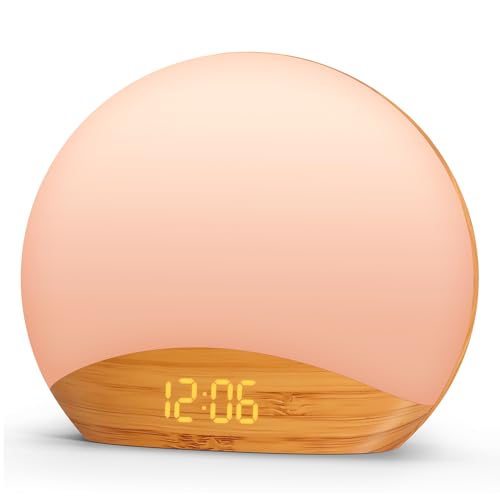
REACHER Wood Grain Sunrise Alarm Clock and Sound Machine – Best for Shared Rooms
If the JALL is the all-rounder, the REACHER is the diplomat. Its listing emphasizes a dimmable digital display, 26 sleep sounds, and a wood-grain finish that looks like dorm furniture rather than electronics. The shared-room case for it is specific: the display dims down so it does not glow across a small room at 3 a.m., the sunrise wakes the owner with light that stays mostly on their side of the room, and the sound machine masks the corridor noise, the roommate’s keyboard, and the radiator’s percussion section at night. Roommate conflict over alarms is one of the most common and most avoidable dorm frictions, and this clock is engineered around avoiding it.
Strengths
- Fully dimmable display respects a roommate’s darkness in a way fixed-brightness clocks never will.
- 26 sleep sounds give real choice for masking dorm noise, from rain to fan noise, without a phone playing audio all night.
- Wood-grain design survives dorm aesthetics and does not scream electronics on a shared desk.
Trade-offs
- The gentle approach has limits: a determinedly deep sleeper may need the shaker pick below as a backstop.
- No Bluetooth speaker headline feature, so it does not consolidate the desk the way the JALL does.
- Sunrise effectiveness depends on placement; it needs to sit where its light actually reaches your face.
Placement is the honest caveat and the honest opportunity. Put the REACHER on the side of the bed your face turns toward, at pillow height rather than down on a low desk, and the sunrise does its work. Students in lofted beds should think about a shelf at mattress level. Get that right and this is the clock least likely to start a roommate argument all semester — which, across a nine-month shared room, may be worth more than any specification on the box.
Best for: students in shared rooms, light-sensitive roommates, and anyone whose dorm is loud at night. / Not suited for: the deepest sleepers, who should pair it with or choose the bed-shaker pick.
Check on Amazon – check the current price on Amazon and look for the dimmable display in the listing details.
A note on the three verified sunrise clocks as a group: they were chosen because their listings state the features dorm life actually tests — dual alarms, dimmable or manageable light, and sound options for both falling asleep and waking — in plain language a buyer can check. Listings in this category love to bury the second alarm or the dimmer in fine print; when you compare any alternative against these picks, search its listing for those two specifications first, because they, not the color of the night light, decide whether the clock survives a shared room.
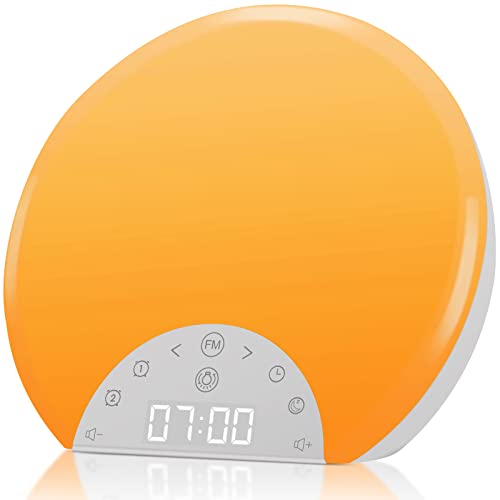
ANTDALIS Sunrise Alarm Clock Wake Up Light – Best Budget Sunrise
The ANTDALIS is the value route into sunrise waking: dual alarms, sunrise simulation, seven nature sounds, eight colors of night light, FM radio, and a snooze, in a simpler package than the JALL. For a student who likes the sunrise idea but is equipping a whole dorm room on a finite budget — bedding, lamp, fan, mini fridge rental, and everything else in the same month — the ANTDALIS keeps the core mechanism that matters, gradual light plus a sound backstop, and trims the extras.
Strengths
- The essential sunrise mechanism with dual alarms, at the budget end of the category.
- Nature-sound alarm options are a calmer way to wake than a buzzer for students who are not heavy sleepers.
- Night light colors double as a soft dorm lamp for reading without the overhead light.
Trade-offs
- Fewer sounds and simpler controls than the JALL; the white-noise library for sleep is thinner.
- Build and buttons feel more basic, which matters for a device handled daily for four years.
- Like all sunrise clocks, it cannot help a sleeper who buries their face or sleeps facing the wall.
Judge the ANTDALIS by what a first-semester student actually needs: a wake-up that works, a second alarm for the early class, and money left over for the rest of the room. It delivers those. Students who discover they love sunrise waking can graduate to a richer machine in a later year; students who discover they need brute force should move to the shaker. Either way, the ANTDALIS is the low-regret way to find out which kind of sleeper you are.
Best for: budget-conscious students who want sunrise waking without the multi-function price tier. / Not suited for: students who need a deep sound library or maximum alarm volume.
Check on Amazon – check the current price on Amazon and confirm the dual-alarm specification before ordering.

Sonic Alert Sonic Bomb Dual Alarm Clock with Bed Shaker – Best for Heavy Sleepers
Some students do not have a waking problem that light or sound can solve. They have slept through phone alarms, roommates shaking them, and in documented dorm legend, a fire drill. For those sleepers the answer is tactile: a vibrating puck on a cord that slides under the mattress or pillow and, at the set time, shakes the bed itself. The Sonic Bomb is the verified representative of that class: its listing confirms a dual alarm clock with a bed shaker, an extra-loud audible alarm and battery backup, and its maker describes vibration, buzz and combined modes, so the shaker can run as the wake-up that is violent for the sleeper and silent for everyone else in the room.
Strengths
- Vibration wakes by touch, bypassing the sound-processing that deep sleepers sleep straight through.
- Shaker-only mode is the most roommate-friendly strong alarm that exists — no noise crosses the room.
- Most models add battery backup and a simple, glove-friendly button layout for midnight programming.
Trade-offs
- The puck can migrate under the mattress over a week; it needs repositioning as part of the routine.
- On a shared bunk or a very soft mattress topper, vibration spreads and weakens; placement takes experimentation.
- It solves waking, not sleep hygiene — a student shaking awake at 7:40 after a 3 a.m. night still has the underlying problem.
Used well, the bed shaker is a backstop in a system, not the whole system: set a sunrise or standard alarm for the intended wake time and the shaker ten minutes later as the guarantee. Students with early labs, clinical rotations, or jobs they cannot be late for are the natural owners. If you have ever been described as someone who could sleep through anything, believe the description and buy the physics, not another beep.
Best for: genuinely heavy sleepers and students with cannot-be-late mornings. / Not suited for: light sleepers, for whom it is an earthquake where a sunrise would do.
Check on Amazon – check the current price on Amazon and confirm the bed shaker and battery backup on the listing.

DreamSky Small Digital Alarm Clock with USB Charging Port – Best Simple and Cheap
There is a durable case for the simplest object in this guide: a digital clock with big readable digits, one alarm you can set in ten seconds, a USB port that charges the phone overnight, and a brightness dimmer with real range. The DreamSky is the verified representative of that class: large numbers readable from anywhere in a dorm room, adjustable alarm volume, a dimmer that can take the display down for a sleeping roommate, and USB-C adapter power with the charging port on the case where a phone cable actually reaches.
Strengths
- Dead simple to set, which means it actually gets set, correctly, the night before an exam.
- The USB port solves the dorm outlet shortage and keeps the phone off the pillow.
- A genuine brightness dimmer — the feature that decides whether a big-digit clock can live in a shared room.
Trade-offs
- One alarm on most models, so weekday and weekend schedules mean reprogramming.
- The wake-up is a plain beep: effective, charmless, and shared with the whole room.
- Display brightness varies wildly in this class; a dimmer control is the feature to insist on.
The buying advice for this class is to shop the dimmer and the charging port, not the digits. Every model in the type shows the time; the ones worth owning let you kill the display glow for a roommate and keep the alarm armed through a dead outlet. Students who want a clock that disappears into the background of college life — no apps, no menus, no firmware — should start here and spend the savings on the rest of the room.
Best for: minimalists, tight budgets, and anyone whose phone has failed them repeatedly. / Not suited for: students needing dual alarms or a gentle wake.
Check on Amazon – check the current price on Amazon and confirm the USB charging port and dimmer on the listing.

Hatch Restore 3 – Best Premium Smart Pick
The Hatch Restore 3 is the premium end of the sunrise idea: a screen-free bedside clock that pairs circadian lighting — a gradual sunrise for waking, warm light for winding down — with a deep library of sleep audio, listed at 80+ sounds, and routines built in the Hatch Sleep app. Where the JALL bundles everything into one dorm-priced unit, the Restore 3 is a deliberate sleep system: a put-it-down phone-free bedtime routine with meditations and sounds, a night light you can tap, and a morning light that brings you up without a noise spike. For the student whose problem is not hearing an alarm but the whole sleep pattern around it, this is the most complete tool in the guide.
Strengths
- A full routine, not just an alarm: wind-down lighting and audio in the evening, sunrise waking in the morning, in one screen-free device.
- A deep, app-delivered sound library — the listing cites 80+ sleep sounds — far beyond the fixed menus of budget sunrise clocks.
- No glowing display in the room at night; the clock face stays dark until you interact with it, which roommates appreciate.
Trade-offs
- Premium tier pricing — the most expensive pick in this guide by a wide margin, and a real loss if a dorm move eats it.
- The routine lives in the app and the dorm WiFi; setup and changes are phone tasks, not button tasks.
- Much of the content library is app-delivered, so the full experience depends on keeping the app side of the product active.
Judge the Restore 3 as a sleep investment rather than a clock purchase. A student with a chaotic sleep schedule, a budget that can absorb the premium, and the intention of keeping the routine for years will get daily value from it. A student who simply needs to be vertical by 8 a.m. should buy the JALL or the DreamSky and spend the difference on blackout curtains. Both are rational; only one of them is this pick.
Best for: students treating sleep as a system, with the budget for the premium tier. / Not suited for: tight budgets or anyone who wants buttons instead of an app.
Check on Amazon – check the current price on Amazon and look at what the app routine includes before ordering.
Comparison Table
| Pick | Badge | Key spec | Best for |
|---|---|---|---|
| JALL Sunrise Alarm Clock | Best Overall | Sunrise simulation, dual alarms, 25 sounds, FM radio, Bluetooth speaker | Most students; heavy sleepers in single rooms |
| REACHER Wood Grain Sunrise Alarm Clock | Best for Shared Rooms | Dimmable display, 26 sleep sounds, sunrise wake-up light | Shared rooms and light-sensitive roommates |
| ANTDALIS Sunrise Alarm Clock | Best Budget Sunrise | Dual alarms, sunrise simulation, 7 nature sounds, FM radio | Budget dorm setups |
| Sonic Alert Sonic Bomb Dual Alarm Clock with Bed Shaker | Best for Heavy Sleepers | Under-mattress vibrating puck, dual alarms, extra-loud audible backup, battery backup | Students who sleep through sound |
| DreamSky Small Digital Alarm Clock | Best Simple and Cheap | Big digits, USB charging port, brightness dimmer, adjustable volume | Minimalists and tight budgets |
| Hatch Restore 3 | Best Premium Smart Pick | Sunrise alarm light, 80+ sleep sounds via app, screen-free routine | Routine-driven sleepers |
How to Choose an Alarm Clock for Dorm Life
Start by diagnosing your failure mode, because each one has a different cure. If you wake up but drift back off, you need a second alarm and distance — a clock across the room that forces your feet to the floor. If you never hear the alarm at all, you need a different sense: light if you are a moderate sleeper, vibration if you are a profound one. If the alarm works but your roommate is suffering, you need a wake method that stays on your side of the room: sunrise light, a shaker, or earbud-friendly designs. And if the alarm fails because it was never set, or was set for p.m. instead of a.m., you need simplicity or voice control — the friction is in the programming, not the waking.
Then audit the room. Count the outlets within reach of the bed and assume one is already lost to a lamp and one to a laptop; a clock with a USB port pays rent in that economy. Check the bunk geometry: a sunrise clock needs line of sight to your face, which argues for a shelf at pillow height in a lofted bed, while a shaker needs a mattress it can actually move. Check the roommate geometry too: whose side does the display face, and can it dim to nothing? Finally, check the calendar reality: a student with one fixed class time can live with a single alarm, while a student with alternating early labs and late seminars should treat dual alarms as non-negotiable. The right clock is the one that survives your actual week, not the one with the longest feature list.
How to Set Up a Wake-Up System That Survives the Semester
Set the system up once, properly, during the first week — not the night before the first early class. Place the clock where the wake method reaches you: sunrise at pillow height facing your face, shaker centered under the mattress at chest level, basic clock across the room if you are a snooze abuser. Program both alarms with a deliberate gap — the gentle first alarm at your target wake time, the absolute backstop ten to fifteen minutes later — and label which is which in your own head so the first one is never treated as optional noise.
One setup detail separates reliable dorm clocks from drawer clocks: the outlet audit. Plug the clock into the outlet or strip position that nothing else competes for — not the strip your roommate switches off for the fairy lights, not the outlet behind the mini fridge that gets unplugged for the vacuum. If the clock has battery backup, install the batteries the day the clock arrives, not the night the power fails; backup batteries discovered missing during an outage are a story every resident advisor has heard. Write the date on the battery with a marker and replace it at the start of each academic year.
Then run a test morning on a day when being late costs nothing. You are testing three things: whether the light or vibration actually wakes you, whether the volume ramp is set where you think it is, and whether the display brightness lets your roommate sleep. Adjust once, with data. After that, protect the system: the clock stays plugged into the outlet that does not get switched, the backup batteries go in before they are needed, and the alarm is set as part of the night routine — bag packed, clothes chosen, alarm armed — because a wake-up system is really a night-before system. Students who make the alarm the last step of a fixed routine stop having the 11 p.m. did-I-set-it panic entirely.
Sunrise, Sound, or Vibration: Matching the Wake Method to the Sleeper
The three wake methods in this guide are not three trim levels of the same product; they are three different physiological bets. Sunrise clocks bet on circadian response: light through closed eyelids suppresses melatonin and raises alertness gradually, which is why sunrise users describe waking up already halfway awake rather than ambushed. The bet fails when the light never reaches the eyes — face buried in a pillow, blackout mask, a loft bed with the clock on the floor — and when the sleeper’s problem is depth rather than timing. Sound clocks bet on hearing, and they win on simplicity and price; they lose when a sleeper’s brain has learned to classify the alarm as background, which happens to heavy sleepers within weeks of nightly exposure to the same tone. Rotating tones and radio alarms fight that habituation, which is one reason the JALL’s sound library and FM option are practical features rather than decoration.
Vibration bets on touch, the channel deep sleep guards least. That is why shaker alarms are standard equipment for deaf and hard-of-hearing sleepers and why they rescue hearing students whom sound has failed. The honest hierarchy for a student choosing blind: if you wake to a normal alarm most days and merely hate it, buy sunrise and fix the hatred. If you miss alarms monthly, buy dual alarms and distance. If you miss alarms weekly and other people have started waking you as a favor, buy the shaker and end the era. Choosing by your record, not your self-image, is the whole secret of this category — every student believes they are a moderate sleeper until the first 8 a.m. exam grades the belief.
The Clock Is Only Half the System: Sleep Habits That Make Any Alarm Work
No alarm clock in this guide can out-perform a 3 a.m. bedtime indefinitely, and the students who chronically oversleep usually have a schedule problem wearing an alarm problem’s clothes. The fixes that make the hardware work are unglamorous. Keep the wake time constant within about an hour even on weekends; the circadian system learns one wake time well and two wake times badly, which is why Monday’s 8 a.m. feels impossible after a weekend of noon. Get light early — the sunrise clock on weekdays, actual daylight on the walk to breakfast — because morning light is what sets the clock that makes the next morning easier. Park the phone outside arm’s reach, both so it cannot be snoozed from the pillow and so the last hour of the night is not spent scrolling; the dedicated alarm clock’s deepest benefit is that it makes this possible without leaving you alarm-less.
Caffeine deserves one honest paragraph in a student guide. A coffee habit that runs into the evening pushes sleep later and lighter, which makes the morning alarm’s job harder in a way no decibel count fixes. Students who move their last caffeine to early afternoon routinely report that the same alarm, at the same volume, starts working — nothing about the clock changed. Treat the alarm purchase and the sleep routine as one decision and the success rate of both climbs; treat the clock as a substitute for sleep and you will be shopping this category again in October, angrier and no better rested.
Budget Tiers for Students: What Each Level Actually Buys
Student budgets sort this category into three honest tiers, and knowing what each tier buys prevents both overspending and false economy. The budget tier buys correctness: a clock that shows the time, sounds one alarm reliably, and keeps that alarm armed on battery power through an outage. It does not buy gentleness, dual alarms, or a dimmer worth the name, which is why budget clocks are best for light sleepers in single rooms. The mid tier — where the sunrise picks in this guide live — buys the wake experience itself: gradual light, dual alarms, sound options, and dimmable displays. For shared rooms and irregular schedules, this is the tier where money converts directly into fewer bad mornings, and it is where most students should land. The premium tier buys ecosystems: app control, smart-home routines, adaptive brightness, and design objects. Those are pleasant and occasionally wonderful, but for a student they carry the replaceability problem — a premium clock lost to a dorm move or a spilled drink is a real loss, where a mid-tier clock is a bad afternoon.
The false economy to avoid is buying the budget tier twice. A student who needs dual alarms and buys a single-alarm clock will improvise with a phone, miss a morning, and buy again — spending the mid-tier money in installments while suffering the budget-tier mornings in between. Read your schedule honestly, buy the tier that matches it once, and the clock disappears from your list of college problems, which is the highest praise any object in a dorm room can earn.
Common Buying Mistakes
- Using the phone as the only alarm. It dies, updates overnight, gets silenced by a sleepy hand, and keeps you scrolling in bed. A dedicated clock separates waking from the device that ruins sleep.
- Buying a bright-display clock for a shared room. A display without a dimmer is a roommate conflict scheduled for the first week of term.
- Skipping battery backup. Dorm power strips get switched off by feet, vacuums, and roommates. An alarm that dies with the outlet is not an alarm.
- Choosing gentle when you need force. Sunrise clocks are wonderful for moderate sleepers. If you have slept through a fire alarm, buy the shaker and stop negotiating with yourself.
- Ignoring dorm WiFi rules for smart clocks. Some campuses block or complicate smart-device connections. Check the policy before the smart display becomes an expensive paperweight.
- Setting one alarm for an irregular schedule. Alternating early and late days demand dual alarms or voice-set alarms; reprogramming a single alarm nightly is where a.m./p.m. disasters come from.
Final Recommendation
For the typical student, the JALL Sunrise Alarm Clock is the buy: it wakes gently, sleeps helpfully with its sound machine, and replaces a speaker and radio on a desk that has no room for any of them. In a shared room where diplomacy matters, take the REACHER Wood Grain Sunrise and its dimmable display; on a tight budget, the ANTDALIS Sunrise keeps the essential mechanism for less. Heavy sleepers should skip the light entirely and go straight to the Sonic Bomb bed-shaker clock, minimalists to the DreamSky digital clock with its USB charging port, and routine-driven students to the Hatch Restore 3 — with a phone backstop set for the first week, always. Whatever you choose, set it up in week one, test it on a morning that does not matter, and make arming it part of your night routine — the students who stop missing morning classes are rarely the ones with the loudest clock; they are the ones whose clock, placement, and routine were decided once, calmly, before the semester had a chance to decide for them.
Shopping for a specific sleep situation? These guides in the same series go deeper: Best Alarm Clocks For Completely Dark Rooms · Best Alarm Clocks For Vision And Hearing Impaired · Best Air Purifiers Below 300
Related guides
Frequently Asked Questions
Are sunrise alarm clocks actually better for students?
For most, yes. Gradual light before sound starts the waking process physiologically instead of relying on a noise spike, which makes mornings feel less violent and reduces the snooze spiral. Profoundly heavy sleepers are the exception and should choose vibration.
Will a sunrise clock wake my roommate?
Much less than a loud buzzer. The light is directional and the sound can stay low, especially with a dimmable model placed on your side of the room. A bed shaker in shaker-only mode is the zero-noise option.
Why not just use my phone?
Phones die, update, get left in bags, and tempt you into late-night scrolling that wrecks the sleep the alarm is protecting. A dedicated clock is a single-purpose tool that is always plugged in, always in the same place, and always set.
How loud does a dorm alarm clock need to be?
Loud enough to wake you through your actual sleep depth, in your actual room, over the building’s background noise — which for most students is a normal alarm volume, and for heavy sleepers is a question volume cannot answer. If a standard alarm at full volume has failed you repeatedly, the answer is not a louder beep but a different channel: light for moderate sleepers, vibration for deep ones. Chasing decibels in a shared room also taxes your roommate for a problem that is yours.
What if I sleep through every sound alarm?
Change senses, not volume. A bed shaker wakes by touch and is the standard answer for deep sleepers; pair it with a sunrise clock as the gentle first stage and the shaker as the guarantee.
Do I need battery backup in a dorm?
Yes. Power strips get switched off and dorm power blips happen. Battery backup keeps the alarm armed and the time correct through both, and it costs nothing extra on most models in this category.
What should I look for if I have a lofted or bunk bed?
Line of sight and reach. A sunrise clock needs a shelf at pillow height facing you, not a desk far below the mattress. A shaker needs its puck placed where the mattress is thin enough to transmit vibration — usually near the chest, not under a thick topper at the foot. And any clock needs to be reachable for snooze but not so reachable that you can silence it without waking; a clock at arm’s length from a loft bed usually means a small shelf or the desk pulled close to the bed frame.
Is a dual alarm really necessary?
For a fixed schedule, no. For the way college schedules actually work — early classes on some days, late starts on others, a job shift on weekends — dual alarms remove the nightly reprogramming that causes most a.m./p.m. mistakes. Students with two distinct wake times in a normal week should treat dual alarms as a requirement, not an upgrade.
Can I bring a smart display clock to my dorm?
Usually, but check your campus network policy first: some schools require registering smart devices or restrict them on the main WiFi. Also plan a backup alarm, since smart displays have no battery backup.


