A dual showerhead system combines a fixed overhead head with a handheld spray, usually switched by a diverter valve. That lets you use one, the other, or sometimes both together. We have not used these products ourselves, so this guide makes no claims about how any of them feel in use. It focuses on the construction details and fit questions that help you compare listings.
Begin with your existing shower arm and plumbing. Most systems screw onto a standard arm, but the length, angle and available space differ from bathroom to bathroom. Flow, spray and finish claims are the maker’s own statements, so read the full description and any installation steps, and measure before you buy.
As an Amazon Associate we earn from qualifying purchases. Links on this site are affiliate links, and they do not change the information we give.
In this guide
Quick Picks
| Pick | Product | Best For |
|---|---|---|
| 1 | AquaDance 48-Setting 3-Way Shower Combo (3323) | Best Overall |
| 2 | Moen Engage Magnetix 26009 2-in-1 Combo | Best Magnetic Dock |
| 3 | Delta In2ition 5-Spray H2Okinetic Shower (58480-PK) | Best Premium |
| 4 | Delta In2ition 4-Setting Shower (75486C) | Best Water-Saving |
| 5 | AquaSpa 48-Mode 3-Way Combo (4347) | Best for Low-Reach Access |
Our Picks

1. AquaDance 48-Setting 3-Way Shower Combo (3323) — Best for Most Bathrooms
The AquaDance 3323 is the value benchmark for this category: a 6-setting rain head and a matching 6-setting handheld joined by a 3-way diverter that runs each head on its own or both together, which the maker counts as 48 combined flow patterns. Settings include power rain, pulsating massage, mist and a water-saving pause, selected with a click dial on each head. The rub-clean jets are worth noting if your water is hard, since wiping the nozzles clears scale the way the guide above recommends. The box includes the diverter, stainless steel hose, Teflon tape and washers, so installation on a standard shower arm needs no extra parts. Construction is chrome-finished ABS rather than solid metal, which keeps it light and inexpensive but will not feel as substantial as the Moen or Delta below. For most bathrooms it covers the guide’s checklist — modes, diverter, combined use — for the least money.

2. Moen Engage Magnetix 26009 2-in-1 Combo — Best for Easy Docking
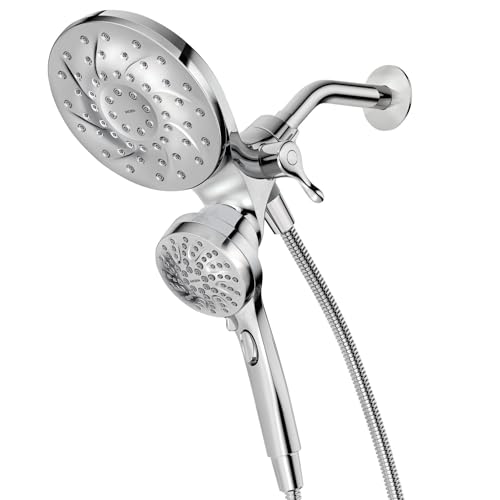
Moen’s Engage Magnetix solves the bracket problem the guide flags: instead of a clip or cradle, the handheld docks to the rain head with a magnet, so it releases with a pull and snaps back into place even with soapy hands. The hand shower offers six spray settings chosen by rotating its outer ring, plus a pause button that drops flow to a trickle while you lather. A 3-way diverter runs the rain head, the handheld or both together, and the 60-inch hose is kink-free metal rather than plastic. The rain head itself is single-function, so all pattern choice lives in the handheld. Chrome is the finish on this version, and Moen backs the range with a limited lifetime warranty. Pick it if people of different heights share the shower and the handheld will be docked and removed many times a day.

3. Delta In2ition 5-Spray H2Okinetic Shower (58480-PK) — Best for Build Quality
Delta’s In2ition design takes a different approach: the handheld nests inside the fixed head, so docked it looks and sprays like one large shower head, and undocked it becomes a separate hand shower on a metal hose. MagnaTite docking pulls it back into place with a magnet and holds it there. The head gives five spray settings with Delta’s H2Okinetic spray, which the maker says shapes the water for a drenching feel, and a diverter lever selects the head alone, the handheld alone or both at once. A pause setting reduces flow to a trickle without losing your temperature setting, useful for shaving or bathing children. The chrome 58480-PK is the long-running version of this design; finishes and flow rates vary across the In2ition range, so check the listing matches your local rules. It is the most expensive pick here, and the one to choose for build quality.

View Delta In2ition 5-Spray H2Okinetic Shower 58480-PK on Amazon

4. Delta In2ition 4-Setting Shower (75486C) — Best for Low-Flow Rules
The 75486C is the water-miser of the In2ition family, rated at 1.75 gallons per minute where many dual systems run at 2.5. That makes it a straightforward fit for the low-flow rules the guide mentions, and for households watching hot-water use. The layout matches the premium model above: a hand shower that docks inside the fixed head, usable separately or at the same time as the outer head, with four spray settings on the hand shower including a massage spray and a pause that slows water to a trickle. Fewer settings and a chrome finish keep the cost down, and the lighter flow means running both heads together divides that 1.75 GPM, so combined mode feels gentle rather than powerful. If your home pressure is already low, read the guide’s flow section before choosing it. For regulated areas and eco-minded retrofits, it is the sensible Delta.


5. AquaSpa 48-Mode 3-Way Combo (4347) — Best for Seated Showering
The AquaSpa 4347 stands out for one practical detail: alongside the standard overhead bracket it includes an extra low-reach wall bracket, so the handheld can live at sitting height — the accessibility point the guide raises for seated showering or bathing children and pets. Each head has six settings (power rain, massage, mist, two mixes and pause), and the 3-way diverter runs them separately or together for up to 48 patterns. The hose is six feet of stainless steel, a foot longer than most rivals here, which adds useful reach when the handheld sits low. The oil rubbed bronze finish suits traditional bathrooms that chrome does not match, and the hand shower has an anti-slip grip for wet hands. Like the AquaDance above, the body is finished ABS rather than solid brass, so handle the fittings gently when tightening, as the guide advises.

What to Look For
| Factor | Why it matters | What to check |
|---|---|---|
| Spray modes | Each head may offer several patterns, from wide to focused. | Count the modes on both heads and see how they are selected. |
| Diverter | Switches water between heads and may allow combined use. | Look at where the diverter sits and whether it has a combined position. |
| Hose length and material | Decides how far the handheld reaches and how well it resists kinking. | Compare stated length and look for a braided or reinforced hose. |
| Head size and arm | A large overhead head needs space and a suitable arm length. | Measure the head diameter and the distance from wall to your head position. |
| Finish and material | Metal, plastic and coated finishes wear and clean differently. | Read the body material and how the finish should be cleaned. |
| Holder and mounting | A good bracket holds the handheld at a useful height. | Check whether the bracket adjusts and what tools are needed. |
Setup and Care Tips
- Turn off the water, remove the old head and clean the threads on the shower arm before fitting the new unit.
- Wrap the threads with plumber’s tape in the direction the maker suggests so the joint seals well.
- Hand tighten first, then use a wrench gently, with a cloth to protect the finish.
- Check each connection for drips by running the water and watching the fittings.
- Clean spray nozzles on a regular basis with a soft brush and the products the maker recommends.
Mistakes to Avoid
- Skipping a measurement and finding the overhead head sits too close to the wall.
- Ignoring hose length, which leaves the handheld too short for its job.
- Overtightening plastic parts and cracking a fitting.
- Choosing by finish alone and overlooking the diverter design.
- Forgetting that some water supplies have limits the maker mentions.
How Flow and Water Pressure Interact
Running two heads from one supply raises questions about pressure that a single head never does. Your home supplies a certain pressure and flow, and a dual system divides that between the overhead head and the handheld, or between both when used together. If your pressure is modest, running both at once can feel weaker than either alone, and that is a reason to check how the system behaves before deciding that it is faulty.
Many regions limit the flow rate of showerheads, and makers design to those limits. Check the listing for the stated flow and any note on whether the combined use stays within local rules. Do not try to remove flow restrictors to boost pressure unless the maker explicitly allows it, and be aware of local regulations that might apply.
Several details affect how a shower feels at a given pressure: the number and size of nozzles, the spray pattern, the internal design and the head diameter. A wide rain-style head spreads water over a larger area and feels gentler, while a smaller, focused head feels more forceful at the same flow. Both are valid preferences, so think about what you like.
If your pressure is low, look for systems whose descriptions mention suitability for lower pressure, and consider checking the supply with a simple test, such as timing how long the water takes to fill a bucket. If pressure is very high, a pressure regulator may be helpful, and a plumber can advise. Noise, leaks at the diverter or spray that sputters may indicate pressure issues.
Diverters and Switching Between Heads
The diverter is the part you use every day, so judge it carefully. It sends water to the overhead head, the handheld or both, and it can be a lever, a dial or a push button. A good diverter moves smoothly, stays where you set it and closes completely so water does not trickle from the head you are not using. Read how the maker describes the positions, and whether a combined position exists.
Placement is also important. A diverter near the shower arm connection is easy to reach for most people but may be awkward for some heights. Some designs place it on the handheld’s handle or on a wall unit. Consider whether children or people with limited grip will use the shower, and choose a control they can operate easily.
Diverters are common sites for leaks and wear. Mineral deposits can make them stick, and seals can degrade. Read the maker’s care notes and how to access the diverter for cleaning. Replacement parts or a clear warranty procedure are useful in case of failure.
Be cautious of drip-through. Some diverters allow a small amount of water to pass to the inactive head, which can be annoying or cause dripping after you finish. If this is a concern, look for designs that describe a positive shutoff and check how the system performs when first installed. Also note that a combined mode may reduce pressure at both heads, as discussed earlier.
Hose, Bracket and Handheld Ergonomics
The handheld is the part you touch most, so its feel matters. Check the weight and grip shape. A handle that fits your hand is easier to use for rinsing, washing hair or cleaning the tub. Heavier models feel solid but tire the wrist, while light ones can feel flimsy. Spray controls on the handle should be easy to operate with wet hands.
Hose length determines reach. A longer hose lets you rinse children or pets and clean the shower, and a short one limits use. Consider the size of your shower and where you stand. The hose material affects durability: reinforced or braided hoses resist kinking and twisting, while some plastic hoses can tangle. Check how the hose connects, and whether swivel connections let it rotate without twisting.
The bracket or holder keeps the handheld in place and sets its height. Adjustable brackets let people of different heights use the shower comfortably, and a sturdy holder keeps the head from dropping or pointing the wrong way. Some systems include a slide bar, giving a range of heights, and this can be useful for households with mixed heights. Check how the bar mounts and what wall support it needs.
Think about ease of use for all family members. If anyone has limited mobility, look for features such as a stable seat, easy-grip handle and reachable controls. Check that the holder is positioned where the handheld can be reached from sitting or standing.
Fitting Your Bathroom and Plumbing
Fit is easy to get wrong with dual systems. Start by looking at your shower arm: its length, angle and position decide where the overhead head hangs. A short arm limits how far the head can extend, and a low ceiling can make a large head sit too close to your head. Measure from the wall to where you stand and from the arm to the ceiling.
Check the connection thread. Many showers use a standard thread, but not all do, and some bathrooms have different arrangements such as ceiling mounts or built-in fixtures. Confirm that the system you consider is designed for your setup. Look at what is included: adapters, tape, brackets and screws. If the system calls for additional hardware, add it to your plan.
Some dual systems add a second connection, such as a splitter or wall elbow for the handheld hose. These attach to the supply line, so check how and where they connect, and whether they need extra space. In a small shower, a large head and a bulky diverter may crowd the area.
If you rent, check whether you may replace fittings and keep the original parts so you can restore them. If your plumbing is old, corroded or unusual, a plumber can advise before you start. Take care with the wall: tiled surfaces need appropriate drill bits for holes, and a drilled hole in tile can crack if rushed. Where a holder mounts to tile, use the method the maker supplies.
Cleaning, Budget Tiers and Replacement Signs
Scale builds up on nozzles and inside diverters, especially in hard water areas. Wipe rubber nozzles with your fingers or a soft brush regularly, and descale as the maker advises, often with a vinegar soak or product they approve. Check whether your finish tolerates the cleaner, because some finishes dull with acids. Rinse thoroughly afterwards. Clean the hose exterior and check the washers at connections.
Broadly, entry-level dual systems tend to use more plastic, simpler diverters and fewer spray modes. Mid-range ones usually add metal components, a better hose and more spray options. Higher tiers often feature solid metal construction, finishes that resist tarnish, smoother diverters and larger heads. Check the specifics for each listing instead of relying on tier names.
Spend on the parts that wear: the diverter, hose and connections. Finish is a matter of taste, but make sure it matches other bathroom fixtures. Remember to include costs of tape, tools, replacement washers and, if needed, a plumber.
Signs that a system needs repair or replacement include persistent leaks at the arm, diverter or hose connections, a diverter that no longer switches cleanly, a cracked or kinked hose, nozzles clogged beyond cleaning, peeling or corroded finish and a bracket that no longer holds. Washers are inexpensive, so try them first. Check warranty terms and keep the receipt. If you notice mold behind or around the fixture, clean it and check for hidden leaks.
Parts of a Dual Showerhead System Explained
A dual system combines a fixed overhead showerhead with a handheld sprayer, usually joined by a diverter. Knowing the parts helps you read a listing and spot compatibility problems before you order.
- Fixed head: Mounts on the shower arm and sprays from above.
- Handheld wand: Hangs on a holder or clips to a bracket and attaches by a hose.
- Diverter: A lever or valve that sends water to one head, the other, or both.
- Hose: Comes in various lengths, so check that it reaches where you need it.
- Bracket or holder: Keeps the wand in place, and some versions adjust the angle.
- Thread connection: Most fit a standard shower arm, but read the listing.
Installation Notes and When to Call a Plumber
Many systems screw onto the existing shower arm with plumber’s tape, and the maker’s instructions list the steps. Turn off the water if the instructions say so, protect the tub from dropped parts, and tighten connections by hand first, then with a tool only if needed. If you see signs of corrosion, a loose arm or hidden leaks behind the wall, call a licensed plumber instead of forcing the parts. Any change to pipes inside the wall is a job for a professional.
Spray Settings, Flow and Water Pressure Questions
Spray patterns such as rain, massage and mist vary by model, and the listing should state how many settings each head offers. Flow limits may be set by local regulations, and your home water pressure also affects how a showerhead feels. Do not expect the same experience from every house. If pressure is low, ask the maker whether the model is designed for it, and consider asking a plumber to check the supply.
Cleaning Mineral Buildup
Hard water can leave deposits in nozzles. Follow the maker’s cleaning instructions, which may suggest wiping the nozzles or soaking the head in a gentle solution, and rinse thoroughly. Check hoses for kinks and replace them if they wear out.
Choosing Finishes and Matching the Bathroom
The finish affects how the shower looks and how easily it cleans. Chrome is common and matches many faucets, while brushed nickel hides water spots better. Matte black and brass finishes add contrast but may show marks in different ways. If you already have a faucet and towel bars in the bathroom, try to match the tone so the room looks planned. Read the maker’s cleaning notes, since some finishes dislike abrasive cleaners. Consider the height of the fixed head, the length of the hose and the shape of the wall holder so the wand is easy to reach for everyone who uses the shower, including children and anyone who prefers to sit. Before you order, check whether the system comes with all the washers and tape you need.
Reading the Shortlist Again: What Really Separates One Dual Showerhead System From Another
Once you have read the individual reviews above, the differences between dual showerhead systems can look smaller than they really are. Listings tend to lead with the same handful of headline claims, and every model is described as powerful, durable or easy to use. The more reliable way to choose is to work backwards from your own situation: where the dual showerhead system will live, how often it will be used, and which frustrations you are trying to leave behind. A choice that suits a neighbour’s household perfectly can be the wrong one for yours, simply because the daily routine around it is different.
Start with fit, in every sense of the word. For this category that means checking the height of the existing shower arm, the width of the stall or tub, the water pressure in your home, and the reach the handheld hose needs. Numbers on a listing only become useful once they are compared with your own measurements, so take them before you fall in love with any particular model. Allow a little margin where the guide above suggests it, because a dual showerhead system that only just fits, only just reaches or only just copes will annoy you every single time you use it, while one with comfortable headroom tends to disappear into the background of the day.
Next, think about the work itself rather than the product. The main jobs here are rinsing shampoo from thick hair, bathing children or helping a family member shower seated, and rinsing down the stall walls after cleaning. Be honest about which of those you will do weekly and which you might do once a year. Features that support your weekly jobs deserve far more weight than impressive extras aimed at rare tasks. Many buyers overspend on capability they use twice and underspend on the handling, controls or build details they touch every day, and that imbalance is the most common cause of quiet disappointment with an otherwise good dual showerhead system.
Finally, consider the ownership side that listings rarely mention: the cleaning, the consumables, the storage footprint and the small habits a dual showerhead system asks of you. Typical owners here include a couple who prefer different spray styles, a family sharing one bathroom on busy mornings, or anyone adding a handheld option to a fixed-head shower, and the right answer differs for each of them. If a model needs attention you know you will not give it, a simpler alternative that asks less of you will usually serve you better over the years, even if it looks less exciting on paper.
Planning the Purchase Around Your Space and Routine
Good planning prevents most returns. Before ordering any dual showerhead system, walk the space where it will be used or installed and note the obstacles that photographs never show: tight corners, uneven surfaces, doors that swing into the working area, and the route the product has to travel from the front door to its final position. Measure twice and write the figures down. If the dual showerhead system is replacing an older one, note what you liked and disliked about the old unit, because those specifics are a better brief than any generic wish list.
Think, too, about timing and the people around the purchase. Work such as rinsing shampoo from thick hair, bathing children or helping a family member shower seated, and rinsing down the stall walls after cleaning is easier when you are not racing a deadline, a houseful of guests or the worst of the weather. If other people in the household will use the dual showerhead system, ask what matters to them before you buy rather than after it arrives. A short conversation now can surface a deal-breaker — a control style someone struggles with, a size that will not work for them — while it is still free to act on.
Budget planning deserves the same realism. The purchase itself is only part of the cost of owning dual showerhead systems; installation help where it is needed, basic accessories the maker recommends, and routine consumables all belong in the picture. None of that argues for buying the most expensive option. It argues for comparing the whole picture rather than a single headline figure, and for leaving a little room in the budget so a sensible extra does not become a painful one.
When the dual showerhead system arrives, resist the urge to judge it in the first ten minutes. Unpack it fully, keep the packaging until you are sure it is staying, and read the manual properly — not as a formality, but because the setup order, safety notes and care instructions in it are written for the exact model you bought. Many early problems with dual showerhead systems trace back to a skipped setup step or a warning that was skimmed, and they are much easier to prevent than to undo.
How the Picks Compare When You Match Them to Real Jobs
The picks above were chosen for different buyers, and comparing them by job rather than by specification sheet makes the shortlist much easier to use. Read each model’s positioning below against the jobs you listed for yourself, and notice where the guide’s emphasis changes: some picks are there for capacity or reach, some for simplicity, and some because they suit a particular space or user. That spread is deliberate, and it is the fastest route to a confident decision.
AquaDance 48-Setting 3-Way Shower Combo (3323) earns its place as best for Most Bathrooms. Treat that positioning as a promise about who it suits best rather than a claim that it beats the others at everything. If the description matches your situation — your space, your routine and the jobs you actually do — it deserves to be at the top of your list. If it reads like someone else’s household, one of the neighbouring picks will almost certainly serve you better, and choosing it instead is not settling for less; it is matching the tool to the task.
Moen Engage Magnetix 26009 2-in-1 Combo earns its place as best for Easy Docking. Treat that positioning as a promise about who it suits best rather than a claim that it beats the others at everything. If the description matches your situation — your space, your routine and the jobs you actually do — it deserves to be at the top of your list. If it reads like someone else’s household, one of the neighbouring picks will almost certainly serve you better, and choosing it instead is not settling for less; it is matching the tool to the task.
Delta In2ition 5-Spray H2Okinetic Shower (58480-PK) earns its place as best for Build Quality. Treat that positioning as a promise about who it suits best rather than a claim that it beats the others at everything. If the description matches your situation — your space, your routine and the jobs you actually do — it deserves to be at the top of your list. If it reads like someone else’s household, one of the neighbouring picks will almost certainly serve you better, and choosing it instead is not settling for less; it is matching the tool to the task.
Delta In2ition 4-Setting Shower (75486C) earns its place as best for Low-Flow Rules. Treat that positioning as a promise about who it suits best rather than a claim that it beats the others at everything. If the description matches your situation — your space, your routine and the jobs you actually do — it deserves to be at the top of your list. If it reads like someone else’s household, one of the neighbouring picks will almost certainly serve you better, and choosing it instead is not settling for less; it is matching the tool to the task.
AquaSpa 48-Mode 3-Way Combo (4347) earns its place as best for Seated Showering. Treat that positioning as a promise about who it suits best rather than a claim that it beats the others at everything. If the description matches your situation — your space, your routine and the jobs you actually do — it deserves to be at the top of your list. If it reads like someone else’s household, one of the neighbouring picks will almost certainly serve you better, and choosing it instead is not settling for less; it is matching the tool to the task.
A useful final exercise is to pick your top two dual showerhead systems and write down, in one sentence each, why each would suit you. If one sentence comes easily and the other feels like a stretch, you have your answer. If both feel strong, decide on the ownership details: which will be easier to clean, store, service or live with in your particular space. Those everyday factors, repeated hundreds of times, are what separate a purchase you are pleased with from one you merely accept.
From First Setup to Confident Everyday Use
The first session with a new dual showerhead system sets the tone for everything after it. Set it up in good light, with the manual open and no time pressure, and work through the maker’s steps in order even if some of them look obvious. Check that everything supplied is present, that moving parts move as described, and that you understand the controls before the first real job. This slow first pass is where you learn the small things — how it sounds when it is working normally, how the controls feel, where your hands naturally go — that make later use relaxed instead of tentative.
Start with an easy version of the job. If your main tasks are rinsing shampoo from thick hair, bathing children or helping a family member shower seated, and rinsing down the stall walls after cleaning, begin with the simplest of them and pay attention to how the dual showerhead system behaves rather than how fast you can finish. Small adjustments early — to position, settings or technique — pay off every time afterwards. It is also worth noting anything that surprises you, good or bad, while the purchase is recent; surprises often point to a setting or accessory that resolves them, and makers’ support teams are far more helpful in the first weeks than months later.
Build your routine gradually. Most people develop a personal rhythm with dual showerhead systems: a preferred order of steps, a place where the product lives between uses, and a quick check they run through before starting. Let that rhythm form over the first few uses rather than forcing it on day one. If other people will share the dual showerhead system, show them the basics in person instead of assuming the manual will be read; five minutes of demonstration prevents most of the misuse that leads to damage, frustration or avoidable safety worries.
Safety deserves a plain word here. Follow the maker’s warnings for this exact model, use the protective equipment or precautions the manual names, and stop and reassess if something feels wrong rather than pushing through. Where a job involves fixed wiring, fuel lines, structural work or anything your local rules reserve for licensed trades, bring in a professional for that part. Doing so is not a failure of DIY spirit; it is how experienced homeowners handle the edges of a project, and it protects both the warranty on the dual showerhead system and the people around it.
Care, Cleaning and Storage: The Routine That Keeps It Performing
Dual showerhead systems rarely fail all at once; they decline gradually, usually because small care tasks were skipped until they became big ones. The routine that protects yours is unglamorous: soaking the nozzles to loosen mineral buildup, wiping the finish with a soft cloth rather than abrasive pads, and checking hose connections for slow drips. None of those tasks takes long on its own. The trick is attaching them to moments that already exist — the end of a job, the start of a season, a regular weekend tidy — so they happen automatically rather than relying on memory or good intentions.
Cleaning deserves care of its own. Use the methods and products the maker approves for your model, because finishes, seals and working surfaces on dual showerhead systems can be damaged by harsh chemicals, abrasive pads or pressure applied in the wrong place. Work gently and often rather than aggressively and rarely: light, regular cleaning keeps grime from hardening into the kind of buildup that tempts people into damaging scrubbing. Let everything dry fully before storage or reassembly, since trapped moisture is behind a large share of odours, corrosion and mildew problems in stored equipment.
Storage matters more than most buyers expect. Keep the dual showerhead system in a dry place out of extremes of temperature where you can, with cords, hoses, attachments or accessories kept together so the next use does not start with a search. If it will sit unused for a season, follow the maker’s storage guidance — some products want a particular preparation before a long rest, and skipping it is a common reason for a disappointing first use months later. A photograph of how it was packed or assembled can be surprisingly helpful when you return to it.
Finally, keep the paperwork. The manual, proof of purchase and any warranty details for your dual showerhead system should live somewhere you can find them, because the first question any support line or repairer asks concerns the exact model and its purchase date. A quick note of when you performed major care tasks helps too. It turns guesswork into a record, makes seasonal servicing easier to schedule, and gives a future buyer or family member a clear picture of how the product has been looked after.
Judgement Calls: Trade-Offs Honest Buyers Should Weigh
Every dual showerhead system involves trade-offs, and naming them plainly leads to better choices than hunting for a model that claims to have none. Bigger usually means heavier or harder to store. More features usually mean more to learn, clean and eventually maintain. A lower purchase cost can mean simpler construction that is perfectly adequate for light use, or it can mean compromises you will feel every day. The guide above positions each pick so you can see which side of these trade-offs it sits on; your job is simply to decide which compromises you mind least.
Consider how your needs may change. A dual showerhead system bought for one household, one home or one stage of life may be asked to serve another. Flexibility — adjustability, compatibility with common accessories, a design that copes with more than one job — is worth something if change is likely, and worth very little if your situation is stable. Buying for a hypothetical future is as wasteful as buying too narrowly for the present, so weigh the changes you genuinely expect rather than every possibility you can imagine.
And if you are replacing an existing dual showerhead system, let the old one teach you. What wore out, what annoyed you, what did you never use? A replacement chosen to fix two specific frustrations will satisfy you far more than one chosen from a generic list of virtues. Where the old unit still works, passing it on, selling it or keeping it as a backup for lighter duties can also soften the cost of upgrading, and keeps a serviceable product in use rather than in landfill.
FAQ
Will it fit my existing shower arm?
Many units use a standard connection, but sizes and arm positions vary. Check the listing and your current plumbing, and read what is included in the box.
Can I run both heads at once?
Some diverters offer a combined setting and others do not. The listing and manual should state it clearly.
Will a dual system reduce my water pressure?
It can when both heads run at once, since the supply is shared. Check the listing for pressure guidance, and test your home pressure if you have concerns.
Can I install it myself?
Many systems are designed for home installation with basic tools, using the existing arm. If you are unsure about plumbing, ask a plumber.
Do I need plumber's tape?
Often yes, for threaded joints. Follow the maker's instructions on direction and number of wraps, and avoid overtightening.
How do I descale the heads?
Follow the maker's cleaning advice, which often involves soaking the head in a mild descaling solution and rubbing the nozzles. Check that the product is safe for your finish.
What if the handheld drips after I switch to the overhead head?
A small drip can be normal with some diverters, but constant flow suggests a worn seal or mineral buildup. Clean the diverter and consult the manual or maker.
Are these suitable for low-flow regulations?
Many are designed to meet flow limits, but rules vary by region. Check the listing and local rules.
Can I use a dual system in a small shower?
Yes, if you measure first. Pick a smaller head and a compact diverter so the unit does not crowd the space.
How do I know which dual showerhead system on this list fits my home?
Start from your own measurements and routine rather than from the products. Check the height of the existing shower arm, the width of the stall or tub, the water pressure in your home, and the reach the handheld hose needs, then read the picks again and match each model’s positioning to those facts. The right choice is the one whose strengths line up with your most frequent jobs, not necessarily the largest or most fully featured option.
What should I check in the first week of owning a new dual showerhead system?
Confirm that everything supplied is present, that setup matches the manual, and that the dual showerhead system behaves as described on an easy first job such as rinsing shampoo from thick hair. Note anything that seems off while the purchase is recent, keep the packaging until you are sure it is staying, and register the warranty if the maker offers one.
How often does a dual showerhead system need cleaning or maintenance?
It depends on how hard and how often it works, and the maker’s schedule for your exact model is the authority. As a habit, build the routine around soaking the nozzles to loosen mineral buildup, wiping the finish with a soft cloth rather than abrasive pads, and checking hose connections for slow drips. Light, regular attention almost always beats occasional deep rescue, both for performance and for how long the product lasts.
Is it worth paying more for a higher-positioned pick?
Only if the extra capability maps to your real jobs. If a premium pick’s positioning describes your household — heavier use, a bigger space, more demanding tasks — the step up can be money well spent. If it describes someone else’s life, a mid-list pick matched to your actual routine will usually satisfy you just as much.
What is the most common mistake people make with dual showerhead systems?
Buying from the headline claims alone, without measuring or thinking through daily use. Skipping the checks around the height of the existing shower arm, the width of the stall or tub, the water pressure in your home, and the reach the handheld hose needs leads to poor fit, and skipping the maker’s setup and care guidance leads to most early problems. Both mistakes are easy to avoid with an hour of preparation.
When should I repair a dual showerhead system and when should I replace it?
Repair makes sense when the fault is isolated, parts are available, and the rest of the product is sound. Replacement makes more sense when problems repeat, when wear is general rather than local, or when your needs have genuinely changed since you bought it. A reputable repairer’s assessment, based on the exact model, is the best guide for anything beyond simple maintenance.
The Short Version
Measure your shower area, then compare spray modes, diverter design and hose length. Check finish and bracket details, and follow the installation steps closely.
Related Guides
- How to Choose the Best Closet Systems: Buyer's Guide (2026)
- How to Choose the Best DIY Security Systems: A Buyer's Guide
- How to Choose the Best Driveway Alarm Systems: A Buyer's Guide
- How to Choose the Best Home Gym Systems: Buyer's Guide (2026)
- How to Choose the Best Home Security Systems: A Buyer's Guide


