Disclosure: airfryerkitchensupply.com is reader-supported. When you buy through links on our site, we may earn an affiliate commission at no extra cost to you.
Where to Buy
The best slow cookers with saute earn their place only if the function is real — hot enough to bloom onions and brown meat before the long cook — so every linked pick below was matched to a live listing with saute or sear/saute stated in the confirmed details. One respected model is deliberately unlinked because its exact listing could not be confirmed; it is discussed without a link rather than replaced by a substitute.
- Ninja PossibleCooker PRO MC1001, 8.5-qt, Sea Salt Gray — Check the current price on Amazon
- Instant Pot Duo 6 Qt 7-in-1 — Check the current price on Amazon
- COSORI Pressure Cooker 6QT, 9-in-1, Ceramic Coating Pot — Check the current price on Amazon
- GreenPan Elite 14-in-1 6QT Electric Slow Cooker, Sage Green — Check the current price on Amazon
- Midea 12-in-1 Electric Pressure Cooker, 8 Quart — Check the current price on Amazon
- Cuisinart Cook Central MSC-400, 4-Quart — Mid-range tier pick; read the review below for how to shop it, because we could not confirm a matching listing to link responsibly.
The best slow cookers with saute understand a simple culinary truth: what happens in the fifteen minutes before the lid goes on decides what the next six hours taste like. Onions softened in fat, spices bloomed, tomato paste darkened, meat given a first sear — a saute function builds that foundation in the same pot that then slow cooks, so the flavors compound instead of being left behind in a skillet. If your slow cooking has ever tasted flat despite correct seasoning, the missing step was almost certainly this one.
This category overlaps its browning cousin but is not identical to it. Saute is the broader, gentler art — aromatics, vegetables, ground meats, grains and sauces — where browning is the narrower pursuit of a crust on whole pieces of meat. Machines here were judged on both, because most buyers want both: a saute hot and responsive enough for onions and garlic without scorching, and strong enough to give stew meat a respectable sear when a recipe asks. The picks span dedicated multi-cookers, pressure-capable dual-duty machines and one true slow cooker with saute built in.
One entry is not linked by design: the Cuisinart MSC-400, the compact Cook Central many shoppers search for, could not be confirmed by exact listing in our checks, so it is discussed honestly without a purchase link. Its confirmed larger sibling anchors another of this program’s guides; here, the linked picks are the machines we can stand behind today, each with saute in its verified function list and a slow cook worthy of the foundation saute builds.
In this guide
Quick Picks
Ninja PossibleCooker PRO MC1001, 8.5-qt, Sea Salt Gray — Best Overall Saute Slow Cooker. Saute and slow cook in one 8.5-quart, oven-going pot with wraparound heat: the category’s most complete machine. Check price on Amazon.
Instant Pot Duo 6 Qt 7-in-1 — Best Saute Plus Pressure Versatility. A stainless-pot saute, a capable slow cook and pressure insurance in the class’s best-documented machine. Check price on Amazon.
COSORI Pressure Cooker 6QT, 9-in-1, Ceramic Coating Pot — Best Easy-Clean Saute. Saute and slow cook in a ceramic pot that never punishes you at the sink: versatility with easy manners. Check price on Amazon.
GreenPan Elite 14-in-1 6QT Electric Slow Cooker, Sage Green — Best True Slow Cooker with Saute. A real slow cooker with in-pot browning in a ceramic crock: saute where the slow cooking actually happens. Check price on Amazon.
Midea 12-in-1 Electric Pressure Cooker, 8 Quart — Best Large-Capacity Saute. Eight quarts of stainless saute room with presets and a manual mode: the volume pick for saute-led slow cooking. Check price on Amazon.
Cuisinart Cook Central MSC-400, 4-Quart — Unlinked: Compact Cook Central. The compact brown/saute Cook Central, discussed without a link because its exact listing could not be confirmed.
How These Picks Were Chosen
Every linked candidate was verified against a live Amazon listing, with the saute function required to appear in the confirmed details — as it does across the Ninja PossibleCooker PRO’s slow cook and saute functions, the Instant Pot Duo’s saute program, the COSORI’s saute mode, the GreenPan Elite’s sear, saute and brown list and the Midea’s saute function. That requirement quietly removed several famous slow-cooker names whose saute claims live in reviews rather than in their current listings.
Judging began with the saute itself: heat-up speed, evenness across the pot, and control range — a saute that only knows full blast will scorch garlic and milk-based foundations, while one that cannot climb will steam onions instead of softening them into sweetness. We then weighed the slow-cook half on its own merits: capacity matched to household size, programmable timing, keep-warm judgment and a pot that moves from saute to slow cook to table without drama. Pot material and cleaning counted throughout, because a saute pot that is miserable to wash will quietly stop being sauteed in.
We kept two philosophies on the page deliberately. Pressure-capable multi-cookers offer saute plus a fast lane for weeknights, at the cost of slow-cook capacity and a sealed-lid style; dedicated slow-cooking multi-cookers offer saute inside a larger, gentler vessel built for all-day dishes. Neither is the correct answer in general — the final recommendation maps them to the households they fit. No prices or fixed ratings are printed anywhere here; check the current price on Amazon for the configuration you choose.
The 6 Best Slow Cookers with Saute

Ninja PossibleCooker PRO MC1001, 8.5-qt, Sea Salt Gray — Best Overall Saute Slow Cooker
The PossibleCooker PRO is the most complete saute-and-slow-cook machine here because it was designed as a slow cooker first and a saute station second to none. Its 8.5-quart nonstick pot sits over heating that wraps the base and sides, so onions soften evenly instead of scorching in a center ring while the edges stay raw, and the same pot then slow cooks the stew those onions founded — or goes into the oven, rated to 500°F, for a finished braise that wants a browned top.
Strengths
- Saute and slow cook share an 8.5-quart pot sized for real family dishes
- Heating from base and sides evens out saute hot spots
- The pot goes to the oven and the table, extending every recipe’s options
Trade-offs
- Large footprint; this is a commitment appliance
- Nonstick pot wants non-metal tools during the saute
- Eight-plus quarts is more vessel than small households need
| Capacity | 8.5 quart |
| Functions | 8-in-1 including slow cook and saute |
| Heating | Triple Fusion Heat technology |
| Pot | Nonstick, oven-safe to 500°F |
The saute itself behaves like cooking, not like a setting: responsive enough for garlic timing, strong enough to sear stew meat in honest batches, and sized so a family chili’s worth of ground meat browns instead of steaming. Around that core, the roast and steam functions and the pot’s table manners make it the household’s general braising station. Smaller households should look down-page at capacity; everyone else should recognize this as the pick that treats saute not as a bullet point but as the first chapter of every recipe it cooks.
Best for: Families whose slow cooking starts with a proper saute / Not suited for: Small households and counters with no room for an 8.5-quart vessel
Check the current price on Amazon

Instant Pot Duo 6 Qt 7-in-1 — Best Saute Plus Pressure Versatility
The Duo is the pragmatic giant of this category: a 6-quart multi-cooker whose saute program, working in a stainless steel pot, builds the aromatic foundation and meat sear a slow cook needs, and whose pressure function forgives the mornings the slow cook never got started. Its slow-cook mode is honest and capable, and for the enormous number of households whose slow cooking shares a life with weeknight time pressure, the combination outranks any purist’s objection.
Strengths
- Saute in a stainless pot that builds real fond for deglazing
- Pressure cooking rescues the days the slow cook was forgotten
- The most documented appliance in its class, with recipes everywhere
Trade-offs
- Slow cooking under a pressure lid behaves differently from a classic crock
- Six quarts is the ceiling; no larger slow-cook batches
- Saute heat control is stepped rather than finely graded
| Capacity | 6 quart |
| Functions | 7-in-1: pressure cook, slow cook, rice, steam, saute, yogurt, warm |
| Pot | Stainless steel inner pot |
| Saute | Dedicated saute program |
Stainless steel is its saute signature. Unlike nonstick pots, it encourages a proper fond — the browned layer that deglazes into sauce depth — and tolerates metal tools and high enthusiasm without complaint. The compromises are real: slow cooking happens under a pressure-style lid with different evaporation than a glass crock lid, and the stepped saute heat asks for a stir rather than a dial for delicate work. Judged as the one appliance that sautes, slow cooks and pressure cooks in a normal kitchen, it remains the default recommendation for versatility per inch of counter.
Best for: Households wanting saute, slow cook and pressure rescue in one pot / Not suited for: Slow-cook traditionalists who want a glass lid and a classic crock
Check the current price on Amazon
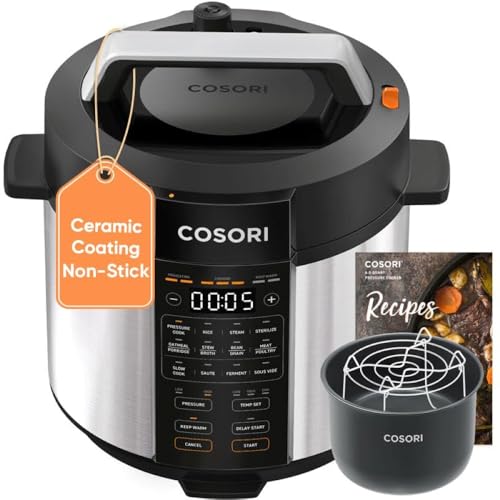
COSORI Pressure Cooker 6QT, 9-in-1, Ceramic Coating Pot — Best Easy-Clean Saute
The COSORI answers the Duo’s formula with a cook’s quality-of-life upgrade: the same 9-in-1 versatility — slow cook, saute, sous vide and more — but with a ceramic-coated inner pot that changes the daily experience of sauteing. Onions slide instead of catching, eggs and grains release, and the post-dinner wash becomes a rinse rather than a project. For cooks whose saute habit has ever been discouraged by the cleanup waiting at the end of it, that coating is not a detail; it is the feature.
Strengths
- Ceramic-coated pot sautes without sticking and washes effortlessly
- Slow cook and saute sit alongside sous vide in a modern function set
- A calmer, more polished take on the pressure multi-cooker formula
Trade-offs
- Ceramic coating prefers non-metal utensils
- Six-quart capacity, shared with its pressure-cooker shape
- Fond forms more gently than in a bare stainless pot
| Capacity | 6 quart |
| Functions | 9-in-1 including slow cook and saute |
| Pot | Ceramic coating inner pot |
| Power | 1100W |
Ceramic’s saute character is gentler than bare steel’s: it browns kindly, builds a lighter fond and rewards moderate heat, which suits aromatics, vegetables, ground meats and sauce foundations — the majority of real saute work — beautifully. Crust absolutists chasing the darkest sear should choose the stainless Duo above. Everyone else gets a machine that sautes, slow cooks and even cooks sous vide in a pot they will never dread washing, which in the arithmetic of home cooking is worth more than a shade of fond.
Best for: Cooks who saute often and clean reluctantly / Not suited for: Maximum-fond seekers who sear in bare stainless only
Check the current price on Amazon

GreenPan Elite 14-in-1 6QT Electric Slow Cooker, Sage Green — Best True Slow Cooker with Saute
Buyers who want a slow cooker with saute — in that order — should start here. The GreenPan Elite is a true 6-quart slow cooker whose 14-in-1 function set includes in-pot browning, so onions, aromatics and meat get their saute in the same PFAS-free ceramic nonstick crock that then spends the day slow cooking them. This Sage Green listing carries the same confirmed design as the Elite in this program’s browning guide, finished for kitchens that leave their cooker out and would like it to look like it belongs there.
Strengths
- A genuine slow cooker at heart, with browning built into the pot
- Ceramic nonstick releases sauteed foundations and cleans in the dishwasher
- Silicone handles and a steamer round out a thoughtful package
Trade-offs
- In-pot browning favors moderate, patient saute technique
- Six quarts, family size but not batch-cooker size
- Ceramic coating care rules apply as with all nonstick
| Capacity | 6 quart |
| Functions | 14-in-1 with in-pot browning (sear/saute family) |
| Crock | PFAS-free ceramic nonstick, removable |
| Extras | Stainless steel steamer; silicone handles; dishwasher-safe lid and crock |
Its saute style is the ceramic style: even, releasing and forgiving, ideal for the aromatic foundations, vegetables and ground meats that make up most saute work, with browning capacity for stew pieces when they are dry and uncrowded. The included steamer, silicone handles and dishwasher-safe crock and lid show a designer who understood the whole life of a slow-cooker meal, not just its first fifteen minutes. If your identity is slow cooker first and your skillet is tired of pre-duty, this is your machine.
Best for: Slow-cooker-first cooks wanting saute without a pressure appliance / Not suited for: Pressure-cooking households and very large batch cooks
Check the current price on Amazon

Midea 12-in-1 Electric Pressure Cooker, 8 Quart — Best Large-Capacity Saute
The Midea scales the saute-and-slow-cook formula to 8 quarts, and scale changes saute quality in a way spec sheets miss: a bigger stainless pot means ground meat browns in one uncrowded batch, onions for a double chili soften without steaming, and the fond of a crowd-sized braise builds in a single session. Its confirmed saute function, twelve presets and a DIY manual setting give both program followers and improvisers a way to run the saute-then-slow sequence at family-and-friends volume.
Strengths
- Eight quarts give sauteing room that 6-quart pots cannot
- Stainless pot builds fond and tolerates enthusiastic technique
- A DIY manual setting lets experienced cooks run their own saute-to-slow sequence
Trade-offs
- Big footprint in pressure-cooker form
- Twelve presets can overwhelm a keep-it-simple cook
- Slow cooking inherits the sealed-lid style of its category
| Capacity | 8 quart |
| Functions | 12-in-1 with saute function and 12 presets |
| Pot | Stainless steel inner pot |
| Timing | 24-hour delay timer; DIY manual setting |
The stainless pot is the right material at this size — durable under metal tools, happy to deglaze, indifferent to the scrubbing a big batch eventually requires. The trade-offs are presence and style: it is a large pressure-format appliance whose slow cooking happens under its sealed lid, and cooks who want the glass-lidded crock experience should choose the GreenPan above. For big households, meal preppers and anyone whose slow-cooker recipes start with the word double, the Midea’s saute room is the deciding argument.
Best for: Large households and batch cooks who saute at volume / Not suited for: Singles, couples and glass-lid traditionalists
Check the current price on Amazon
Cuisinart Cook Central MSC-400, 4-Quart — Unlinked: Compact Cook Central
The MSC-400 is the compact member of Cuisinart’s Cook Central family — a 4-quart multi-cooker whose design pairs slow cooking with a Brown/Saute function, aimed at couples and small kitchens that want the one-pot saute workflow without a 6-quart appliance owning the counter. By family design and reputation it is a sensible, well-liked machine, and it is the model a significant share of this category’s shoppers arrive already wanting.
Strengths
- The compact Cook Central pairs slow cooking with a Brown/Saute function
- Four quarts is the right size for couples and small kitchens
- Simmer and steam flexibility in the family design
Trade-offs
- No matching listing could be confirmed, so no purchase link is provided
- Small capacity is a hard ceiling for batch cooks
- Sibling models differ; the name alone does not specify the machine
It is not linked here under the same rule applied across this program: Amazon check could not confirm a matching listing for the MSC-400 by exact model, so no link is attached and no sibling is silently linked under its name. Its larger sibling, the MSC-600, was confirmed and is linked in this program’s browning guide for readers who want the same workflow with a verified purchase today. If you shop the MSC-400 elsewhere, buy the exact model number from a listing that names it, and confirm the Brown/Saute function appears in that listing’s own details before paying.
Best for: Couples set on the compact Cook Central format / Not suited for: Anyone who needs a confirmed, clickable purchase today
Unlinked pick: Unlinked because no matching Amazon listing for the MSC-400 could be confirmed; no substitute model has been linked in its place. The confirmed MSC-600 sibling is linked in this program’s browning-setting guide.
Comparison Table
| Pick | Badge | Key Spec | Best For |
|---|---|---|---|
| Ninja PossibleCooker PRO MC1001, 8.5-qt, Sea Salt Gray | Best Overall Saute Slow Cooker | 8.5 quart | Families whose slow cooking starts with a proper saute |
| Instant Pot Duo 6 Qt 7-in-1 | Best Saute Plus Pressure Versatility | 6 quart | Households wanting saute, slow cook and pressure rescue in one pot |
| COSORI Pressure Cooker 6QT, 9-in-1, Ceramic Coating Pot | Best Easy-Clean Saute | 6 quart | Cooks who saute often and clean reluctantly |
| GreenPan Elite 14-in-1 6QT Electric Slow Cooker, Sage Green | Best True Slow Cooker with Saute | 6 quart | Slow-cooker-first cooks wanting saute without a pressure appliance |
| Midea 12-in-1 Electric Pressure Cooker, 8 Quart | Best Large-Capacity Saute | 8 quart | Large households and batch cooks who saute at volume |
| Cuisinart Cook Central MSC-400, 4-Quart | Unlinked: Compact Cook Central | Mid-range tier | Couples set on the compact Cook Central format |
How to Choose a Slow Cooker with a Saute Function
Saute is a technique before it is a setting, and the machines here only supply the heat and the pot. This guide covers the judgments that make in-pot saute succeed: heat management without a burner dial, the order foundations are built in, pot materials and their fond, and the dishes where saute matters most — and least — before a slow cook.
Heat control without a flame
A burner gives infinite gradation; a saute function gives steps, and cooking well on steps is a skill of timing rather than temperature. Preheat the pot before adding oil for meat and onions; add garlic and delicate spices after the pot’s fiercest heat has done its work, or in the last minute before liquid arrives; use the liquid itself as a brake, since a splash of stock drops a pot’s temperature instantly. Cooks who manage saute by sequence rather than by dial produce foundations indistinguishable from stovetop work in any machine on this page.
The order a foundation is built in
Fat first, then the ingredients in descending order of the time they need: onions and hard vegetables to soften and sweeten, meat to brown where the recipe builds it in the pot, garlic and spices for a brief bloom, tomato paste to darken, then liquid to deglaze and stop the cooking at its peak. Each layer seasons the next, and the pot accumulates flavor that the slow cook then distributes for hours. Reordering carelessly — garlic first, liquid early — burns the delicate and strands the fond, which is why recipes are written in the order they are.
Pot materials and the fond they make
Bare stainless steel, as in the Duo and the Midea, builds the darkest fond and shrugs off metal tools, at the cost of more attentive stirring and a firmer wash. Ceramic nonstick, as in the COSORI and GreenPan, builds a lighter fond that releases almost completely at the deglaze and washes without effort, at the cost of utensil discipline. Neither is the correct material; they are different saute instruments. Choose by your cooking: dark, meat-led foundations favor steel; vegetable, grain and everyday sauteing favors ceramic’s manners.
Where saute pays, and where it does not
Saute repays its fifteen minutes most in dishes built on aromatics and browned meat: chilis, braises, curries, bean soups and any sauce that begins with onion. It repays least in dump-and-go recipes designed around raw convenience — creamy chicken dishes, fruit-based sauces, delicate seafood — where its flavors flatten the brightness the recipe wants. The honest skill this category demands is not technique but selection: saute where depth belongs, skip it where freshness does, and the function becomes a judgment amplifier instead of a toll booth.
Saute capacity and the uncrowded rule
A pot sautes what fits in one layer with room to breathe, whatever its total quarts claim. Onions for a family chili fit most 6-quart pots; ground meat for the same chili may want two batches; stew meat always wants batches. The 8-quart picks here exist because batch count is a real cost across a cooking life. When comparing models, picture your largest regular recipe’s saute stage spread in the pot — that image, not the slow-cook volume, is the capacity figure that predicts your satisfaction.
Saute foundations by cuisine
The saute step wears different clothes in different kitchens, and a cook who knows the variations gets more from any machine here. A French-leaning braise wants onions soft and sweet and a fond built patiently; a curry wants whole spices bloomed in fat until fragrant, then a paste fried until the oil glistens at its edges; a chili wants ground meat properly browned and its fat used, not wasted; a bean soup wants its sofrito — onion, pepper, garlic — cooked down until it is a paste of pure savor. Each of those foundations is a five-to-fifteen-minute saute, each is transformed by happening in the cooking pot, and each is a reason the function on these machines is a culinary feature rather than a convenience. Learn two foundations deeply and the slow cooker becomes an instrument you play, rather than an appliance you load.
Saute for grains, lentils and the fast slow cook
An underappreciated saute use is waking up the dry goods. Lentils, rice, quinoa and dried beans all gain depth when they are toasted briefly in the aromatic fat before liquid arrives — rice turns nutty, lentils hold a firmer shape through the cook, and spices coat every grain instead of floating in the broth. The saute also lets a cook jump-start a slow recipe: bringing the assembled pot to a simmer on saute before switching to slow cook trims the long, slow climb through lukewarm temperatures and tightens timing for evening meals. Used with judgment — this is a head start, not a shortcut around food-safety sense — it makes the slow cooker responsive to real schedules, which is how a saute function quietly expands the number of days the machine gets used at all.
Teaching the next cook: saute as the visible lesson
Slow cooking hides its process behind a lid, which makes it a poor teacher; saute is the opposite — visible, audible and immediate — and a cooker that does both lets an experienced cook teach the craft in one vessel. A new cook can watch onions change, hear the sizzle settle as moisture leaves a pan, smell the exact moment garlic turns from raw to ready, and then see what six patient hours do to that foundation. Households bringing children or partners into cooking will find the saute-equipped cooker a better classroom than the sealed slow cooker ever was, because its first fifteen minutes contain most of what cooking judgment is. That may be the function’s least advertised value: it keeps the cook in the cooking, in an appliance category famous for the opposite.
Saute and the slow cooker’s comeback in modern kitchens
The slow cooker spent a decade as the appliance of dump recipes, and the saute function is the feature returning it to serious kitchens, because it restores the cook’s hand to a process that had been reduced to loading and leaving. A generation of cooks raised on building flavor — blooming spices, browning meat, cooking a sofrito down to sweetness — looked at a raw-load crock and saw a machine that skipped the cooking. The machines in this guide answer that objection completely: the first fifteen minutes are cooking, in every meaningful sense, and the following hours are the appliance’s patience put to proper use. That reunion of craft and convenience is why this category keeps growing, and why the picks here were judged as cooking equipment first and scheduling equipment second. The slow cooker did not need more programs; it needed its saute, and now that it has one, it is a braising station again.
Cleaning the saute pot: keeping the habit alive
A saute pot accumulates the most flavorful and most stubborn residue in the kitchen — browned proteins, caramelized sugars, spice oils — and the habit of using the function survives only if cleaning it is easy. The routine that works is immediate and brief: while the pot is still warm from the finished dish’s transfer, a soak in hot water loosens the fond lines, and a soft brush finishes what the soak started. Ceramic-coated pots, like the COSORI and GreenPan here, release their residue with the least persuasion and tolerate the dishwasher; stainless pots, like the Duo and Midea, occasionally want a deglazing boil — water simmered on saute and scraped — which restores them completely without abrasives. What never works is delay: a saute pot left until morning teaches its owner, one crusty dawn at a time, to stop sauteing. Protect the habit by protecting the wash, and the function will still be in daily use when the machine is old.
The saute habit: building it into a cooking week
A saute function changes a household gradually, and the cooks who get the most from these machines build the step into their planning rather than improvising it at loading time. Recipes get chosen with the foundation in mind — the chili whose onions are worth softening properly, the curry whose spices deserve their minute in fat — and prep shifts earlier in the day, when chopping is pleasant, so the saute itself is a calm fifteen minutes instead of a scramble. Over a month, a pattern emerges: two or three house foundations, mastered and repeated, carrying a rotation of slow-cooked dishes that all taste more deliberate than the calendar that produced them. That is the mature form of this category’s promise. The machine supplies heat, a pot and patience; the habit supplies the rest, and the habit is built one properly sauteed foundation at a time until it stops feeling like a step and starts feeling like cooking.
Storing and serving from the saute pot
The pot that sautes and slow cooks often becomes the serving vessel as well, and a few habits keep that final role graceful. Let the finished dish rest off the heat for ten minutes before serving; the sauce settles, the temperature evens, and the flavors you built present themselves more clearly than they do at a rolling, just-finished boil. Serve from the pot on a trivet with the lid resting beside it rather than sealed, so steam does not rain back into a sauce you reduced with care. Leftovers should leave the pot for shallow containers and prompt refrigeration rather than spending the night in the cooking vessel, however convenient that seems — the pot returns to service clean the next day, and the food keeps at its best. Small disciplines, but they are the difference between an appliance that produces dinners and a cooking system that presents them.
How to Saute in a Slow Cooker Before the Long Cook
This is the master sequence for saute-led slow cooking, written for the machines in this guide. It builds a beef-and-vegetable stew foundation, but the steps transfer to chilis, curries and bean soups by changing only the ingredients, not the order.
Step 1: Preheat the pot on saute and prep everything
Set the machine to saute and let the pot warm while you finish chopping — a saute station waits for no one once it is hot. Have onions, carrots, garlic, spices, tomato paste and deglazing liquid measured and within reach, and pat any meat dry. The mise en place habit that restaurant cooks treat as religion matters doubly here, because a multi-cooker’s saute does not pause politely while you hunt for the cumin.
Step 2: Soften the aromatics in fat
Add oil or butter to the hot pot, then the onions and hard vegetables with a pinch of salt, and cook, stirring, until they soften, turn translucent at the edges and begin to sweeten — several unhurried minutes. This stage builds the dish’s bass note. Rushing it leaves raw onion bite that six hours of slow cooking will soften but never convert to sweetness; the transformation happens here, in the fat, or it does not happen at all.
Step 3: Brown the meat and bloom the flavors
Push the vegetables to the sides or remove them briefly, and brown the meat in the pot’s center in an uncrowded layer, letting a crust form before stirring. Return the vegetables, add garlic, spices and tomato paste, and stir for one fragrant minute as the paste darkens and the spices bloom in the fat. The pot now holds a concentrated foundation that smells like the finished dish in miniature — the surest sign the sequence is on track.
Step 4: Deglaze and assemble the slow cook
Pour in stock, wine or tomatoes and scrape the pot’s bottom completely, dissolving the fond into the liquid. Add the remaining ingredients — beans, potatoes, grains, the bulk of the liquid — and stir the pot into its final composition. Taste the liquid now and adjust salt and acid; a slow cooker will meld flavors but rarely fixes a foundation that started under-seasoned, and this is your last easy moment to correct it.
Step 5: Switch modes and let the pot work
Cancel saute, set the slow-cook program and time, and put the lid on. Resist lifting it to admire the process — each lift costs the pot accumulated heat and the dish a measure of its gentle rhythm. When the cook finishes, finish actively: a splash of acid, fresh herbs, a swirl of something rich, and a final taste. The saute built the depth; the slow cook married it; the last thirty seconds are where you present it as cooking rather than as an appliance’s output.
Common Buying Mistakes
Sauteing everything, always, out of obligation
A saute function used indiscriminately flattens the bright, fresh dishes that make slow cooking varied — the creamy chicken, the fruit-laced curry, the delicate soup that wanted its vegetables vivid. Depth is one flavor direction, not a moral quality. Cooks who saute selectively produce better sauteed dishes and better un-sauteed ones, and enjoy the function more in both cases.
Adding garlic and spices to a ripping-hot empty pot
Garlic burns in under a minute at full saute heat, and ground spices scorch scarcely slower, turning bitter compounds loose in a foundation that then flavors hours of cooking. Bloom them in fat, over aromatics or meat, in the final minute before liquid arrives. The sequence in this guide exists largely to protect this one step, which separates a fragrant foundation from an acrid one using identical ingredients.
Skipping the preheat and sauteing in a warming pot
Ingredients added to a cold pot release their juices before the surface is hot enough to evaporate them, and the saute becomes a simmer in vegetable water — soft, pale and sweetless. Let the pot reach temperature first, add oil, and listen for the sizzle that confirms contact cooking has begun. Thirty patient seconds at the start decide whether the next fifteen minutes are a saute or a steaming.
Forgetting that the pot stays hot after the switch
A pot at full saute heat does not become a gentle slow cooker the instant the mode changes; it carries its heat into the first phase of the cook. For delicate dishes, let the pot settle for a few minutes or add the cool bulk ingredients promptly to absorb the energy. Ignoring the carryover is how a carefully sauteed foundation overcooks its edges in a machine the cook then blames for running hot.
Buying saute claims that the listing does not make
This category attracts borrowed glory: models described as saute-capable in roundups whose own listings promise no such function. The discipline modeled in this guide — requiring the word in the confirmed listing, and treating unconfirmed famous models like the MSC-400 as unlinked — is the shopper’s protection. If the product page itself will not say saute, believe the product page.
Final Recommendation
The Ninja PossibleCooker PRO is the recommendation for most buyers: a genuine slow cooker whose saute shares an 8.5-quart, oven-going pot with the long cook, at family scale. The Instant Pot Duo remains the versatility answer — stainless fond, pressure rescue, endless documentation — with the COSORI as its easier-cleaning ceramic alternative. Slow-cooker-first households belong with the GreenPan Elite, and large families with the Midea’s 8-quart saute room.
The MSC-400 stays a reasonable research target for couples committed to the compact Cook Central format; shop it by exact model number, since we could not confirm a listing to link. Whichever machine you bring home, the returns are in the ritual: preheat, aromatics, bloom, deglaze, then let time work. Fifteen honest minutes before the lid goes on is the difference between slow cooking as an appliance and slow cooking as a craft.
Keep researching the cluster: Best Slow Cookers With Browning Setting Best Slow Cookers With Inserts That Go On Stove Best Slow Cookers Best Multi Cookers Best 8 Quart Slow Cookers Best Programmable Slow Cookers
Frequently Asked Questions
What is the difference between saute and browning on a slow cooker?
Browning is the pursuit of a crust on pieces of meat; saute is the broader technique of cooking ingredients in fat in an open pot — aromatics, vegetables, ground meats, spices and sauce foundations. Most machines here do both under a saute or sear/saute function, and the browning guide in this program covers the crust-focused side in depth. For most recipes, saute is the step that matters daily: the onion-and-spice foundation that decides whether a slow-cooked dish tastes built or merely assembled.
Can I really saute well without a stove?
Yes, within the honest limits of stepped heat. The machines here preheat properly, hold a working saute temperature and give you a pot sized for real foundations; the technique adjustments are about sequence — aromatics before garlic, liquid as a brake — rather than compromise. A competition cook chasing a steakhouse sear still wants a burner and cast iron, which is why stovetop-insert cookers have their own guide here. For the foundations slow cooking actually needs, in-pot saute is complete.
Why is the Cuisinart MSC-400 listed without a buy link?
Amazon check could not confirm a matching listing for that exact model, and this program never substitutes another product’s link under a model’s name. It is included as a pick without a link so shoppers know what it is and how to buy it carefully elsewhere — by exact model number, from a listing that names it and states its Brown/Saute function. Its confirmed larger sibling, the MSC-600, is linked in this program’s browning-setting guide.
Does sauteing before slow cooking really take extra time?
About ten to fifteen active minutes, and it returns them in flavor many times over on the dishes where it belongs — chilis, braises, curries and bean soups. It also saves the washing of a separate skillet, since the saute happens in the cooking pot. On dump-style recipes designed for raw convenience, skip it without guilt; the skill is choosing, and the guides here exist to help you choose by dish rather than by habit.
Which pot material is best for sauteing in a slow cooker?
Stainless steel builds the darkest fond and tolerates any utensil, suiting meat-led foundations; ceramic nonstick releases effortlessly and cleans in minutes, suiting vegetable, grain and everyday sauteing. The page offers both — Duo and Midea in steel, COSORI and GreenPan in ceramic — because the right answer is a cooking-style question, not a quality ranking. Match the material to the foundations you actually build most weeks.
How much can I saute at once in a 6-quart cooker?
One uncrowded layer of the pot’s base: typically a large onion batch, about a pound of ground meat, or a pound of stew pieces per round. Doubling a recipe usually means two saute batches for the meat and one for the aromatics, which is normal practice. If your regular cooking doubles everything, the 8-quart picks — the Ninja PRO and the Midea — exist precisely to cut that batch count, and their extra room is the feature you will feel at every single meal.


