Disclosure: airfryerkitchensupply.com is reader-supported. When you buy through links on our site, we may earn an affiliate commission at no extra cost to you.
Where to Buy
Most slow-cooker inserts are stoneware that must never meet a burner, so the best slow cookers with inserts that go on stove live or die on one verified detail: an insert the manufacturer rates for the stovetop. Every linked pick below was matched to a live listing where stovetop-safe or cooktop-safe appears in the confirmed product details. Read the material notes in each review, because cooktop type — gas, electric, glass and induction — matters as much as the rating itself.
- Hamilton Beach 33662 Programmable Slow Cooker, 6 Quart Stovetop-Safe Sear & Cook Crock — Check the current price on Amazon
- Hamilton Beach Programmable Slow Cooker 33663, 6 Quart, with Travel Lid Lock — Check the current price on Amazon
- GreenLife 8QT Ceramic Nonstick Slow Cooker, Cooktop/Oven Safe, Turquoise — Check the current price on Amazon
- GreenLife 3.5QT Ceramic Nonstick Slow Cooker, Cooktop/Oven Safe, Turquoise — Check the current price on Amazon
- All-Clad 5 Quart 7-in-1 Electric Slow Cooker, Black Enamel Cast Iron Crock — Check the current price on Amazon
- Cuisinart PSC-650 Programmable Slow Cooker — Mid-range tier pick; read the review below for how to shop it, because we could not confirm a matching listing to link responsibly.
The best slow cookers with inserts that go on the stove solve the oldest frustration in slow cooking: the flavor lives in a seared crust, but the crock that slow cooks cannot touch the burner that sears. Stoneware inserts — the majority of the market — crack or fail under direct stovetop heat, which is why most slow-cooker owners brown in a separate skillet and lose the fond to the transfer. A stovetop-rated insert ends the compromise: sear on the burner, carry the same pot to the slow-cooker base, and let every browned bit cook into the dish for hours.
This is a small, specific category, and honesty about its boundaries matters. The confirmed stovetop-safe inserts here are metal or metal-cored — Hamilton Beach’s Sear & Cook crocks and GreenLife’s cooktop-rated inner pots are the category’s proven designs — plus one cast-iron crock discussed with its guidance notes. You will not find the famous stoneware names linked as stovetop picks, because their inserts are not rated for it, and one such model appears below as an unlinked cautionary entry explaining exactly that distinction.
Before the picks, the safety frame that governs everything on this page: an insert rated stovetop-safe is rated for the cooktop types its manufacturer specifies, used at sensible heat, never heated empty for long, and never shocked from burner to cold water. Glass-ceramic and induction cooktops have their own compatibility rules, noted per pick. Respect those lines and a stovetop insert is the most liberating slow-cooking upgrade available; ignore them and no insert from any brand will save the meal or itself.
In this guide
Quick Picks
Hamilton Beach 33662 Programmable Slow Cooker, 6 Quart Stovetop-Safe Sear & Cook Crock — Best Overall Stovetop Insert. A crock rated stovetop-safe in its own listing, on a programmable 6-quart base: the category’s reference pick. Check price on Amazon.
Hamilton Beach Programmable Slow Cooker 33663, 6 Quart, with Travel Lid Lock — Best Stovetop Insert for Transport. The stovetop-safe Sear & Cook crock plus a locking travel lid: sear at home, slow cook, carry it anywhere. Check price on Amazon.
GreenLife 8QT Ceramic Nonstick Slow Cooker, Cooktop/Oven Safe, Turquoise — Best Large Stovetop Insert. Eight quarts of cooktop-and-oven-safe ceramic nonstick on a programmable base: the volume pick of the category. Check price on Amazon.
GreenLife 3.5QT Ceramic Nonstick Slow Cooker, Cooktop/Oven Safe, Turquoise — Best Small Stovetop Insert. Cooktop-safe searing in a compact 3.5-quart pot: the one-pot workflow sized for small households. Check price on Amazon.
All-Clad 5 Quart 7-in-1 Electric Slow Cooker, Black Enamel Cast Iron Crock — Best Cast Iron Crock. An enamel cast iron crock in a 7-in-1 cooker: the traditionalist’s searing insert, with guidance to read before the burner. Check price on Amazon.
Cuisinart PSC-650 Programmable Slow Cooker — Unlinked: Stoneware Cautionary Pick. A fine programmable cooker whose stoneware insert must never meet a burner — included so nobody learns that the hard way.
How These Picks Were Chosen
Verification in this category turned on a single phrase. Each linked pick was matched to a live Amazon listing, and the listing’s own details had to state the stovetop claim — ‘Stovetop-Safe Sear & Cook Crock’ in both Hamilton Beach listings, ‘Cooktop/Oven Safe’ in the GreenLife listings. Where a model’s insert material suggested stovetop potential without a confirmed rating, the pick was written with explicit caution or moved to unlinked, because guessing about cookware on a burner is how inserts and dinners are ruined.
Beyond the rating itself, we judged the insert as cookware: weight and handling when full and hot, how evenly a metal crock sears compared with a skillet, whether the slow-cooker base and controls justify the system around the insert, and how the insert cleans after fond-heavy work. Capacity was matched to use — the 6-quart sear-and-cook format is the family standard, the 8-quart GreenLife serves batch cooks, and the 3.5-quart serves small households who still want to sear in the same pot they slow cook in.
We also screened for the category’s traps. Oven-safe is not stovetop-safe; broiler-safe is neither; and a metal-looking coating on stoneware changes nothing. One unlinked entry below covers a respected programmable line whose stoneware inserts must stay off the stove, included because shoppers constantly assume otherwise. As everywhere in this program, no prices or fixed ratings are printed — check the current price on Amazon, and confirm your cooktop type against the listing’s guidance before ordering.
The 6 Best Slow Cookers with Inserts That Go on Stove
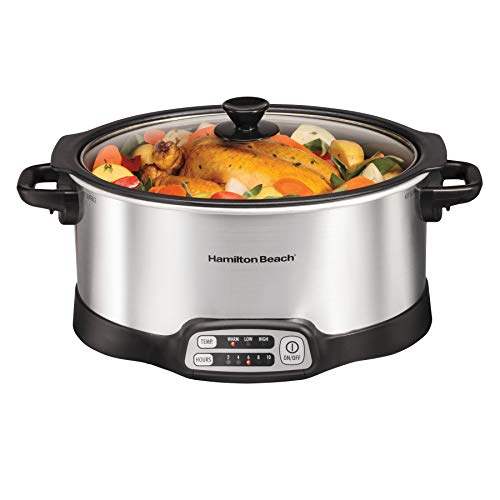
Hamilton Beach 33662 Programmable Slow Cooker, 6 Quart Stovetop-Safe Sear & Cook Crock — Best Overall Stovetop Insert
The 33662 is the category in its purest form: a programmable 6-quart slow cooker whose Sear & Cook crock is rated, in the confirmed listing’s own words, stovetop-safe. The workflow it unlocks is the one this page exists for — set the crock on the burner, sear the beef in batches, saute the onions in the drippings, deglaze in the same vessel, then carry the crock to its base and let the programmable timer run the long cook while the kitchen returns to calm.
Strengths
- The crock is explicitly rated stovetop-safe for searing on the burner
- Programmable base handles the long cook after the stovetop start
- Six quarts is the family braise standard this category revolves around
Trade-offs
- Metal crock sears differently from a heavy skillet; preheat management matters
- Confirm your cooktop type against the listing guidance before first use
- No locking travel lid on this variant — its sibling below covers that need
| Capacity | 6 quart |
| Insert | Stovetop-safe Sear & Cook crock |
| Controls | Programmable slow cooker |
| Finish | Silver |
As cookware, the metal crock behaves like the lightweight searing pan it is: it heats quickly, responds fast and asks the cook to manage heat rather than relying on thermal mass, which experienced stovetop cooks do without thinking. It will not mimic a cast-iron skillet’s crust on a steakhouse scale, but for stew meat, chicken thighs and ground-meat browning it produces a genuine sear and, more importantly, keeps the fond in the cooking vessel. For most households searching this exact phrase, this is the machine they were describing.
Best for: Families wanting true sear-on-the-stove, slow-cook-in-the-base workflow / Not suited for: Travelers who need a locking lid — see the 33663 below
Check the current price on Amazon
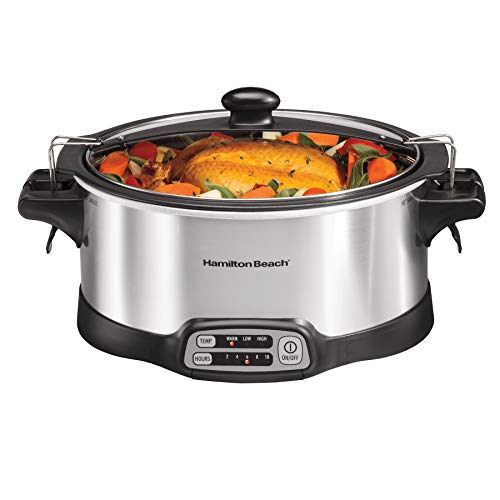
Hamilton Beach Programmable Slow Cooker 33663, 6 Quart, with Travel Lid Lock — Best Stovetop Insert for Transport
The 33663 takes the same stovetop-safe Sear & Cook foundation and adds the feature potluck and tailgate cooks actually need: a travel lid lock that secures the finished dish for the car ride. Sear on your stove at home, slow cook in the base, lock the lid and carry the whole cooker to the gathering, where the base keeps it warm. That arc — stovetop start, slow middle, portable finish — is a complete cooking story no skillet-and-crock combination tells as neatly.
Strengths
- Same stovetop-safe Sear & Cook crock as the category benchmark
- Travel lid lock makes the finished dish genuinely portable
- Programmable cooking for sear-at-home, serve-anywhere routines
Trade-offs
- Locking lids must be unlatched for cooking; the lock is for transport
- Metal crock needs the same heat discipline as its sibling
- Silver finish shows a working kitchen’s splashes honestly
| Capacity | 6 quart |
| Insert | Stovetop-safe Sear & Cook crock |
| Lid | Travel lid lock for portable transport |
| Controls | Programmable slow cooker |
Everything said about the crock’s stovetop manners in the 33662 review applies here, because the Sear & Cook concept is shared: preheat with sense, sear in batches, respect your cooktop type. The lock deserves one clarification the listing makes and owners sometimes miss — it seals for transport, and the lid is unlatched for cooking so steam behaves normally. Households whose slow cooking travels — church suppers, office parties, family across town — should choose this variant over its sibling without hesitation; the price of the lock is nothing next to a car seat full of chili.
Best for: Cooks who transport finished slow-cooker dishes / Not suited for: Stay-at-home cooks who will never latch a lid for travel
Check the current price on Amazon

GreenLife 8QT Ceramic Nonstick Slow Cooker, Cooktop/Oven Safe, Turquoise — Best Large Stovetop Insert
GreenLife’s 8QT is the batch cook’s stovetop insert: a removable inner pot the confirmed listing rates for both cooktop and oven, wrapped in PFAS-free ceramic nonstick, on a programmable base with delay timer and keep warm. Eight quarts changes the searing math — bigger batches of short ribs, double chili meat browning, a whole party’s worth of pulled pork started on the burner and finished low and slow without a vessel change at any point.
Strengths
- An 8-quart cooktop-safe pot for batch-scale searing and slow cooking
- PFAS-free ceramic nonstick releases fond and food alike
- Programmable timing with delay start and keep warm
Trade-offs
- Nonstick searing rewards moderate heat and non-metal tools
- Eight quarts is a large, heavy pot when full and hot
- Ceramic nonstick longevity depends on utensil and heat discipline
| Capacity | 8 quart |
| Insert | Removable inner pot rated cooktop and oven safe |
| Coating | PFAS-free ceramic nonstick |
| Controls | Programmable with keep warm and delay timer |
The ceramic nonstick surface defines its stovetop style. It sears best at honest medium-high heat with the pot properly preheated, releases its fond completely at the deglaze, and then asks for the standard nonstick courtesies: no metal spatulas, no thermal shock, no empty-pot blasting on a high burner. Cooks who treat it as the coated cookware it is will find it the easiest insert on this page to live with daily; cooks who treat it like cast iron will shorten its life and blame the coating. For volume plus versatility — stove, oven and slow base in one pot’s life — nothing else here matches it.
Best for: Batch cooks and large families wanting one pot for stove, oven and slow cooking / Not suited for: Small households who will never fill eight quarts
Check the current price on Amazon

GreenLife 3.5QT Ceramic Nonstick Slow Cooker, Cooktop/Oven Safe, Turquoise — Best Small Stovetop Insert
Small households are usually told to accept stoneware and a separate skillet, which is why this 3.5-quart GreenLife matters: its removable inner pot carries the same confirmed cooktop-and-oven-safe rating as the 8-quart model, in a lightweight, compact cooker with simple low, high and warm settings. A couple can sear two chicken thighs or a small batch of stew meat on the stove, in the pot, and slow cook dinner in it an hour later — the full one-pot workflow at the scale small kitchens actually cook.
Strengths
- The same cooktop-safe freedom in a compact, lightweight size
- Three simple heat settings suit set-and-forget small-batch cooking
- Dishwasher-safe pot makes a small cooker genuinely low-effort
Trade-offs
- Manual settings only — no programmable timer or delay start
- 3.5 quarts caps the recipe ambition honestly
- Nonstick stovetop use follows the same heat discipline as its big sibling
| Capacity | 3.5 quart |
| Insert | Removable inner pot rated cooktop and oven safe |
| Coating | PFAS-Free ceramic nonstick |
| Controls | 3 heat settings: low, high, warm |
The simplicity is deliberate. There is no timer to program because small-batch slow cooking is usually supervised by proximity rather than schedule, and the three settings cover the work. On the stove the little pot is the easiest insert here to handle — light enough to toss aromatics one-handed, quick to heat, quick to wash, and dishwasher-safe when the evening is done. Its ceiling is obvious and honest: this is not the pot for a crowd. For one-to-three-person households who refuse to give up searing, it is the category’s most livable pick.
Best for: Small households wanting stovetop searing at dinner-for-two scale / Not suited for: Program-driven cooks and anyone feeding a crowd
Check the current price on Amazon

All-Clad 5 Quart 7-in-1 Electric Slow Cooker, Black Enamel Cast Iron Crock — Best Cast Iron Crock
The All-Clad entry approaches the category from the material side: a 5-quart, 7-in-1 electric slow cooker built around a black enamel cast iron crock. Cast iron is the searing material cooks have trusted for a century — it holds heat through a batch of cold meat, builds a deep fond and moves between heat sources with a confidence thin metal cannot match — and in enamel form it adds easy release and no seasoning ritual to that heritage.
Strengths
- Enamel cast iron is the classic searing material, with superb heat retention
- A 7-in-1 function set around the slow-cook core
- Five quarts suits couples and small families who cook seriously
Trade-offs
- Read the listing’s use guidance for your exact cooktop before stovetop use
- Cast iron is heavy — a full crock is a two-handed carry
- Premium positioning within this category
| Capacity | 5 quart |
| Crock | Black enamel cast iron |
| Functions | 7-in-1 electric slow cooker |
| Power | 1200W (per listing) |
Precision matters here, so this review states its terms plainly: the confirmed listing establishes the enamel cast iron crock and the cooker’s functions; before using any crock on your specific stovetop, read the listing’s and manufacturer’s use guidance for your cooktop type, particularly glass-ceramic and induction, and follow it over any general advice, including ours. Treated as premium cookware — preheated patiently, lifted with both hands, never shocked with cold water — it is the connoisseur’s route into this category: the heaviest, most traditional and, for crust devotees, the most satisfying insert on the page.
Best for: Experienced cooks who prize cast iron searing and will follow its guidance / Not suited for: Anyone wanting the lightest possible insert or an unconditional rating
Check the current price on Amazon
Cuisinart PSC-650 Programmable Slow Cooker — Unlinked: Stoneware Cautionary Pick
The PSC-650 earns its place on this page as the honest answer to a common question. It is a well-regarded programmable slow cooker — and its removable insert is stoneware, which means it belongs in the base and the oven conversation, never on a stovetop burner. Direct flame or element heat can crack stoneware and ruin both insert and dinner, so the many shoppers who assume a premium programmable crock can sear like a pan are exactly the readers this entry exists to protect.
Strengths
- A respected programmable slow cooker in its own right
- Touchpad controls and a timer format many cooks prefer
- Included here because shoppers constantly ask whether its insert sears on the stove
Trade-offs
- Its stoneware insert is not a stovetop insert and must never go on a burner
- No matching listing could be confirmed, so no purchase link is provided
- Programmable siblings PSC-350 share the same stoneware limitation
It is also unlinked for the program’s standing reason: our checks could not confirm a matching listing for the PSC-650 (or its PSC-350 sibling) by exact model, so no link is attached and no other model is substituted under its name. If you own one, brown in a skillet and deglaze into the crock — you lose a little fond to the transfer and keep a fine cooker intact. If you are shopping specifically for stovetop freedom, the linked Hamilton Beach and GreenLife picks above are the confirmed route, and this entry is the signpost that kept you from buying stoneware for a burner’s job.
Best for: Owners who want the facts about a cooker they already have / Not suited for: Anyone shopping for a stovetop-rated insert today
Unlinked pick: Unlinked because no matching Amazon listing for the PSC-650 could be confirmed; its stoneware insert is in any case not stovetop-rated. No substitute model has been linked in its place.
Comparison Table
| Pick | Badge | Key Spec | Best For |
|---|---|---|---|
| Hamilton Beach 33662 Programmable Slow Cooker, 6 Quart Stovetop-Safe Sear & Cook Crock | Best Overall Stovetop Insert | 6 quart | Families wanting true sear-on-the-stove, slow-cook-in-the-base workflow |
| Hamilton Beach Programmable Slow Cooker 33663, 6 Quart, with Travel Lid Lock | Best Stovetop Insert for Transport | 6 quart | Cooks who transport finished slow-cooker dishes |
| GreenLife 8QT Ceramic Nonstick Slow Cooker, Cooktop/Oven Safe, Turquoise | Best Large Stovetop Insert | 8 quart | Batch cooks and large families wanting one pot for stove, oven and slow cooking |
| GreenLife 3.5QT Ceramic Nonstick Slow Cooker, Cooktop/Oven Safe, Turquoise | Best Small Stovetop Insert | 3.5 quart | Small households wanting stovetop searing at dinner-for-two scale |
| All-Clad 5 Quart 7-in-1 Electric Slow Cooker, Black Enamel Cast Iron Crock | Best Cast Iron Crock | 5 quart | Experienced cooks who prize cast iron searing and will follow its guidance |
| Cuisinart PSC-650 Programmable Slow Cooker | Unlinked: Stoneware Cautionary Pick | Mid-range tier | Owners who want the facts about a cooker they already have |
How to Choose a Slow Cooker with a Stovetop-Safe Insert
An insert that goes on the stove is cookware first and an accessory second. This guide covers the judgments that keep it safe and effective: which ratings actually mean stovetop, how cooktop types change the rules, how a metal crock sears compared with a skillet, and the handling habits that let a dual-duty insert live a long life in both its homes.
Oven-safe is not stovetop-safe
The most expensive misunderstanding in this category is a vocabulary one. Oven-safe means an insert tolerates surrounding hot air; stovetop-safe means it tolerates direct, concentrated heat from below — a far harsher test that cracks stoneware and warps unfit metal. Broiler ratings are a third, unrelated claim. When shopping, look for the explicit words stovetop or cooktop in the listing’s own details, as the linked picks here carry, and treat every other phrasing — however premium the brand — as a no. The unlinked entry on this page exists because that distinction matters more than any feature list.
Your cooktop type writes half the rules
Gas burners are the most forgiving partners for stovetop inserts; electric coil elements ask for a flat, stable base; glass-ceramic tops demand smooth bottoms, no dragging and strict adherence to the manufacturer’s guidance; induction only works with a magnetic insert, which many slow-cooker crocks are not. Before ordering any pick here, match the insert against your actual cooktop using the listing’s guidance — the Hamilton Beach and GreenLife listings state their cooktop claims plainly, and the All-Clad entry on this page instructs you to do exactly that check for its cast iron crock.
How a metal crock sears, honestly
A stovetop-rated slow-cooker crock is a lightweight metal pot, and it sears like one: fast to preheat, quick to respond, less able than a heavy skillet to hold temperature when cold meat lands. The technique adjustments are small and learnable — preheat fully, sear in batches, give each batch a moment to recover heat, and deglaze while the pot is hot. In exchange you get something no skillet offers: the fond, the aromatics and the braise all finish in the vessel that slow cooks them, with no transfer loss and one pot to wash.
Heat discipline: the habits that keep inserts alive
Four rules govern every insert on this page. Never heat an empty insert on high for an extended preheat; bring it up at moderate heat. Never set a burner-hot insert onto a cold or wet surface, or run cold water into it — thermal shock is the enemy of coatings, enamel and stoneware alike. Lift and carry with both hands and dry mitts, because a full insert is heavier than it looks. And keep the insert off the stove entirely unless its rating, like the ones confirmed here, explicitly allows it. Follow those rules and a dual-duty insert outlives the base it serves.
When the skillet still wins
Honesty requires the boundary: for a steakhouse crust on thick cuts, for very large searing batches, or on a cooktop your insert is not rated for, a heavy skillet remains the right tool, with its fond deglazed and poured into the crock. The stovetop insert’s victory is the everyday braise — stew meat, thighs, ground meat, aromatics — where convenience and flavor capture beat a marginal difference in crust. Buy it for the ninety percent of slow cooking that fits that description, and keep the skillet for the rest without feeling the purchase failed.
The two-pot kitchen: who this category is really for
A stovetop-safe insert matters most to a specific kind of cook: the one-pot braiser whose kitchen runs on stews, chilis and curries, and whose counter cannot justify a slow cooker, a Dutch oven and a searing skillet in rotation. For that cook, the insert collapses the equipment list — the pot that sears is the pot that simmers all day is the pot that goes to the table — and the slow-cooker base becomes a patient, precise heat source rather than another vessel. Cooks whose slow cooking is mostly dump-style, with no searing step, gain nothing from the rating and should buy on capacity and programming instead; cooks who sear in a beloved cast-iron skillet and deglaze faithfully lose only a little fond to the transfer. The category is a workflow choice before it is a product choice, and the picks here serve the workflow completely for the kitchens that live it.
Insert care across its two lives
A dual-duty insert ages in two environments — burner heat and slow, moist cooking — and its care routine should acknowledge both. Wash it as cookware, not as an appliance part: warm water, a soft brush for fond lines, and no abrasive pads on coated surfaces. Inspect the base periodically for warping by setting it on a flat counter; a pot that rocks has been heat-shocked and will heat unevenly thereafter, on stove and base alike. Store it nested in its base with a cloth between surfaces if it is stacked with other cookware, and keep the lid’s rim clean, since a gritty rim grinds coatings at every seating. None of this is burdensome, but it is the difference between an insert that serves for a decade in both its homes and one that becomes a slow-cooker-only crock with a story about a burner.
Travel and table: the insert’s third and fourth lives
The stovetop insert’s usefulness continues past the cook. A metal or enamel crock that seared and slow cooked can hold its dish at serving temperature on the stove’s lowest setting in a way stoneware cannot, go to the table as its own serving vessel with a trivet beneath, and — in the locking-lid Hamilton Beach variant — travel to a gathering in the base that cooked it. Each of those roles replaces another dish, another transfer and another washing-up, which is how a single rating on a listing quietly reorganizes an entire meal’s logistics. Hosts in particular should weigh this: the cooker that sears at home, finishes in the base and arrives locked and warm has solved the potluck problem at every stage, and that is a larger promise than the words stovetop-safe first suggest.
A week with a stovetop insert: the rhythm it creates
Living with a stovetop-safe insert changes the week’s cooking rhythm in ways a feature list cannot convey. Monday’s chili starts on the burner during the time the onions would have taken anyway and finishes unattended; Wednesday’s chicken braise sears in the same pot that then holds it warm for staggered dinners; Sunday’s big batch browns in the insert, slow cooks through the afternoon and goes to the table in the vessel it was born in. The cumulative effect is not any single saved pan but a kitchen with fewer handoffs, fewer hot transfers and fewer moments where a tired cook decides the searing step is not worth it tonight. That last effect is the real one: when browning costs no extra equipment, it stops being skipped, and the whole standard of a household’s slow cooking rises to meet the convenience. The rating on a listing sounds like a materials detail; in practice it is a habit, and habits are what dinners are made of.
Choosing between the insert route and the browning-setting route
This program covers both one-pot philosophies — inserts that sear on the stove and machines that brown in the pot — and the choice between them is a genuine fork worth deciding deliberately. The insert route gives you a real burner: faster preheats, familiar control, a crust built by the stove you already know, at the cost of handling a hot pot between two appliances. The browning-setting route gives you a single station: nothing moves, the machine sequences itself, and programmable timing wraps around the whole dish, at the cost of a saute surface that asks slightly more technique. Kitchens with excellent stoves and confident cooks lean insert; kitchens run on schedules and one-counter convenience lean browning setting. Many households eventually own both philosophies in different sizes, and there is no contradiction in that — only the recognition that the one-pot idea is bigger than any single product’s way of achieving it.
Reading an insert listing before you buy
Because this category turns on a single claim, it rewards the most careful listing-reading in all of slow cooking. Find the stovetop or cooktop statement in the product’s own details — not in a review, a roundup or a question answered by another shopper — and note exactly which cooktop types it names. Check the insert’s material and base construction against your stove, confirm the capacity against your recipes, and look for the handling details that predict daily life: handle design, lid style, whether the base offers the programming your schedule needs. If any of those answers is missing, treat the model as unconfirmed for your kitchen rather than probably fine, because probably is how stoneware meets burners. The picks in this guide passed that reading on your behalf; any model you consider beyond them deserves the same three minutes, and a listing that survives it has earned your confidence the honest way.
How to Sear in a Stovetop-Safe Insert, Then Slow Cook
This is the complete workflow this category exists for, written for the Hamilton Beach and GreenLife inserts confirmed on this page. It assumes a beef stew or chicken braise and a gas or electric cooktop the insert is rated for; check your listing’s guidance for glass or induction tops before beginning.
Step 1: Confirm the rating and set up safely
Before the first sear, re-read your insert’s stovetop guidance for your cooktop type — this thirty-second check is part of the recipe, not fine print. Set the empty insert on a burner that matches its base size, gather tongs, a splatter screen if you use one, and a heatproof rest for the insert’s next move. Have the slow-cooker base waiting nearby, unplugged or off, so the hot insert’s landing place is ready before it is needed.
Step 2: Preheat at moderate heat and dry the meat
Bring the insert up over medium heat for a few minutes while you pat the meat thoroughly dry and season it. Add a thin film of oil once the pot is warm, let it shimmer, and only then begin. Metal inserts heat quickly and overshoot easily on high, so moderate preheating protects both the crust — which needs contact, not violence — and the insert’s surface, which will serve you for years if it is never blasted empty.
Step 3: Sear in batches and build the base
Sear the meat in uncrowded batches, leaving each piece undisturbed until it releases with a proper crust, and set finished batches aside. Soften onions and aromatics in the drippings, bloom any tomato paste or spices briefly, then deglaze with stock or wine, scraping the bottom completely. Everything that makes a braise taste like itself has now happened in one vessel, on the stove, exactly as this category promises.
Step 4: Transfer the insert, not the food
Using both hands and dry mitts, lift the insert by its handles and settle it into the slow-cooker base — the food never moves, the fond never travels, nothing is left behind in a skillet. Add any remaining liquid and ingredients, set the lid, and program the cook. Take a moment to wipe the cooktop and set the kitchen back in order; the hours ahead ask nothing of you, which is the slow cooker’s half of the bargain.
Step 5: Finish, serve and cool with care
At the end of the cook, the insert can return to a low burner for a final sauce reduction or go straight to the table on a trivet, but it must cool gradually before washing — no cold water into a hot pot, ever. Wash with the coating’s rules in mind, dry fully and store the insert in its base. The pot that seared at noon and slow cooked until six has done two jobs; treating its cool-down gently is how it stays ready to do them both again next week.
Common Buying Mistakes
Putting a stoneware insert on the burner
The category’s cardinal error, and the reason the PSC-650 appears on this page: stoneware crocks — including premium, programmable, expensive ones — are not stovetop cookware, and direct heat can crack them mid-recipe. If a listing does not say stovetop or cooktop in its own words, the answer is no, regardless of how sturdy the crock feels. When in doubt, sear in a skillet and keep the cooker you own alive.
Blasting an empty insert on high heat
Lightweight metal and coated inserts heat fast and suffer when left empty over a high burner: coatings degrade, bases warp and the first food to land scorches instantly. Preheat at moderate heat, add oil as the pot warms, and treat the preheat as a stage of cooking rather than a delay to be shortened. Inserts that die young almost always die this way, in their first month, at the hands of an impatient burner setting.
Dragging the insert across a glass cooktop
On glass-ceramic tops, sliding a loaded insert scratches the surface and can stress both the glass and the pot’s base. Lift, move, set down — never drag — and keep the insert’s bottom clean and dry before it meets the glass. The same lift-don’t-drag habit protects enamel and coated bases on every cooktop type, and costs nothing but a moment’s attention with a heavy pot.
Shocking a hot insert with cold water
Running cold water into a burner-hot insert — or setting it on a cold, wet counter — invites warping in metal and cracking in enamel or stoneware. Let the insert cool on a trivet until it can be handled comfortably, then wash in warm water. Slow cooking is a cuisine of patience; extending that patience by fifteen minutes at the sink is what keeps a dual-duty insert dual-duty for years.
Assuming induction compatibility
Induction cooktops only heat magnetic cookware, and many slow-cooker inserts — aluminum-cored, ceramic-coated or stoneware — are not magnetic, rating or no rating. Induction owners must confirm the insert’s induction compatibility in the listing’s own details before ordering, not discover the exception at the first sear. The check takes a minute on the product page and saves a return, a ruined dinner plan and a misplaced grudge against a category that works beautifully on the right stove.
Final Recommendation
The Hamilton Beach 33662 is the default recommendation: a crock whose stovetop-safe rating is stated in its own listing, on a programmable 6-quart base, at the center of the category. Choose its 33663 sibling if your cooking travels and a locking lid matters, the GreenLife 8QT if your batches are large and you value its cooktop-and-oven versatility, or the GreenLife 3.5QT if your household is small and your searing ambitions are not. The All-Clad cast iron crock serves experienced cooks who will read its guidance and prize its searing heritage.
And keep the page’s cautionary lesson with the recommendations: the PSC-650 is a fine cooker whose stoneware insert must stay off the stove, which is precisely why this category is bought by rating, not by reputation. Choose an insert whose listing promises the stovetop in writing, match it to your cooktop, and the sear-then-slow-cook workflow will change what your slow cooker is for.
Keep researching the cluster: Best Slow Cookers With Browning Setting Best Slow Cookers With Saute Best Slow Cookers Best 6 Quart Slow Cookers Best Programmable Slow Cookers Best Slow Cookers For Browning Meat
Frequently Asked Questions
Can I really put these inserts on my stove?
Yes — the Hamilton Beach Sear & Cook crocks and GreenLife inner pots on this page carry stovetop or cooktop ratings in their confirmed listings, which is the entire basis of the category. The rating applies within the manufacturer’s guidance for your cooktop type, at sensible heats, with the handling care described in this guide. What you cannot do is generalize the permission to other slow cookers: a rating belongs to the specific insert it was issued to, and stoneware inserts from any brand stay off the burner.
Will a stovetop insert work on induction?
Only if the insert is magnetic and the listing says so. Many stovetop-rated inserts are built for gas and electric heat and will not register on an induction hob at all. Induction owners should confirm induction compatibility in the specific listing’s details before buying — it is a one-minute check on the product page — and glass-ceramic owners should likewise follow the maker’s guidance on smooth bases and lifting rather than dragging.
Does searing in the insert taste different from searing in a skillet?
The crust itself is comparable when the meat is dry, the pot is preheated and batches are uncrowded; a heavy skillet holds a small edge for very thick cuts. The insert wins the dish overall, because the fond never leaves the cooking vessel — in a skillet workflow, some browned flavor always stays in the pan despite deglazing. For the braises and stews slow cookers exist to make, that capture advantage outweighs the skillet’s marginal crust edge.
Can the insert go in the oven too?
Some can — the GreenLife pots on this page are listed as cooktop and oven safe, which adds a finishing option: a braise can take oven color or hold at serving temperature without a vessel change. Oven safety is its own rating, distinct from stovetop safety, so confirm it per model in the listing rather than assuming one rating implies the other. And the reverse rule is absolute: an oven-safe stoneware crock is still forbidden on the stovetop.
How do I avoid warping or damaging a metal insert?
Preheat at moderate heat rather than blasting it empty on high, sear in batches so the pot recovers between loads, lift instead of dragging it on smooth cooktops, and let it cool gradually before washing — never cold water into a hot pot. Those four habits cover nearly every insert failure story. A stovetop insert is real cookware with a second job, and it lasts exactly as long as it is treated like cookware.
What size stovetop-insert slow cooker should I buy?
Six quarts — the Hamilton Beach format — covers most family braises and is the category’s natural center. Step up to the GreenLife 8QT for batch cooking and entertaining quantities, or down to the 3.5QT GreenLife for one-to-three-person households that still want to sear in the pot. Size by the meals you cook weekly, remembering the insert must also be a pot you can lift comfortably when it is full and hot.


