Disclosure: airfryerkitchensupply.com is reader-supported. When you buy through links on our site, we may earn an affiliate commission at no extra cost to you.
Where to buy
This list spans charcoal, pellet and electric models as well as gas, so check the fuel type in the listing title before anything else — a pellet grill needs an outlet and a bag of pellets, a kettle needs charcoal storage, and an electric grill needs a circuit that can carry it. Every pick below links to its Amazon listing so you can check price on Amazon and confirm the exact configuration, color and included accessories for the model you intend to order.
- Weber Original Kettle Premium Charcoal Grill 22-Inch — Check the current price on Amazon
- Weber Original Kettle Charcoal Grill 22-Inch — Check the current price on Amazon
- Traeger Pro 22 Wood Pellet Grill & Smoker — Check the current price on Amazon
- Z Grills ZPG-7002B Pellet Smoker Grill with PID Control — Check the current price on Amazon
- George Foreman Indoor/Outdoor Electric Grill with Stand — Check the current price on Amazon
- Weber Lumin Compact Portable Electric Grill — Check the current price on Amazon
The best selling grills are not one kind of grill at all, and that is exactly the point of this guide. Ask a dozen households what they cook on and you will hear a charcoal kettle that has survived a decade of summers, a pellet grill that holds temperature like an oven, a gas cart for weeknight speed, and an electric grill doing quiet duty on an apartment balcony where open flame is banned. “Best selling” across the whole category means the designs that keep earning their patio space year after year, in every fuel type — and the right one for you depends on how you like to cook, not on which fuel wins an argument.
So this roundup is organized by cooking style. The kettle picks are for people who love live-fire flavor and hands-on control. The pellet picks are for cooks who want smoke flavor with set-and-forget temperature management. The electric picks solve the balcony, condo and indoor problem, where gas and charcoal are simply not allowed. One premium charcoal kettle anchors the top of the range, and one compact electric grill anchors the small-space end. If you already know you want gas only, our companion guide to the best selling gas grills narrows the field; this page is for everyone still choosing a fuel.
As with every guide in this series, each model below was cross-checked against Amazon’s catalog before earning a link, and we describe popularity in plain qualitative terms — sustained demand, long model runs, deep owner communities — rather than quoting sales figures that change by the week.
Read this guide fuel-first: each review assumes you have tentatively chosen its fuel and asks whether this model is that fuel’s right representative for your household. If a review talks you out of a fuel entirely, that is the guide working as intended — the companion gas-only and outdoor guides pick up exactly where each fuel’s story continues.
In this guide
Quick Picks
Best Overall — Weber Original Kettle Premium Charcoal Grill 22-Inch. The 22-inch kettle perfected: built-in thermometer, hinged grate and the One-Touch cleaning system on the charcoal grill more people learn on than any other. Check on Amazon
Best Budget Charcoal — Weber Original Kettle Charcoal Grill 22-Inch. The classic kettle in its simplest form — same bowl, same lid, same cooking ability, fewer frills and a budget-tier ticket. Check on Amazon
Best Pellet Grill — Traeger Pro 22 Wood Pellet Grill & Smoker. 572 square inches, a meat probe and an 18 lb hopper: the pellet grill that defined set-and-forget smoking for the home cook. Check on Amazon
Best Pellet Value — Z Grills ZPG-7002B Pellet Smoker Grill with PID Control. 700 square inches and PID temperature control with a rain cover in the box — more space and tighter control at a value tier. Check on Amazon
Best for Apartments — George Foreman Indoor/Outdoor Electric Grill with Stand. A 15-serving electric grill on a removable stand — the balcony and condo answer where gas and charcoal are banned, and a handy indoor option in winter. Check on Amazon
Best Premium Electric — Weber Lumin Compact Portable Electric Grill. Weber’s compact electric grill for small spaces — high-heat electric searing in a portable body from the brand that knows grills. Check on Amazon
How These Picks Were Chosen
We selected for staying power within each fuel type. A model qualified if it has remained in its manufacturer’s lineup across multiple seasons, if parts and accessories are easy to source, and if its design solves a real cooking job better than the alternatives at its tier. That filter produces a deliberately mixed list: two charcoal kettles at different levels, two pellet grills with different control systems, and two electric grills for the spaces where flame is not an option.
We also weighted honesty of specification. Pellet grills were judged on hopper capacity and temperature range as published by their makers; kettles on grate diameter, ash management and lid features; electrics on cooking surface and whether the stand and temperature control are genuinely useful. Where a beloved model has a real weakness — pellet grills in heavy rain, electrics on thick steaks, kettles on a windy day — the review says so. A best seller with a known limitation you can live with beats a spec-sheet hero with a hidden one.
The 6 Best Best Selling Grills

Weber Original Kettle Premium Charcoal Grill 22-Inch — Best Overall
This is the grill for anyone who wants to actually learn fire cooking. The 22-inch kettle roasts whole chickens indirect, sears steaks directly over coals, and — with patience — smokes ribs for hours. The Premium version adds the conveniences that make charcoal a weekly habit instead of a special occasion: a lid thermometer you can trust as a guide, a hinged grate for adding coals mid-cook, and an enclosed ash catcher that keeps the patio clean.
Strengths
- One-Touch cleaning sweeps ash into an enclosed catcher in seconds
- Hinged cooking grate lets you add charcoal without lifting food off
- Enormous accessory ecosystem — rotisseries, griddles, pizza kits
Trade-offs
- Charcoal means 25–30 minutes from match to cooking, every time
- Temperature control is manual: vents, coal placement and practice
- No side tables built in — plan a work surface nearby
Key specs: 22-inch charcoal kettle; built-in lid thermometer; hinged plated-steel grate; One-Touch ash cleaning system.
The kettle’s genius is geometry: a deep round bowl that circulates heat, a tight-fitting lid, and dampers top and bottom that give you real control once you learn them. Two-zone cooking is natural here — coals banked on one side, food on the other — and the Premium’s ash system removes the one chore that made older kettles messy. Durability is the quiet headline: porcelain-enameled steel shrugs off years of weather, and the few wear parts (grates, dampers) are cheap and everywhere. If you can only own one grill and you enjoy the process of cooking, this is the one generations of grillers would hand you.
Ownership of the Premium kettle compounds over time because the accessory shelf never ends: a rotisserie one year, a cast-iron sear grate the next, a side table after that. The kettle accommodates each without complaint, and its core parts — dampers, grates, handles — remain cheap and universal. It is less a purchase than a platform, which is precisely how a design stays a best seller across generations of cooks.
Best for: Live-fire learners and flavor-first cooks who want one versatile charcoal grill / Not suited for: Anyone who needs dinner on the table 15 minutes after walking outside

Weber Original Kettle Charcoal Grill 22-Inch — Best Budget Charcoal
Choose the standard Original Kettle when you want the genuine kettle cooking experience at the lowest sensible cost. You give up the enclosed ash catcher, the hinged grate and the lid thermometer of the Premium, but the fire bowl and cooking performance are fundamentally the same, which is why this model has introduced more people to charcoal than any other grill on sale.
Strengths
- The authentic kettle cook at a budget tier
- Dead-simple design with almost nothing to break
- Light enough to move around the yard or load for a park cookout
Trade-offs
- Open ash pan means ash blows around on breezy days
- Adding coals mid-cook means lifting the grate with food on it
- No built-in thermometer — budget for an instant-read instead
Key specs: 22-inch charcoal kettle; One-Touch cleaning system with open ash catcher; plated-steel cooking grate.
Think of this as the kettle with training wheels removed and price lowered. Long cooks are slightly more fiddly — you will lift the grate to add coals, and an inexpensive instant-read thermometer becomes essential kit — but burgers, steaks, chickens and ribs all cook exactly as they do on the Premium, because the bowl that does the work is the same. It is also the better choice for a second grill: the beach house, the campsite base, the son or daughter’s first apartment patio. Buy the Premium if charcoal will be your main grill for a decade; buy this one if you want the flavor now and the frills later.
The standard kettle’s ownership charm is its indifference to neglect: ash aside, there is almost nothing to adjust, calibrate or plug in, so it works the same in year ten as in week one. Many owners keep it as the second grill after upgrading, or pass it to a kid heading to a first apartment — a lifecycle few appliances achieve. Its low price is not its main virtue; its permanence is.
Best for: Budget buyers who want real charcoal flavor and a proven design / Not suited for: Frequent long-cook smokers who will miss the hinged grate and ash catcher daily

Traeger Pro 22 Wood Pellet Grill & Smoker — Best Pellet Grill
The Pro 22 suits the cook who wants brisket, pulled pork and ribs without babysitting a fire. You set a temperature, the controller feeds pellets to hold it, and the meat probe tells you when the cook is done. It also grills respectably up to its 450°F ceiling, covering weeknight chicken and burgers with a whisper of wood smoke on everything.
Strengths
- Controller holds temperature like an oven for long, calm smokes
- 18 lb hopper runs long cooks without constant refilling
- 572 sq in fits a brisket or several racks of ribs comfortably
Trade-offs
- 450°F ceiling means good grilling, not hard searing — plan a cast-iron finish
- Needs electricity and dry pellet storage to be happy
- Auger and electronics add maintenance a kettle never asks for
Key specs: Wood pellet grill and smoker; 572 sq in cooking area; 18 lb hopper; meat probe included; 450°F maximum temperature.
Pellet cooking trades a little top-end heat for a lot of calm. The Pro 22’s controller watches the fire so you do not have to, which changes smoking from a project into a plan: pork shoulder on at breakfast, done by dinner, with the cook free in between. Flavor is gentler than a charcoal smoker’s — clean, sweet wood rather than assertive smoke — and most households prefer exactly that. Keep the pellets dry, vacuum the fire pot every few cooks, and shelter it from driving rain, and the machine is undemanding. For steaks, many owners pair it with a small cast-iron grate session on the stove; judged as a smoker-roaster first, it earns its best seller status honestly.
Living with the Pro 22 means adopting two habits: a pellet bin stored dry indoors, and a quick vacuum of the fire pot every few cooks. In exchange, smoking becomes a calendar event rather than a project — set the shoulder on in the morning, baste at lunch, eat at dinner. The Traeger owner community is enormous, so recipes, settings and troubleshooting for any cut are a search away, a real ownership asset.
Best for: Smoking enthusiasts who value steady temperatures and hands-off long cooks / Not suited for: Sear-first steak cooks or anyone without a covered spot and an outdoor outlet

Z Grills ZPG-7002B Pellet Smoker Grill with PID Control — Best Pellet Value
Pick the ZPG-7002B when the Traeger formula appeals but you want more grate space for gatherings and tighter temperature swings for competition-style consistency. PID control adjusts the pellet feed continuously rather than in coarse steps, which keeps long cooks steadier in changing weather — useful for overnight briskets and winter smoking.
Strengths
- 700 sq in is the most cooking space in this roundup
- PID controller holds set temperatures with small swings
- Rain cover included — a small thing pellet grills genuinely need
Trade-offs
- Value-tier fit and finish below the Traeger benchmark
- Brand network for parts is smaller, though improving
- Same pellet realities: outlet required, pellets must stay dry
Key specs: Wood pellet grill with PID control; 700 sq in cooking area; rain cover included.
Space plus control is a persuasive combination. Seven hundred square inches swallows two briskets or a party’s worth of wings, and the PID controller is not marketing garnish — on long cooks it visibly reduces the temperature sawtooth that simpler controllers produce when wind or cold hits the barrel. The compromises live in the details: thinner steel, simpler wheels, and hardware that rewards a careful assembly afternoon. For the cook who hosts and smokes often, those are fair trades. As with any pellet grill, your results will track pellet quality; buy fresh, name-brand pellets and store them sealed indoors.
The Z Grills asks the same pellet habits as its rival — dry fuel, periodic ash vacuuming, shelter from driving rain — and returns a larger stage for them. Its PID steadiness shows most on overnight cooks, where owners report waking to a grill still holding its set temperature through a cold night. For hosts who smoke big and often, that combination of space and calm is the entire argument, and it is a good one.
Best for: Hosts and frequent smokers who want maximum pellet space per dollar / Not suited for: Buyers who prioritize premium fit-and-finish and the largest dealer network
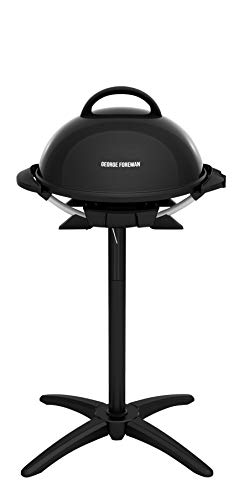
George Foreman Indoor/Outdoor Electric Grill with Stand — Best for Apartments
This is the grill for the rule-bound cook: apartment balconies with no-flame policies, condos, dorm-adjacent patios, and households that simply want to grill in the kitchen in January. On its stand it works like a small patio grill; lift the grill off and it sits on the counter. The sloped, nonstick surface drains fat into a tray, in classic Foreman fashion.
Strengths
- Legal almost everywhere flame grills are banned
- Removable stand converts patio grill to countertop in seconds
- Sloped nonstick grate is fast to cook on and easy to wipe down
Trade-offs
- Electric heat cannot match charcoal or gas for deep sear and smoke flavor
- 15-serving rating is generous — plan on family-size batches, not parties
- Temperature dial control is approximate compared with gas burners
Key specs: Electric grill; 15-serving rated cooking surface; removable stand; sloped nonstick grate with drip tray.
Judge an electric grill by the jobs it can do that no other grill is allowed to do. Weeknight salmon, chicken breasts, burgers, vegetables and panini-style sandwiches all cook quickly and cleanly here, with no tank to refill, no coals to light and no smoke drifting into a neighbor’s window. The trade is ceiling: you will not get a charcoal crust or wood smoke, and thick steaks are better finished with modest expectations. Within its brief — convenient, permitted, everyday grilling — it is the long-running best seller for a reason, and its stand-or-countertop flexibility remains unmatched at its tier.
The Foreman’s ownership story is about frequency: because it lives on a stand or counter and heats without fuel rituals, it gets used on nights when no other grill would be lit. Cleanup is a wipe of the nonstick plates and an emptied drip tray. It will never be the weekend centerpiece, but as the most-used grill in many apartments, it quietly justifies its best-seller longevity.
Best for: Apartment, condo and balcony cooks, plus anyone wanting an indoor winter grill / Not suited for: Flavor purists chasing smoke and char, or hosts cooking for large crowds

Weber Lumin Compact Portable Electric Grill — Best Premium Electric
The Lumin Compact is for the small-space cook who refused to settle: city balconies, tiny patios, boat decks and RV life where an outlet exists but flame is impractical. It is built like a Weber — porcelain-enameled cast-iron grates, a proper lid, real temperature ambition — in a body one person can carry and store in a closet.
Strengths
- Cast-iron grates and high heat output give electrics a real sear
- Compact, portable and storable — made for small-space living
- Weber build quality and parts support behind an electric platform
Trade-offs
- Premium tier pricing for a compact cooking surface
- Electric element cycling feels different from burner control at first
- Small grate means cooking for two to four, in batches beyond that
Key specs: Compact portable electric grill; porcelain-enameled cast-iron cooking grates; designed for small outdoor spaces.
Most electric grills feel like appliances; the Lumin feels like a grill that happens to plug in. The cast-iron grate retains enough heat to mark food properly, the lid lets you roast and melt, and the whole unit heats fast — plug to cooking in the time a kettle is still lighting. It suits a rhythm of small, frequent cooks: two steaks, a handful of skewers, vegetables for the week. If your constraint is space rather than budget, and you want the electric category’s best cooking manners, this is the premium pick that justifies itself every time it comes out of the closet.
The Lumin’s ownership pleasure is storage: it appears from a closet, cooks like a serious grill, and disappears again, which in a small home is a feature no full-size grill can copy. Weber’s support stands behind the platform, and the cast-iron grate seasons beautifully with use. Owners tend to grill more often simply because the friction is so low — plug, heat, cook, wipe, store.
Best for: Small-space and portable living where quality matters more than capacity / Not suited for: Large households or anyone who needs to feed six at once
Comparison Table
| Pick | Badge | Key spec | Best for |
|---|---|---|---|
| Weber Original Kettle Premium Charcoal Grill 22-Inch | Best Overall | 22-in charcoal kettle, hinged grate | Live-fire learners and flavor-first cooks who want one versatile charcoal grill |
| Weber Original Kettle Charcoal Grill 22-Inch | Best Budget Charcoal | 22-in charcoal kettle, classic trim | Budget buyers who want real charcoal flavor and a proven design |
| Traeger Pro 22 Wood Pellet Grill & Smoker | Best Pellet Grill | Pellet, 572 sq in, 18 lb hopper | Smoking enthusiasts who value steady temperatures and hands-off long cooks |
| Z Grills ZPG-7002B Pellet Smoker Grill with PID Control | Best Pellet Value | Pellet, 700 sq in, PID control | Hosts and frequent smokers who want maximum pellet space per dollar |
| George Foreman Indoor/Outdoor Electric Grill with Stand | Best for Apartments | Electric, removable stand, 15-serving rated | Apartment, condo and balcony cooks, plus anyone wanting an indoor winter grill |
| Weber Lumin Compact Portable Electric Grill | Best Premium Electric | Electric, compact, cast-iron grates | Small-space and portable living where quality matters more than capacity |
How to Choose Between Charcoal, Pellet, Gas and Electric Grills
Choose charcoal if flavor and ritual are the point. Nothing else tastes like food cooked over real coals, and a kettle is the cheapest route to genuinely great grilling. The costs are time — half an hour to light and stabilize — and attention, because you are the thermostat. Choose pellet if you want smoke flavor with oven-like calm: set the temperature, walk away, and let the controller feed the fire. Pellet grills roast and smoke beautifully and grill adequately, but they need electricity, dry pellet storage and a little mechanical sympathy.
Choose gas if speed and control rule your weeknights: ten minutes to heat, dial-adjustable zones, no ash and no pellets. Our dedicated guide to best selling gas grills covers that field in depth. Choose electric if your housing rules ban flame, or if you want to grill indoors in winter. Modern electrics like the Lumin sear respectably; none of them make smoke, so set flavor expectations accordingly.
Many serious households eventually own two: a kettle or pellet grill for weekends and a small gas or electric grill for Tuesday. If you are buying your first and only grill, be honest about your calendar. The best grill is the one whose startup routine fits the time you actually have on the nights you actually cook.
Size, Space and the Serving-Count Illusion
Ignore ‘serving’ counts on boxes; they assume every serving is a small burger. Shop by square inches and grate dimensions instead. Roughly 300–450 square inches serves most families; 550–700 covers parties and big smoking projects. Then measure your space with the lid open and shelves up, and check the route from storage to cooking spot — a grill you cannot move is a grill you will not clean.
Portability is its own feature class. The standard kettle rolls anywhere and loads into a car trunk with the legs removed; the Lumin Compact stores in a closet; the Foreman stands on a balcony or sits on a counter. Pellet grills, by contrast, want a permanent home near an outlet and under some shelter. Match the grill’s living arrangements to your home before falling for its cooking résumé.
What Best Selling Really Tells You in Each Fuel Type
In charcoal, best selling means the design has been refined for decades — the kettles in this guide are direct descendants of grills from the last century, and every weak point has been engineered out or priced honestly. In pellet, best selling means the controller and auger system have survived hundreds of thousands of cooks; electronics reward proven platforms. In electric, it means the element, thermostat and nonstick surfaces have a track record, because those are the parts that fail on cheap electrics.
The common thread is support. A best seller in any fuel has grates, covers, gaskets, igniters or elements you can actually buy next year. That is the practical meaning of popularity, and it is why this guide treats sustained sales as a feature in itself — stated qualitatively, because the value is in the longevity of the platform, not in any week’s sales figure.
Fuel Costs and Running Costs, Compared Honestly
Charcoal is the cheapest fuel per cook for occasional grilling and the most expensive in time. A kettle’s running costs beyond charcoal are nearly zero — a grate every few years — which is part of its best-seller economics. Pellet grills burn a steady stream of pellets on long cooks; the fuel cost per brisket is real but modest, and the true costs are the machine’s price and its electrical components over time.
Gas sits in the middle: propane is convenient and predictable, with burner and igniter replacements as the long-term line items. Electric is the simplest ledger — household current and an eventual element — with the lowest maintenance of any fuel here. None of these numbers should decide your grill alone, but they explain ownership satisfaction: the cheapest grill to buy is often not the cheapest to own, and the best sellers tend to be the ones whose total cost of ownership feels fair in year five.
Smoke Flavor, Explained Without Romance
Smoke flavor comes from combustion by-products settling on food, and each fuel produces a different signature. Charcoal gives the most assertive, classic barbecue flavor, deepened further with wood chunks. Pellet grills burn real wood but very cleanly, yielding a gentler, sweeter smoke that suits poultry, fish and long cooks where heavy smoke would overwhelm. Gas produces almost no smoke of its own — its flavor comes from drippings vaporizing on hot bars — which is why gas results taste ‘grilled’ rather than ‘smoked.’
Electric grills produce the least smoke flavor, by design and by housing rules. None of these is ‘best’ in the abstract: the kettle and pellet picks exist for cooks who chase smoke, the electric picks for cooks who cannot have it, and gas for cooks who prioritize control. Match the flavor profile to your cooking and the fuel debate dissolves.
Buying a Best Seller Used: What to Check
Best sellers are the safest used purchases in grilling because parts exist. For a kettle: check the bowl for rust-through at the leg sockets, confirm dampers move, and price in a new grate. For a pellet grill: insist on seeing it run through a full heat cycle — auger, fan, igniter and controller all reveal themselves in fifteen minutes — and inspect the fire pot for rust.
For gas (covered in depth in the gas-only companion guide) and electrics, the same principle applies: run it, watch it, and verify the wear parts are replaceable for that exact model. A used best seller with a season of life left in its grates is often the smartest money in this entire category — popularity means the rescue parts are a search away rather than a fabrication project.
Matching a Grill to Your Signature Dishes
Let your five most-cooked dishes choose the grill. Burgers, dogs and weeknight chicken point to gas or a kettle used casually. Ribs, brisket and pork shoulder point to a pellet grill or a kettle with smoking discipline. Steaks above all point to charcoal’s ceiling or a gas grill with a true sear zone. Vegetables, fish and delicate foods reward the controllable, gentler heat of pellet and electric models.
Write the five dishes down before shopping; the exercise takes two minutes and prevents the classic error of buying for an imaginary cooking life. Every pick in this guide is the right answer to some household’s list — the work is knowing yours, and this roundup’s structure (fuel first, model second) is designed to walk you through exactly that decision.
Grill Lifespan: What Actually Wears Out, Fuel by Fuel
Kettles wear at the grate, the dampers and the leg sockets — all cheap, all replaceable, which is why a kettle’s practical lifespan is measured in decades. Pellet grills wear at the igniter rod, the auger motor and the controller; proven platforms keep these parts available and affordable, value platforms less reliably. Electrics wear at the element and the nonstick surface, and are the most ‘appliance-like’ in their lifespan expectations.
The pattern explains the best-seller effect: in each fuel, the long-running models are the ones whose wear parts form an ecosystem. When you buy from this list, you are buying into that ecosystem — the guarantee that a fifteen-dollar part in year six will not become a new-grill decision.
A Season With Each Fuel: What Ownership Actually Feels Like
Spring with a kettle is a reunion: ash out, grate brushed, and the first burgers taste like the season changing. Summer is abundance — the kettle handles the big nights, and its only demand is a charcoal bag kept dry. Autumn is when kettle owners get smug about ribs, and winter separates the devoted (who grill on, bundled) from the seasonal, whose kettles wait patiently and lose nothing by it.
A pellet year runs differently: the grill becomes an outdoor oven with a smoke accent, pressed into service for holiday turkeys and Sunday roasts as much as for barbecue. Electric ownership is the steadiest rhythm of all — no fuel runs, no weather vetoes beyond the patio door — and gas, covered in the companion guide, is the weeknight metronome. None of these years is better; they are different relationships with fire, and choosing among the picks in this guide is really choosing which year you want to live.
Resale, Hand-Me-Downs and the Second Life of Best Sellers
Popularity compounds after the first sale: best sellers circulate. Kettles move to college apartments and lake houses; pellet grills sell quickly because buyers know the platform; KitchenAid-grade support has its grill equivalents in Weber and Broil King parts networks. When you buy a best seller, you are buying liquidity — the ability to sell, gift or hand down the grill with its next decade intact.
This is also why this guide is comfortable recommending proven designs over novel ones. A grill is a ten-year object in a way few electronics are, and the designs that have already survived ten years of other people’s summers carry evidence no launch review can fake. Buy the platform with a past, and your grill is likely to have a future — possibly in someone else’s backyard, still cooking.
Key Takeaways
- One-grill answer: the Weber Original Kettle Premium — flavor, versatility and a decades-deep accessory ecosystem.
- Smoking made easy: pellet picks (Traeger Pro 22, Z Grills 7002B) trade top-end sear for set-and-forget calm.
- Where flame is banned: George Foreman for families, Weber Lumin Compact for quality-first small spaces.
- Choose fuel by lifestyle first, model second — the grill you light weekly beats the grill you admire.
How to Use a Two-Zone Fire on Any Grill
Two-zone cooking is the single technique that improves results on every grill in this guide. The idea is simple: one side hot for searing, one side gentle for finishing, holding and rescuing food from flare-ups.
On a charcoal kettle: bank the lit coals against one side of the bowl. Sear over the coals, then move food to the empty side, lid on, vents half open, to finish gently. A drip pan under the food side catches fat and keeps the kettle clean.
On a pellet grill: you cannot bank pellets, so fake the zones with temperature and timing — sear first at maximum temperature or in a cast-iron pan on the grate, then drop the set temperature to finish. A small cast-iron skillet lives happily on a pellet grate and gives you the hot surface the grill itself cannot.
On an electric grill: zones come from the dial and from batching. Cook in smaller batches so the element recovers, sear at the highest setting, then reduce heat and close the lid (where fitted) to finish. Keep a warm holding plate ready; electric grates forgive less crowding than gas.
Practice drill: cook a batch of chicken thighs using only zone movement — no other changes — and notice how flare-ups disappear and skin renders evenly. Ten minutes of this teaches more than a chapter of theory, on any fuel.
A note on thermometers, whichever fuel you chose: every grill in this guide benefits from two — an instant-read for the food and, for kettle and pellet cooks, a grate-level probe for the cooking environment. Lid thermometers are orientation, not measurement. Calibrate your instincts against the instant-read for a month and your timing judgment will permanently improve, on any fuel, at any price tier.
Common Buying Mistakes
Choosing fuel by ideology instead of lifestyle. The charcoal devotee who grills twice a summer because lighting coals feels like a project should have bought gas or electric. Match the grill to your calendar, not your self-image.
Crowding the grate. Every fuel suffers when food is packed edge to edge: temperatures crash, steam replaces searing, and cooking turns uneven. Cook in batches; a holding oven at low heat keeps batch one perfect.
Neglecting fuel storage. Damp charcoal lights badly and burns dirty; damp pellets swell and jam augers. Store both sealed and indoors, and your grill’s reliability problems mostly vanish.
Lifting the lid constantly. On kettles and pellet grills especially, every peek dumps heat and adds minutes. Trust your thermometer and your timing; look when you have a reason.
Skipping the instant-read thermometer. Color and poke-tests lie. One inexpensive instant-read thermometer improves results on every grill in this guide more than any accessory.
Final Recommendation
If one grill must do the most jobs with the most flavor, the Weber Original Kettle Premium is the best selling grill to buy; its standard sibling is the budget way into the same craft. Pellet cooks should choose between the Traeger’s proven platform and the Z Grills’ extra space and PID control. Where flame is banned or space is tight, the George Foreman serves families affordably and the Weber Lumin Compact serves quality-first small households.
Narrow further with the sibling guides: Best Selling Gas Grills for propane-only depth, and Best Selling Outdoor Grills for patio, portable and camping angles. More charcoal and pellet comparisons live in Best Grills and Best 10 Grills. Check price on Amazon for the exact model and fuel configuration before ordering.
Ready to shop? Compare the picks directly: Weber Original Kettle Premium Charcoal Grill 22-Inch, Weber Original Kettle Charcoal Grill 22-Inch, Traeger Pro 22 Wood Pellet Grill & Smoker, Z Grills ZPG-7002B Pellet Smoker Grill with PID Control, George Foreman Indoor/Outdoor Electric Grill with Stand, Weber Lumin Compact Portable Electric Grill.
Frequently Asked Questions
Which fuel type is best for a first grill?
For most beginners, the honest answer is whichever you will use weekly. Gas and electric start fastest; a kettle teaches the most and costs the least; a pellet grill makes smoking easy from day one. If you are unsure, the 22-inch kettle is the classic low-risk start — inexpensive, versatile and easy to resell or hand down if you later specialize.
Can a pellet grill replace a gas grill?
For roasting, smoking and everyday chicken and burgers, largely yes. For high-heat searing it cannot fully match gas or charcoal, because most pellet grills top out around 450–500°F. Many owners solve this with a cast-iron pan on the pellet grate or a small secondary grill for steak nights.
Are electric grills worth it?
Where flame is banned, they are not just worth it — they are the only option, and good ones cook far better than their reputation. Expect convenience and decent browning rather than smoke flavor, and size your batches to the element’s recovery speed.
How big a grill do I actually need?
Most households are best served by 350–575 square inches. Go larger only if you regularly cook for eight or more, or smoke full briskets and multiple rib racks. Bigger grills cost more fuel and cleaning time on every small cook.
Why do kettles outsell fancier charcoal grills?
Because the kettle design is close to a solved problem: even heat, simple control, tiny parts count and decades of refinement at a fair price. Fancier charcoal grills add insulation and features, but the basic bowl-and-lid geometry is hard to beat for the money.
What maintenance do best selling grills need?
Kettles: ash removal and grate brushing. Pellet grills: fire-pot vacuuming, grease management and dry pellet storage. Electrics: nonstick-safe cleaning and drip tray emptying. In every case, a cover and five minutes after each cook matter more than any deep-clean ritual.
Can I smoke properly on a kettle grill?
Yes — the kettle is a legitimate smoker for ribs, pork shoulder and even brisket using a two-zone fire, a water pan and vent discipline. It asks more attention than a pellet grill’s controller, but the flavor ceiling is higher and the technique is a genuine craft worth learning.
Do pellet grills work in winter?
They do, with longer preheats and higher pellet consumption as the controller fights the cold. An insulated blanket made for the model helps considerably. Keep the grill sheltered from wind and the pellets dry, and winter smoking is entirely practical.
Is it worth owning two grills?
For many households, yes — a fast weekday grill (gas or electric) plus a weekend flavor grill (kettle or pellet) covers more cooking with less compromise than one flagship. The used market for best sellers makes the second grill an inexpensive addition.
How do I clean a pellet grill’s fire pot?
With the grill cool and unplugged, remove the grate and heat diffuser, vacuum the fire pot and interior with a shop vacuum, and check the igniter area for ash buildup. Every few cooks is the rhythm most owners settle into.


