Disclosure: airfryerkitchensupply.com is reader-supported. When you buy through links on our site, we may earn an affiliate commission at no extra cost to you.
Where to buy
Below is the verified shortlist for the best microwave rice cookers category in this guide.
Every rice cooker in this guide was verified against Amazon’s catalog data before earning its link, because this category is full of vented bowls calling themselves rice cookers. The real ones manage steam and foam deliberately, and that engineering is what the badges below sort by — capacity, venting design and versatility. Find your household size first, then check price on Amazon for your finalist.
- Joseph Joseph M-Cuisine Microwave Rice Cooker Steamer, 8.5 Cup (Best Overall) — check price on Amazon
- Sistema Heat & Eat Microwaveable Rice Cooker & Food Container Set (Best Cook-Store-Reheat Loop) — check price on Amazon
- Home-X Microwave Rice Cooker, 10 Cups (Best Large Capacity) — check price on Amazon
- Nordic Ware Microwave Multi-Boiler, 5.5 Cup, Red (Best for One or Two People) — check price on Amazon
- Bene Casa 2.6 Qt Microwave Pressure Cooker (Best for Big Rice Batches, Sealed) — check price on Amazon
- Handy Gourmet Eco Friendly Microwave Pressure Cooker (Beige) (Best Eco-Material Rice Option) — check price on Amazon
Rice is the food that justifies the microwave cooker’s existence. The best microwave rice cookers take the two failure modes of the naive approach — the starchy boil-over that coats the turntable, and the gummy-edged bowl of unevenly steamed grains — and engineer them away with vented lids, foam-breaking inserts and shapes that circulate steam properly. What remains is rice of genuinely good quality, from an appliance you already own, in a vessel that costs a fraction of an electric rice cooker and stores in a drawer.
The category divides by ambition. Dedicated rice steamers like the Joseph Joseph focus entirely on grain texture. Vented pot systems like the Sistema and Home-X trade a little specialization for capacity or a cook-store-reheat loop. Generalist vessels — the Nordic Ware multi-boiler, the Bene Casa pressure pot, the Handy Gourmet — cook rice well as one job among several, which suits kitchens that cannot justify a single-purpose tool. All six approaches are represented below because all six are somebody’s right answer.
One calibration truth governs everything in this guide: rice is a ratio dish. The cooker provides the environment; you provide the water measure, and the difference between good and great rice in the same vessel is usually two tablespoons of water and a respected rest. Every review notes how forgiving its pick is while you find that ratio, because the first three batches with any microwave rice cooker are tuition — cheap, edible tuition, but tuition all the same.
Key Takeaways
- The foam stage is the engineering problem — lid and vent design is what separates real rice cookers from vented bowls.
- Rice is a ratio dish: calibrate your water measure across three batches and write the result down.
- The ten-minute lidded rest is part of the recipe. Rice served at the beep is unfinished rice, whatever the cooker.
- Translate every capacity claim into people fed before comparing; listings mix cooked, uncooked and litres freely.
- Rinsing the rice is the cheapest upgrade in the guide — less gumminess, less foam, better texture, no purchase required.
In this guide
Quick Picks
Joseph Joseph M-Cuisine Microwave Rice Cooker Steamer, 8.5 Cup — Best Overall. A purpose-built rice steamer with an 8.5-cup rating and a lid system engineered around the foam stage, plus a storing paddle. The finest grain texture in this guide. Check the current price on Amazon.
Sistema Heat & Eat Microwaveable Rice Cooker & Food Container Set — Best Cook-Store-Reheat Loop. A steam-vented rice cooker bundled with a matching storage container, BPA-free and dishwasher and freezer safe per the listing. Built for meal prep’s full cycle, not just the cook. Check the current price on Amazon.
Home-X Microwave Rice Cooker, 10 Cups — Best Large Capacity. A 10-cup microwave rice cooker with steam-release vents and easy-locking clips per its listing, doubling as a vegetable steamer. The family-batch pick at a budget-friendly tier. Check the current price on Amazon.
Nordic Ware Microwave Multi-Boiler, 5.5 Cup, Red — Best for One or Two People. A compact 5.5-cup boiler that cooks a small rice batch as capably as it handles vegetables and noodles. The small-household generalist that happens to do rice right. Check the current price on Amazon.
Bene Casa 2.6 Qt Microwave Pressure Cooker — Best for Big Rice Batches, Sealed. A locking-lid pressure pot whose listing rates it for up to 12 cups of cooked rice, with a non-stick interior. For rice in real quantity, cooked sealed and moist. Check the current price on Amazon.
Handy Gourmet Eco Friendly Microwave Pressure Cooker (Beige) — Best Eco-Material Rice Option. A sealed pressure pot in a non-toxic, biodegradable material per its listing, with rice named first in its menu. For buyers who want their rice cooker to reduce plastic, not add to it. Check the current price on Amazon.
How These Picks Were Chosen
Verification ran against the airfry site’s Amazon data: each cooker was searched by brand and product name, the returned listing title was matched to the intended product, and only confirmed matches were given ASINs and links. Several vented bowls marketed loosely as rice cookers could not be confirmed as purpose-built products and were excluded on that basis.
Selection criteria were rice-specific. Vent and lid design came first — how the cooker survives the foam stage without eruption and keeps steam working on the grains. Capacity honesty second, reading each listing’s cup claims carefully and translating them into servings in the reviews. Third, the rest of the ownership picture: whether the cooker doubles as storage or serving, how its parts wash, and whether it does a second job for kitchens short on space. Forgiveness for beginners — how wide the water-ratio window is before results suffer — was the tiebreaker across the whole list. Prices are not printed anywhere here; check price on Amazon at the listing.
The 6 Best Microwave Rice Cookers

Joseph Joseph M-Cuisine Microwave Rice Cooker Steamer, 8.5 Cup — Best Overall
If rice quality is the point, this is the cooker. The M-Cuisine is designed around rice alone: its lid system manages the foam stage that defeats lesser vessels, steam circulates rather than escapes, and the included paddle lives with the cooker instead of wandering the drawer. The 8.5-cup rating fits households of two to four cooking rice several times a week. It suits texture-sensitive cooks — the ones who notice when jasmine is gummy at the edges — and anyone whose rice accompanies dishes where the grain is a co-star rather than a backdrop.
Strengths
- Purpose-built lid system controls foam and steam for even grains
- 8.5-cup rating matches two to four person households
- Paddle included and stores with the cooker
Trade-offs
- Rice specialist — less versatile than the generalist pots
- Premium tier for a single-job tool
- Best texture still depends on your calibrated ratio
| Capacity from listing | 8.5 cup |
| Type from listing | Microwave rice cooker steamer |
| Brand | Joseph Joseph |
The M-Cuisine’s advantage appears in the last third of the cook, when escaping steam at a loose rim would leave the top layer underdone while the bottom overcooks. Its lid keeps the environment closed and circulating, so the batch finishes as one texture. It also rests gracefully — leave it lidded on the counter and the rice holds at serving quality while the rest of dinner finishes, which is how rice is treated in kitchens that take it seriously. For a rice-first household, this is the closest a microwave gets to a good electric appliance, at a fraction of the counter cost.
Households that entertain should weigh the M-Cuisine’s holding behavior as heavily as its cooking: rice that waits gracefully for late guests and slow mains is rice that removes stress from the whole menu. In practice this cooker often gets loaded first, before any other cooking starts, precisely because its output can be trusted to wait. That sequencing freedom is a professional kitchen habit — start the thing that holds best — and this is the pick that makes it available to a home cook with a microwave.
The foam stage is the whole engineering problem. Rice water foams vigorously a few minutes into cooking, and a cooker either manages that foam — with vent geometry, an inner lid, a foam-breaking insert or sheer headroom — or redecorates your microwave with it. When the reviews below praise a lid system, understand that they are praising the difference between a tool you will use weekly and one you will quietly stop trusting after the second cleanup.
Best for: Rice-first households of two to four / Not suited for: Kitchens that need one vessel for every job
Check on Amazon to check price on Amazon and confirm the current listing details before you buy.
Sistema Heat & Eat Microwaveable Rice Cooker & Food Container Set — Best Cook-Store-Reheat Loop
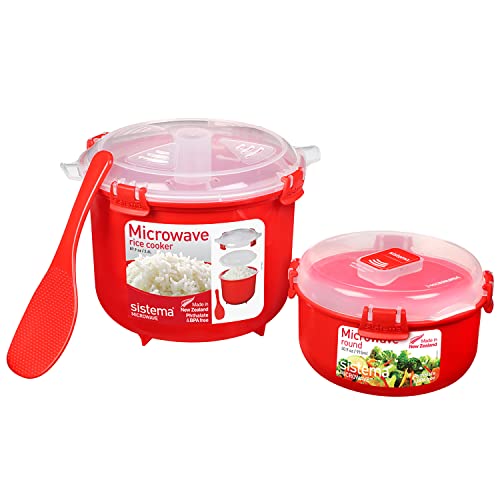
Meal preppers, this is your rice system. The Sistema set treats rice as a cycle — cook a batch in the vented cooker, portion the surplus into the matching container, refrigerate or freeze, reheat later in the same vented system — and every step uses vessels designed to hand off to each other. The listing’s steam-release vents handle the foam stage during cooking and prevent dried edges during reheating, and its BPA-free, dishwasher and freezer-safe notes cover the full loop’s demands. It suits students and small households cooking rice in deliberate surplus, several times a week.
Strengths
- Cooker plus storage container covers the whole prep cycle
- Steam-release vents manage cooking foam and reheating moisture
- Listing states BPA-free; dishwasher and freezer safe
Trade-offs
- Two-piece system takes more storage than a single pot
- Vent tabs collect starch and need a deliberate rinse
- Rice texture is very good rather than best-in-guide
| Set from listing | Microwave rice cooker and round food storage container |
| Vents from listing | Steam release vents |
| Care from listing | Dishwasher and freezer safe; BPA-free |
Judge this set by Tuesday’s lunch, not Sunday’s first cook. Rice reheated in a vented Sistema container tastes freshly made in a way that rice reheated under a paper towel in a random bowl does not, because the vent meters the steam that revives the grains instead of either drying or drowning them. The cooker itself is a dependable foam-managed vessel; the system thinking around it is the product. Households that cook rice to eat once may prefer the Joseph Joseph; households that cook rice to eat three times should buy this.
The Sistema’s vents repay a tiny maintenance habit: a rinse under the tap after each cook, before the starch dries in the vent tabs. Ten seconds, and the vent keeps metering steam precisely for years; neglected, starch builds until the vent sticks and the cooker mysteriously starts misbehaving. This is true of every vented design in the guide, but the Sistema’s loop — cook, store, reheat, repeat — cycles its vents more often than any rival’s, so the habit pays the highest interest here.
Water ratio is your craft to learn, and it is rice-specific before it is cooker-specific. Long-grain white, jasmine, basmati and brown rice each drink differently, and brown rice in particular needs more water and substantially more time in a microwave environment. Keep one rice as your calibration standard — the one you cook most — and master it before varying the grain. The cooker that seems mediocre across five grains is usually a cooker that has never been calibrated on one.
Best for: Meal preppers and rice-in-surplus households / Not suited for: Cook-once households wanting peak texture only
Check on Amazon to check price on Amazon and confirm the current listing details before you buy.

Home-X Microwave Rice Cooker, 10 Cups — Best Large Capacity
Families outgrow 8-cup-class cookers quickly, and the Home-X answers with a 10-cup rating, locking clips that keep the lid seated through the foam stage, and a second job as a vegetable steamer. The listing states BPA-free construction and dishwasher safety, which at family scale is not a footnote — a big rice cooker that must be hand-washed is a big rice cooker that gets used less. It suits households of four to six, rice-with-everything cooking styles, and anyone whose batches feed tonight’s dinner and tomorrow’s fried rice in one cook.
Strengths
- 10-cup rating is the largest dedicated rice capacity here
- Locking clips keep the lid seated through foaming
- Doubles as a vegetable steamer; dishwasher safe per listing
Trade-offs
- Large footprint in both microwave and cabinet
- Big batches amplify ratio errors — calibrate on a half batch first
- Budget-tier finish compared with the Joseph Joseph
| Capacity from listing | 10 cups |
| Features from listing | Steam release vents; easy locking clips |
| Material / care from listing | BPA-free; dishwasher safe |
Scale changes rice cooking: a family batch foams harder, steams longer and punishes a loose lid more than a two-cup test batch ever will. The Home-X’s locking clips are therefore the headline, not a detail — the lid stays where the steam needs it for the whole cook. Its steamer second job also matters at this size, because a vessel this large must justify its shelf, and vegetables steamed over or after the rice make it a two-course tool. Calibrate your ratio on a half batch, scale up once, and the family rice problem is simply solved.
Family cooks should calibrate the Home-X in a specific order: half batch first, with the household’s everyday rice, notes taken; then a three-quarter batch; then full. Scaling changes steam dynamics enough that jumping straight to a full 10-cup load with an untested ratio wastes the most rice when it disappoints. The staged approach costs two small batches of tuition and buys certainty at the scale where certainty matters — the full-family cook, where a failed batch is a dinner problem, not a learning exercise.
The rest is where microwave rice becomes good rice. Off the heat, still lidded, the grains finish absorbing surface moisture and the texture evens from top to bottom. Serve straight from the beep and the top layer is wet and the bottom is dense; rest ten minutes and the same batch is uniformly fluffy. Every pick in this guide assumes the rest in its design thinking, and skipping it is the most common reason good cookers get bad reviews.
Best for: Families of four to six and batch rice cooks / Not suited for: Singles or small microwaves
Check on Amazon to check price on Amazon and confirm the current listing details before you buy.
Nordic Ware Microwave Multi-Boiler, 5.5 Cup, Red — Best for One or Two People
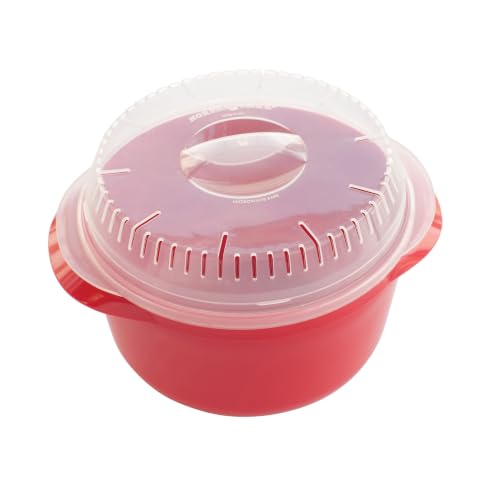
Small households face a real problem with dedicated rice cookers: the minimum batch. A cooker sized for family rice turns out a poor small batch — too much surface, too little depth. The Multi-Boiler’s 5.5-cup scale is the honest answer for one or two people: a cup of rice cooks in a vessel proportioned to it, and the same pot steams vegetables and boils noodles on the nights rice is not the plan. It suits singles, couples, dorm rooms and office kitchens, and anyone whose cabinet cannot house a single-purpose anything.
Strengths
- Right-sized for one to two servings of rice
- Generalist vessel — vegetables, noodles and reheating too
- Compact storage for dorms and small kitchens
Trade-offs
- Too small for family batches or rice in surplus
- No dedicated foam insert — respect the fill level
- Rice is one job among several, not its sole engineering focus
| Capacity from listing | 5.5 cup |
| Brand | Nordic Ware |
| Color from listing | Red |
Proportion is this pot’s rice argument. In a correctly sized vessel, a small batch keeps enough depth for steam to circulate through the grains rather than across a thin, drying layer, and the Multi-Boiler’s lid contains the modest foam a small batch produces without drama. The result is that a solo cook gets rice of the same quality the big dedicated cookers give a family, which is rarer than it should be. Add its competence at every other small boiling job and it becomes the default small-kitchen vessel — the one that lives in the microwave rather than the cabinet.
The Multi-Boiler’s rice has a quiet advantage for brown rice in small households: the modest batch size means the longer, wetter brown-rice cook happens in a vessel proportioned to it, and the results — chewy, separate grains — satisfy the one or two people eating them without a family-size commitment of leftovers. Brown rice for one is a dish most cooking systems handle badly; this little pot handles it as a matter of routine, which whole-food solo cooks will appreciate immediately.
Capacity language needs a translator. Microwave rice cookers variously quote cups cooked, cups uncooked, litres of vessel and servings, sometimes in the same listing. As a working rule, a cup of uncooked rice yields roughly three cups cooked and serves two modest or one generous portion. The spec boxes quote each listing’s own words, and the reviews translate those words into people fed, which is the only unit that matters at dinner time.
Best for: Singles, couples, dorms and offices / Not suited for: Families or surplus rice cooking
Check on Amazon to check price on Amazon and confirm the current listing details before you buy.
Bene Casa 2.6 Qt Microwave Pressure Cooker — Best for Big Rice Batches, Sealed
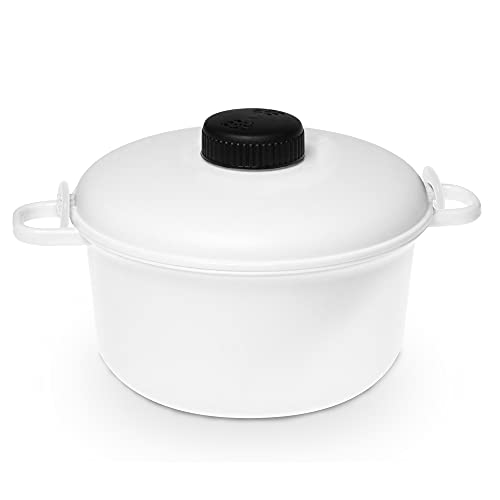
When the rice batch is genuinely large — a family’s week, a gathering, a fried-rice plan — the Bene Casa’s stated capacity, up to 12 cups cooked from 6 cups uncooked per its listing, outruns every dedicated cooker here. The sealed pressure environment keeps a big batch uniformly moist, which is where large open batches dry at the edges, and the non-stick interior answers the cleanup that a batch this size implies. It suits large households and batch cooks who have already read our pressure cooker guide’s discipline — fill limits and rests apply here exactly as there — and want those rules working on rice at scale.
Strengths
- Largest stated rice output here: 12 cups cooked per listing
- Sealed cooking keeps big batches uniformly moist
- Non-stick interior makes batch cleanup manageable
Trade-offs
- Pressure discipline required — fill limits and rest before opening
- Overkill for daily two-person rice
- Heavier process than a simple vented cooker
| Capacity from listing | 2.6 qt; up to 12 cups cooked rice (6 cups uncooked) |
| Surface from listing | Non-stick surface |
| Lid | Locking lid |
Big-batch rice fails by gradient: edges dry, center stays wet, and stirring mid-cook turns the whole thing gummy. The sealed environment is the fix, because the moisture has nowhere to go — it stays in the pot, working on the grains, for the entire cook and the rest that follows. The Bene Casa pairs that physics with the capacity to matter and an interior that survives the aftermath gracefully. It is not the everyday two-cup answer and does not pretend to be; it is the batch weapon, and for households whose rice consumption is measured in kilos per month, it is the right one.
Batch households using the Bene Casa for rice should plan the week’s arc when they load it: tonight’s plain rice, tomorrow’s fried rice (better with day-old grains, conveniently), and a final portion destined for soup or rice pudding. The sealed pot’s batch is not three dinners by accident but by design, and cooks who plan the arc get the full value of the capacity. It also reheats its own leftovers superbly, which closes the loop without a second vessel.
Rinsing rice is worth its thirty seconds. A brief rinse until the water runs clearer removes surface starch, which reduces both gumminess and foam — meaning it improves texture and makes your cooker’s venting job easier at the same time. It is the cheapest performance upgrade in this entire guide, it requires no purchase, and it is the step most likely to convert a skeptic whose first batch came out sticky.
Best for: Large households and weekly batch rice / Not suited for: Small daily batches or pressure-rule skeptics
Check on Amazon to check price on Amazon and confirm the current listing details before you buy.

Handy Gourmet Eco Friendly Microwave Pressure Cooker (Beige) — Best Eco-Material Rice Option
Plastic reduction is a legitimate buying criterion, and this is the pick that honors it without surrendering performance. The Handy Gourmet’s listing names rice among its core jobs, and the sealed pressure format suits rice genuinely well — moist, even grains with the water held in the pot rather than vented. It suits eco-minded households cooking rice for two to four, and anyone whose rice shares the pot with chicken, pasta and vegetables across the week, since the listing positions the vessel across that whole menu. One pot, several jobs, less conventional plastic: that is a coherent kitchen philosophy in a single purchase.
Strengths
- Non-toxic, biodegradable material per listing — unique here
- Sealed format produces moist, even rice
- Versatile across rice, chicken, pasta and more per listing
Trade-offs
- Pressure rules apply — fill limits and resting are mandatory
- Smaller batches than the Bene Casa for big rice days
- Eco material care instructions should be followed as directed
| Style | Microwave pressure cooker with locking lid |
| Material note from listing | Non-toxic and bio-degradable material; beige |
| Listing menu | Rice, chicken, pasta and more |
Judged strictly as a rice cooker, the Handy Gourmet’s sealed steam gives it an inherent edge over vented pots on moisture retention: the grains finish plump and separate, and the rest inside the closed pot is the most forgiving in this guide — rice held ten extra minutes emerges fine rather than tired. Its versatility is the tiebreaker for small kitchens: the same vessel that cooks Tuesday’s rice braises Thursday’s vegetables and handles a pasta-in-sauce night, all while keeping a plastic-reducing household’s principles intact. That combination earns its badge outright.
The Handy Gourmet’s rice has one more virtue worth naming: forgiveness on timing. Because the pot stays sealed, rice that finishes ten minutes before the rest of dinner waits in its own steam and emerges ready rather than tired — a wider serving window than any vented cooker offers. For households whose dinners assemble chaotically, with members arriving across half an hour, that window is a daily mercy, and it is a direct consequence of the pressure format doing rice duty.
Think about the second life of the vessel. Rice is rarely eaten to the last grain, so a cooker that stores its leftovers in the fridge and reheats them without a transfer — the Sistema’s whole design premise — removes two washing-up events from every batch. In a small kitchen, that loop is a feature on par with cooking quality, and it is why storage-integrated designs punch above their specifications in real households.
Best for: Eco-minded households cooking rice plus more / Not suited for: Huge batch rice or pressure-rule avoiders
Check on Amazon to check price on Amazon and confirm the current listing details before you buy.
Comparison Table
| Pick | Badge | Key spec | Best for |
|---|---|---|---|
| Joseph Joseph M-Cuisine Microwave Rice Cooker Steamer, 8.5 Cup | Best Overall | 8.5-cup rice steamer; foam-managing lid; paddle included | Rice-first households of two to four |
| Sistema Heat & Eat Microwaveable Rice Cooker & Food Container Set | Best Cook-Store-Reheat Loop | Vented cooker + storage container; full prep loop | Meal preppers and rice-in-surplus households |
| Home-X Microwave Rice Cooker, 10 Cups | Best Large Capacity | 10-cup; locking clips; steamer second job | Families of four to six and batch rice cooks |
| Nordic Ware Microwave Multi-Boiler, 5.5 Cup, Red | Best for One or Two People | 5.5-cup multi-boiler; small-batch proportion | Singles, couples, dorms and offices |
| Bene Casa 2.6 Qt Microwave Pressure Cooker | Best for Big Rice Batches, Sealed | 12 cups cooked rice per listing; sealed; non-stick | Large households and weekly batch rice |
| Handy Gourmet Eco Friendly Microwave Pressure Cooker (Beige) | Best Eco-Material Rice Option | Sealed pressure pot; eco material; rice-led menu | Eco-minded households cooking rice plus more |
Texture purists take the Joseph Joseph. Meal preppers take the Sistema loop. Families take the Home-X for dedicated capacity or the Bene Casa for sealed scale. Small households take the Nordic Ware, and eco-minded generalists take the Handy Gourmet. Every pick cooks good rice once calibrated — the differences are batch size, storage loop and how much specialization your kitchen can house.
How to Choose a Microwave Rice Cooker That Matches Your Household
Translate every capacity claim into people before comparing. A cup of uncooked rice makes roughly three cups cooked and feeds about two people as a side. On that math the 8.5-cup class covers most households’ daily rice, the 10-cup and 12-cup-cooked designs serve families and batch plans, and the 5.5-cup boiler is correctly sized for one or two. Buying one class up from your real need is the category’s most common mistake: oversized vessels cook small batches unevenly and store badly.
Decide how specialized your kitchen can afford to be. A dedicated rice cooker earns its shelf when rice appears four or more times a week; below that frequency, a generalist that also steams, boils or pressure-cooks will be used more and resented less. The picks here span that spectrum deliberately, from the single-minded Joseph Joseph to the multi-job Handy Gourmet, and the honest frequency count is the way to choose between them.
Budget tiers buy lid engineering and systems, not rice magic. The budget end delivers competent vented cooking; the mid tier adds foam management, locking clips and storage loops; the premium end buys the Joseph Joseph’s steam discipline and finish. Since every tier reaches good rice after calibration, spend on the friction you actually have — boil-overs, storage chaos, batch size — rather than on the most expensive vessel in the list.
Rice Ratios, Rests and Grain Differences
Start every new cooker with its own stated ratio for your staple rice, then adjust in small steps: a spoonful or two of water per batch is the unit of change, not a quarter cup. Wetter is not safer — excess water makes gumminess that no rest can fix — while slightly dry rice can be rescued by the rest and a sprinkle of water before a short second steam. Keep notes for the first month; three recorded batches teach you your cooker, your grain and your oven as a system.
Grains are not interchangeable. Jasmine wants a lighter hand with water than long-grain white. Basmati rewards a brief soak. Brown rice needs meaningfully more water and time, and in a microwave it benefits from a mid-cook rest that lets the bran layer hydrate. Sushi rice wants precision most of all. Master one grain per cooker before varying, and treat each new grain as a fresh calibration rather than a failure of the vessel.
The rest deserves the same respect as the cook. Ten lidded minutes off the heat is the difference between rice that is merely cooked and rice that is finished: surface moisture absorbs, texture evens, grains separate under the paddle instead of clumping. Fluff once, gently, at the end of the rest — never stir mid-rest — and serve from the cooker where the design allows it. This single habit improves every pick in this guide more than any upgrade could.
Brown Rice, Jasmine and Basmati: One Cooker, Several Grains
Jasmine rice is the microwave cooker’s home game: fragrant, slightly sticky by nature, and forgiving of small ratio errors. It wants a touch less water than standard long-grain and rewards the rinse, which keeps its natural stickiness at ‘pleasantly clinging’ rather than ‘porridge’. Most households calibrate on jasmine or long-grain white first, and the settings they find become the household standard against which every other grain is an adjustment, not a new project.
Basmati asks for two courtesies: a brief soak when time allows, which lets the long grains elongate instead of breaking, and a gentle hand at fluffing, because cooked basmati is fragile. Its water appetite is modest and its foam is light, making it the best-behaved grain in vented cookers. Brown rice is the opposite personality — thirsty, slow, and determined. It needs meaningfully more water and time, benefits from a mid-cook pause that lets the bran hydrate, and forgives nothing about skipped rests. Master it separately, on a weekend batch, rather than debuting it for guests.
Short-grain and sushi rice demand precision above all: the ratio window narrows, and the difference between glossy, distinct grains and a sticky mass is a spoonful of water either way. Cook these in your most controlled vessel — the Joseph Joseph in this guide — and weigh consistency of measure above every other variable. Across all grains, the meta-lesson is the one this whole guide teaches: the cooker is a constant, the grain is the variable, and the cook who keeps notes becomes the person whose rice is always right.
A note on cooking rice for one specific audience: babies, toddlers and grandparents all eat rice at textures the family batch does not provide u2014 softer, porridged, or salt-free. A microwave rice cooker handles these small special batches gracefully, in the same vessel, while the main dinner cooks elsewhere. Congee from leftover rice, a soft small batch for a recovering appetite, plain unsalted rice for a first-food eater: these are unglamorous, essential jobs, and they are where a flexible second rice vessel earns a permanent place in a family kitchen.
Store the cooked rice conversation deserves its final word here, because a rice cooker’s life is half cooking and half what happens after. Cooked rice cools best spread or loosely covered, refrigerates in a sealed container, and reheats best with a spoonful of water and a vented lid — the same venting that cooked it. Frozen rice, portioned flat, reheats from frozen in the microwave remarkably well, which makes the batch cookers in this guide a quiet meal-prep system: cook once on Sunday, freeze in portions, and eat rice that tastes fresh on Thursday. The cooker that manages your leftovers as well as your cooking is the one still earning its shelf in year three.
How to Use a Microwave Rice Cooker for Fluffy Rice Every Time
The sequence below works across the vented, sealed and generalist cookers in this guide. Where a product’s own directions differ, its directions win — but the rinse, the ratio discipline and the rest are universal.
- Rinse the rice briefly until the water runs clearer. This removes surface starch, cutting both gumminess and the foam your cooker’s vents must handle.
- Add rice and water at your cooker’s stated ratio for your grain, and check the level against the fill limit — rice expands and foams, so headroom is mandatory, especially in sealed pots.
- Seat or lock the lid exactly as designed, with vents set as directed, and cook for the stated time for your batch size and oven wattage.
- Leave the cooker closed when the time ends. Rest the rice lidded for about ten minutes; for pressure designs, this rest is also the pressure release and must not be rushed.
- Fluff once with a paddle, moving gently from the edges inward, and serve. Note the result — texture, moisture, any dry edges — against your ratio for next time.
- Rinse the cooker and its lid parts while warm. Starch films set fast, and a clean vent is a working vent on the next batch.
Three batches is the calibration horizon: batch one by the book, batch two adjusted by a spoonful of water, batch three confirmed. After that, microwave rice stops being an experiment and becomes the most dependable side dish in your kitchen — the one that is ready, fluffy and waiting when everything else finishes.
Common Buying Mistakes
Skipping the rinse. Surface starch is the main cause of gummy rice and violent foaming. Thirty seconds of rinsing improves texture and makes every vent design in this guide work better.
Judging the rice before the rest. Rice served at the beep is wet on top and dense below, whatever the cooker. The ten-minute lidded rest is part of the recipe; skipping it manufactures disappointment.
Using one ratio for every grain. Jasmine, basmati and brown rice all drink differently. Calibrate per grain and keep notes, or you will blame a good cooker for a brown-rice batch that simply needed more water and time.
Filling to the brim for a crowd. Rice foams and expands. An overfilled cooker erupts or cooks unevenly; two correct batches — or the right large-capacity pick — beat one heroic overflow.
Stirring during the rest. Stirring breaks grains and releases starch, turning fluffy rice gummy at the last step. Fluff once, gently, after the rest is complete, and then leave it alone.
Final Recommendation
Buy the Joseph Joseph M-Cuisine if rice texture is your priority and your household eats it constantly. Choose the Sistema set if your rice life runs on meal prep and reheating, the Home-X if a family needs dedicated capacity, and the Bene Casa if your batches are measured in dozens of cups. Small households should take the Nordic Ware Multi-Boiler without a second thought, and eco-minded generalists the Handy Gourmet. Calibrate any of them across three batches and the electric rice cooker on your counter starts looking like storage with a cord.
Rice is one stop in the Cookers cluster; the general microwave overview and the pressure deep dive are here: Best Microwave Cookers and Best Microwave Pressure Cookers, with the college-sized electric minis in the final guide below.
Ready to shop the shortlist? Start with Joseph Joseph M-Cuisine Microwave Rice Cooker Steamer, 8.5 Cup (Best Overall), Sistema Heat & Eat Microwaveable Rice Cooker & Food Container Set (Best Cook-Store-Reheat Loop), Home-X Microwave Rice Cooker, 10 Cups (Best Large Capacity) — or check price on Amazon for any pick above to compare the current listings side by side.
Best Microwave Cookers Best Microwave Pressure Cookers Best Mini Rice Cookers For College Best Microwave Egg Cookers Best Mini Multi Cookers
Frequently Asked Questions
Is microwave rice as good as rice from an electric rice cooker?
Once calibrated, yes for most households and most grains. A purpose-built microwave cooker manages steam and foam properly, and the rice rests in the same vessel, so texture lands where a decent electric appliance lands. High-volume daily rice for large families can still justify the electric appliance’s set-and-forget capacity.
How much water do I use in a microwave rice cooker?
Start with the ratio printed for your specific cooker and grain — designs differ enough that a universal number would mislead you. Then adjust by a spoonful or two per batch based on results. Slightly dry rice can be rescued with a sprinkle and a short rest; gummy rice means less water next time.
Can these cookers handle brown rice?
Yes, with more water and substantially more time than white rice, and a mid-cook pause helps the bran hydrate. Calibrate brown rice as its own project rather than expecting your white-rice settings to transfer, and the results are properly chewy and separate.
Why does my rice boil over?
The usual causes are overfilling, unrinsed rice foaming harder than the vents expect, or a lid not seated as designed. Fill to the limit at most, rinse the rice, seat the lid properly, and favor the foam-managing designs in this guide if boil-over has been your history.
How many people does an 8.5-cup rice cooker feed?
Using the standard yield of roughly three cups cooked from one cup uncooked, an 8.5-cup-class cooker handles a daily batch for about two to four people as a main side. Appetites and menu matter — rice as the centerpiece of the meal stretches capacity faster than rice as an accompaniment.
Can I reheat leftover rice in these cookers?
Yes, and vented designs reheat best because the steam revives the grains. Sprinkle a spoonful of water over the rice, vent as directed, and heat in a shorter cycle than the original cook. The Sistema set in this guide is built around exactly this cook-store-reheat loop.


