Disclosure: airfryerkitchensupply.com is reader-supported. When you buy through links on our site, we may earn an affiliate commission at no extra cost to you.
Where to buy
Below is the verified shortlist for the best microwave hard boiled egg cookers category in this guide.
Hard boiled eggs are a precision job disguised as a simple one, so this guide separates true shell-on microwave boilers from the gadgets that merely cook eggs near a microwave. Every pick was verified against Amazon’s catalog data first; the list includes the category’s reference boiler, the popular chicken-shaped boilers, a shell-less alternative for people who hate peeling, and one electric countertop cooker included honestly as the alternative technology. Check price on Amazon from the links on each pick.
- Nordic Ware Microwave Egg Boiler (Best Overall for Hard Boiled) — check price on Amazon
- Microwave Egg Boiler for 4 Eggs, Chicken Shape (XIHUADOU) (Best for Small Batches) — check price on Amazon
- Microwave Egg Cooker, 4 Eggs, Chicken Shaped (Vornetil) (Best Space-Saving Design) — check price on Amazon
- Chicken Shaped Microwave Egg Boiler (iayokocc) (Best for Home and Small Cafés) — check price on Amazon
- Egglettes Egg Cooker — Hard Boiled Eggs without the Shell, 4 Egg Cups (Best for People Who Hate Peeling) — check price on Amazon
- Dash Rapid Egg Cooker (Electric) (Best Electric Alternative — Not a Microwave Cooker) — check price on Amazon
Hard boiled eggs expose every weakness in a cooking method. The white should be fully set but never rubbery, the yolk cooked through without that grey-green ring, and the shell should release without taking half the white with it. On the stovetop, that outcome depends on boil timing, egg age and luck. The best microwave hard boiled egg cookers attack the problem differently: a sealed, water-metered steam environment that treats every egg identically, batch after batch. If you eat hard boiled eggs weekly — for snacks, salads, deviled eggs or ramen — that repeatability is worth more than speed.
This guide is deliberately narrower than our general egg cooker roundup. Poachers, omelet pans and sandwich makers are excluded on purpose, however good they are, because they cannot cook an egg in its shell. What remains are the shell-on boilers: the established Nordic Ware design, the chicken-shaped boilers that dominate the category’s sales, and two honest alternatives — shell-less egg cups for the peeling-averse, and a plug-in electric boiler for people who would rather not use the microwave at all. Each solves the hard boiled problem from a different direction.
Understand the one real variable before you buy: doneness lives in the timing, and timing lives in your microwave’s wattage. A boiler that produces firm, golden yolks at seven minutes in one oven needs eight in another. Every pick here rewards a single calibration batch — cook, chill, cut, judge, adjust by thirty seconds — and then reproduces your result with a consistency the stovetop rarely matches. The reviews are frank about which designs make that calibration easiest.
Key Takeaways
- Doneness is decided in three acts — the timed steam, the lid-on rest and the prompt cold-water chill. All three count.
- The grey-green yolk ring means overcooking or a late chill, not a defective boiler; fix the chill first.
- Older eggs peel better under every method. Boil the week-old carton; save fresh eggs for frying and poaching.
- Calibrate in thirty-second steps across two batches, chill fully before judging, and write your time on the boiler.
- If peeling is your real enemy, shell-free cups (Egglettes) solve it completely; if calibration is, the electric Dash removes it.
In this guide
Quick Picks
Nordic Ware Microwave Egg Boiler — Best Overall for Hard Boiled. The reference shell-on boiler: a water-reservoir design from the most established name in microwave cookware, built for repeatable boiled eggs without a pot. For hard boiled specifically, its consistency is the benchmark. Check the current price on Amazon.
Microwave Egg Boiler for 4 Eggs, Chicken Shape (XIHUADOU) — Best for Small Batches. A four-egg chicken-shaped boiler with a lid, sized for daily snacking batches rather than weekly prep marathons. The listing positions it for soft and hard boiled eggs alike. Check the current price on Amazon.
Microwave Egg Cooker, 4 Eggs, Chicken Shaped (Vornetil) — Best Space-Saving Design. Another confirmed four-egg chicken-shaped listing, badged here for space-saving: the listing itself calls out its compact footprint for small kitchens. A near-twin format to the pick above, from a different seller. Check the current price on Amazon.
Chicken Shaped Microwave Egg Boiler (iayokocc) — Best for Home and Small Cafés. A chicken-shaped boiler whose listing explicitly pitches it at home kitchens and restaurants — the small-batch boiler for households that serve boiled eggs to guests, or tiny cafés doing the same. Check the current price on Amazon.
Egglettes Egg Cooker — Hard Boiled Eggs without the Shell, 4 Egg Cups — Best for People Who Hate Peeling. Not a shell-on boiler at all: four cups you crack the egg into, so the cooked egg comes out shell-free and ready to eat. Included because for many buyers, peeling — not cooking — is the actual problem. Check the current price on Amazon.
Dash Rapid Egg Cooker (Electric) — Best Electric Alternative — Not a Microwave Cooker. Included transparently as the non-microwave option: Dash’s countertop electric cooker for hard boiled and poached eggs, with automatic shut-off per its listing. For buyers whose real goal is set-and-forget eggs, not microwave cooking specifically. Check the current price on Amazon.
How These Picks Were Chosen
Verification ran against the airfry site’s Amazon data: candidates were searched by brand and product name, returned listing titles were matched against the intended cooker, and only confirmed matches received ASINs and links. This mattered acutely here, because the chicken-shaped boiler segment contains multiple near-identical listings from different sellers; each one in this guide is a specific, confirmed listing, not a generic description of the shape.
Selection criteria were specific to hard boiling. First, genuine shell-on design with a water reservoir or measured-water system — the mechanism that makes microwave boiling controlled rather than explosive. Second, capacity: four-egg boilers suit daily snacking, while prep households need to think in weekly batches. Third, doneness control — how finely the design lets you adjust between soft, medium and firm. Fourth, the peeling experience the design produces, because a boiler that cooks perfectly but welds the shell on has failed half its job. The electric Dash was included under a transparency rule: it is not a microwave product, it is the alternative a hard boiled specialist should know about, and it is badged as such.
The 6 Best Microwave Hard Boiled Egg Cookers
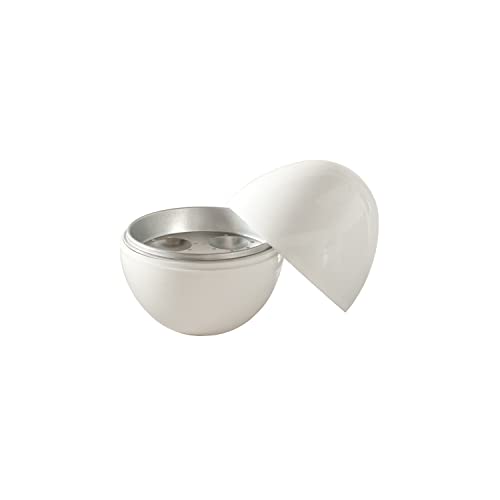
Nordic Ware Microwave Egg Boiler — Best Overall for Hard Boiled
For hard boiled eggs as a weekly staple, this is the boiler to own. Its reservoir design surrounds shell-on eggs with a measured steam environment, which is what produces evenly set whites from batch to batch instead of the stovetop’s lottery of cracked shells and uneven centers. It suits deviled-egg makers, salad-and-snack households and anyone who has ever produced a dozen eggs for an event and discovered three doneness levels in one pot. Where the chicken-shaped boilers compete on charm, this one competes on track record, and for a food defined by repeatability, track record wins.
Strengths
- Reservoir steam environment gives the most repeatable doneness in this guide
- Established design from a specialist microwave-cookware maker
- Batch-friendly for weekly prep and events
Trade-offs
- Utilitarian looks — function over charm
- Doneness still requires one calibration batch per microwave
- No novelty shape for kids or gifting
| Type | Microwave egg boiler for shell-on eggs |
| Brand | Nordic Ware |
| Method | Measured water reservoir; steam cooking |
Judged purely as a hard boiled machine, the Nordic Ware boiler’s advantage is variance reduction. The enclosed reservoir holds the same water measure against the same egg load every time, so the only variable left is your chosen time — and once that is set, the eggs come out the same on a rushed Tuesday as on a careful Sunday. That is the exact property hard boiled cooking needs, because the dish has no mid-cook correction: you cannot peek at a shell-on egg. Buy it for certainty, chill the eggs promptly to protect the yolks, and peeling will be as good as the eggs’ age allows.
Deviled egg makers should judge this boiler by a party standard: twelve eggs, one afternoon, zero casualties. The reservoir’s consistency means the yolks sit centered and evenly set — the two properties that decide whether deviled eggs look catered or homemade-in-a-bad-way. Cook in two runs if your batch outgrows one load, chilling the first while the second steams; the rhythm is faster than it sounds and the results are more uniform than any single stovetop pot delivers.
Doneness is a yolk story. For hard boiled eggs the target most people mean is a fully set, bright yolk with no grey ring — that ring is iron and sulfur reacting during overcooking and slow cooling, which is why the chill step after cooking matters as much as the cook itself. Every boiler in this guide produces its best hard boiled result when the eggs go into cold water promptly after their rest, stopping the yolk at golden instead of grey.
Best for: Weekly hard boiled routines, deviled eggs and events / Not suited for: Buyers wanting a novelty design or shell-free cooking
Check on Amazon to check price on Amazon and confirm the current listing details before you buy.

Microwave Egg Boiler for 4 Eggs, Chicken Shape (XIHUADOU) — Best for Small Batches
Four eggs is the right batch for a lot of real lives: two for today’s salads, two for tomorrow’s snacks, none lingering long enough to tire anyone. This chicken-shaped boiler is built to exactly that scale, with a lidded body that keeps the steam environment enclosed and a footprint small enough to live beside the microwave. The listing describes it for soft and hard boiled eggs, so it also suits households still exploring their doneness preference — small batches make experimentation cheap. It is a good first boiler for singles and couples.
Strengths
- Four-egg capacity matches daily snacking without waste
- Enclosed lidded design for controlled steaming
- Compact footprint stores beside the microwave
Trade-offs
- Four eggs at a time means repeat runs for prep households
- Doneness range depends on your calibration, like all boilers
- Novelty shape will not suit every kitchen’s taste
| Capacity from listing | 4 eggs |
| Design from listing | Chicken shape egg cooker with lid; steamer for soft and hard boiled eggs |
| Material note from listing | Food grade |
The chicken shape is easy to dismiss as decoration, but the underlying format — a small, lidded, measured-water boiler — is sound, and the scale is its real feature. Small batches heat through more uniformly than crowded ones, so a four-egg boiler often delivers more consistent doneness than a large vessel used half-empty. For hard boiled eggs specifically, run the full stated time, rest with the lid on, then chill promptly; the small thermal mass means the eggs respond quickly to the chill, which protects the yolks from greying. As a daily-driver boiler for one or two people, it is honestly sized.
The four-egg scale has a freshness argument behind it: eggs boiled in small batches get eaten within days, at their best, instead of a large batch aging toward the back of the fridge. Households that graze on boiled eggs — one with lunch, one after the gym — often find the small boiler’s rhythm matches consumption better than weekly mega-batches. Freshness, in a food this simple, is a quality you can taste, and small-batch boiling is how you keep it.
Egg age is the peeling variable nobody can design away. Very fresh eggs bond their membranes tightly and peel badly no matter the method; eggs that have sat in the fridge for a week release far more willingly. If peeling is your recurring frustration, the fix is partly procurement — boil the older eggs first — and partly technique: crack all over, start at the wide end where the air pocket sits, and peel under a thin stream of water.
Best for: Singles and couples boiling eggs daily / Not suited for: Weekly prep of a dozen or more eggs
Check on Amazon to check price on Amazon and confirm the current listing details before you buy.
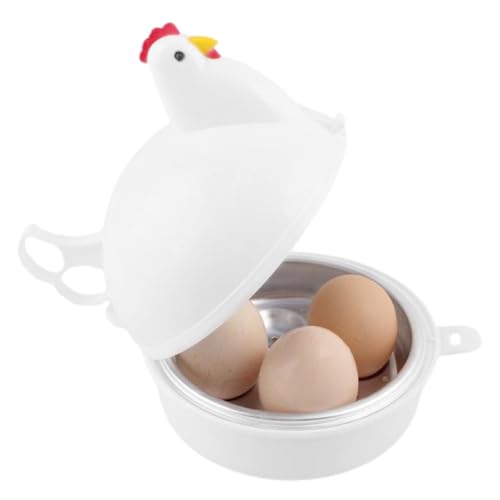
Microwave Egg Cooker, 4 Eggs, Chicken Shaped (Vornetil) — Best Space-Saving Design
We include a second chicken-shaped boiler deliberately, because this segment is where buyers actually shop — and this listing distinguishes itself by emphasizing space-saving storage for small kitchens. Functionally it follows the same proven pattern: four shell-on eggs, measured water, lidded steam environment, results from soft to hard boiled as its listing describes. It suits apartment and dorm cooks whose storage is a single shelf, and anyone choosing between the lookalike listings who wants the one that talks honestly about footprint. Between this and the XIHUADOU above, choose by which listing’s details you prefer; the cooking pattern is the same family.
Strengths
- Listing emphasizes space-saving size for small kitchens
- Four-egg batches for soft through hard boiled results
- Lidded steam design in a compact body
Trade-offs
- Same four-egg ceiling as other small boilers
- Lookalike segment — buy the exact listing, not a copy
- No capacity advantage for prep households
| Capacity from listing | 4 eggs capacity |
| Design from listing | Chicken shaped poacher boiler cooker; space saving |
| Styles from listing | Soft and hard boiled eggs |
Honesty about this segment helps buyers more than pretending the near-twins are radically different machines. They are the same sound idea — small lidded steam boilers — sold by different sellers, which is exactly why this guide verified each listing individually rather than reviewing the shape once. What you are choosing here is the specific product behind the link: its stated capacity, its lid fit and its seller. For hard boiled results, treat it identically to the other small boilers: full measure of water, full time, lid-on rest, prompt chill. The eggs will not know which chicken they rode in.
Storage in a shared fridge is this pick’s quiet test, and the compact chicken body passes it: the boiler itself doubles as the storage container for its cooked eggs in many households, lid on, taking one small footprint on the shelf. That dual use matters in apartments and dorms where container collections do not exist. Just mark the cooking date on a piece of tape on the lid — the boiler-as-storage trick only works if the date travels with the eggs.
Calibration deserves its own ritual. Cook one batch at the product’s suggested time, chill it fully, and cut the eggs before judging — yolks keep setting as eggs cool, so a warm cut misleads. Note the result against your preference, adjust the next batch by thirty seconds in the right direction, and write your final time on the boiler itself. Two batches is the whole tuition for years of exact eggs.
Best for: Small kitchens and dorm rooms short on storage / Not suited for: Anyone needing more than four eggs per run
Check on Amazon to check price on Amazon and confirm the current listing details before you buy.
Chicken Shaped Microwave Egg Boiler (iayokocc) — Best for Home and Small Cafés
This listing earns its own badge by aiming at a slightly different user: the home entertainer and the very small food business. Its description speaks to home kitchen and restaurant use, which in practice means boiled eggs as a served food — halved over salads, quartered on ramen, arranged on a brunch board — rather than meal-prep stock. The format is the familiar lidded chicken boiler for shell-on eggs, so the cooking is the proven pattern; the difference is intent. If your boiled eggs get plated for other people, this is the listing written for you.
Strengths
- Listing positions it for home and restaurant serving
- Familiar lidded steam-boiler format for shell-on eggs
- Small batches keep served eggs freshly cooked
Trade-offs
- Small batch size limits true restaurant volume
- Same calibration requirement as every boiler here
- Novelty appearance may not suit a professional pass
| Design from listing | Chicken shaped microwave egg boiler |
| Use note from listing | For home kitchen restaurants |
| Styles from listing | Hard boiled egg cooking and poaching gadget |
Serving changes the doneness calculation. Meal preppers forgive a slightly firm yolk; a guest at your table notices a grey ring. The discipline this boiler rewards is the full sequence — exact water, exact time, lid-on rest, immediate chill — because that sequence is what produces yolks that cut bright and clean for presentation. Cooked in small batches close to serving time, eggs from a boiler like this beat a stovetop batch cooked hours ahead and held, which is the real argument for the format in an entertaining or small-café setting.
For small cafés and bed-and-breakfast kitchens, the honest calculation is batches per hour: a small boiler cycling four eggs at a time, with chilling between runs, supplies a modest service of salads and breakfast plates without a stovetop burner committed to a boiling pot all morning. That burner freedom is the product being bought. Establishments needing dozens of eggs should look at electric countertop cookers like the Dash in this guide; establishments needing a dozen across a morning are this boiler’s natural home.
Batch rhythm matters more than batch size for most households. A four-egg boiler used twice in an evening, with the first batch chilling while the second cooks, produces eight eggs with less total attention than one large stovetop pot demands. Small boilers also forgive experimentation — testing a jammy six-minute egg costs you four eggs, not twelve — which is how people actually find their perfect doneness.
Best for: Entertainers and tiny cafés serving boiled eggs / Not suited for: High-volume prep or back-of-house batch work
Check on Amazon to check price on Amazon and confirm the current listing details before you buy.

Egglettes Egg Cooker — Hard Boiled Eggs without the Shell, 4 Egg Cups — Best for People Who Hate Peeling
Be honest about your bottleneck. If your hard boiled eggs cook fine but peeling them shreds the whites and your patience, the Egglettes approach removes the shell from the process entirely: crack a raw egg into each cup, cook, and turn out a smooth, shell-free egg. The listing sells a four-cup set, matching snack and salad scale. The trade is real — the eggs have a molded shape and the texture is a close cousin of a true shell-on boiled egg rather than an identical twin — but for egg salad, meal prep and kids’ lunches, the elimination of peeling is worth more than shell authenticity.
Strengths
- No peeling, ever — eggs cook shell-free in the cups
- Four cups match snack and salad batches
- Smooth, portioned eggs suit egg salad and prep
Trade-offs
- Molded shape and texture differ slightly from shell-on eggs
- Cups need greasing for the cleanest release
- Not a boiled-in-shell egg, for purists
| Format from listing | Hard boiled eggs without the shell; 4 egg cups |
| Brand | Egglettes (Copper Fit listing) |
| Method | Eggs cracked into cups before cooking |
Egglettes reframes what ‘hard boiled’ needs to be. The shell’s only jobs are containment and tradition; the cups handle containment, and tradition turns out to be negotiable once you have eaten a week of peel-free eggs. The cups also open a door shell-on cooking cannot: seasonings, a little cheese or chopped herbs can go in with the raw egg, producing a flavored cooked egg that no boiler can match. Judge it as its own method rather than a failed imitation and it is the most practical pick in this guide for prep-heavy households.
Egglettes also change the food-safety rhythm of meal prep in a subtle, useful way: because there is no shell, you can see and smell the cooked egg’s condition directly when you open the fridge, with no crack-and-guess. And the cups’ portioning is exact — one egg per cup, no halves or doubles — which makes them a quiet favorite with anyone tracking protein portions. The molded shape that purists mock turns out to be a measuring system in disguise.
Storage of the cooked eggs is part of the system. Hard boiled eggs keep in the shell in the fridge for days, and peeling just before eating keeps the whites smooth and the flavor fresh. Mark the carton or container with the cooking date; boiled and raw eggs look identical in the shell, and every household eventually learns this the confusing way. A dedicated boiler makes batches frequent enough that a simple date habit pays off immediately.
Best for: Peeling-haters, egg salad makers and meal preppers / Not suited for: Purists who want a true in-shell boiled egg
Check on Amazon to check price on Amazon and confirm the current listing details before you buy.

Dash Rapid Egg Cooker (Electric) — Best Electric Alternative — Not a Microwave Cooker
This pick breaks the guide’s own frame on purpose, and it is badged so you cannot miss it: the Dash is an electric countertop cooker, not a microwave product. It belongs here because a share of hard boiled shoppers are not committed to the microwave — they are committed to effortless eggs — and the Dash’s water-measure-and-walk-away operation, with automatic shut-off in its listing, is the benchmark for effortlessness. It cooks hard boiled and poached eggs and handles omelets and steaming per its listing. If your microwave is small, busy or shared, this appliance earns counter space the boilers cannot.
Strengths
- Automatic shut-off per listing — true walk-away cooking
- Covers hard boiled, poached, steamed and omelet styles per listing
- Independent of microwave size, wattage and availability
Trade-offs
- Not a microwave cooker — needs counter space and an outlet
- Appliance price tier, above the plastic boilers
- Another single-purpose appliance to store
| Type from listing | Electric egg poacher, boiler, steamer and omelette maker |
| Feature from listing | Automatic shut-off; BPA-free |
| Doneness from listing | Soft, medium or hard eggs |
The Dash reframes the buying question honestly: are you shopping for a microwave tool, or for reliable hard boiled eggs by the easiest route? Its measured-water system removes wattage calibration entirely — the water amount sets the doneness, and the shut-off removes the timing — which is why electric cookers convert people who found microwave boilers fiddly. The costs are counter space, an appliance-tier price and one more thing to store. For a household eating eggs daily, that trade frequently wins, and a guide that hid the option to protect its own title would be serving itself, not you.
The Dash’s deeper appeal is cognitive: it removes the two decisions — how long, and is it done — that make people avoid boiling eggs at all. Water measured to a line, eggs loaded, button pressed, and the machine announces the end. For households where eggs are daily infrastructure rather than a cooking project, that removal of thought is worth an appliance’s footprint, and it is why electric cookers hold their category against cheaper microwave tools year after year.
Safety in this category is a design question, not a warning label. Shell-on eggs superheat; the boilers here exist to meter water and contain that energy in a controlled steam environment. That is why this guide contains no ‘hack’ methods, no foil tricks and no pierced-shell shortcuts: the products are the safety system. Follow the fill measure, keep the lid closed for the stated rest, and the category is as safe as any in the kitchen.
Best for: Daily egg eaters who want zero calibration / Not suited for: Anyone specifically equipping a microwave-only kitchen
Check on Amazon to check price on Amazon and confirm the current listing details before you buy.
Comparison Table
| Pick | Badge | Key spec | Best for |
|---|---|---|---|
| Nordic Ware Microwave Egg Boiler | Best Overall for Hard Boiled | Shell-on reservoir boiler; repeatability benchmark | Weekly hard boiled routines, deviled eggs and events |
| Microwave Egg Boiler for 4 Eggs, Chicken Shape (XIHUADOU) | Best for Small Batches | 4-egg lidded boiler; soft and hard boiled per listing | Singles and couples boiling eggs daily |
| Microwave Egg Cooker, 4 Eggs, Chicken Shaped (Vornetil) | Best Space-Saving Design | 4-egg chicken boiler; space-saving per listing | Small kitchens and dorm rooms short on storage |
| Chicken Shaped Microwave Egg Boiler (iayokocc) | Best for Home and Small Cafés | Chicken boiler; home/restaurant positioning per listing | Entertainers and tiny cafés serving boiled eggs |
| Egglettes Egg Cooker — Hard Boiled Eggs without the Shell, 4 Egg Cups | Best for People Who Hate Peeling | 4 shell-free egg cups; no peeling | Peeling-haters, egg salad makers and meal preppers |
| Dash Rapid Egg Cooker (Electric) | Best Electric Alternative — Not a Microwave Cooker | Electric cooker; auto shut-off; soft/medium/hard per listing | Daily egg eaters who want zero calibration |
For a true microwave hard boiled egg, the choice is among the first four: the Nordic Ware for benchmark consistency, and the three chicken-shaped boilers for small, storage-friendly batches — pick among those by the exact listing details you prefer. The Egglettes answer a different question (peeling), and the Dash answers another (microwave-free convenience). All six produce hard-cooked eggs; they just disagree about which part of the job matters most.
How to Choose a Microwave Hard Boiled Egg Cooker
Decide first whether your eggs must be cooked in the shell. Deviled eggs, Easter eggs and classic presentation say yes, and that means a reservoir boiler — the Nordic Ware or one of the chicken-shaped designs. Egg salad, snack prep and lunchbox eggs have no such requirement, which is when the shell-free Egglettes become arguably the smartest purchase in this guide. Let the dish decide the technology, not the other way round.
Capacity planning for hard boiled eggs works in weeks, not meals. A household eating two eggs a day needs fourteen a week: that is four runs of a four-egg boiler, or fewer runs of a larger batch rhythm with chilling in between. Small boilers are not a compromise here — their runs are short and their doneness consistent — but count your weekly eggs before choosing, because the household that boils a dozen every Sunday should weight the Nordic Ware’s batch temperament most heavily.
Budget tiers in this narrow category buy convenience, not egg quality. The plastic boilers all cook by the same steam principle and all reach excellent hard boiled results once calibrated. Money moves you toward capacity, brand track record, or out of the microwave entirely to the electric Dash. Spend on the friction you actually feel — peeling, calibration, batch size — rather than on a more expensive version of the same steam.
Getting Doneness Right: Time, Chill and the Grey Ring
Hard boiled doneness is decided in three acts, and the cook is only the first. Act one is the timed steam, calibrated to your wattage in thirty-second steps across your first two batches. Act two is the lid-on rest, where the yolk finishes setting from residual heat — shorten it and the center stays jammy, which is a feature when soft-boiled is the goal and a flaw when it is not. Act three is the chill: prompt cold water stops the cooking, firms the white for clean slicing, and prevents the grey-green ring that forms when hot yolks sit and react as they cool slowly.
That ring deserves its reputation as the category’s tell. It is harmless but ugly, and it signals overcooking or lazy cooling more reliably than any timer. If your eggs ring despite correct times, your chill is late; if they ring and the whites are rubbery, your time is long. Fix one variable at a time and keep notes for two batches — the system converges fast, and after that your boiler produces presentation-grade eggs on demand.
Finally, match the batch to the eggs you have. Older eggs peel better and are the right choice for deviled eggs and events; the freshest eggs are better saved for poaching and frying, where peeling never enters into it. A household with a boiler develops this rotation naturally: new eggs to the back of the fridge, boiling stock to the front, and a small note of the date on the carton to keep the system honest.
Serving Hard Boiled Eggs Well: Deviled, Salads, Ramen and Snacking
Deviled eggs are the hard boiled egg’s highest calling and its strictest examiner. The whites must be firm enough to hold a piped filling without tearing, the yolks bright and dry enough to crumble into a smooth, seasonable paste. Boiler eggs excel here for a structural reason: the enclosed steam cooks the white evenly all around, so there is no tough side and no fragile side, and the prompt chill keeps the yolk’s color clean for the filling. Halve the eggs lengthwise with a sharp, wet knife, and season the yolk mixture more boldly than instinct suggests — cold food needs it.
For salads and grain bowls, the ideal egg is a half-step firmer than the deviled standard: a yolk just set through, slicing into clean halves and quarters that hold their shape over greens. That is one calibration notch above jammy, and it is where a boiler’s repeatability pays off most visibly — every egg on the plate identical, because every egg had the same steam, the same rest and the same chill. Ramen eggs invert the preference: there the yolk should be jammy and the white tender, achieved by shortening the cook and chilling fast and hard to stop the yolk exactly where you want it.
Plain snacking eggs reward the simplest discipline of all: consistency and salt. A boiled egg eaten from the fridge with flaky salt is only as good as its doneness is reliable, and the household that calibrates its boiler once eats a perfect snack for years. Keep a small rotation — this week’s batch in front, last eggs eaten first, dates marked — and the humble boiled egg becomes what it should be: the most dependable ready food in the house, produced by the smallest appliance routine you own.
How to Use a Microwave Egg Boiler for Perfect Hard Boiled Eggs
This sequence applies to the shell-on boilers in this guide; the Egglettes and Dash follow the same rhythm with their own product directions. The chill at the end is part of the method, not an optional garnish.
- Add the boiler’s measured water exactly as directed. The water measure is the doneness mechanism in a steam boiler, so treat it like an ingredient, not a splash.
- Load eggs at room temperature if you can; fridge-cold eggs cook slightly slower and less evenly. Use eggs that have been in the fridge a few days for the easiest peeling later.
- Close the lid fully and cook for your calibrated time — start with the product’s suggested time on your first batch and treat that batch as tuition.
- Leave the lid on for the stated rest after cooking. The yolk finishes here; opening early to peek costs you the set.
- Move the eggs straight into cold water and leave them until cool to the touch. This stops the cooking, protects the yolk color and loosens the shells.
- Peel under a thin stream of water, starting from the wide end, or store the eggs unpeeled in the fridge with the cooking date marked.
Cut one egg from your first two batches and judge the yolk honestly against your preference, adjusting the next cook by thirty seconds. By the third batch the boiler is calibrated to your microwave and your taste, and hard boiled eggs become the most repeatable item in your kitchen.
Common Buying Mistakes
Judging doneness while the egg is still warm. Yolks keep setting as eggs cool, and a warm cut looks softer than the finished egg will be. Chill fully before judging, or your calibration will chase its own tail.
Skipping or delaying the cold-water chill. Late chilling is the main cause of grey-ringed yolks and sulfurous flavor. The chill is a cooking step; set the bowl of cold water out before the boiler finishes.
Boiling your freshest eggs for an event. Very fresh eggs peel badly under any method. Rotate stock — boil the week-old eggs, save the fresh ones for frying and poaching — and deviled egg day stops being a peeling battle.
Assuming one boiler time fits every microwave. Wattage shifts doneness by minutes in this category. Calibrate in thirty-second steps and write your time on the boiler; your neighbor’s number is not yours.
Storing boiled and raw eggs together unmarked. They look identical in the shell. Keep boiled eggs in a marked container with the cooking date, and save your household the crack-and-guess ritual.
Final Recommendation
For most households, the Nordic Ware boiler is the hard boiled answer: the most repeatable doneness, from the category’s most established maker. Small households should pick one of the chicken-shaped four-egg boilers by the listing details they prefer, peeling-frustrated cooks should seriously consider the Egglettes’ shell-free route, and anyone who wants to skip calibration altogether should look at the electric Dash with open eyes about its counter footprint. Every route here produces good hard boiled eggs; they differ in which friction they remove.
This guide is the deep dive on one egg style; the full breakfast picture — poachers, omelet pans and sandwich makers — lives in the companion roundup: Best Microwave Egg Cookers, with the rest of the Cookers cluster below.
Ready to shop the shortlist? Start with Nordic Ware Microwave Egg Boiler (Best Overall for Hard Boiled), Microwave Egg Boiler for 4 Eggs, Chicken Shape (XIHUADOU) (Best for Small Batches), Microwave Egg Cooker, 4 Eggs, Chicken Shaped (Vornetil) (Best Space-Saving Design) — or check price on Amazon for any pick above to compare the current listings side by side.
Best Microwave Egg Cookers Best Microwave Bacon Cookers Best Microwave Cookers Best Microwave Rice Cookers Best Mini Rice Cookers For College
Frequently Asked Questions
How long do hard boiled eggs take in a microwave boiler?
Times vary by boiler and, more importantly, by your microwave’s wattage, so the honest answer is: the product’s suggested time is your starting point, and your calibrated time — found within two batches by adjusting in thirty-second steps — is your real answer. Expect the whole cycle including rest and chill to fit comfortably inside fifteen minutes.
Why do my yolks have a grey-green ring?
The ring forms when eggs are overcooked or cooled slowly: iron in the yolk reacts with sulfur from the white. It is harmless but signals technique. Shorten the cook slightly and, more often the fix, chill the eggs promptly in cold water as soon as their rest ends.
How do I get shells to peel cleanly?
Use eggs that have spent several days in the fridge rather than the freshest ones, chill the cooked eggs fully, crack the shell all over, start peeling at the wide end where the air pocket sits, and peel under a thin stream of water. If peeling remains your nemesis, the Egglettes in this guide remove the shell from the process entirely.
Can microwave boilers make soft or medium boiled eggs too?
Yes — the chicken-shaped boilers in this guide are listed for soft and hard boiled eggs, and any boiler reaches softer doneness with a shorter calibrated time and a shorter rest. Calibrate downward in thirty-second steps and chill promptly, since soft yolks keep setting while warm.
How long do hard boiled eggs keep?
Kept in the shell and refrigerated in a marked container, hard boiled eggs hold well for several days. Peel just before eating for the best texture and flavor, and when in doubt about a batch’s age, the date you marked at cooking time settles the question.
Is a microwave boiler better than an electric egg cooker?
They optimize different things. A microwave boiler costs little, stores in a drawer and uses an appliance you own. An electric cooker like the Dash removes wattage calibration and adds walk-away shut-off, at appliance price and counter space. Daily egg households often prefer the electric route; occasional boilers get full value from the microwave tools.


