Disclosure: airfryerkitchensupply.com is reader-supported. When you buy through links on our site, we may earn an affiliate commission at no extra cost to you.
Where to buy
Every verified pick in this guide to the best looking above range stove microwaves is sold through Amazon, where you can check price on Amazon and compare finishes and configurations side by side before ordering. Listings change configurations over time, so confirm the exact model number, finish and hole count on the product page before you check out. The shortlist below is the fastest route in:
- Samsung Smart SLIM OTR — Best Looking Overall: check price on Amazon
- GE Profile Low Profile — Best Looking Low-Profile: check price on Amazon
- Cosmo Stellar Slim OTR — Best Looking Black Slim: check price on Amazon
- Midea Slim Low Profile — Best Looking Value Slim: check price on Amazon
- Frigidaire FMOS1746BS — Best Looking Classic Full-Size: check price on Amazon
- BLACK+DECKER OTR Air Fryer — Best Looking Multi-Function: check price on Amazon
Choosing the best looking above range stove microwaves is a design decision with engineering consequences: this is the appliance at eye level, centred over the hob, in the sightline of every photograph your kitchen will ever appear in. This guide judges looks seriously — profile, finish, integration with cabinetry — while refusing to excuse weak venting, cramped cavities or controls nobody can read, because a beautiful box that cooks badly is just scenery.
Every pick was verified, with dimensions, capacities and vent figures taken only from the verified listing titles. Where a listing does not state a figure, the review says so by omission rather than inventing one. No Hamilton Beach over-range model could be verified — catalog searches show no Hamilton Beach microwave line on Amazon — so none appears here.
Two honest starting points: measure your space and your tallest dish before falling for any silhouette, and remember that ‘looking’ is plural — slim minimal, classic stainless and dramatic black are all correct answers in the right room.
In this guide
Quick Picks
Samsung Smart SLIM OTR — Best Looking Overall. A slim-profile smart over-range unit with a powerful vent and voice control — the OTR that looks like it belongs in a designed kitchen rather than a rental renovation. check price on Amazon.
GE Profile Low Profile — Best Looking Low-Profile. GE Profile’s low-profile design with a serious vent and LED lighting — the tailored, built-in look for standard 30-inch spaces. check price on Amazon.
Cosmo Stellar Slim OTR — Best Looking Black Slim. A slim black over-range unit from Cosmo’s Stellar collection — the dramatic, low-line option for dark and contemporary kitchens. check price on Amazon.
Midea Slim Low Profile — Best Looking Value Slim. Midea’s slim stainless low-profile unit with sensor cooking — the fitted look at the accessible end of the format. check price on Amazon.
Frigidaire FMOS1746BS — Best Looking Classic Full-Size. For kitchens where the classic full-size stainless OTR is the look — proportioned, familiar, and finished to sit comfortably among stainless ranges and fridges. check price on Amazon.
BLACK+DECKER OTR Air Fryer — Best Looking Multi-Function. A stainless over-range unit that folds air frying and convection into the box above the hob — good looks plus one less appliance on the counter. check price on Amazon.
How These Picks Were Chosen
Selection began with current over-range models from established makers, then scored them as furniture as much as appliances: profile height, finish quality and coherence, handle and control design, and how the unit terminates against cabinetry. Slim and low-profile formats earned their prominence because they change a kitchen’s sightlines most, but a classic full-size stainless earned its place for the rooms where that is the correct look.
Looks never outvoted function entirely. Venting had to be credible for real cooking, cavities had to fit stated dishes, and lighting — the feature that decides how your hob looks every evening — was weighed as a design element in its own right.
Models were cut when their finish ranges were incoherent with real appliance suites, when venting was nominal, or when the maker could not be verified through the API.
The 6 Best Looking Above Range Stove Microwaves

Samsung Smart SLIM OTR — Best Looking Overall
A slim-profile smart over-range unit with a powerful vent and voice control — the OTR that looks like it belongs in a designed kitchen rather than a rental renovation.
Strengths
- D
- e
- s
- i
- g
- n
- –
- l
- e
- d
- k
- i
- t
- c
- h
- e
- n
- s
- w
- a
- n
- t
- i
- n
- g
- a
- s
- l
- i
- m
- p
- r
- o
- f
- i
- l
- e
Trade-offs
- H
- o
- m
- e
- s
- n
- e
- e
- d
- i
- n
- g
- m
- a
- x
- i
- m
- u
- m
- c
- a
- v
- i
- t
- y
- v
- o
- l
- u
- m
- e
Key specs (from the verified listing title): 1.1 Cu Ft Smart SLIM; 550 CFM hood vent, Wi-Fi and voice control per the verified listing title.
Over-range microwaves are the most visible appliance in most kitchens — a great metal box at eye level — and the Samsung’s slim profile is the first design decision that respects that fact. It occupies less visual height, reads as part of the cabinetry run, and still vents like it means it.
Choose it when the kitchen’s look is a genuine priority and your cooking fits a compact cavity. The households that regret slim OTRs are the ones that measured the kitchen’s style and forgot their casserole dish.
In daily use the Samsung Smart SLIM OTR earns its place through consistency rather than novelty. The controls become second nature within a few days, the parts that move or get handled every day feel deliberate rather than loose, and the design does not fight the way a real kitchen actually works — crowded counters, wet hands, half-finished prep and someone always reaching past you for something else.
Ownership is the other half of the story. Parts support, documentation and the brand’s track record matter more after month six than any launch-day feature list, and the Samsung Smart SLIM OTR sits in the part of the market where replacement components and clear manuals are realistically available rather than theoretical. That is a large part of why it survives a shortlist built for this specific brief instead of a generic one.
Installation and day-one setup deserve a mention too, because a pick only earns its badge if a normal household can get it running without drama. The Samsung Smart SLIM OTR follows the conventions of its category — standard fittings, standard clearances, instructions written for owners rather than engineers — so the gap between delivery and daily use is measured in an afternoon, not a weekend of troubleshooting. Keep the manual and the receipt together; if you ever do need support, those two documents turn a vague complaint into a solved problem.
Best for: [‘Slim silhouette keeps sightlines open over the hob’, ‘Strong venting for a slim-format unit’, ‘Smart controls suit a connected kitchen’] / Not suited for: [‘1.1 cu ft is compact for family cookware’, ‘Smart features need network setup to earn their place’, ‘Slim format limits the largest dishes’]
Check on Amazon to see the current configuration and finish options.

GE Profile Low Profile — Best Looking Low-Profile
GE Profile’s low-profile design with a serious vent and LED lighting — the tailored, built-in look for standard 30-inch spaces.
Strengths
- S
- t
- a
- n
- d
- a
- r
- d
- k
- i
- t
- c
- h
- e
- n
- s
- w
- a
- n
- t
- i
- n
- g
- a
- f
- i
- t
- t
- e
- d
- l
- o
- o
- k
Trade-offs
- C
- o
- o
- k
- s
- n
- e
- e
- d
- i
- n
- g
- a
- t
- a
- l
- l
- c
- a
- v
- i
- t
- y
- f
- o
- r
- b
- i
- g
- d
- i
- s
- h
- e
- s
Key specs (from the verified listing title): 30-inch, 1.2 Cu. Ft., 1000 Watts; 400 CFM hood vent and LED lighting per the verified listing title.
The low-profile format exists because standard OTRs hang like wardrobes over the hob, and the GE Profile is its most polished expression: clean lines, serious ventilation, lighting that makes the cooking surface look intentional rather than floodlit.
Measure the cavity opening against your tallest everyday dish before ordering — that single measurement decides whether this tailored fit is your kitchen’s best decision or its daily irritation.
In daily use the GE Profile Low Profile earns its place through consistency rather than novelty. The controls become second nature within a few days, the parts that move or get handled every day feel deliberate rather than loose, and the design does not fight the way a real kitchen actually works — crowded counters, wet hands, half-finished prep and someone always reaching past you for something else.
Ownership is the other half of the story. Parts support, documentation and the brand’s track record matter more after month six than any launch-day feature list, and the GE Profile Low Profile sits in the part of the market where replacement components and clear manuals are realistically available rather than theoretical. That is a large part of why it survives a shortlist built for this specific brief instead of a generic one.
Installation and day-one setup deserve a mention too, because a pick only earns its badge if a normal household can get it running without drama. The GE Profile Low Profile follows the conventions of its category — standard fittings, standard clearances, instructions written for owners rather than engineers — so the gap between delivery and daily use is measured in an afternoon, not a weekend of troubleshooting. Keep the manual and the receipt together; if you ever do need support, those two documents turn a vague complaint into a solved problem.
Best for: [‘Low-profile format integrates with cabinetry lines’, ‘400 CFM venting handles real cooking steam’, ‘LED lighting flatters the hob and the food’] / Not suited for: [‘Low profile means a shorter cavity opening’, ‘Profile-tier positioning’, ‘Controls reward a read of the manual’]
Check on Amazon to see the current configuration and finish options.
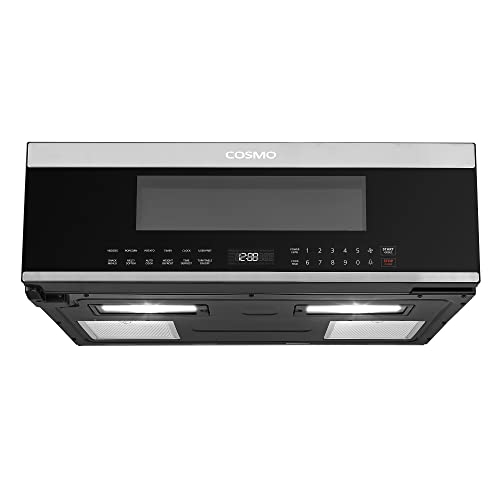
Cosmo Stellar Slim OTR — Best Looking Black Slim
A slim black over-range unit from Cosmo’s Stellar collection — the dramatic, low-line option for dark and contemporary kitchens.
Strengths
- D
- a
- r
- k
- c
- o
- n
- t
- e
- m
- p
- o
- r
- a
- r
- y
- k
- i
- t
- c
- h
- e
- n
- s
Trade-offs
- T
- r
- a
- d
- i
- t
- i
- o
- n
- a
- l
- k
- i
- t
- c
- h
- e
- n
- s
- w
- a
- n
- t
- i
- n
- g
- s
- t
- a
- i
- n
- l
- e
- s
- s
- w
- a
- r
- m
- t
- h
Key specs (from the verified listing title): 1.2 cu ft slim over-range; 1000W per the verified listing title.
In a black or deep-toned kitchen, a stainless OTR is a silver interruption at eye level, and the Cosmo exists to end that interruption. Its slim black form continues the cabinetry’s line and lets the hob become the visual event instead of the box above it.
Buy it for the scheme, maintain it with the honesty black finishes demand — a quick wipe after greasy cooking — and it will keep a dark kitchen looking composed for years.
In daily use the Cosmo Stellar Slim OTR earns its place through consistency rather than novelty. The controls become second nature within a few days, the parts that move or get handled every day feel deliberate rather than loose, and the design does not fight the way a real kitchen actually works — crowded counters, wet hands, half-finished prep and someone always reaching past you for something else.
Ownership is the other half of the story. Parts support, documentation and the brand’s track record matter more after month six than any launch-day feature list, and the Cosmo Stellar Slim OTR sits in the part of the market where replacement components and clear manuals are realistically available rather than theoretical. That is a large part of why it survives a shortlist built for this specific brief instead of a generic one.
Installation and day-one setup deserve a mention too, because a pick only earns its badge if a normal household can get it running without drama. The Cosmo Stellar Slim OTR follows the conventions of its category — standard fittings, standard clearances, instructions written for owners rather than engineers — so the gap between delivery and daily use is measured in an afternoon, not a weekend of troubleshooting. Keep the manual and the receipt together; if you ever do need support, those two documents turn a vague complaint into a solved problem.
Best for: [‘Black slim profile disappears into dark cabinetry schemes’, ‘Slim line keeps the hob area visually open’, ‘1000W is full-power cooking, not a slim compromise’] / Not suited for: [‘Black surfaces show dust and grease honestly’, “Cosmo’s service network is smaller than GE or Samsung’s”, ‘Slim cavity constraints apply’]
Check on Amazon to see the current configuration and finish options.

Midea Slim Low Profile — Best Looking Value Slim
Midea’s slim stainless low-profile unit with sensor cooking — the fitted look at the accessible end of the format.
Strengths
- B
- u
- d
- g
- e
- t
- –
- a
- w
- a
- r
- e
- f
- i
- t
- t
- e
- d
- –
- k
- i
- t
- c
- h
- e
- n
- p
- r
- o
- j
- e
- c
- t
- s
Trade-offs
- H
- o
- m
- e
- s
- w
- a
- n
- t
- i
- n
- g
- t
- h
- e
- l
- a
- r
- g
- e
- s
- t
- v
- e
- n
- t
- r
- a
- t
- i
- n
- g
- s
Key specs (from the verified listing title): 1.2 Cu.Ft, 1000W, Stainless Steel; slim low profile with sensor cook per the verified listing title.
Not every good-looking kitchen is an expensive one, and the Midea proves the slim format’s visual benefit is available without the profile-brand premium: the same low line over the hob, the same opened sightlines, at a friendlier commitment.
It is the pick for rental upgrades, first fitted kitchens and anyone whose design ambitions currently outrun their appliance budget — which is a respectable and common position.
In daily use the Midea Slim Low Profile earns its place through consistency rather than novelty. The controls become second nature within a few days, the parts that move or get handled every day feel deliberate rather than loose, and the design does not fight the way a real kitchen actually works — crowded counters, wet hands, half-finished prep and someone always reaching past you for something else.
Ownership is the other half of the story. Parts support, documentation and the brand’s track record matter more after month six than any launch-day feature list, and the Midea Slim Low Profile sits in the part of the market where replacement components and clear manuals are realistically available rather than theoretical. That is a large part of why it survives a shortlist built for this specific brief instead of a generic one.
Installation and day-one setup deserve a mention too, because a pick only earns its badge if a normal household can get it running without drama. The Midea Slim Low Profile follows the conventions of its category — standard fittings, standard clearances, instructions written for owners rather than engineers — so the gap between delivery and daily use is measured in an afternoon, not a weekend of troubleshooting. Keep the manual and the receipt together; if you ever do need support, those two documents turn a vague complaint into a solved problem.
Best for: [‘Slim stainless profile at an accessible tier’, ‘Sensor cooking for everyday reheating’, ‘1000W full-power delivery’] / Not suited for: [‘Vent performance is class-typical rather than class-leading’, ‘Brand support network still growing in some regions’, ‘Slim cavity limits tall cookware’]
Check on Amazon to see the current configuration and finish options.

Frigidaire FMOS1746BS — Best Looking Classic Full-Size
For kitchens where the classic full-size stainless OTR is the look — proportioned, familiar, and finished to sit comfortably among stainless ranges and fridges.
Strengths
- C
- l
- a
- s
- s
- i
- c
- s
- t
- a
- i
- n
- l
- e
- s
- s
- k
- i
- t
- c
- h
- e
- n
- s
- n
- e
- e
- d
- i
- n
- g
- f
- u
- l
- l
- c
- a
- p
- a
- c
- i
- t
- y
Trade-offs
- K
- i
- t
- c
- h
- e
- n
- s
- p
- u
- r
- s
- u
- i
- n
- g
- t
- h
- e
- s
- l
- i
- m
- m
- i
- n
- i
- m
- a
- l
- l
- i
- n
- e
Key specs (from the verified listing title): 1.7 Cu. Ft. over-the-range, Stainless Steel per the verified listing title.
Minimalism is not the only aesthetic. In a classic stainless kitchen — range, fridge and dishwasher all in brushed metal — a full-size Frigidaire in the same finish looks correct in a way a slim black unit never will, and it brings the cavity family cooking actually needs.
Choose it when capacity and coherence matter more than the low line. Looking right is about matching the room’s own logic, and this pick honours the most common logic of all.
In daily use the Frigidaire FMOS1746BS earns its place through consistency rather than novelty. The controls become second nature within a few days, the parts that move or get handled every day feel deliberate rather than loose, and the design does not fight the way a real kitchen actually works — crowded counters, wet hands, half-finished prep and someone always reaching past you for something else.
Ownership is the other half of the story. Parts support, documentation and the brand’s track record matter more after month six than any launch-day feature list, and the Frigidaire FMOS1746BS sits in the part of the market where replacement components and clear manuals are realistically available rather than theoretical. That is a large part of why it survives a shortlist built for this specific brief instead of a generic one.
Installation and day-one setup deserve a mention too, because a pick only earns its badge if a normal household can get it running without drama. The Frigidaire FMOS1746BS follows the conventions of its category — standard fittings, standard clearances, instructions written for owners rather than engineers — so the gap between delivery and daily use is measured in an afternoon, not a weekend of troubleshooting. Keep the manual and the receipt together; if you ever do need support, those two documents turn a vague complaint into a solved problem.
Best for: [‘Full 1.7 cu ft cavity takes family cookware without negotiation’, ‘Stainless finish matches the classic appliance suite’, “Frigidaire’s support network is nationwide”] / Not suited for: [‘Full-size box is the most visually present format here’, ‘No slim-profile sightline benefit’, ‘Standard feature set rather than smart’]
Check on Amazon to see the current configuration and finish options.

BLACK+DECKER OTR Air Fryer — Best Looking Multi-Function
A stainless over-range unit that folds air frying and convection into the box above the hob — good looks plus one less appliance on the counter.
Strengths
- C
- o
- u
- n
- t
- e
- r
- s
- t
- h
- a
- t
- n
- e
- e
- d
- t
- h
- e
- a
- i
- r
- f
- r
- y
- e
- r
- g
- o
- n
- e
Trade-offs
- P
- u
- r
- i
- s
- t
- s
- w
- h
- o
- v
- e
- n
- t
- a
- n
- d
- m
- i
- c
- r
- o
- w
- a
- v
- e
- o
- n
- l
- y
Key specs (from the verified listing title): 1.5 Cu.Ft, 900W; 6-in-1 with air fryer, convection and sensor cook per the verified listing title.
The best-looking kitchen is often simply the emptiest one, and this BLACK+DECKER earns its badge by subtraction: the air fryer leaves the counter, the counter clears, and the room looks designed. Its stainless OTR form is handsome enough; its real beauty is the absence it creates elsewhere.
Accept the cleaning discipline combo cooking demands — an air-fried cavity wiped promptly — and this is the pick that improves two rooms’ worth of visual clutter with one installation.
In daily use the BLACK+DECKER OTR Air Fryer earns its place through consistency rather than novelty. The controls become second nature within a few days, the parts that move or get handled every day feel deliberate rather than loose, and the design does not fight the way a real kitchen actually works — crowded counters, wet hands, half-finished prep and someone always reaching past you for something else.
Ownership is the other half of the story. Parts support, documentation and the brand’s track record matter more after month six than any launch-day feature list, and the BLACK+DECKER OTR Air Fryer sits in the part of the market where replacement components and clear manuals are realistically available rather than theoretical. That is a large part of why it survives a shortlist built for this specific brief instead of a generic one.
Installation and day-one setup deserve a mention too, because a pick only earns its badge if a normal household can get it running without drama. The BLACK+DECKER OTR Air Fryer follows the conventions of its category — standard fittings, standard clearances, instructions written for owners rather than engineers — so the gap between delivery and daily use is measured in an afternoon, not a weekend of troubleshooting. Keep the manual and the receipt together; if you ever do need support, those two documents turn a vague complaint into a solved problem.
Best for: [‘Removes a separate air fryer from the counter entirely’, ‘Stainless OTR presence suits most modern kitchens’, ‘Sensor cook covers daily reheating intelligently’] / Not suited for: [‘Combo cavity needs diligent cleaning after air frying’, ‘900W is mid-pack for an OTR’, ‘Multi-function controls take learning’]
Check on Amazon to see the current configuration and finish options.
Comparison Table
| Pick | Badge | Key spec | Best for |
|---|---|---|---|
| Samsung Smart SLIM OTR | Best Looking Overall | 1.1 cu ft slim, 550 CFM | [‘Slim silhouette keeps sightlines open over the hob’, ‘Strong venting for a slim-format unit’, ‘Smart controls suit a connected kitchen’] |
| GE Profile Low Profile | Best Looking Low-Profile | 1.2 cu ft, 400 CFM | [‘Low-profile format integrates with cabinetry lines’, ‘400 CFM venting handles real cooking steam’, ‘LED lighting flatters the hob and the food’] |
| Cosmo Stellar Slim OTR | Best Looking Black Slim | 1.2 cu ft slim, black | [‘Black slim profile disappears into dark cabinetry schemes’, ‘Slim line keeps the hob area visually open’, ‘1000W is full-power cooking, not a slim compromise’] |
| Midea Slim Low Profile | Best Looking Value Slim | 1.2 cu ft slim, sensor | [‘Slim stainless profile at an accessible tier’, ‘Sensor cooking for everyday reheating’, ‘1000W full-power delivery’] |
| Frigidaire FMOS1746BS | Best Looking Classic Full-Size | 1.7 cu ft full-size | [‘Full 1.7 cu ft cavity takes family cookware without negotiation’, ‘Stainless finish matches the classic appliance suite’, “Frigidaire’s support network is nationwide”] |
| BLACK+DECKER OTR Air Fryer | Best Looking Multi-Function | 1.5 cu ft, 6-in-1 | [‘Removes a separate air fryer from the counter entirely’, ‘Stainless OTR presence suits most modern kitchens’, ‘Sensor cook covers daily reheating intelligently’] |
Installation Realities Behind the Pretty Picture
An over-range microwave is a two-person lift, a cabinet-anchored mount and an electrical decision, and the good-looking outcome depends on all three being planned rather than improvised. Confirm the cabinet above can carry the unit, that the mounting plate lands on sound fixing points, and whether the vent will duct outside or recirculate — a decision that affects both performance and the ceiling’s future cleanliness.
Clearances between hob and unit are specified for heat and safety, not aesthetics, and they bound how low a profile you can choose over a powerful range. Gas hobs in particular demand their stated distances. Measure with the actual range in place, not from the plan drawing.
Budget the installation honestly: a handyman hour or two for most replacements, more if ducting is new. The total cost of a beautiful OTR is the unit plus its fitting, and guides that pretend otherwise set up the category’s commonest disappointment — a superb box leaning in its carton while the kitchen waits.
Keeping an Eye-Level Appliance Looking Its Best
An OTR lives in the grease plume of everything you cook, so its beauty is a maintenance rhythm: the underside and filters take the worst of it. Wash or replace grease filters on the maker’s rhythm, wipe the underside weekly before deposits bake, and clean the door’s inner glass while it is warm and willing rather than cold and set.
Finishes reward gentleness — soft cloths, no abrasives, stainless wiped with its grain, black finishes dried rather than left spotted. The units in this guide were chosen partly for finishes that tolerate this rhythm gracefully, but no finish survives a scouring pad, and at eye level every scratch testifies.
Treat the under-light as part of the ritual: a smeared light lens dims the whole hob’s appearance, and thirty seconds with a cloth restores the effect the kitchen was designed around.
Styling the Wall: Making the OTR Belong
Stand across the kitchen and read the wall as one composition: range, OTR, cabinets, splashback. The installations that look designed align three things — the unit’s centreline with the range’s, its finish temperature with the suite’s, and its bottom edge with a horizontal line the cabinetry already draws. Slim profiles make the third alignment easier, which is most of their magic; full-size units achieve it by matching the cabinet run’s depth and finish instead.
Splashback choice interacts with the OTR more than any other surface: a busy patterned splashback under a sculptural unit competes, while a calm surface lets either the unit or the hob be the single event. If a renovation is in progress, choose the splashback after the OTR, not before — the eye-level box is the fixed point of the wall.
Handles and knobs are the cheapest coherence available: cabinet hardware that rhymes with the OTR’s handle integrates a mid-tier unit into a designed wall, and mismatched hardware makes even a flagship look rented. It is a small spend with an outsized effect, and it belongs in this guide precisely because this brief is looks.
Renting, Selling and the Eye-Level Box
An over-range microwave punches above its price in property photographs, because it sits at the centre of the kitchen’s most-photographed wall. Sellers replacing one tired appliance before listing routinely choose this one, and the slim profiles in this guide photograph as the most renovated-looking for the spend. That is a legitimate reason to buy for looks, stated plainly: kitchens sell houses, and this box is the kitchen’s portrait.
Renters face the inverse logic: an OTR is a fitted appliance, usually the landlord’s, so the renter’s version of this guide is maintenance and honesty — keep the filters clean, report vent problems early, and leave the unit looking as though the next tenant’s photographs matter, because to the landlord, they do.
Either way, the lesson is the same one the whole guide teaches: at eye level, condition reads as character. A clean, coherent, well-lit OTR wall tells a story about the household before a word is spoken, which is why ‘best looking’ is a serious brief and not a shallow one.
Profile First: Slim, Low and Full-Size
The profile decision dominates everything else in this category. Slim and low-profile units sacrifice cavity height to buy back sightline — the hob feels open, tall cooks stop ducking, and the kitchen’s horizontal lines run unbroken. That trade delights households whose microwave work is reheating and mid-size dishes, and frustrates households whose signature dish is a tall stockpot or a deep casserole.
Full-size units invert the trade: maximum cavity, maximum presence. In a kitchen designed around a substantial range and a full stainless suite, that presence is coherence, not bulk. The error is choosing a profile by fashion rather than by your dishes and your room’s proportions — measure the opening, measure the dish, stand back and look at the wall as a composition.
Whichever profile you choose, check the vent path with equal care: ducted outside beats recirculating for steam and grease, and the prettiest installation in the world cannot fix a vent that returns cooking moisture to the room.
Finishes, Lighting and the Details That Read as ‘Designed’
Finish coherence is the cheapest design win available: match the OTR to the range below it first, the fridge second, and let small appliances vary. Stainless has grades of warmth, black stainless and matte black are different commitments, and pure black — the Cosmo’s route — is the boldest and the most honest about grease. Handles matter more than logos: a handle that echoes your cabinet hardware integrates the box; a sculptural handle fights it.
Lighting is the detail owners underrate until the first evening. The under-unit light is the hob’s working light and its evening ambience in one; LED systems with a low setting make a kitchen look composed at night, while a single harsh bulb makes the best cabinetry look like a workshop. Two picks here state LED lighting in their verified listings, and it weighed in their favour for this brief specifically.
Finally, controls: a clean, legible panel at eye level is a design feature. Cryptic membranes and shouty displays date a kitchen faster than any finish, so favour the interfaces you would be happy to read daily for a decade.
How to Plan an Over-the-Range Installation
Looks are decided before the unit leaves its box. This planning sequence is the difference between a fitted kitchen feature and a heavy compromise.
- Measure the opening width, the cabinet depth and the distance from hob to cabinet underside; compare all three with the listing’s requirements.
- Measure your tallest everyday dish and confirm the chosen profile’s cavity opening accepts it.
- Decide ducted versus recirculating venting now, and check what the ceiling and cabinet above allow.
- Confirm the cabinet structure and fixing points can carry the unit’s weight, with a second pair of hands booked for fitting day.
- Match the finish against the range below in daylight, not showroom light, before the return window becomes urgent.
- Plan the electrical supply — a dedicated, reachable outlet inside the cabinet run is the clean outcome.
- After fitting, set the clock, test the vent on a steaming pan, and check the under-light at its evening setting.
Live with the installation for a week before judging it: sightlines, light and door swing reveal themselves across real cooking, not on fitting day. Most regrets in this category trace to a skipped measurement in step one or two — which is why they come before every aesthetic question in this guide. Photograph the finished wall in daylight and in the evening: the two photographs are the honest record of what you bought, and comparing them teaches you more about your kitchen’s light — and where a finish or a bulb temperature wants adjusting — than any showroom visit ever will.
Common Buying Mistakes
Choosing a profile your dishes cannot use. A slim silhouette over a household of tall casseroles is a daily defeat. The dish measurement is not optional homework.
Matching the fridge instead of the range. The OTR’s visual partner is the appliance directly beneath it. Match that first; suites cohere from the hob outward.
Ignoring the vent decision until fitting day. Ducting choices change performance, cost and ceiling outcomes. Decide on paper, early.
Forgetting the underside exists. The part of the OTR you see most is its underside and light. Grease filters and a weekly wipe are the price of the look.
Buying the box and forgetting the lift. An OTR is heavy, awkward and mounted above head height. Purchases that ignore fitting — hands, fixings, ducting parts — stall in the carton while the kitchen waits. Plan the installation with the same care as the finish choice, because in this category they are the same purchase.
Judging finishes under showroom light. Daylight at home is the truth. Check samples and the delivered unit in your own kitchen’s light within the return window.
Final Recommendation
Match the profile to the room and the dishes, and the badges sort themselves: the Samsung Smart SLIM for the designed connected kitchen, the GE Profile for the tailored low line, the Cosmo for black schemes, the Midea for the fitted look on a budget, the Frigidaire for classic full-size coherence, and the BLACK+DECKER when clearing the counter is the design move that matters most.
Measure first, match the range, plan the vent — and the box over your hob becomes the kitchen’s centrepiece on purpose rather than by accident of size.
Give the finished installation its first evening before you judge it completely: cook something steamy, watch the vent work, read a recipe under the unit’s light, and stand where your guests will stand. If the wall reads as one composed idea in that light, the brief is fulfilled — and every meal afterwards will be cooked inside a kitchen that looks the way it was meant to.
Ready to order? Start with the Samsung Smart SLIM OTR (check price on Amazon) or the Midea Slim Low Profile (check price on Amazon) and work down the shortlist from there.
Keep exploring the cluster: Best Microwaves Best Countertop Microwaves Best Small Microwaves Best Over The Range Microwaves Best Inverter Microwaves
Frequently Asked Questions
Are slim over-range microwaves big enough for family cooking?
For reheating, vegetables and mid-size dishes, yes. For tall stockpots and the deepest casseroles, measure first — slim formats trade cavity height for sightline, and households with tall signature dishes should take the full-size pick.
How much venting do I actually need?
Enough to clear your real cooking: frequent high-heat frying and steaming argue for the stronger stated vent figures in this guide and for ducting outside where the building allows it.
Does black or stainless look better over a range?
Whichever matches the range beneath it and the room’s scheme. Black disappears into dark cabinetry and shows grease honestly; stainless coheres with classic suites and hides handling better.
Can I install an over-range microwave myself?
It is a heavy two-person lift with structural fixings and an electrical supply. Confident, equipped pairs do it; everyone else should budget for fitting — the cost of a dropped unit or a bad mount dwarfs the saving.
Why does under-lighting matter so much?
Because it is the light you cook by and the light the kitchen glows by at night. A good LED system flatters both the food and the room, and it is the design detail owners mention most after a month.
How long does an over-range microwave take to install?
A straightforward like-for-like replacement, with the mount and vent already in place, is typically a couple of hours for two people. New ducting, structural surprises or electrical work extend that — another reason the planning sequence in this guide happens before the unit arrives, not after.
Does an over-range microwave need professional installation?
Not legally in most homes, but practically it needs two capable people, sound fixings and a planned vent path. Many households use a fitter for an hour and consider it the best money in the project, because a level, solidly mounted unit is both the safe outcome and the good-looking one.
What clearance does an over-range microwave need?
The maker’s stated distance between hob and unit underside is a safety specification, and powerful gas hobs demand the most. Measure your actual installation against the chosen model’s requirements before ordering — slim profiles in particular must still respect the heat clearance, and no look is worth a scorched underside.
How do I keep a black OTR looking clean?
Wipe it after greasy cooking rather than weekly — black finishes reward frequency over effort. A soft cloth, warm water and immediate drying prevent both the grease film and the water spots that black shows honestly, and the routine takes under a minute while the hob is still warm.
Will a smart OTR date my kitchen?
Interfaces date faster than silhouettes. The slim and low profiles in this guide will read as current long after any app generation passes, which is why this guide weights profile and finish above connectivity.


