Disclosure: airfryerkitchensupply.com is reader-supported. When you buy through links on our site, we may earn an affiliate commission at no extra cost to you.
Where to buy
Every pick in this guide to the best kitchen sinks double undermount was confirmed against Amazon’s own catalog data before it earned a place here, and each one is sold through Amazon, so ordering, delivery and returns run through the same checkout you already know. Use the short list below to jump straight to a listing, or read on for the full reviews first.
- Kraus KHU104-33 Standart Pro 33-Inch Undermount 60/40 Double Bowl 16-Gauge Sink (Best Overall Undermount) — check price on Amazon
- Kraus KBU32 Premier 32-Inch Undermount 50/50 Double Bowl Low Divider 18-Gauge Sink (Best Low Divider) — check price on Amazon
- Elkay Crosstown 16-Gauge Equal Double Bowl Undermount Sink Kit (Best Complete Kit) — check price on Amazon
- Kraus KBU22 Premier 32-Inch Undermount 50/50 Double Bowl 18-Gauge Sink (Best Value Undermount) — check price on Amazon
- Ruvati RVM4350 32-Inch 16-Gauge 50/50 Undermount Double Bowl Sink (Best Finish and Corners) — check price on Amazon
- Kraus KHU103-32 32-Inch Undermount 60/40 Double Bowl 16-Gauge Sink (Best Compact 60/40) — check price on Amazon
An undermount double bowl is two decisions fused into one object: the workflow decision — two basins, working in parallel — and the installation decision — a sink bonded beneath the counter, with no rim, no lip, and no easy way back. The best kitchen sinks double undermount designs get both halves right: splits and depths matched to real cooking, in steel heavy enough to justify being sealed under stone for a decade. This guide is about that intersection, and it is deliberately narrower than our general double-bowl guide.
Where the general guide ranges across farmhouse, drop-in, cast iron and composite, this one stays under the counter: six stainless undermount doubles, compared on the things undermount ownership actually turns on — gauge, divider height, corner radius, cabinet fit, reveal compatibility and how each basin behaves once it is permanently installed. Bowl splits here run 50/50, low-divider 50/50, and 60/40, because under stone, that choice is forever.
One warning before the picks: an undermount is only as good as its installation. Every sink below assumes solid-surface, stone or quartz counters, a cabinet that meets its minimum, and a competent install — DIY with the right tools and patience, or professional. Laminate counters and undermounts do not mix, and no sink in this guide can change that.
How this guide is organized differently from its companion: the general double-bowl guide argues about workflow and materials across every mount; this one assumes the undermount decision is made and interrogates execution — gauge under stone, divider permanence, cabinet and cutout math, reveal and sealing. If you are still choosing a mount, read that guide first. If you are choosing which undermount, you are in the right place.
In this guide
Quick Picks
If you are short on time, these are the six best kitchen sinks double undermount we would point to first. Each one is reviewed in full further down, with the same badge it carries here, so you can match a name on this list to its detailed review in seconds.
- Kraus KHU104-33 Standart Pro 33-Inch Undermount 60/40 Double Bowl 16-Gauge Sink — Best Overall Undermount. The flagship formula under stone: 33 inches, 16-gauge steel, a 60/40 split — the undermount double against which the rest of this guide is measured. — Check the current price on Amazon
- Kraus KBU32 Premier 32-Inch Undermount 50/50 Double Bowl Low Divider 18-Gauge Sink — Best Low Divider. A 32-inch 50/50 undermount whose divider stops low — long pans span both basins, faucets swing less, and two strainers are included in the box. — Check the current price on Amazon
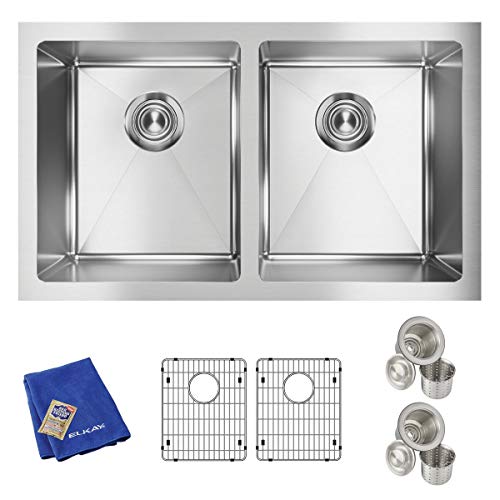
- Elkay Crosstown 16-Gauge Equal Double Bowl Undermount Sink Kit — Best Complete Kit. A 16-gauge Crosstown at 30-3/4 x 18-1/2 x 10 inches, sold as a kit — Elkay’s tight-cornered, deep-bowled undermount with its hardware sorted in one box. — Check the current price on Amazon
- Kraus KBU22 Premier 32-Inch Undermount 50/50 Double Bowl 18-Gauge Sink — Best Value Undermount. The straightforward equal double under stone: 32 inches, 18-gauge, both strainers included — the undermount entry point that does not feel like one. — Check the current price on Amazon
- Ruvati RVM4350 32-Inch 16-Gauge 50/50 Undermount Double Bowl Sink — Best Finish and Corners. A 32-inch 16-gauge 50/50 in T-304 steel with a brushed finish chosen to hide scratches — Ruvati’s tight, commercial-style take on the equal double. — Check the current price on Amazon
- Kraus KHU103-32 32-Inch Undermount 60/40 Double Bowl 16-Gauge Sink — Best Compact 60/40. The 60/40 split in a 32-inch frame of 16-gauge steel — the pan-friendly layout for cabinets that cannot take the 33-inch flagship. — Check the current price on Amazon
How These Picks Were Chosen
The screen here was undermount-specific. Each candidate had to be a true double-bowl undermount — verified against Amazon’s catalog data, with gauge, dimensions and split taken only from the listing itself — and then judged on installed-life criteria: steel gauge (16 is the heavy standard; 18 is the value grade), divider design, whether strainers or a kit are included, and the manufacturer’s support depth for a product class where replacement is surgery.
We also weighed the two philosophies of the category: the 60/40 capacity play, and the 50/50 family in its standard and low-divider forms. The low divider in particular earned two slots in this guide, because under a fixed counter it is the single feature owners praise most and miss most.
The 6 Best Kitchen Sinks Double Undermount

Kraus KHU104-33 Standart Pro 33-Inch Undermount 60/40 Double Bowl 16-Gauge Sink — Best Overall Undermount
The Standart Pro KHU104-33 is the undermount double in its most considered form. Thirty-three inches across, built from 16-gauge stainless, split 60/40 so the large basin takes a half-sheet pan flat for soaking while the small basin runs the rinse-and-prep station. Under stone, that asymmetry is the difference between a sink that fits your cookware and one that argues with it nightly.
It suits the main kitchen of a cooking household: stone or quartz counters, a 36-inch cabinet, and a cook who wants the seamless sweep-in cleanup of undermount with the pan capacity doubles are bought for. This is the install-once choice, specced like it.
Strengths
- 16-gauge steel — the heavy, quiet, dent-resistant grade
- 60/40 split solves the sheet-pan problem permanently
- Standart Pro line finishing suits a decade-long installation
Trade-offs
- The small bowl is genuinely small — test it against your colander and stockpot lid
- Undermount permanence means the split choice cannot be revisited
- Professional installation recommended; budget for it
| Specification | Detail |
|---|---|
| Material | 16-gauge stainless steel |
| Size | 33-inch |
| Split | 60/40 double bowl |
| Mount | Undermount |
| Model | KHU104-33 Standart Pro (per listing title) |
Installed life is where the Standart Pro earns its badge. Heavy steel with sound treatment knocks rather than rings when the disposal runs or a pot lands — under a stone counter, a thin sink’s drumming is amplified by the slab itself, which is why gauge matters more in undermounts than in any other mount. The 60/40 layout then does its quiet daily work: soak left, prep right, nothing waiting on anything.
For the reveal, this class of sink suits a negative or flush reveal that shows a sliver of the sink’s rim and forgives minor cutting tolerances — ask your fabricator, and read the compatibility section below before the counter is cut, not after.
Best for: Cooking households installing once under stone or quartz / Not suited for: Anyone who wants equal bowls or a future of easy sink swaps
Check on Amazon — check the current price on Amazon before you decide, because listing prices move with seasons and promotions.

Kraus KBU32 Premier 32-Inch Undermount 50/50 Double Bowl Low Divider 18-Gauge Sink — Best Low Divider
The low divider is the undermount’s best idea, and the KBU32 is its cleanest expression in this guide: equal 50/50 bowls in a 32-inch undermount, with the center wall dropped so a roasting pan, a long griddle or a rack of ribs on a tray can rest across both basins. Two strainers are included, which matters more under stone — you want the sink’s hardware settled before it is sealed in.
It suits cooks torn between single and double: the low wall preserves double-bowl separation for soaking-versus-prep, while surrendering just enough height to admit the oversized items that defeat ordinary doubles. In a 32-inch width, it is also the friendliest serious undermount here for slightly smaller cabinets.
Strengths
- Low divider admits long pans across both bowls
- Equal bowls keep the classic wash/rinse symmetry
- Two strainers included — install-day completeness
Trade-offs
- 18-gauge steel is the value grade — lighter and livelier than 16
- Low divider means soaking water seeks the lower level between bowls
- 32 inches is snug for the largest cookware even with the span trick
| Specification | Detail |
|---|---|
| Material | 18-gauge stainless steel |
| Size | 32-inch |
| Split | 50/50 double bowl, low divider |
| Mount | Undermount |
| Included | Strainers (x2) (per listing title) |
| Model | KBU32 Premier (per listing title) |
Think about the divider physically. A full-height wall makes two small sinks; a low wall makes one flexible workspace with a speed bump. Faucets swing less because items pass over the middle; sheet pans soak at an angle that actually submerges them; a big cutting board bridges the bowls as a work surface. Owners consistently describe it as the feature they would not give back.
The 18-gauge construction is the honest trade: it keeps this sink attainable and lighter to install, at some cost in drum and dent resistance versus the 16-gauge picks. Under a well-supported counter with the included hardware, it is a rational trade — and the divider is worth more than the gauge to the cooks this sink is for.
Best for: Cooks who want double-bowl workflow without the sheet-pan penalty / Not suited for: Purists who want two fully independent basins
Check on Amazon — check the current price on Amazon before you decide, because listing prices move with seasons and promotions.
Elkay Crosstown 16-Gauge Equal Double Bowl Undermount Sink Kit — Best Complete Kit
Elkay’s Crosstown line is the modern American undermount: tight corners that maximize basin volume, a flat bottom that stands glasses upright, and here a full kit format in 16-gauge steel. The stated dimensions — 30-3/4 by 18-1/2 inches with 10-inch depth — make it the deepest pick in this guide and one of the most compact across, an unusual and useful combination.
It suits smaller stone-counter kitchens that refuse to compromise on depth: apartment renovations, galley kitchens, and any cabinet run where 33 inches will not fit but a stockpot still must. Equal bowls keep the classic two-station workflow, and ten inches of depth keeps the splashing where it belongs.
Strengths
- 10-inch depth — the deepest bowls in this guide
- 16-gauge steel in a compact footprint
- Kit format settles hardware before installation
Trade-offs
- Equal bowls cannot soak a sheet pan flat
- Compact width means each bowl is modest across
- Tight corners need a brush, not just a sponge, to stay clean
| Specification | Detail |
|---|---|
| Material | 16-gauge stainless steel |
| Size | 30-3/4 x 18-1/2 in (per listing title) |
| Depth | 10 in (per listing title) |
| Split | Equal double bowl |
| Mount | Undermount sink kit (per listing title) |
Depth changes an undermount’s personality. Ten-inch bowls hide a day of dishes below the counter line, take a stockpot without the rim towering over the faucet, and contain the spray of a pull-down at full pressure. In a compact kitchen that containment is not luxury; it is what keeps the counters dry.
The kit framing matters for undermounts specifically: matched components, one warranty conversation, nothing improvised under stone. Elkay’s support depth behind it is the other quiet asset — for a fixture you cannot easily replace, the maker’s permanence is part of the product.
Best for: Compact stone-counter kitchens that need maximum depth / Not suited for: Sheet-pan bakers — the equal split will frustrate you
Check on Amazon — check the current price on Amazon before you decide, because listing prices move with seasons and promotions.

Kraus KBU22 Premier 32-Inch Undermount 50/50 Double Bowl 18-Gauge Sink — Best Value Undermount
The KBU22 is the undermount for buyers who want the format’s benefits at its fairest cost: a 32-inch, 50/50 double bowl in 18-gauge stainless, with two strainers in the box. No low divider, no asymmetry — two honest equal basins under a clean counter edge, from a maker whose sink catalog runs deep.
It suits dish-workflow households: wash in one, rinse and drain in the other, both bowls the same so the routine never thinks about which side. For kitchens where cookware is moderate and dishes are the daily load, equal bowls are not a compromise at all — they are the correct tool.
Strengths
- Complete with two strainers at a value position
- Equal bowls suit the classic two-station dish routine
- 32-inch width fits the common undermount cabinet
Trade-offs
- 18-gauge steel — lighter sound and dent resistance than 16
- Full-height divider blocks long pans
- No grids or extras bundled beyond the strainers
| Specification | Detail |
|---|---|
| Material | 18-gauge stainless steel |
| Size | 32-inch |
| Split | 50/50 double bowl |
| Mount | Undermount |
| Included | Strainers (x2) (per listing title) |
| Model | KBU22 Premier (per listing title) |
Value in an undermount must be judged differently from value in a drop-in: the sink is semi-permanent, so the saving must not come from the steel’s integrity. The KBU22’s economy is in gauge and simplicity, not in corners cut on welding or finishing — the bowls are properly formed, the finish is the line’s standard brushed steel, and the included strainers remove the usual second purchase.
Choose it when the budget is real and the workflow is dishes. It is the undermount we would specify for a rental renovation or a first stone counter — the format’s full experience, at the honest end of its price range.
Best for: Budget-conscious stone-counter renovations with dish-centric workflow / Not suited for: Pan-soaking cooks or buyers wanting the heaviest gauge
Check on Amazon — check the current price on Amazon before you decide, because listing prices move with seasons and promotions.
Ruvati RVM4350 32-Inch 16-Gauge 50/50 Undermount Double Bowl Sink — Best Finish and Corners
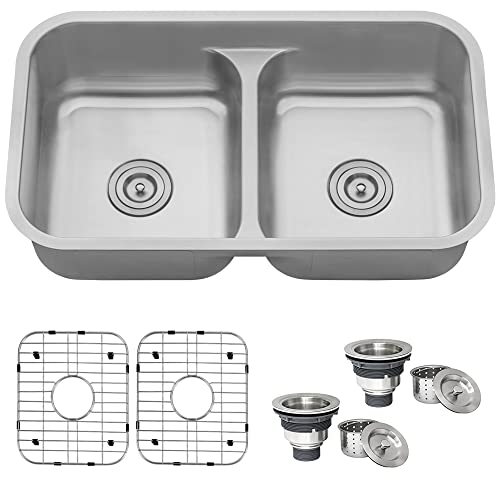
Ruvati builds sinks like commercial equipment, and the RVM4350 shows it: 16-gauge T-304 stainless, equal 50/50 bowls, and a brushed finish the listing itself notes is chosen to hide scratches. That finish philosophy matters in an undermount, where the sink will catch a decade of pot bases and cutlery and cannot be swapped when it tires of them.
It suits cooks who are hard on sinks and honest about it — cast iron cookware, sheet pans slid across bottoms, daily heavy use — and who prefer the equal-bowl routine. The tight-radius style reads modern under stone and maximizes usable floor in each basin.
Strengths
- 16-gauge T-304 — the full-strength specification
- Brushed finish hides the scratches of real use
- Commercial-style tight corners maximize bowl floor
Trade-offs
- Tight corners demand deliberate cleaning
- Equal split keeps the sheet-pan limitation
- Modern squared look suits contemporary kitchens best
| Specification | Detail |
|---|---|
| Material | 16-gauge T-304 stainless steel |
| Size | 32-inch |
| Split | 50/50 undermount double bowl |
| Finish | Brushed, hides scratches (per listing title) |
| Model | RVM4350 (per listing title) |
The scratch-hiding point deserves respect. Stainless sinks do not wear out, but they do wear in — the first year’s scuffs either become a shabby look or settle into a patina, and the difference is the finish’s grain and depth. Ruvati’s brushing is chosen for the second outcome, which is why owners of this class of sink report it looking better in year three than polished rivals.
Paired with 16-gauge substance, that makes the RVM4350 the durability pick among the equal bowls. If your workflow is 50/50 and your cookware is heavy, this is the undermount built for your habits.
Best for: Heavy-use kitchens wanting equal bowls in the strongest steel / Not suited for: Traditional kitchens or low-divider seekers
Check on Amazon — check the current price on Amazon before you decide, because listing prices move with seasons and promotions.

Kraus KHU103-32 32-Inch Undermount 60/40 Double Bowl 16-Gauge Sink — Best Compact 60/40
One inch sounds like nothing until it is the inch your cabinet does not have. The KHU103-32 compresses this guide’s flagship formula — 16-gauge steel, 60/40 split — into 32 inches, opening the layout to kitchens whose cabinet run or counter layout vetoes the 33-inch Standart Pro.
It suits 60/40 believers in slightly smaller kitchens, and renovators replacing a 32-inch undermount who want to upgrade the split without touching the counter cutout’s neighborhood. The big basin still takes the pans; the small one still runs prep; the whole arrangement simply fits where its bigger sibling cannot.
Strengths
- 60/40 capacity logic in a 32-inch footprint
- 16-gauge steel matches the flagship’s substance
- A natural upgrade path from older 32-inch undermounts
Trade-offs
- Both bowls are slightly tighter than the 33-inch model’s
- Small bowl suits prep better than washing-up volume
- Same undermount permanence — measure twice
| Specification | Detail |
|---|---|
| Material | 16-gauge stainless steel |
| Size | 32-inch |
| Split | 60/40 double bowl |
| Mount | Undermount |
| Model | KHU103-32 (per listing title) |
The comparison with the Standart Pro at the top of this guide is the whole review: same maker, same gauge, same philosophy, one inch less width and correspondingly less basin room. If your cabinet takes the 33, take the 33. If it does not, this sink ensures the compromise costs you almost nothing in workflow.
That honesty about fit is what undermount buying is. The counter is cut once; the cabinet is what it is; the right sink is the best one that fits both — and for a large class of real kitchens, this is that sink.
Best for: 32-inch cabinets that want the 60/40 layout in heavy steel / Not suited for: Kitchens with room for the 33-inch — take the extra inch there
Check on Amazon — check the current price on Amazon before you decide, because listing prices move with seasons and promotions.
Comparison Table
| Pick | Badge | Key spec | Best for |
|---|---|---|---|
| Kraus KHU104-33 Standart Pro 33-Inch Undermount 60/40 Double Bowl 16-Gauge Sink | Best Overall Undermount | 33in / 16 gauge / 60/40 / undermount | Cooking households installing once under stone or quartz |
| Kraus KBU32 Premier 32-Inch Undermount 50/50 Double Bowl Low Divider 18-Gauge Sink | Best Low Divider | 32in / 18 gauge / 50/50 low divider | Cooks who want double-bowl workflow without the sheet-pan penalty |
| Elkay Crosstown 16-Gauge Equal Double Bowl Undermount Sink Kit | Best Complete Kit | 16 gauge / 10in deep / equal bowls / kit | Compact stone-counter kitchens that need maximum depth |
| Kraus KBU22 Premier 32-Inch Undermount 50/50 Double Bowl 18-Gauge Sink | Best Value Undermount | 32in / 18 gauge / 50/50 / strainers included | Budget-conscious stone-counter renovations with dish-centric workflow |
| Ruvati RVM4350 32-Inch 16-Gauge 50/50 Undermount Double Bowl Sink | Best Finish and Corners | 32in / 16ga T-304 / 50/50 / brushed finish | Heavy-use kitchens wanting equal bowls in the strongest steel |
| Kraus KHU103-32 32-Inch Undermount 60/40 Double Bowl 16-Gauge Sink | Best Compact 60/40 | 32in / 16 gauge / 60/40 / undermount | 32-inch cabinets that want the 60/40 layout in heavy steel |
How to Choose the Best Kitchen Sinks Double Undermount Models
Undermount selection adds a layer no other sink decision has: compatibility. The sink, the counter material, the cabinet and the fabricator form a system, and the best sink is the best one inside that system. These are the checks, in the order they veto.
Countertop compatibility comes first
Undermounts require counters with structural integrity at the cutout: granite, quartz, solid surface and concrete qualify; laminate and tile do not, because their substrates cannot carry a loaded sink’s weight on clips and adhesive. If your counters are laminate, the honest options are a drop-in from our general double guide or new counters — in that order of cost.
Cabinet minimums and the cutout
A 32- or 33-inch undermount double typically needs a 36-inch sink base cabinet, and the fabricator cuts the counter from the sink’s template — which is why the sink must be chosen before the counter is fabricated, and why templates from the actual unit, not a similar model, govern the cut. Reveal style is decided at the same moment: positive reveal shows a ledge of sink rim, negative reveal overhangs the counter slightly into the bowl, and flush aims for a continuous line. Each changes cleaning and chip risk at the edge; discuss it with the fabricator, not the internet.
Gauge, corners and sound under stone
Under stone, thin steel drums — the slab is a sounding board. Sixteen gauge is the specification that keeps an undermount quiet and dent-resistant across a decade; 18 gauge is workable value, chosen knowingly. Corner radius is the other installed-life spec: tight corners maximize space and modernize the look but need a brush’s attention; generous radii clean with a sponge and read traditional. There is no wrong answer, only an unexamined one.
Divider Design: The Decision You Live With Longest
Mounts can be re-sealed and faucets can be swapped, but the divider is cast into the sink forever. Undermount buyers should spend more thought here than on any finish.
Full-height 50/50
Two true basins: soak in one while the other stays dry and usable, wash and rinse in parallel. The cost is absolute — nothing longer than one basin fits, ever. Dish-centric kitchens thrive here; pan-centric kitchens resent it by month two.
60/40 asymmetry
One basin sized for cookware, one for workflow. The large side takes sheet pans flat — the single most common failure of equal doubles — while the small side fills fast for hand-washing and works as a prep well. For mixed kitchens it is the safest permanent choice, which is why it tops this guide.
The low divider
A middle wall dropped to half height: separation for soaking, a bridge for long items, an easier faucet swing. Its compromise is hydraulic — deep soaking in one side is limited by the wall’s height. Cooks who value flexibility over isolation choose it and rarely go back.
Faucets, Disposals and Accessories in an Undermount Double
An undermount is a system, and its supporting hardware has constraints the sink alone does not reveal. Plan these three before fabrication, while every option is still open.
Faucet placement through stone
With no deck on the sink, the faucet’s holes are drilled in the counter behind it — which fixes your faucet choice at fabrication time and sets its reach geometry permanently. Pull-down faucets dominate undermount doubles for good reason: their spray reaches both bowls and rinses the corners square sinks create. Confirm the faucet’s reach against your chosen sink’s bowl positions on the template, not from memory.
Disposal fit under deep bowls
Deep undermount bowls lower the drain outlet, and the disposal must hang below it with room for the trap. Measure the vertical stack — bowl depth, disposal height, trap arm elevation — as one system before ordering, especially with the 10-inch Crosstown in this guide. A quarter inch of miscalculation here is a plumbing rebuild, not an adjustment.
Grids, racks and boards
Bottom grids protect a semi-permanent sink’s floor from a decade of pot traffic and are the single accessory we call near-essential in an undermount. Rinse racks that span a bowl, and cutting boards that bridge the divider — especially on low-divider models — extend the workspace the counter gave up. Buy them with the sink so their fit is the maker’s problem, not yours.
The Seal and the Seam: Maintenance That Protects the Installation
An undermount’s only real vulnerability is its hidden joint. This is the complete maintenance picture — short, because the format asks little, and firm, because what it asks matters.
Inspecting the seam
Twice a year, empty the cabinet, dry the underside thoroughly, then fill each bowl and let it stand while you check below with a flashlight and a dry hand. Any dampness, darkened silicone or musty smell is an early warning that costs almost nothing to answer now — a reseal — and a great deal to ignore.
Living gently with the edge
The counter’s cut edge over an undermount is its most chip-prone line. Land heavy pots in the bowl, not on the edge; run the faucet’s spray into the basins rather than across the seam; and keep a board between cast iron and stone during the big transfers. These are habits, not chores, and they protect the most expensive surface in the kitchen.
Questions to Ask Your Fabricator Before the Counter Is Cut
The undermount is the one sink purchase where a conversation matters as much as the product. These are the questions whose answers should be settled — in writing, on the template — before fabrication.
The fabrication checklist
Which reveal, and why, for this stone and this sink? What clip and support system, rated for this sink’s loaded weight? Where exactly do the faucet and any dispenser holes fall relative to the bowls? What is the seam sealant, and what is its renewal path? A fabricator who welcomes these questions is the right fabricator; the answers protect a decade of daily use, and they cost nothing but ten minutes at the right moment — before the saw, not after it.
A Note on Resale and the Next Owner
Undermount doubles are one of the few renovation choices that speak well of a house to its next owner — with one condition.
What the next owner inherits
They inherit your split, your gauge and your seam. A 16-gauge sink with a sound seal line and a sensible split reads as quality infrastructure in any showing; a tired seam or a split that fights the kitchen’s cooking reads as a project. It is one more reason — beyond your own decade of dinners — to choose the workflow honestly and keep the seam inspected. Permanence cuts both ways, and in a well-chosen undermount it cuts in your favor.
Living With an Undermount: The First Year, Honestly
The first month with an undermount double is pure pleasure: crumbs sweep off the counter into the bowl in one motion, the stone reads as one unbroken plane, and guests ask about the sink. The education begins around month two, at the seam. The silicone line where sink meets stone is a maintenance item — it wants inspection, occasional renewal, and prompt attention to any darkening, because a failed seal lets water where water must never go.
By month six the divider decision has fully declared itself. The 60/40 owners are soaking pans flat without thinking about it. The low-divider owners are spanning roasters across both bowls. The equal-bowl owners are either running a happy wash-rinse routine or quietly shopping for a basin rack that lets a sheet pan soak at an angle. None of these outcomes is a surprise — each was predictable from the kitchen’s cooking, which is why this guide keeps returning to workflow over appearance.
A year in, the undermount’s permanence feels less like a risk taken and more like infrastructure: the sink has disappeared into the kitchen’s background, doing its work silently, which is the highest compliment a fixture can earn. Choose the split for your cooking, the gauge for your decade, and the installer for your peace of mind — in that order — and your undermount will earn the same compliment.
One more installed-life reality deserves plain statement: undermounts concentrate risk at a hidden seam, and the defense is inspection, not anxiety. Twice a year, run a dry hand along the underside joint after a full-bowl soak; any dampness or darkened silicone is a small job now and a cabinet job later. Owners who build that thirty-second habit into their routine essentially never meet the undermount horror story.
It is also worth saying what undermount ownership gives back for that vigilance: the easiest counter cleanup in the kitchen world, a countertop that reads as architecture, and bowls that feel larger than their dimensions because nothing interrupts their rim. The format’s devotees are not romantics — they have simply done the math of daily use, and the math favors the seam.
Make those small disciplines routine and the undermount double becomes what it promises on the day the sealant cures: a silent, seamless workstation that asks almost nothing and gives back clean counters and parallel workflow for a decade or more. That is the whole case for the format — and on the evidence of these six sinks, it is a strong one.
Everything in this guide finally reduces to a sentence a fabricator once tells every customer: we can install almost any of these beautifully — the question is which one you want to live with. Live with the split at every dish, the gauge at every dropped pot, the seam at every inspection. Chosen on those terms, an undermount double is not a risk. It is the kitchen’s quietest success.
How to Install a Double Undermount Sink (Overview for Owners and Confident DIYers)
This overview exists so owners can judge an installer’s work and capable DIYers can plan honestly. Undermount installation is unforgiving of improvisation; if any step reads as unfamiliar, that is the signal to hire it out.
- Dry-fit everything first: sink in the cabinet, template on the counter, faucet and disposal staged. Confirm the cabinet meets the sink’s stated minimum and the drains align with the trap arm before any adhesive appears.
- Support is structure, not glue: the sink hangs from a combination of clips, rails or a cradle system plus silicone sealant. Adhesive alone is never the support. Confirm the system your sink and fabricator specify, and that the counter’s material can take the clip anchors.
- Set the reveal deliberately — positive, negative or flush — with shims during the dry fit, because the reveal is frozen the moment the sealant cures. Check it from standing height, where you will actually see it for ten years.
- Run a continuous, generous silicone bead, seat the sink evenly, engage the clips in a cross pattern, and wipe the squeeze-out immediately. Then leave it alone for the full cure time the sealant specifies — loading a fresh undermount early is the classic DIY failure.
- Connect drains, disposal and faucet only after curing. Deep doubles lower the drain line; confirm trap geometry with the actual bowls in place before final tightening.
- Water-test both bowls full, separately and together, and inspect every joint from below with a dry hand and a flashlight before the cabinet is loaded with supplies.
Finally, photograph the installed underside — clips, seal line, plumbing — and keep the sink’s template and paperwork. Future faucet swaps, disposal changes and any warranty conversation all start from that record.
Common Buying Mistakes
Mistake 1: Choosing the sink after the counter is cut
Undermount cutouts are made from the specific sink’s template. A counter cut for one 32-inch double may not accept another. The sink decision precedes fabrication — always, without exception.
Mistake 2: Undermounting under laminate
Laminate substrates cannot carry an undermount’s loaded weight or survive its moisture line. The result is a sagging, swelling failure. If the counters are laminate, choose a drop-in double and spend the savings elsewhere.
Mistake 3: Trusting adhesive alone
Silicone seals; it does not support. A loaded double bowl of water and dishes is heavy, and it must hang from clips, rails or a cradle. Any installer who describes glue as the system is describing a future accident.
Mistake 4: Ignoring the reveal until install day
Positive, negative and flush reveals clean differently and chip differently. Deciding mid-install, with sealant open, is how kitchens get the reveal nobody wanted for a decade.
Mistake 5: Picking the split for the photograph
Equal bowls photograph symmetrically and strand sheet pans; the low divider looks odd and cooks beautifully. Under stone, you will live with the workflow, not the photo. Choose for your pans.
Final Recommendation
Install the Standart Pro KHU104-33 if your cabinet takes 33 inches and your cooking is pan-led — it is the most complete undermount double we verified. Take the KBU32’s low divider if flexibility is your religion, the Crosstown kit if depth in a compact width is the brief, the Ruvati if your cookware is heavy and your bowls must match it, the KHU103-32 for 60/40 logic in 32 inches, and the KBU22 when value leads and dishes rule.
Still deciding whether undermount itself is right? Back up one step to Best Kitchen Sinks Double, where farmhouse, drop-in, cast iron and composite doubles make their case — the mount is a bigger decision than any single sink in either guide.
Ready to order? Start with the three safest bets in this guide: Kraus KHU104-33 Standart Pro 33-Inch Undermount 60/40 Double Bowl 16-Gauge Sink, Kraus KBU32 Premier 32-Inch Undermount 50/50 Double Bowl Low Divider 18-Gauge Sink, Elkay Crosstown 16-Gauge Equal Double Bowl Undermount Sink Kit.
Best Kitchen Sinks Double Best 16 Gauge Stainless Steel Undermount Kitchen Sinks Best 32 Undermount Stainless Steel Kitchen Sinks
Frequently Asked Questions
What countertops work with a double undermount sink?
Granite, quartz, solid surface and concrete — materials whose substrate can carry the sink on clips and sealant. Laminate and tile counters do not qualify; their cores cannot support the load or survive the moisture at the seam.
What cabinet size do 32- and 33-inch undermount doubles need?
Typically a 36-inch sink base cabinet, but always confirm the specific model’s stated minimum before ordering. The cabinet check comes before the counter is fabricated, because the cutout is made from the sink’s own template.
Is 16 gauge really better than 18 for an undermount?
Yes, and more so under stone than anywhere else: the slab amplifies a thin sink’s drumming, and the heavier steel resists dents across a semi-permanent installation. Eighteen gauge is a legitimate value choice, made knowingly.
Can I install a double undermount myself?
A capable DIYer with the right support system, patience for cure times and a helper for the lift can. The unforgiving steps are support and sealing; if either feels uncertain, professional installation is cheap insurance on a decade-long fixture.
Where does the faucet go with an undermount?
Through the countertop behind the sink, or a wall mount — undermounts have no deck. That hole is drilled by the fabricator from your plan, which is why faucet selection belongs in the same conversation as the sink and the reveal.
60/40, 50/50 or low divider — which should I choose?
Pan-led kitchens: 60/40. Dish-led kitchens: 50/50. Kitchens that do both and hate compromises: the low divider. It is a permanent choice under stone, so decide from your largest pan and your daily routine, not from a photograph.
Can an undermount double be replaced later?
Yes, but it is a project: the sink is clipped and sealed under a cut counter, so replacement means working from below, breaking the seal, and matching the existing cutout — which is why choosing the right split and gauge now matters so much more than with a drop-in.
What reveal should I choose?
A small positive reveal is the forgiving classic — a sliver of sink rim visible, easy to seal and clean. Negative reveals look sharp and demand precise fabrication and more careful edge cleaning. Discuss your stone and your habits with the fabricator; there is no universal right answer.
How long does undermount sealant last?
Years under normal conditions, and it is renewable: a failing bead is removed and re-run without disturbing the sink’s supports. Treat resealing as scheduled maintenance on a long cycle, not as a failure — the inspection habit in this guide is what catches it early.
Do undermount doubles work in a small kitchen?
Yes — the Crosstown kit in this guide was chosen for exactly that case, pairing a compact width with the deepest bowls here. Small kitchens benefit most from the counter space an undermount returns.
How do I clean the seam area day to day?
Wipe the rim line as part of normal counter cleaning, keep standing water from pooling at the joint, and let the twice-yearly inspection below the counter do the deeper work. Daily care is seconds; the habit is everything.
Best Kitchen Sinks Double Best 25 Undermount Stainless Steel Kitchen Sinks


