Disclosure: airfryerkitchensupply.com is reader-supported. When you buy through links on our site, we may earn an affiliate commission at no extra cost to you.
Finding the best inexpensive toilets is an exercise in knowing where money matters in a toilet and where it does not. Porcelain is porcelain: the inexpensive end of the market, bought wisely, delivers the same ceramic, the same flush physics and the same decades of service as models costing several times more — what it surrenders is styling, exotic mechanisms and brand ceremony. This guide therefore ranks value the household way: complete packages over bare fixtures, included seats over surprise extras, conventional parts over proprietary anything, and verified listings over headline claims. No product prices are printed here, by design; each pick tells you how to check price on Amazon and, more importantly, what to add up before deciding which toilet is truly the inexpensive one.
Where to buy
The inexpensive tier lives happily on Amazon, where the listings state the inclusions that decide real value — seat or no seat, kit or no kit, height and rough-in — clearly enough to build a true comparison. Check price on Amazon for each pick, then add the cost of anything not in the box before ranking them; the cheapest box is frequently not the cheapest installed toilet.
- Gerber Maxwell Crest Round Two-Piece Toilet — Best Overall Value: Check the current price on Amazon
- Gerber Maxwell Select Round Two-Piece Dual-Flush Toilet — Best Dual-Flush Value: Check the current price on Amazon
- TOTO Entrada Two-Piece Round Toilet — Best Brand Value: Check the current price on Amazon
- American Standard Cadet PRO Round Front Toilet (Value Listing) — Best Pro-Line Value: Check the current price on Amazon
- Kohler Wellworth Round-Front Toilet, 14-Inch Rough-In — Best Value for Odd Rough-Ins: Check the current price on Amazon
- Niagara Original Single Flush Elongated Toilet — Best Water-Saving Value: Check the current price on Amazon
Always re-check the listing for the exact configuration you intend to order. Toilets in the same family often share a name across different rough-ins, bowl shapes, seat inclusions, voltages and flush volumes, and the wrong variant is a heavy, expensive mistake to return.
In this guide
Quick Picks
- Best Overall Value: Gerber Maxwell Crest Round Two-Piece Toilet — The complete-package champion: round-front two-piece with soft-close seat, tool-free install kit and wax ring all in the listing — the true inexpensive toilet, extras included. Check price on Amazon
- Best Dual-Flush Value: Gerber Maxwell Select Round Two-Piece Dual-Flush Toilet — Dual-flush water saving at the value tier, with a lift-off seat and tool-free kit — the inexpensive pick that also lowers the water bill. Check price on Amazon
- Best Brand Value: TOTO Entrada Two-Piece Round Toilet — The distinguished brand’s accessible round-front model: universal height at 1.28 gpf, for buyers who want the name’s engineering without its flagship tier. Check price on Amazon
- Best Pro-Line Value: American Standard Cadet PRO Round Front Toilet (Value Listing) — The professional line’s value fixture: standard height, round front, 1.28 gpf — the toilet landlords and facilities choose when cost-per-year is the metric. Check price on Amazon
- Best Value for Odd Rough-Ins: Kohler Wellworth Round-Front Toilet, 14-Inch Rough-In — A 1.28 gpf Wellworth in the uncommon 14-inch rough-in — the inexpensive answer for older bathrooms whose flange sits further from the wall. Check price on Amazon
- Best Water-Saving Value: Niagara Original Single Flush Elongated Toilet — A conservation-brand elongated toilet built around water saving — the value pick whose cheapness compounds on every water bill. Check price on Amazon
How These Picks Were Chosen
Value was scored on total installed cost and decade cost, not ticket price. A model with a seat, wax ring and install kit included outranks a bare model at a lower headline figure. Conventional internals outrank proprietary mechanisms, because the inexpensive toilet that needs one specialist part in year six has quietly become an expensive one. Flush adequacy was a gate, not a trade: every pick clears properly at its stated volume, because a cheap toilet that clogs is the most expensive object in the bathroom.
A note on a name you will not find: a certain big-box house brand is often assumed in this category, but its toilets could not be verified for this guide — a search attempt met the API’s rate limit and no data was invented in its place — so the value picks below are the verified ones, from makers whose listings could be confirmed. Delta, likewise, sells parts rather than complete toilets on Amazon and appears nowhere as a pick.
The 6 Best Inexpensive Toilets

Gerber Maxwell Crest Round Two-Piece Toilet — Best Overall Value
The cheapest toilet is the one you buy once, completely. This round-front Maxwell Crest’s verified listing is a small masterpiece of value honesty: soft-close seat included, tool-free install kit included, wax ring included, glazed trapway for clog resistance. Add nothing but a supply line and an afternoon, and the installed cost is the listed package — a claim most premium brands cannot make, since their seats and kits so often ride separately.
Strengths
- Seat, install kit and wax ring included per the listing — no accessory surprises
- Glazed trapway supports reliable clearing in daily use
- Round-front format fits the small bathrooms where budget replacements usually happen
Trade-offs
- Round bowl is less spacious for larger adults than elongated models
- Value-tier finish and detailing beside premium brands
- Trade brand offers fewer showroom previews before purchase
| Specification | Detail (from verified listing) |
|---|---|
| Format | Two-piece, round front |
| Included | Soft-close seat, tool-free install kit, wax ring, per listing |
| Trapway | Glazed, per listing |
Run the household arithmetic the listing invites: a competing bare fixture needs a seat bought separately, a ring, bolts and a hardware trip, each small, together decisive at this tier. The Maxwell Crest’s completeness also simplifies the human side — one delivery, one install session, no mid-job merchant run with the bathroom dismantled. Inexpensive done properly is a logistics achievement as much as a price, and this pick understands that completely.
Performance is not sacrificed to achieve it. The listing’s flush claim is plain — clears the bowl with ease — and the glazed trapway is the correct budget engineering: spend on the internal surface that decides clog resistance, save on the exterior sculpture nobody’s life depends on. For rentals, first homes and family budget replacements, this is the shape of the right answer.
Best for: Budget replacements, rentals and first homes wanting one complete package / Not suited for: Buyers wanting elongated comfort or a design-led fixture
Check on Amazon — check price on Amazon before ordering, and confirm rough-in, bowl shape and seat inclusion on the listing.

Gerber Maxwell Select Round Two-Piece Dual-Flush Toilet — Best Dual-Flush Value
Inexpensive has two meanings — cheap to buy and cheap to run — and this Maxwell Select addresses both. Its verified listing states a water-saving dual flush, so the household pays less per year as well as less per purchase, plus two ownership kindnesses rare at this tier: a seat that lifts off in seconds for cleaning around the hinges, and the tool-free install kit in the box. It is the value pick for households that count running costs as part of the price.
Strengths
- Dual flush reduces daily water use — value that compounds every year
- Lift-off seat makes the worst cleaning zone a seconds-long job
- Tool-free install kit included per the listing
Trade-offs
- Dual-flush mechanism is one more system than a single-flush lever
- Round-front bowl trades adult spaciousness for footprint
- Value-tier aesthetics are functional rather than decorative
| Specification | Detail (from verified listing) |
|---|---|
| Flush | Dual-flush, water-saving, per listing |
| Seat | Lift-off for cleaning, per listing |
| Install | Tool-free kit included |
The dual-flush saving deserves an honest frame: it is real but habitual. A household that adopts the light setting as its default saves on the majority of its flushes, which across a family year is a meaningful volume; a household that presses the full button from habit saves nothing and owns a slightly more complex mechanism. The toilet offers the saving; the first-week family conversation delivers it. Budget guides rarely say that part out loud, so we will.
The lift-off seat is the feature owners praise longest. Hinge-area grime is the hygiene failure of every hard-used family toilet, and a seat that removes in seconds converts the deep clean from a dreaded production into a routine wipe. At the inexpensive tier, where design budgets are spent carefully, spending them here — on water and cleaning — rather than on silhouette is exactly correct prioritisation.
Best for: Value buyers who count water bills and cleaning time as part of the price / Not suited for: Anyone who prefers the simplest possible single-flush mechanism
Check on Amazon — check price on Amazon before ordering, and confirm rough-in, bowl shape and seat inclusion on the listing.

TOTO Entrada Two-Piece Round Toilet — Best Brand Value
Some inexpensive-toilet buyers are really buying risk reduction: a brand whose flush engineering and parts support have decades of proof, at the lowest rung that brand offers. The Entrada round-front is that rung in TOTO’s line — universal height, 1.28 gallons, cotton white, in the listing’s plain specification. It lacks the glaze and embellishments of its expensive siblings, and it flushes with the competence the family name is built on.
Strengths
- TOTO engineering and support at the accessible end of its range
- Universal height in a compact round-front footprint
- Efficient 1.28 gpf suits modern drains and septic systems
Trade-offs
- No premium glaze at this tier — cleaning relies on design and habit
- Round bowl is the compact choice, not the spacious one
- Seat planning should be confirmed on the listing
| Specification | Detail (from verified listing) |
|---|---|
| Format | Two-piece, round, universal height |
| Flush volume | 1.28 GPF |
| Finish | Cotton White, per listing |
The brand-value argument is really about the tail of ownership: the fill valve in year nine, the flapper in year six, the advice on any forum at midnight. Established brands shrink all of those events. Households that have been burned by an anonymous fixture’s orphan parts understand instantly why the accessible rung of a major line is a value pick even when a no-name rival lists lower — inexpensive is a decade’s average, not a day’s headline.
Universal height in a round-front body is the quietly versatile combination: adult-friendly seating in the footprint small bathrooms demand. Guest bathrooms, older homes and compact ensuites are its natural territory, and within them it will simply work, efficiently and without ceremony, for the foreseeable future. That is not a small promise at this tier; it is the entire promise, kept.
Best for: Risk-averse value buyers wanting a major brand’s accessible model / Not suited for: Buyers wanting premium glaze or elongated spaciousness
Check on Amazon — check price on Amazon before ordering, and confirm rough-in, bowl shape and seat inclusion on the listing.

American Standard Cadet PRO Round Front Toilet (Value Listing) — Best Pro-Line Value
Professional buyers — landlords, facilities managers, contractors furnishing on a budget line — converge on fixtures like this Cadet PRO for reasons households should steal. Standard height and round front fit the widest tenancy and the smallest rooms; the pro-line build assumes hard use and easy service; the 1.28-gallon flush keeps utility costs defensible. Its verified listing is all specification and no theatre, which at this tier is a compliment.
Strengths
- Pro-line durability and serviceability at a value position
- Standard height and round front fit the most rooms and users
- Efficient 1.28 gpf supports low running costs in high-use settings
Trade-offs
- Plain, institutional-adjacent styling
- Standard height will not please chair-height devotees
- Seat inclusion should be verified on the listing before budgeting
| Specification | Detail (from verified listing) |
|---|---|
| Format | Two-piece, round front, standard height |
| Flush volume | 1.28 gpf |
| Line | Cadet PRO, per listing |
The landlord lens clarifies value better than any other: cost per year of unremarkable service. By that metric the Cadet PRO’s conventionality is its genius — every part standard, every plumber fluent, every failure a twenty-minute fix. Households with one bathroom and no appetite for drama are, functionally, their own landlords, and should buy with the same unsentimental arithmetic this fixture was designed for.
Standard height deserves its value note too: it is the height children, shorter adults and the broad middle of humanity use most comfortably, and choosing it avoids paying a fashion premium for altitude a household may not want. In the inexpensive category, declining to buy features your household does not need is not settling — it is the entire discipline, practised correctly.
Best for: Rentals, high-use family bathrooms and cost-per-year thinkers / Not suited for: Design-led bathrooms or chair-height requirements
Check on Amazon — check price on Amazon before ordering, and confirm rough-in, bowl shape and seat inclusion on the listing.
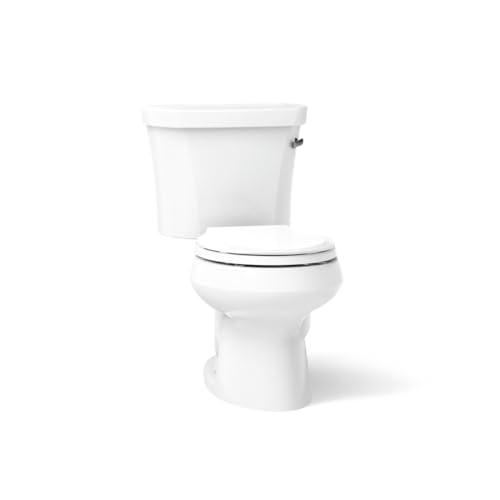
Kohler Wellworth Round-Front Toilet, 14-Inch Rough-In — Best Value for Odd Rough-Ins
The most expensive toilet problem in an older home is often not the toilet: it is the rough-in that matches nothing standard, turning a simple replacement into plumbing work. This Wellworth’s verified listing states its saving grace plainly — a 14-inch rough-in, round-front, 1.28 gallons, from one of the most supported lines in the industry. For the bathrooms that need exactly that measurement, it converts a project back into a purchase.
Strengths
- 14-inch rough-in fits older bathrooms that defeat standard models
- Efficient 1.28 gpf in a proven, widely serviced line
- Round-front footprint suits the small rooms odd rough-ins usually inhabit
Trade-offs
- Only a value if your rough-in truly is 14 inches — measure before celebrating
- Right-hand lever is fixed on this variant
- Round bowl trades spaciousness for fit
| Specification | Detail (from verified listing) |
|---|---|
| Rough-in | 14-inch, per listing — measure yours first |
| Flush volume | 1.28 gpf |
| Lever | Right-hand trip lever, per listing |
Measure your rough-in before reading another word of any toilet guide: wall to the centre of the floor bolts, in inches. Twelve is standard; ten and fourteen are the common variants, and ordering the wrong one converts a Saturday swap into a return, a reorder and a bathroom out of service. This pick exists in the guide as the standing reminder that inexpensive begins with measurement — the cheapest toilet is the one that fits the first time.
Within its niche, the Wellworth name carries the usual dividend: parts everywhere, knowledge everywhere, a design that has been maintained by two generations of plumbers. An older bathroom kept serviceable by a correctly-fitting, efficient fixture is worth more to a household than a renovated one built on a moved flange and a stretched budget. Fit first, then value — this pick is both, in that order.
Best for: Older bathrooms with a genuine 14-inch rough-in / Not suited for: Standard 12-inch bathrooms, where the standard-rough-in picks serve better
Check on Amazon — check price on Amazon before ordering, and confirm rough-in, bowl shape and seat inclusion on the listing.

Niagara Original Single Flush Elongated Toilet — Best Water-Saving Value
Niagara built its name on conservation, and this Original’s verified listing carries that identity into the value tier: an elongated single-flush toilet from a maker whose entire line exists to use less water. For households whose inexpensive calculation runs through the utility bill — high-rate water districts, septic systems, wells — the cheapest toilet to own can be the one that sips, even before its purchase figure enters the discussion.
Strengths
- Conservation-brand design centred on low water use
- Elongated bowl delivers adult comfort at a value position
- Single-flush simplicity keeps the mechanism conventional
Trade-offs
- Listing detail is sparer than the big-brand entries — verify configuration carefully
- Brand’s dealer and showroom presence is smaller than the legacy makers
- Single flush offers no light-setting option for further saving
| Specification | Detail (from verified listing) |
|---|---|
| Format | Elongated, single flush, per listing |
| Brand focus | Water conservation, per listing |
| Bowl | Elongated |
The elongated bowl at this tier deserves emphasis, because value lines often ration comfort first. A household’s main bathroom is used thousands of times a year, and the difference between a bowl that fits adults properly and one that merely functions is paid in daily micro-discomforts that never appear on an invoice. A value pick that refuses that particular economy — while keeping its water discipline — understands household economics better than most premium marketing does.
Verify this listing’s configuration with extra care before ordering, because its published detail is thinner than the legacy brands’: rough-in, height and seat position should all be confirmed rather than assumed. That diligence is the fair price of the conservation-brand value tier, and it is a price paid once, in minutes, against years of lower water use. Households comfortable with a checklist will find this pick quietly excellent.
Best for: Water-bill-focused households wanting elongated comfort at a value tier / Not suited for: Buyers who want the fullest published specification before ordering
Check on Amazon — check price on Amazon before ordering, and confirm rough-in, bowl shape and seat inclusion on the listing.
Comparison Table
| Pick | Badge | Key spec | Best for |
|---|---|---|---|
| Gerber Maxwell Crest Round Two-Piece Toilet | Best Overall Value | Two-piece, round front | Budget replacements, rentals and first homes wanting one complete package |
| Gerber Maxwell Select Round Two-Piece Dual-Flush Toilet | Best Dual-Flush Value | Dual-flush, water-saving, per listing | Value buyers who count water bills and cleaning time as part of the price |
| TOTO Entrada Two-Piece Round Toilet | Best Brand Value | Two-piece, round, universal height | Risk-averse value buyers wanting a major brand’s accessible model |
| American Standard Cadet PRO Round Front Toilet (Value Listing) | Best Pro-Line Value | Two-piece, round front, standard height | Rentals, high-use family bathrooms and cost-per-year thinkers |
| Kohler Wellworth Round-Front Toilet, 14-Inch Rough-In | Best Value for Odd Rough-Ins | 14-inch, per listing — measure yours first | Older bathrooms with a genuine 14-inch rough-in |
| Niagara Original Single Flush Elongated Toilet | Best Water-Saving Value | Elongated, single flush, per listing | Water-bill-focused households wanting elongated comfort at a value tier |
How to Judge an Inexpensive Toilet’s True Cost
Add the whole installation before comparing anything: fixture, seat if separate, wax ring and bolts, supply line, and disposal of the old toilet. Then add the decade: water at your household’s flush volume, and the probable parts — a flapper, a fill valve, perhaps a seat — priced as shelf items for conventional models or as special orders for proprietary ones. The toilet that wins that full sum is the inexpensive one, and it is regularly not the one with the lowest number on the box.
This guide prints no product prices, deliberately: prices move, and a value guide quoting stale figures misleads. Check price on Amazon for each pick at the moment you buy, confirm the inclusions on the listing at the same moment, and build your comparison from those live facts. The method outlives any price we could print.
Where Inexpensive Toilets Save — and Where They Must Not
The safe economies are styling, silhouette and ceremony: a plain two-piece body costs less to make and loses nothing in function; a standard lever outlasts fashionable buttons; a famous-enough brand’s accessible line carries the engineering without the flagship’s finish budget. The dangerous economies are hidden: an unglazed trapway that snags and clogs, thin vitreous that chips, proprietary internals that orphan the fixture, and flush volumes cut below what the bowl geometry can clear with.
Learn to spot which economy you are being offered. Glazed trapways, standard parts and honest flush claims are stated in good listings — every pick in this guide states at least the first two virtues in some form. Silence on trapway and parts, paired with loud claims about design, is the signature of the wrong kind of cheap, and it is the only kind this guide exists to steer you around.
Matching the Value Pick to the Room and the Household
Small bathrooms take round-front value models and gain floor space as a bonus. Main family bathrooms justify the elongated value picks, because comfort multiplies across thousands of uses. Older homes must measure rough-in before admiring anything — the 14-inch pick in this guide is a fortune saved for the few rooms that need it and an irrelevance to the rest. Rentals and high-turnover settings belong to the pro-line value fixtures whose parts any plumber carries.
Household composition finishes the match: standard height for child-centred homes, the patience to verify seat inclusion for every model, and dual flush where the family will genuinely use the light setting. Inexpensive is not a product category; it is a fit between a household’s real pattern and a fixture’s real total cost, and the picks above cover the patterns most households actually live.
The Rental and Resale Angle on Value Toilets
A sound inexpensive toilet quietly protects property value in a way a neglected premium one does not: it is the fixture that never appears in a tenant’s complaint, a buyer’s inspection note, or a landlord’s emergency call-out log. Pro-line and complete-package value models dominate rental practice for exactly this reason, and owner-occupiers planning an eventual sale should note that a clean, conventional, correctly-finished bathroom reads as cared-for — the quality buyers actually pay for — at a fraction of a designer refit’s cost.
The reverse also holds: the false-economy toilet, clogging and orphaned, announces itself in every viewing and inspection. Value in this category is therefore not the opposite of quality; chosen by total cost and parts sanity, it is quality’s most durable form.
How to Install an Inexpensive Toilet and Keep It Inexpensive
The value install protects the saving: no plumber call-out for a straightforward swap, no water damage from a rushed seal, and no second purchase from a mis-measured rough-in.
- Measure the rough-in and confirm it against the listing before the box is opened.
- Inspect the new fixture for chips or cracks immediately on delivery — exchanges are easiest before install day.
- Stage the seat, ring, bolts and supply line; several picks here include the kit, so check the box contents against the listing.
- Remove the old toilet, clean the flange fully, and check the floor for old water damage.
- Set the new toilet on a fresh ring in one motion; level, bolt evenly, and do not overtighten porcelain.
- Connect water, refill, and flush-test repeatedly with paper-towel checks at every joint.
- Fit the seat and set the tank water level to the maker’s line for the designed flush.
- Keep the receipt, model number and a spare flapper in the household file.
If anything in the old installation surprises you — a cracked flange, a spongy floor, a valve that will not close — the inexpensive move is to fix it during this same opening rather than install over it. Every value calculation in this guide assumes a sound base; five inexpensive years begin with one honest hour at the flange.
Common Buying Mistakes
- Comparing box prices only. Seats, rings and kits decide the real ranking at this tier.
- Buying the wrong rough-in. Measurement is the cheapest step in the entire purchase.
- Choosing proprietary cheap. Orphaned parts convert a saving into a replacement.
- Skipping the trapway question. An unglazed trapway is a clog subscription; glazed is the budget-correct spend.
- Forgetting disposal. Old-toilet removal has a cost in money or effort; plan it with the purchase.
- Ignoring water volume. At household scale, the flush figure is a yearly bill, not a specification detail.
Final Recommendation
For most buyers the Maxwell Crest round-front is the inexpensive answer in its purest form: everything in the box, a glazed trapway, and nothing to buy twice. Households counting water as well as money take the Maxwell Select’s dual flush or the Niagara’s conservation design; brand-risk-averse buyers take the Entrada; landlords and their household equivalents take the Cadet PRO; and the owners of one specific older bathroom will find the 14-inch Wellworth close to priceless, however inexpensive it is.
Judge each by the full sum — box, extras, water, parts, years — and the inexpensive category stops being a compromise and becomes what it should be: the same ceramic, the same physics, bought with open eyes.
Best House Toilets Best Household Toilets Best Insulated Toilets Best Hygienic Toilets Best Home Toilets Strong Flush
Reading a Value Listing: The Inclusions Checklist
At the inexpensive tier, the listing is the contract, and it rewards a slower read than any other category in this batch. Work through it in a fixed order. First, the fixture itself: format, bowl shape, height, rough-in and flush volume, each matched against your room’s measurements rather than your hopes. Second, the box: seat included or not, and if included, whether it is soft-close; ring and bolts included or not; any install kit and what the kit actually contains. Third, the support story: the maker’s name, the line the model belongs to, and whether its wear parts are the standard sizes your local merchant stocks.
Each unchecked line in that reading has a price, and the prices are knowable: a seat bought separately, a hardware run, a second delivery. Add them to the headline figure before comparing models and the value ranking reshuffles itself — frequently in favour of the complete packages this guide leads with, and always in favour of the truth. The discipline takes four minutes per model and is the entire difference between buying inexpensively and buying twice.
Photograph or save the listing details at purchase, with the model number, in the household file. Value fixtures are bought by households that keep houses running for years, and the file is what turns a future parts question into a lookup. The inexpensive toilet’s final economy is informational: the household that knows what it owns never pays the ignorance surcharge at the parts counter.
Value Traps: The False Economies That Cost Households Most
The unglazed trapway is the first trap, and it is set inside the porcelain where no photograph shows it. Waste drags, residue builds, the flush weakens across months, and the household concludes that inexpensive toilets clog — when in fact one specific economy clogged. Glazing is stated in honest listings, as it is for the picks in this guide; its absence from a suspiciously cheap listing is information, and should be priced as a future of plungers and call-outs.
The proprietary mechanism is the second trap: the unusual flush valve, the button assembly, the seat hinge that only one catalogue on earth supplies. Each works beautifully until it doesn’t, whereupon the inexpensive toilet becomes a special order and a waiting period with the bathroom out of service. Conventional internals are the value shopper’s insurance policy, and the premium for that insurance, at this tier, is usually zero — the conventional models are the inexpensive ones, which is the happiest alignment in the category.
The third trap is subtler: the volume cut too far. A flush volume below what the bowl’s geometry can clear with does not save water; it spends it twice, on the second flush, while teaching the household to distrust efficiency itself. The picks here hold to volumes their designs genuinely support. Cheap that works is the goal — and the traps above are simply the three ways cheap stops working, each avoidable at the listing-reading stage this guide has tried to make a habit.
When to Spend More: The Honest Limits of the Value Tier
A value guide earns its credibility by naming the cases where value is the wrong master. The first is the problem drain: a household whose line genuinely needs the carrying power of a specialist strong-flush design should buy that design, because a decade of plumber visits is the most expensive toilet programme of all. The second is accessibility: where a specific height, a bidet function or a care requirement is in play, the fixture that meets the need is the inexpensive one by definition, whatever shelf it sits on, because the unmet need bills the household daily.
The third case is the forever bathroom in a forever home, where a household will look at and clean the same fixture for twenty years. There, the one-piece’s cleaning ease or a glaze’s staying power can be worth their premium in the only currency that compounds — daily experience — and calling that spend indulgence is a category error. Value discipline is not a vow of cheapness; it is the insistence that every premium be bought for a named reason. Premiums with reasons are purchases. Premiums without them are donations.
Notice what is absent from that list: brand anxiety, guest impression and showroom shine. Nobody’s life was improved by a toilet’s logo, and the households happiest with this category are the ones that internalised the total-cost method, bought the complete and conventional package, and redirected the saving toward the parts of the bathroom — ventilation, lighting, a decent seat — where money is actually felt. That redirection, more than any single model in this guide, is the inexpensive toilet’s real product.
Closing Perspective
Delivery and inspection deserve a value shopper’s paragraph, because heavy ceramic bought online carries one risk the showroom never does: the fixture that arrives chipped, cracked or simply wrong. Inspect on delivery, before the old toilet is disturbed, and photograph anything questionable the same day; exchanges are painless at that point and miserable after an install has begun. Keep the packaging until the new toilet has flushed its first week — returns in this category are rare but heavy, and the box is the difference between a collection and a construction project in the hallway.
Finally, remember that inexpensive is a property of the whole decision, and the decision includes the room. A value toilet installed on a rotten flange, in a bathroom whose fan has been dead for years, beside a supply valve that weeps, will be blamed for its address. The savings this category frees are spent best exactly there — on the sound base, the working valve and the moving air — because a cheap toilet in a sound room outperforms a premium toilet in a failing one across every year that matters. That is the value method in one sentence, and it is the sentence this guide was written to leave behind.
One More Consideration
Renters, who cannot replace a toilet at all, might reasonably ask what an inexpensive-toilet guide offers them, and the answer is the diagnostic half of it. The listing-reading skills here — inclusions, trapway glazing, parts standardisation, the difference between a volume problem and a mechanism problem — are precisely the skills that turn a vague complaint to a landlord into a specific, fixable report: this flapper, this fill valve, this seat. Households that can name the part get the repair; households that report a sad toilet get a queue. Knowledge is the one value-tier upgrade available at every tenure.
And for the buyer at the actual moment of decision, the method compresses to a breath: measure the room, read the inclusions, favour the complete and the conventional, hold the volume honest, and add the decade before adding the item to the cart. Five habits, none of them expensive, all of them learnable in the time this guide takes to read. The inexpensive category rewards exactly that reader — which is to say, it rewards the reader it has just made.
Putting It Into Practice
A final practical sequence for the buyer ready to act: measure the rough-in before opening a single listing, then read each candidate for its inclusions in the fixed order this guide set out — fixture, box, support — and build the true comparison from live prices checked on Amazon at that moment, with every missing extra added honestly. Choose the complete and conventional over the bare and exotic at every tie, stage the install so the old toilet moves only when everything is in the room, and write the model into the house file before the packaging leaves. That sequence, followed once, is the entire inexpensive method; the models in this guide are simply its best current answers, verified and ready to be priced by the only figures that matter — today’s.
Consider, as the last word, what the inexpensive category teaches about every other category in this batch: that the disciplines of the value buyer — measure first, read the inclusions, price the decade, distrust the adjective — are not poverty habits but purchasing literacy itself. The strong-flush buyer, the hygienic buyer and the whole-house buyer in the companion guides all spend better for having read this one. Cheap was never the point. Seeing clearly was, and a toilet bought with clear eyes at the value tier will out-serve a careless purchase at three times its figure, in this room and in every room the method travels to next.
Keep, as the purchase’s final artefact, the comparison itself — the few lines of arithmetic, inclusions and live prices from which the decision was made, filed with the model number in the house records. It will look, in five years, almost comically thorough for a toilet, right up until the day a part is needed, a second bathroom is planned, or a neighbour asks how the household furnished a bathroom so sensibly for so little. Then it becomes what it always was: proof that inexpensive is not a price but a method, and that the method, once learned on a toilet, quietly improves every purchase the household makes after it.
One sentence, then, to carry out of the category and into every other aisle: the cheapest toilet is the one whose total — box, extras, water, parts and years — you actually added up. Households that learn to add are never again at the mercy of a headline, in this category or any other, and the five minutes of arithmetic is the only accessory this guide insists every buyer take home, whatever model they choose to go with it.
That arithmetic, practised once in this category, tends to become the household’s permanent way of buying everything else in the bathroom and beyond it.
Frequently Asked Questions
Are inexpensive toilets lower quality?
The ceramic and flush physics at the value tier are fundamentally sound; what is surrendered is styling, exotic features and sometimes finish refinement. The genuine quality risks are specific and avoidable: unglazed trapways, proprietary parts and flush volumes the bowl cannot support. Every pick in this guide was screened against those three.
What is the true cost of a cheap toilet?
The fixture plus seat if separate, ring and hardware, supply line, any delivery or disposal cost, then a decade of water and shelf-price parts. Build that sum for each candidate from live listing facts — check price on Amazon and confirm inclusions — rather than comparing box prices.
Which flush volume is cheapest to run?
Lower volumes cost less water per year, with dual flush saving most when the household uses the light setting as its default. The exception is the older drain line that genuinely needs volume to clear reliably; a clogging toilet’s plumber visits outcost any water saving.
Is a round or elongated bowl better value?
Whichever fits the room and the users. Round-front suits small bathrooms and costs the household nothing it will miss there; elongated earns its place in main bathrooms used thousands of times a year. Paying for elongated where the door barely swings is not value; neither is cramping the main bath to save a small difference.
Should I buy a toilet with the seat included?
At the value tier, usually yes: included-seat packages — several picks here bundle the seat, kit and even the wax ring — remove the most common budget surprise and guarantee the seat matches the bowl. If a model you prefer sells seat-separately, simply add a correct seat to the comparison honestly.
How long will an inexpensive toilet last?
Decades, for the ceramic; the wear parts follow the same schedule as premium models and, on conventional designs, cost the same shelf prices to replace. Longevity at this tier is decided by parts standardisation, which is why this guide’s picks lean pro-line and established-brand.


