Disclosure: airfryerkitchensupply.com is reader-supported. When you buy through links on our site, we may earn an affiliate commission at no extra cost to you.
Choosing the best house toilets is a different job from choosing one toilet for one bathroom. A house decision repeats: the same fixture, or a deliberate family of fixtures, across a primary bath, a family bath, a guest bath and maybe a powder room — bought during a renovation or a phased replacement plan, expected to match in feel, share spare parts where possible, and survive a decade of mixed users. This guide is written for that whole-home angle: consistency, serviceability and sensible variety by room, rather than a single hero specification. Every linked model was confirmed, and the recommendations deliberately mix formats — a flagship for the primary bath, workhorses for family rooms, a compact for the small room — because that is how houses actually get fitted out.
Where to buy
Buying several toilets at once through Amazon makes configuration discipline essential: rough-in, bowl shape, height and seat inclusion must match room by room, and the listings state those variants clearly enough to build a room-by-room order list before you commit. Stage deliveries if your renovation schedule is phased; ceramic fixtures store well but hate being moved repeatedly around a building site.
- TOTO Drake Two-Piece Elongated 1.28 GPF Toilet — Best Overall for the Whole House: Check the current price on Amazon
- Kohler Highline Comfort Height Two-Piece Round-Front Toilet — Best for Mixed Rough-Ins and Round Bowls: Check the current price on Amazon
- American Standard Champion PRO Two-Piece Elongated Toilet — Best Family-Bathroom Workhorse: Check the current price on Amazon
- Gerber Avalanche Select Chair Height Elongated Toilet — Best Trade-Channel Consistency Pick: Check the current price on Amazon
- Swiss Madison St. Tropez One-Piece Elongated Toilet — Best Design Pick for the Primary Bath: Check the current price on Amazon
- WOODBRIDGE One-Piece Dual Flush Toilet T-0018 — Best One-Piece for Secondary Baths: Check the current price on Amazon
Always re-check the listing for the exact configuration you intend to order. Toilets in the same family often share a name across different rough-ins, bowl shapes, seat inclusions, voltages and flush volumes, and the wrong variant is a heavy, expensive mistake to return.
In this guide
Quick Picks
- Best Overall for the Whole House: TOTO Drake Two-Piece Elongated 1.28 GPF Toilet — The default house-wide answer: a proven two-piece elongated design with TORNADO FLUSH, CEFIONTECT glaze and an included SoftClose seat, in a line broad enough to furnish every room consistently. Check price on Amazon
- Best for Mixed Rough-Ins and Round Bowls: Kohler Highline Comfort Height Two-Piece Round-Front Toilet — A comfort-height round-front workhorse with Class Five flushing — the room-saver of the set, for bathrooms where an elongated bowl will not fit. Check price on Amazon
- Best Family-Bathroom Workhorse: American Standard Champion PRO Two-Piece Elongated Toilet — A chair-height elongated two-piece from a trade-oriented line, built for the bathroom that gets used hardest by everyone in the house. Check price on Amazon
- Best Trade-Channel Consistency Pick: Gerber Avalanche Select Chair Height Elongated Toilet — A WaterSense-certified chair-height model whose listing bundles a soft-close seat and install kit — the tidy, complete-package option for phased house refits. Check price on Amazon
- Best Design Pick for the Primary Bath: Swiss Madison St. Tropez One-Piece Elongated Toilet — The design-led one-piece of the set — dual vortex flush and modern lines for the bathroom visitors actually see and judge. Check price on Amazon
- Best One-Piece for Secondary Baths: WOODBRIDGE One-Piece Dual Flush Toilet T-0018 — A modern one-piece dual-flush for the secondary bathrooms — water choice per flush, soft-close seat, and a cleaner silhouette than the two-piece workhorses. Check price on Amazon
How These Picks Were Chosen
For a whole-house brief we weighted three things a single-bathroom guide can ignore. First, family coherence: models from lines with wide variant coverage — round and elongated, standard and comfort height, 10, 12 and 14-inch rough-ins — so one design language can serve every room. Second, shared serviceability: common flappers, fill valves and seats across the house shrink the spares box and the learning curve. Third, room-appropriate variety: the best house plan is rarely six identical toilets; it is a considered set, and our six picks map to the rooms a real house contains.
A note on scope honesty: one famous name is absent as a pick because it does not belong here. Delta does not sell complete toilets through Amazon — only parts and accessories — so no Delta toilet is linked or recommended in this guide, whatever roundup habits elsewhere suggest. Every pick below is a complete toilet whose listing was verified.
The 6 Best Toilets for a Whole House

TOTO Drake Two-Piece Elongated 1.28 GPF Toilet — Best Overall for the Whole House
If a renovation plan needs one name written against most rooms, the Drake is the industry’s default answer for good reason. The verified listing combines the elements a whole-house buyer actually repeats: a strong swirling flush, a glaze that resists sticking and staining, universal height that suits most adults, and a soft-close seat in the box so the delivered price is the real price. It is not the cheapest or the flashiest pick here; it is the one least likely to generate a complaint from any room in the house.
Strengths
- TORNADO FLUSH and CEFIONTECT glaze per the listing — performance and easier cleaning in one specification
- Universal height elongated bowl suits the widest range of household users
- SoftClose seat included and WASHLET+ ready if a future bidet upgrade is planned
Trade-offs
- Premium-tier positioning compared with the value picks in this list
- Two-piece format has a tank seam to clean that one-piece designs avoid
- The design is conservative; statement bathrooms may want a bolder silhouette
| Specification | Detail (from verified listing) |
|---|---|
| Flush | TORNADO FLUSH, 1.28 GPF |
| Glaze | CEFIONTECT, per listing |
| Format | Two-piece, elongated, universal height, SoftClose seat included |
Across a house, the Drake’s quiet virtue is predictability. Guests use it without instructions, children cannot easily defeat it, and its flush clears consistently at 1.28 gallons, keeping water bills and septic loads proportionate when multiplied by every bathroom in the home. Parts support is as good as the category offers, which matters when the same model is installed in triplicate and one fill valve eventually needs attention in year eight.
Plan the house set around it sensibly: Drakes in the primary and family bathrooms, where traffic and expectations are highest, and let the picks below handle the rooms with special constraints. That tiered approach spends the budget where daily life happens instead of gold-plating the powder room, and it keeps one dominant set of spare parts for most of the house.
Best for: Renovations furnishing several bathrooms with one trusted, consistent model / Not suited for: Buyers furnishing a single statement bathroom as a design centrepiece
Check on Amazon — check price on Amazon before ordering, and confirm rough-in, bowl shape and seat inclusion on the listing.

Kohler Highline Comfort Height Two-Piece Round-Front Toilet — Best for Mixed Rough-Ins and Round Bowls
Every house has one bathroom that defeats the standard plan: the small ensuite, the under-stair powder room, the older bath built around a round bowl. The Highline’s verified listing answers with a round-front bowl at comfort height and Kohler’s Class Five flush platform at 1.28 gallons. Writing this model into the small rooms keeps the house set coherent — same height feel, same brand service story — without forcing an elongated footprint where the door swing forbids it.
Strengths
- Round-front bowl fits rooms where elongated models crowd the door swing
- Comfort height matches the taller feel of the rest of a modern house set
- Class Five flush technology at an efficient 1.28 gpf
Trade-offs
- Round bowl offers less seating room than elongated for larger adults
- Right-hand trip lever is fixed on this variant — check your tank-side preference
- Seat inclusion varies by variant; confirm on the listing before ordering
| Specification | Detail (from verified listing) |
|---|---|
| Flush | Class Five, 1.28 gpf |
| Bowl | Round-front, comfort height |
| Lever | Right-hand trip lever, per listing |
Round-front is sometimes treated as a downgrade; in a whole-house plan it is better understood as the correct tool for specific rooms. A powder room used briefly by guests gains floor space and loses nothing that matters, while the household’s main bathrooms carry the elongated models. Kohler’s support network is the other house-scale argument: a brand this widely distributed means the small-room toilet is never the orphan fixture nobody can get a part for.
Check the lever side against the room layout before ordering multiples. In tight rooms a lever on the wall side can be awkward for children and for anyone with limited reach, and it is exactly the kind of detail that gets overlooked when ordering three toilets at midnight during a renovation. The listing states the configuration plainly; use that clarity.
Best for: Small bathrooms and powder rooms inside a larger whole-house refit / Not suited for: Primary bathrooms where elongated comfort is available and expected
Check on Amazon — check price on Amazon before ordering, and confirm rough-in, bowl shape and seat inclusion on the listing.

American Standard Champion PRO Two-Piece Elongated Toilet — Best Family-Bathroom Workhorse
The family bathroom is the harshest environment in the house: highest flush count, widest range of users, least gentle treatment. The Champion PRO’s listing puts it in that role — chair height, elongated front, 1.28 gallons, from American Standard’s professional line. Pro-line fixtures trade decorative flourish for robust internals and straightforward service, which is the correct exchange in the room that can never be out of order for long.
Strengths
- Chair-height elongated format suits adults and older children in the main family bath
- Pro-line positioning means conventional, widely stocked service parts
- Efficient 1.28 gpf keeps the highest-traffic room’s water use in check
Trade-offs
- Utilitarian styling next to the design-led picks in this list
- Chair height is tall for younger children without a step stool
- Two-piece tank joint needs correct, even bolting at install to stay dry
| Specification | Detail (from verified listing) |
|---|---|
| Format | Two-piece, elongated front, chair height |
| Flush volume | 1.28 gpf |
| Line | Champion PRO, per listing |
Think about the family bath’s failure cost: when this toilet is down, the whole household queues elsewhere. That argues for the most serviceable, conventional design in the room — exactly this pick’s profile. Any competent plumber in any town knows this fixture family, and its wear parts sit on shelves rather than in shipping queues. In a whole-house plan, put your most exotic fixture in the primary bath if you must; put this kind of dependability where the traffic is.
Chair height deserves one honest note for family use: it is the right call for adults, teenagers and grandparents, and a temporary inconvenience for small children that a sturdy step stool solves completely. Households often find the stool years are short and the chair-height decades are long. Ordered for the family bath, this is the pick least likely to be regretted in year five.
Best for: The main family bathroom in a whole-house replacement plan / Not suited for: Design-led primary suites wanting a sculptural one-piece statement
Check on Amazon — check price on Amazon before ordering, and confirm rough-in, bowl shape and seat inclusion on the listing.
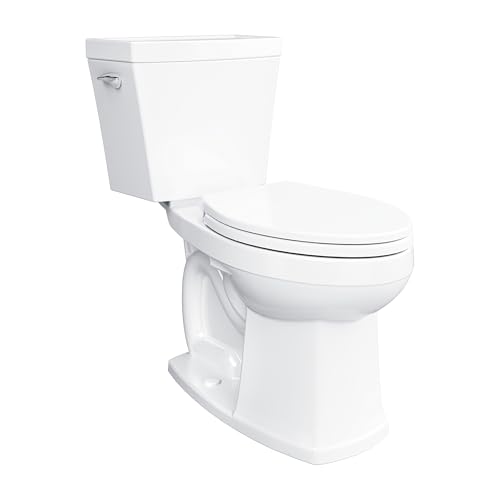
Gerber Avalanche Select Chair Height Elongated Toilet — Best Trade-Channel Consistency Pick
Phased renovations — one bathroom this spring, another next year — reward fixtures that arrive complete and install without a second shopping trip. The Avalanche Select’s verified listing is explicit about the bundle: WaterSense-certified 1.28 gpf performance, a stain-resistant glaze, and both a soft-close seat and an install kit included. Gerber’s trade heritage shows in that completeness; this is a fixture specified by people who bill by the hour and dislike surprises.
Strengths
- Listing confirms WaterSense certification at 1.28 gpf
- Soft-close seat and install kit included — no accessory surprises
- Stain-resistant glaze supports the low-maintenance house brief
Trade-offs
- Trade-brand retail presence is thinner if you want showroom comparison
- Chair-height elongated only — no round variant in this verified listing for tight rooms
- Aesthetic is clean and neutral rather than distinctive
| Specification | Detail (from verified listing) |
|---|---|
| Certification | WaterSense, 1.28 gpf, per listing |
| Glaze | Stain-resistant, per listing |
| Included | Soft-close seat and install kit, per listing |
The included-kit detail matters more across a house than in a single room. Multiply a missing wax ring, a seat bought separately, or an unplanned hardware run by three bathrooms and a renovation schedule starts to fray. A listing that states its inclusions this clearly lets you build an accurate per-room budget — the unglamorous spreadsheet work that separates calm renovations from chaotic ones.
Performance positioning is balanced rather than extreme: an efficient certified flush, a glaze aimed at keeping the bowl presentable between cleans, and a quiet-flush claim in the listing that guest-room and ensuite users will appreciate at night. As the second or third bathroom’s fixture in a house set, that balance is precisely right; not every room needs the flagship.
Best for: Phased renovations wanting complete, predictable per-room packages / Not suited for: Buyers who need to see and sit on a model in a local showroom first
Check on Amazon — check price on Amazon before ordering, and confirm rough-in, bowl shape and seat inclusion on the listing.

Swiss Madison St. Tropez One-Piece Elongated Toilet — Best Design Pick for the Primary Bath
A whole-house plan usually has one room where appearance is a legitimate priority: the primary ensuite or the guest bath that sets visitors’ impression of the renovation. The St. Tropez fills that slot in this set. Its verified listing describes a modern one-piece elongated body with dual vortex flush and black hardware detailing — a deliberate contrast to the workhorse two-pieces elsewhere in the house, and a reminder that a house set can have a hierarchy rather than a uniform.
Strengths
- Modern one-piece silhouette elevates the primary or guest bathroom
- Dual vortex flush gives a strong, even bowl wash
- One-piece body wipes clean quickly — no tank seam to detail
Trade-offs
- Design-tier positioning above the value picks in this set
- Black hardware finish is a style commitment other rooms must tolerate or echo
- One-piece weight demands two-person handling during the renovation shuffle
| Specification | Detail (from verified listing) |
|---|---|
| Format | One-piece, elongated |
| Flush | Dual Vortex, per listing |
| Hardware | Black hardware, per listing |
Use this pick deliberately. A design fixture in every room multiplies cost and replacement complexity; a design fixture in the one room that carries the renovation’s visual story delivers most of the pleasure at a fraction of the commitment. The dual vortex flush keeps it honest functionally — this is not a sculpture that flushes as an afterthought — and the one-piece form keeps daily cleaning quick in the bathroom most likely to be tidied before guests arrive.
Coordinate the black hardware with faucets and handles in that one room, or the detail reads as an accident. And record the model name in your house file: when a seat or button needs replacing in nine years, future-you will be grateful the renovation paperwork names the exact fixture in each room. Whole-house ownership is paperwork as much as plumbing.
Best for: The primary ensuite or showcase guest bath in a house-wide refit / Not suited for: Uniform-budget plans that need every room at workhorse pricing
Check on Amazon — check price on Amazon before ordering, and confirm rough-in, bowl shape and seat inclusion on the listing.
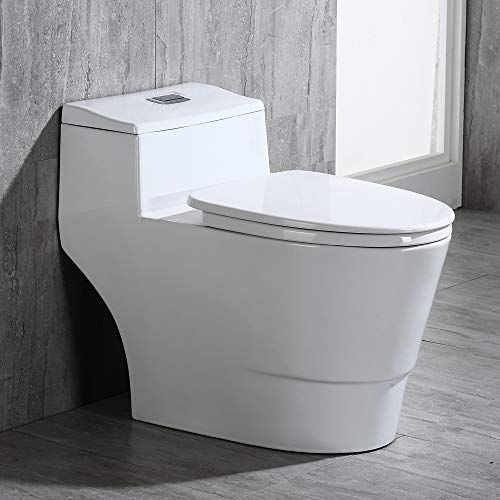
WOODBRIDGE One-Piece Dual Flush Toilet T-0018 — Best One-Piece for Secondary Baths
Secondary bathrooms — the kids’ bath, the guest bath, the basement bath — benefit from one-piece cleaning ease and dual-flush water discipline more than they need flagship status. This WOODBRIDGE’s listing states the formula plainly: modern one-piece design, dual flush with a light and a full setting, soft-closing seat, elongated bowl. Installed in the rooms where seats get slammed and bowls get neglected, it quietly outperforms the brief.
Strengths
- Dual flush 1.0/1.6 GPF lets each secondary bath save water on most flushes
- One-piece body and soft-closing seat minimise cleaning and slam damage
- Modern design lifts secondary rooms without flagship spend
Trade-offs
- Full flush at 1.6 uses more than the 1.28-class picks when selected
- Top-button flush is less intuitive for first-time guests than a lever
- Brand service network is smaller than the legacy American makers
| Specification | Detail (from verified listing) |
|---|---|
| Format | One-piece, elongated, white |
| Flush | Dual flush 1.0/1.6 GPF |
| Seat | Soft-closing, included per listing |
The dual-flush habit is worth teaching the household explicitly: light setting as the default, full setting when needed. In secondary bathrooms used heavily by children and guests, that one conversation, repeated at install, is worth more water than any single specification on the box. The soft-close seat removes the nightly slam soundtrack that travels through a quiet house — a small luxury every parent recognises instantly.
As with all one-pieces, measure the route from kerb to bathroom before delivery day: stair turns and door widths decide whether the fixture arrives calmly or dramatically. Once in place, its smooth sides make the weekly clean of a children’s bathroom noticeably faster, which over a decade of weeks is a real quality-of-life return on a modest premium over the cheapest two-piece.
Best for: Kids’, guest and basement bathrooms in a tiered whole-house plan / Not suited for: Houses wanting one identical model and one spare-parts list throughout
Check on Amazon — check price on Amazon before ordering, and confirm rough-in, bowl shape and seat inclusion on the listing.
Comparison Table
| Pick | Badge | Key spec | Best for |
|---|---|---|---|
| TOTO Drake Two-Piece Elongated 1.28 GPF Toilet | Best Overall for the Whole House | TORNADO FLUSH, 1.28 GPF | Renovations furnishing several bathrooms with one trusted, consistent model |
| Kohler Highline Comfort Height Two-Piece Round-Front Toilet | Best for Mixed Rough-Ins and Round Bowls | Class Five, 1.28 gpf | Small bathrooms and powder rooms inside a larger whole-house refit |
| American Standard Champion PRO Two-Piece Elongated Toilet | Best Family-Bathroom Workhorse | Two-piece, elongated front, chair height | The main family bathroom in a whole-house replacement plan |
| Gerber Avalanche Select Chair Height Elongated Toilet | Best Trade-Channel Consistency Pick | WaterSense, 1.28 gpf, per listing | Phased renovations wanting complete, predictable per-room packages |
| Swiss Madison St. Tropez One-Piece Elongated Toilet | Best Design Pick for the Primary Bath | One-piece, elongated | The primary ensuite or showcase guest bath in a house-wide refit |
| WOODBRIDGE One-Piece Dual Flush Toilet T-0018 | Best One-Piece for Secondary Baths | One-piece, elongated, white | Kids’, guest and basement bathrooms in a tiered whole-house plan |
How to Choose Toilets for an Entire House
Begin with a room inventory, not a product list. For each bathroom record the rough-in measurement, the available footprint and door swing, who uses the room, and any special needs — height, accessibility, water discipline. That inventory, usually four to six lines, dictates the house set far more accurately than any brand preference. Most houses resolve into a pattern: elongated comfort-height models for adult rooms, one round-front for the tight room, and a considered splurge for one showcase room.
Then decide your consistency strategy. Maximum consistency — one model everywhere it fits — minimises spare parts and learning curves, and suits landlords and busy families. Tiered consistency — one brand family, different tiers by room — balances budget and experience. Full variety is rarely right for a house; it multiplies maintenance knowledge for no daily benefit. Write the strategy down in the renovation file, because phased projects drift without it.
Budgeting a Whole-House Toilet Replacement
Think in per-room totals, not fixture prices: the toilet, the seat if not included, the wax ring and hardware, the supply line, and disposal of the old fixture. Listings in this guide state inclusions explicitly — several picks bundle the seat and even the install kit — and those inclusions are real money when multiplied by four bathrooms. This guide prints no product prices by design; use the linked listings to check price on Amazon per room and build the spreadsheet from live figures.
Sequence the spend with the renovation. Primary and family bathrooms first, because they carry daily life; powder and guest rooms can follow in a later phase without disrupting the household. Keep one contingency line in the budget for the surprise every old house hides — a corroded flange, a non-standard rough-in, a subfloor repair — because discovering it mid-phase with no contingency is how toilet projects stall half-finished.
Matching Heights and Bowls Across Rooms
Consistency of seat height across a house is an underrated comfort: adults moving between bathrooms at night appreciate a predictable fixture, and older relatives visiting appreciate it even more. Comfort or chair height is the modern default for adult rooms; standard height still serves households centred on young children. Mixed heights across rooms are acceptable when deliberate — standard in the children’s bath, comfort elsewhere — and confusing when accidental.
Bowl shape follows space, not fashion. Elongated wherever the room allows it, round-front where the tape measure insists. The roughly two inches between them decides door clearances and knee room in small bathrooms, and no flush technology compensates for a bowl that physically crowds the room. Measure every room individually; houses built or extended in stages routinely mix rough-ins and footprints in ways that defeat a single bulk order.
One Brand or Several? The Spares-Box Argument
Every additional brand in a house adds a second set of wear parts to learn and stock: different flapper sizes, fill-valve quirks, seat hinge patterns. A one-brand house can keep a single spares kit in a cupboard and fix most midnight failures from it. That is a genuine, if unglamorous, argument for building the set from one or two families, as this guide’s picks allow.
The counter-argument is room fit: no single line is best at everything, and forcing one model into the tiny powder room or the showcase ensuite serves the spares box at the expense of the rooms. The settled practice most renovators land on — one dominant family for the working bathrooms, one deliberate exception for the special room — captures most of the serviceability benefit without surrendering the rooms that need something different.
How to Plan and Install a Whole-House Toilet Replacement
Sequencing is the skill that separates a calm whole-house refit from a weekend with no working bathroom. The rule is absolute: never have every toilet in the house out of service at once.
- Measure every room first: rough-in, footprint, door swing, and shut-off valve condition, recorded room by room.
- Order per room against that record, confirming seat inclusion and rough-in on each listing.
- Replace one bathroom at a time, starting with the least-used room if your install confidence is still growing.
- Keep the old toilet functional until its replacement is on site and inspected for shipping damage.
- Set each new toilet on a fresh ring, level it, connect, and leak-test with a paper towel at every joint.
- Flush-test each room several times before moving to the next bathroom.
- Log model names, rough-ins and install dates in the house file for future parts and warranty needs.
- Dispose of old fixtures through local bulky-waste or recycling routes rather than storing them indefinitely.
If a flange sits below floor level or the subfloor shows water damage, pause that room and repair properly before setting the new fixture; a new toilet on a failed flange is a leak with better styling. Valves that will not fully close should be replaced during the same phase — they are cheap while the water is already off and expensive as a separate emergency later.
Common Buying Mistakes
- Ordering identical toilets for every room unmeasured. Rough-ins and footprints vary within one house, especially across extensions.
- Removing all toilets at once. Always keep one working bathroom throughout the project.
- Ignoring seat inclusion. A house set with two seat-included and two seat-separate models wrecks the budget maths; check each listing.
- Mixing brands casually. Every extra brand multiplies spare parts and maintenance knowledge.
- Skipping the house file. Model names and dates recorded now save hours when a part is needed in year eight.
- Gold-plating the powder room. Spend where daily life happens; tier the set deliberately.
Final Recommendation
For most houses, the plan writes itself from the picks above: Drake models carrying the primary and family rooms, the Highline solving the small room, the Champion PRO or Avalanche holding the high-traffic middle, the St. Tropez giving one room its moment, and the WOODBRIDGE lifting the secondary baths. Adjust the tiers to your rooms, keep the brand count low, and measure everything twice.
A house set chosen this way stops being six separate purchases and becomes one system — consistent to use, simple to service, and honest in every room. That is the whole point of deciding at house scale.
Best Home Toilets Strong Flush Best Household Toilets Best Hygienic Toilets Best Inexpensive Toilets Best Houseboat Toilets
Phasing a Whole-House Refit Without Losing a Bathroom
The logistics of replacing every toilet in a house reward the same thinking as the product choices: sequence, staging and one working fallback at all times. Professional renovators phase bathroom work so that the household always has one functioning toilet, one functioning shower path, and one room that is finished rather than promised. Applied to a toilet programme, that means completing one bathroom fully — fixture set, tested, seat fitted, joints proven — before the next room’s old toilet is touched, even when bulk delivery tempts you to strip everything at once.
Delivery staging is the second discipline. Ceramic fixtures are heavy, fragile and awkward, and a house mid-renovation is a hostile environment for them: trades crossing, materials stacked, doorways narrowed by protection. Where the project allows, take delivery room by room or store fixtures in the least-trafficked space available, still boxed, until their room is ready. Inspect every unit on arrival regardless of staging — a hairline crack found on delivery day is a phone call, while the same crack found on install day is a schedule collapse.
The third discipline is the unglamorous paperwork that makes a house set an asset: a single page per bathroom recording the model, the rough-in, the seat, the install date and any parts replaced thereafter. Houses accumulate fixtures across decades and owners, and the next person to maintain yours — possibly future you, possibly a buyer reading the file at purchase — will bless the page. A whole-house toilet decision is one of the few renovation choices whose quality is still visible in year fifteen, and it is visible mostly through exactly this kind of record.
The Guest Bathroom and the Powder Room: Small Rooms, Outsized Impressions
Visitors form their judgement of a renovation in the smallest rooms. The powder room and guest bath are where a house set’s coherence is actually perceived, because they are the rooms outsiders use — and they are also the rooms where the tiered strategy of this guide pays its visible dividend. A round-front comfort-height model that fits the powder room properly, in the same finish family as the rest of the set, reads as intentional; a flagship elongated shoehorned into the same space reads as a measuring error, whatever it cost.
Powder rooms reward two specific virtues: a quiet flush, because the room usually sits near living space, and a seat and lid that present well, because the fixture is essentially furniture in a small decorated room. Neither virtue requires the premium tier. What they require is that the small rooms were planned as part of the set rather than furnished with whatever remained in the budget’s final week — the single most common whole-house mistake, and the easiest to avoid with the room inventory this guide began with.
Guest bathrooms add one more consideration: intuitive operation. A guest should never need to study a toilet. Lever flushes and standard seats ask nothing of a visitor at midnight in an unfamiliar house, while multi-button panels and unfamiliar smart features occasionally do. Put the household’s experimental fixture, if there is one, in the primary bath where its users are its owners, and keep the guest room in the grammar every traveller already speaks.
Accessibility Across a Whole House: Planning for the Decade, Not the Day
A whole-house toilet plan is usually drawn for the household as it stands on renovation day, and the households that age best in their homes drew it for the household of ten years later. Seat heights chosen with ageing knees in mind, one bathroom — ideally on the entry level — fitted to the most accessible specification in the set, and clear floor space preserved beside that toilet for future support: these decisions cost nothing extra during a refit and are disproportionately expensive to retrofit later. The tiered set in this guide accommodates that thinking naturally, because it already assigns different specifications to different rooms.
Children run the same argument in reverse at the other end of the decade. The bathroom specified for a toddler becomes a teenager’s bathroom without asking anyone’s permission, and fixtures chosen at a sensible middle height serve both chapters without replacement. Houses are long commitments furnished by short chapters of life, and the toilet set that survives those chapters is the one specified for the transitions rather than for any single portrait of the family. Renovators call this future-proofing; grandparents and teenagers, using the same bathroom in the same week, call it the house working.
There is a financial shadow to the same point. Accessibility-minded specifications — comfort heights, elongated bowls, lever operation — are also the specifications the resale market increasingly expects in a main bathroom, so the accessible house set is rarely money spent on only one family’s future. It is unusual for kindness and value to coincide so completely in a renovation budget; the whole-house toilet plan is one of the places they do, and it deserves the extra ten minutes of thought this section is asking for.
Closing Perspective
The paperwork of a house set deserves one more paragraph, because it is where whole-house plans most often quietly fail. Warranties, model numbers and rough-in records scattered across emails and boxes are, in practice, records that do not exist. One envelope or one digital folder per house, added to at every install, converts the set from a collection of purchases into a documented system, and it is the document — not the porcelain — that a future plumber, buyer or insurer actually consults. The ten minutes per bathroom that this discipline costs is the highest-value time in the entire programme after the measuring itself.
Step back from the individual rooms and the whole-house decision reveals its real shape: it is the purchase of a standard. A household that standardises its toilets gains the calm of sameness — same operation for every user in every room, same parts in one cupboard, same cleaning routine, same expectations of a flush at 2 a.m. in an unfamiliar bathroom of one’s own home. That calm is worth more than the sum of the individual fixtures, and it is available at every budget tier in this guide, because it is a property of the plan rather than of any price point.
One More Consideration
A house set also has a sound, and households notice it more than they expect. Toilets chosen from one or two families flush with a familiar voice in every room, and the small hours of the night are when that familiarity matters: a guest or a child moving through a sleeping house is steadied by fixtures that behave identically behind every door. It sounds like a poetic criterion for a plumbing purchase, yet owners of mixed, inherited fixture sets mention the opposite — the one bathroom whose toilet roars, or hesitates, or refills for minutes — with a consistency that suggests the ear keeps its own specification sheet. Coherence is audible, and the set planned as a set delivers it for free.
There is one more planning habit that separates the durable whole-house refits from the drifting ones: deciding the set before the first purchase rather than discovering it purchase by purchase. A renovation bought fixture by fixture, room by room, across two years of offers and moods, arrives at a house of strangers. The same money, committed to a written set at the start — flagship here, workhorse there, round-front for the small room, heights assigned by user — arrives at a system. The picks in this guide were assembled to be chosen exactly that way: as a cast, not as auditions.
Putting It Into Practice
A final practical sequence for the buyer ready to act: walk the house with the tape and the inventory sheet on a single morning, sit — literally — with the height question in each room, and only then open the listings. Order in the sequence the rooms will be fitted, keep one bathroom sacred throughout, and let each completed room teach the next one’s installation. By the second room the household will be measurably faster; by the last, the set will feel less like a project that happened and more like a standard the house simply has. That feeling, sustained across years of unremarkable mornings, is the return on the whole-house method, and it is available at every tier in this guide to any household willing to plan once and buy once.
There is a temptation, at the end of a whole-house plan, to upgrade one more room than the budget intended — the flagship creeping from the primary bath into the guest room, the workhorse displaced by its prettier sibling. Resist it with the plan’s own logic: the tiers were assigned by traffic and by who actually lives with each fixture, and a plan followed is worth more than a plan improved mid-stream at the cost of the contingency that protects the whole project. The house set’s quality is its coherence, and coherence is finished exactly where the inventory said it would be.
Keep, as the plan’s final artefact, the habit of reviewing the set once — a year after the last room is finished, walk the house and ask of each bathroom only whether the fixture assigned to it still matches the life lived there. Rooms change occupants, children grow, parents arrive and depart, and a set planned as a system can be adjusted as a system: a seat height swapped between rooms, a workhorse promoted to the bathroom that became the busy one. The review takes twenty minutes and closes the loop the inventory opened, turning a renovation into a maintained standard — which was, from the first measurement, the actual ambition of buying for a whole house rather than for a single room.
Frequently Asked Questions
Should I buy the same toilet for every bathroom?
Mostly, with deliberate exceptions. One dominant model across the working bathrooms simplifies parts and maintenance, but tight rooms may need a round-front variant and many owners choose one design-led model for the primary bath. Tiered consistency beats both rigid uniformity and random variety.
How many toilets can I replace in a day?
A confident installer typically completes one to two straightforward replacements in a day, including testing. Keep one bathroom working at all times, and stop the sequence if you find flange or subfloor damage — that repair outranks the schedule.
What rough-in sizes will my house have?
Twelve inches is the modern standard, but older and smaller bathrooms often have 10 or 14-inch rough-ins. Measure each room from the finished wall to the centre of the floor bolts before ordering; do not assume uniformity across a house built or extended in stages.
Is it cheaper to buy toilets during a renovation?
Consolidating purchases during a renovation usually saves on delivery, installer visits and disposal compared with scattered one-off replacements, and it lets you negotiate the project as a whole. The savings come from logistics and labour, not from rushing — measure first, then order.
Do all the toilets in a house need the same height?
No, but heights should be chosen deliberately. Comfort height suits adult rooms; standard height can serve a young children’s bathroom. Accidental mixtures — whatever was on offer that week — are what households regret, not planned ones.
What should I keep as spares for a house set?
One universal fill valve, flappers matching your dominant models, a spare wax ring, and the seat hardware for your most-used bathroom. Record model numbers in a house file so replacement parts are a lookup, not an investigation.

