Disclosure: airfryerkitchensupply.com is reader-supported. When you buy through links on our site, we may earn an affiliate commission at no extra cost to you.
Where to buy
This guide to the best dutch ovens for sourdough is built only on listings verified. Every Dutch oven below was verified, and the detail that matters most for bread — capacity and shape — comes from the verified listing. Buy through the linked Amazon listing for the exact size reviewed; Dutch ovens are sold in families of near-identical sizes, and for sourdough the difference between a 4-quart and a 5.5-quart is the difference between a loaf that fits and a loaf that climbs the walls.
- Le Creuset Enameled Cast Iron Round Dutch Oven, 5.5 qt, Cerise — check price on Amazon
- Tramontina Bestow Enameled Cast Iron 5.5-Qt Round Dutch Oven, Blue — check price on Amazon
- STAUB Cast Iron Dutch Oven 4-qt Round Cocotte, Cherry — check price on Amazon
- Lodge Essential Enamel Cast Iron Dutch Oven, 6 Quart, Island Spice Red — check price on Amazon
- Le Creuset Enameled Cast Iron Round Dutch Oven, 7.25 qt, Cerise — check price on Amazon
- Amazon Basics Enameled Cast Iron Dutch Oven, 6-Quart, Blue — check price on Amazon
The best Dutch ovens for sourdough succeed at one job before all others: they trap steam around a baking loaf in a fiercely hot, sealed iron chamber, which is what gives home sourdough the blistered crust, open crumb and oven spring that a bare oven shelf cannot. A Dutch oven is a steam oven in miniature for the first half of the bake, and a radiant roasting pan for the second. This guide ranks six verified ovens by how well they do that job — size against loaf, lid seal, base shape and the handles you will grip with mitts at full temperature.
Size is the decision most buyers get wrong, so here is the honest map. A standard home sourdough loaf built on 500 grams of flour wants a round oven of about 5 to 5.5 quarts: room to expand without touching the walls, close enough walls to support the rise. A 4-quart suits smaller 350–400 gram loaves and rewards them with a taller profile. A 6 to 7.25-quart suits double batches, larger boules and bakers who also braise for a crowd — with the caveat that a small loaf in a big pot spreads flatter. Every pick below is round or honestly described, enamelled or honestly flagged, and sized against those jobs.
One more framing note: a sourdough Dutch oven lives a harder thermal life than a stew pot. It is preheated empty at full temperature, loaded with wet dough, and cycled bake after bake. Enamel quality, knob heat tolerance and lid fit are therefore bread issues, not cosmetic ones, and they are weighted that way in every review that follows.
In this guide
Quick Picks
Best Overall — Le Creuset Enameled Cast Iron Round Dutch Oven, 5.5 qt, Cerise. The 5.5-quart round is the reference size for a standard sourdough boule, with Le Creuset’s enamel, lid seal and heat tolerance — the benchmark bread oven.
Best Value — Tramontina Bestow Enameled Cast Iron 5.5-Qt Round Dutch Oven, Blue. The same reference 5.5-quart round format at a value tier, with a listing that names bread baking outright — the sourdough starting point that needs no apology.
Best for Small Loaves — STAUB Cast Iron Dutch Oven 4-qt Round Cocotte, Cherry. A French 4-quart with Staub’s self-basting lid — sized for smaller loaves, which it rewards with the tallest, proudest profile in this guide.
Best Large-Capacity Value — Lodge Essential Enamel Cast Iron Dutch Oven, 6 Quart, Island Spice Red. Six quarts, a moisture-sealing lid per the listing, and Lodge’s value pricing — the big-loaf and double-duty oven for bakers who also braise.
Best for Big Batches — Le Creuset Enameled Cast Iron Round Dutch Oven, 7.25 qt, Cerise. The 7.25-quart flagship — for double loaves, very large boules and bakers whose Dutch oven is also the household’s biggest braising pot.
Best Budget — Amazon Basics Enameled Cast Iron Dutch Oven, 6-Quart, Blue. A 6-quart round enamelled oven at the lowest tier in the guide — the loaf will not know the difference, even if the enamel will show its years sooner.
How These Picks Were Chosen
We verified candidate ovens and ranked them as bread tools first. Capacity was mapped against real loaf sizes — the 500-gram-flour standard boule above all — and round shapes were favoured over oval for boules, since an oval pot shapes an oval loaf whether you planned one or not. Lid seal came next: a heavy, well-fitting lid is the steam system, and ovens known for tight lids scored accordingly. Base interior mattered too — a flat, wide floor fits a proofed boule without forcing it, and light-coloured versus dark interiors were noted for how they show crust colour and how they handle scorching.
Heat tolerance was checked as a bread criterion: these ovens are preheated empty at high temperature, so enamel credibility and knob construction counted, and any oven whose realistic ceiling cramped a proper bread preheat lost ground. Handles were judged with mitts on — wide, grippable loops beat decorative knobs and stubby tabs when the pot is at full heat and full weight. Finally, tier honesty: the premium French ovens were required to justify themselves in enamel, seal and longevity, and the budget ovens in how little of the bread result they actually surrender.
The 6 Best Dutch Ovens for Sourdough

Le Creuset Enameled Cast Iron Round Dutch Oven, 5.5 qt, Cerise — Best Overall
If one oven defines this category, it is the Le Creuset 5.5-quart round. The capacity is the sweet spot the intro described — a 500-gram-flour boule proofs, loads and expands with supportive room to spare — and the execution around that size is the premium standard: dense cast iron, a smooth enamel that releases a baked loaf cleanly, and a heavy lid whose seal holds the steam that makes the crust. Cerise is the classic colourway; the oven is the point.
Strengths
- Reference 5.5 qt size for the standard home boule
- Heavy, tight-sealing lid for maximum steam retention
- Premium enamel tolerates empty high-heat preheats
Trade-offs
- Premium tier pricing, plainly
- Heavy in hand when loaded and at full temperature
- Light interior shows staining from years of bakes
| Spec | Detail (from verified listing) |
|---|---|
| Capacity | 5.5 qt, round (per Amazon title) |
| Material | Enameled cast iron (per Amazon title) |
| Colourway verified | Cerise |
Bread results are where this oven argues for itself. The lid seal keeps the dough’s own steam in the chamber through the critical first twenty minutes, so the crust stays supple while the loaf completes its spring, then sets glossy and blistered when the lid comes off. The round walls support a boule symmetrically — no oval drift, no flat side — and the base is wide and flat enough to load a proofed loaf from parchment without folding it. The enamel shrugs off the empty preheat cycle that bread demands bake after bake, which is precisely where cheaper enamels craze and chip over time. You pay the premium tier once and the oven simply leaves the sourdough equation: every bake’s variable becomes your dough, not your pot. For a committed sourdough baker, that is the correct place to spend.
Best for: committed sourdough bakers baking the standard boule weekly / Not suited for: occasional bakers who cannot justify a premium tier pot
Check on Amazon — check the current price on Amazon.
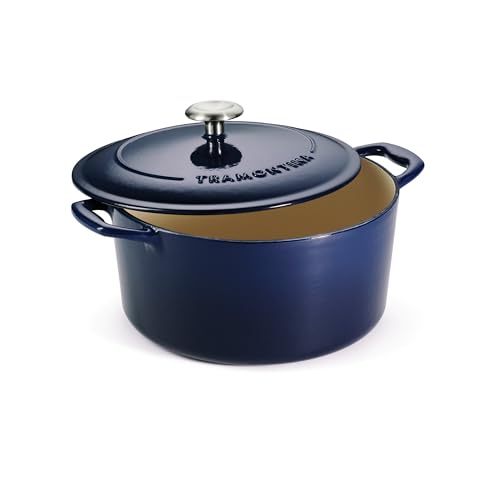
Tramontina Bestow Enameled Cast Iron 5.5-Qt Round Dutch Oven, Blue — Best Value
Tramontina’s Bestow 5.5-quart round is the value answer to the same brief: the reference boule size, enamelled cast iron, a proper heavy lid — and a verified listing that lists bread baking among its intended jobs. It does not match the French ovens’ enamel refinement or heft of heritage, and at its tier it does not need to: the loaf geometry and steam chamber that decide your crust are all present.
Strengths
- Reference 5.5 qt round size at a value tier
- Listing explicitly covers bread baking
- Heavy lid and enamelled interior for steam and release
Trade-offs
- Enamel is less refined than the premium French ovens
- Long-term chip resistance is the tier’s open question
- Slightly less polished finishing on handles and rim
| Spec | Detail (from verified listing) |
|---|---|
| Capacity | 5.5-Qt round (per Amazon title) |
| Material | Enameled cast iron (per Amazon title) |
| Stated uses | Braising, roasting and bread baking (per Amazon title) |
Bake the same dough in this oven and in the premium pick, side by side, and the loaves are close cousins: the steam chamber works, the round walls support the rise, and the crust sets properly when the lid lifts. The differences live at the margins — enamel that will show its years sooner, a lid fit that is very good rather than exceptional, and finishing that prioritises function. For a baker’s first dedicated sourdough oven, or a second oven for double-bake days, those margins are exactly the right ones to trade away. The Bestow also braises and roasts honourably, so it earns its shelf space on non-bread days in a way a specialist never could. As value in this category goes, this is the pick we hand to friends starting sourdough.
Best for: new sourdough bakers and anyone wanting the right size on a budget / Not suited for: buyers seeking a decades-long heirloom enamel finish
Check on Amazon — check the current price on Amazon.

STAUB Cast Iron Dutch Oven 4-qt Round Cocotte, Cherry — Best for Small Loaves
Staub’s 4-quart cocotte is the small-loaf specialist. Its verified listing notes it serves 3–4, and for sourdough its virtue is proportion: a 350–400 gram loaf in a 4-quart round sits closer to the walls, which support it upward, producing the tall, tight boule that small-batch bakers chase. Staub’s lid is the other distinction — its underside is designed to distribute condensation back over the contents, a braising feature that in bread terms means an evenly humid chamber.
Strengths
- Ideal proportions for 350–400 g loaves
- Self-basting lid design keeps the chamber evenly humid
- Made in France with Staub’s matte enamel tradition
Trade-offs
- Too small for the standard 500 g boule to expand freely
- Premium tier for its size class
- Dark interior makes judging crust colour harder
| Spec | Detail (from verified listing) |
|---|---|
| Capacity | 4-qt round cocotte (per Amazon title) |
| Origin | Made in France (per Amazon title) |
| Serving size | Serves 3-4 (per Amazon title) |
Small loaves are not failed big loaves — they are the right format for one and two-person households, for test bakes of a new flour, and for the daily-bread rhythm where a giant boule would stale before it is eaten. In the Staub 4-quart, those loaves bake with a shape the big pots cannot give them: wall support all the way up, a domed top, and a crumb set by a chamber sized to the dough’s own steam output. The matte dark interior hides a decade of bake marks gracefully and is famously forgiving of scorching, at the small cost of judging crust colour by eye — set a timer discipline instead. If your sourdough life is small loaves baked often, this is not the compromise pick; it is the correct one, at French-oven quality.
Best for: small households and bakers of 350–400 g loaves / Not suited for: bakers whose standard loaf is 500 g of flour or more
Check on Amazon — check the current price on Amazon.

Lodge Essential Enamel Cast Iron Dutch Oven, 6 Quart, Island Spice Red — Best Large-Capacity Value
Lodge’s Essential Enamel 6-quart is the capacity pick at a value tier: a round enamelled oven a step up in size from the 5.5-quart reference, with a listing that names bread baking among its jobs and describes a moisture-sealing lid and dual handles. For bakers whose standard loaf runs large, who bake boules for a family table, or who want one oven that braises Sunday and bakes Saturday, this is the size-and-tier intersection to buy.
Strengths
- 6-quart capacity suits large boules and family braises
- Moisture-sealing lid per the verified listing
- Lodge value tier with wide availability
Trade-offs
- A small loaf spreads flatter in a 6-quart chamber
- Enamel care is more delicate than bare cast iron
- Heavier to handle at full temperature than the 5.5 qt class
| Spec | Detail (from verified listing) |
|---|---|
| Capacity | 6 quart (per Amazon title) |
| Lid | Moisture-sealing lid, dual handles (per Amazon title) |
| Stated uses | Bread baking, braising, marinating, slow cooking (per Amazon title) |
The 6-quart question is always loaf discipline: fill it with a loaf sized for it — 600 grams of flour and up — and the Lodge produces a generous, well-sprung boule with room to score elaborately. Put a small loaf in it and the dough relaxes sideways into the space, which is geometry, not a flaw in the pot. Bakers who scale recipes to the oven will love the headroom, and the same volume swallows a family braise on non-bread days, making this the hardest-working oven per dollar in the guide. The enamel asks for the standard courtesies — no thermal shock, no metal battering — and the dual handles are genuinely grippable with mitts, which at 6 quarts and full heat is a safety feature as much as a convenience.
Best for: large-loaf bakers and households wanting one oven for bread and braises / Not suited for: small-loaf bakers, who should size down to the Staub or 5.5 qt class
Check on Amazon — check the current price on Amazon.

Le Creuset Enameled Cast Iron Round Dutch Oven, 7.25 qt, Cerise — Best for Big Batches
The 7.25-quart Le Creuset is the big-batch flagship of the line: the same enamel, lid and build standard as the 5.5-quart benchmark, scaled for the bakers who outgrow it — those baking two loaves’ worth of dough as one grand boule, feeding a crowd, or running the oven as the kitchen’s largest braiser six days a week and its bread oven on the seventh.
Strengths
- Capacity for very large boules and double batches
- Same premium enamel and lid standard as the 5.5 qt
- Doubles as the household’s largest braising pot
Trade-offs
- Standard loaves spread flatter in the extra volume
- Heaviest handling in this guide at full temperature
- Highest tier in the list
| Spec | Detail (from verified listing) |
|---|---|
| Capacity | 7.25 qt, round (per Amazon title) |
| Material | Enameled cast iron (per Amazon title) |
| Colourway verified | Cerise |
Buy this oven for the loaves the 5.5-quart cannot hold and judge it on those: a kilo-scale boule rises with room to spare, a double batch bakes as one dramatic centrepiece loaf, and the chamber’s steam volume stays proportional because the dough itself is bigger. The recurring caution of this guide applies at full strength — a standard loaf in this pot is a flatter loaf — so the 7.25-quart is a second-oven or big-household purchase, not an upgrade path for a happy 5.5-quart baker. Its secondary life justifies it in busy kitchens: as a braising and stock pot it is the largest vessel most homes own. Handled with mitts and respect for its loaded weight, it is a lifetime pot at the top tier, bought for scale.
Best for: big-batch bakers and large households / Not suited for: standard-loaf bakers, who belong in the 5.5 qt class
Check on Amazon — check the current price on Amazon.

Amazon Basics Enameled Cast Iron Dutch Oven, 6-Quart, Blue — Best Budget
The Amazon Basics 6-quart is the budget entry to sourdough Dutch oven baking: round, enamelled, dual-handled, and described in its verified listing as oven safe for stews, roasting and baking. It makes the honest budget argument of this whole category — the steam-chamber physics that create a great crust do not check the badge on the pot — while asking you to accept enamel and finishing that will age faster than the premium ovens’.
Strengths
- Lowest tier in the guide for a full-size round oven
- 6-quart round format fits large standard loaves
- Dual handles and a proper heavy lid
Trade-offs
- Enamel longevity is the budget tier’s known unknown
- Finishing and lid fit are functional, not refined
- Same small-loaf spread caveat as any 6-quart
| Spec | Detail (from verified listing) |
|---|---|
| Capacity | 6-quart, round (per Amazon title) |
| Material | Enameled cast iron, dual handles (per Amazon title) |
| Stated uses | Stews, roasting and baking (per Amazon title) |
For a first year of sourdough, this oven removes every excuse: the size is right for a generous standard loaf, the chamber seals well enough to set a proper crust, and the tier is low enough that a beginner can start now instead of saving for a French flagship. The loaves it produces are genuinely good — steam is steam. What the budget tier buys down is time: expect the enamel to mark and eventually chip at the rim sooner than a Le Creuset’s, expect finishing that is workmanlike, and plan on this being the oven you learn on and perhaps hand on. Many bakers find that arc perfect — learn on the Basics, and if sourdough becomes a decade-long practice, the premium upgrade later is bought with knowledge. If it stays a happy habit at this tier, the oven has still done its job.
Best for: beginners who want to start baking now at a budget tier / Not suited for: buyers shopping for a single lifetime heirloom purchase
Check on Amazon — check the current price on Amazon.
Comparison Table
| Pick | Badge | Key spec | Best for |
|---|---|---|---|
| Le Creuset Enameled Cast Iron Round Dutch Oven, 5.5 qt, Cerise | Best Overall | 5.5 qt round enameled cast iron | committed sourdough bakers baking the standard boule weekly |
| Tramontina Bestow Enameled Cast Iron 5.5-Qt Round Dutch Oven, Blue | Best Value | 5.5 qt round enameled cast iron | new sourdough bakers and anyone wanting the right size on a budget |
| STAUB Cast Iron Dutch Oven 4-qt Round Cocotte, Cherry | Best for Small Loaves | 4 qt round cocotte, made in France | small households and bakers of 350–400 g loaves |
| Lodge Essential Enamel Cast Iron Dutch Oven, 6 Quart, Island Spice Red | Best Large-Capacity Value | 6 qt enameled, moisture-sealing lid | large-loaf bakers and households wanting one oven for bread and braises |
| Le Creuset Enameled Cast Iron Round Dutch Oven, 7.25 qt, Cerise | Best for Big Batches | 7.25 qt round enameled cast iron | big-batch bakers and large households |
| Amazon Basics Enameled Cast Iron Dutch Oven, 6-Quart, Blue | Best Budget | 6 qt round enameled, budget tier | beginners who want to start baking now at a budget tier |
How to Choose a Dutch Oven for Sourdough
Choose by loaf first. Weigh your standard dough: a loaf built on roughly 500 grams of flour belongs in a 5 to 5.5-quart round oven; 350–400 gram loaves belong in a 4-quart; 600 grams and up want 6 quarts or more. Then choose round over oval for boules — an oval pot will shape your loaf oval — and reserve oval ovens for batards you actually intend to bake. Lid fit is the third check: the lid is your steam system, so weight and a clean, even seat matter more than any other single feature after size.
After size and seal, judge the bread-specific details. The knob and handles will be worked at maximum temperature through mitts, so they should be metal or rated for high heat and shaped to grip. Interior colour is a real trade: light enamel shows crust colour beautifully and shows staining just as honestly; dark interiors hide the years and hide the crust’s colour cues with them. Finally, buy enamel quality in proportion to your baking frequency — weekly bakers amortise a premium oven across hundreds of preheats, while a monthly baker is rationally served by the value tier.
Why the Dutch Oven Works: Steam, Spring and the Two-Stage Bake
A sourdough loaf needs two contradictory environments in one bake. For the first stage it needs saturated steam, so the crust stays soft and extensible while the interior expands — the oven spring — and the surface starches gelatinise into what will become a glossy crust. A home oven cannot hold that steam; it vents away. A sealed Dutch oven can, because the loaf’s own moisture, trapped by the heavy lid, becomes the steam. That is the entire trick, and it is why lid seal outranks almost every other feature in this guide.
The second stage needs the opposite: dry, radiant heat to set, deepen and crisp the crust. Lifting the lid at the halfway point converts the same pot from steam chamber to roasting chamber, and the cast iron’s stored heat drives the colour. Understanding the two stages explains the technique rules that follow — preheat the pot so stage one starts at full temperature, score the loaf so the spring has a planned direction, and never skip the lid-off stage, or the crust stays pale and soft no matter how good the spring was.
Budget Tiers for Sourdough Dutch Ovens
The budget tier buys the physics in full: a round enamelled chamber of the right size will spring and crust a loaf properly, and the Amazon Basics and Tramontina picks prove it. What it does not buy is enamel longevity under the empty-preheat cycle — expect marking and eventual rim chips sooner. The mid-to-premium step, Lodge’s enamel line and then the French ovens, buys enamel that tolerates years of that cycle, lids that seal like instruments, and handles and knobs designed for gloved work at full heat.
The rational way to tier-shop is by bakes per year. Under twenty bakes, the value tier is not a compromise at all. At a hundred bakes a year, the premium oven’s cost per bake drops below the replacement cost of budget enamel — and its results are marginally better every single time. Sourdough people tend to become high-frequency bakers, which is why the premium pick leads this guide despite its tier.
How to Bake Sourdough in a Dutch Oven, Step by Step
Step 1 — Preheat the oven with the pot inside. Place the Dutch oven, lid on, in the oven and preheat fully — a good thirty minutes at your baking temperature — so the iron is heat-soaked, not merely air-hot.
Step 2 — Turn the dough onto parchment. Tip the proofed boule onto a sheet of baking parchment. The parchment is your loading sling and your insurance against sticking.
Step 3 — Score decisively. One confident slash with a lame or sharp blade, at a shallow angle, gives the spring a direction and creates the ear. Hesitant, shallow scratches tear instead.
Step 4 — Load with mitts, lid on, timer set. Lower the loaf in its parchment sling into the hot pot, lid on immediately to trap the steam, and bake the first stage — about twenty minutes — untouched.
Step 5 — Lid off for the second stage. Remove the lid and bake until the crust is the deep colour you actually want — most home bakers under-bake here. Judge by colour, not by the clock alone.
Step 6 — Cool on a rack, fully, before slicing. The crumb is still setting as it cools. Two hours is the discipline; a loaf sliced hot gums its own crumb, whatever oven baked it.
Beyond the Boule: Batards, Enriched Doughs and Second Bakes
A round Dutch oven bought for boules turns out to be a flexible bread tool once its logic is understood. A batard dough can bake in a round pot — it will relax toward the pot’s shape somewhat, so proof it slightly under-sized and score it along its length, and the result is a handsome oval-leaning loaf rather than a failure. Enriched doughs — brioche-style sourdough, milk breads, cinnamon swirls — bake beautifully in the chamber at gentler temperatures, where the lid protects their sugary crusts from scorching while the crumb sets; the pot that steams a lean boule coddles a rich loaf just as well. Even pizza-adjacent bakes work: a focaccia dough proofed and baked in the wide base of a 6 or 7.25-quart oven emerges with the crisp, oil-fried bottom that sheet pans imitate badly.
The second bake of the day is where capacity planning pays. A baker running two loaves sequentially can hold the second loaf’s proof in the refrigerator while the first bakes, then load it into the still-hot pot — the iron’s retained heat shortens the second preheat and the rhythm becomes a morning’s easy cadence. Bakers who do this weekly are the ones who justify a second, value-tier oven fastest: two chambers, two loaves in parallel, one oven heating cycle. The Tramontina and Amazon Basics picks in this guide exist in many kitchens precisely as that second chamber beside a premium first.
Enamel Care for Bread Bakers: Living With the Preheat Cycle
Bread baking is the hardest service an enamelled oven performs, because the empty preheat — thirty minutes at full temperature with nothing inside to moderate the heat — is exactly what enamel ages under. The care rules follow from that. Always heat the pot with the oven, never place a cold pot into a fully hot oven or a hot pot onto a cold wet surface; thermal gradients, not temperature itself, are what craze enamel. Expect the interior to darken gradually over years of bakes — that patina is normal, harmless, and no argument for abrasive cleaning, which thins the very surface you are trying to preserve.
Stuck dough remnants release with a warm soak, never a metal scraper. Rim chips, when they eventually appear on hard-worked ovens, are cosmetic on the outside and worth a dab of care on the inside edge where food touches. Knobs deserve a thought at purchase: phenolic knobs have temperature ceilings that bread preheats can approach, while metal knobs simply do not care — check your model’s hardware once and bake forever without wondering. Treated this way, even the value-tier enamels in this guide give years of loaves, and the premium French ovens give decades — the care is the same, only the timeline stretches.
Revisit the picks: Le Creuset 5.5 qt round Dutch oven · Tramontina Bestow 5.5-Qt round Dutch oven · STAUB 4-qt round cocotte — check price on Amazon for each.
Proofing, Scoring and Loading: The Technique Around the Pot
The Dutch oven does the steaming, but the loaf’s fate is set by three techniques around it. Proofing decides the crumb’s openness and the dough’s strength: a boule proofed to the point where a floured fingertip’s dent springs back slowly, leaving a shallow mark, is ready for the pot — under-proofed dough tears its own crust in the spring, over-proofed dough has spent its rise before the heat arrives. The pot cannot rescue either, and honest bakers learn to read the dough rather than the clock, because kitchen temperature moves the schedule by hours across the seasons.
Scoring is the spring’s steering wheel. A single decisive slash, made with a lame held at a shallow angle so it cuts a flap rather than a trench, opens into the classic ear as the loaf expands; a cross or a grid trades the ear for an even, rustic bloom and suits softer doughs. Loading is the moment of respect for the pot’s heat: parchment sling, both mitts, a confident lower rather than a drop, lid on in one motion. Every second the lid is off during loading is steam the first stage will not get back, and every fumble risks the burn that teaches the lesson permanently. Bakers who rehearse the load once with a cold pot never fumble it hot.
One Pot, Many Loaves: A Rotation for Households That Bake Weekly
Weekly bakers settle into a rotation that matches loaves to the ovens in this guide. The standard boule — the household loaf — lives in the 5.5-quart, baked on the main bake day at the dough’s peak. A smaller midweek loaf, mixed at three-quarter scale, belongs to the 4-quart, whose proportions turn a modest dough into a tall, proud loaf rather than a spreading one. The weekend’s second act might be a large celebration boule or a double batch in the 6 or 7.25-quart, timed so its bake follows the first while the oven is already hot, sharing the preheat across two loaves.
The rotation has an equipment logic too: the premium oven takes the flagship bake, the value oven takes the experimental one — the new flour, the inclusions test, the enriched trial — so learning never risks the loaf that matters. Retired-to-oven-duty pans from other sets can join as lidded proofing-to-baking vessels for rolls and small shapes. Run this way, a two-oven sourdough kitchen produces a bakery’s variety from a home oven’s single cavity, and the Dutch oven stops being a purchase and becomes the bakery itself.
Troubleshooting Loaves: Reading a Bake and Fixing the Next One
A pale, soft crust with good spring means the steam stage ran long or the dry stage ran short — extend the lid-off bake and judge by deep colour, not by the timer. A dark crust with a tight, gummy crumb points away from the pot entirely, toward slicing too early or a proof cut short; the oven did its work and the schedule did not. A loaf that spread instead of rising, in a correctly sized pot, is usually dough strength — more folds during bulk fermentation — while the same loaf in an oversized pot is geometry, fixed by sizing down or scaling the dough up.
A scorched base with a pale top is the preheat’s signature: the pot was heat-soaked but the oven’s top heat lagged, cured by a parchment layer and, if it persists, a baking sheet on the rack below the pot as a heat shield. A loaf stuck to the pot is a parchment skipped once and never again. Read this way, every bake is a diagnostic for the next — and the Dutch oven, doing the same steady work each time, is what makes the diagnosis possible. Consistency in the tool is what turns baking into learning.
From First Loaf to House Loaf: How Bakers Grow Into the Right Pot
Almost every sourdough baker’s equipment story has the same chapters. The first loaf is baked in whatever lidded pot exists — often a thin stockpot that scorches the base and leaks the steam — and it still emerges better than any shelf-baked attempt, because the principle is that powerful. The second chapter is the first real Dutch oven, usually a value pick like the Tramontina or the Amazon Basics in this guide, and the jump in crust and spring teaches the baker that the pot was never the ceiling. The third chapter, for those the hobby keeps, is the premium oven and the right-size specialisation: a 5.5-quart flagship for the house loaf, a 4-quart for the small midweek bake, the value oven retained as the experimental second chamber.
Notice what the story never requires: buying the flagship first, or owning every size at once. The rational path is to bake, learn what your household’s loaf actually is — its weight, its frequency, its ambitions — and let that knowledge choose the pot. This guide’s rankings are arranged so each chapter has its correct purchase waiting. Start where you are; the bread will tell you when to move.
Storing and Handling a Heavy Pot as a Weekly Habit
A Dutch oven in weekly service deserves a home that respects its weight: a low cabinet or a sturdy pull-out, never a high shelf from which a hot-seasoned, iron-heavy pot must be lifted down at arm’s length. Store it with the lid ajar or separated by a cloth if your kitchen is humid, so the enamel and any exposed iron rim stay dry and sweet. Move it empty with two hands and full with two mitts, and plan the route from oven to trivet before the bake ends — the pot at full temperature allows no improvisation. These are small disciplines, but they are the difference between an heirloom that serves for decades and a beautiful pot retired early by one bad lift. The bakers who keep their first good oven for twenty years are not luckier than the rest of us; they are just the ones who made the handling boring.
Common Buying Mistakes
Buying the biggest oven as an ‘upgrade’. For a standard loaf, a bigger chamber is a flatter loaf. Size the pot to the dough, not to ambition.
Skipping the pot preheat. Loading dough into a cold pot and heating both together destroys the spring’s timing. The iron must be heat-soaked before the loaf lands.
Leaving the lid on for the whole bake. Steam is stage one only. A loaf baked fully lidded emerges pale and soft-crusted, however good the dough was.
Shocking hot enamel with cold water. Washing a just-baked enamel pot under cold water is how enamel crazes. Let it cool to warm before it meets water.
Slicing the loaf hot. The most common sourdough mistake of all, and no oven can protect you from it. The crumb finishes cooking as it cools — give it its two hours.
Final Recommendation
Most sourdough bakers should buy the Le Creuset 5.5-quart round: the reference size, the benchmark seal and enamel, and a pot that removes itself from the list of variables. The Tramontina Bestow 5.5-quart delivers the same geometry at a value tier and is our recommendation for starting out without compromise on size; the Amazon Basics 6-quart is the budget floor that still bakes a proper loaf. Small-loaf households belong in the Staub 4-quart, large-loaf and double-duty kitchens in the Lodge 6-quart, and big-batch bakers in the Le Creuset 7.25-quart. Size honestly, preheat fully, and let the lid do the steaming. The ovens above pair with every cooktop in this cluster — see Best Double Induction Cooktops for the countertop option that heats cast iron beautifully, Best Dual Fuel Cooktops for gas, and the flat-base cookware guides at Best Cookware Sets For Glass Cooktops and Best Cookware To Use On Ceramic Cooktops if your bread pot shares the kitchen with a glass panel.
Frequently Asked Questions
What size Dutch oven is best for sourdough?
For the standard home loaf built on about 500 grams of flour, a round 5 to 5.5-quart oven is the sweet spot — supportive walls with room to expand. Smaller 350–400 gram loaves suit a 4-quart, and loaves from 600 grams of flour up want 6 quarts or more. Matching pot to loaf size matters more than brand.
Round or oval Dutch oven for sourdough?
Round for boules, which is most home sourdough: the loaf proofs round, bakes round and is supported symmetrically. An oval oven suits batards — oval loaves — and will gently shape a round-proofed loaf oval if you load one into it. Buy the shape of the loaf you actually bake.
Do I need to preheat the Dutch oven?
Yes — preheating the pot, lid on, for a full thirty minutes as the oven comes to temperature is what makes the first steam stage work at full power from the first second. A cold pot delays the spring and softens the crust result noticeably.
Enameled or bare cast iron for bread?
Both bake excellent bread. Enamel releases the loaf cleanly, needs no seasoning and tolerates acidic doughs and easy washing; bare cast iron is nearly indestructible and cheaper, but asks for seasoning care and can react to long acidic contact. Most home sourdough bakers prefer enamel for its release and easy cleanup.
Why did my loaf spread flat instead of rising?
The usual causes are an oversized pot for the dough — the loaf relaxed sideways into the space — under-proofing or over-proofing, or weak dough structure from insufficient folding. The pot is the first suspect only when its size jumped a class above the loaf; the 5.5-quart-for-500-grams map in this guide prevents it.
Can I bake two loaves at once in one Dutch oven?
Not side by side — two loaves need two chambers to trap their steam properly. Bake sequentially, keeping the second loaf proofing in the refrigerator while the first bakes, or use a large oven for one double-size loaf, which is exactly the job the 7.25-quart pick in this guide exists for.
Best Double Induction Cooktops Best Dual Fuel Cooktops Best Cookware Sets For Glass Cooktops Best Cookware To Use On Ceramic Cooktops Best Cookware For Smooth Top Electric Cooktops

