Disclosure: airfryerkitchensupply.com is reader-supported. When you buy through links on our site, we may earn an affiliate commission at no extra cost to you.
Where to buy
The fastest way to compare the best cookware sets non toxic in this guide is on Amazon, where every pick below is listed with its full piece list, lid type and care instructions on one page. Use the links in this section to jump straight to a pick, or read the full reviews first and use the check-price links inside each one.
- Lodge Cast Iron 5-Piece Set — Best Overall. Check the current price on Amazon.
- LEGEND Cookware 5-Ply 14-Piece Cookware Set — Best Stainless, No Coatings. Check the current price on Amazon.
- Cuisinart Chef’s Classic 11-Piece Cookware Set (77-11G) — Best Budget Non-Toxic. Check the current price on Amazon.
- STAUB Cast Iron 4-Piece Stackable Set — Best Enamelled Cast Iron. Check the current price on Amazon.
- GreenPan Valencia Pro 11-Piece Cookware Set — Best Ceramic Nonstick. Check the current price on Amazon.
- Caraway 12-Piece Cookware Set — Best Designed Ceramic Set. Check the current price on Amazon.
The best cookware sets non toxic enough for daily cooking start with a simple idea: the fewer engineered surfaces between your food and the pan, the fewer questions there are to ask. For this guide we verified every pick on 2026-11-22 and favoured sets whose listings make the relevant claim in their own words — PFAS-free in the title, “made without PTFE, PFOA, or PFAS” in the features, non-toxic and no coatings stated outright. Bare stainless steel, cast iron and enamel cannot leach a coating because there is no coating; the two ceramic nonstick sets included are here because their listings state PFAS-free construction in plain language.
A note on honesty before the picks: “non-toxic” is not a regulated label, and no listing can prove a negative for every substance a reader might worry about. What a buyer can do — and what this guide does — is choose materials with long, well-understood food-contact histories, read exactly what each manufacturer claims, and avoid repeating claims the listing does not make. The buying guide below explains the material science in plain terms so you can judge any set, including ones we have never seen.
In this guide
Quick Picks
If you are short on time, these are the best cookware sets non toxic we would shortlist first. Each pick carries its own badge, and the same badge appears again at the top of its full review further down the page, so you can jump between the summary and the detail without losing track of which set or machine is which.
- Best Overall — Lodge Cast Iron 5-Piece Set: Pre-seasoned cast iron with PFAS-Free stated in the listing title — the oldest, simplest non-toxic cooking surface there is.
- Best Stainless, No Coatings — LEGEND Cookware 5-Ply 14-Piece Cookware Set: Five-ply stainless whose title says “Non-Toxic, No Coatings” and whose features state it is made without PTFE, PFOA or PFAS — a full family set in bare metal.
- Best Budget Non-Toxic — Cuisinart Chef’s Classic 11-Piece Cookware Set (77-11G): Budget stainless whose listing calls it a non-toxic, PFAS-free set — proof that the simplest material story does not require a premium tier.
- Best Enamelled Cast Iron — STAUB Cast Iron 4-Piece Stackable Set: French-made enamelled cast iron that stacks into one footprint — glass-smooth enamel over iron, with no nonstick layer involved.
- Best Ceramic Nonstick — GreenPan Valencia Pro 11-Piece Cookware Set: The ceramic nonstick option for cooks who will not give up easy release: PFAS-free stated in the title, with a diamond-reinforced Thermolon surface per the listing.
- Best Designed Ceramic Set — Caraway 12-Piece Cookware Set: The design-led ceramic set — PFAS and PFOA free per its title, with storage organisers included so the coated pans are not stacked into an early grave.
How These Picks Were Chosen
Candidates were searched by brand and model, and the material claims were taken from the listing text itself. Lodge’s cast iron set carries PFAS-Free in its Amazon title; LEGEND’s set states “Non-Toxic, No Coatings” in its title and “made without PTFE, PFOA, or PFAS coatings” in its features; Cuisinart’s Chef’s Classic listing describes a non-toxic, PFAS-free stainless set; GreenPan’s Valencia Pro and Caraway’s set both state PFAS-free in their titles; and STAUB’s cast iron set is enamelled iron with no applied nonstick layer. Sets whose nonstick was conventional PTFE were excluded from this guide regardless of other merits.
Ranking weighed the simplicity of the material story first — bare metal ahead of any coating — then construction and everyday usefulness. Prices from the listing were used only as an internal tier check and never printed. One boundary we kept throughout: this article makes no medical claims. It describes materials and manufacturer statements, and leaves health judgements to the reader and the evidence they trust.
The 6 Best Cookware Sets Non Toxic by Construction

Lodge Cast Iron 5-Piece Set — Best Overall
Cast iron seasoned with oil is the original nonstick, and Lodge’s 5-piece set states its credentials in the title: PFAS-Free, pre-seasoned, ready to cook. Two skillets, a griddle and a 5-quart Dutch oven with a cast iron lid give you a complete frying, searing and braising kit in a single material that has been in food contact for centuries and contains no manufactured coating of any kind.
Strengths
- PFAS-free stated in the listing title; the surface is polymerised oil on iron, nothing else
- Seasoning renews with use instead of wearing out — the surface improves for years
- Works on every heat source including induction, oven, grill and open flame
Trade-offs
- Heavy — the full set is a serious shelf load and the Dutch oven is a two-handed lift
- Needs basic care: dry promptly, avoid long soaks, refresh the seasoning occasionally
- No saucepans in the box, so it pairs best with even one simple stainless pot
| Pieces | 5-piece set |
| Material | Pre-seasoned cast iron, PFAS-free (per listing) |
| Includes | 8-in and 10.25-in skillets, 10.5-in griddle, 5-qt Dutch oven with lid |
| Surface | Oil seasoning; no synthetic coating |
| Compatibility | All stovetops, oven, grill, open flame |
The non-toxic case for cast iron is its transparency: iron, plus oil baked into seasoning, plus food. There is no layer whose composition you have to research, no temperature at which a coating degrades, and no point at which the surface is “used up.” When seasoning thins in a spot, you cook oily food, or run a quick stovetop seasoning, and the surface rebuilds — a self-repairing quality no manufactured coating offers. Lodge has cast in Tennessee for over a century, and the pre-seasoning on current sets is even enough that the pans cook politely from the first week.
As cookware it covers the high-heat half of a kitchen superbly: skillets that sear without flinching, a griddle for pancakes and smash burgers, and a Dutch oven that moves from hob to oven to table. What it does not do is simmer a delicate sauce in a tall, light pan — which is why this guide pairs it in spirit with the stainless picks below. As the non-toxic foundation of a kitchen, though, nothing here beats it for simplicity, price or lifespan.
Best for: cooks who want the simplest possible material story and cookware that improves with age / Not suited for: anyone who needs lightweight pans or a full set of saucepans in one box
Check the current price on Amazon for the Lodge Cast Iron 5-Piece Set.

LEGEND Cookware 5-Ply 14-Piece Cookware Set — Best Stainless, No Coatings
LEGEND built this 14-piece set around the exact promise this search asks for: its title states “Non-Toxic, No Coatings,” and the features specify a coating-free stainless cooking surface made without PTFE, PFOA or PFAS coatings. Under that promise sits serious hardware — five-ply construction in heavy-gauge steel, stainless lids, and a family-sized piece mix running from a 1.5-quart saucepan to an 8-quart stockpot.
Strengths
- Non-toxic, no-coatings claim stated in the title; PTFE/PFOA/PFAS-free stated in features
- Five-ply fully clad construction with stainless steel lids — bare metal throughout
- The most complete piece mix in this guide, including Dutch oven and large stockpot
Trade-offs
- Fourteen pieces need real cupboard space
- Bare stainless asks for proper preheating technique to keep eggs and fish polite
- A younger brand than the heritage names, with a shorter record to rely on
| Pieces | 14-piece set |
| Surface | 304 stainless steel, no coatings; made without PTFE, PFOA or PFAS (per listing) |
| Construction | 5-ply stainless, heavy-duty gauge |
| Lids | Stainless steel |
| Includes | 3 saucepans, sauté, Dutch oven, stockpot, fry pans, lids |
Stainless steel’s non-toxic argument is metallurgical boredom, which is a compliment: food touches a chromium-rich alloy whose surface forms a passive oxide layer, the same material family used for surgical instruments and commercial kitchens, with nothing applied on top to chip or age. LEGEND’s contribution is to say so in the listing and to build the set to a gauge that behaves like professional clad — even heat up the walls, lids that seal, and pieces sized for real family cooking rather than showroom symmetry.
If your household cooks three meals a day and your worry is cumulative — years of daily contact between food and pan — a set like this is the calm answer: one material, stated plainly, with no surface lifecycle to manage. The learning curve is the familiar stainless one (preheat, oil, let proteins release), and the guide below walks through it. For a one-box, coating-free family kitchen, this is the most complete option we verified.
Best for: families who want a complete coating-free clad set with the claim stated by the maker / Not suited for: small kitchens, or cooks who want nonstick release without technique
Check the current price on Amazon for the LEGEND Cookware 5-Ply 14-Piece Cookware Set.

Cuisinart Chef’s Classic 11-Piece Cookware Set (77-11G) — Best Budget Non-Toxic
The Chef’s Classic 77-11G is the budget route to a coating-free kitchen: Cuisinart’s listing describes it as a non-toxic stainless steel set, PFAS free, with an aluminium encapsulated base, cool-grip handles, measurement markings and a steamer insert in the box. It is ordinary, honest stainless — the material does the non-toxic work, not any special technology — and the same listing states it is backed by a lifetime warranty.
Strengths
- Non-toxic and PFAS-free stated in the listing, at a budget tier
- Encapsulated base heats evenly and works on induction; steamer insert included
- Listing states a lifetime warranty — unusual reassurance at this level
Trade-offs
- Single-ply sidewalls can scorch sauces at the edges where clad sets would not
- Tempered glass lids cap oven use at 450°F, below the pans’ 500°F
- Thinner steel than the premium picks — lighter in hand and in heat reserve
| Pieces | 11-piece set (77-11G) |
| Material | Stainless steel, non-toxic, PFAS free (per listing) |
| Base | Aluminium encapsulated base |
| Lids | Tempered glass |
| Warranty | Lifetime warranty (per listing) |
There is a useful lesson in this set: non-toxic does not have to mean expensive or exotic, because plain stainless steel has been the default food-safe cookware material for generations. The Chef’s Classic puts its money into an encapsulated base (the right budget architecture), sensible handles and genuinely useful extras, and lets the material speak for itself. For a first kitchen, a rental, or a household replacing a tired coated set on a budget, it removes the coating question entirely for less than many single “premium” pans.
Its limits are cooking limits, not safety ones: sauces need a stir because the walls are not clad, and the glass lids set the oven ceiling. Neither matters for the weeknight rotation of pasta, grains, soups, steamed vegetables and pan-fried proteins this set will actually cook. Buy it as the affordable end of the bare-metal philosophy, and it will not disappoint you.
Best for: budget buyers replacing coated pans with simple, stated-PFAS-free stainless / Not suited for: sauce-heavy cooks who need clad sidewalls, or high-temperature oven finishing under lids
Check the current price on Amazon for the Cuisinart Chef’s Classic 11-Piece Cookware Set (77-11G).

STAUB Cast Iron 4-Piece Stackable Set — Best Enamelled Cast Iron
STAUB’s stackable 4-piece set covers the braising heart of a kitchen — a 5.25-quart Dutch oven, a 3.5-quart braiser-style pan, a 10-inch grill pan and one universal cast iron lid that fits them all — in enamelled cast iron made in France per the listing. Enamel is powdered glass fused to iron at high temperature: a hard, inert, glass-smooth surface with no applied nonstick coating, on a core that will outlive its owner.
Strengths
- Enamel over cast iron — no nonstick coating to degrade, chip into food or research
- Stackable design stores four pieces in the footprint of the Dutch oven
- Universal lid with moisture-return spikes fits every piece in the set
Trade-offs
- Premium tier, and enamel can chip if knocked hard against other iron or stone
- Heavy, as all cast iron is — the stacked set is a committed lift
- A braising-focused set: no saucepan or skillet for the daily small jobs
| Pieces | 4-piece stackable set |
| Material | Enamelled cast iron |
| Origin | Made in France (per listing) |
| Includes | 5.25-qt Dutch oven, 3.5-qt pan, 10-in grill pan, universal lid |
| Surface | Enamel; no nonstick coating |
Enamel occupies a sweet spot in the non-toxic conversation: it gives cast iron a smooth, non-reactive, easy-clean face — tomato sauces and wine braises that would strip seasoning from bare iron leave enamel unbothered — while remaining a fused mineral surface rather than a polymer coating. STAUB’s matte interior enamel is also unusually good at browning for an enamel, and the lid’s spikes return condensed moisture evenly over a braise, a detail borrowed from professional French ovens.
The stackable format is the practical masterstroke for small kitchens: Dutch oven cooking is the first thing keen cooks add and the first thing cupboards resent, and here the whole system nests into one tower. Buy it as the braising core of a non-toxic kitchen, pair it with any simple saucepan, and you have covered the cooking that matters most with materials that ask no questions.
Best for: braise-loving cooks who want enamel’s easy care in a space-saving, coating-free set / Not suited for: budgets in a hurry, or anyone who finds cast iron weight a barrier
Check the current price on Amazon for the STAUB Cast Iron 4-Piece Stackable Set.

GreenPan Valencia Pro 11-Piece Cookware Set — Best Ceramic Nonstick
Some cooks reading this guide want nonstick’s behaviour without PTFE, and the Valencia Pro is the strongest ceramic answer we verified: its title states PFAS-Free, and its features describe the Thermolon ceramic coating as toxin-free and diamond-reinforced for durability, on hard-anodised bodies with induction-ready bases. It is included with a clear caveat, stated in the guide below: ceramic nonstick is a wearing surface with a shorter life than bare metal, however clean its chemistry.
Strengths
- PFAS-free stated in the title; ceramic coating contains no PTFE by design
- Diamond-reinforced Thermolon surface is the most durability-focused ceramic we verified
- Hard-anodised, induction-ready bodies with oven safety to 600°F for the pans
Trade-offs
- Ceramic nonstick loses release gradually over a few years — it is a consumable surface
- Tempered glass lids are oven safe only to 425°F, far below the pans
- Needs gentle utensils and washing to reach even its expected lifespan
| Pieces | 11-piece set |
| Surface | Thermolon ceramic nonstick, PFAS-free (per listing) |
| Body | Hard-anodised aluminium, induction ready |
| Includes | 8/9.5/11-in frypans, 2-qt and 3-qt saucepans, 3-qt sauté, 5-qt stockpot, 11-in grill pan, lids |
| Oven safe | Pans to 600°F; lids to 425°F |
Ceramic nonstick is a sol-gel silica surface — essentially a very thin, glass-like layer — rather than a fluoropolymer, which is why it can honestly be sold as PFAS-free while still releasing an egg. The Valencia Pro is the version engineered for people who have been disappointed by ceramic before: the diamond reinforcement and the hard-anodised body address the two usual failure modes, surface wear and base warping, better than the colourful budget ceramic sets that give the category its reputation.
Buy it with the right contract in mind and it is a good tool: two to several years of genuinely easy-release, PFAS-free cooking for eggs, fish and reheats, in exchange for gentle handling and an eventual replacement the bare-metal picks will never need. Households often land on a hybrid answer — a ceramic set like this for the delicate work, cast iron or stainless for everything else — and this guide considers that a perfectly rational reading of the evidence.
Best for: cooks who want easy-release cooking without PTFE and accept a wearing surface / Not suited for: buy-it-for-life shoppers — choose the bare-metal picks above instead
Check the current price on Amazon for the GreenPan Valencia Pro 11-Piece Cookware Set.
Caraway 12-Piece Cookware Set — Best Designed Ceramic Set
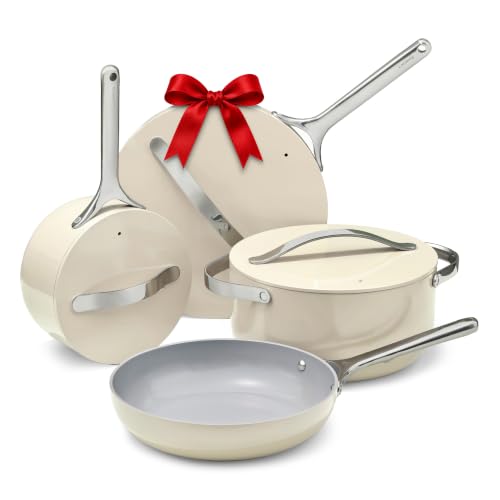
Caraway built its name on two ideas: ceramic-coated cookware stated to be PFAS and PFOA free in the listing title, and storage that treats the pans like the wearing surfaces they are — the 12-piece set includes magnetic pan racks and a canvas lid holder alongside the fry pan, saucepan, sauté pan and Dutch oven. If you want the ceramic route and a kitchen that looks considered rather than accumulated, this is the set designed for you.
Strengths
- PFAS and PFOA free stated in the listing title
- Included pan racks and lid storage protect the ceramic surface between uses
- Complete four-vessel core with lids, oven safe and induction compatible per the listing
Trade-offs
- Same ceramic reality as any rival: the release surface wears over years, not decades
- Premium tier for a four-vessel set — you are paying for design and storage as well as pans
- Light colours show exterior scorch marks that darker sets hide
| Pieces | 12-piece set (incl. storage) |
| Surface | Ceramic non-stick coating, PFAS and PFOA free (per listing) |
| Includes | 10.5-in fry pan, 3-qt saucepan, 4.5-qt sauté pan, 6.5-qt Dutch oven, lids, 4 magnetic pan racks, canvas lid holder |
| Colour | Cream (other colourways on the listing) |
| Compatibility | Induction compatible, oven safe |
The storage system is not a gimmick — it is the most honest part of the product. Ceramic coatings die by a thousand contacts: stacked pans grinding, lids sliding, utensils clattering in a drawer. Caraway’s racks keep every coated surface separated, which is how a ceramic set reaches the good end of its lifespan instead of the disappointing end. The pans themselves cook as modern ceramic should: quick, even heating from the aluminium core, easy release, and a Dutch oven size that handles a family pasta bake.
Position it correctly in your head — a well-designed, PFAS-free ceramic system with a finite surface life, bought by people who value how their kitchen looks and how an egg slides today over how a pan performs in year fifteen — and it delivers exactly that. Readers who feel a small pang at “finite surface life” have their answer in the four bare-metal picks above this one, and this guide is content either way.
Best for: design-conscious cooks who want PFAS-free ceramic with storage that protects it / Not suited for: anyone buying cookware as a decades-long, one-time purchase
Check the current price on Amazon for the Caraway 12-Piece Cookware Set.
Comparison Table
| Pick | Badge | Key spec | Best for |
|---|---|---|---|
| Lodge Cast Iron 5-Piece Set | Best Overall | Cast iron, PFAS-free, pre-seasoned | cooks who want the simplest possible material story and cookware that improves with age |
| LEGEND Cookware 5-Ply 14-Piece Cookware Set | Best Stainless, No Coatings | 5-ply stainless, no coatings, PFAS-free stated | families who want a complete coating-free clad set with the claim stated by the maker |
| Cuisinart Chef’s Classic 11-Piece Cookware Set (77-11G) | Best Budget Non-Toxic | Stainless, PFAS-free stated, lifetime warranty stated | budget buyers replacing coated pans with simple, stated-PFAS-free stainless |
| STAUB Cast Iron 4-Piece Stackable Set | Best Enamelled Cast Iron | Enamelled cast iron, made in France, stackable | braise-loving cooks who want enamel’s easy care in a space-saving, coating-free set |
| GreenPan Valencia Pro 11-Piece Cookware Set | Best Ceramic Nonstick | Ceramic nonstick, PFAS-free stated, induction ready | cooks who want easy-release cooking without PTFE and accept a wearing surface |
| Caraway 12-Piece Cookware Set | Best Designed Ceramic Set | Ceramic, PFAS/PFOA-free stated, storage included | design-conscious cooks who want PFAS-free ceramic with storage that protects it |
How to Choose a Non-Toxic Cookware Set
Begin with the material, because in this category the material is the claim. The surfaces with the longest, simplest food-contact histories are bare stainless steel, cast iron (bare or enamelled) and carbon steel: nothing is applied to them that can wear into food, and their behaviour at any cooking temperature is well understood. Ceramic nonstick is the next tier of simplicity — a silica-based surface without fluoropolymers — with the honest asterisk that it wears. Conventional PTFE nonstick is a different material family entirely; readers avoiding PFAS should note that PTFE is itself a fluoropolymer, which is why no PTFE set appears in this guide.
Reading claims like a sceptic
- Trust claims that name the substance: “PFAS-free,” “made without PTFE, PFOA or PFAS” — as the listings in this guide do — can be checked and compared.
- Discount claims that name nothing: “chemical-free” and “eco” are marketing, since everything is chemicals and nothing is impact-free.
- Check what the claim attaches to. A PFAS-free surface on a pan is one thing; a brand-level slogan may not describe the specific set in your cart.
- Remember that “non-toxic” is not a regulated certification. The material itself — steel, iron, enamel, ceramic — is the evidence; the adjective is decoration.
Then match the material to your cooking honestly. Bare stainless and cast iron ask for technique — preheating, patience with proteins, a little fat — and repay it with decades of service and high-heat freedom. Ceramic asks for gentleness and repays it with easy release for eggs, fish and sticky reheats. Many households in this guide’s audience end up mixed: stainless or iron as the permanent skeleton, one ceramic pan as the delicate-work specialist. That is not indecision; it is the materials used where each is strongest.
Caring for Coating-Free and Ceramic Cookware
Bare metal care is mostly about heat discipline. Preheat stainless before adding oil and food stops sticking; deglaze while warm and cleaning is a wipe; simmer baking-soda water for anything stubborn. Cast iron wants drying on the hob and a whisper of oil while warm; enamel wants the same gentleness you would give a good plate — no thermal shocking from ripping hot to cold water, and wooden or silicone tools on the surface.
Ceramic care is about preserving a thin, hard, slightly fragile surface: medium heat rather than maximum (ceramic conducts well and rarely needs more), no aerosol sprays whose additives bake onto the surface, hand washing where practical, and storage that keeps coated faces apart — the reason one pick in this guide ships with racks. Follow those rules and ceramic gives its full service life; ignore them and even the best ceramic set in this guide will tire early. None of this is medical advice — it is simply how to get the years you paid for out of materials chosen for their simplicity.
What About the Rest of the Kitchen? Extending the Same Logic
Readers who start with cookware usually ask where the same material logic leads next, and the honest answer is: to fewer, simpler objects. Bakeware in bare aluminised steel, stainless or cast iron follows the same no-coating principle as the sets in this guide. Utensils in stainless steel, wood or high-heat silicone remove the melting-plastic question from the pan entirely. Storage in glass and steel replaces the plastics debate with materials whose behaviour is settled. None of this requires a purge — the staged approach from our mistakes section applies: replace by wear and by use frequency, starting with whatever touches hot food daily.
It is equally worth saying what this logic does not require. It does not require discarding a sound PTFE pan in a panic tonight — this guide’s position is about what to buy next and what the materials are, stated from the listings themselves, not alarm. It does not require imported, artisanal or expensive versions of anything: the budget pick in this guide is a mass-market stainless set whose listing simply states what it is. And it does not require certainty about questions the evidence has not settled; it requires only that the surfaces you cook on be ones whose composition you can name. That standard — nameable surfaces — is achievable at every tier in this guide, which is rather the point.
Building the Rest of a Low-Question Kitchen, Gradually
Cookware is where this search starts, but the same readers usually extend the logic in a predictable order, and the order matters more than the speed. After the daily pans, the highest-contact items are the spatula and spoon that sit in hot food, the cutting boards that meet every ingredient, and the containers that store leftovers warm. Stainless tools, solid wood boards maintained with oil, and glass or steel storage are the settled-material answers in each case — the same philosophy as the sets in this guide: surfaces you can name, with nothing applied that can wear into the meal.
What the philosophy does not demand is simultaneity. A kitchen converted over two years of considered replacements ends up better fitted than one converted in a weekend of anxious ordering, because each purchase gets made at the size and shape your cooking actually uses. The cookware sets in this guide are the natural first step precisely because they are the highest-heat, highest-contact, longest-lived items in the room. Start there, cook on them for a season, and let the rest of the kitchen follow at the pace of genuine need.
And keep the perspective this guide opened with: the goal is a kitchen whose surfaces ask no questions, not a household run on vigilance. Steel, iron, enamel, wood and glass have fed people safely for a very long time. Choosing them is less a health intervention than a return to the default settings of cooking — which is why, once the swap is made, most people stop thinking about it entirely. That forgetting is the real product being sold in this guide, and every pick here delivers it.
Temperature Honesty: What Heat Does to Each Surface
Heat is where material differences stop being philosophical. Bare stainless and cast iron are indifferent to any temperature a home oven or burner produces — their surfaces are metal and mineral all the way through, which is why the iron and steel picks in this guide carry the highest oven ratings and the fewest handling rules. Enamel is similarly robust within its one weakness: sudden temperature change, not temperature itself, is what can craze or chip it, so it goes into a preheating oven rather than under a cold tap while hot.
Ceramic nonstick asks for the most heat discipline of the surfaces here. Its silica-based layer tolerates normal cooking temperatures comfortably — the GreenPan pans in this guide are rated to 600°F — but sustained maximum-burner preheating ages the release faster than any other habit, and the makers’ care guidance reflects that. The fair summary is not that ceramic is fragile; it is that ceramic has a preferred operating style (medium heat, prompt washing, separated storage) and rewards it with its full service life. Choose the surface whose preferred style matches how you actually cook, and the non-toxic question largely answers itself.
How to Cook on Stainless Steel and Cast Iron Without Sticking
Most “sticking” complaints about non-toxic cookware are really temperature complaints. This routine works for the stainless and iron picks in this guide and removes the main reason cooks reach for coated pans.
- Start with a dry pan on medium heat for one to two minutes. Stainless and iron both need to be properly hot before food or oil arrives.
- Test stainless with water: a flicked droplet should skitter across the surface in dancing beads. Too cool and it sizzles flat; that is the sticking zone. Cast iron is ready when a hand held above it feels strong, even heat.
- Add oil now — not before — and give it ten seconds to shimmer. Oil added to a hot pan stays fluid and coats evenly instead of pooling and scorching.
- Lay the food in and leave it alone. Proteins bond to metal, then release themselves as the crust forms and moisture at the interface cooks off. If it resists the spatula, it is not ready; wait thirty seconds and try again.
- Manage heat down, not up. Once searing is established, bare metal usually cooks a setting lower than you expect, because the pan is holding and spreading heat efficiently.
- For eggs and fish — the true test — use the same routine with a little more fat and a fully preheated pan, or simply accept the division of labour and cook them in the ceramic pan if your kitchen has one.
A week of cooking this way rewires the instinct that food needs a coating to behave. The pan was never the problem; the temperature was.
Common Buying Mistakes
Treating “non-toxic” as a certification
There is no regulator stamping cookware “non-toxic.” The phrase is a starting point for reading, not a conclusion. Judge the material — stainless, iron, enamel, ceramic — and the specific substances the maker names as absent, as this guide did from each listing, rather than the adjective on the box.
Assuming all nonstick is the same material
PTFE nonstick and ceramic nonstick are different surface families with different compositions and different lifespans. A reader avoiding PFAS who rejects ceramic along with PTFE gives up the easiest-release PFAS-free option; a reader who thinks ceramic lasts like steel is in for disappointment. Know which surface you are actually buying.
Overheating empty pans “to get them ready faster”
Blasting any pan empty on maximum heat is bad practice — it discolours steel, stresses enamel and ages ceramic surfaces fastest of all. Medium heat for a minute or two reaches cooking temperature in every pick in this guide. Patience here is the cheapest cookware care there is.
Replacing a whole kitchen in one anxious purchase
If your current pans are intact and you simply want to move toward simpler materials, replace in the order you use things: the daily fry pan first, then the saucepan, keeping sound pieces in service. A rushed full-kitchen swap often lands on the wrong sizes; a staged one — guided by the picks here — lands on a kitchen that fits your actual cooking.
Final Recommendation
The calm centre of this guide is bare metal: the Lodge cast iron set for the simplest material story in cooking, the LEGEND 14-piece for a complete coating-free clad kitchen, the Cuisinart Chef’s Classic for the same philosophy at a budget tier, and the STAUB stackable set where enamelled iron makes braising effortless. If easy release is non-negotiable, the GreenPan Valencia Pro and Caraway sets are the PFAS-free ceramic options — bought with clear eyes about surface lifespan.
Keep reading around the decision: Best Cookware Sets No Glass Lids for the shatter-proof lid angle, Best Cookware Sets Lifetime Warranty for the sets with decades promised in writing, Best Cookware Sets German for verified made-in-Germany stainless, Best 8 Ceramic Cookware Sets for the wider ceramic field, and Best Cookware Sets For Glass Cooktops if your hob needs gentle bases as much as your food needs clean ones.
Start your shortlist with the top three picks: Lodge Cast Iron 5-Piece Set, LEGEND Cookware 5-Ply 14-Piece Cookware Set, Cuisinart Chef’s Classic 11-Piece Cookware Set (77-11G) — each link goes to the current listing so you can check the current price on Amazon and confirm the piece list before you buy.
Frequently Asked Questions
What is the safest, simplest cookware material?
Bare stainless steel and cast iron have the longest track records and the simplest compositions: food touches metal (or, on cast iron, metal plus baked-on oil seasoning), with no manufactured coating involved. Enamelled cast iron adds a fused glass surface that is likewise inert and durable. This guide makes no medical claims — it simply notes that these materials ask the fewest questions, which is why they lead the picks.
Is ceramic nonstick really PFAS-free?
Ceramic nonstick surfaces are silica-based sol-gel coatings, a different material family from fluoropolymer nonstick, and the ceramic sets in this guide state PFAS-free (and for Caraway, PFAS and PFOA free) in their own listings. The trade-off is lifespan: ceramic release fades gradually over years of use, while bare stainless and iron surfaces do not wear out at all.
Does stainless steel leach anything into food?
Stainless steel is the standard material for commercial kitchens and food processing precisely because its chromium-rich passive surface is stable and food-safe in normal cooking. Highly acidic foods simmered for very long periods can pick up trace metallic taste in any metal pan — a flavour issue cooks manage by moving long tomato sauces to enamel, not a reason to avoid the material. Listings in this guide describe the steel grades used where relevant.
Is PTFE nonstick the same thing as PFAS?
PTFE is a fluoropolymer, and PFAS is the wider family of per- and polyfluoroalkyl substances that fluoropolymers belong to — which is why readers who set out to avoid PFAS generally avoid PTFE-coated pans too, and why this guide contains none. Older nonstick was also associated with PFOA, a processing chemical phased out of production; the ceramic and bare-metal picks here sidestep the entire family tree.
How long does ceramic nonstick last compared with stainless?
Expect a few years of strong release from a well-kept ceramic set — the makers in this guide reinforce their surfaces and publish care rules for a reason — versus effectively indefinite service from stainless or cast iron, whose surfaces cannot wear away. Many households treat ceramic as the replaceable specialist and bare metal as the permanent core, which this guide considers the rational arrangement.
Can I put non-toxic cookware in the dishwasher and oven?
Mostly yes, with material-specific limits stated in each listing: the stainless and cast iron picks here are oven-safe to high temperatures, glass lids (where fitted) cap lower, and ceramic lasts longest with hand washing. Check the individual listing for the set you choose — every pick in this guide links to its own care and temperature details.
Is enamelled cast iron a good choice for acidic foods?
Yes — enamel is one of the best surfaces for long, acidic cooking, because the fused glass layer does not react with tomato, wine or vinegar the way bare metals can, and it does not strip like the seasoning on raw cast iron. That is why the STAUB set in this guide is positioned for braises and sauces. Keep the care rules: avoid thermal shock and metal impacts that can chip the enamel, and it will serve for decades.
What about aluminium cookware — is it non-toxic?
Bare aluminium is a traditional, widely used cookware material, and anodising hardens its surface further; the sets in this guide that use aluminium (the ceramic picks) use it as a body material under their cooking surfaces, which is the common modern pattern. Readers who prefer to minimise aluminium contact entirely have the stainless, iron and enamel picks — four of the six sets here — to choose from, which is why this guide leads with them.
Should I throw away my existing nonstick pans today?
That is a personal judgement this guide deliberately does not make for you. What the evidence in these listings supports is a buying direction: when coated pans wear out — and scratched, flaking nonstick should be retired on condition alone — the replacements that ask no further questions are the bare-metal sets in this guide. A staged replacement, pan by pan as each reaches the end of its life, is the approach most households actually complete.

