Disclosure: airfryerkitchensupply.com is reader-supported. When you buy through links on our site, we may earn an affiliate commission at no extra cost to you.
Where to buy
Every sink in this guide to the best kitchen single bowl stainless steel undermount sinks is sold through Amazon, where the listing confirms the exact bundle — important in a category where some sinks include the grid and drain and some do not. Start with the Kraus KHU100-30 for the complete benchmark package, or its 32-inch sibling the KHU100-32 if your cabinet allows. Counter-space hunters want the Kraus KWU110-30 workstation; heavy-build hunters the SANYCASA 3mm workstation; big-batch cooks the BoomHoze 30×19; and budget remodels the Kichae 30.
The best kitchen single bowl stainless steel undermount sinks are the default sink of the modern kitchen for good reasons: one uninterrupted bowl that fits the pans you actually own, steel that cannot chip and never goes out of style, and an undermount installation that lets you sweep the counter straight into the bowl. This guide compares the best kitchen single bowl stainless steel undermount sinks across the decisions that actually separate them — gauge, size, workstation ledges, corner geometry, and what is in the box — with every pick verified against Amazon’s catalog data before it earned a place.
There is a reason this exact format — single bowl, stainless, undermount — became the default recommendation of kitchen designers over the last decade, and it is not fashion. It is the only sink format with no structural weakness: the bowl has no divider to strand a pan, the material has no glaze to chip or coating to wear, and the mounting has no rim to trap crumbs or interrupt the counter’s sweep. Every alternative format wins on some specific axis — fireclay on looks, double bowls on staged washing, workstations on small-kitchen space math — and this guide’s other picks cover two of those axes. But the plain format’s completeness is why it anchors the category, and why the differences between good and great examples of it are worth a guide of their own.
Two framing facts before the picks. First, size is dictated by cabinet: a 30-inch sink wants a 33-inch base, a 32-inch sink wants 36, and no enthusiasm overrides a tape measure. Second, the spread in this category is not really about the bowl — it is about everything around the bowl: whether a grid and drain are included, how the corners clean, how the steel is padded, and whether the brand will sell you parts in ten years. That is what the reviews below weigh. Check the current price on Amazon from each pick’s link, and confirm the box contents on the listing, because bundles in this category genuinely vary.
In this guide
Quick Picks
- Kraus Standart Pro KHU100-30 30-Inch Undermount — Best Overall. The benchmark 30-inch single bowl: TRU16 steel, rounded corners, channel grooves, NoiseDefend pads, and a full accessory kit in the box — the safest single purchase in this category. Check the current price on Amazon.
- Kraus KWU110-30 30-Inch Workstation Undermount — Best Workstation. The KHU100’s workstation sibling: same TRU16 steel and NoiseDefend build, plus an integrated ledge with a cutting board and roll-up rack included, turning the bowl into counter space. Check the current price on Amazon.
- SANYCASA 30-Inch 11-Gauge Workstation Undermount — Best Heavy-Duty Build. A workstation undermount built from 3mm steel — dramatically thicker than the 16-gauge standard — with an integrated ledge and a full workstation set, for buyers who equate mass with quality. Check the current price on Amazon.
- BoomHoze 30×19-Inch Undermount Workstation — Best Deep Bowl. A 30×19-inch footprint — an inch deeper front-to-back than standard — with a 10-inch-deep commercial-style bowl and workstation ledge, for cooks whose pans defeat normal sinks. Check the current price on Amazon.
- Kichae 30-Inch Undermount Single Bowl — Best Budget. A handmade-look 30×18 undermount in genuine 16-gauge steel with rounded corners, at the budget tier — proof that the important spec, the gauge, does not require a premium brand. Check the current price on Amazon.
- Kraus Standart Pro KHU100-32 32-Inch Undermount — Best Larger Size. The KHU100 formula at 32 inches: TRU16 steel, rounded corners, drain grooves, and NoiseDefend pads, for 36-inch cabinets that can give the bowl two more inches of width. Check the current price on Amazon.
How These Picks Were Chosen
We required three things of every pick: a single bowl, a stainless undermount format, and 16-gauge steel as the floor — with one deliberate exception, the SANYCASA, which exceeds the standard at 3mm. Thinner 18-gauge sinks were excluded regardless of styling, because gauge is the spec that decides denting, drumming, and bowl flex across a decade of use, and it cannot be upgraded after installation.
Within that floor, we weighed the ownership details: corner radius and cleanability, drain geometry, sound treatment, accessory completeness, workstation value where a ledge is offered, and the depth of each brand’s parts and support channel. Kit contents were taken from the manufacturers’ own listing data, and where a budget listing’s bundle is inconsistent, the review says so plainly rather than assuming. As everywhere in this program, prices are left to the live listings — heavy fixtures fluctuate too much for printed figures to stay honest.
The 6 Best Kitchen Single Bowl Stainless Steel Undermount Sinks

Kraus Standart Pro KHU100-30 30-Inch Undermount — Best Overall
Some products become the reference point for their category, and the KHU100-30 is that product for single-bowl undermounts. Its formula is unglamorous and exactly right: a 30-inch bowl in genuine 16-gauge T-304 steel, corners rounded enough to clean with a single sponge pass, a bowl floor grooved to move water to the drain, and sound pads that keep the disposal’s growl and the faucet’s drumming at conversation level. It fits a 33-inch cabinet, which is the most common sink base in American kitchens, and it arrives with the grid, drain, and hardware that rival sinks make you buy separately.
It suits the widest range of households in this guide: family kitchens that wash everything from sheet pans to a Sunday stockpot, renovators who want a proven model with a decade of installers’ familiarity behind it, and anyone who values the boring virtues — fit, finish, parts availability — over novelty. If you read nothing else in this article, the short version is that this is the sink against which the other five are priced and judged.
Strengths
- Complete kit in the box: grid, drain assembly, hardware, and template included
- Rounded corners and drain grooves make daily cleaning genuinely easy
- NoiseDefend padding keeps a big steel bowl civilized under a disposal
Trade-offs
- The classic design has no workstation ledge for sliding accessories
- At 10 inches deep it asks shorter cooks to reach — check the ergonomics section below
- Its popularity means it looks like everyone’s sink, because it is
| External dimensions | 30 x 18 in; bowl 28 x 16 x 10 in (listing-verified) |
| Minimum cabinet | 33 in (listing-verified) |
| Steel | T-304, 16 gauge (listing-verified) |
| In the box | Bottom grid, drain assembly with strainer, mounting hardware, cutout template, towel (listing-verified) |
What long ownership reveals is the value of the details Kraus got right early. The rounded corner radius is the Goldilocks point of sink design: tight enough that the bowl floor stays usefully flat for pans, open enough that a sponge clears the corners without a brush. The channel grooves sound like marketing until you rinse the bowl at night and watch water actually leave instead of sheeting into puddles that dry as mineral maps. And the included grid fits the bowl’s exact floor, which third-party grids rarely do.
Support is the other long-game argument. Kraus sells grids, drains, and strainers for this model through normal channels, and any plumber in America has installed one. For a fixture that is literally set in stone — undermounted beneath a counter you will not remove — that ecosystem is worth more than a marginal design flourish. This is the default recommendation, and it has earned the position.
Best for: Almost any kitchen with a 33-inch or larger cabinet wanting one proven, complete, do-everything sink / Not suited for: Counter-space-starved kitchens that need a workstation ledge to function
Check the current price on Amazon for the Kraus KHU100-30.

Kraus KWU110-30 30-Inch Workstation Undermount — Best Workstation
The workstation idea is simple: mill a ledge into the bowl’s rim, and boards, colanders, and drying racks slide along it, working over the sink instead of beside it. The KWU110-30 is that idea executed by the same line that makes our top pick — 16-gauge TRU16 steel, NoiseDefend pads, and the two accessories that prove the concept, a cutting board and a roll-up drying rack, included in the box rather than sold as a second purchase.
It suits kitchens where counter space is the binding constraint — galley kitchens, apartment kitchens, any layout where a cutting board normally lives on the stove. The workflow is real: chop over the bowl and sweep scraps in, rinse produce in a colander on the ledge while the bowl soaks a pan, park washed glasses on the roll-up rack to drain into the sink instead of onto a towel. Each of those is a small daily reclaiming of space that adds up to a different kitchen.
Strengths
- Integrated ledge with board and rack included — the workstation works on day one
- Same 16-gauge TRU16 construction and NoiseDefend pads as the benchmark KHU line
- Roll-up rack doubles as a trivet and a small-item drying station
Trade-offs
- The ledge slightly narrows the bowl’s top opening versus a plain sink
- Workstation accessories are model-specific; expanding the kit means buying Kraus’s
- Corners are tighter than the KHU100’s, so cleaning takes a touch more attention
| Steel | 16-gauge TRU16 (per Amazon title) |
| Ledge | Integrated workstation ledge (per Amazon title) |
| Included | Cutting board and roll-up rack (per Amazon title) |
| Sound | NoiseDefend soundproofing (per Amazon title) |
The honest test of a workstation is whether the accessories leave their drawer. Kraus’s do, mostly because the two included pieces cover the two highest-frequency jobs — a board and a drying rack — and because the ledge is integrated into the steel rather than clipped on, so accessories slide with a solidity that aftermarket rails never match. The roll-up rack in particular becomes invisible infrastructure: hot pans land on it, rinsed herbs drain on it, and it rolls into a drawer corner when the bowl needs to be fully open.
Choose this over the top pick if your counters are genuinely scarce; choose the top pick if they are not, because the plain bowl is marginally easier to clean and the kit is marginally cheaper. Either way you are buying the same steel, the same sound treatment, and the same support channel — the decision is purely about how your kitchen works.
Best for: Small and galley kitchens where a ledge that returns counter space changes daily cooking / Not suited for: Kitchens with generous counters, where the ledge solves a problem you do not have
Check the current price on Amazon for the Kraus KWU110-30.
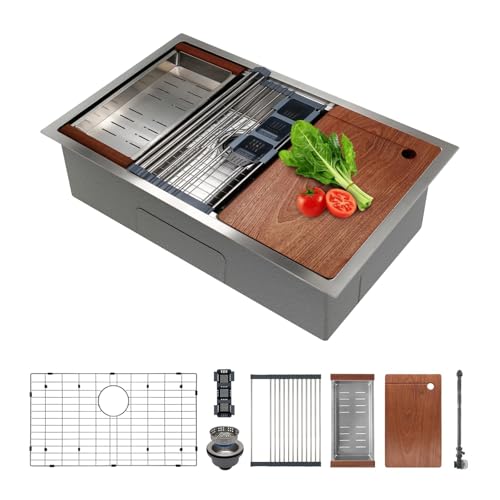
SANYCASA 30-Inch 11-Gauge Workstation Undermount — Best Heavy-Duty Build
Every category has a buyer who asks the same question: what is the heaviest-built one? For single-bowl undermounts, the answer is this SANYCASA. Its bowl is formed from 3mm stainless steel — sold as 11-gauge — against the 1.5mm of a 16-gauge sink. That is not a marginal difference; it is double the material, and you feel it in everything: the bowl does not flex, does not oil-can, does not drum, and shrugs at impacts that would dent thinner steel. Around that bowl it builds a workstation format with an integrated ledge and a multifunctional accessory set.
It suits buyers who keep things for decades and spec accordingly, households hard on equipment, and anyone who has dented a thin sink and sworn never again. The superior-drain design addresses the other heavy-use complaint, slow and incomplete draining, with a floor pitched to move water decisively.
Strengths
- 3mm steel is in a different durability class from standard 16-gauge bowls
- Integrated ledge plus workstation set covers prep and drying over the bowl
- Heavy mass delivers near-silent operation without relying on pads alone
Trade-offs
- Weight cuts both ways: installation needs solid support and a second pair of hands
- A newer brand; its decade-long parts support is unproven next to Kraus or Elkay
- Thick steel and tight geometry make the corners the most demanding here to keep clean
| Steel | 11 gauge / 3mm stainless steel (per Amazon title) |
| Configuration | Single bowl with integrated ledge (per Amazon title) |
| Kit | Multifunctional workstation set (per Amazon title) |
A word of calibration: thicker steel is real, but it is not magic. It will not resist scratches better — surface hardness is similar — and it cannot fix a bad installation. What it buys is structural: a bowl floor that stays flat under a full load of water and cast iron, rim edges that do not flex against the counter seal, and an acoustic deadness that makes the whole sink feel carved rather than folded. If you are the buyer who taps a sink in the showroom and judges by the sound, this one thuds where others ring.
Buy it with the install planned: confirm the cabinet can carry the sink plus a full bowl of water, use the maker’s template, and set it with a helper. Treated that way, the SANYCASA is the pick for the household that breaks things and is tired of it.
Best for: Hard-use households and decades-long owners who prioritize sheer build mass / Not suited for: DIY installers working alone, or buyers who rank brand track record above specifications
Check the current price on Amazon for the SANYCASA 30 workstation.

BoomHoze 30×19-Inch Undermount Workstation — Best Deep Bowl
Most 30-inch sinks are 30×18; the BoomHoze stretches the format to 30×19 and keeps the bowl a full 10 inches deep, and that extra inch of front-to-back room plus true commercial depth changes what fits. A half-sheet pan lies flat with room to spare, a tall stockpot sits fully below the rim so the faucet can swing over it, and a day of canning jars stands in one load. The workstation ledge runs along the bowl, so the prep-over-the-sink workflow is available in the big format too.
It suits serious home cooks, bakers, canners, and brewers — the people whose equipment is sized by the batch, not the serving. Commercial styling is part of the package: squared geometry, a utilitarian finish, and no attempt to look like anything but a tool.
Strengths
- 30×19 footprint and 10-inch depth swallow equipment that defeats standard bowls
- 16-gauge steel keeps the big bowl quiet and dent-resistant
- Workstation ledge adds prep space in the large format
Trade-offs
- The 19-inch depth needs a cabinet and counter run that can take it — verify front-to-back fit
- Deep bowls ask shorter cooks to reach down; consider who washes up
- Commercial styling reads industrial next to traditional cabinetry
| Dimensions | 30 x 19 in (per Amazon title) |
| Depth | 10 in (per Amazon title) |
| Steel | 16-gauge stainless steel (per Amazon title) |
| Style | Commercial single bowl workstation (per Amazon title) |
Fit is the whole conversation with this sink. Front-to-back is the dimension remodels forget: the counter must cover the bowl’s 19 inches plus the undermount reveal, and the cabinet interior must clear the bowl and its plumbing. Measure both before ordering — in a standard-depth cabinet run it usually fits, but ‘usually’ is not a measurement. The reward for the homework is a bowl that ends the nightly negotiation about what gets washed in the sink and what gets washed in a tub on the floor.
Daily life in a deep commercial bowl is straightforward: everything fits, the ledge handles prep, and the squared corners want a brush in the cleaning kit rather than just a sponge. For the batch-cooking household, that is a trade made gladly.
Best for: Bakers, canners, brewers, and batch cooks whose equipment is oversized / Not suited for: Shallow cabinet runs, shorter cooks, or traditional-styled kitchens
Check the current price on Amazon for the BoomHoze 30 workstation.

Kichae 30-Inch Undermount Single Bowl — Best Budget
Budget sinks usually cut the one spec that matters — they drop to 18-gauge steel and spend the savings on styling. The Kichae refuses that trade: it is a 30×18 single bowl in 16-gauge steel with a handmade, squared look and sensibly rounded corners, at a price tier well below the big brands. That makes it the value pick of this guide by a clear margin, because gauge is the difference between a sink that feels solid for fifteen years and one that drums and dents by year three.
It suits budget remodels, rental upgrades, first homes, and anyone whose renovation money is better spent on the countertop or faucet. The handmade styling — tight corners with a small radius, flat planes, a modern rectangular read — looks a class above its tier, especially under a stone counter where only the bowl shows.
Strengths
- Real 16-gauge steel at a budget tier — the key spec is not cut
- Handmade styling looks premium once undermounted
- Rounded corners keep cleaning simple
Trade-offs
- Accessory completeness varies by listing configuration — confirm what is in the box before ordering
- Brand support and parts channels are thinner than Kraus or Elkay
- Sound padding on budget sinks is usually lighter; expect a little more bowl noise
| Dimensions | 30 x 18 in (per Amazon title) |
| Steel | 16-gauge stainless steel (per Amazon title) |
| Corners | Rounded corner, handmade style (per Amazon title) |
Set expectations with the honesty the tier deserves. The steel is the real thing, but the finishing budget shows in small places: the polish is good rather than flawless, the included hardware (where included) is functional rather than heavy, and if sound deadening matters to you, a set of aftermarket pads is a cheap upgrade that closes most of the gap to the premium brands. None of that changes the core math — the bowl, the part set in stone for a decade, is built from the right material.
For a rental property or a flip, this calculus is even clearer: tenants and buyers see a modern handmade-look sink, and the owner paid for gauge instead of a logo. Just verify the exact box contents on the listing at order time, since budget listings bundle accessories inconsistently.
Best for: Budget remodels, rentals, and first homes that refuse to compromise on steel gauge / Not suited for: Buyers who want a complete premium kit and deep brand support in one purchase
Check the current price on Amazon for the Kichae 30 undermount.

Kraus Standart Pro KHU100-32 32-Inch Undermount — Best Larger Size
If your cabinet is a 36-inch base — the other common standard — the KHU100-32 is the natural upgrade from our top pick: the same TRU16 steel, the same rounded corners and grooved floor, the same NoiseDefend quiet, stretched two inches wider. Two inches sounds trivial on a spec sheet and is not trivial at the sink: it is the difference between a roasting pan sitting flat with room to maneuver and the same pan parked at a compromise angle, and it lets a soaking pan and a rinsing zone coexist in one bowl.
It suits larger households and bigger cooking in the standard 36-inch cabinet, and it is the pick we would make in any full remodel where the cabinet plan is still flexible — designing the sink base around a 32-inch bowl costs nothing at the planning stage and pays out daily.
Strengths
- Two extra inches of bowl over the 30-inch class, in the same proven design
- All the KHU virtues: rounded corners, drain grooves, sound pads, deep parts support
- Ideal match for the common 36-inch base cabinet
Trade-offs
- Will not fit the 33-inch cabinets the 30-inch model serves — measure first
- Like its sibling, no workstation ledge
- The bigger bowl wants a faucet with reach to cover it
| Size | 32 in (per Amazon title) |
| Steel | 16-gauge TRU16 (per Amazon title) |
| Features | Rounded corners, channel grooves, NoiseDefend pads (per Amazon title) |
Everything said about the KHU100-30’s ownership applies here, amplified slightly: the wider floor fits wider equipment, the grooves still move water properly, and the Kraus accessory ecosystem — grids and drains cut for the model — is fully available. The one planning note is faucet reach: a 32-inch bowl’s far corner is a long way from a faucet mounted behind the center, so pair it with a pull-down whose hose genuinely travels, and the pair will feel designed together.
Between this and the 30-inch top pick, the decision is made entirely by your cabinet tape measure. Have the inches? Take them.
Best for: 36-inch cabinets and larger households wanting the proven KHU design at full size / Not suited for: 33-inch cabinets — that is the KHU100-30’s job
Check the current price on Amazon for the Kraus KHU100-32.
Comparison Table
| Pick | Badge | Key spec | Best for |
|---|---|---|---|
| Kraus Standart Pro KHU100-30 30-Inch Undermount | Best Overall | 30×18 in, bowl 28x16x10 in, 16-gauge | Almost any kitchen with a 33-inch or larger cabinet wanting one proven, complete, do-everything sink |
| Kraus KWU110-30 30-Inch Workstation Undermount | Best Workstation | 30 in, 16-gauge, integrated ledge | Small and galley kitchens where a ledge that returns counter space changes daily cooking |
| SANYCASA 30-Inch 11-Gauge Workstation Undermount | Best Heavy-Duty Build | 30 in, 3mm (11-gauge class) steel, workstation set | Hard-use households and decades-long owners who prioritize sheer build mass |
| BoomHoze 30×19-Inch Undermount Workstation | Best Deep Bowl | 30×19 in, 10 in deep, 16-gauge | Bakers, canners, brewers, and batch cooks whose equipment is oversized |
| Kichae 30-Inch Undermount Single Bowl | Best Budget | 30×18 in, 16-gauge, rounded corners | Budget remodels, rentals, and first homes that refuse to compromise on steel gauge |
| Kraus Standart Pro KHU100-32 32-Inch Undermount | Best Larger Size | 32 in, 16-gauge, NoiseDefend | 36-inch cabinets and larger households wanting the proven KHU design at full size |
How to Choose the Best Kitchen Single Bowl Stainless Steel Undermount Sinks
Work through four decisions in order — cabinet size, gauge, ledge or no ledge, and depth — and the category narrows itself. Cabinet size is pure measurement: interior width minus roughly three inches gives your maximum sink width, and front-to-back depth matters too if you are tempted by a 19-inch-deep model. Gauge is a values decision we have effectively made for you in this guide: 16-gauge is the residential standard worth insisting on, 3mm is the heavy-duty overbuild, and 18-gauge is the false economy. The ledge decision is about your counters, covered below. Depth is about your household’s bodies and pans, also below.
Why gauge is the first spec to check
Gauge runs backwards — lower is thicker — and the practical ladder in residential sinks is 18-gauge (about 1.2mm), 16-gauge (about 1.5mm), and the heavy 3mm class. The differences are not subtle in use. Thicker steel resists the dent when a cast-iron pan lands corner-first; it flexes less under a full bowl’s weight, so the seal against the counter stays honest; and it sounds different — a lower, deader note under running water and disposal vibration, especially combined with proper sound pads. Since an undermount sink is effectively permanent, buying gauge is buying the next fifteen years of those moments. It is the last place to save money in a kitchen.
Workstation ledge: worth it, or a narrower bowl?
A workstation ledge converts the bowl’s rim into a rail for cutting boards, colanders, and drying racks. In a kitchen short on counter space it is transformative — prep happens over the sink, scraps sweep straight in, and washed items drain into the bowl instead of onto towels. The costs are real but modest: the bowl’s top opening narrows slightly, accessories are model-specific, and the ledge line adds a cleaning detail. Our rule: if you regularly cook with a board parked on the stove or the table for lack of counter, buy the workstation; if your counters are generous, buy the plain bowl and the easier clean.
Depth and ergonomics: the 9 vs 10 inch decision
Single bowls run deep, and depth cuts two ways. A 10-inch bowl swallows stockpots whole and contains splash from a high faucet; it also makes a shorter cook reach down into the bowl all evening, a strain that compounds across years. Nine inches is the ergonomic compromise many households land on, and taller households can take 10 without a thought. Consider also the stack beneath: bowl depth plus a garbage disposal plus drain plumbing must fit your cabinet’s interior height, and deeper bowls leave less room for under-sink storage. Measure the whole stack, not just the bowl.
Living with one bowl: how the workflow actually changes
Switching from a double bowl to a single bowl rearranges habits more than first-time buyers expect, and it is worth rehearsing honestly. The gains are the famous ones: every pan fits, every soak is simple, and washing a roasting rack stops being a spatial puzzle. The adjustments are smaller but real. Without a second basin, the rinse-and-set-aside flow needs a landing zone — a roll-up rack over the bowl, a small tub for the soaking stage, or the dishwasher used as the draining rack it secretly is. Most households settle into one of those within a week and stop thinking about it.
The single bowl also changes how the sink shares work with the dishwasher. In double-bowl kitchens the second basin often becomes a staging area for dishes waiting their turn; in single-bowl kitchens the bowl itself is the staging area, which is fine until you need the sink for cooking while it holds a load. The households that thrive with one bowl run the dishwasher a little more often and keep the bowl clear as a cooking tool. If your household’s pattern is a permanent pile in one basin and cooking in the other, be honest about that before converting — the double-bowl category exists for you, and there is no shame in it.
Accessories that earn their place, and those that do not
Three accessories genuinely earn their cost with a single-bowl undermount. A bottom grid fitted to the bowl protects the finish, keeps items out of standing water, and turns the bowl floor into a draining surface. A roll-up rack — included with workstation models, available for plain bowls — creates the missing second surface for drying and hot pans. And a small sink-side tub recreates the soak-and-rinse split on the days you need it, then lives in a cabinet the rest of the time. Together they close nearly every functional gap between a single bowl and a double, for a fraction of the price difference.
The accessories that do not earn their place are the decorative and the duplicative: sink-shaped organizers that shrink a bowl you bought for its size, in-sink caddies that trap grime at the waterline, and third-party workstation rails that wobble on rims they were not milled for. Buy the grid from the sink’s maker when one is offered — the fit to the bowl floor and corner radius is the entire point — and let the rest of the accessory catalog persuade you only after a month of living with the sink has shown you a real gap.
Corner radius, drain position, and the daily clean
Corner geometry decides your cleaning tools. Fully rounded corners rinse clean with a sponge but steal a little flat floor; near-zero-radius corners maximize the floor and the modern look but want a brush and a deliberate wipe. The middle radii on the Kraus KHU line are popular precisely because they split that difference. Drain position matters less in a single bowl than folklore suggests, but a slightly rear-set drain frees usable floor at the front and improves the under-sink layout; grooved or sloped floors, as on the KHU models, genuinely reduce the standing-water film that dries into mineral marks.
How to Measure and Prepare for an Undermount Sink Installation
An undermount sink is installed once and lived with for years, and nearly every regret traces back to a measurement skipped in the planning week. Work through this sequence before ordering.
- Measure the cabinet three ways: interior width (your sink should be about three inches narrower), interior front-to-back depth, and the height stack from cabinet floor to counter underside, accounting for the bowl depth plus disposal and drain fittings.
- Confirm the countertop plan with your fabricator: undermounts need a finished cutout with a small reveal — positive, negative, or flush — and the choice affects both looks and how crumbs behave at the rim. Decide it deliberately, not by default.
- Order the sink before the counter is cut, and have the fabricator template from the physical sink and its included template, not from a downloaded drawing alone.
- Dry-fit the accessories at the same time: the grid should sit flat, the drain assembly should match your disposal or strainer plan, and the faucet’s reach should cover the bowl’s far corner — a pull-down is the practical standard at these bowl sizes.
- Support the bowl properly: undermounts are held by clips, rails, or a support frame per the maker’s instructions — never by adhesive alone — and the cabinet must carry the sink plus a full bowl of water.
- Seal, connect, and test: a continuous silicone seal at the rim, drains connected at final position, then a full-bowl fill and drain test while you watch every joint from below with a flashlight.
If your remodel keeps the existing countertop, be honest about the constraint: undermount swaps under an existing counter are limited to sinks that match the existing cutout, which is why so many of them happen during a counter replacement. Plan the two projects together whenever you can.
While the cabinet is open, take the opportunity to solve the under-sink zone properly: confirm the shutoff valves turn freely, replace tired supply lines while access is free, and think through where the grid, the roll-up rack, and cleaning supplies will live so the disposal and drain stack keep their clearance. Installers charge by the visit; everything you bundle into this one is effectively free, and everything you defer becomes a second visit at full price. Photograph the finished under-sink layout before the doors go back on — the next plumber, possibly you at midnight with a leak, will be grateful for the map.
Common Buying Mistakes
Buying 18-gauge to save money
The savings are small and the compromise is permanent: more drumming, easier dents, a bowl that feels thin every day. In an undermount — the hardest sink to replace — gauge is the worst place to economize.
Guessing the cabinet fit
Sink width is not cabinet width. A 32-inch sink in a 33-inch cabinet is a return shipment, not an installation. Measure the interior and respect the three-inch rule.
Assuming the grid and drain are included
Some picks here include a full kit; others bundle inconsistently. A grid and drain bought separately are a real cost — check the listing’s box contents before comparing prices in your head.
Pairing a big bowl with a short faucet
A 30 or 32-inch bowl’s far corner is beyond a standard faucet’s stream. A pull-down with genuine hose travel is the matching choice; discovering the mismatch after the counter is drilled is an expensive order of operations.
Skipping the support frame
Adhesive alone is not an undermount installation. Clips, rails, or framing per the manufacturer carry the load; a bowl full of water and dishes is heavier than intuition suggests — a 30-inch bowl at washing depth holds well over a hundred pounds of water alone, before a single pot is added. Installers who shrug at support hardware are telling you they have not yet been called back for the failure, not that the failure does not happen.
Judging a sink by its showroom shine
Mirror-polished display sinks photograph beautifully and show every water spot in service. The brushed and satin finishes on the picks here are not a lesser tier — they are the finishes that look the same on day three hundred as on day one, because their fine grain breaks up spotting and blends the micro-scratches of daily use into a uniform surface. Choose the finish for the kitchen you live in, not the showroom you visited.
Final Recommendation
For most kitchens the KHU100-30 remains the answer: complete kit, right gauge, easy-clean corners, deep support — the benchmark because it does everything well. Take the KHU100-32 if your 36-inch cabinet offers the width, the KWU110-30 if your counters demand a workstation, the SANYCASA if build mass is your religion, the BoomHoze if your equipment is oversized, and the Kichae if the budget is real but your standards on gauge are not negotiable.
Measure the cabinet, insist on the gauge, confirm the box contents — in that order, this category is genuinely hard to get wrong.
And if you are choosing between two finalists on this list, let the tiebreaker be the life you actually cook: the household that bakes weekly should weight bowl floor area, the household that entertains should weight the workstation’s staging space, and the household that simply wants the sink question answered for fifteen years should take the benchmark and stop shopping. All three instincts are correct — for different kitchens. The picks above are ordered so that the first one that matches your kitchen is very likely the right one to buy.
Keep researching the cluster: Best Kitchen Farm Sinks Best Kitchen Sinks Blanco Stainless Steel Best Kitchen Faucet For Two Sinks Best 16 Gauge Stainless Steel Kitchen Sinks Best Deep Single Bowl Stainless Kitchen Sinks
Frequently Asked Questions
What size cabinet do I need for a 30-inch undermount sink?
The working rule is a base cabinet about three inches wider than the sink, so a 30-inch sink pairs with a 33-inch minimum cabinet, and a 32-inch sink with a 36-inch cabinet. Also check front-to-back depth and the under-sink height stack if you plan a garbage disposal.
Is 16-gauge steel really better than 18-gauge?
Yes, in ways you feel daily: 16-gauge is roughly a quarter thicker, so it resists dents, flexes less under load, and sounds quieter under running water and a disposal. For an undermount sink that is impractical to replace, it is the standard worth insisting on.
Do undermount sinks work with garbage disposals?
Yes — all six picks here accept a standard disposal flange. The planning point is space: bowl depth plus the disposal body plus drain fittings must fit your cabinet’s interior height, which is worth measuring on deep-bowl models.
What is the difference between a workstation sink and a regular sink?
A workstation has an integrated ledge milled into the bowl’s rim, so cutting boards, colanders, and drying racks slide over the bowl. It converts sink area into prep area — valuable in small kitchens, unnecessary in large ones. The bowl underneath is a normal single bowl.
How do I keep a stainless sink from looking scratched?
Use a bottom grid, rinse and wipe after heavy use, clean with a soft sponge in the direction of the grain, and avoid leaving wet cast iron or steel wool sitting in the bowl. Fine scratches are inevitable and blend into a uniform patina; the grid prevents the deep ones.
How long should a stainless undermount sink last?
Decades. The bowl itself has no wear-out mechanism short of abuse: 16-gauge steel does not rust through in kitchen service, does not chip, and its finish renews visually with normal cleaning. The parts that age are the consumables around it — the drain assembly, the grid’s feet, the faucet above it — all replaceable without touching the sink. Buying a well-made undermount is reasonably treated as a one-time purchase for the life of the kitchen.
Can I replace my drop-in sink with an undermount?
Only if the countertop is being replaced or recut — an undermount needs a finished cutout sized to it, and it mounts beneath the counter rather than resting on top. Most undermount conversions happen as part of a countertop project, which is the right time to choose the sink first and template the cut from it.


