Disclosure: airfryerkitchensupply.com is reader-supported. When you buy through links on our site, we may earn an affiliate commission at no extra cost to you.
Where to buy
Welcome to our guide to the best kenmore under cabinet microwaves — researched, verified against live product data, and written for buyers who want the honest shortlist without the sales pitch.
This search deserves a straight answer before any shopping: there is no current Kenmore under-cabinet microwave to buy. The format — a shallow microwave mounted under a wall cabinet — was a Sears-era category, and Kenmore’s line, like every brand’s, has left the mainstream market. What exists today, verified against Amazon’s product data and linked below, is the format’s modern successor: slim, low-profile over-the-range microwaves that mount under the cabinet run above a hob and give the counter back the same way. The original Kenmore under-cabinet models are covered in a clearly marked as unlinked entry. Prices are not printed; check the current price on Amazon for the live models.
- GE Profile UVM9125 1.2 Cu.Ft Low Profile Over-the-Range Microwave (Black) — Best Overall Under-Cabinet Solution. Check the current price on Amazon before you order, because microwave pricing and stock move around a lot.
- Samsung 1.1 Cu.Ft Smart SLIM Over-the-Range Microwave — Best Venting in a Slim Body. Check the current price on Amazon before you order, because microwave pricing and stock move around a lot.
- Cosmo COS-3012ORLP1SS 1.2 Cu.Ft Slim Over-the-Range Microwave — Best Value Slim OTR. Check the current price on Amazon before you order, because microwave pricing and stock move around a lot.
- Midea 1.2 Cu.Ft Slim Low Profile Over-the-Range Microwave — Best Sensor Cooking in a Slim Body. Check the current price on Amazon before you order, because microwave pricing and stock move around a lot.
- Kenmore Countertop Microwave 0.7 Cu.Ft 700W (Stainless Steel) — Best If You Must Have the Kenmore Badge. Check the current price on Amazon before you order, because microwave pricing and stock move around a lot.
- Kenmore Under-Cabinet ‘Space-Saver’ Microwaves (Original Sears-Era Models) — The Original — Legacy, Unlinked. This pick is covered without a link below: the Kenmore under-cabinet line is discontinued, with no current verified listing.
Measure the space under your cabinets and above your hob before falling for any model here: low-profile units are designed for standard 30-inch cabinet gaps, but the height from hob to cabinet underside decides whether your tallest stockpot still fits.
The search for the best Kenmore under cabinet microwaves is really a search for a lost format — and for the counter space it used to save. Kenmore’s under-cabinet ‘space-saver’ microwaves mounted beneath wall cabinets in the small kitchens of the Sears era, and owners remember them fondly because the idea was perfect: microwave at eye level, worktop completely clear. The category has since been absorbed by slim over-the-range design, and this guide does the honest thing: it explains the Kenmore original, then reviews the five current, verified machines that actually solve the same problem today.
In this guide
Quick Picks
Four slim low-profile over-the-range models carry the format’s torch, joined by the one current Kenmore compact shallow enough to live happily under a cabinet run on the counter, and the legacy Kenmore under-cabinet entry itself, unlinked, for owners and the curious.
- Best Overall Under-Cabinet Solution: GE Profile UVM9125 1.2 Cu.Ft Low Profile Over-the-Range Microwave (Black) — GE Profile’s low-profile design — 1000 watts, 400 CFM of venting and LED hob lighting in a shallow under-cabinet body.
- Best Venting in a Slim Body: Samsung 1.1 Cu.Ft Smart SLIM Over-the-Range Microwave — Samsung’s SLIM design hides the strongest vent in this guide — 550 CFM — plus Wi-Fi and voice control in a shallow body.
- Best Value Slim OTR: Cosmo COS-3012ORLP1SS 1.2 Cu.Ft Slim Over-the-Range Microwave — Cosmo’s Stellar Collection slim model — 1.2 cubic feet and 1000 watts in a 30-inch low-profile body at a value tier.
- Best Sensor Cooking in a Slim Body: Midea 1.2 Cu.Ft Slim Low Profile Over-the-Range Microwave — Midea’s slim stainless model pairs the low-profile body with sensor cooking at 1000 watts.
- Best If You Must Have the Kenmore Badge: Kenmore Countertop Microwave 0.7 Cu.Ft 700W (Stainless Steel) — the only current Kenmore route to the under-cabinet look — a shallow stainless compact that lives on the counter beneath the cabinets.
- The Original — Legacy, Unlinked: Kenmore Under-Cabinet ‘Space-Saver’ Microwaves (Original Sears-Era Models) — the original space-savers were shallow, cabinet-mounted and clever — and they belong to a discontinued era, explained here for their many remaining owners.
How These Picks Were Chosen
Verification shaped this guide more than any other in the batch. We searched the live catalogue for Kenmore under-cabinet microwaves specifically, and for Kenmore microwaves generally. No under-cabinet Kenmore verified as a current product — the current Kenmore range confirmed by those searches is the countertop compacts and a standard-depth 1.7 cubic foot over-the-range model, neither of which is a slim under-cabinet unit. Rather than fill this page with stale listings, we verified the modern successors instead: slim, low-profile over-the-range models whose listings confirm the shallow-depth, under-cabinet mounting that defines the job.
The successor picks were judged on the under-cabinet brief itself: shallow height so pots still fit on the hob, genuine mounting into a standard 30-inch cabinet gap, venting strong enough for hob duty (these machines double as cooker hoods), sensor cooking where offered, and capacity honest about the format’s limits. A slim OTR is typically 1.1 to 1.2 cubic feet — compact-plus, not family size — and the reviews say so.
The Kenmore under-cabinet originals are assessed in an unlinked entry on their own terms, because thousands are still mounted in kitchens and their owners need maintenance and replacement guidance, not a sales pitch for a product that no longer exists. That structure — one honest legacy entry, five buyable successors — is the truthful shape of this search in today’s market.
The Best Kenmore Under Cabinet Microwaves Question, Answered Honestly: Modern Successors and the Original
Entries one to five are current, verified products you can buy. Entry six is the Kenmore under-cabinet original, unlinked with no purchase link, included because it is the reason this page exists.
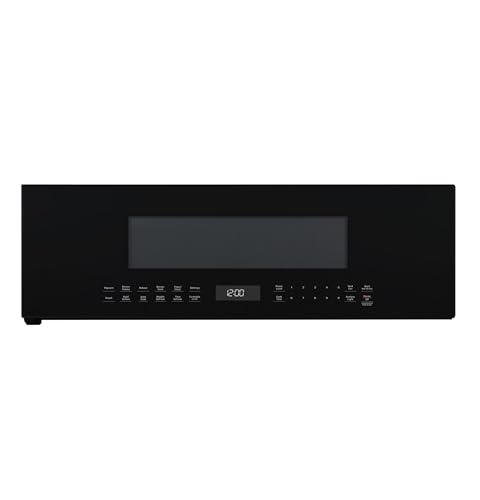
GE Profile UVM9125 1.2 Cu.Ft Low Profile Over-the-Range Microwave (Black) — Best Overall Under-Cabinet Solution
The GE Profile UVM9125 is what the under-cabinet idea grew up to be: a low-profile over-the-range microwave that mounts in the standard 30-inch cabinet gap above the hob, in a shallow body that leaves room for tall pots below, while delivering a full 1000 watts, a serious 400 CFM hood vent and LED lighting for the hob. In black, it also suits the darker cabinet schemes where the Kenmore-era white space-savers would look lost. For most kitchens asking the under-cabinet question today, this is the answer.
Strengths
- 400 CFM venting is genuine cooker-hood performance, not a token fan — the OTR format’s whole second job done properly
- Low-profile body preserves headroom and stockpot clearance over the hob
- 1000 watts and 1.2 cubic feet is the strongest cooking package in the slim class
Trade-offs
- It is an over-the-range install: it needs the hob beneath and proper mounting, not a simple under-cabinet shelf
- 1.2 cubic feet remains compact-plus; the biggest family dishes still belong to full-size formats
- Black finish will not match every kitchen; check the sibling finishes before ordering
| Capacity | 1.2 cu.ft |
| Power | 1000W |
| Venting | 400 CFM hood vent |
| Lighting | LED |
| Format | Low-profile over-the-range, 30 inch |
The dual brief is what makes or breaks this format, and the GE does both halves well. As a microwave it is a brisk, sensor-era 1000-watt unit sized for plates and medium dishes; as a hood it actually extracts, which owners of feeble older OTRs will feel immediately when frying. The shallow body is the design’s quiet triumph: the hob keeps its working height, and the kitchen gains a microwave without surrendering a single inch of worktop — the exact promise the Kenmore space-savers made, kept with modern hardware.
Choose it when the cabinet gap above your hob is free or holds a dying hood or old OTR. It is the most complete current answer to the under-cabinet question, and the one we would install in our own small kitchen first.
Best for: standard 30-inch cabinet gaps where the microwave must mount shallow and vent a real hob / Not suited for: kitchens with no hob beneath the cabinet run; this format assumes an over-the-range install
Check on Amazon — check price on Amazon for the GE Profile UVM9125 1.2 Cu.Ft Low Profile Over-the-Range Microwave (Black) before you decide.

Samsung 1.1 Cu.Ft Smart SLIM Over-the-Range Microwave — Best Venting in a Slim Body
Samsung’s Smart SLIM takes the low-profile brief and adds the one specification keen cooks care about most: extraction. Its 550 CFM hood vent is the strongest in this guide by a wide margin, in a slim 1.1 cubic foot body that still mounts in the standard gap, with Wi-Fi and voice control layered on top for households that run a connected kitchen. If your hob sees searing, frying and steaming under the cabinets, this is the under-cabinet solution built for your cooking.
Strengths
- 550 CFM venting out-extracts everything else here — a real hood wearing a microwave
- Slim body preserves hob headroom while the smart features add remote and voice control
- LED lighting and a modern control story suit contemporary fitted kitchens
Trade-offs
- 1.1 cubic feet is the smallest cavity among the OTR picks; big dishes are out
- Smart features assume a household that will actually connect and use them
- The specification is premium, and the slim-smart tier prices accordingly
| Capacity | 1.1 cu.ft |
| Venting | 550 CFM hood vent |
| Format | Smart SLIM over-the-range |
| Notable features | Wi-Fi, voice control, LED lighting |
Venting is where slim OTRs are usually caught compromising, because a shallow body leaves little room for a serious fan path. Samsung clearly refused the compromise, and the result is the rare microwave-hood that a frying cook will respect. As a microwave it is a competent compact-plus for plates and bowls; as a connected appliance it joins the Samsung ecosystem for households already there.
Buy it for the extraction and the ecosystem, in that order. If your cooking is gentle and your kitchen unconnected, the GE Profile above is the more straightforward spend. If your hob works hard and your cabinets suffer for it, this Samsung is the slim solution with the muscle your cooking actually needs.
Best for: keen cooks whose hob produces serious steam and smoke under a slim microwave / Not suited for: buyers who want the simplest possible controls; the smart features are a lot of machine
Check on Amazon — check price on Amazon for the Samsung 1.1 Cu.Ft Smart SLIM Over-the-Range Microwave before you decide.
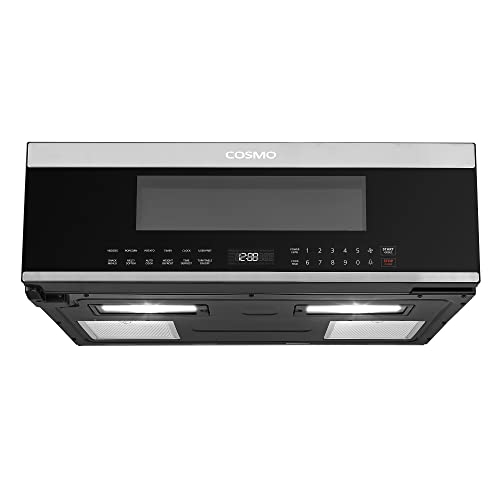
Cosmo COS-3012ORLP1SS 1.2 Cu.Ft Slim Over-the-Range Microwave — Best Value Slim OTR
Cosmo has built its name by selling the fitted-kitchen look without the fitted-kitchen invoice, and this slim over-the-range model is that formula in microwave form: 1.2 cubic feet, 1000 watts, a 30-inch low-profile body from its Stellar Collection, at the value end of the slim class. For a renovation where the budget is being counted across twenty line items, it delivers the under-cabinet result — counter clear, hob vented, microwave at eye level — without the premium badges’ pricing.
Strengths
- Full 1000-watt power and 1.2 cubic feet match the class leaders’ cooking package
- Slim 30-inch body gives the low-profile fitted look the format exists for
- Value positioning makes the OTR route affordable inside a wider renovation
Trade-offs
- Challenger badge means a smaller installer and support footprint than GE or Samsung
- Feature depth is functional rather than flagship — expect solid basics over smart extras
- As with all slim OTRs, cavity height limits tall dishes
| Capacity | 1.2 cu.ft |
| Power | 1000W |
| Format | Slim over-the-range, 30 inch |
| Collection | Cosmo Stellar |
The Cosmo’s case is arithmetic: the same headline cooking numbers as the premium slim models, the same installation footprint, a materially lighter demand on the renovation budget. In daily use it reheats, defrosts and vents like a proper OTR, and its styling holds up in a modern kitchen run. What you forgo is the flagship layer — the strongest extraction, the smart ecosystem, the deepest sensor menus.
For a landlord renovating to a good standard, a first fitted kitchen, or any project where three other appliances are also competing for the budget, those are the right things to forgo. The Cosmo is the slim OTR we would specify when value is a stated requirement rather than a guilty secret.
Best for: renovators who want the low-profile look and full power at a value-specialist price / Not suited for: buyers who prioritise the biggest service networks; Cosmo is a challenger badge
Check on Amazon — check price on Amazon for the Cosmo COS-3012ORLP1SS 1.2 Cu.Ft Slim Over-the-Range Microwave before you decide.

Midea 1.2 Cu.Ft Slim Low Profile Over-the-Range Microwave — Best Sensor Cooking in a Slim Body
Midea is one of the world’s largest appliance manufacturers, and its slim over-the-range model brings that scale to the format: 1.2 cubic feet, 1000 watts, sensor cooking, in stainless steel, in the shallow 30-inch body the under-cabinet brief demands. Its distinguishing emphasis is the sensor — reheating judged by the food’s steam rather than by a guessed time — which is the feature households use most once they have it.
Strengths
- Sensor cooking takes the guesswork out of the daily reheat, the slim class’s most-used upgrade
- 1000 watts and 1.2 cubic feet match the class standard for cooking
- Stainless finish and a global maker’s support footprint reassure on a fitted purchase
Trade-offs
- Extraction is competent rather than class-leading; heavy frying households should look at the Samsung
- Slim cavity height still rules out tall containers
- Midea’s brand recognition in microwaves trails its manufacturing scale in some markets
| Capacity | 1.2 cu.ft |
| Power | 1000W |
| Format | Slim low-profile over-the-range |
| Notable features | Sensor cooking, stainless steel |
Sensor reheating sounds minor until a household lives with it: the plate of leftovers that comes out evenly hot without a mid-cycle stir, the soup that does not boil over in the last ten seconds. In a slim unit bought partly for convenience, that daily smoothness is the right place to spend. The Midea otherwise covers the format’s brief completely — proper power, proper size, fitted-kitchen finish.
Choose it over the GE if sensor reheating matters more than extraction strength, and over the Cosmo if the maker’s scale and sensor matter more than the last increment of value. In a crowded slim class, it is the balanced, quietly competent option.
Best for: households that reheat by sensor and want a slim stainless unit from a global appliance maker / Not suited for: cooks who need maximum extraction; venting is not this model’s headline
Check on Amazon — check price on Amazon for the Midea 1.2 Cu.Ft Slim Low Profile Over-the-Range Microwave before you decide.

Kenmore Countertop Microwave 0.7 Cu.Ft 700W (Stainless Steel) — Best If You Must Have the Kenmore Badge
Here is the honest Kenmore option for this search. Kenmore’s current mounted model is a standard-depth over-the-range unit for above the hob, not an under-cabinet unit for above a counter — so for this position, the badge’s answer is its compact: the current Kenmore 0.7 cubic foot compact is shallow enough to sit on the counter directly beneath a standard wall cabinet, giving much of the old space-saver’s visual result — microwave up at eye level zone, in stainless, wearing the badge — with none of the installation. For a loyalist whose under-cabinet run is worktop rather than hob, it is the pragmatic answer.
Strengths
- The only way to put a current, warranted Kenmore in the under-cabinet position today
- Zero installation: unbox, place under the cabinet, plug in — and it can move house with you
- Six auto-preset menus, child lock, defrost and express cooking cover the compact brief fully
Trade-offs
- It occupies counter, unlike a true mounted unit — the space-saving is partial, not total
- 700 watts and 0.7 cubic feet are compact-class; full plates are a squeeze
- Needs the manufacturer’s ventilation clearance beneath the cabinet; do not wedge it in tight
| Capacity | 0.7 cu.ft |
| Power | 700W |
| Menus | 6 auto-preset menus |
| Notable features | Child lock, defrost, express cooking |
Judged as a placement strategy rather than a mount, it works better than sceptics expect: under-cabinet counter runs are usually the least useful stretch of worktop — too shadowed for prep, too high for storage — and a compact microwave converts it into the kitchen’s drinks-and-reheating station while the main counter stays clear. The Kenmore’s stainless front keeps it looking deliberate rather than parked.
It will not satisfy a buyer whose heart is set on a mounted unit, and for them the slim OTRs above are the true successors. But for the Kenmore loyalist with the right counter run, this little compact is the badge’s honest representative in this guide — current, verified and available, which the mounted original below no longer is.
Best for: Kenmore loyalists whose under-cabinet space is a counter run, not a hob, and who want the badge’s current compact / Not suited for: anyone needing a mounted unit; this is a countertop model that sits under cabinets, not in them
Check on Amazon — check price on Amazon for the Kenmore Countertop Microwave 0.7 Cu.Ft 700W (Stainless Steel) before you decide.
Kenmore Under-Cabinet ‘Space-Saver’ Microwaves (Original Sears-Era Models) — The Original — Legacy, Unlinked
The Kenmore under-cabinet microwaves — sold in the space-saver era alongside similar units from other Sears-era brands — mounted a shallow microwave directly beneath a wall cabinet, often with a drop-down or low-profile door, freeing the entire counter in small kitchens. They were a genuinely clever answer to a real problem, which is why their owners still search for them by name. They are also, definitively, a discontinued format: no current Kenmore under-cabinet model verified in the live catalogue for this guide, and the same is true of the mainstream market generally.
Strengths
- The format itself was excellent: eye-level access, zero counter cost, ideal for the small kitchens of its era
- Surviving units share an era’s standard mounting patterns, so brackets and spacers are understood by appliance technicians
- Owners’ underlying need — counter space — is now well served by the slim OTR successors reviewed above
Trade-offs
- Discontinued: no new Kenmore under-cabinet microwave exists to buy, at any price
- Ageing units face the usual risks — door mechanisms, control boards, magnetron wear — with shrinking parts support
- Mounting hardware and clearances differ from modern OTR standards, so replacement is a small project, not a swap
If yours still works, the guidance is the same as for any cherished legacy appliance: use it, keep the cavity and filters clean, check the mounting bolts annually — an under-cabinet unit lives by its fixings — and start planning its successor before it fails, because failure will not arrive on a convenient weekend. The successor plan depends on what sits beneath it: a hob means a slim OTR from the picks above; a counter run means a compact placed beneath the cabinet, as with the current Kenmore 0.7.
And if you came here hoping to buy the original new, let this entry save you from the stale listings and marked-up old stock that this search attracts elsewhere. The format’s idea survives and thrives in modern form. The Kenmore space-saver itself is a piece of kitchen history — a good one, honestly recorded.
Best for: existing owners seeking maintenance and replacement guidance / Not suited for: new purchases — the line is discontinued across the market, not just at Kenmore
Unlinked pick: Kenmore under-cabinet microwaves are a discontinued Sears-era format; no current Amazon listing data match exists.
Comparison Table
Read the format column first: the four OTR models mount in the cabinet gap above a hob; the Kenmore compact sits beneath cabinets on the counter; the original Kenmore is history. Venting and sensor columns separate the successors.
| Pick | Badge | Key spec | Best for |
|---|---|---|---|
| GE Profile UVM9125 1.2 Cu.Ft Low Profile Over-the-Range Microwave (Black) | Best Overall Under-Cabinet Solution | 1.2 cu.ft low profile OTR, 1000W, 400 CFM vent, LED lighting | standard 30-inch cabinet gaps where the microwave must mount shallow and vent a real hob |
| Samsung 1.1 Cu.Ft Smart SLIM Over-the-Range Microwave | Best Venting in a Slim Body | 1.1 cu.ft SLIM OTR, 550 CFM hood vent, Wi-Fi, voice control | keen cooks whose hob produces serious steam and smoke under a slim microwave |
| Cosmo COS-3012ORLP1SS 1.2 Cu.Ft Slim Over-the-Range Microwave | Best Value Slim OTR | 1.2 cu.ft slim OTR, 1000W, 30-inch Stellar Collection | renovators who want the low-profile look and full power at a value-specialist price |
| Midea 1.2 Cu.Ft Slim Low Profile Over-the-Range Microwave | Best Sensor Cooking in a Slim Body | 1.2 cu.ft slim OTR, 1000W, sensor cooking, stainless steel | households that reheat by sensor and want a slim stainless unit from a global appliance maker |
| Kenmore Countertop Microwave 0.7 Cu.Ft 700W (Stainless Steel) | Best If You Must Have the Kenmore Badge | 0.7 cu.ft, 700W, compact countertop — fits beneath standard wall cabinets | Kenmore loyalists whose under-cabinet space is a counter run, not a hob, and who want the badge’s current compact |
| Kenmore Under-Cabinet ‘Space-Saver’ Microwaves (Original Sears-Era Models) | The Original — Legacy, Unlinked | Discontinued under-cabinet format; no current model exists | existing owners seeking maintenance and replacement guidance |
Why True Under-Cabinet Microwaves Disappeared
The under-cabinet microwave solved a 1980s problem: kitchens were small, counters were precious, and the microwave was a new appliance with no established home. Mounting it under a wall cabinet was ingenious. Three forces retired the format. Kitchens grew, and islands and tall units gave microwaves better homes. Over-the-range design absorbed the under-cabinet position above the hob and added venting to the bargain. And safety and ventilation standards for anything mounted above cooking surfaces tightened around the OTR format specifically, leaving the pure under-cabinet mount without a compliance home.
The result is the market this guide describes: the position above the hob belongs to slim OTRs, the position in the tall unit belongs to built-ins, and the under-cabinet counter run belongs to shallow compacts. The space-saver’s idea — never waste the counter — won completely. Only its hardware retired.
How to Choose Your Under-Cabinet Solution Today
Start with what is underneath the cabinets. If it is the hob, you are in over-the-range territory: measure the cabinet gap (30 inches is standard), the height from hob to cabinet underside, and decide your venting route — ducted outside if the kitchen allows it, recirculating if it does not. Then choose among the slim models by priority: extraction (Samsung), all-round polish (GE Profile), sensor convenience (Midea), or value (Cosmo).
If what is underneath is worktop, the honest options are a shallow compact placed beneath the cabinet — the current Kenmore 0.7 among them — or a proper built-in if a tall unit can take one. Respect the ventilation clearance above and behind a countertop compact tucked under cabinets; the space-saver era’s dedicated mounts handled airflow by design, and a modern compact needs its specified breathing room to do the same job safely.
- Hob beneath: slim OTR. Worktop beneath: shallow compact or built-in. The position chooses the format.
- Measure gap width, hob-to-cabinet height, and your tallest stockpot before shortlisting.
- Decide ducted versus recirculating venting early; it shapes both model choice and installation cost.
- Prioritise one headline: extraction, sensor, polish or value — the slim class rewards a clear brief.
- Budget installation with the appliance; OTR mounting is a two-person, drill-and-template job.
Venting, Clearances and the Rules Above a Hob
An over-the-range microwave is also a cooker hood, and building practice treats it as one. The cabinet gap, the mounting height above the hob, and the vent path are specified by the manufacturer and by local code, with minimum heights above both gas and electric hobs. Those numbers are not decoration: too low and the unit cooks itself; too high and the hood stops capturing. Every model in this guide publishes its requirements, and a competent installer works from them.
Recirculating installations — where the vent returns filtered air to the room — are legitimate where ducting is impossible, but they manage grease and odour rather than removing heat and moisture, and their charcoal filters need scheduled replacement. If your cooking is heavy, ducted extraction with a strong fan, like the Samsung SLIM’s, is the specification to chase. The Kenmore-era space-savers, mounted away from hobs, never faced these questions — one more reason their modern heirs are engineered as hoods first and nostalgia never.
The Space-Saver Era: a Short History of the Under-Cabinet Microwave
The under-cabinet microwave was born of the 1980s kitchen: small, short on worktop, and suddenly expected to house a large new appliance. Manufacturers answered with shallow units designed to bolt beneath wall cabinets — GE’s Spacemaker line became the famous name, and Kenmore’s space-savers served the same brief for Sears households — often with drop-down doors, under-cabinet lighting and even radios in the era’s exuberant top trims. For a decade they were the clever answer, and their owners’ loyalty has outlived the category by thirty years.
The format faded for structural reasons rather than failure. Kitchens grew islands and tall units that housed microwaves better; over-the-range design claimed the above-hob position and added extraction; and the pure under-cabinet mount, suspended over a worktop with its own ventilation questions, had no standards home in the modern kitchen code landscape. What survives is the idea — the counter is sacred — now executed by slim OTRs, built-ins and drawers. Understanding that lineage helps owners choose a successor with confidence rather than grief: they are not abandoning the space-saver’s idea, they are buying its grandchildren.
Maintaining a Legacy Under-Cabinet Kenmore: the Owner’s Checklist
For the thousands of Kenmore space-savers still in service, longevity is now a maintenance discipline, and it is refreshingly mechanical. Annually, check the mounting: an under-cabinet microwave hangs from its fixings, so confirm the bolts are snug and the unit sits level, and treat any new rattle as a prompt, not a personality trait. Keep the cavity and the door seals clean — perished seals and food-caked hinges are the commonest age faults — and wash or replace filters on units that vent. The interior light and the turntable, where fitted, are the cheap parts; keep them working and the machine feels cared for.
Know the retirement signs, too: uneven cooking that a clean cavity does not fix, a door that must be lifted to latch, sparking, or a control that needs persuasion. Any of those ends the repair conversation for a unit of this age, and the successor planning in this guide — slim OTR over a hob, compact beneath a counter run — should already be measured and ready. A legacy appliance deserves a planned retirement, not an emergency one, and its owner deserves the new machine’s first month to feel like an upgrade rather than a rescue.
Under-Cabinet Alternatives Nobody Mentions: the Built-In and the Drawer
Two further formats answer the under-cabinet brief from unexpected directions, and a complete guide should name them. The first is the true built-in in a tall unit: it does not mount under a cabinet, but it achieves the space-saver’s entire purpose — the counter stays completely clear — with a full-size cavity, at the cost of renovation. Our integrated microwaves guide covers those models. The second is the microwave drawer in an island or under a counter run: again not a cabinet mount, but the modern format that loads at counter height and frees every worktop, at a premium and a 1.2 cubic foot ceiling.
Why mention them on a Kenmore under-cabinet page? Because the readers of this search are solving a space problem, not collecting a format. If the kitchen is being renovated anyway, the built-in and the drawer may solve it better than the slim OTR that headlines this guide. If it is not, the slim OTR and the under-cabinet compact remain the answers that arrive in a box rather than with a cabinetmaker. Either way, the space-saver’s founding idea — never surrender the counter — now has four living heirs, and this cluster of guides covers them all.
Clearance, Heat and the Rules Nobody Should Improvise
Anything mounted beneath a cabinet lives in a thermal neighbourhood, and the rules exist because the neighbourhood is unforgiving. Manufacturers specify minimum heights above hobs, clearances to cabinet sides, and ventilation paths for every slim OTR in this guide, and local codes layer their own requirements on top, particularly over gas. Those numbers are the accumulated record of other people’s mistakes: cabinets scorched by a unit mounted inches too low, electronics cooked by their own trapped exhaust, extraction that failed because the hood sat too high to capture. The space-saver era’s dedicated mounts encoded the same lessons in brackets and spacers.
The practical translation for today’s buyer is simple. Use the manufacturer’s template and dimensions, not a tape-measure approximation of them. If the existing cabinet run cannot meet the specification, change the plan — a compact beneath the cabinets, a built-in elsewhere — rather than shaving the clearance. And never suspend a countertop microwave from improvised brackets to imitate the mounted look: the legitimate routes in this guide cover every kitchen the space-savers ever served, safely and with warranties intact.
A Final Word for the Space-Saver Faithful
If you have read this far as the owner of a working Kenmore space-saver, the guide’s message is ultimately a reassuring one. Your appliance was a good idea, bought from a good line, and the industry did not abandon its principle — it industrialised it. The slim OTR above your hob, the compact beneath your cabinets, the drawer in your island are all the space-saver’s descendants, and each is better vented, better powered and better supported than the original could be. When replacement day comes, you are not losing a beloved format. You are trading up within its family — and the counter it saved for thirty years stays saved.
The Short Version
No new Kenmore under-cabinet microwave exists; the format’s modern heirs are the slim over-the-range models and shallow compacts reviewed above. Measure the cabinet, choose by what sits beneath it, and the counter the space-savers saved stays saved.
How to Plan an Under-Cabinet Microwave Installation
Whether the answer is a slim OTR or a compact beneath the cabinets, the planning order is the same — and it starts with a tape measure, not a shopping basket.
- Measure the cabinet gap width, the height from the hob or counter to the cabinet underside, and the cabinet depth; write all three down with the make of your hob.
- Check your tallest stockpot on the hob against the underside height a slim OTR would leave; if the pot does not fit, the format does not fit your cooking.
- Establish the venting route for an OTR: existing duct, new duct, or recirculating with charcoal filters — and confirm the electrical supply position in the cabinet.
- For a countertop compact beneath cabinets, measure its height against the counter-to-cabinet gap and confirm the manufacturer’s clearance above and behind the unit.
- Use the manufacturer’s mounting template, two people and a stud finder for any OTR install; these are heavy units held above a hob.
- Commission with a full-power water test and a vent test — a tissue at the intake tells you more than the fan’s noise does.
Legacy Kenmore owners get one extra step: before removing the old unit, photograph its mounting and measure its bracket pattern. Modern OTRs will not reuse it, but the photograph settles every question the installer asks about what the cabinet has already endured.
Common Buying Mistakes
The defining mistake with this search is paying new money for old stock: discontinued under-cabinet units surface in marketplaces at confident prices, with no warranty, no current support and ageing safety components. A discontinued format should be priced as the used appliance it is.
- Assuming a slim OTR fits because the width matches, without checking hob-to-cabinet height and stockpot clearance.
- Treating an OTR as a shelf-mount job; it is a structural mount above a heat source and needs its template and fixings.
- Wedging a countertop compact under a cabinet with no ventilation clearance to imitate the mounted look.
- Choosing recirculating venting for heavy frying cooking and blaming the microwave for the grease.
- Removing a working legacy Kenmore before its successor is measured, ordered and scheduled.
A gentler mistake is pure nostalgia pricing — keeping a failing space-saver alive through repeated repairs because the format is loved. Love the idea, by all means; the slim successors in this guide exist to carry it. But price the repairs against them honestly.
Final Recommendation
For the great majority of kitchens asking this question, the answer is the GE Profile UVM9125: the under-cabinet idea in its modern, complete form — slim body, full power, real extraction — so check price on Amazon and measure your cabinet gap twice. Heavy hob cooks should take the Samsung SLIM for its 550 CFM vent; sensor lovers the Midea; renovation budgets the Cosmo.
Kenmore loyalists are not forgotten: the current Kenmore 0.7 compact under the cabinets is the badge’s honest route to the look, and the original space-savers are recorded above with the respect — and the candour about their discontinued status — that they deserve. The counter-saving idea Kenmore pioneered is alive and better than ever; it simply answers to new model names now.
Start your shortlist with these three: GE Profile UVM9125 1.2 Cu.Ft Low Profile Over-the-Range Microwave (Black), Samsung 1.1 Cu.Ft Smart SLIM Over-the-Range Microwave, Cosmo COS-3012ORLP1SS 1.2 Cu.Ft Slim Over-the-Range Microwave. Each link goes to the verified listing — check price on Amazon, confirm the dimensions against your space, and order with the confidence that the model in the box is the model reviewed here.
Best Kenmore Microwaves Best Counter Microwaves Kenmore Best Hanging Microwaves
Frequently Asked Questions
Can I still buy a Kenmore under-cabinet microwave?
No. The Kenmore under-cabinet line is discontinued, and no current model verified against live product data for this guide. Listings that appear elsewhere are old stock or used units and should be treated — and priced — as such. The modern successors are slim over-the-range models and shallow compacts, reviewed above.
What replaced under-cabinet microwaves?
Two formats split the inheritance. Above a hob, slim low-profile over-the-range microwaves — like the GE Profile, Samsung SLIM, Cosmo and Midea picks here — mount in the same cabinet zone and add proper venting. On a counter run beneath cabinets, shallow compact countertop models, including the current Kenmore 0.7, deliver the same eye-level, counter-saving idea without installation.
How much space does a slim over-the-range microwave need?
A standard 30-inch cabinet gap is the norm, but the critical measurement is height: the distance from the hob to the cabinet underside, checked against both the manufacturer’s mounting specification and your tallest stockpot. Slim bodies exist precisely to protect that clearance, which is why they are the format’s modern standard.
Is a slim OTR big enough for a family?
At 1.1 to 1.2 cubic feet, slim models handle plates, bowls and medium dishes comfortably, but they are compact-plus, not family-size: tall containers and the largest casseroles exceed them. Families who microwave big dishes daily should consider a full-size OTR or a built-in, covered in our integrated microwaves guide.
My Kenmore space-saver still works. Should I replace it pre-emptively?
Not while it cooks evenly and its mountings are sound — but do plan the successor. Check the mounting bolts annually, keep filters and cavity clean, and know which route you will take (slim OTR over a hob, compact under a counter run) so a failure is an inconvenience rather than a crisis.
Can I mount a normal countertop microwave under my cabinets?
Not with improvised brackets. Countertop models are not rated or vented for suspended mounting, and the practice is unsafe. The legitimate routes are a purpose-built slim OTR, a true built-in in a tall unit, or a compact sitting on the counter beneath the cabinets with its specified clearances — all covered in this guide.
Keep exploring the rest of this microwave cluster: Best Above Range Microwaves Best 1-2 Cf Otr Microwaves Best Kitchen Microwaves


