Disclosure: airfryerkitchensupply.com is reader-supported. When you buy through links on our site, we may earn an affiliate commission at no extra cost to you.
Where to buy
Every linked pick in this guide to the best inexpensive toaster ovens was verified against Amazon’s catalogue on 2026-11-22: the product name and ASIN below come from that check, not from memory. Prices move constantly, so this guide never prints them — use a link to see today’s figure.
- BLACK+DECKER TO1745SSG 4-Slice Toaster Oven — check price on Amazon
- Proctor Silex 4 Slice Countertop Toaster Oven 31260G — check price on Amazon
- Hamilton Beach 4 Slice Countertop Toaster Oven 31143J — check price on Amazon
- BLACK+DECKER TO1313SBD Toaster Oven — check price on Amazon
- Elite Gourmet ETO449X Toaster Oven, 9.5Qt / 4-Slice — check price on Amazon
- Hamilton Beach Easy Reach 4 Slice Toaster Oven — check price on Amazon
Finding the best inexpensive toaster ovens means accepting one truth up front: at the budget end, you are buying heating elements, a timer and a box that gets hot — and the good ones are simply the boxes that do those three things reliably for years. The picks below are the inexpensive models whose listings, verified, show real cooking functions, honest capacities and designs that owners can actually clean.
Cheap toaster ovens fail in predictable ways. Dials with vague markings burn toast on one side. Doors that do not seal leak heat and stretch cooking times. Crumb trays that do not remove turn cleaning into a chore that never happens. Every pick here was screened against those failure points: a removable crumb tray, a real temperature range, an auto shutoff or timer, and enough interior room for the food the size class promises.
We left out the no-name ovens whose listings could not confirm basic specifications, and the novelty mini-ovens that fit two slices and little else. What remains is six inexpensive ovens from makers with service networks — because the cheapest oven is the one you do not have to replace next year.
In this guide
Quick Picks
Best Overall — BLACK+DECKER TO1745SSG 4-Slice Toaster Oven. The TO1745SSG is what an inexpensive toaster oven should be: four functions you will use, a crumb tray that slides out, and BLACK+DECKER’s Even Toast shading that keeps one side of the bread from coming out pale while the other scorches. Check the current price on Amazon.
Best Budget — Proctor Silex 4 Slice Countertop Toaster Oven 31260G. The Proctor Silex 31260G strips the toaster oven back to its essentials and prices accordingly: bake, broil and toast across a proper 200 to 450°F range, a 30-minute timer, and automatic shutoff so a forgotten bagel never becomes a smoke alarm event. Check the current price on Amazon.
Best for Bagels and Toast — Hamilton Beach 4 Slice Countertop Toaster Oven 31143J. Hamilton Beach added the one mode budget ovens usually skip and breakfast people actually want: a bagel setting that toasts the cut side while gently warming the crust. Check the current price on Amazon.
Best Compact with Convection — BLACK+DECKER TO1313SBD Toaster Oven. The TO1313SBD’s trick is bringing convection — normally the first feature cut at this tier — into a compact, inexpensive oven. Check the current price on Amazon.
Best for Dorms and RVs — Elite Gourmet ETO449X Toaster Oven, 9.5Qt / 4-Slice. Most budget ovens assume a house. Check the current price on Amazon.
Best for Easy Access — Hamilton Beach Easy Reach 4 Slice Toaster Oven. The Easy Reach solves the budget oven’s most annoying daily interaction: the drop-down door you must reach over, dripping and hot, to reach food at the back of a small cavity. Check the current price on Amazon.
How These Picks Were Chosen
Budget picks were verified the same way as premium ones: each ASIN was matched to its listed title before linking, and the specifications quoted in the spec boxes come from those titles, not from memory or third-party roundups. If a budget model could not be confirmed, it did not appear, however often it shows up in other lists.
Within the budget tier we weighted, in order: toast performance (the job these ovens do most), temperature range and control honesty, capacity truthfulness (slice counts are measured in standard bread; pizza diameter is the more honest metric), ease of cleaning, and safety basics like auto shutoff. Air fry at this tier was treated as a bonus, never a reason to forgive bad toast.
We also thought about total cost. An inexpensive oven that eats counter space, needs a dedicated pan you must buy separately, or dies in eighteen months is not inexpensive. The picks skew toward 4-slice models because that is the size budget buyers actually keep, with one roll-top design for awkward counters.
The 6 Best Inexpensive Toaster Ovens

BLACK+DECKER TO1745SSG 4-Slice Toaster Oven — Best Overall
The TO1745SSG is what an inexpensive toaster oven should be: four functions you will use, a crumb tray that slides out, and BLACK+DECKER’s Even Toast shading that keeps one side of the bread from coming out pale while the other scorches. It has been in the range for years, which at this tier is a recommendation in itself — parts, pans and owner knowledge are all easy to find.
Strengths
- Even Toast shading is genuinely consistent for the tier
- Four honest functions without menu clutter
- Removable crumb tray makes weekly cleaning realistic
Trade-offs
- No convection fan, so baking is slower than fan models
- Interior fits a 9-inch pizza, not a 12-inch
- Dial controls need a learning week for exact shades
| Capacity: 4 slices |
| Functions: bake, broil, toast, keep warm (4) |
| Features: Even Toast technology, removable crumb tray, timer |
There is no convection fan, so a tray of biscuits takes a little longer than in a fan oven, and the cavity tops out at a 9-inch pizza. Within those limits it is remarkably honest: the timer works, the keep-warm function is genuinely useful for slow breakfasts, and the footprint suits the counters budget ovens usually live on. If your budget stretches to exactly one oven and toast matters most, this is it.
Ownership is where this model quietly wins: the crumb tray slides out without a fight, the interior wipes down in a minute, and the dial layout means every member of the household produces the same toast without a tutorial. Expect a short calibration period — note your shade number once and breakfast becomes automatic. The oven’s long presence in the range means a replacement rack or pan is a search away, not an archaeological dig.
Best for: budget buyers who mostly toast, reheat and bake small meals / Not suited for: families needing a 12-inch pizza oven.
Check on Amazon — check price on Amazon for the current figure.

Proctor Silex 4 Slice Countertop Toaster Oven 31260G — Best Budget
The Proctor Silex 31260G strips the toaster oven back to its essentials and prices accordingly: bake, broil and toast across a proper 200 to 450°F range, a 30-minute timer, and automatic shutoff so a forgotten bagel never becomes a smoke alarm event. For a first apartment or a replacement bought in a hurry, that specification is not a compromise — it is the whole job description, done.
Strengths
- The lowest-cost route to a full 200–450°F range
- Auto shutoff is standard, not an upsell
- Simple controls anyone in the house can use
Trade-offs
- 30-minute timer caps longer bakes
- Basic interior finish needs prompt crumb care
- No keep-warm or bagel specialty modes
| Capacity: 4 slices |
| Temperature: 200–450°F adjustable |
| Timer: 30 minutes with automatic shutoff |
| Functions: bake, broil, toast |
The limits are the honest kind. Thirty minutes is the longest single cycle, so slow roasts need a timer reset, and the interior finish is basic, which rewards wiping crumbs before they bake on. But nothing here pretends to be what it is not, and the money saved against fancier budget rivals buys a lot of bread. This is the floor of the category, and it is a solid floor.
Living with the Proctor Silex means living simply: it asks for a weekly crumb empty and a wipe while warm, and in return it asks for nothing else. There are no menus to reset after a power cut and no touch panel to misread with wet hands. Owners upgrading from it years later usually report the same story — it was still working when they gave it away, which is the budget category’s highest honour.
Best for: first apartments, dorms and anyone replacing a dead oven cheaply / Not suited for: bakers who need long, unattended cycles.
Check on Amazon — check price on Amazon for the current figure.
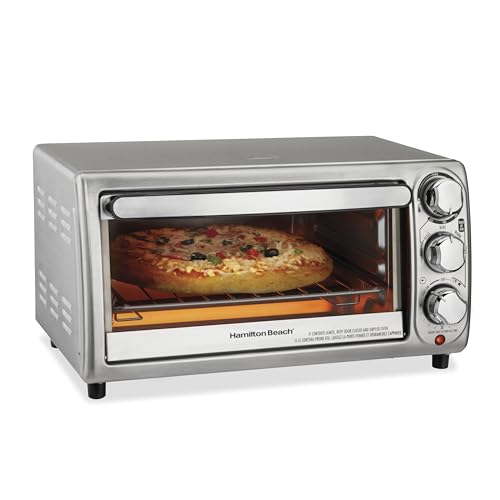
Hamilton Beach 4 Slice Countertop Toaster Oven 31143J — Best for Bagels and Toast
Hamilton Beach added the one mode budget ovens usually skip and breakfast people actually want: a bagel setting that toasts the cut side while gently warming the crust. Combined with two rack positions — a small thing that transforms broiling — the 31143J feels designed by someone who watched people use a toaster oven rather than someone filling a feature grid.
Strengths
- Dedicated bagel mode earns its place at breakfast
- Two rack positions add real cooking flexibility
- Stay-on plus auto shutoff covers both cooking styles
Trade-offs
- Still a 9-inch-pizza class cavity
- Stainless finish shows fingerprints
- No convection fan at this price
| Capacity: 4 slices |
| Modes: bake, broil, toast, keep warm, bagel (5) |
| Temperature: 200–450°F, 2 rack positions |
| Features: stay-on option and auto shutoff |
The cavity remains firmly 4-slice class, and there is no convection fan, so set expectations for baking accordingly. The stay-on option suits keep-warm duty during long brunches, while auto shutoff protects ordinary toast cycles. In stainless it also looks a tier above its price on the counter. For toast-first households, it is the budget pick with the fewest daily annoyances.
The Hamilton Beach becomes a breakfast specialist in practice: bagels on their setting, toast on the middle rack, keep-warm holding the first round while the second cooks. The two rack positions get used more than expected — broiling sits higher, baking lower — and the stainless front wipes clean of the fingerprints it inevitably collects. It is an oven that improves a specific meal of the day, measurably, every day.
Best for: breakfast households that toast bagels more than bread / Not suited for: anyone needing family-size capacity.
Check on Amazon — check price on Amazon for the current figure.
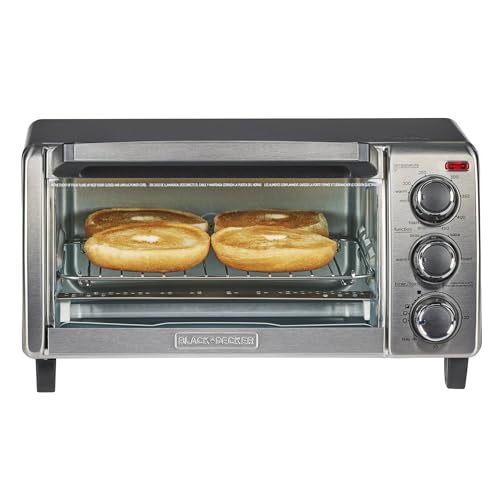
BLACK+DECKER TO1313SBD Toaster Oven — Best Compact with Convection
The TO1313SBD’s trick is bringing convection — normally the first feature cut at this tier — into a compact, inexpensive oven. The fan will not turn it into an air fryer, but it evens out baking noticeably: frozen snacks cook without the raw-centre problem, and a small batch of cookies browns edge to edge instead of in a gradient.
Strengths
- Convection at a genuinely budget position
- Compact 15.47-inch width suits tight counters
- Removable crumb tray, again, where rivals skip it
Trade-offs
- Convection fan is gentle, not a crisping powerhouse
- Small cavity crowds a full 4-slice load
- Silver finish is practical rather than pretty
| Capacity: fits 9-inch pizza |
| Heating: compact convection |
| Features: timer, stay-on function, removable crumb tray |
| Width: 15.47 inches |
At 15.47 inches wide it earns its place in kitchens where counter depth is measured in sighs. A 9-inch pizza fits; a family’s Friday-night pizza does not. The stay-on function and removable crumb tray round out a specification that reads like it was written by someone tired of budget-oven corners being cut in the wrong places. Small, cheap and smarter than it needs to be.
The TO1313SBD’s convection makes it the baker’s budget pick in daily life: small batches of muffins and frozen snacks emerge evenly browned in a way still-air budget ovens rarely manage. Its compact body also heats fast, so it becomes the default for single portions that would never justify the big oven. Keep the crumb tray empty — convection fans distribute neglected crumbs as smoke with real efficiency.
Best for: small kitchens that still want fan-assisted baking / Not suited for: households cooking for more than two.
Check on Amazon — check price on Amazon for the current figure.

Elite Gourmet ETO449X Toaster Oven, 9.5Qt / 4-Slice — Best for Dorms and RVs
Most budget ovens assume a house. The ETO449X assumes a dorm room, an RV galley or a studio counter, and its 800-watt quartz heating is chosen for circuits that cannot spare 1,400 watts for toast. It still covers a real 200 to 450°F range and a 30-minute timer, and its 9.5-quart cavity handles four slices or an 8-inch personal pizza — the actual menu of the spaces it is built for.
Strengths
- 800W draw suits dorm and RV electrical limits
- Quartz elements heat fast for quick snacks
- Smallest, lightest footprint in this guide
Trade-offs
- 8-inch pizza ceiling is a real constraint
- 800W cooks slower than full-power ovens
- Best for one or two people, hard stop
| Capacity: 9.5 qt, 4 slices, fits 8-inch pizza |
| Power: 800W quartz heating |
| Temperature: 200–450°F, 30-minute timer |
| Footprint: compact mini design |
Lower wattage means patience: everything takes a little longer, and four slices is a ceiling, not a suggestion. But an oven that trips no breakers, stores in a cupboard and reheats a slice properly instead of microwaving it into rubber has a genuine job to do. For small-space living it is not the cheap option; it is the right-sized one.
The Elite Gourmet’s ownership story is about fit: it stores in a cupboard, travels in an RV locker and runs where other ovens cannot. Owners learn its pace — everything a few minutes slower at 800W — and plan around it without resentment, because the alternative in those spaces is a microwave. Quartz elements also cool fast, making it one of the safer ovens to put away soon after use in tight quarters.
Best for: students, RVers and single-person households / Not suited for: anyone cooking family quantities.
Check on Amazon — check price on Amazon for the current figure.

Hamilton Beach Easy Reach 4 Slice Toaster Oven — Best for Easy Access
The Easy Reach solves the budget oven’s most annoying daily interaction: the drop-down door you must reach over, dripping and hot, to reach food at the back of a small cavity. Its door rolls up over the top instead, the food rolls forward with it, and suddenly a 4-slice oven feels twice as usable — especially for shorter users, older hands and anyone who has ever branded a forearm on a door edge.
Strengths
- Roll-top door removes the reach-over-a-hot-door problem
- Food sits forward and visible, not buried at the back
- Auto shutoff and simple dials suit every age of user
Trade-offs
- Roll-top mechanism needs its track kept crumb-free
- Same 4-slice capacity ceiling as its siblings
- No convection or specialty modes
| Capacity: 4 slices |
| Door: roll-top Easy Reach design |
| Temperature: 200–450°F |
| Features: auto shutoff, bake/broil/toast |
Mechanically there is one more moving part than a basic oven, and the door track appreciates a weekly brush-out. The cooking specification is standard Hamilton Beach — 200 to 450°F, bake, broil, toast, auto shutoff — executed competently. You are paying a small premium over the plainest budget boxes for access, and at breakfast, every day, it feels worth it.
The Easy Reach changes a daily gesture, and owners feel it every morning: no reaching over a hot door, no food hiding at the back. The roll-top track wants a weekly brush to stay smooth, a ten-second habit. For households with older users, this oven frequently becomes the most appreciated appliance in the kitchen — not for what it cooks, but for how safely and easily it lets them cook it.
Best for: anyone who hates reaching over a drop-down hot door / Not suited for: feature hunters — this oven keeps it simple.
Check on Amazon — check price on Amazon for the current figure.
Comparison Table
| Pick | Badge | Key spec | Best for |
|---|---|---|---|
| BLACK+DECKER TO1745SSG 4-Slice Toaster Oven | Best Overall | 4 slices | budget buyers who mostly toast, reheat and bake small meals |
| Proctor Silex 4 Slice Countertop Toaster Oven 31260G | Best Budget | 4 slices | first apartments, dorms and anyone replacing a dead oven cheaply |
| Hamilton Beach 4 Slice Countertop Toaster Oven 31143J | Best for Bagels and Toast | 4 slices | breakfast households that toast bagels more than bread |
| BLACK+DECKER TO1313SBD Toaster Oven | Best Compact with Convection | fits 9-inch pizza | small kitchens that still want fan-assisted baking |
| Elite Gourmet ETO449X Toaster Oven, 9.5Qt / 4-Slice | Best for Dorms and RVs | 9.5 qt, 4 slices, fits 8-inch pizza | students, RVers and single-person households |
| Hamilton Beach Easy Reach 4 Slice Toaster Oven | Best for Easy Access | 4 slices | anyone who hates reaching over a drop-down hot door |
How to Choose an Inexpensive Toaster Oven
Spend on toast, not on menus
At this tier, a 12-preset digital menu is money taken away from elements and insulation. Judge an inexpensive oven by its toast: even shading, a timer that actually stops the elements, and a temperature dial with real numbers. The picks here top out at five modes because that is what budget engineering does well.
Read pizza diameter, not slice count
Slice counts assume slim sandwich bread. The honest capacity metric is pizza diameter: 8-inch ovens are personal, 9-inch ovens serve two, and only 12-inch ovens replace a family pizza night. Match the oven to the largest thing you genuinely cook weekly.
Check the cleaning specification
A removable crumb tray is the single best predictor of whether a budget oven stays pleasant. Without one, crumbs carbonise on the floor, smoke at high heat and flavour everything. Also confirm the interior is reachable — roll-top and wide doors clean easier than deep narrow cavities.
Respect the electrical budget in small spaces
Full-size toaster ovens draw serious wattage. In dorms, RVs and older kitchens, an 800W model like the Elite Gourmet is not a downgrade; it is the difference between an oven that works and one that trips the breaker mid-toast.
How to Set Up a Budget Toaster Oven for Even Toast
- Give it air. Leave several inches behind and above the oven; budget cabinets insulate poorly and trapped heat skews the thermostat and ages the finish.
- Run two empty heat cycles at 200°C-equivalent high heat before first food use to burn off manufacturing residues — with a window open.
- Calibrate your dial with sacrificial bread. Toast four slices on the middle setting, note the gradient, and learn your oven’s honest shade numbers; every budget dial lies a little, each in its own direction.
- Use the middle rack position for toast and the upper for broiling; on 2-position ovens this single habit fixes most uneven results.
- Empty the crumb tray weekly and wipe the interior while it is merely warm. Ten minutes a month is the entire maintenance budget of a cheap oven — spend it and the oven lasts years.
Common Buying Mistakes
Buying by preset count
Ten presets on a weak oven produce ten ways to undercook. Elements, insulation and a working timer matter; presets are decoration at this price.
Ignoring the timer’s maximum
A 30-minute cap is fine for toast and snacks but interrupts casseroles and slow bakes. Check the maximum against your real cooking before ordering.
Placing it under low cabinets with no clearance
Toaster ovens vent serious heat upward. Scorched cabinet undersides are the most common budget-oven accident and entirely preventable with a tape measure.
Never removing the crumb tray
Carbonised crumbs smoke, smell and eventually flavour food. If the model you are eyeing has no removable tray, that is a reason to choose another model.
Expecting air-fry results from a plain oven
A basic bake/broil/toast box reheats pizza beautifully but will not crisp like a fan-forced air fryer. Buy the function you will actually use.
Why Cheap Ovens Burn Toast on One Side
Most budget ovens use two straight quartz or calrod elements and no fan. The element nearer the bread does more work, the door leaks a little heat at the front, and the result is a gradient across every slice. Makers fight it with reflector shaping and element tuning — BLACK+DECKER’s Even Toast is exactly this fight — which is why established budget brands toast more evenly than no-name boxes with identical wattage on paper.
You can help any cheap oven: preheat two minutes before toasting, use the middle rack, and rotate the tray halfway for thick items like bagels. These habits close most of the gap between a budget oven and one costing twice as much.
The Real Cost of a Cheap Oven
The purchase is only the first line of the ledger. A budget oven that lasts five years of daily toast costs less per breakfast than a premium oven replaced in six because its electronics failed — and far less than the cheapest oven of all if that one dies in a year. Longevity at this tier tracks simplicity: dials outlive touch panels, and models that stay in a maker’s range for years accumulate spare pans, racks and institutional knowledge.
Energy is the other quiet cost. A small oven heating a small cavity for a small meal uses a fraction of the energy of a full-size range oven doing the same job, which is why a good inexpensive toaster oven can pay for itself in a household that would otherwise heat a big oven for two slices and a handful of nuggets.
Dial vs Digital at the Budget Tier
Inexpensive ovens split into two control philosophies, and the choice predicts your ownership experience. Dials are approximate but immortal: they survive power cuts, wet hands and a decade of mornings, and their vagueness is solved once with a note of your shade number. Budget digital panels promise precision but introduce the tier’s most common failure point and a menu learning curve for every user in the house.
Our bias at this price is open: dials for longevity, digital only when a specific mode — a bagel setting, a precise timer — genuinely serves your routine. Every pick in this guide was chosen partly on that logic, because an inexpensive oven’s value is measured in years of breakfasts, not in features listed on the box.
Where the Next Step Up Actually Goes
If your budget stretches one tier above this guide, spend it in this order: first convection, for even baking; then capacity, if your household genuinely cooks bigger loads; then build — stainless finishes and better trays. Spend it last on preset counts and touch panels, which add cost without adding breakfast quality.
If it does not stretch, take comfort in the arithmetic of this tier: the picks here cover the complete daily work of a toaster oven, and the gap to premium models is measured in refinement, not in meals you cannot cook. A budget oven plus good ingredients beats a premium oven plus an empty pantry, every single week.
Toaster Oven vs Toaster vs Air Fryer, Settled Briefly
A slot toaster toasts faster and more evenly than any oven — and does nothing else. A basket air fryer crisps better than any budget oven — and reheats pizza into sadness. The inexpensive toaster oven is the generalist: second-best at everything, capable of everything, and for most small households the only one of the three that earns permanent counter space.
Choose by your dominant meal. Toast-dominant homes can justify the slot toaster pairing; crisp-dominant homes should read the air fryer guides; the mixed reality of most kitchens — toast, reheating, small bakes, broiling — is exactly the inexpensive oven’s home turf.
Reading a Budget Oven’s Specification Sheet
Four numbers matter and the rest is garnish. Temperature range tells you whether real baking is possible — insist on roughly 200–450°F. Timer maximum tells you the longest unattended cook. Pizza diameter tells you true capacity. Wattage tells you both speed and whether your circuit can host the oven at all.
Everything else — preset counts, designer finishes, novelty modes — should be weighed after those four. A budget oven that nails the four numbers, as every pick here does, will cook honestly for years. One that misses any of them will annoy you in proportion to how often you cook, which is the most expensive outcome of all.
What Inexpensive Ovens Do Better Than Expensive Ones
Budget ovens hold two genuine advantages over their premium relatives. They heat a small cavity quickly, so the gap between deciding on toast and eating it is measured in moments. And their simplicity makes them socially robust appliances: any guest, babysitter or teenager can operate one without instruction, which in a real household is a form of reliability no specification sheet captures.
They also fail more gracefully. When a dial oven eventually drifts, it drifts slowly and visibly, giving its owner months of compensated breakfasts. Complex ovens tend to work perfectly until a board decides otherwise. Neither philosophy is wrong, but the budget pattern suits households that value continuity over precision.
None of this argues against premium ovens where they belong — the best-made guide on this site makes that case. It argues that inexpensive is a legitimate engineering destination, not merely a compromise on the way to somewhere better.
Reheating: The Budget Oven’s Secret Career
Ask owners what their inexpensive oven actually does all week and the honest answer is reheating — pizza, fries, yesterday’s roast, the pastry that must never meet a microwave. Still, warm air restores what microwaves destroy: crust, crispness and the distinction between components. A slice reheated at moderate heat for a few minutes returns as food; microwaved, it returns as a reminder.
Technique is minimal but real. Use the rack, not a plate, so air reaches the underside. Give fried foods high heat briefly; give pizza moderate heat slightly longer; add a minute rather than a temperature jump when in doubt. The budget oven’s small cavity is an advantage here — it reaches reheating temperature almost immediately.
Households that master reheating quietly transform their leftover culture: food cooked once gets eaten twice, willingly. That, more than toast, is where an inexpensive oven repays its price across a year.
Safety Habits for Hot Little Boxes
A toaster oven is a box of exposed heating elements, and budget models deserve the same respect as premium ones. Keep the clearance the manual specifies, never line the crumb tray or cavity floor with foil unless the maker explicitly allows it, and treat broiling — the highest, closest heat — as an attended activity, always.
Cords matter at this tier: route them away from the oven’s hot rear panel, and avoid running a full-power oven on a tired power strip shared with a kettle. In dorms and RVs, the low-wattage pick in this guide exists precisely because shared circuits are a design constraint, not an afterthought.
Finally, teach the household the two-minute rule: any oven that smells wrong, smokes from crumbs or behaves erratically gets unplugged and cleaned before its next use, not after. Nearly every budget-oven incident begins as a small, ignored warning.
Accessories Worth Buying for a Cheap Oven
Three accessories transform a budget oven’s daily life for very little money. A pair of pans actually sized to the cavity ends the foil improvisation and the too-big tray wedged at an angle. An oven thermometer converts your dial’s approximations into knowledge, once, permanently. And a silicone mat for the counter in front of the oven catches the crumbs and drips that otherwise migrate across the kitchen.
Skip the rest until a habit demands it. Pizza stones, specialty racks and rotisserie kits for ovens without the power or space to use them well are how a low-cost purchase quietly becomes a mid-cost disappointment. The discipline that chose the oven should also choose its companions.
If a fourth item earns a place, make it a second rack — many budget models accept one, and two levels of reheating doubles the oven’s usefulness at family breakfast more than any other single addition.
Energy, Time and the Small-Oven Advantage
A full-size range oven heats roughly ten times the air volume of a 4-slice toaster oven, and for small meals that difference is pure overhead: longer preheats, more energy, a hotter kitchen. The inexpensive toaster oven’s entire economic case rests on this geometry. For the meals small households actually cook — toast, a personal pizza, a tray of nuggets, a reheated portion — the small cavity is not a compromise but the correctly sized tool.
Time follows the same curve. A budget oven reaches toasting temperature while a big oven is still thinking about it, which changes behaviour: people cook real food for one instead of defaulting to the microwave or skipping the meal’s hot component entirely. Appliances shape diets quietly, and the small oven shapes them toward cooking.
None of this requires the oven to be clever. It requires it to be present, sized honestly and fast — the three properties this guide’s picks share, and the reason inexpensive ovens remain the highest-value square footage on most counters.
Two Slices at a Time: Cooking for One, Well
Cooking for one is where inexpensive ovens quietly outperform every alternative. A single portion in a big oven feels wasteful enough that many solo cooks simply do not bother; the same portion in a 4-slice oven feels proportionate, and so it happens — the salmon fillet gets roasted, the vegetables get broiled, the leftovers get reheated into something with texture.
The technique adjustments are minimal: smaller trays, slightly shorter times, and the middle rack as home base. The psychological adjustment is the real one — treating a meal for one as worth an oven’s attention. Budget ovens democratise that attention by removing the guilt of heating a cavern for a fillet.
If you cook mainly for yourself, this guide is effectively written for you, and the compact convection pick — the TO1313SBD — is probably your oven: fast, even, small enough to justify itself daily and cheap enough to justify itself immediately.
Troubleshooting Uneven Toast, Once and for All
Uneven toast in a budget oven has four causes, in order of frequency. First, a cold start: bread loaded into a cold oven meets elements at full overshoot on one face. Preheat two minutes and half of all complaints vanish. Second, rack position: toast belongs in the middle, and on two-position ovens the wrong slot guarantees a gradient.
Third, crumb and grease film on the interior walls and elements, which absorbs and re-radiates heat unevenly — the oven that toasted evenly in month one and strangely in month six is usually dirty, not broken. Fourth, bread itself: artisan loaves with irregular thickness toast irregularly in any oven ever built, and blaming the appliance is a category error.
Work the list in order before concluding an oven is faulty. Budget ovens are simple machines, and their faults are usually simple too — which is, in the end, the strongest argument for buying one.
The Inexpensive Oven in a Family Kitchen
In a family kitchen the budget oven plays a different role: not the main oven but the auxiliary that absorbs the small, constant jobs — the children’s snacks, the reheated slices, the garlic bread that must not wait for the roast’s temperature. Assigning it those jobs keeps the big oven free and the cook sane, at a purchase price lower than a single holiday meal’s ingredients.
Durability in this role is about tolerance for many hands. Dials survive the household’s range of users; simple interiors survive its range of cleaning enthusiasm. The models in this guide were chosen with family auxiliary duty in mind as much as solo primary duty.
Set one family rule — crumbs out weekly, rotating chore — and an inexpensive oven will serve a family for years at a cost per use that rounds to nothing. Few appliances in the house can make that claim with a straight face.
Cleaning Calendar for a Budget Oven
Week one habits decide year three condition, so here is the whole regime in one place. Weekly: empty the crumb tray and brush the door seal line. Monthly: wipe the interior walls and elements’ surroundings with a warm, damp cloth, and run one empty high-heat cycle to clear vapour film. Seasonally: inspect the cord and plug, check the door still closes evenly, and note whether toast has drifted — drift is information, usually about film on the elements rather than failing parts.
Nothing here needs a product beyond water, a cloth and bicarbonate for stubborn spots. Budget ovens die of accumulated neglect far more often than of defective parts, and this calendar is the difference between the two obituaries.
Breakfast, Lunch and the Snack Hour
An inexpensive oven’s day divides into three services. Breakfast is toast and bagels at speed. Lunch is the reheat — pizza, pastries, yesterday’s portions restored rather than endured. The snack hour, which in many households is the real dinner for teenagers and late workers, is where the oven quietly becomes essential: frozen things, crisped properly, in minutes, without ceremony.
Each service rewards the same virtues — fast preheat, predictable settings, a tray that comes out clean — and punishes the same vice, which is an oven left dirty from the last service. Judge any budget oven by all three services, not by breakfast alone, and the picks in this guide explain themselves.
What to Cook First in a New Budget Oven
Calibrate a new oven with three cooks, in this order. First, four slices of your usual bread at the middle setting: learn the shade map. Second, a tray of frozen snacks you know well from your old method: learn the fan or its absence. Third, one small bake — muffins or a mini loaf — at a temperature you trust from experience: learn the thermostat’s honesty against a result you can judge blind.
Write the three results on a card. That card is your oven’s true manual, worth more than the printed one, and it converts the first month of guesswork into a week of measurement. Every inexpensive oven has a personality; these three cooks introduce you properly.
Counter Space: The Budget Oven’s Real Price
The scarcest resource in a small kitchen is not money but counter, and an inexpensive oven should be audited against it honestly. The compact picks here earn their footprint by being used daily; a larger budget oven that forces other tools into cupboards may cost more in friction than it saves in purchase price.
Measure the working footprint — door open, tray pulled, cook standing — rather than the closed box. Roll-top and compact designs win this audit disproportionately, which is why they anchor this guide despite unremarkable specifications. The cheapest oven is the one whose space you never resent.
A Note on Second-Hand and Hand-Me-Down Ovens
Budget ovens circulate: to students, to first flats, to the relative setting up a kitchen. If you are receiving one, run the breakfast test before accepting the gift’s premise — a drifting thermostat or a missing crumb tray turns generosity into a chore. If you are giving one, include the shade card and the tray; the knowledge is half the appliance.
The models in this guide circulate best because their parts and quirks are known quantities. A hand-me-down TO1745SSG arrives with a decade of public knowledge behind it. In the low-cost world, that inheritance is a genuine feature.
Final Recommendation
The BLACK+DECKER TO1745SSG is the inexpensive oven we would buy first: honest functions, even toast, easy cleaning. The Proctor Silex undercuts it for the tightest budgets, Hamilton Beach’s bagel mode and Easy Reach door solve specific daily annoyances, and the Elite Gourmet fits the small spaces the others cannot.
Spend the savings on a small oven thermometer and good bread — at this tier, those improve breakfast more than any upgrade.
Related guides on this site: Best Toaster Ovens Best Low Cost Toaster Ovens Best Large Capacity Toaster Ovens Best Toaster Ovens Under $100 Best Small Toaster Ovens
Revisit the top picks: BLACK+DECKER TO1745SSG 4-Slice Toaster Oven.
Revisit the top picks: Proctor Silex 4 Slice Countertop Toaster Oven 31260G.
Revisit the top picks: Hamilton Beach 4 Slice Countertop Toaster Oven 31143J.
Frequently Asked Questions
How long should an inexpensive toaster oven last?
With weekly crumb care, three to five years of daily use is a fair expectation from the established brands in this guide. Dial-controlled models generally outlast touch-panel budget models.
Is a 4-slice toaster oven big enough?
For one or two people, yes — it handles toast, sandwiches, personal pizzas and reheating comfortably. Households of three or more who cook whole meals should look at 6-slice and large-capacity models instead.
Can a cheap toaster oven bake properly?
Yes, within its size. Convection models bake most evenly; non-convection models benefit from preheating and rotating the pan halfway. Keep to dishes that fit with air space around them.
What wattage do I need in a dorm or RV?
Look for models around 800W, like the Elite Gourmet pick here, and always check your circuit and housing rules first. Full-power countertop ovens can draw 1,400W or more.
Do I need an air fry function at this price?
Only if you will use it weekly. Budget air fry is a fan and a basket; it crisps small batches well but does not replace a dedicated air fryer for family quantities.
Why does my budget oven toast darker on one side?
Element layout and door heat loss cause it. Preheat briefly, use the middle rack, and rotate thick items halfway through; if one brand of bread consistently scorches, drop one shade setting.