Disclosure: airfryerkitchensupply.com is reader-supported. When you buy through links on our site, we may earn an affiliate commission at no extra cost to you.
Where to buy
For shoppers comparing the best house microwaves options in this guide, start here. A house microwave is bought once and used by everyone, so this guide only links models confirmed against verified listings — family-size countertop machines, a whole-house over-the-range unit, a compact second microwave, and a multi-function model, each with its capacity and wattage taken from verified listing data. Microwave pricing moves with capacity and season, so no fixed prices are printed; use the links to check price on Amazon, and measure your space against the guidance in this guide before ordering.
- Toshiba EM131A5C 1.2 Cu.Ft Countertop Microwave — Best Overall for Most Homes: Check on Amazon
- Panasonic NN-SN68KS 1.2 Cu.Ft Inverter Microwave — Best for Reheating and Defrosting: Check on Amazon
- Toshiba 2.2 Cu.Ft Inverter Countertop Microwave — Best for Large Families: Check on Amazon
- GE JVM3160RFSS 1.6 Cu.Ft Over-the-Range Microwave — Best Over-the-Range for a Whole House: Check on Amazon
- COMFEE EM720CPL-PM 0.7 Cu.Ft Countertop Microwave — Best Second Microwave for the House: Check on Amazon
- Toshiba 4-in-1 1.5 Cu.Ft Microwave with Air Fryer Combo — Best Multi-Function House Microwave: Check on Amazon
The best house microwaves are not the best dorm microwaves, office microwaves or apartment microwaves wearing a bigger label. A house microwave serves a whole household — reheating family dinners, defrosting in quantity, handling the big casserole and the oversized plate, surviving breakfast-to-midnight use by people of every age and patience level. That duty profile changes what best means: capacity and wattage matter more, sensor cooking earns its keep, and durability under family volume matters most of all. This guide shortlists six verified models chosen for whole-home duty, across the formats a house actually uses.
The six divide by household job. The Toshiba 1.2 cubic foot model is the all-round family countertop standard; the Panasonic inverter model serves households that reheat and defrost constantly and hate hot-spot roulette; the Toshiba 2.2 is the large-family and entertaining answer; the GE over-the-range unit covers houses whose microwave lives above the stove and must ventilate as well as cook; the COMFEE compact is the second microwave — the basement, granny flat, workshop or upstairs workhorse; and the Toshiba 4-in-1 adds air frying and convection for houses that want one appliance to cover for several.
Every capacity, wattage and turntable figure in this guide comes from verified listing data, because microwave specifications are where listings exaggerate most cheerfully. What this guide will not do is print prices or rating counts — both change too fast to state honestly — or recommend a size without telling you how to measure for it. A house microwave is a ten-year resident; the sections below treat the purchase with that respect.
In this guide
Quick Picks: The Shortlist for Best house microwaves
Start with the Toshiba 1.2 cubic foot for most family kitchens, the Panasonic inverter if reheating quality is your daily frustration, and the Toshiba 2.2 if your household cooks and entertains at volume.
- Toshiba EM131A5C 1.2 Cu.Ft Countertop Microwave — Best Overall for Most Homes. The family standard: 1.2 cubic feet and 1000 watts with a humidity sensor that judges reheating by steam, a mute for open-plan peace, and a turntable that takes a full dinner plate. — Check the current price on Amazon
- Panasonic NN-SN68KS 1.2 Cu.Ft Inverter Microwave — Best for Reheating and Defrosting. Inverter power delivery at 1200 watts: true low-power cooking instead of on-off pulsing, for the households whose microwave reheats and defrosts more than it cooks. — Check the current price on Amazon
- Toshiba 2.2 Cu.Ft Inverter Countertop Microwave — Best for Large Families. The volume answer: 2.2 cubic feet on a 16.5-inch turntable with inverter power — built, as its own listing says, for large families and the dishes they actually use. — Check the current price on Amazon
- GE JVM3160RFSS 1.6 Cu.Ft Over-the-Range Microwave — Best Over-the-Range for a Whole House. The above-the-stove whole-house answer: 1.6 cubic feet of family capacity with a 300 CFM vent hood doing double duty over the range. — Check the current price on Amazon
- COMFEE EM720CPL-PM 0.7 Cu.Ft Countertop Microwave — Best Second Microwave for the House. The second-microwave pick: a compact 700W unit for the basement bar, granny flat, workshop or upstairs — small, quiet-able, and honest about its supporting role. — Check the current price on Amazon
- Toshiba 4-in-1 1.5 Cu.Ft Microwave with Air Fryer Combo — Best Multi-Function House Microwave. One appliance covering for three: microwave, air fryer and convection oven in a 1.5 cubic foot family format, with sensor cooking and a position-memory turntable. — Check the current price on Amazon
How These Picks Were Chosen
Picks were chosen for household duty specifically, in three passes. Format coverage came first: a house guide must serve the main countertop role, the over-the-range role, the second-microwave role and the multi-function role, because real houses use all four. Capacity and power screening followed, using only verified listing figures — family roles demanded family capacities and full household wattage, while the compact pick was judged as a second unit, where its smaller footprint is the point rather than a compromise.
The final pass weighed family ownership: sensor cooking that reduces the guesswork children and guests bring to the keypad, mute and eco functions for open-plan houses, turntable sizes matched to real family dishes, and brands with the service depth a decade of household use requires. Specifications in the mini boxes are transcribed from verified records only. Where a household-famous model could not be confirmed against a verified listing, it was left out rather than described from memory — the same standard this programme applies to every category.
The 6 Best House Microwaves for Whole-Home Duty, Reviewed

Toshiba EM131A5C 1.2 Cu.Ft Countertop Microwave — Best Overall for Most Homes
This is the default recommendation for the typical family kitchen — big enough for the family casserole and the large dinner plate, powerful enough to cook rather than merely warm, and smart enough that every household member gets decent results without learning its moods. The mute function alone earns its place in open-plan houses where a beeping microwave punctuates every film night.
Strengths
- Humidity sensor reheats by actual steam, ending the guess-the-minutes game
- 1.2 cu ft and 12.4 in turntable fit real family dishes, not just mugs
- Mute and ECO modes respect open-plan living and standby costs
Trade-offs
- Countertop footprint is substantial — measure depth with the door open
- Stainless finish shows family fingerprints without a wipe routine
- No inverter — reheating is very good, not Panasonic-class even
| Specification | Detail |
|---|---|
| Capacity | 1.2 cu ft (per verified listing title) |
| Power | 1000W (per verified listing title) |
| Turntable | 12.4 in (per verified listing title) |
| Features | Smart humidity sensor, mute function, ECO mode (per verified listing title) |
The EM131A5C’s reputation rests on the sensor, and rightly: most reheating failure is timing failure, and a humidity sensor removes timing from the equation by reading the food’s own steam. Leftovers emerge hot through rather than scorched at the edges, which is the single most common household microwave complaint answered in one feature. The twelve auto menus cover the family repertoire without keypad archaeology.
Around that headline, everything is correctly judged for the role — family capacity without countertop conquest, full household wattage, an easy-clean interior for the inevitable boil-overs, and Toshiba’s support behind it. As the overall house pick it is not the biggest, fastest or cleverest here; it is the one whose balance fits the most households, which is what overall means.
Best for: Most family kitchens wanting one right answer / Not suited for: Tiny counters or households needing maximum volume
Check the current price on Amazon

Panasonic NN-SN68KS 1.2 Cu.Ft Inverter Microwave — Best for Reheating and Defrosting
Choose the Panasonic if your household’s microwave life is reheating and defrosting — batch-cooked meals, frozen proteins, last night’s portions — and you are tired of the standard result: icy centres, rubbery edges. Inverter technology delivers genuinely reduced power continuously, so gentle jobs are done gently. Sensor cooking and Turbo Defrost complete the specialist brief.
Strengths
- Inverter delivers true continuous low power — defrosting and reheating transform
- 1200W is the strongest cooking power among the countertop picks here
- Genius Sensor automates the household’s most common jobs well
Trade-offs
- Same capacity class as the Toshiba overall pick — no volume gain
- Inverter sophistication is wasted on households that only boil water and pop corn
- Panasonic’s control logic takes a week of family adjustment
| Specification | Detail |
|---|---|
| Capacity | 1.2 cu ft (per verified listing title) |
| Power | 1200W (per verified listing title) |
| Technology | Inverter with Genius Sensor cooking (per verified listing title) |
| Features | Turbo Defrost, Quick 30Sec (per verified listing title) |
The inverter difference is physics, not marketing. A conventional microwave simulates half power by cycling full power on and off, which is why defrosted mince cooks at the edges while the centre stays frozen. The Panasonic’s inverter actually throttles, holding a steady gentle output that lets heat conduct evenly — defrosting becomes a single-stage job and reheating stops punishing delicate foods. Households feel this difference daily, in the two jobs they do most.
At 1200 watts it is also the fastest countertop cook in this guide when full power is wanted. For the reheat-and-defrost household, that combination — fastest at the top, gentlest at the bottom — is the complete argument, and it is why this specialist pick outranks larger machines for its intended homes.
Best for: Batch-cooking and defrost-heavy households / Not suited for: Households wanting maximum capacity above all
Check the current price on Amazon

Toshiba 2.2 Cu.Ft Inverter Countertop Microwave — Best for Large Families
This is the microwave for the big household and the entertaining kitchen: the 9×13 casserole, the oversized serving platter, the double batch. Its turntable swallows dishes that mid-size machines reject at the door, and its inverter brings the Panasonic-style evenness to the large format. Homes with four-plus people, regular guests, or a batch-cooking rhythm are its constituency.
Strengths
- Largest verified capacity here — family and entertaining dishes fit whole
- Inverter evenness at large scale, where conventional power struggles most
- 1200W keeps big loads moving instead of lingering
Trade-offs
- Countertop footprint is the largest here — this is a furniture decision
- Oversized for small households; heating small portions in a big cavity is inefficient theatre
- Heaviest pick — choose its home once, carefully
| Specification | Detail |
|---|---|
| Capacity | 2.2 cu ft (per verified listing title) |
| Power | 1200W (per verified listing title) |
| Turntable | 16.5 in (per verified listing title) |
| Technology | Inverter with sensor cook (per verified listing title) |
Capacity is the specification households outgrow, and 2.2 cubic feet is the size that ends outgrowing: the rectangular family dishes that define real cooking rotate freely, and holiday-scale reheating stops being a relay race. The inverter matters more, not less, at this scale, because large loads are where pulsed power’s unevenness is most punishing — the Toshiba’s continuous delivery keeps the big casserole honest from edge to centre.
The honest cost is space, stated plainly: measure the counter, the depth with the door swung, and the cabinet above. Households with the room and the volume will find this the most capable house microwave in the guide; households without the volume should take the hint from its own positioning and choose the 1.2 class instead.
Best for: Large families, entertainers and batch cookers with counter space / Not suited for: Small households or tight galley kitchens
Check the current price on Amazon

GE JVM3160RFSS 1.6 Cu.Ft Over-the-Range Microwave — Best Over-the-Range for a Whole House
Choose the GE if your house’s microwave lives over the range — as most American houses’ do — and must therefore be two appliances honestly: a family-capacity microwave and a working vent hood. Its 300 CFM ventilation clears real cooking steam and smoke, its capacity exceeds most over-the-range rivals in this guide’s class, and GE’s service network is the deepest in American appliances.
Strengths
- 300 CFM venting makes it a genuine hood, not a microwave with a fan attached
- 1.6 cu ft is generous family capacity for the over-range format
- GE’s parts and service depth suits a built-in, decade-long installation
Trade-offs
- Installation is a project — mounting, venting configuration and electrics, not a countertop unboxing
- Over-range height limits the tallest cookware beneath and inside
- Recirculating setups vent less effectively than ducted ones — plan the duct if you can
| Specification | Detail |
|---|---|
| Capacity | 1.6 cu ft (per verified listing title) |
| Power | 1000W (per verified listing title) |
| Ventilation | 300 CFM hood vent (per verified listing title) |
| Format | 30 in over-the-range (per verified listing title) |
Over-the-range is the format where households most often underbuy, choosing by microwave features while the hood half disappoints for a decade. The JVM3160’s 300 CFM is the specification that prevents that: it moves enough air for real frying and searing, and its lighting and turntable size complete a specification written for family duty rather than apartment compromise.
As a built-in decision it also benefits from being one of the most established models in its class — documentation, parts and installer familiarity are all maximal. For the house whose microwave position is above the stove, this verified GE is the guide’s confident answer: family capacity, honest ventilation, and a support story measured in decades.
Best for: Houses with the microwave over the range / Not suited for: Countertop shoppers or renters
Check the current price on Amazon

COMFEE EM720CPL-PM 0.7 Cu.Ft Countertop Microwave — Best Second Microwave for the House
Every large house develops a second microwave location: the basement entertaining zone, the in-law suite, the garage workshop, the teenager’s den. The COMFEE is curated for that job — compact enough for a shelf, simple enough for any user, with sound control for quiet zones and a child lock for family spaces. It is not a main-kitchen machine and does not pretend to be.
Strengths
- Compact footprint fits shelves and secondary spaces main units cannot
- Sound on/off respects quiet zones — media rooms, nurseries, night use
- Simple one-touch operation suits guests and occasional users
Trade-offs
- 700W cooks noticeably slower — allow the extra minutes its size implies
- 0.7 cu ft rejects large plates and family dishes by design
- Basic feature set; the main kitchen deserves a pick from higher in this guide
| Specification | Detail |
|---|---|
| Capacity | 0.7 cu ft (per verified listing title) |
| Power | 700W (per verified listing title) |
| Features | ECO mode, sound on/off, child safety lock (per verified listing title) |
| Finish | Black (per verified listing title) |
Second appliances succeed by fitting their niche completely rather than imitating the main unit at a discount. The COMFEE’s niche execution is thorough: the footprint, the muted-or-not sound choice, the ECO standby behaviour and the lock all serve secondary spaces and mixed users. Its 700 watts reheat a soup or a snack perfectly well once expectations are set by its class.
Priced and positioned as an accessible-tier appliance — in tier terms, not printed figures — it lets a house add microwave convenience to a second zone for a fraction of a main unit’s commitment. Judged as what it is, it is the most sensible pick in this guide; judged as a main family microwave, it would be the wrong purchase, and the guide says so in its verdict line.
Best for: Basements, in-law suites, workshops and second zones / Not suited for: Main family kitchen duty
Check the current price on Amazon
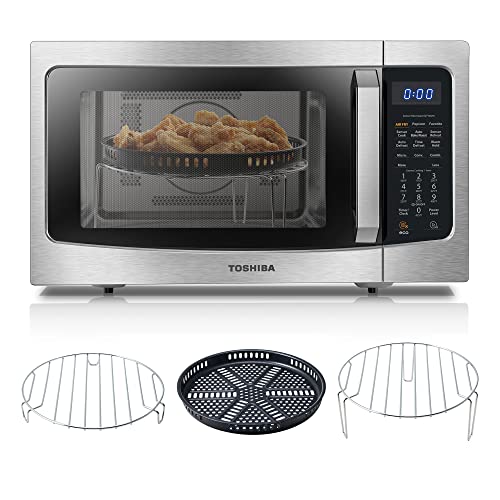
Toshiba 4-in-1 1.5 Cu.Ft Microwave with Air Fryer Combo — Best Multi-Function House Microwave
The 4-in-1 suits the house that wants countertop consolidation — smaller kitchens in family houses, second kitchens, and households whose air fryer and microwave would otherwise fight for the same counter. Its 1.5 cubic feet keeps family dishes in play, and the convection function covers the small-roast and bake jobs that justify a second oven during holiday cooking.
Strengths
- Four functions genuinely reduce appliance count and counter competition
- Family-size 1.5 cu ft — consolidation without the capacity sacrifice
- Position memory turntable returns the dish to its starting position — a small, daily kindness
Trade-offs
- Combo cooking is very good at several jobs rather than supreme at one
- More functions mean a longer household learning curve
- Air fry capacity is family-snack scale, not whole-meal scale
| Specification | Detail |
|---|---|
| Capacity | 1.5 cu ft (per verified listing title) |
| Power | 1000W (per verified listing title) |
| Functions | Microwave, air fryer, convection (4-in-1, per verified listing title) |
| Features | Smart sensor, mute function, position memory turntable (per verified listing title) |
Multi-function appliances live or die on whether the secondary functions are real. The Toshiba’s are: the air fry crisps credibly, the convection bakes and roasts at small scale, and the microwave half keeps the sensor and mute features that make its sibling the overall pick in this guide. For a house short on counter or long on appliances, that credibility converts directly into reclaimed space.
The position-memory turntable deserves its line: it returns the dish to the position it started in, so handles face you as you left them — the kind of detail that signals a design team thinking about households rather than specifications. As the consolidation pick for family houses, the 4-in-1 earns its badge completely.
Best for: Counter-short family houses wanting fewer appliances / Not suited for: Purists wanting a single-function specialist
Check the current price on Amazon
Comparison Table
Compare the six by household job first — main family unit, reheating specialist, volume unit, over-the-range, second microwave, multi-function — then by the verified capacity and wattage that decide daily fit. Measure your dishes, not just your counter, before choosing.
| Pick | Badge | Key spec | Best for |
|---|---|---|---|
| Toshiba EM131A5C 1.2 Cu.Ft Countertop Microwave (Check on Amazon) | Best Overall for Most Homes | 1.2 cu ft; 1000W; 12.4 in turntable; humidity sensor | Most family kitchens wanting one right answer |
| Panasonic NN-SN68KS 1.2 Cu.Ft Inverter Microwave (Check on Amazon) | Best for Reheating and Defrosting | 1.2 cu ft; 1200W; inverter technology; Genius Sensor | Batch-cooking and defrost-heavy households |
| Toshiba 2.2 Cu.Ft Inverter Countertop Microwave (Check on Amazon) | Best for Large Families | 2.2 cu ft; 1200W; 16.5 in turntable; inverter | Large families, entertainers and batch cookers with counter space |
| GE JVM3160RFSS 1.6 Cu.Ft Over-the-Range Microwave (Check on Amazon) | Best Over-the-Range for a Whole House | 1.6 cu ft; 1000W; 300 CFM venting; 30 in format | Houses with the microwave over the range |
| COMFEE EM720CPL-PM 0.7 Cu.Ft Countertop Microwave (Check on Amazon) | Best Second Microwave for the House | 0.7 cu ft; 700W; compact footprint; sound on/off | Basements, in-law suites, workshops and second zones |
| Toshiba 4-in-1 1.5 Cu.Ft Microwave with Air Fryer Combo (Check on Amazon) | Best Multi-Function House Microwave | 1.5 cu ft; 1000W; microwave + air fry + convection combo | Counter-short family houses wanting fewer appliances |
How to Choose the Best House Microwaves for Your Household
Measure dishes before counters. The classic household mistake is measuring the countertop gap and forgetting the 9×13 casserole, the oversized dinner plate, the mixing bowl the family actually reheats in. A house microwave must rotate your largest regular dish with clearance — which is why this guide’s main picks start at 1.2 cubic feet with turntables above twelve inches, and why the 2.2 exists for households whose dishes demand it. Then measure the space honestly: width, depth with the door open at its full swing, and height under cabinets, because a microwave that fits closed and blocks a walkway open is a daily negotiation.
Match wattage to patience and volume. Household cooking power runs from the compact pick’s 700 watts — fine for a second zone — through the 1000-watt family standard to the 1200-watt inverter models that also deliver the gentlest low power. More watts cook faster and, with an inverter, more evenly at low settings; without one, more watts mostly cook faster. Finally, decide the format by the house’s architecture: countertop for flexibility, over-the-range for the built-in position with honest ventilation, compact for the second zone, and multi-function when counter competition is the household’s real problem.
Inverter vs Conventional: The Household Difference That Matters
Most household microwave frustration is power-delivery frustration. A conventional microwave has one power level — full — and simulates gentleness by switching it on and off in cycles. Defrosting exposes the fraud: edges cook while centres freeze, because the off periods are too short for heat to conduct through a large frozen mass. An inverter microwave, like the Panasonic and the large Toshiba in this guide, genuinely throttles its output, holding a continuous low power that lets conduction keep pace. The result is defrosting in one stage and reheating that respects delicate foods.
The household calculus follows from your menu. Homes that defrost proteins several times a week, reheat batch cooking, or melt and soften as part of real cooking will feel the inverter difference constantly and should weight the Panasonic and inverter Toshiba heavily. Homes whose microwave boils water, pops corn and reheats pizza — all full-power jobs — will feel it rarely, and the sensor-equipped conventional pick serves them completely. Neither answer is wrong; the honest matching of technology to menu is the whole skill of this purchase.
Sizing a House Microwave: Capacity, Turntables and Real Dishes
Capacity figures describe the cavity; turntable diameter describes your life. A microwave earns its household place by rotating the dishes the household owns, so inventory yours before ordering: the largest casserole, the dinner plates, the baby bottles or the popcorn bowl, whichever is biggest and most frequent. The guide’s classes map cleanly — 0.7 cubic feet for mugs and bowls in a second zone, 1.2 for the standard family plate-and-casserole repertoire, 1.5 to 1.6 for family-plus and built-in positions, and 2.2 for the entertaining household whose serving dishes defeat everything smaller.
Remember the two hidden dimensions. Cavity height decides tall items — baby-bottle sterilisers, large mugs, covered bowls with lids — more often than width does. And door swing decides placement: a microwave whose open door blocks the fridge or a walkway will be cursed daily regardless of its specifications. Measure the room the door opens into, not just the box it closes into, and the size you choose will fit the house as well as the counter.
Power Levels, Explained for Households: What the Numbers Do
A microwave’s power levels are widely misunderstood, and the misunderstanding drives most disappointing cooking. On a conventional machine, level five does not mean half heat — it means full heat for half the time, in pulses. That is why the same setting can leave a sauce scorched at the rim and cool in the middle: during each on-pulse the surface receives full power. Inverter machines, two of which anchor this guide, break the pattern by delivering genuinely reduced continuous power, which is why their low levels behave like a hob’s simmer rather than a strobe.
Households can use this knowledge immediately, whatever machine they own. On conventional microwaves, lower levels work best with stirring and standing time built in — the standing minutes are not dead time but the conduction that finishes the job the pulses started. On inverters, trust the low levels for defrosting and delicate work without the stirring ritual. Either way, the recipe instruction to cook at seventy percent means something real once the mechanism is understood — and a household that understands it gets better results from any microwave in this guide.
Microwave Safety and Materials: The Household Rules That Matter
Microwave safety for a household reduces to a short list of durable rules. Use containers labelled microwave-safe, and treat that label as applying to the container, not to everything that fits inside it — metal, including foil trim and metallic-glaze ceramics, stays out unless the appliance’s own manual explicitly provides for it. Cover food with microwave-safe covers rather than cling film touching the food, both for even heating and for a clean cavity. Respect standing time after cooking: it is part of the cooking, finishing the temperature equalisation and making family servings safer to handle.
Two household-specific rules complete the list. Supervise young children’s use until their competence is demonstrated rather than assumed, and use the child lock the picks in this guide provide where the household agrees it helps. And keep the door area and seals clean and undamaged — the door system is the appliance’s containment, and a monthly wipe during the cleaning rhythm in this guide’s setup section is all the attention it asks. Followed consistently, these rules make the microwave what it should be in a house: the most boringly safe appliance in the kitchen.
The Second-Oven Effect: How a House Microwave Changes Family Cooking
Households consistently underestimate how a well-chosen microwave reorganises their cooking, because its largest effect is temporal rather than culinary. Batch cooking becomes practical when reheating is trustworthy — the sensor and inverter picks in this guide exist precisely to make Sunday’s cooking taste like Sunday on Wednesday. Holiday and entertaining cooking gains a parallel track: vegetables, sauces and sides hold and reheat in the microwave while the oven serves the centrepiece, which is the quiet reason the 1.5 and 2.2 cubic foot classes earn their counterspace in entertaining houses.
The multi-function pick extends the effect furthest, absorbing the small roasts and bakes that would otherwise heat a full oven for a family side dish. None of this requires new skills — it requires capacity matched to the household’s dishes, power delivery matched to its menu, and the setup habits this guide describes. Chosen that way, the house microwave stops being the appliance of last resort and becomes the household’s second cook: unglamorous, constantly used, and missed immediately on the rare day it rests.
How to Set Up a House Microwave for Safe, Even Family Use
A microwave’s first hour decides years of household habits. The setup below covers placement, ventilation and the family’s first calibration cooks — the steps that make a new house microwave perform as its specifications promise, for every member of the household.
- Place for ventilation and reach. Set the microwave on a stable surface with the clearances its manual specifies — vents blocked by walls or stored items are the leading cause of early failure. Position it so children old enough to use it can reach safely without climbing, and so hot dishes travel the shortest path to a landing surface.
- Level and test the turntable. Seat the turntable ring and plate exactly as the manual shows, then run the empty-check the manufacturer prescribes — never a dry full-power run. Confirm rotation is smooth and silent; a mis-seated ring announces itself now, not mid-dinner.
- Set the household defaults. Program the clock, test the mute or sound setting for open-plan peace, set the child lock policy the household agrees on, and run the eco or standby mode if your house uses it. Defaults set once, together, prevent a year of individual workarounds.
- Calibrate with water. Heat a measured cup of water and time it against the wattage class — a simple first check that the machine performs to its specification and that the household learns its pace. Every microwave has a personality; this is the five-minute introduction.
- Teach the sensor and the cover. Run one sensor reheat cycle on a real leftover portion so the household sees the machine judge doneness itself, and establish the house rule: food covered with a microwave-safe cover reheats evenly and keeps the cavity clean. Habits formed in week one are the machine’s maintenance programme.
- Establish the cleaning rhythm. Steam a bowl of water with a squeeze of lemon, wipe the softened interior, and note the date — monthly repetition keeps the cavity fresh and the door seals honest. A clean microwave cooks more evenly and smells of nothing, which is the correct smell.
- File the specification. Record the model, capacity and wattage where the household keeps appliance information. The turntable size and wattage class are the two facts every future recipe conversion, replacement part and successor purchase will ask for.
A house microwave set up this way disappears into the household’s competence — everyone can use it, it cooks the way its specifications claim, and its maintenance is a rhythm rather than a rescue. That disappearance is the goal: the best house appliances are the ones the house stops noticing.
Where the House Microwave Lives: Counter, Cabinet and Clearance
Placement is the house microwave decision that outlives every feature comparison, so it closes this guide’s guidance. Countertop positions win on flexibility and ventilation but spend the kitchen’s most useful surface; measure the full footprint with the door open and be honest about the prep space that remains. Built-in and over-range positions reclaim the counter at the cost of installation and fixed dimensions — the GE pick’s format — and they reward households certain of their kitchen’s layout for the appliance’s whole life.
Whichever position you choose, respect the unglamorous clearances: ventilation gaps as the manual specifies, a landing surface within one step for hot dishes, and a door swing that does not cross a walkway or the fridge’s arc. A microwave placed by those rules is used more, cleaned more willingly and replaced less resentfully than a marginally larger one placed badly — the final sense in which house, in this search, is the operative word.
Teaching the Household: One Microwave, Many Cooks
A house microwave’s final specification is its users, and the households that get the most from the picks in this guide spend ten minutes aligning them. Agree the house conventions together: sensor first for reheating, covers always, standing time respected, metal never. Write nothing down if your household runs on demonstration — cook one shared meal with the new machine, using each headline feature once, and the conventions set themselves more durably than any note on the fridge.
Children graduate by demonstration too: supervised turns reheating familiar foods teach the keypad, the hot-dish discipline and the lock’s purpose in the order real life will ask for them. A microwave everyone in the house can use well is a safer and more capable appliance than a technically superior one only one person understands — which is why this guide weighted sensor automation and household manners as heavily as watts and litres.
Common Buying Mistakes
Mistake 1: Buying capacity from the box instead of the dishes. Cavity litres do not reheat dinner; turntables and door openings do. Measure your largest regular dish and match the turntable class to it — the guide’s sizing section maps the classes to real repertoires.
Mistake 2: Underbuying the over-the-range hood. An over-range microwave is also the kitchen’s ventilation for a decade. Choosing it on microwave features while ignoring its CFM — the GE pick’s 300 CFM is the honest benchmark here — leaves the house under-ventilated at every sear and fry.
Mistake 3: Expecting a compact to do family duty. The 0.7 cubic foot, 700-watt class is a second-zone appliance. Installed as a main family microwave it will be slow, small and resented — a mismatch of role, not a failure of the machine, and entirely avoidable at purchase.
Mistake 4: Blocking the vents for a flush fit. Microwaves breathe through specified clearances. A built-in look achieved by sealing a countertop unit into a tight cubby shortens its life and can void its safe operation — respect the manual’s gaps or choose a format designed for the space.
Mistake 5: Skipping the household defaults. Mute settings, child locks and sensor habits left unconfigured become daily friction distributed across every family member. Twenty minutes of setup in week one is the cheapest harmony a household appliance ever buys.
Final Recommendation
For most houses, the Toshiba EM131A5C is the recommendation: family capacity, sensor intelligence and household manners in one verified package. Choose the Panasonic when reheating and defrosting quality is the household’s daily pain, the Toshiba 2.2 when volume rules, and the GE when the microwave’s home is over the range and its ventilation must be honest. The COMFEE completes the house in a second zone, and the Toshiba 4-in-1 consolidates a crowded counter without surrendering family capacity.
Measure your dishes, respect the formats, set the defaults together — and the microwave you install will serve the whole house, quietly and evenly, for the decade it was bought for. That is what best means at household scale: not the most features, but the right ones, verified.
To recap the confirmed purchases in this guide: Toshiba EM131A5C 1.2 Cu.Ft Countertop Microwave (Best Overall for Most Homes) — check price on Amazon; Panasonic NN-SN68KS 1.2 Cu.Ft Inverter Microwave (Best for Reheating and Defrosting) — check price on Amazon; Toshiba 2.2 Cu.Ft Inverter Countertop Microwave (Best for Large Families) — check price on Amazon; GE JVM3160RFSS 1.6 Cu.Ft Over-the-Range Microwave (Best Over-the-Range for a Whole House) — check price on Amazon; COMFEE EM720CPL-PM 0.7 Cu.Ft Countertop Microwave (Best Second Microwave for the House) — check price on Amazon; Toshiba 4-in-1 1.5 Cu.Ft Microwave with Air Fryer Combo (Best Multi-Function House Microwave) — check price on Amazon.
Keep researching within this range with these companion guides: Best 1.1 Cu Ft Microwaves; Best 1.5 Microwaves; Best 1.6 Cu Ft Microwaves; Best 1000 Watt Microwaves; Best Kitchen Faucets Available.
Frequently Asked Questions
What size microwave does a family house actually need?
For most families, the 1.2 cubic foot class with a turntable above twelve inches — the Toshiba overall pick’s class — covers the full repertoire of dinner plates and standard casseroles. Larger households and entertainers should step to the 1.5 to 2.2 classes in this guide. The deciding measurement is your largest regular dish rotating with clearance, not the cavity figure on the box.
Is an inverter microwave worth it for a house?
If your household defrosts and reheats frequently, yes — the difference is physical, not cosmetic. Inverters deliver continuous low power instead of pulsing full power, so defrosting completes in one stage and reheating stops scorching edges. Households that mostly boil water and pop corn at full power will feel the benefit rarely and are well served by the sensor-equipped conventional pick.
How much ventilation does an over-the-range microwave need?
Enough to clear real cooking — the GE pick in this guide vents at 300 CFM, which handles family frying and searing honestly. Lower figures suit lighter cooking. Ducted installation outperforms recirculating wherever the house allows it, so if your over-range position can be ducted during installation, that one-time work pays out for the appliance’s whole life.
Can a compact microwave serve as a house’s only microwave?
It can, for a small household with modest dishes — but it is not what the class is for. The 0.7 cubic foot, 700-watt pick here is curated as a second microwave for basements, suites and workshops. As a main family unit it will be slow with large loads and too small for family dishes; the guide’s verdict lines mark that boundary deliberately.
What does a position memory turntable do?
On the Toshiba 4-in-1 in this guide, it returns the turntable to its starting position at the end of cooking, so the dish — and its handles — face you exactly as you placed them. It is a small feature with daily value in a family house, where the person removing a hot dish is often not the person who loaded it.
How long should a house microwave last, and what kills them early?
A household microwave from the brands in this guide should serve for many years of family use. The early killers are environmental, not electronic: blocked ventilation from too-tight placement, door-seal abuse from slamming and hanging, and interiors left soiled until odours bake in. The setup and cleaning rhythm in this guide’s how-to section addresses all three — placement clearances, household handling habits, and a monthly steam clean.
Should a house microwave have a turntable or a flatbed?
Turntables remain the household standard because they rotate family dishes evenly without intervention, and every pick in this guide uses one — up to the 16.5-inch platform of the large-family model. Flatbed designs trade the rotating plate for a flat cavity floor that fits awkward shapes and wipes clean in seconds, at the cost of relying on the machine’s distribution system alone. For most houses the turntable’s proven evenness wins; households dominated by rectangular dishes should weigh the flatbed’s convenience honestly against it.


