Disclosure: airfryerkitchensupply.com is reader-supported. When you buy through links on our site, we may earn an affiliate commission at no extra cost to you.
Where to buy
Start your search for best gas smoker grills with the pick that matches your space, fuel and headcount, then check price on Amazon before you commit. Every linked model below was confirmed against the Amazon catalog data we pulled for this guide, and availability can shift with the season, so use the links here as your shortlist rather than wandering the full category:
- Masterbuilt 40-Inch ThermoTemp Propane Smoker (Best Overall) — Check the current price on Amazon
- Dyna-Glo 36-Inch Vertical LP Gas Smoker (DGY784BDP) (Best Value Cabinet) — Check the current price on Amazon
- Masterbuilt MPS 230S Propane Smoker 30-Inch (Best for Small Patios) — Check the current price on Amazon
- Pit Boss 3-Series Gas Vertical Smoker (Best Looking Cabinet) — Check the current price on Amazon
- Char-Broil The Big Easy TRU-Infrared Smoker, Roaster & Grill (Best for Poultry) — Check the current price on Amazon
- Char-Griller Texas Trio Gas & Charcoal Grill and Smoker (Best Grill-First Hybrid) — Check the current price on Amazon
If you are shopping for the best gas smoker grills, you are really shopping for patience without the babysitting: real wood smoke and low-and-slow tenderness, but with a burner you can light in seconds and a dial instead of a fire to manage. That is the honest promise of this category, and also its honest limit. A propane smoker will not reproduce the deep bark of a well-run offset stick burner, because the fuel burns clean and the smoke comes from a chip tray rather than from the fire itself. What it does give you is repeatability. You can hold a cabinet near a steady temperature for six hours while you do something else, and for most backyard cooks that trade is exactly right.
The market splits into three shapes. Vertical cabinet smokers are the classic gas smoker grill: a tall box, a burner at the bottom, a water pan above it, a chip tray, and racks stacked like shelves. They are cheap to run, easy to load, and brilliant for ribs, pork shoulder and whole birds. Then there are the hybrids — gas grills with a smoker box or a full charcoal side — which grill first and smoke second. Finally there are infrared cooker-smokers that roast and smoke in a drum. This guide covers all three honestly, because the right answer depends on whether smoking is your main event or a weekend sideline.
One warning before the picks: gas smokers live and die by temperature control at the low end. A burner that cannot throttle down will run hot on a summer afternoon no matter what the dial says, and a cabinet with thin walls will swing every time the wind changes. Every pick below was chosen because it can genuinely sit in the low smoking range, seal well enough to keep smoke on the meat, and be cleaned without a fight. Capacity claims are treated skeptically throughout — what matters is how many racks you can actually use before the bottom rack scorches.
In this guide
Quick Picks
Masterbuilt 40-Inch ThermoTemp Propane Smoker — Best Overall. The ThermoTemp line solves the classic gas smoker complaint — temperature drift — with a thermostat-style control that cycles the burner to hold your set point. The 40-inch cabinet gives you 960 square inches across its racks, enough for a serious holiday load, and the analog dial keeps the interface dead simple. Check price on Amazon.
Dyna-Glo 36-Inch Vertical LP Gas Smoker (DGY784BDP) — Best Value Cabinet. A long-running, no-nonsense vertical propane smoker with a black powder-coat finish and a simple burner-and-dial layout. It skips thermostatic tricks and apps entirely, which keeps it affordable and easy to repair, and its 36-inch cabinet is the sweet spot for most families. Check price on Amazon.
Masterbuilt MPS 230S Propane Smoker 30-Inch — Best for Small Patios. The 30-inch MPS 230S shrinks the classic Masterbuilt propane cabinet for smaller patios and smaller households. Same vertical logic — burner, water pan, chip tray, stacked racks — in a cabinet that one person can move and store without drama. Check price on Amazon.
Pit Boss 3-Series Gas Vertical Smoker — Best Looking Cabinet. Pit Boss brings its pellet-grill polish to a gas vertical: the 3-Series wears a red hammertone finish, a proper viewing window in the door and a cabinet layout aimed at people who like to watch the cook without opening the door and dumping the heat. Check price on Amazon.
Char-Broil The Big Easy TRU-Infrared Smoker, Roaster & Grill — Best for Poultry. The Big Easy is the oddball that works: an infrared drum that roasts, grills and smokes with a chip box tucked between its walls. It is famous for turkeys and chickens — juicy inside, crisp outside, no oil vat — and it smokes ribs and shoulders in its own fast, hot-smoke style. Check price on Amazon.
Char-Griller Texas Trio Gas & Charcoal Grill and Smoker — Best Grill-First Hybrid. Three cookers in one frame: a 3-burner gas grill for weeknights, a charcoal grill chamber, and a side fire box that turns the charcoal side into an offset smoker. If your household grills four times for every once it smokes, the Trio matches that reality. Check price on Amazon.
How These Picks Were Chosen
Each candidate was checked against the Amazon catalog through Amazon data for this site, and only models with a confirmed listing and a confirmed identity made the list. From there the filters were practical. The smoker had to hold low temperatures without constant vent fiddling, based on its burner design and cabinet construction. The chip system had to be refillable without dumping all the heat and smoke — a side loader or an external tray beats opening the main door every hour. Water pan size mattered, because a small pan that boils dry at hour three is a design flaw, not a quirk.
We also weighed the unglamorous things: whether the racks fit a full packer brisket or only trimmed flats, whether the thermometer sits where the meat actually cooks, whether replacement burners and regulators are easy to source, and whether the cabinet can be moved by one person. Models that were really charcoal smokers with a gas ignition gimmick were cut. So were cabinets with no meaningful low-end control. What survived is a short list of six that covers big-batch smoking, small patios, tight budgets and grill-first households.
The 6 Best Gas Smoker Grills

Masterbuilt 40-Inch ThermoTemp Propane Smoker — Best Overall
Check the current price on Amazon
This is the pick for the cook who smokes often enough to be annoyed by babysitting a burner valve. If your current routine involves checking the cabinet every thirty minutes and nudging a knob, the ThermoTemp approach feels like a genuine upgrade rather than a gadget. It suits families who smoke in batches — several racks of ribs at once, or a shoulder plus a chicken — and who want to load the cabinet in the morning and trust it until the food is done. The footprint is still a slim vertical tower, so it fits a patio corner that would never take a horizontal offset.
Strengths
- Thermostatic burner control holds a set temperature far more steadily than a manual valve
- 960 square inches of rack space handles batch smoking for a crowd
- Analog temperature control is simple, repairable and free of electronics to fail
Trade-offs
- Tall cabinet means the top racks run cooler than the bottom — rotation still helps on big loads
- At 40 inches it is a two-person lift and wants a permanent patio spot
- Analog control has no remote monitoring, so you still check in person
| Spec | Detail |
|---|---|
| Format | Vertical propane cabinet smoker |
| Cooking area | 960 sq in (per Amazon title) |
| Control | ThermoTemp analog temperature control |
| Model | MB20051316 |
The reason this model tops the list is boring and important: temperature stability is the entire game in smoking, and a thermostatic gas valve is the closest a propane cabinet gets to set-and-forget. Manual-valve smokers overshoot after every door opening and creep upward as the day warms; the ThermoTemp cycles instead, which flattens those swings. In practice that means your pork shoulder spends its hours in the zone you chose rather than on a slow climb. The cabinet itself is the familiar Masterbuilt vertical layout — burner low, water pan and chip tray in the middle path, racks above — which produces even smoke distribution as long as you do not pack the racks edge to edge. Leave gaps for airflow and the smoke kisses everything; crowd it and the center pieces lag. The 960 square inches is real, usable space for ribs laid flat and shoulders side by side, though a full untrimmed packer brisket still asks for a trim or a rack bend. Build quality is mid-tier pressed steel, so a cover is not optional if it lives outside. Treat it as an appliance, keep the burner ports brushed clean, and it rewards you with the most hands-off gas smoking experience in this guide.
Best for: Frequent smokers who want steady temperatures without electronics / Not suited for: Anyone who needs app monitoring or plans to smoke in high wind unsheltered
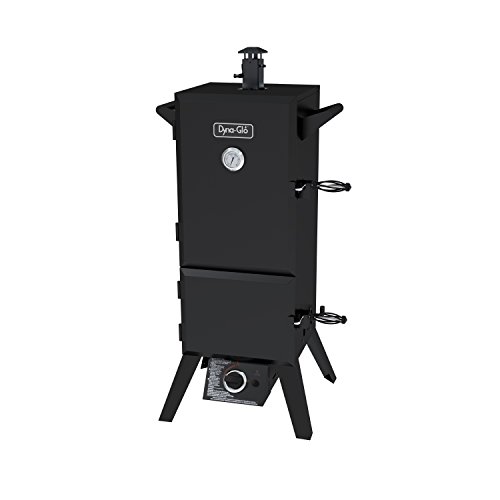
Dyna-Glo 36-Inch Vertical LP Gas Smoker (DGY784BDP) — Best Value Cabinet
Check the current price on Amazon
Buy this if you want to learn gas smoking properly without paying for features you have not yet decided you need. The Dyna-Glo is the cabinet experienced smokers often recommend to beginners because everything is manual and visible: you set the burner, you watch the gauge, you learn how weather moves the temperature. That education transfers to every smoker you will ever own. It is also a sensible second smoker for grill owners who only smoke six or eight times a year and cannot justify a premium cabinet.
Strengths
- Simple manual design with very little to break
- 36-inch cabinet balances capacity against patio footprint
- Powder-coat finish shrugs off ordinary backyard weather with a cover
Trade-offs
- Manual valve means you manage temperature swings yourself
- Stock door thermometer should be verified against a probe at grate level
- Chip tray refills mean opening the cabinet and losing some heat
| Spec | Detail |
|---|---|
| Format | Vertical LP gas smoker |
| Size | 36 in cabinet (per Amazon title) |
| Finish | Black powder coat |
| Model | DGY784BDP |
There is a real virtue in a smoker this straightforward. The burner lights, the chips smolder in their tray, the water pan steadies the climate, and the food cooks. Because nothing is automated, you quickly learn the two skills that matter — how far to open the valve for a given outdoor temperature, and how your cabinet behaves in wind. Owners who add one cheap upgrade, a probe thermometer clipped at rack level, close most of the gap to fancier cabinets. The rack layout fits ribs, shoulders and chickens in sensible combinations, and the vertical shape keeps the smoke path long, which helps flavor. Where it shows its price is in the details: the door seal is adequate rather than airtight, so expect a wisp of smoke leakage and slightly higher propane use, and the chip tray is sized for a couple of hours rather than an entire cook, so plan one refill on long sessions. None of that prevents excellent food. It simply asks you to participate, and many cooks end up preferring exactly that.
Best for: Beginners and occasional smokers who want a repairable, affordable cabinet / Not suited for: Cooks who want to load the smoker and ignore it for eight hours

Masterbuilt MPS 230S Propane Smoker 30-Inch — Best for Small Patios
Check the current price on Amazon
This is the gas smoker for couples, small families and anyone whose outdoor space is a modest patio or deck corner. A 30-inch cabinet still fits a pork shoulder, a spatchcocked chicken or a couple of racks of ribs with sensible trimming, which covers the way most households actually smoke. If your typical cook is one main item plus a tray of something else, rather than a full competition load, the smaller cabinet is not a compromise at all — it heats faster, uses less propane per session and stores in half the space of its bigger siblings.
Strengths
- Compact vertical footprint suits balconies and small patios where local rules allow gas appliances
- Heats quickly and sips propane on short and medium cooks
- Familiar Masterbuilt layout with widely available parts and accessories
Trade-offs
- Full packer briskets and untrimmed rib racks need trimming to fit
- Smaller water pan needs a mid-cook check on long sessions
- Batch cooking for a large party means running two sessions
| Spec | Detail |
|---|---|
| Format | Vertical propane smoker |
| Size | 30 in (per Amazon title) |
| Model | MPS 230S |
Small smokers have one underappreciated advantage: thermal responsiveness. With less air volume to heat, the MPS 230S recovers temperature quickly after you open the door to spritz or wrap, and that shorter recovery keeps total cook times predictable. The flip side is less thermal mass, so a gusty day moves the needle more than it would on the big ThermoTemp cabinet — park it out of the wind and it behaves. The rack spacing handles the realistic small-household menu well. A shoulder on one rack, beans or mac and cheese below to catch drippings, and you have the classic setup. Chip management is the standard tray routine, good for a couple of hours of smoke per load, which matches how most people smoke anyway: heavy smoke early, clean heat late. As a first propane smoker it teaches the same lessons as the Dyna-Glo in a smaller, friendlier box, and as a household’s only smoker it covers weeknight-to-weekend smoking without dominating the patio.
Best for: Small households and small patios that smoke one or two items at a time / Not suited for: Hosts who regularly smoke for ten or more people
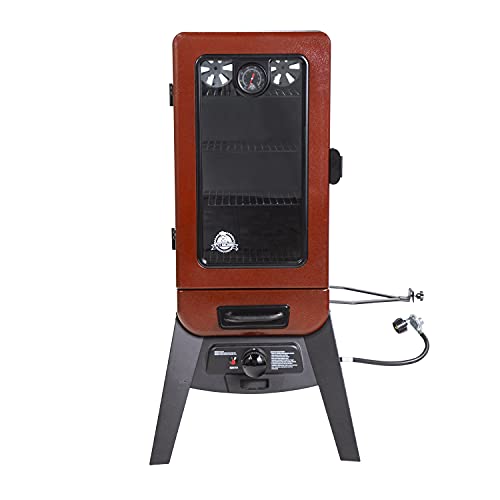
Pit Boss 3-Series Gas Vertical Smoker — Best Looking Cabinet
Check the current price on Amazon
Choose this if presentation and process both matter to you. The window sounds like a styling flourish until you have smoked with one: being able to check color on a bark, see whether the water pan is still working and confirm the chips are smoking — all without opening the door — genuinely improves results, because every door opening costs heat and time. The red hammertone finish also makes it the one cabinet in this guide that looks like furniture rather than a filing cabinet, which matters on a finished patio.
Strengths
- Door window lets you monitor bark and smoke without losing heat
- Hammertone finish looks sharp and hides minor scuffs well
- Pit Boss dealer and parts network is broad if you need support
Trade-offs
- Window needs regular cleaning or smoke film defeats its purpose
- Still a manual-temperature cabinet — the window informs, it does not automate
- Finish-forward pricing versus plainer cabinets of similar size
| Spec | Detail |
|---|---|
| Format | Vertical gas smoker |
| Series | 3-Series (model 10773, per Amazon title) |
| Finish | Red hammertone |
The 3-Series earns its place on design that serves the cook rather than the brochure. The window is the headline, but the supporting details hold up: a cabinet that seals decently, racks that slide without drama, and a burner with enough low-end manners to run a genuine smoking temperature on a calm day. Smoke flavor from its chip system is on par with the other cabinets here, which is to say good and clean — gas cabinets produce a lighter smoke profile than charcoal, and this one is no exception. Plan your wood accordingly: stronger chips early, and resist the urge to keep adding chips for six straight hours, which produces bitter, ashy notes rather than more flavor. The hammertone finish deserves a mention for durability as well as looks; textured powder coats tolerate the heat cycles of a smoker cabinet better than glossy paint. If your patio is an outdoor room rather than a utility corner, this is the gas smoker that belongs in it.
Best for: Patio cooks who value monitoring and appearance as well as results / Not suited for: Bargain hunters — plainer cabinets smoke the same food for less

Char-Broil The Big Easy TRU-Infrared Smoker, Roaster & Grill — Best for Poultry
Check the current price on Amazon
Buy this if poultry is your headline act. Nothing else in this guide cooks a whole turkey or chicken with the same combination of speed and skin quality, because the infrared drum surrounds the bird with even heat instead of blasting it from below. It also suits cooks who find cabinet smokers slow and fussy: the Big Easy runs hotter, finishes faster and asks very little of you. What it will not do is a twelve-hour low-and-slow brisket session — that is simply not its design brief, and pretending otherwise leads to disappointment.
Strengths
- Superb whole poultry — crisp skin, juicy meat, no frying oil to buy or discard
- Infrared drum cooks evenly with no flare-ups and minimal attention
- Chip box adds genuine smoke flavor to its roasting style
Trade-offs
- Hot, fast profile does not suit true low-and-slow brisket or shoulder sessions
- Basket format limits flat items like multiple rib racks
- It is a specialist — households wanting one do-everything smoker should look at the cabinets
| Spec | Detail |
|---|---|
| Format | Infrared smoker / roaster / grill drum |
| Technology | TRU-Infrared (per Amazon title) |
| Model | 14101550 |
Think of the Big Easy as a smoke-kissed roaster rather than a miniature cabinet, and it makes complete sense. The double-wall drum uses infrared energy to cook from all sides, so a turkey emerges evenly browned without turning, and the smoker chip box that sits in the wall gap perfumes the cook from the first minutes. Ribs come out tender on a shorter clock than a cabinet’s, with a different texture — more roasted, less pull-apart — that many families honestly prefer. Assembly and cleanup are the easiest in this guide, and the small footprint suits decks where a cabinet plus a grill would crowd the space. The honest limits are shape and temperature philosophy: food must fit the basket or the rib hooks, and the unit wants to cook, not to idle at the lowest smoking temperatures all day. As a second cooker beside a grill, or as the poultry specialist in a household that smokes occasionally, it is a delight. As your only path to traditional barbecue, it is the wrong tool.
Best for: Turkey, chicken and fast smoke-roasting households / Not suited for: Low-and-slow purists planning long brisket cooks

Char-Griller Texas Trio Gas & Charcoal Grill and Smoker — Best Grill-First Hybrid
Check the current price on Amazon
This is for the grill-first household that refuses to give up real offset smoking. The gas side handles burgers, chicken and vegetables with push-button convenience; the charcoal chamber grills with genuine fire flavor; and on the weekend the side fire box lets you run the charcoal chamber as a true offset smoker, with wood chunks and charcoal doing the work that a chip tray only imitates. You give up the set-and-forget nature of a gas cabinet on smoke days — offset cooking is active cooking — but you gain the deepest smoke flavor available anywhere in this guide.
Strengths
- Real offset smoking via the side fire box — the strongest smoke flavor here
- Gas side covers weeknight grilling with zero fuss
- Dual temperature gauges and push-button ignition keep both sides manageable
Trade-offs
- Large footprint and more parts to clean than any single-purpose pick
- Offset mode demands fire management — no dial to set and forget
- Thin steel on the fire box benefits from gasket and care upgrades over time
| Spec | Detail |
|---|---|
| Format | Gas + charcoal combo with offset side fire box |
| Gas side | 3 burners, push-button ignition (per Amazon title) |
| Monitoring | Dual temperature gauges |
The Texas Trio is really two philosophies sharing a cart, and it succeeds because it does not pretend otherwise. Weeknights belong to the gas chamber: quick ignition, predictable heat, dinner done. Smoke days belong to the offset configuration, where the fire lives in the side box and heat and smoke draw across the charcoal chamber. That is the configuration competition cooks built their reputations on, and the bark and smoke ring it produces are a class above chip-tray cabinets. The cost is attention — an offset fire wants feeding and vent adjustments roughly every hour — and space, since this is the largest footprint in the guide by a wide margin. Steel gauge is the known compromise at this tier; the fire box will age faster than the rest, and a cover plus occasional high-heat paint touch-ups are part of ownership. If you have the patio and the appetite for both styles of cooking, no other single purchase in this guide covers as much ground.
Best for: Grill-first households that also want authentic offset smoke flavor / Not suited for: Small patios or cooks who want smoking to be hands-off
Comparison Table
| Pick | Badge | Key spec | Best for |
|---|---|---|---|
| Masterbuilt 40-Inch ThermoTemp Propane Smoker | Best Overall | 960 sq in, ThermoTemp control | Frequent smokers who want steady temperatures without electronics |
| Dyna-Glo 36-Inch Vertical LP Gas Smoker (DGY784BDP) | Best Value Cabinet | 36 in vertical LP cabinet | Beginners and occasional smokers who want a repairable, affordable cabinet |
| Masterbuilt MPS 230S Propane Smoker 30-Inch | Best for Small Patios | 30 in compact propane cabinet | Small households and small patios that smoke one or two items at a time |
| Pit Boss 3-Series Gas Vertical Smoker | Best Looking Cabinet | Gas vertical with viewing window | Patio cooks who value monitoring and appearance as well as results |
| Char-Broil The Big Easy TRU-Infrared Smoker, Roaster & Grill | Best for Poultry | TRU-Infrared 3-in-1 drum | Turkey, chicken and fast smoke-roasting households |
| Char-Griller Texas Trio Gas & Charcoal Grill and Smoker | Best Grill-First Hybrid | 3-burner gas + charcoal + offset box | Grill-first households that also want authentic offset smoke flavor |
How to Choose the Best Gas Smoker Grills for Your Cooking Style
Start with the smoke itself. In a gas smoker, the burner makes heat and a tray of wood chips makes smoke, so flavor intensity depends on tray size, tray position and how long the chips smolder. Cabinets that let you add chips without opening the main door keep both the smoke and the temperature steadier. If deep, heavy smoke is your priority, be honest with yourself: a hybrid with a real charcoal fire box will out-smoke any pure gas cabinet, while a pure gas cabinet will out-convenience it every single time.
Next, judge temperature control at the low end, not the headline maximum. Almost any burner can run hot; the skill is idling low and steady for hours. Thermostatic control, as on the ThermoTemp pick, automates that. Manual valves can match it on a calm day with an attentive cook, but they drift with sun, wind and tank pressure. Whichever you choose, budget for a probe thermometer at grate level — the lid or door gauge on almost every smoker in this class reads the air somewhere your food is not.
Capacity should be measured in racks you can use, not square inches you can quote. A four-rack cabinet where the bottom rack scorches everything is really a three-rack smoker. Check rack spacing against your menu: ribs want flat racks, shoulders want height, and whole birds want headroom. Finally, think about the fuel routine. A standard propane tank is cheap to swap and lasts many sessions, but a cabinet that lives far from where you store the spare will eventually catch you mid-cook — keep the spare close and the regulator hose inspected.
Gas Smoker Grills vs Pellet and Electric: An Honest Comparison
Pellet smokers automate both heat and smoke, and at their best they are the easiest path to consistent barbecue. Their costs are the cooker itself, a steady diet of pellets and electronics that dislike damp storage. Gas smokers answer with simplicity: no auger, no controller board, no power cord — a burner, a valve and a tank. They light in any weather, run through a power cut and cost very little per hour. Their smoke is lighter, because chips smolder rather than combust as the primary fuel.
Electric smokers sit between the two on effort and at the gentle end on flavor. They hold temperature beautifully and are often allowed where open flame is restricted, but their smoke is the mildest of the three and they are useless in an outage. The practical verdict: choose gas when you want flame independence, fast startup and low running costs with honest mid-weight smoke; choose pellets when automation matters more than anything; choose a charcoal hybrid when flavor outranks convenience. Many serious backyard cooks end up with gas for reliability and charcoal for ceremony — which is exactly the split this guide’s hybrid pick exists to serve.
Wood Chips, Chunks and Smoke Quality in a Gas Smoker
Because a gas burner produces almost no flavor of its own, your wood choice is the entire smoke program — and it deserves more thought than the bag you grabbed at checkout. Chips are the standard fuel for cabinet trays: they ignite quickly, smolder for a moderate window and suit the way gas smokers are built. Fruitwoods such as apple and cherry give a mild, sweet smoke that flatters pork and poultry. Hickory is the assertive all-rounder for ribs and shoulders. Mesquite is the strongest voice in the drawer and should be used briefly and early, especially on beef, because a full cook of mesquite smoke turns harsh. Oak sits in the middle and mixes well with everything, which is why experienced cooks blend — oak for the base, a fruitwood for the top note.
Technique matters as much as species. A tray packed loosely with dry chips smolders steadily; a tray mounded tight can starve and sulk, then flare when the door opens. If your cabinet supports it, a second tray or a pellet tube extends smoke time without a door-opening refill, at the cost of a slightly different burn character. Judge smoke by its look, not its volume: thin, pale, almost blue smoke is the goal, carrying clean flavor compounds. Thick white billows mean incomplete combustion and deposit the bitter, acrid notes that make people say they do not like smoked food. They usually do like it — they just met it in its worst form first.
Finally, match smoke duration to the meat, not to the cook’s enthusiasm. Poultry takes smoke eagerly and needs a light hand. Pork shoulder forgives almost anything. Brisket wants a steady early smoke and a clean finish. In every case, the gas smoker’s advantage is control: you can stop adding smoke precisely when the food has had enough, something a charcoal fire never quite lets you do. Use that control and your results will taste deliberate rather than accidental.
Gas Smoker Maintenance: Burners, Seals and Seasonal Care
A gas smoker asks for less maintenance than any other smoker type, but the little it asks for is non-negotiable. The burner is the heart: its ports clog with rust scale, grease mist and the occasional spider web, and a clogged burner announces itself as a lazy yellow flame, uneven heat or a cabinet that will not reach temperature. Once a season, remove the burner if your model allows, brush the ports with a soft wire brush, clear the venturi tube, and check the electrode gap. The regulator and hose deserve the same visit — look for cracks, stiffness and chewed spots, and replace a hose that shows any of them rather than negotiating with propane hardware.
The cabinet itself needs two habits. First, manage the water pan and drip path: old pan water and grease residue turn rancid between cooks and will flavor the next session before you add a single chip. Empty, wash and dry them after long cooks. Second, protect the exterior. A fitted cover, a dry storage spot and an occasional wipe of the door seal keep a cabinet tight for years; a smoker left uncovered in the rain will rust at its seams and leak smoke at its door no matter how well it was built. Check the door gasket or seal each spring, adjust latches that have loosened, and touch up exterior rust spots early while they are cosmetic. Ten minutes of this attention twice a year is the entire maintenance budget of a gas smoker — which is precisely why so many households choose one.
How to Use a Gas Smoker Grill: First Cook, Step by Step
Your first cook on a gas cabinet should be something forgiving — a pork shoulder or a whole chicken — while you learn how your particular smoker breathes. Work through these steps in order and you will finish with good food and a notebook of settings that make the second cook easier.
- Season the cabinet first. Before food ever goes in, run the empty smoker at a medium smoking temperature with a tray of chips for about an hour. This burns off manufacturing oils and lays down the first seasoning layer on the walls. Let it cool, wipe the racks, and you are ready to cook for real.
- Soak or not. Prepare your wood chips. Soaking was traditional advice, but wet chips mostly steam before they smoke; most experienced gas-smoker cooks now load dry chips for faster, cleaner smoke. Use a generous handful-to-cup per tray load, and pick a wood that matches the meat — fruitwoods for poultry and pork, stronger woods for beef.
- Fill the water pan. Set the water pan in place and fill it most of the way with hot water. Hot water avoids dragging the cabinet temperature down at startup. The pan buffers temperature swings and keeps the cooking climate humid, which helps bark set without drying the surface.
- Preheat and stabilize. Light the burner, set your target temperature, and give the cabinet a full twenty to thirty minutes to stabilize before loading food. Watch the gauge settle rather than spike. This patience is the difference between a steady cook and an afternoon of chasing the dial.
- Load food cold-side aware. Place the largest, thickest items on the middle racks and anything delicate higher up. Leave space between pieces for smoke to circulate. Put a drip-catching tray of beans or vegetables under a fatty shoulder if you like — it is the easiest side dish in barbecue.
- Manage smoke early. Smoke absorption happens mostly while the meat is cool and the surface is moist, so make your first chip load count and add a second load around the one-hour mark if you want a stronger profile. After the first couple of hours, clean heat matters more than more smoke.
- Probe, do not peek. Cook to internal temperature and tenderness, not to the clock. Keep the door closed, monitor with a probe, and when you do open up, work quickly — spritz, wrap or rotate in one visit rather than three.
- Rest and clean while warm. Rest smoked meat wrapped and insulated for at least thirty minutes before slicing or pulling. While the cabinet is still warm, empty the chip tray, dump the water pan once it is safe to handle, and brush the racks. Ten minutes of cleanup now prevents the rancid, acrid start that ruins the next cook.
Keep notes on this first cook: outdoor temperature, valve setting, how long a chip load smoked, and where your probe read versus the door gauge. Those four lines turn a new appliance into a known tool, and by the third cook you will be running the cabinet from memory.
Common Buying Mistakes
Buying by square inches alone. Manufacturers sum every rack, including the one inches above the water pan that cooks like a broiler. Judge a cabinet by the racks you would actually load, their spacing, and whether your usual cuts fit without folding or trimming.
Trusting the door thermometer. Door and lid gauges are approximate and often read the temperature of the metal around them. A probe at grate level tells the truth, and the difference is routinely enough to explain cooks that finish mysteriously fast or slow.
Adding chips for the whole cook. Meat takes on smoke mainly in the early hours. Chipping continuously for eight hours layers bitter, stale smoke over good meat. Load early, then let clean heat finish the job.
Skipping the water pan. Running a gas cabinet dry makes temperatures jumpy and surfaces leathery. The water pan is a temperature stabilizer and a humidity source, not an optional accessory.
Ignoring wind. A vertical cabinet in a crosswind loses heat through every seam and can blow temperature readings all over the map. Position the smoker in a sheltered corner, never in an enclosed space, and your control problems shrink by half.
Final Recommendation
For most households, the Masterbuilt 40-Inch ThermoTemp is the gas smoker to beat: its thermostatic control removes the one chore that makes people abandon smoking, and its capacity covers real family cooking. If the budget is tighter or the patio smaller, the Dyna-Glo 36-inch and the Masterbuilt MPS 230S deliver the same style of food with more manual involvement. Poultry lovers should look hard at the Big Easy, and grill-first cooks who crave real offset flavor should give the Texas Trio the patio space it demands.
Whichever cabinet you choose, spend your first month learning it with forgiving cuts — shoulders, chickens, ribs — before attempting a brisket for guests. Gas smoking rewards routine: the same setup, the same notes, small adjustments. That routine, more than any feature, is what produces barbecue your family asks for by name.
The shortlist, one more time: Masterbuilt 40-Inch ThermoTemp Propane Smoker (Best Overall); Dyna-Glo 36-Inch Vertical LP Gas Smoker (DGY784BDP) (Best Value Cabinet); Masterbuilt MPS 230S Propane Smoker 30-Inch (Best for Small Patios); Pit Boss 3-Series Gas Vertical Smoker (Best Looking Cabinet); Char-Broil The Big Easy TRU-Infrared Smoker, Roaster & Grill (Best for Poultry); Char-Griller Texas Trio Gas & Charcoal Grill and Smoker (Best Grill-First Hybrid). Check price on Amazon for the linked models before you buy, since availability shifts with the season.
Keep exploring the cluster: Best Gas Grills And Smokers Best Gas Stainless Steel Grills Best Gas Wood Grills Best Smokers Best Gas Grills
Frequently Asked Questions
Do gas smoker grills produce real smoke flavor?
Yes, but a lighter and cleaner version than charcoal or pellet cooking. The smoke comes from wood chips smoldering over the burner rather than from the fuel itself. Loading chips early, while the meat is cool and moist, maximizes the flavor you get, and most families find the result perfectly satisfying for ribs, pork and poultry.
How long does a propane tank last in a smoker?
A standard tank runs a cabinet smoker for many sessions, because smoking uses the burner at low output most of the time. Wind, cold weather and high-temperature cooking shorten that considerably. Keep a spare tank stored safely nearby so a long cook never ends with a fuel run.
Can I use wood chunks instead of chips in a gas smoker?
Small chunks can work in some trays, but most gas smoker chip trays are designed for chips, which smolder at the lower heat a tray receives. Oversized chunks may simply char on one side or refuse to smoke at all. Follow your tray’s design and use chips, or pellets in a tube accessory made for the purpose.
What temperature should I smoke at in a gas smoker?
Most barbecue staples cook in the low-to-mid smoking range — ribs, shoulders and brisket at the lower end, poultry a little higher for better skin. Your specific cabinet’s manual gives its intended range; the important habit is holding one temperature steadily rather than chasing an exact number.
Do I need to soak wood chips before smoking?
Soaking is optional and many experienced cooks skip it. Wet chips must dry before they smoke, which delays smoke and adds steam. Dry chips start smoking sooner and cleaner. If your chips catch and flame rather than smolder, a brief soak or a foil pouch with holes can tame them.
How do I stop my gas smoker from running too hot?
Work on the low end of the valve, keep the cabinet out of direct sun and wind, make sure the water pan is full, and open vents gradually rather than all at once. If a cabinet still will not settle, check that the burner is clean and the regulator is not in bypass mode — a slow, careful relight following the manual usually resets it.


