Disclosure: airfryerkitchensupply.com is reader-supported. When you buy through links on our site, we may earn an affiliate commission at no extra cost to you.
Where to buy
For best blenders for raw veggies, Amazon is the practical place to buy: listings show the current configuration, included accessories, and return terms in one place, and stock on popular models turns over quickly. Our top recommendation is the Vitamix 5200 Professional-Grade Blender, 64 oz, Black. Also consider the Vitamix Propel Series 750, 64 oz, Black and the Blendtec Classic 575, WildSide+ Jar for the needs described below, the Ninja Professional Plus Blender BN701, 1400W Peak, 72 oz as a strong alternative, the Ninja Professional Blender BL610, 1000W, 72 oz for its specific strength, and the KitchenAid K400 Variable Speed Blender with Tamper, Contour Silver to round out the list. Check the current price on Amazon for whichever model you choose, and confirm the exact bundle, size, and finish on the listing before ordering, because manufacturers revise bundles more often than they revise model names.
Raw vegetables are a harder test than fruit smoothies, and that shapes this whole list. Carrots, beets, celery, kale stems, and frozen greens resist blades, trap air pockets, and leave stringy fibers behind in underpowered jars. Every pick below is a full-size countertop blender with the motor, jar geometry, and tamper or program support to turn raw produce into a smooth, drinkable result — not a personal bullet blender asked to do a job it was never built for.
Introduction
If you are shopping for the best blenders for raw veggies, start with the honest problem: raw vegetables do not want to blend. A ripe banana collapses in seconds, but a raw carrot fights back, celery leaves strings, beet chunks bounce above the blade, and kale stems turn into confetti instead of puree. The blenders that handle this well share three things — enough sustained power to keep dense loads moving, a jar shape that pulls ingredients down into the blades instead of throwing them up the walls, and a way to manage air pockets, usually a tamper or a well-designed vortex. The blenders that handle it badly are not necessarily bad machines; they are simply built for softer work.
That is why this guide contains no small personal blenders. A compact cup blender can make a fine fruit smoothie, but loading it with raw carrot, beet, and greens is how you get a hot motor, a half-chewed result, and a jar you have to stop and shake four times. Every pick here is a countertop machine with a family-size jar, because raw-vegetable blending is batch work: you load greens, dense roots, liquid, and something sweet to balance the flavor, and you need headroom for the load to circulate. If your goal is a daily green blend that actually tastes smooth, capacity is not a luxury — it is part of the method.
A second expectation is worth setting now. Even the best machine in this guide will ask something of you: enough liquid, ingredients added in a sensible order, and dense pieces cut to a size the vortex can grab. Technique matters with raw produce in a way it simply does not with frozen berries. The how-to section below walks through the loading order and liquid ratios that separate a silky result from a fibrous one, and it applies to every pick on this list. Buy the right blender, use it the right way, and raw vegetables stop being the hard case.
In this guide
Quick Picks
- Best Overall: Vitamix 5200 Professional-Grade Blender, 64 oz, Black — Variable-speed control and a tall, narrow 64 oz jar that folds raw greens and root chunks back into the blades better than any wide jar here.
- Best with Programs: Vitamix Propel Series 750, 64 oz, Black — Four programs plus variable speed and pulse in a 64 oz jar — the Vitamix for buyers who want the machine to run the raw-veg cycle for them.
- Best for Large Batches: Blendtec Classic 575, WildSide+ Jar — A wide WildSide+ jar and four preprogrammed cycles that suit big, liquid-rich vegetable batches for families and meal prep.
- Best Mid-Range Power: Ninja Professional Plus Blender BN701, 1400W Peak, 72 oz — 1400 peak watts, a 72 oz pitcher, and three Auto-iQ presets — strong raw-vegetable performance without stepping into the premium tier.
- Best Budget Full-Size: Ninja Professional Blender BL610, 1000W, 72 oz — The long-running 1000W, 72 oz Ninja — the lowest tier at which raw-vegetable blending still genuinely works.
- Best with Tamper Included: KitchenAid K400 Variable Speed Blender with Tamper, Contour Silver — A variable-speed dial, Intelli-Speed motor control, preset programs, and a supplied tamper for pushing stubborn raw loads down.
How These Picks Were Chosen
We verified every candidate against Amazon product data, confirming each model is a real, current listing in the configuration described. From that verified field we scored blenders on the criteria that matter for raw vegetables specifically. First, sustained blending power and blade design, because dense roots and fibrous stalks stall weak motors. Second, jar geometry and circulation — whether the jar forms a vortex that folds greens and chunks back into the blades. Third, air-pocket management: a supplied tamper or a program cycle that pauses and restarts to collapse pockets. Fourth, capacity and loading headroom for batch green blends. Fifth, cleaning reality, because a blender used daily for vegetables must rinse clean quickly or it will stop being used daily.
We deliberately excluded immersion blenders and personal cup blenders from the picks, even though several verified models exist in those formats. They are good tools for soups and single fruit smoothies, but they cannot circulate a full load of raw roots and stems, and recommending one here would set buyers up for exactly the chunky, stringy result they came to this guide to avoid. We also excluded any model we could not verify as a current listing. What remains is six countertop machines at different tiers, each with a distinct reason to own it, and each reviewed with three strengths and three trade-offs — because a review that lists only positives is an advertisement, not a review.
The 6 Best blenders for raw veggies

Vitamix 5200 Professional-Grade Blender, 64 oz, Black — Best Overall
The Vitamix 5200 is the machine for the household that blends raw vegetables daily and wants the smoothest possible texture without negotiation. Its tall, narrow container is the key: instead of spreading a load of kale, carrot, and celery across a wide base where pieces can hide, the narrow jar forces everything through the blade zone in a tight vortex. The variable-speed dial gives you direct control — start slow to pull the load down, then climb to full speed to finish fibrous material completely. If you blend vegetables most days, this is the benchmark the rest of the list is measured against.
Strengths
- Tall, narrow jar creates a powerful vortex that circulates dense raw vegetables instead of stranding them at the walls
- True variable-speed dial lets you start slow to engage the load, then finish at full speed for a smooth texture
- Simple, durable control layout with no fragile touchscreen — built for years of daily use
Trade-offs
- Premium tier; buyers who blend vegetables only occasionally will not use enough of its capability to justify the step up
- No preset programs — you control speed and time yourself, which beginners must learn
- Tall profile needs cabinet clearance, and the jar is hand-wash preferred for longest life
Key specs (verified)
- Container: 64 oz
- Controls: variable speed dial, high-speed switch
- Self-cleaning function (per Amazon listing)
- Blades: stainless steel
The deeper story is texture. Raw celery and kale stems fail in most blenders not from lack of raw power but from lack of circulation time at speed — fibers need repeated passes through the blades. The 5200 sustains that circulation because the jar keeps the load compact and moving, so a sixty-to-ninety-second run at high speed genuinely finishes the job rather than warming up a chunky mixture. It also handles the progression well: greens first with liquid, then dense roots, then something frozen on top to weight the load down. Owners who follow that order rarely need to stop and scrape, and that reliability is what turns vegetable blending from a project into a habit.
Check the current price on Amazon for the Vitamix 5200 Professional-Grade Blender, 64 oz, Black.
Best for: daily green-blend households, buyers who want the smoothest raw-vegetable texture, long-term owners / Not suited for: preset lovers, very low cabinets, occasional smoothie makers on a tight budget

Vitamix Propel Series 750, 64 oz, Black — Best with Programs
The Propel 750 suits the buyer who wants Vitamix circulation and power but prefers pressing a program to riding a dial. Its four programs include cycles that ramp speed automatically, which helps with raw vegetables in a specific way: the ramp pulls a stiff load of greens and roots down gradually instead of cavitating an air pocket in the first second. You still get variable speed and pulse for manual control, and the same generous 64 oz capacity for batch blending. Choose it over the 5200 if other people in your household will use the machine and need a simpler, repeatable routine.
Strengths
- Four programs automate the speed ramp that dense vegetable loads need, making results repeatable for any user
- Variable speed and pulse remain available when a particular load needs manual help
- Full 64 oz capacity handles family-size green batches in one run
Trade-offs
- Programs add cost over the simpler 5200 without adding raw blending power
- Programmed cycles still need sensible loading order and enough liquid to work well
- Large footprint, like most full-power countertop blenders
Key specs (verified)
- Container: 64 oz
- Programs: 4, plus variable speed and pulse
- Self-cleaning program (per Amazon listing)
In practice, the programs earn their keep on weekday mornings. A load of spinach, carrot, apple, ginger, and water behaves predictably, and a programmed ramp means the person blending does not need to learn dial technique to get a smooth result. For fibrous loads — celery, kale stems, beet — you may still finish with a short manual run at full speed, and the dial is right there when you need it. Think of the 750 as the same underlying capability as the 5200 with a layer of automation on top: you are paying for convenience and consistency across users, not for a different class of blend.
Check the current price on Amazon for the Vitamix Propel Series 750, 64 oz, Black.
Best for: households with several users, buyers who prefer programs, batch green blending / Not suited for: buyers who want the simplest possible controls, strict budgets

Blendtec Classic 575, WildSide+ Jar — Best for Large Batches
The Blendtec Classic 575 takes the opposite jar philosophy to Vitamix: a wide, five-sided WildSide+ jar designed to pull a large load into the blade through the jar geometry itself, with no tamper. For raw vegetables, that approach shines when the batch is big and liquid is generous — a full pitcher of greens, roots, and fruit for a family, or a meal-prep batch for the fridge. Its four preprogrammed cycles and five speeds cover the routine, and the blunt safety blade design is famously easy to clean under. Pick it if your vegetable blending is high-volume; pick a Vitamix if your batches are smaller and denser.
Strengths
- WildSide+ jar geometry circulates large loads without a tamper to push ingredients down
- Four preprogrammed cycles plus five speeds handle routine green batches with one touch
- Blunt blade design is easy and safe to wipe clean after fibrous blends
Trade-offs
- Wide jar is less effective on small, dense loads — a single serving of raw vegetables can ride above the blades
- No tamper included, so very stiff, low-liquid loads may need a pause and a stir
- Loud at full speed, like most high-power blenders, and the jar is large to store
Key specs (verified)
- Jar: WildSide+ (large capacity, per Amazon listing)
- Cycles: 4 preprogrammed blending cycles
- Speeds: 5 speeds, self-cleaning
The honest way to choose between this and the Vitamix picks is batch size and liquid level. Blendtec rewards the cook who loads the jar properly — greens and liquid first, a genuinely full batch — and then lets the cycle run. Under those conditions it produces smooth vegetable blends quickly and cleans up in seconds. It punishes the half-empty, low-liquid load, where a tamper machine would simply push the mixture down. If your household blends for three or more people, or you prep a large green batch every few days, the trade favors Blendtec. If you blend one dense serving at a time, it does not, and no program setting changes that geometry.
Check the current price on Amazon for the Blendtec Classic 575, WildSide+ Jar.
Best for: families, meal-prep batches, buyers who dislike using a tamper / Not suited for: single dense servings, low-liquid recipes, small kitchens with little storage

Ninja Professional Plus Blender BN701, 1400W Peak, 72 oz — Best Mid-Range Power
The Ninja BN701 is the value-power pick: a stacked-blade 72 oz pitcher and Auto-iQ programs that pulse and pause in patterns designed to pull ingredients down. For raw vegetables, that pulsing pattern is genuinely useful — it collapses the air pocket that forms over carrot and greens, then resumes blending, which is the budget-friendly substitute for standing there with a tamper. The stacked blade column also processes material at several heights in the jar, so greens near the top get cut instead of floating. It suits buyers who blend vegetables several times a week and want strong results at a mid-range tier.
Strengths
- Auto-iQ preset patterns pulse and pause to collapse air pockets in dense vegetable loads
- Stacked Total Crushing blades cut at multiple jar heights, so leafy greens process instead of floating
- Large 72 oz pitcher and dishwasher-safe parts suit frequent, family-size use
Trade-offs
- Stacked blade assembly is sharp and must be handled carefully when washing by hand
- Texture on the most fibrous loads (heavy celery, kale stems) can finish a step less silky than the Vitamix picks
- Peak-watt figures describe startup power, not sustained power — technique and liquid still matter
Key specs (verified)
- Power: 1400 peak watts (per Amazon listing)
- Pitcher: 72 oz
- Programs: 3 Auto-iQ presets
- Care: dishwasher-safe parts
Where the BN701 earns its place is consistency for the money. A typical raw load — spinach, carrot, cucumber, apple, ginger, water — comes out smooth in one Auto-iQ cycle, with a second short cycle reserved for beet-heavy or celery-heavy mixtures. The pitcher markings and pour spout are well judged for batch work, and the whole jar assembly going in the dishwasher matters more than it sounds when the alternative is hand-washing around blades every morning. It is not the quietest machine here and it will not match a Vitamix on a deliberately brutal test load, but for real household vegetable blending several times a week, the gap is smaller than the tier gap suggests.
Check the current price on Amazon for the Ninja Professional Plus Blender BN701, 1400W Peak, 72 oz.
Best for: frequent vegetable blending on a mid-range budget, families, dishwasher-first households / Not suited for: buyers chasing the absolute smoothest fiber finish, anyone uncomfortable handling sharp blade columns
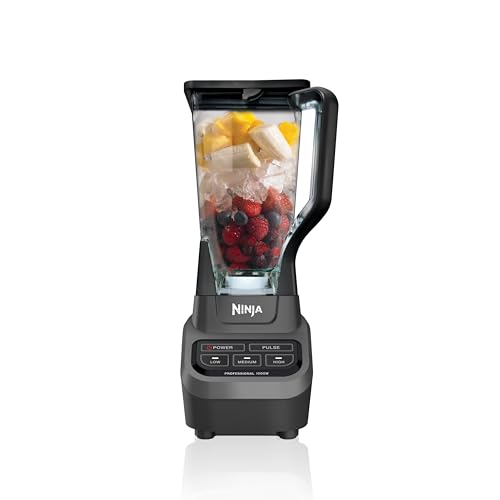
Ninja Professional Blender BL610, 1000W, 72 oz — Best Budget Full-Size
The BL610 is the honest budget floor for this category. Its 1000W motor and stacked Total Crushing blades in a 72 oz pitcher can absolutely blend raw vegetables — provided you respect its limits: cut dense roots smaller, keep liquid generous, and blend in the order the how-to section describes. What you give up versus the BN701 is preset intelligence and a margin of power on the toughest loads; what you keep is the big pitcher, the multi-height blades, and a machine that has been in production long enough that its behavior is well understood. For a first raw-vegetable blender, it is a rational place to start.
Strengths
- Full-size 72 oz pitcher and stacked blades at a budget tier — no capacity penalty for spending less
- Simple, proven controls with nothing fragile to fail
- Dishwasher-safe parts keep daily vegetable blending realistic
Trade-offs
- No Auto-iQ programs — you manage pulses and timing yourself on dense loads
- Very fibrous mixtures may need a stop, a stir, and a second cycle to finish smooth
- Less sustained power than every other pick here; small pieces and enough liquid are not optional
Key specs (verified)
- Power: 1000W (per Amazon listing)
- Pitcher: 72 oz
- Technology: Total Crushing stacked blades
- Use: family batches, dishwasher-safe parts
Treat the BL610 as a technique blender and it will reward you. Dice carrot and beet to roughly thumbnail size, put greens and liquid in first, and use short pulses to settle the load before committing to a full-speed run — that sequence turns a load this machine might otherwise struggle with into a smooth result. Where it visibly trails the premium picks is the last ten percent: a faint fiber in a celery-heavy blend, a need to re-run a beet mixture. For most households blending vegetables for flavor and nutrition rather than for a texture competition, that compromise at this tier is entirely reasonable, and it is why this model, rather than a cheaper personal blender, holds the budget slot.
Check the current price on Amazon for the Ninja Professional Blender BL610, 1000W, 72 oz.
Best for: first-time buyers, budget-conscious households blending vegetables regularly, simple-controls fans / Not suited for: buyers who want one-touch perfection on the toughest fibrous loads, low-liquid recipes

KitchenAid K400 Variable Speed Blender with Tamper, Contour Silver — Best with Tamper Included
The K400 earns its slot on one practical feature: it ships with a tamper. When a raw load of kale and carrot bridges over the blades and an air pocket forms, a tamper is the difference between a ten-second fix and opening the lid, stirring, and restarting. Around that feature KitchenAid builds a sturdy die-cast style machine with a five-speed variable dial, Intelli-Speed motor control that maintains speed under load, and preset programs including a smoothie cycle. It suits buyers who like the tamper workflow but want a different design language and control feel than Vitamix offers.
Strengths
- Tamper included for collapsing air pockets in stiff raw-vegetable loads without stopping
- Intelli-Speed motor control holds speed as dense ingredients engage the blades
- Variable dial plus presets (including smoothie) covers both manual and routine blending
Trade-offs
- Jar capacity is smaller than the 64–72 oz picks, so family batches may need two runs
- Heavier, premium-feeling base is less easy to move and store
- On the very toughest fibrous loads it finishes close to, but not quite at, the Vitamix level
Key specs (verified)
- Controls: 5-speed variable dial, Intelli-Speed Motor Control
- Presets: Ice Crush, Icy Drinks, Smoothie (per Amazon listing)
- Accessory: tamper included
- Model: KSB4028, Contour Silver
The K400 is at its best in the messy middle of vegetable blending — the half-frozen, half-raw load with greens that want to float and roots that want to bounce. The tamper lets you keep the mixture moving through that phase without adding extra liquid, which protects flavor: many vegetable blends get watered down precisely because the cook added liquid to fix a circulation problem a tamper solves mechanically. Its presets are sensibly tuned rather than numerous, and the dial gives a satisfying, deliberate feel. If you expect to blend raw produce often and you know air pockets are your enemy, a machine that hands you the tool for them, in the box, deserves serious consideration.
Check the current price on Amazon for the KitchenAid K400 Variable Speed Blender with Tamper, Contour Silver.
Best for: tamper fans, medium-size households, buyers who blend mixed raw and frozen loads / Not suited for: large families needing one-run batches, buyers who want the largest jar for the tier
Comparison Table
| Pick | Badge | Key spec | Best for |
|---|---|---|---|
| Vitamix 5200 Professional-Grade Blender, 64 oz, Black | Best Overall | Container: 64 oz | daily green-blend households, buyers who want the smoothest raw-vegetable texture, long-term owners |
| Vitamix Propel Series 750, 64 oz, Black | Best with Programs | Container: 64 oz | households with several users, buyers who prefer programs, batch green blending |
| Blendtec Classic 575, WildSide+ Jar | Best for Large Batches | Jar: WildSide+ (large capacity, per Amazon listing) | families, meal-prep batches, buyers who dislike using a tamper |
| Ninja Professional Plus Blender BN701, 1400W Peak, 72 oz | Best Mid-Range Power | Power: 1400 peak watts (per Amazon listing) | frequent vegetable blending on a mid-range budget, families, dishwasher-first households |
| Ninja Professional Blender BL610, 1000W, 72 oz | Best Budget Full-Size | Power: 1000W (per Amazon listing) | first-time buyers, budget-conscious households blending vegetables regularly, simple-controls fans |
| KitchenAid K400 Variable Speed Blender with Tamper, Contour Silver | Best with Tamper Included | Controls: 5-speed variable dial, Intelli-Speed Motor Control | tamper fans, medium-size households, buyers who blend mixed raw and frozen loads |
How to Choose the Best Blenders for Raw Veggies
Start with circulation, not headline power. Watt figures — especially peak-watt figures — describe a moment, not a blending session. What finishes a raw carrot is a jar that keeps the load moving through the blades for a full minute: a narrow jar with a strong vortex, a wide jar designed to fold a large load inward, or stacked blades that cut at several heights. Every pick in this guide uses one of those three strategies. A blender with a big number on the box and none of those strategies will make vegetable soup with chunks in it, and you will blame the vegetables.
Next, decide how you will manage air pockets, because with raw produce you will meet them. Greens and chopped roots stack loosely, trap air, and can spin as a dry mass above the blades while the liquid below blends alone. The three honest solutions are a tamper you push the load down with, a program that pulses and pauses to settle the load, or your own pulse-and-shake routine on a budget machine. There is no fourth solution; a blender that offers none of these will frustrate you on exactly the recipes this guide is about. Choose the solution that matches how you cook, and the rest of the decision gets much easier.
Finally, match capacity to your real batch. Vegetable blends are bulky before they are smooth — a family green blend can start as a heaped 64 oz jar of leaves and chunks. Undersized jars force you to blend in stages and remix, which is where uneven texture creeps in. If you blend for one person only, a 48–56 oz jar is workable; for households, the 64–72 oz jars in this guide are the right scale. Also check the boring details: whether the jar and blades go in your dishwasher, whether replacement jars are sold separately, and whether the machine fits under your cabinets with the jar seated. Daily tools fail on boring details far more often than on power.
What Raw Vegetables Demand That Fruit Does Not
Fibrous structure is the core difference. Celery strings, kale and chard stems, ginger fibers, and the woody core of older carrots are built by the plant to resist being torn apart, and a blender must cut them repeatedly at speed until the pieces are too small to feel. That takes sustained circulation and a full run at high speed — typically longer than a fruit smoothie needs. If you habitually stop a vegetable blend at thirty seconds because it looks mixed, you are probably drinking the fibers you could not see. Give fibrous loads their full cycle, then judge texture in the glass, not through the jar wall.
Density and water content vary wildly inside one recipe, and that is the second demand. Beet and carrot sink; leaves float; cucumber is mostly water; frozen mango, if you add it for sweetness, is a rock for the first ten seconds. A good raw-vegetable blender handles that mixed load as one system, which is why loading order matters so much in the how-to below: liquid and leaves first to establish the vortex, dense and frozen pieces last, on top, where their weight feeds them down into the moving mixture instead of pinning them under it.
Budget Tiers for Vegetable Blending, Honestly Framed
Blenders for this job sort into three tiers, and the tiers buy different things. The budget tier — represented here by the Ninja BL610 — buys enough power and jar size to blend raw vegetables well when you help it with knife work and liquid. The mid-range tier buys automation and margin: preset patterns that settle loads for you and enough extra power that technique matters less. The premium tier buys texture and longevity: the smoothest finish on fibrous material, the strongest circulation, and machines built to do it daily for years. None of the tiers buys silence, and none of them repeals the need for liquid and loading order.
The one place not to save is below the budget tier in this guide. Small personal blenders are excellent at what they are for, but raw roots and stems are not it: the jars are too small to circulate, the motors are duty-cycled for short soft blends, and the result is a hot, chunky compromise that puts people off vegetable blending entirely. If the budget is firm, buy the full-size budget pick and a decent knife for dicing roots small. That combination outperforms any compact blender on raw vegetables, at a similar total commitment.
How to Blend Raw Vegetables Smoothly, Step by Step
Step 1: Wash, trim, and cut dense produce small. Rinse greens and vegetables well, trim woody stem ends and beet tops, and cut carrot, beet, and celery into roughly thumbnail-size pieces. Smaller pieces enter the vortex instead of bridging over the blades, and this single habit fixes more chunky blends than any machine upgrade.
Step 2: Add liquid and leaves first. Pour in your liquid — water, juice, or a plant milk — then add leafy greens and herbs. Blending the leaves into the liquid for a few seconds first creates a moving base that pulls everything else down, instead of leaving dry leaves plastered to the jar wall.
Step 3: Layer soft, then dense, then frozen. Add soft ingredients next (cucumber, tomato, apple, citrus), then the dense diced roots, and any frozen ingredient last, on top. Weight on top feeds the load downward as the vortex forms, which is the correct order for every pick in this guide.
Step 4: Start slow or pulse, then commit to full speed. Begin on low or with several short pulses to settle the load and collapse air pockets. Once the mixture is moving as one mass, climb to high speed and let it run a full cycle — fibrous vegetables need sustained time at speed, not a quick burst.
Step 5: Use the tamper or pause deliberately, not randomly. If your machine has a tamper, push the corners down while blending, keeping the tamper through the lid opening as designed. If it does not, stop once, stir the corners down with a spatula with the machine off, and restart. One deliberate correction beats five hopeful shakes.
Step 6: Taste, adjust, and serve promptly. Taste before you pour: raw blends usually need acid (lemon or lime) and a sweet element (apple, orange, mango) more than they need more blending. Serve soon after blending for the best color and flavor, or refrigerate in a filled, sealed jar and shake before drinking.
A note on quantities: as a working ratio, aim for roughly one to one-and-a-half cups of liquid for a full jar of raw produce, adjusting for watery ingredients like cucumber and orange, which contribute their own liquid. Too little liquid is the most common cause of a stalled, overheated blend; too much gives you vegetable water instead of a smoothie. You will find your ratio within two or three blends — write it on the recipe the first time it works, because your future self will not remember it.
Cleaning and Care for a Blender You Use Every Day
Raw vegetables are kind to blenders in one way — no sticky fats or burnt sugars — and unkind in another: fibers and pigments. Beet and turmeric stain pale plastics, and fine fibers lodge under blade assemblies and in lid seals. The routine that prevents both problems takes a minute: rinse the jar immediately after pouring, then run the self-clean approach that suits your model — warm water with a drop of dish soap, blended briefly, then rinsed — or place the parts in the dishwasher if the manufacturer rates them for it, as the Ninja picks here are. The worst thing you can do is leave a green blend sitting in the jar until evening; dried vegetable fiber is genuinely hard to remove, and pigments set.
Once a week, if you blend daily, take the extra five minutes: wash the lid and its seal separately, check under the blade area for trapped fiber, and wipe the base and controls with a damp cloth, since green splashes dry invisibly on dark finishes. Inspect the jar for clouding or fine scratches if you blend a lot of ice and frozen produce, and confirm replacement jars and blade assemblies are available for your model before you need them — every brand in this guide sells them as standard parts. A blender maintained this way is not a two-year appliance; the premium picks here are routinely used for a decade, and even the budget pick will serve for years if it is rinsed promptly and never run dry and empty at full speed, which stresses the motor for no benefit.
Building a Raw Vegetable Blend That Actually Tastes Good
Equipment is only half of this category; the other half is recipe architecture, and it follows a simple grammar. Every successful raw blend has four elements: a liquid base, a leafy or soft vegetable body, a dense element for substance, and a balancing element that makes the result taste like food rather than lawn. The liquid base — water, coconut water, citrus juice, or a plant milk — sets the texture. The body — spinach, romaine, cucumber, zucchini — provides volume without bitterness. The dense element — carrot, beet, apple, frozen mango — provides body and natural sweetness. The balancer — lemon or lime juice, ginger, mint, a pinch of salt — is what separates a blend people finish from a blend people endure. When a raw blend disappoints, it is almost always a missing or timid balancer, not a blender problem, and the fix takes ten seconds and no money.
Ratios make the grammar concrete. For a full jar, start with roughly one to one-and-a-half cups of liquid, two generous handfuls of leaves, one medium dense vegetable or fruit, and balancer to taste — then adjust one variable at a time across your next few blends. Spinach is the most forgiving leaf and the right training green; kale and chard bring more flavor and more fiber, and their stems are where your blender earns its keep, so introduce them after your technique is set. Beet is powerful in both color and earthiness: half a small beet flavors and paints a whole jar, and a whole large one will dominate everything else in it. Ginger is similarly exponential — a thumb-sized piece is a background warmth, and twice that is the entire drink. Write your winning combinations down with quantities, because raw blending rewards a small repertoire of proven recipes far more than constant improvisation.
Texture troubleshooting closes the loop between recipe and machine. If the blend is fibrous, the cause is almost always one of three: pieces cut too large for the vortex, too little time at full speed, or a genuinely fibrous ingredient — celery and kale stems are the usual suspects — present in a quantity beyond the recipe’s liquid. Fix them in that order: smaller pieces, a longer full-speed finish, then a splash more liquid. If the blend is foamy, you blended a high-water load too long and whipped air into it; a shorter finish and thirty seconds of rest before pouring settles most of it. If it separates in the glass, that is normal for raw blends without emulsifiers — a shake or a stir restores it, and drinking it reasonably promptly is the real answer. None of these are machine failures. They are the normal physics of raw produce, and a cook who understands them will get excellent results from every pick in this guide, including the budget one.
Tamper, Programs, or Jar Geometry: Which Air-Pocket Solution Fits You?
Since air pockets are the defining frustration of raw-vegetable blending, the choice among this guide’s three solutions deserves a direct comparison. The tamper — the Vitamix workflow and the KitchenAid K400 in the box — is the most flexible: it works on any load, at any moment, with instant feedback, and it lets you blend thicker mixtures with less liquid, which protects flavor. Its cost is attention: someone stands at the machine for the first half-minute. Programs — the Vitamix Propel 750’s ramps and the Ninja BN701’s Auto-iQ patterns — trade that attention for automation: the machine pulses, pauses, and settles the load on a schedule that works for the great majority of recipes, and anyone in the household gets the same result. Their cost is edge cases, the unusually stiff or dry load that still needs a human pause and stir.
Jar geometry — the Blendtec answer — removes the problem by design for the loads it suits: large, liquid-adequate batches that the wide jar can fold continuously. Its cost is the small, dense load, where geometry cannot help and there is no tamper to fall back on. The honest summary is that no solution dominates: tamper for control and thick blends, programs for shared households and routine, geometry for volume. Decide by picturing your most common blend — a thick single serving of greens and roots, a family’s morning batch, or a meal-prep pitcher — and choose the solution that was built for that picture. The rest of the machine’s virtues, which the reviews detail, will then be bonuses rather than compensations.
Common Buying Mistakes
Buying a personal blender for a countertop job. Compact cup blenders cannot circulate a full load of roots and stems. The result is a hot motor and a chunky blend, and the buyer concludes that vegetable smoothies are unpleasant. They are not — the tool was undersized.
Loading the jar in the wrong order. Dense and frozen ingredients at the bottom pin the load and trap air, while leaves on top never reach the blades. Liquid and leaves first, dense and frozen last, is not a fussy detail; it is how the vortex forms.
Skimping on liquid to keep it thick. Too little liquid stalls circulation and overheats the mixture, which dulls flavor and color. Add liquid gradually to the texture you want instead of starting below the minimum the load needs to move.
Stopping the blend too early. A vegetable blend can look uniform through the jar while celery and kale fibers are still long enough to feel. Run the full high-speed cycle for fibrous loads, then check texture in a spoon, not through plastic.
Judging blenders by peak watts alone. Peak figures describe startup, not sustained blending. Jar geometry, blade design, and air-pocket management decide raw-vegetable results. A well-designed mid-power machine beats a poorly designed stronger one on real produce.
Leaving the blend in the jar to clean later. Dried greens and beet pigment turn a one-minute rinse into a scrubbing session and can stain the jar permanently. Rinse immediately; your future self is the one who pays for every shortcut here.
Final Recommendation
For most households blending raw vegetables regularly, the Vitamix 5200 remains the safest recommendation: its jar circulation and variable control produce the smoothest fibrous blends with the least fuss, day after day. Start with the Vitamix 5200 Professional-Grade Blender, 64 oz, Black if you want the safest all-round choice, consider the Vitamix Propel Series 750, 64 oz, Black for the alternative strength described above, and look at the KitchenAid K400 Variable Speed Blender with Tamper, Contour Silver if your priority is value within this category. Check price on Amazon for the model that matches your routine, and re-check the included accessories on the listing on the day you order.
Related guides on this site: Best Blenders For Green Smoothies Best Blenders For Smoothies Best Blenders For Frozen Drinks Best Blenders For Nut Butter Best Blenders.
Frequently Asked Questions
Can a blender really make raw carrots and beets smooth?
Yes, with the right machine and method. Cut dense roots small, use enough liquid, load leaves and liquid first, and run a full high-speed cycle. The picks in this guide all have the power and jar design for it; the premium Vitamix models finish fibrous loads the most smoothly, while the budget Ninja needs smaller pieces and occasionally a second cycle.
Do I need a tamper for blending raw vegetables?
A tamper is the most convenient way to collapse air pockets in stiff loads, and two picks here — the Vitamix 5200 workflow and the KitchenAid K400 in the box — center on it. It is not the only way: Auto-iQ pulsing patterns on the Ninja BN701 settle loads automatically, and Blendtec jar geometry is designed to avoid a tamper altogether. Choose the approach that matches how you like to cook.
Why does my green blend taste bitter or grassy?
Usually balance, not blending. Raw greens, celery, and ginger need acid and sweetness against them: add lemon or lime juice and a sweet fruit such as apple, orange, or mango. Also check your greens — large kale stems and older, tough leaves are more bitter than young leaves. Blend quality affects texture; ingredients decide flavor.
How much liquid should I use for raw vegetables?
Start with about one to one-and-a-half cups of liquid for a full jar of produce, then adjust. Watery ingredients like cucumber, tomato, and orange count toward that liquid. If the load stalls or rides above the blades, add liquid a splash at a time rather than a full cup, so you fix circulation without watering down the result.
Can I blend raw vegetables ahead for the week?
You can refrigerate a finished blend in a filled, sealed jar for a day or two with modest loss of color and freshness, shaking it before drinking. For a week of mornings, a better system is portioning washed, cut produce into freezer bags and blending fresh each day — the blend takes two minutes, and flavor and texture are noticeably better than a five-day-old batch.
Are the jars and parts dishwasher safe?
It varies by model, which is why we note it per pick. The Ninja models in this guide list dishwasher-safe parts, which suits daily use. Vitamix containers are typically hand-wash or self-clean preferred for longest life. Check the listing and manual for your exact model, and never put a motor base in water.


