Disclosure: airfryerkitchensupply.com is reader-supported. When you buy through links on our site, we may earn an affiliate commission at no extra cost to you.
Where to buy
Shoppers comparing the best blenders for processing nuts will find every pick in this guide on Amazon. Processing nuts is a dry, dense, high-friction job: there is little or no liquid to carry the load, so the machine has to grind, circulate and keep grinding until the nuts break down. Every pick below is a full-size countertop blender with the sustained power that job demands, and all are sold on Amazon, where you can confirm jar size and included accessories before buying.
The six machines in this guide are: Vitamix 5200 Professional-Grade Blender, Blendtec Total Blender Classic, Ninja Professional Plus Blender BN701, AMPOIA 2000W Blender, CRANDDI K96 Professional Smoothie Blender, Oster Extreme Mix Blender (8-Cup Glass Jar). Check the current price on Amazon for the model you choose, and check price on Amazon again before ordering if you are comparing configurations, because jar sizes, included cups and colors vary by listing.
Introduction: Dry Loads Punish Weak Blenders First
Choosing the best blenders for processing nuts starts with an honest fact: nuts are close to the hardest common load a blender handles. Almonds, walnuts, cashews, hazelnuts and seeds go in dry, they do not flow like a smoothie, and the machine must first shatter them into meal, then keep that heavy meal moving until friction and pressure do the rest. A blender that breezes through frozen fruit can stall, overheat or simply spin an air pocket over a pile of nut meal.
What separates the machines that finish from the ones that quit is not a single headline number. It is the combination of sustained motor power, a jar shape that folds a dry load back onto the blades instead of letting it ride up the walls, blade geometry that bites rather than skims, and controls that let you pulse, ramp and hold speed while you work a tamper or pause to scrape. Every pick in this guide was chosen against those four tests, and every one was verified by brand and model before it earned a link here.
Set expectations correctly and the job is genuinely satisfying. Expect stages, not a single blast: whole nuts become coarse meal, meal becomes a clumping paste, and only then — with roasted nuts especially — does the paste loosen as the nuts release their own oils. Work in sensible batch sizes, rest a hot motor rather than forcing it, and the six machines below will process nuts for spreads, flours, crusts, pestos and baking reliably, week after week.
One clarification before the picks: processing nuts spans three different products — chopped pieces for toppings, meal or flour for baking, and butter-smooth spreads — and the same machine does not work identically for all three. Chopping is a pulse discipline, flour is a stop-early discipline, and butter is an endurance discipline. The reviews below note which end of that spectrum each machine serves best, because a buyer whose real goal is almond flour has different needs from a buyer whose real goal is cashew butter, even though both typed the same search.
In this guide
Quick Picks
Six full-size machines, six different routes to the same result. If you only read one line per pick, read these.
- Vitamix 5200 Professional-Grade Blender — Best Overall: The benchmark for dry loads: a 64 oz container, true variable speed and stainless blades that keep a heavy meal circulating instead of stalling. Check the current price on Amazon.
- Blendtec Total Blender Classic — Best Wide-Jar Batch Pick: The wide FourSide jar folds big dry batches back into the blades, with 10 speeds and six preprogrammed cycles for hands-off stages. Check the current price on Amazon.
- Ninja Professional Plus Blender BN701 — Best Value High-Power: 1400 peak watts and a stacked Total Crushing blade assembly that shatters whole nuts fast, in a family-size 72 oz pitcher. Check the current price on Amazon.
- AMPOIA 2000W Blender — Best with Dedicated Grinder Cup: The only pick here with a separate 28 oz grinder cup in the listing — small dry batches get their own vessel instead of rattling around a big pitcher. Check the current price on Amazon.
- CRANDDI K96 Professional Smoothie Blender — Best Large-Capacity: A 1500W, 80 oz commercial-style machine built for volume — the pick when nut processing is a batch-production job, not an occasional one. Check the current price on Amazon.
- Oster Extreme Mix Blender (8-Cup Glass Jar) — Best Glass-Jar Power Pick: 1600 watts, a 10-point blade and a glass jar — the strongest glass-jar option here for cooks who process nuts and prefer glass. Check the current price on Amazon.
How These Picks Were Chosen
We built this list for dry-load performance first and everything else second. Each candidate was checked for four things: enough sustained power to grind without constant stalling, a jar profile that recirculates a dry, heavy load, blade design suited to shattering hard pieces rather than only liquefying soft ones, and speed control fine enough to manage the meal-to-paste transition, which is where most nut processing succeeds or fails.
Every product named here was verified by searching brand and model and matching the returned title before any ASIN was used. Only listing-confirmed products carry Amazon links in this guide. Specifications in the mini spec boxes are taken only from those verified listings — where a listing does not state a figure, we do not invent one.
We deliberately left personal and portable blenders off this list. Small single-serve cups are excellent for shakes, but a dry load of nuts needs jar volume to circulate, headroom for the meal to fold over, and a motor rated for sustained work. Matching the tool class to the job matters more here than in almost any other blender category.
We also considered ownership reality: dry-load work is hard on gaskets, blades and motors, so every pick here comes from a range with established replacement-part availability through normal retail channels. A nut-processing blender is a tool you will push weekly; being able to replace a jar or a gasket in year three is part of the product, and the six names below all pass that test.
The 6 Best Blenders for Processing Nuts — Reviewed in Detail

Vitamix 5200 Professional-Grade Blender — Best Overall
The Vitamix 5200 is the machine experienced nut processors measure others against, and the reason is control. True variable speed lets you start low to crack whole nuts without blasting meal up the walls, then climb steadily as the load turns to paste, while the 64 oz container gives a dry batch room to fold and recirculate.
Strengths
- Variable speed with a high-speed switch gives precise control over every stage from meal to paste
- 64 oz container sized for real batches with room for the load to circulate
- Stainless steel blades and a self-cleaning cycle that makes oily residue cleanup simple
Trade-offs
- Premium-tier machine, so the commitment is bigger than casual processors need
- Tall classic profile needs cabinet clearance — measure before buying
- No preset programs; the results come from your hand on the dial, which beginners must learn
| Specification | Detail (as listed) |
|---|---|
| Container | 64 oz |
| Controls | Variable speed with high-speed switch |
| Blades | Stainless steel |
| Cleaning | Self-cleaning cycle |
For nut work, technique with this machine is a rhythm: pulse to crack, run at a climbing speed while tamping the corners down, pause and scrape once, then finish at high speed until the texture evens out. The variable dial is what makes that rhythm possible — fixed-speed machines force you to improvise with on-off bursts, and the paste stage suffers for it.
It also doubles as the most versatile machine in this guide once the nuts are done: the same container handles smoothies, soups and frozen desserts, and the self-cleaning cycle — water, a drop of soap, a short run — deals with the oily film nuts leave behind better than hand-washing around blades.
Ownership of the 5200 for nut work rewards one accessory habit: keep the tamper within reach and treat it as part of the machine rather than an extra. The corners of the classic container are where dry meal hides, and thirty seconds of tamping during the paste stage saves two scrape-down stops. Experienced owners also run the self-cleaning cycle immediately after butters, while the residue is still soft — the difference between a one-minute cleanup and a ten-minute one.
Best for: Serious home processors who want one premium machine for nuts and everything else / Not suited for: Occasional users who process a handful of nuts twice a year
Check on Amazon — check the current price on Amazon at the listing.

Blendtec Total Blender Classic — Best Wide-Jar Batch Pick
The Blendtec Total Blender Classic approaches dry loads from the jar side: the wide FourSide jar is shaped so a heavy meal slides back toward the blades instead of climbing and camping in the corners, which is exactly the behavior you want when there is no liquid vortex to do the work.
Strengths
- Wide FourSide jar geometry recirculates dry, heavy loads back onto the blades
- 10 speeds with pulse plus six preprogrammed cycles for repeatable stages
- Generous jar capacity suits double batches for baking and meal prep
Trade-offs
- Preprogrammed cycles are tuned for general blending; nut paste still needs supervision and scraping
- Wide jar pours dry meal less precisely than a narrow container
- A powerful machine that is loud at full speed, like every pick in this class
| Specification | Detail (as listed) |
|---|---|
| Jar | FourSide jar (75 oz total capacity as listed) |
| Speeds | 10 speeds with pulse |
| Programs | 6 preprogrammed cycles |
The practical workflow here is to lean on pulse first: short bursts shatter whole nuts into meal without flinging them, then a medium speed run consolidates the meal while you watch for the moment it starts to clump. That clumping is your cue to stop, scrape the walls down once, and finish — the jar shape does more of the recirculation work for you than narrow pitchers do.
Choose this one if your nut processing skews toward volume: almond meal for baking, walnut pieces for toppings, big batches of mixed nuts for crusts. The capacity and the cycles reward cooks who process by the batch rather than by the spoonful.
A Blendtec habit worth copying: weigh your batch rather than eyeballing it. The FourSide jar’s recirculation has a sweet range — enough load to fold, not so much that the top stratifies — and a kitchen scale finds that range in one batch and keeps it forever. Bakers who process almond meal weekly also sift the result and return the coarse fraction for one final short cycle, which produces a noticeably more uniform flour without over-oiling the fine fraction.
Best for: Batch processors and bakers who work through nuts in quantity / Not suited for: Small households making tiny single-recipe amounts
Check on Amazon — check the current price on Amazon at the listing.

Ninja Professional Plus Blender BN701 — Best Value High-Power
The Ninja BN701 brings the stacked-blade approach to nut processing: instead of blades only at the base, the Total Crushing assembly works at multiple heights in the 72 oz pitcher, so whole nuts get cut wherever they tumble — a real advantage in the first, violent stage of the job.
Strengths
- 1400 peak watts with strong initial shattering power on whole nuts
- Stacked blade assembly cuts through the full height of the load
- 72 oz pitcher and dishwasher-safe parts keep big-batch cleanup easy
Trade-offs
- Stacked blades are sharp and demand care when washing and handling
- Dry paste stages still need pauses and scraping — no blade design removes that step
- Auto-iQ presets are smoothie-oriented; nut work is a manual-speed job here
| Specification | Detail (as listed) |
|---|---|
| Motor | 1400 peak watts |
| Pitcher | 72 oz |
| Programs | 3 Auto-iQ presets |
| Cleaning | Dishwasher-safe parts |
Where the BN701 earns its place is the opening minute. Whole almonds and hazelnuts that bounce around a conventional blade get caught by the stacked assembly and reduced quickly, which shortens the meal stage and reduces the time the motor spends straining. From meal onward, work in pulses and short runs, scraping between them, and the texture comes together well.
It is also the value story of this guide: the performance-per-commitment is strong, the pitcher covers family smoothie duty the rest of the week, and the three Auto-iQ presets handle the easy jobs so the manual work is reserved for loads like nuts that genuinely need it.
With the BN701, respect the blade stack as the serious tool it is: remove it by its central post, wash it separately with a brush, and never leave it soaking where a hand might find it blind in soapy water. In use, the stack’s height is your friend in the cracking stage but can fling dry meal upward if you start at full speed — begin with pulses, let the load settle onto the blades, and only then run sustained speeds.
Best for: Value-focused buyers who want real dry-load power without the premium tier / Not suited for: Anyone who dislikes handling a sharp removable blade stack
Check on Amazon — check the current price on Amazon at the listing.

AMPOIA 2000W Blender — Best with Dedicated Grinder Cup
The AMPOIA 2000W is the specialist’s pick because its listing includes something none of the other five offer: a separate 28 oz grinder cup alongside the 70 oz pitcher. Small, hard, dry loads — a cup of almonds, a handful of flax, spices with nuts for a rub — process far better in a small vessel where they cannot escape the blades.
Strengths
- Dedicated 28 oz grinder cup in the listing, ideal for small dry batches
- 2000W listing and a 6-leaf blade give the big pitcher strong shattering power too
- Two-vessel system covers both spice-scale and batch-scale nut work
Trade-offs
- A newer brand name in this company, so long-term ownership history is thinner
- Big pitcher is oversized for a single small serving — use the grinder cup instead
- Multiple speeds need manual management through the paste stage, as with all picks here
| Specification | Detail (as listed) |
|---|---|
| Motor | 2000 watts (as listed) |
| Pitcher | 70 oz pitcher plus 28 oz grinder cup |
| Blade | 6-leaf blade |
| Extras | Grinder cup listed for nut butter and grinding |
Think of this as two tools sharing one motor base. The grinder cup is where coffee-bean-sized jobs, nut flours and small amounts of nut meal belong: the load stays in the blade path, the grind is even, and you are not scraping a giant pitcher for two tablespoons of product. The 70 oz pitcher then handles the spreads, crusts and big baking batches.
If your nut processing is mostly small and frequent — seeds for breakfast bowls, almonds for a single cake, walnuts for one pesto — this two-vessel logic may serve you better than any single premium jar. Match vessel to batch size and the results follow.
The AMPOIA’s grinder cup rewards small, exact work: spices blended with nuts for dukkah, flax ground fresh for baking, a single serving of almond meal for a crust. Keep the cup’s loads dry and small — it is a precision vessel, not a miniature pitcher — and shake it once midway through grinding to redistribute the meal. Used that way, its results on small dry loads are the most even in this guide.
Best for: Cooks who process small dry batches often and large batches occasionally / Not suited for: Buyers who want a single-jar, single-workflow machine
Check on Amazon — check the current price on Amazon at the listing.

CRANDDI K96 Professional Smoothie Blender — Best Large-Capacity
The CRANDDI K96 is the volume pick: 1500 watts, an 80 oz container and a commercial-style build aimed at people who process nuts as production — granola makers, bakers selling at markets, cafés prepping toppings — rather than as an occasional recipe step.
Strengths
- 80 oz capacity is the largest in this guide, built for batch production
- 1500W motor with a stainless steel blade for sustained heavy work
- Commercial-style design brief suits frequent, back-to-back use
Trade-offs
- Footprint and capacity are more than a small kitchen needs or stores easily
- Oversized for small loads, which rattle in a big jar and grind unevenly
- Fewer consumer conveniences and presets than the household brands here
| Specification | Detail (as listed) |
|---|---|
| Motor | 1500 watts |
| Capacity | 80 oz |
| Blade | Stainless steel blade |
Volume changes the nut-processing equation. When you are working through several cups at a time, jar capacity stops being a spec and becomes the workflow: fewer batches, fewer scrape-downs per pound finished, and a motor and blade assembly specified for commercial-style duty rather than a morning smoothie.
The discipline it demands is batch discipline — do not underfill it. A near-empty 80 oz jar is the worst of both worlds. If your typical load is a cup or two, pick a smaller machine from this list and be happier; if your typical load is measured in pounds, this is your pick.
Production users of the K96 should build a simple batch rhythm: process in timed runs with scrape-downs at set intervals, and log the intervals per nut. Commercial-style work is about repeatability, and a notebook page per product — peanuts four runs, almonds five, scrape after the second — turns an art into a process that any helper can reproduce on a busy market morning.
Best for: High-volume processors, market bakers and café prep / Not suited for: Small kitchens and small-batch cooks
Check on Amazon — check the current price on Amazon at the listing.
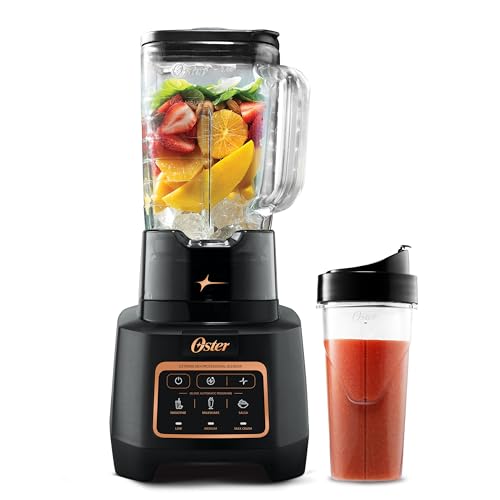
Oster Extreme Mix Blender (8-Cup Glass Jar) — Best Glass-Jar Power Pick
The Oster Extreme Mix in its 8-cup glass jar configuration answers a specific preference: many cooks who process nuts regularly simply prefer glass — it does not hold odors, shrugs off oily residue, and lets you watch the meal-to-paste transition clearly. At 1600 watts with a 10-point blade, it has the power to back the preference up.
Strengths
- 1600W motor and 10-point stainless blade handle hard dry loads confidently
- Glass jar resists odor retention from oily nuts and washes up clean
- Blend-N-Go cup adds a small-vessel option for quick single jobs
Trade-offs
- Glass is heavier and breakable — a real consideration with heavy dry loads and busy counters
- Jar capacity suits household batches, not production volume
- iBlend programs are general-purpose; nut stages still run manually
| Specification | Detail (as listed) |
|---|---|
| Motor | 1600 watts |
| Jar | 8-cup glass jar |
| Blade | 10-point stainless steel blade |
| Extras | Blend-N-Go cup |
Watching the load matters more in nut processing than in almost any other blending task, because the visual cues — meal, clump, paste, flow — are how you time your pauses and scrapes. A clear glass jar makes those cues easy to read, and for cooks who process oily nuts like walnuts and pecans often, glass also avoids the lingering smells plastic can keep.
Respect the format: seat the jar firmly, start low, and let the 10-point blade do the shattering before you climb in speed. Handled that way, this is a genuinely capable nut processor that happens to live in the jar material many traditional cooks trust most.
Glass-jar care matters more with dry loads than with smoothies: thermal shock and impact are the enemies, so let roasted nuts cool to warm rather than blending them oven-hot, and seat the jar fully before starting. The Oster’s weight is also a quiet advantage here — a heavy glass jar sits stable through the vibration of the cracking stage instead of walking across the counter.
Best for: Cooks who prefer a glass jar and process nuts at household scale / Not suited for: Anyone prone to knocking heavy jars off counters — choose plastic instead
Check on Amazon — check the current price on Amazon at the listing.
Comparison Table
All six process nuts credibly; they differ in how they circulate a dry load and what batch size they suit. Match the jar and the workflow to the amount you actually process.
| Pick | Badge | Key spec | Best for |
|---|---|---|---|
| Vitamix 5200 Professional-Grade Blender | Best Overall | 64 oz | Serious home processors who want one premium machine for nuts and everything else |
| Blendtec Total Blender Classic | Best Wide-Jar Batch Pick | FourSide jar (75 oz total capacity as listed) | Batch processors and bakers who work through nuts in quantity |
| Ninja Professional Plus Blender BN701 | Best Value High-Power | 1400 peak watts | Value-focused buyers who want real dry-load power without the premium tier |
| AMPOIA 2000W Blender | Best with Dedicated Grinder Cup | 2000 watts (as listed) | Cooks who process small dry batches often and large batches occasionally |
| CRANDDI K96 Professional Smoothie Blender | Best Large-Capacity | 1500 watts | High-volume processors, market bakers and café prep |
| Oster Extreme Mix Blender (8-Cup Glass Jar) | Best Glass-Jar Power Pick | 1600 watts | Cooks who prefer a glass jar and process nuts at household scale |
How to Choose the Best Blenders for Processing Nuts
Start with the load, not the logo. Dry nut loads fail in blenders for three reasons: the motor cannot sustain torque, the jar lets the meal ride above the blades, or the blades skim instead of bite. When you compare machines, read past headline wattage and ask how the jar is shaped, whether speed is truly variable, and whether the blade design suits shattering hard pieces. The six picks above each answer those questions a different way.
Batch size should drive jar choice. Processing two tablespoons of seeds in a 72 oz pitcher gives an uneven grind and a frustrating scrape-fest; processing four cups in a small personal cup gives a stalled motor. Honest self-knowledge about your typical batch — baking-day volume, weekly granola, a single recipe — narrows this list faster than any other factor.
Jar Shape, Blades and the Dry-Load Vortex
In a smoothie, liquid creates a vortex that pulls ingredients down. In a dry nut load there is no vortex until the nuts themselves begin to paste and flow, so jar geometry does the pulling instead. Wide jars let the meal slide back down the walls; narrow jars concentrate the load over the blades; tamper-friendly designs let you push corners down manually. None is universally best — wide suits volume, narrow suits concentration, tampers suit control.
Blade design matters in the first stage most. Stacked assemblies cut at several heights and shatter whole nuts quickly; single base blades rely on the load falling to them; multi-leaf designs sweep a wider path. All six picks here can finish the job, but they finish it with different rhythms, and the review notes above describe each rhythm so you can pick the one that matches your patience.
Budget Tiers for Nut Processing, in Plain Terms
Think in three tiers. The premium tier buys you the finest speed control and the most durable drive systems — worth it if nut processing is weekly and central to how you cook. The mid tier, where most of this guide sits, buys genuinely sufficient power and jar design for regular home use. The value tier still processes nuts honestly, but asks more of you: smaller batches, more pulses, more patience at the paste stage.
What no tier buys is exemption from technique. Roasting, batch sizing, pausing and scraping matter at every level, and a mid-tier machine used well will out-process a premium machine used carelessly. Spend for the tier that matches your frequency, then invest the difference in good nuts.
Which Nuts and Seeds Process Best — and Which Fight Back
Roasted peanuts and cashews are the friendliest loads: their oils release readily and the paste stage arrives quickly. Almonds are harder and drier — roast them, process them warm, and expect a longer meal stage. Walnuts and pecans are oily and cooperative but can turn bitter if friction overheats them, so pulse in bursts. Hazelnuts benefit from roasting and skin removal first. Seeds split the difference: sunflower and pumpkin seeds grind readily, while flax and sesame are small enough to escape big jars entirely — those belong in a grinder cup like the AMPOIA’s.
Frozen or refrigerated nuts process worse than room-temperature ones, and raw nuts process worse than roasted in every case we would plan a recipe around. Warm, roasted, room-temperature nuts in a right-sized batch: that single sentence is most of nut processing success, whatever machine you own.
Motor Heat, Duty Cycles and Working in Stages
Every blender motor heats under a dry load, because the load resists constantly and there is no liquid to carry heat away from the blade area. Working in stages — run, scrape, rest briefly — is not a workaround for weak machines; it is the correct operating method for all of them, including the premium picks in this guide. The rest pauses let heat dissipate and let you redistribute the load, so each subsequent run starts with the meal in a better position than the last one ended.
Learn your machine’s signals: a rising pitch, a hot smell, or a base that is warm to the touch all say the same thing — pause. Nuts are patient; they will wait two minutes without any loss of quality, and the butter you finish with a rested motor tastes better than the butter you finish with an overheated one, because scorched notes from friction heat are real and unwelcome.
Nut Flours for Baking: Getting the Texture Right
Nut flour fails in two directions. Under-processed, it is coarse meal that makes cakes dense and coatings patchy. Over-processed, it releases oil, clumps, and becomes the first stage of nut butter wearing a flour costume. The working window between those failures is managed with pulses, cold nuts and small additions: a spoonful of the recipe’s own dry ingredients — flour or sugar — blended with the nuts absorbs surface oil and keeps the particles separate, an old baker’s trick that works in every machine in this guide.
Sifting is the professional finish: sift the ground nuts, return the coarse pieces for one more short cycle, and combine. Two passes with a sift between them produce a more uniform flour than one heroic long grind, with less oil release. Store nut flours airtight and cool, and grind close to baking day when you can — freshly ground nuts carry an aroma that pre-ground products lose within weeks.
Storage, Freshness and Food Safety for Processed Nuts
Processed nuts spoil faster than whole ones because grinding exposes vastly more surface to air. Nut butters and flours belong in airtight containers, away from light and heat, and the oily varieties — walnut, pecan, macadamia — keep best refrigerated. If a processed nut product smells paint-like or bitter-sharp, its oils have turned; discard it rather than cooking around the flavor, because rancidity does not bake out.
Batch sizing is a freshness strategy as much as a blending one: process what you will use within a reasonable window, and let whole nuts — which keep far better — wait in the pantry for the next round. The machines in this guide make processing fast enough that small, frequent batches are practical, and fresh small batches beat heroic monthly ones on flavor every time.
Whole, Chopped, Meal, Butter: Reading the Four Finishes
It helps to name the four finishes precisely, because each asks the machine for something different. Chopped nuts want short pulses and immediate stopping — the line between chopped and meal is about three pulses wide. Meal wants the load kept dry and moving, with the cook resisting the urge to ‘just finish it smooth.’ Flour wants meal taken finer with sifting discipline. Butter wants the opposite of restraint: sustained work through the paste stage until the load flows. A buyer who knows which finish dominates their cooking can read the reviews in this guide with a sharper eye, because each pick quietly favors part of that spectrum.
Mixed-use cooks — most of us — should weight the middle: machines that chop cleanly and butter reliably will handle flour with technique. The reverse is not always true, which is why this guide’s top picks earned their places on butter-stage competence first and everything else second.
Soaking, Sprouting and Other Preparation Questions
Some recipes call for soaked nuts — for certain milks, raw-food preparations and gentler flavors. Soaked nuts process completely differently from roasted ones: they are softer, wetter and blend toward cream rather than meal, and they should never be ground for flour. Drain them well, expect a shorter and quieter processing run, and treat the result as a fresh product with a short refrigerator life rather than a pantry staple.
Skins are the other preparation decision. Almond and hazelnut skins add color flecks and a slight bitterness to fine flours and pale butters; blanching and rubbing them off first gives the cleanest result. For rustic baking and dark nut butters, skins are harmless and save real time. Decide per recipe, and let the machine do the part it is good at — the grinding — while you do the part it cannot: the judgment.
Troubleshooting Dry Loads: A Symptom Guide
If the load rides up the walls and stays there, the batch is too small for the jar or the speed started too high — drop the speed, pulse, and let gravity reseat the meal. If the motor pitch climbs and the base heats, the load is too dense or has run too long without redistribution — stop, scrape, rest. If the meal clumps into balls that roll without breaking, oil is releasing unevenly — colder nuts and shorter runs with scraping between them restore the dry, even grind.
If the finished butter is grainy, it needs more time at the flowing stage, not more ingredients. If flour tastes faintly cooked, friction heat is the cause — chill the nuts before the next batch and shorten each run. Nearly every dry-load failure maps to batch size, temperature or staging, and all three are in the cook’s hands regardless of which pick from this guide is on the counter.
How to Process Nuts in a Blender, Step by Step
This method works with every pick in this guide, for whole nuts destined to become meal, flour or butter. The stages are the same; only the timing changes with the nut.
- Roast the nuts first unless the recipe forbids it: a moderate oven until fragrant, then let them cool only to warm — warm nuts release oil far better than cold ones.
- Measure a right-sized batch: enough to cover the blades and fill the jar’s working zone, not so much that the top layer never moves.
- Start with short pulses to crack whole nuts into coarse meal without blasting them up the walls.
- Run at a low-to-medium speed, watching the meal begin to clump — clumping means the paste stage is starting.
- Stop, scrape the walls and corners down into the center, and redistribute any dry meal hiding at the top.
- For flour or meal, finish with a few more pulses and stop early — over-processing flour releases oil and turns it toward paste.
- For butter, continue in short runs with scraping pauses, letting the paste loosen as the nuts release their oils.
- Rest the motor if the base feels hot; a two-minute pause protects the machine and the flavor.
- Stop when the texture is even, then transfer promptly — nut pastes thicken as they cool.
- Clean immediately: warm water, a drop of soap and a short self-clean run where available beats scrubbing around blades.
Two habits separate clean results from frustrating ones. First, never walk away from a dry load — the transition from meal to paste can happen quickly, and catching it is the whole craft. Second, keep notes per nut: your almonds may need an extra scrape that your cashews do not, and next time’s batch will thank you.
Common Buying Mistakes
Buying a personal blender for a countertop job. Single-serve cups are built for liquid shakes. Dry nut loads need jar volume, circulation room and sustained-duty motors — the mismatch ends in stalls and disappointment.
Overfilling the jar. A load packed to the lid cannot fold or circulate. The bottom pastes while the top stays whole. Process in two right-sized batches instead.
Skipping the roast. Raw, cold nuts resist releasing their oils, lengthening the paste stage and straining the motor. Roasting is not a flavor luxury here; it is a processing aid.
Running one long heroic blast. Continuous maximum speed overheats both motor and nuts. Stages with pulses, pauses and scrapes produce better texture and protect the machine.
Grinding tiny seeds in a huge jar. Flax and sesame escape big blade paths and grind unevenly. Use a grinder cup or small vessel matched to the load.
Final Recommendation
For most kitchens, the decision resolves quickly. The Vitamix 5200 is the best overall of the best blenders for processing nuts because its variable control and jar design handle every stage of a dry load with the least drama. Batch bakers should look at the Blendtec Total or the CRANDDI K96 depending on scale, value hunters at the Ninja BN701, small-batch specialists at the AMPOIA with its grinder cup, and glass loyalists at the Oster Extreme Mix.
Whichever you choose, pair it with the method above — roasted, warm, right-sized, staged — and nut processing stops being the job your blender dreads and becomes one of the most useful things it does. Round out your research with the neighboring guides in this cluster: Best Blenders For Nuts, Best Blenders For Nut Butter, Best Blenders For Crushing Nuts And Seeds, Best Blenders For Making Nut Butter, Best Blenders For Making Nut Milk.
Start here: Vitamix 5200 Professional-Grade Blender, Blendtec Total Blender Classic, Ninja Professional Plus Blender BN701. Check the current price on Amazon for each before you decide.
Best Blenders For Nuts Best Blenders For Nut Butter Best Blenders For Crushing Nuts And Seeds Best Blenders For Making Nut Butter Best Blenders For Making Nut Milk
Frequently Asked Questions
Can any blender process nuts, or do I need a high-power model?
Almost any full-size blender can crack nuts into a coarse meal with pulsing. The high-power requirement arrives at the paste stage: turning meal into an even flour or a flowing butter takes sustained torque and circulation that light machines cannot hold. For occasional coarse chopping, a modest blender suffices; for butters and fine flours, choose from machines like the six here.
Is a blender or a food processor better for nuts?
They excel at different stages. A food processor chops and grinds dry loads evenly and is superb for meal and coarse textures. A high-power blender goes further, to smooth butters and very fine flours, because its vortex keeps the paste moving. Many serious kitchens use both; if you must choose one for the full range from chop to butter, choose the blender.
Why does my nut butter keep forming a ball that will not move?
That ball is the paste stage announcing itself — the meal has absorbed its own released oil unevenly and clumped. Stop, scrape everything down and toward the blades, add nothing yet, and resume in short runs. The ball breaks down and loosens as more oil releases. Patience and scraping, not liquid, are the fix.
Should I add oil to help nuts process?
Roasted nuts usually release enough of their own oil given time and scraping. If a very dry nut like raw almonds refuses to flow after several cycles, a small spoon of a neutral oil can help the vortex start — add it sparingly, because you cannot take it back out, and note that it changes a strict whole-nut recipe.
How fine can a blender grind nut flour?
Fine enough for most baking: a high-power blender with pulses and scraping produces almond meal suitable for cakes, coatings and crusts. It will not match a dedicated mill for perfectly uniform commercial flour, and over-processing tips flour into paste, so pulse and check often near the end.
How do I clean oily nut residue safely?
Immediately after use, fill the jar partway with warm water and a drop of dish soap and run a short cycle or self-clean program where fitted, then rinse. The soap emulsifies the oil film before it sets. Wash blade assemblies with care and never reach into a jar near exposed blades with your fingers — use a brush or spatula.

