Disclosure: airfryerkitchensupply.com is reader-supported. When you buy through links on our site, we may earn an affiliate commission at no extra cost to you.
Where to buy
Bakers shopping for the best blenders for mixing cookie dough for under 100 dollars will find every pick in this guide on Amazon. The budget frame in the search is the tier we shopped: every pick sits in the under-100-dollars class of the blender market. We will also be honest about the physics — cookie dough is a stiff, low-moisture load that blenders handle only with the right technique and, ideally, a processor bowl — so this guide favors systems and pulse control over raw smoothie power. All picks are sold on Amazon, where you check the current price before buying.
The six machines in this guide are: Hamilton Beach Blender and Food Processor Combo 58163, Ninja Fit QB3001SS Compact Personal Blender, Hamilton Beach Power Elite 58148AG 700W, Hamilton Beach Wave Crusher 54221 700W, BLACK+DECKER BL2010BG Countertop Blender, Oster Classic Series Heritage Blender 1000 Peak W. Check the current price on Amazon for the model you choose, and check price on Amazon again before ordering if you are comparing configurations, because capacities, included accessories and finishes vary by listing.
Introduction: Stiff Dough, Small Budget, Honest Physics
Searching for the best blenders for mixing cookie dough for under 100 dollars means accepting two constraints at once. The first is the budget frame itself: under 100 dollars rules out the high-performance flagships, so every pick here is a budget-tier machine chosen for value mechanics rather than bragging rights. The second is the dough: cookie dough is dense, sticky and nearly dry, the opposite of the liquid loads blenders are designed around. A blender motor asked to churn stiff dough continuously will strain, heat and stall.
The workable answer at this tier is vessel and technique. Blender systems with a food processor bowl handle dough the way dough wants to be handled — a blade cutting and folding at low speed in short bursts — while pitcher-only blenders can manage cookie dough only in small, softened-butter batches with constant spatula help. Our top picks are therefore the budget systems that include a processor bowl, followed by the strongest budget pitchers with genuine pulse control, each labeled for what it can honestly do.
Every pick was verified by brand and model, and positioned in the under-100-dollars tier without printing a single product price — check the current price on Amazon to confirm any pick still sits in your budget, because prices move. If you bake large or stiff doughs weekly, we will also tell you plainly when a stand mixer is the better hundred dollars.
In this guide
Quick Picks
Best Overall Under $100 — Hamilton Beach Blender and Food Processor Combo 58163: A blender plus a 3-cup food chopper on one 700-watt-peak base: the dough goes in the chopper bowl, the smoothies in the glass jar. Check the current price on Amazon.
Best for Single-Batch Soft Doughs — With Caveats — Ninja Fit QB3001SS Compact Personal Blender: Included with clear limits: 700 watts in a compact cup can cream a small soft batch, but this is a smoothie machine moonlighting — read the trade-offs. Check the current price on Amazon.
Best Budget Pitcher — Hamilton Beach Power Elite 58148AG 700W: The enduring budget pitcher: a 40 oz glass jar, Wave Action circulation and twelve functions at the friendliest tier in this guide. Check the current price on Amazon.
Best Ice-and-Dough Budget Rival — Hamilton Beach Wave Crusher 54221 700W: Fourteen functions and Ice Sabre blades in a 40 oz glass jar: the Wave Crusher matches its sibling’s dough assist with stronger frozen credentials. Check the current price on Amazon.
Best Simple Budget Pick — BLACK+DECKER BL2010BG Countertop Blender: A 6-cup glass jar and ten speeds with pulse: the simple, sturdy budget blender for small households and gentle dough help. Check the current price on Amazon.
Best Budget Power Pick — Oster Classic Series Heritage Blender 1000 Peak W: 1000 peak watts, a 6-cup glass jar and a ten-year warranty in the classic Oster format — the strongest budget pitcher here for dense small loads. Check the current price on Amazon.
How These Picks Were Chosen
We selected within the budget frame on dough mechanics. First, vessel: a processor bowl outranks any pitcher for dough, full stop. Second, pulse and low-speed control, because dough is made in bursts that fold rather than whirl. Third, motor adequacy for dense loads at this tier — enough torque to keep a blade moving through a stiff batch without the burning smell of a straining motor. Fourth, the rest of the machine’s life: a dough-capable budget blender should still make smoothies and sauces well, or the hundred dollars was spent on a single trick.
We excluded personal single-serve blenders, which cannot handle dough at all, and any model we could not verify. Every review states its dough ceiling honestly — batch size, dough stiffness, technique required — in its trade-offs, because overselling a budget blender’s dough ability is how motors die.
The 6 Best Blenders for Mixing Cookie Dough for Under 100 Dollars
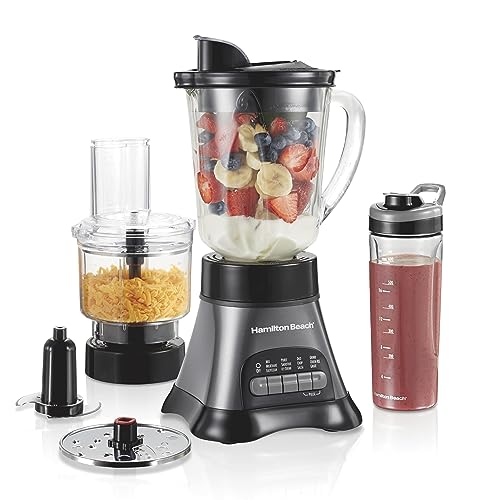
1. Hamilton Beach Blender and Food Processor Combo 58163 — Best Overall Under $100
The Hamilton Beach 58163 combo is the smartest dough answer under 100 dollars because it refuses to make the pitcher do the dough. The verified listing confirms a 700-watt peak base driving a 40 oz glass jar, a 3-cup electric food chopper attachment and a travel cup. Cookie dough belongs in the chopper bowl, where the blade cuts butter into flour and folds a small batch together in pulses — the correct mechanics — while the glass jar handles the batters, shakes and smoothies around baking day.
Strengths
- 3-cup chopper attachment gives dough its proper vessel at a budget tier
- 700W peak is adequate for small, correctly staged dough batches in pulses
- Glass jar plus travel cup cover the rest of a baker’s blending life
Trade-offs
- 3-cup bowl means cookie dough in small batches — roughly a half batch at a time
- Stiff, cold-butter doughs still belong to a stand mixer; soften butter first
- Peak wattage is not continuous wattage — pulse discipline is mandatory
| Specification | Detail |
|---|---|
| Power | 700W peak |
| Jar | 40 oz glass jar |
| Attachment | 3-cup electric food chopper |
| Extras | Blender travel cup |
In the chopper bowl, the dough method is the food processor method in miniature: flour and cold butter cubes pulsed to crumbs, sugar and egg added, then pulsed just until the dough gathers. A half batch of chocolate chip or sugar cookie dough comes together cleanly, and the small bowl is actually an advantage for the pulse-and-check rhythm dough needs — nothing hides in a corner.
The honest ceiling is batch size and stiffness. A full double batch or a stiff gingerbread will overwhelm the bowl and motor; split batches and soften butter for anything beyond a standard cookie dough. Judged as the under-100-dollars machine that can genuinely make cookie dough — in its bowl, in pulses, at home scale — this combo is the pick to beat.
Best for: budget bakers making small cookie batches who also need a full daily blender / Not suited for: high-volume or stiff-dough bakers who need stand-mixer capacity
Check on Amazon — check the current price on Amazon before you buy.

2. Ninja Fit QB3001SS Compact Personal Blender — Best for Single-Batch Soft Doughs — With Caveats
We include the Ninja Fit with unusual candor: it is a personal smoothie blender, not a dough machine, and it appears here because its 700-watt base and compact cups can handle one specific dough job — a small batch of soft cookie dough built on melted or very soft butter, worked in short pulses with the cup shaken between them. The verified listing confirms the 700-watt base and two 16 oz cups. If your cookie dough is a single small batch of soft dough, it copes; for anything stiffer or larger, choose a system pick above or below.
Strengths
- 700W in a small cup concentrates power on small loads better than big weak pitchers
- Compact cups suit single small batches without washing a full system
- Dishwasher-safe cups keep baking-day cleanup light
Trade-offs
- No processor bowl — dough technique is pulse-and-shake, with real limits
- 16 oz cups cap batches at small, soft doughs only; stiff dough will stall it
- Continuous dough work overheats personal motors — rest between pulses is required
| Specification | Detail |
|---|---|
| Power | 700W |
| Cups | (2) 16-oz cups with spout lids |
| Format | Compact personal blender |
| Cleanup | Dishwasher safe |
The technique that makes the Fit cope is moisture and temperature management: butter fully softened or melted, wet ingredients combined first to form a slurry, flour folded in by hand at the end rather than powered through. At that point the blender is creaming and mixing rather than kneading, which is within its design. Present it with cold butter and a full flour load and it will stall — the machine is honest about its lane if the cook is.
Why include a caveated pick at all? Because many under-100-dollars shoppers already own or are set on a personal blender, and a truthful account of what it can do — small soft batches, carefully staged — serves them better than pretending dough requires a flagship. For deliberate dough-first buying, the system picks in this guide are the correct spend.
Best for: personal-blender owners making occasional small batches of soft cookie dough / Not suited for: anyone buying primarily for dough — choose a processor-bowl system instead
Check on Amazon — check the current price on Amazon before you buy.

3. Hamilton Beach Power Elite 58148AG 700W — Best Budget Pitcher
The Hamilton Beach Power Elite is the budget pitcher benchmark: the verified listing confirms a 40 oz glass jar, the Wave Action system, twelve functions including puree and ice crush, and 700 watts. For cookie dough, its case is the Wave Action circulation, which continuously pulls contents down toward the blades — in a pitcher, that circulation is what lets a small, soft dough batch keep moving instead of packing into a dead lump above the blades.
Strengths
- Wave Action system keeps small loads circulating — the pitcher trait dough needs most
- 40 oz glass jar is the right scale for half batches and all daily blending
- Twelve functions with pulse-style control at the most accessible tier here
Trade-offs
- Pitcher dough means small, softened batches with spatula stops — no exceptions
- 700 watts strains audibly on stiff loads; rest the motor between pulse rounds
- No processor attachment; dough purists should take the 58163 combo instead
| Specification | Detail |
|---|---|
| Power | 700W |
| Jar | 40 oz glass jar |
| System | Wave Action System |
| Functions | 12 functions including Puree, Crush Ice |
Pitcher dough technique on the Power Elite is a managed process: cream butter and sugar first while they are soft and flowing, add egg and vanilla, then add flour in two additions, pulsing briefly and stopping to scrape the dough down with a spatula between them. The final flour should be folded by hand more often than not. That reads like a limitation because it is one — but it produces real cookies from a budget pitcher, which is the assignment.
Outside dough days, this is simply a good budget blender: the glass jar, the circulation system and the function range cover smoothies, soups and frozen drinks with the competence that has kept this model a default recommendation for years. As a hundred-dollar-and-under all-rounder that can help with cookie dough, it earns its slot.
Best for: budget all-round buyers who bake small soft batches occasionally / Not suited for: regular dough makers who should put the same money toward the combo system
Check on Amazon — check the current price on Amazon before you buy.

4. Hamilton Beach Wave Crusher 54221 700W — Best Ice-and-Dough Budget Rival
The Wave Crusher is the Power Elite’s close rival in the same budget family: the verified listing confirms a 40 oz glass jar, fourteen functions, Ice Sabre blades and 700 watts. Its dough relevance mirrors its sibling’s — circulation plus pulse control for small soft batches — while its ice-crushing blade design makes it the better choice for bakers whose non-dough life leans frozen: shakes, frozen coffee drinks and smoothie bowls on the same counter.
Strengths
- Ice Sabre blades and 14 functions give the widest budget menu here
- Glass jar circulation supports the same small-batch dough technique as its sibling
- Strong frozen performance covers the rest of a baker’s blending week
Trade-offs
- Same pitcher limits: small, softened dough batches with spatula management
- No processor bowl — the combo remains the dough-first budget buy
- Function count exceeds dough needs; dough still runs on manual pulses
| Specification | Detail |
|---|---|
| Power | 700W |
| Jar | 40 oz glass jar |
| Blades | Ice Sabre Blades |
| Functions | 14 functions |
Choosing between the Wave Crusher and the Power Elite is a lifestyle question: both circulate small loads well and share the pitcher dough technique. The Crusher’s blade and function set tilt frozen, the Elite’s tilt general. A baker who freezes cookie dough portions and blends frozen drinks with the same machine — a common small-kitchen pattern — gets more weekly value from the Crusher.
For dough itself, apply the same discipline as every pitcher pick: softened butter creamed first, flour in additions, pulses short, spatula ready, final fold by hand. The machine assists; the technique delivers. Expect good small-batch results and do not ask it to be a stand mixer.
Best for: frozen-drink bakers who want one budget jar for drinks and occasional small doughs / Not suited for: dough-first buyers — the processor combo is the better spend at this tier
Check on Amazon — check the current price on Amazon before you buy.

5. BLACK+DECKER BL2010BG Countertop Blender — Best Simple Budget Pick
The BLACK+DECKER BL2010BG is the simplicity pick: the verified listing confirms a 6-cup glass jar and ten-speed settings in a classic countertop format. Ten speeds matter for dough help because the low end is where dough lives — gentle pulses that fold rather than whip — and a straightforward speed dial gives a budget cook more dough control than a couple of preset buttons. It is an unpretentious machine that does the budget basics well.
Strengths
- Ten speeds include the gentle low range dough pulsing actually uses
- 6-cup glass jar is a generous daily size at a budget tier
- Simple dial operation suits shared and first kitchens
Trade-offs
- Budget motor: dough help is limited to small, soft, carefully staged batches
- No circulation system branding or processor attachment — technique carries the load
- Basic feature set; no programs for the rest of the blending week
| Specification | Detail |
|---|---|
| Capacity | 6-cup glass jar |
| Speeds | 10-speed settings |
| Format | Countertop blender |
The low-speed range deserves its paragraph: cookie dough in a pitcher fails when the only speeds are fast ones, because speed packs dough against the jar walls and heats the motor. A genuine low gear lets the cook nudge a creamed mixture along and incorporate flour in short, slow pulses. Among pure budget pitchers, that control is the BL2010BG’s real dough credential.
Beyond dough, it is the blender equivalent of a reliable sedan: smoothies, soups, sauces and shakes in a big glass jar, with parts that are easy to replace. Small households equipping a first kitchen under a strict budget will find it covers the brief — dough help included, within the stated limits — without drama.
Best for: first-kitchen and small-household buyers wanting simple controls and a big glass jar / Not suited for: frequent bakers or anyone needing processor-bowl dough mechanics
Check on Amazon — check the current price on Amazon before you buy.

6. Oster Classic Series Heritage Blender 1000 Peak W — Best Budget Power Pick
The Oster Classic Heritage closes the guide with the budget tier’s strongest pitcher claim: the verified listing confirms 1000 peak watts, a 6-cup glass jar, a stainless steel blade, two speeds and a ten-year warranty in the classic Oster format. Peak watts are not continuous watts, and this guide treats them accordingly — but for short dough pulses, peak torque is precisely what turns a stiff small batch, and the Heritage’s classic all-format design has been doing kitchen work for generations.
Strengths
- 1000 peak watts is the strongest pulse torque in this budget lineup
- Classic Oster format with a 6-cup glass jar and easy-clean design
- Ten-year warranty per the verified listing — rare confidence at this tier
Trade-offs
- Two speeds only; dough finesse comes from pulse timing, not speed selection
- Peak power is for bursts — continuous stiff-dough running will still heat the motor
- No processor bowl; the Hamilton Beach combo remains the dough-mechanics winner
| Specification | Detail |
|---|---|
| Power | 1000 peak watts |
| Jar | 6-cup glass jar |
| Blade | Stainless steel blade |
| Speeds | 2 speeds |
| Warranty (verified listing) | 10 year warranty |
For dough, the Heritage’s method is the pulse-burst method in its purest form: two speeds, the cook’s timing, and torque that does not fade mid-pulse. Cream softened butter and sugar on the low speed, then work flour in with the shortest bursts that move the load, scraping down between rounds. The glass jar’s weight and the classic base’s stability help — a machine that walks across the counter under load is a machine you stop trusting.
The warranty is the closing argument for budget buyers: at this tier, longevity differences are real, and a manufacturer willing to stand behind a budget blender for a decade is telling you something about its drive and motor. If your under-100-dollars blender must be a pitcher and must last, this is the one.
Best for: budget buyers wanting the strongest, longest-warranted pitcher for dense small loads / Not suited for: cooks who want many speeds, programs or a processor attachment in the box
Check on Amazon — check the current price on Amazon before you buy.
Comparison Table
| Pick | Badge | Key spec | Best for |
|---|---|---|---|
| Hamilton Beach Blender and Food Processor Combo 58163 | Best Overall Under $100 | 700W peak, 3-cup chopper, 40 oz glass jar | budget bakers making small cookie batches who also need a full daily blender |
| Ninja Fit QB3001SS Compact Personal Blender | Best for Single-Batch Soft Doughs — With Caveats | 700W, (2) 16 oz cups, personal format | personal-blender owners making occasional small batches of soft cookie dough |
| Hamilton Beach Power Elite 58148AG 700W | Best Budget Pitcher | 700W, 40 oz glass jar, Wave Action | budget all-round buyers who bake small soft batches occasionally |
| Hamilton Beach Wave Crusher 54221 700W | Best Ice-and-Dough Budget Rival | 700W, 40 oz glass jar, 14 functions | frozen-drink bakers who want one budget jar for drinks and occasional small doughs |
| BLACK+DECKER BL2010BG Countertop Blender | Best Simple Budget Pick | 6-cup glass jar, 10 speeds | first-kitchen and small-household buyers wanting simple controls and a big glass jar |
| Oster Classic Series Heritage Blender 1000 Peak W | Best Budget Power Pick | 1000 peak W, 6-cup glass jar, 2 speeds | budget buyers wanting the strongest, longest-warranted pitcher for dense small loads |
One row in this table is different in kind, not degree: the Hamilton Beach combo’s chopper bowl changes the dough mechanics themselves, which is why it leads despite sharing its wattage class with the pitchers. The remaining rows sort by how their circulation, speed range and pulse torque support the creaming-and-folding technique. If dough is your first priority, the table’s first row is the shortlist; if dough is a side duty, choose among the rest by your daily blending.
Let the table’s honesty guide the money: if your eyes went straight to the combo’s row, dough matters to you — buy it. If you read the pitcher rows with equal interest, dough is one duty among many in your kitchen, and any row whose daily strengths match your smoothies, soups and frozen drinks will serve you, dough help included. The worst purchase in this category is a pitcher bought as if it were a processor; the table exists to prevent exactly that.
A final note on the frame itself: the under-100-dollars tier is crowded with machines that differ more in attachments than in motors. That is why this table rewards the buyer who reads the ‘what is in the box’ line as carefully as the wattage line — at this budget, the included bowl or cup is frequently the entire difference between a machine that does your job and one that merely resembles it.
The budget frame deserves one last defense: under 100 dollars, spent on the right vessel, is not a compromise purchase — it is the correct price for the job as most households actually do it. The expensive mistake in this category is not buying cheap; it is buying the wrong shape at any price. A pitcher bought for dough disappoints at twice the money, while the combo in this table, at this tier, simply works. Shape first, then watts, then everything else.
Cookie Dough Technique for Blenders: Soften, Cream, Pulse, Fold
Every successful blender dough follows the same sequence. Butter must be genuinely soft — room temperature until it yields to a finger — or melted for the soft-dough styles. Cream butter and sugar first while the mixture still flows. Add egg and vanilla and blend smooth. Then add flour in two or three additions, pulsing two or three seconds per addition and scraping the jar or bowl down between them. Chips, nuts and oats are folded in by hand at the end, always — powered mixing at that stage crushes them and overworks the dough.
In a processor bowl the sequence compresses: pulse flour and cold butter to crumbs first if the recipe is a cut-in style, then proceed. Either way, the moment the dough gathers, stop. Blender dough fails by excess — too much load, too stiff a mixture, too long a run — and succeeds by restraint. Chill the finished dough before baking and the cookies will not know a stand mixer was not involved.
When the Right Answer Is Not a Blender at All
Honesty section, plainly stated: if you bake cookies weekly in full batches, or your repertoire runs to stiff doughs — gingerbread, shortbread, thick oatmeal — a stand mixer or a full-size food processor is the correct hundred-dollar-class purchase, and a hand mixer beats any blender for creaming at this tier. Blenders earn their dough place in small kitchens, small batches and multi-purpose budgets where one machine must do drinks, sauces and dough help together.
That is not a dismissal of this guide’s picks; it is their job description. The combo system genuinely makes small cookie batches. The pitchers genuinely help with soft ones. Buy them for the whole week of work they do, with dough as one duty among several, and they are money well spent. Buy any blender as a dedicated dough machine and you will be disappointed by physics, not by the brand.
Reading a Budget Spec Sheet Like a Baker
Budget blender listings are written for smoothie buyers, so a baker must translate. Peak wattage tells you the burst strength available for a pulse — relevant to dough — but says nothing about how long the motor tolerates dense work, which is why every technique in this guide is built on rests. Jar material matters more than it appears: glass jars are heavier and more stable under a dough load, and they do not flex when you scrape them. Speed count matters at the bottom, not the top — a budget machine with a genuinely slow first speed is a better dough tool than one with fourteen fast ones.
The spec that never appears is the one that matters most: whether a processor or chopper attachment exists for the base, and what it costs if it is sold separately. A budget blender whose chopper attachment is available and affordable can be a better dough purchase than a nominally stronger pitcher-only rival. Check the attachment ecosystem before the wattage, and the wattage before the color.
Five Cookie Doughs, Five Verdicts at This Tier
Chocolate chip dough — softened butter, moderate stiffness — is the budget sweet spot: the combo makes it properly, and the pitchers help credibly in half batches. Sugar cookie dough behaves similarly and rolls out none the wiser. Oatmeal dough is stiffer and carries bulky mix-ins; keep it to the processor bowl and fold the oats in by hand. Peanut butter dough is dense and oily — small processor batches succeed, pitchers strain. Shortbread and gingerbread are the honest failures at this tier: their stiffness and low moisture belong to stand mixers and hand mixers, and forcing them through a budget blender trades a batch of cookies for a motor.
That spread is the realistic promise of the under-100-dollars frame: the two most common home cookie doughs, done well, plus honest help on a third. Bakers whose repertoire lives in the first two will be genuinely satisfied. Bakers who live in the last two should redirect the same money — this guide’s deep sections exist to tell them so before the purchase, not after the smell of hot motor windings.
Motor Care: Making a Budget Blender Survive Dough Duty
Budget motors die from heat, and dough is heat work. The survival rules are simple and absolute: pulse in seconds, never run a stiff load continuously, rest the base a full minute between pulse rounds on a big job, and stop entirely if the base smells hot or the sound changes pitch under load. Smell is information — a warm electrical smell means the session is over, and a cook who listens to it owns the same blender next year.
Load order protects the motor as much as batch size does. A flowing base — creamed butter and sugar, or a slurry of wet ingredients — lets the blade start moving before resistance builds, where a dry flour-first load in a pitcher can lock the blade at startup. In processor bowls the opposite order is correct, because the blade sits under the load by design. Know which vessel you are in, load it its way, and the budget machine will repay the respect with years of service.
The Half-Batch Baking Life: Why Small Batches Bake Better Anyway
There is a case that the budget tier’s limitation is secretly a baking philosophy. Half batches keep dough fresh, let a household rotate flavors instead of committing to four dozen of one cookie, and fit the way people actually eat cookies — a few warm ones tonight, a freezer log for the week. Small batches also forgive experimentation: a new spice, a different chip, a brown-butter variation costs six cookies of risk, not forty-eight. Many experienced home bakers work in half batches by choice long after their equipment could handle more.
The machines in this guide fit that philosophy precisely because they were scoped honestly. A processor combo that makes a perfect half batch, a pitcher that creams a small soft dough, a freezer log rolled from each — together they describe a complete, sustainable home baking practice at an under-100-dollars equipment cost. The limitation only bites the baker who genuinely produces in volume, and this guide has already pointed that baker, honestly and by name, toward the stand mixer aisle.
What Success Looks Like: Judging Your First Budget Dough
A successful budget-blender dough looks shaggy, not smooth — gathered into a mass that holds together when squeezed, with no dry flour pockets and no glossy, warm sheen. It should feel cool to the touch; a warm dough means the motor worked it too long, and the cookies will spread and toughen. Chill it before judging further, because cold dough scoops cleanly and bakes evenly, and many first attempts that look doubtful warm turn out perfectly after thirty minutes in the fridge.
If the first batch disappoints, diagnose in order: butter temperature, batch size, pulse length, load order. Those four variables explain nearly every failure at this tier, and all four are free to fix. The machine is rarely the problem once its honest limits are respected — which is, in one sentence, the entire argument of this guide.
How to Choose the Best Blenders for Mixing Cookie Dough for Under 100 Dollars
Spend the budget on a bowl if dough matters
Within the under-100-dollars frame, the single best dough decision is a processor or chopper attachment. It converts dough from a strained improvisation into a proper pulsed process. If dough is an occasional soft-batch event, a circulating pitcher with pulse control is an acceptable second choice.
Read wattage like an adult
Peak watts describe bursts; continuous watts describe endurance. Dough runs in bursts, so peak figures are relevant — but a 700-watt-peak budget machine still needs softened butter, small batches and rests. Any listing promising stand-mixer dough performance from a budget blender is selling, not informing.
Count the rest of the week
A budget blender that only survives dough day is a poor hundred dollars. The picks here all earn their counter space on smoothies, soups, sauces and frozen drinks between bakes. Choose the one whose non-dough strengths match your kitchen’s actual daily blending.
What about the travel cup and small attachments in these boxes?
Several picks include travel cups or small accessories aimed at smoothies. For dough they are irrelevant at best — a narrow cup is the worst dough vessel in any box. Judge these machines on their main jar and any processor or chopper bowl, and treat the cups as a bonus for the rest of the week rather than part of the dough decision.
What about cookie dough for freezing and slice-and-bake logs?
Freezer dough is the budget baker’s best friend and suits these machines perfectly: make small pulsed batches, roll the dough into logs in parchment, freeze, and slice-and-bake fresh cookies in small quantities for weeks. The small-batch limit of this tier stops mattering when the production model is a freezer log rather than a same-day marathon — arguably the smartest way to bake at this budget.
A closing practical note before you decide
Make your first budget dough a friendly one: a small batch of chocolate chip cookies, butter properly soft, everything measured before the motor starts, and the freezer log method as your production plan. Success with the friendliest dough builds the pulse rhythm and the scraping habit that stiffer recipes will later demand. Judge the result after chilling and baking, not at the bowl — warm, shaggy dough always looks like a failure and usually is not one. If that first batch works, and with the technique in this guide it should, you own a repeatable small-batch baking practice for the price of a modest dinner out.
How to Mix a Small Batch of Cookie Dough with a Budget Blender
This method suits the processor combo directly and the pitcher picks with the spatula discipline described. It makes a small batch — roughly a dozen cookies — which is the honest scale for this tier.
Step 1: Soften and stage everything
Bring butter fully to room temperature and measure all ingredients before starting. In the processor bowl, flour can go first for cut-in styles; in a pitcher, the creamed mixture must go first. Staging prevents the mid-recipe pauses that let a small motor’s work sit and stiffen.
Step 2: Cream the soft ingredients smooth
Blend or pulse butter and sugar until pale and combined, then add egg and vanilla and run smooth. This flowing base is what carries the flour later — if this stage is lumpy or cold, the dough stage will fail, so take the extra thirty seconds here.
Step 3: Add flour in additions, pulsing briefly
Add flour in two or three portions. Pulse two to three seconds per portion, then stop and scrape down the sides and around the blade. The dough should progress from shaggy to gathered. If the motor strains or the load stops moving, the batch is too big or too stiff — remove half and finish in two rounds.
Step 4: Fold in chips by hand and chill
Turn the dough onto a surface or into a bowl and fold in chips, nuts or oats by hand — never by motor. Chill at least thirty minutes before scooping and baking. Clean the jar or bowl immediately; dough residue hardens into concrete if left to sit.
Common Buying Mistakes
Using cold butter straight from the fridge
Cold butter is the number one budget-blender dough killer. It will not cream, it will not incorporate, and it will stall the motor. Room temperature means genuinely soft, every time.
Loading a full double batch to save time
Budget vessels are sized for small batches. Overloading produces raw flour pockets, a strained motor and a worse dough than two quick half batches ever would.
Running the motor continuously to ‘knead’
Blenders do not knead; they heat and tear. Dough in a blender is made in pulses measured in seconds. Continuous running is how budget motors earn their burning smell.
Powering chips and nuts through the blades
Mix-ins get crushed and the dough gets overworked and warm. Fold them in by hand — it takes twenty seconds and protects both texture and motor.
Final Recommendation
If you want the shortest possible shortlist, start with these three: Hamilton Beach Blender and Food Processor Combo 58163, Ninja Fit QB3001SS Compact Personal Blender, Hamilton Beach Power Elite 58148AG 700W. Each links to its Amazon listing, where you can check the current price on Amazon and confirm the exact configuration before deciding.
Within the under-100-dollars frame, the Hamilton Beach 58163 combo is the clear recommendation for actual cookie dough: its chopper bowl gives dough the right mechanics at a budget tier, and the glass jar covers the rest of the kitchen’s week. Pitcher buyers should choose by their other blending — the circulating Power Elite or Wave Crusher for general and frozen work, the simple BL2010BG for a first kitchen, the Oster Heritage for peak pulse torque and warranty — and personal-blender owners can take the Ninja Fit’s honestly limited soft-batch ability for what it is.
Check the current price on Amazon before ordering to confirm your pick still sits inside the under-100-dollars frame, soften the butter, halve the batch, and pulse like you mean it. Small-batch cookies from a budget blender are a technique win, and technique is free.
Keep exploring the cluster: Best Blenders For Smoothies Best Blenders For Baking Best Blenders For Meat Best Blenders For Mom Best Blenders For Small Kitchens
Frequently Asked Questions
Can a blender under $100 really mix cookie dough?
Yes, at small scale with technique: a processor-bowl combo like the Hamilton Beach 58163 makes genuine small batches by pulsing, and budget pitchers can cream and partially mix soft doughs with spatula help. Full or stiff batches exceed what this tier can do — that is a physics limit, not a brand failure.
What matters more for dough, watts or the bowl?
The bowl. A processor or chopper attachment changes the mechanics from whirling to cutting and folding, which is what dough needs. Wattage supports the work, but a powerful pitcher still struggles where a modest processor bowl succeeds.
How big a batch can a budget blender handle?
Roughly a half batch — about a dozen cookies’ worth — in a 3-cup processor bowl, and similar or less in a pitcher with staged additions. Split larger recipes into sequential small batches rather than overloading once.
Why does my blender stall or smell hot on dough?
The load is too stiff, too large or too continuous. Soften butter fully, halve the batch, and pulse in two-to-three-second bursts with scrapes and rests between rounds. A hot smell is the motor asking for exactly those changes.
Should I buy a blender or a hand mixer for cookies under $100?
If cookies are the main job, a hand mixer creams better than any blender at this tier, and a stand mixer is the long-term answer for weekly baking. A blender earns the money when it must also do smoothies, soups and sauces all week — dough as one duty among many.
Can I mix bread dough in these blenders?
No — bread dough requires sustained kneading that will overheat and damage budget blender motors, and risks the jar and blade assembly. Cookie dough in small pulsed batches is the ceiling for this category; bread belongs to stand mixers and dedicated machines.

