Disclosure: airfryerkitchensupply.com is reader-supported. When you buy through links on our site, we may earn an affiliate commission at no extra cost to you.
Where to buy
Every linked pick in this guide to the best high quality industrial microwaves was verified against Amazon’s catalog on 2026-11-21, so the model name and specification on this page are the ones on the listing you land on. Commercial listings reward exact model numbers more than any category here, so buy the verified unit whose listing states its class and supply. Start with Amana HDC182 Heavy-Duty Compact Commercial Microwave 1800W, Amana HDC12A2 Heavy-Duty Commercial Microwave 1200W, Amana RCS10TS Commercial Microwave 1.2 Cu.Ft 1000W. Check the current price on Amazon from any pick’s link, because finishes and bundle configurations rotate.
The best high quality industrial microwaves are not household microwaves with steel paint, and this guide begins with the distinction that decides everything else: a true commercial microwave is built for a duty cycle, hundreds of cycles a day, in a listed, inspectable appliance with a flat cavity floor, no consumer turntable, programmable or dial production controls and a service network behind it. Every pick here is a genuine commercial model from Amana, Panasonic or Sharp, verified on 2026-11-21. One warning belongs up front: the household brand literally named ‘Commercial Chef’, which appears elsewhere on this site, is a home appliance line, not commercial equipment, and no model of that kind is badged as industrial here.
The category divides by duty. Light-duty ovens serve cafés and grab-and-go stations, medium-duty ovens carry restaurants and buffets through daily service, and heavy-duty ovens run near-continuously in high-volume kitchens at up to 1800 verified watts. Choosing the wrong class is the expensive error in this market, in both directions: a light-duty oven on a heavy line dies young, and a heavy-duty oven in a coffee shop is capital asleep. This guide ranks a champion per class and explains the boundaries in operational terms, portions per hour and hours per day, rather than in brochure adjectives.
In this guide
Quick Picks
Six models made the cut for this guide. Each carries its own badge, and the same badge follows it into the full review below so you can track a recommendation from summary to verdict.
- Best Heavy-Duty Power — Amana HDC182 Heavy-Duty Compact Commercial Microwave 1800W: The power ceiling of true commercial: 1800 watts in a compact heavy-duty Amana built for back-to-back service all day. Key spec: 1800W / heavy-duty compact / stainless steel commercial.
- Best Heavy-Duty All-Rounder — Amana HDC12A2 Heavy-Duty Commercial Microwave 1200W: The heavy-duty sweet spot: 1200 watts of Amana HDC-series durability for operations that run hard all day without needing 1800. Key spec: 1200W / heavy-duty commercial / stainless steel.
- Best Medium-Duty — Amana RCS10TS Commercial Microwave 1.2 Cu.Ft 1000W: The medium-duty workhorse: a stackable, NSF-listed 1.2 cu ft Amana with push-button controls for restaurants, buffets and catering. Key spec: 1000W / 1.2 cu ft / stackable / NSF / push-button controls.
- Best Medium-Duty Power — Amana RFS12TS Medium-Duty Commercial Microwave 1200W: Medium-duty with muscle: 1200 watts and push-button programming on a standard 120V supply, for operations outgrowing 1000 watts. Key spec: 1200W / medium-duty / stainless steel / push-button controls / 120V.
- Best Light-Duty Commercial — Panasonic NE-1054F Commercial Microwave 0.8 Cu.Ft 1000W: The compact professional: Panasonic’s light-duty commercial oven with 10 memory programs for cafés, offices and grab-and-go stations. Key spec: 1000W / 0.8 cu ft / 10 programmable memory / touch controls / compact.
- Best Dial-Control Simplicity — Sharp R-21LCFS Commercial Microwave Dial Control 1000W: The unbreakable brief: a stainless commercial Sharp with a simple dial timer any staff member can run with gloves on. Key spec: 1000W / dial timer / stainless steel / 120V foodservice design.
How These Picks Were Chosen
We admitted only models whose verified listings identify them as commercial foodservice equipment: commercial series designations from Amana’s HDC, RCS and RFS lines, Panasonic’s commercial NE series and Sharp’s foodservice R series, with commercial attributes, NSF listing, stackable design, programmable memory, duty-class language, stated in the listings themselves. Household models, however powerful or steel-clad, were excluded, as were household brands with commercial-sounding names. Verification ran as throughout this program, with power, capacity, supply and certification taken only from the returned listing titles.
Ranking weighed the commercial virtues in commercial order: duty class first, because it decides survival; then pace within class; then the operational features that decide a working day, programmability, stackability, control simplicity and supply requirements. Brand ecosystems matter at this level in a way they do not at home: Amana’s depth in commercial parts and service is a genuine specification, and it is one reason the brand holds four of the six badges, a concentration we report rather than disguise.
The 6 Best High Quality Industrial Microwaves
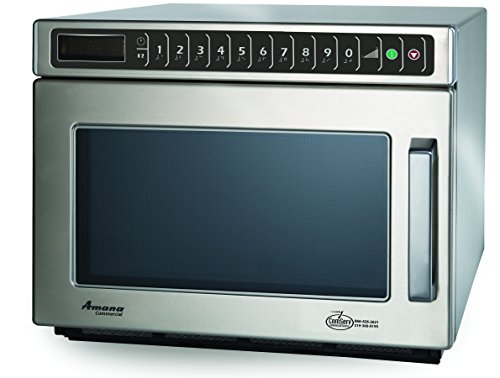
Amana HDC182 Heavy-Duty Compact Commercial Microwave 1800W — Best Heavy-Duty Power
The Amana HDC182 suits the operation whose microwave is a production tool: high-volume kitchens, busy cafés and foodservice lines where portions must move from cold to service temperature in seconds, hundreds of times a day. Its 1800 watts is the highest verified output in this guide, delivered in a compact heavy-duty commercial body from Amana, the brand that effectively defines the category. This is not a household oven with ambitions; it is industrial equipment that happens to be microwave-sized.
Strengths
- 1800 watts is the fastest reheating and cooking pace in the commercial class here
- Heavy-duty construction and duty cycle are built for continuous commercial service
- Compact commercial footprint delivers that power without a full-size station
Trade-offs
- Requires the electrical supply its class demands; confirm voltage and circuit before ordering
- No household conveniences: no turntable theatre, no sensor lifestyle features, just production controls
- Premium commercial pricing that only high-volume use can justify
| Power | 1800 watts |
| Class | Heavy-duty commercial |
| Build | Stainless steel, compact commercial body |
| Maker | Amana Commercial |
| Intended use | High-volume foodservice |
Commercial power is a different discipline from household power. A household flagship’s 1250 watts is designed for minutes of daily use; this Amana’s 1800 watts is designed for a duty cycle, cycle after cycle through a lunch rush, with components, cooling and cavity engineering rated for that punishment. The speed is not a party trick either: in a service line, thirty seconds saved per portion is covers per hour, and covers per hour is the business. Operations that think in those terms will find the HDC182’s specification reads like it was written by their accountant.
The commitments are equally industrial. Electrical supply must be confirmed before purchase, because heavy-duty commercial ovens can demand dedicated circuits and, in some models of this class, higher-voltage service. Staff controls are production-oriented, programmable and repeatable rather than friendly, and there is no turntable: commercial cavities heat from a flat floor with stirrer distribution, which is why portions are portioned the way they are. Buy it for a line that needs it and it will earn daily; buy it for a home and you have purchased a racing engine for a school run.
Best for: high-volume kitchens and service lines where seconds per portion are money / Not suited for: households, low-volume cafés, or sites without confirmed electrical supply
Check the current price on Amazon for the Amana HDC182 Heavy-Duty Compact Commercial Microwave 1800W.
Amana HDC12A2 Heavy-Duty Commercial Microwave 1200W — Best Heavy-Duty All-Rounder
The HDC12A2 suits the serious foodservice operation whose microwave works every service but whose menu does not demand the 1800-watt flagship’s pace: restaurants, hotel kitchens, institutional cafeterias and high-end food trucks. As part of Amana’s HDC heavy-duty series it carries the class’s construction, stainless build, production controls and a duty rating for continuous use, at 1200 watts, which covers the overwhelming majority of commercial reheating, steaming and rapid cooking tasks.
Strengths
- HDC heavy-duty series construction at the class’s most versatile wattage
- 1200 watts covers nearly all commercial reheat, steam and rapid-cook tasks
- Amana’s commercial parts and service ecosystem is the category’s deepest
Trade-offs
- Listing detail is concise; confirm program and cavity specifics on the listing before fleet orders
- Still industrial equipment: dedicated supply and staff training come with the class
- Household buyers gain durability they cannot use and lose conveniences they would miss
| Power | 1200 watts |
| Class | Heavy-duty commercial |
| Build | Stainless steel |
| Series | Amana HDC |
| Intended use | Continuous foodservice duty |
Every equipment category has a specification where the curve bends, and in commercial microwaves it is here: 1200 heavy-duty watts handles the category’s real workload, reheating plated portions, steaming vegetables, rapid-cooking sides and thawing under control, at a pace service can build around, without the flagship’s electrical demands. The HDC badge matters as much as the number: it is Amana’s heavy-duty line, engineered for the cycle counts that kill household ovens in a month of service. For most professional kitchens, this is the correct commercial microwave, and the 1800-watt model is the specialization.
We note transparently that this model’s verified listing title is concise, stating power, class and build without a long feature recitation. Commercial buyers are accustomed to specification sheets beyond the listing, and fleet purchasers should confirm cavity dimensions, programmability and electrical requirements against their station plan before ordering multiples. None of that uncertainty touches the model’s position here: the HDC series’ reputation in professional kitchens is the substance of this pick, and the listing verifies the machine itself is what it claims to be.
Best for: restaurants and institutional kitchens running all-day service / Not suited for: households, or the highest-volume lines that need 1800 watts
Check the current price on Amazon for the Amana HDC12A2 Heavy-Duty Commercial Microwave 1200W.

Amana RCS10TS Commercial Microwave 1.2 Cu.Ft 1000W — Best Medium-Duty
The RCS10TS suits the broad middle of foodservice: restaurants, buffet stations, catering operations and cafeterias that need a real commercial oven, NSF-listed, stainless, stackable, without heavy-duty volume. Its 1.2 cu ft cavity is the largest in this guide, its push-button controls program the repeatable portions service depends on, and its stated dimensions and 120-volt supply make it the easiest true commercial oven here to place. For most businesses buying their first commercial microwave, this is the correct door into the category.
Strengths
- NSF listing and stainless commercial build: a genuine foodservice appliance, verifiably
- Stackable design lets growing operations double capacity in one footprint
- 1.2 cu ft cavity and 120V supply make it the most placeable true commercial pick here
Trade-offs
- 1000 watts is medium-duty pace: high-volume lines will queue behind it
- Medium-duty cycle rating assumes breaks between rushes that heavy-duty models do not need
- No household features whatsoever; this is staff equipment
| Power | 1000 watts |
| Capacity | 1.2 cu ft |
| Class | Medium-duty commercial |
| Dimensions | 22-inch W x 19-inch D x 13-7/8-inch H (per listing) |
| Supply | 120V (per listing) |
| Certification | NSF (per listing) |
| Design | Stackable, push-button controls |
Medium-duty is the class where commercial quality becomes accessible, and the RCS10TS shows what the money buys over a household oven: a cavity and door engineered for hundreds of daily cycles, controls that program a portion once and repeat it identically for every staff member, a stackable case that plans for growth, and an NSF listing that health inspectors recognize. The buffet and catering contexts in its own listing are honestly chosen: those are operations where the microwave reheats and finishes constantly but in waves, exactly the duty pattern this class is rated for.
The stackable detail deserves emphasis because it changes the capacity conversation. A growing operation can start with one RCS10TS and add a second in the same footprint when volume demands, instead of replacing the station. That is industrial thinking, capacity as a system rather than a box, and it is unavailable in the household world. Buyers should still respect the medium-duty boundary: if your line will run the oven near-continuously through long services, step up to the HDC picks above rather than discovering the boundary during a rush.
Best for: restaurants, buffets, catering and cafeterias entering true commercial equipment / Not suited for: continuous high-volume lines, or home use
Check the current price on Amazon for the Amana RCS10TS Commercial Microwave 1.2 Cu.Ft 1000W.

Amana RFS12TS Medium-Duty Commercial Microwave 1200W — Best Medium-Duty Power
The RFS12TS suits the operation that has outgrown 1000-watt medium-duty pace but not its electrical infrastructure: it delivers 1200 watts on a 120-volt supply, per its listing, with push-button controls in a stainless medium-duty body. Busy cafés, quick-service kitchens and institutional stations whose portions are dense and whose queues are forming will feel the extra 200 watts as shorter cycles all day long. It is the step-up pick inside the medium-duty class, before the heavy-duty commitment.
Strengths
- 1200 watts on 120V supply: extra pace without an electrical project
- Push-button programmable controls keep portions identical across staff and shifts
- Medium-duty Amana build carries commercial durability at a friendlier tier than HDC
Trade-offs
- Medium-duty cycle still assumes a human rhythm of use, not a conveyor belt
- Fewer published details in the listing than the RCS10TS; confirm cavity specifics before ordering
- Not the pick for the very highest-volume stations, which belong to the HDC series
| Power | 1200 watts |
| Class | Medium-duty commercial |
| Supply | 120V (per listing) |
| Controls | Push-button controls |
| Build | Stainless steel |
| Maker | Amana Commercial |
Wattage steps inside commercial classes are worth more than the same steps at home, because they multiply by cycle count. Two hundred extra watts saving fifteen seconds a portion is a curiosity in a household and a staffing fact across three hundred portions a day. The RFS12TS is aimed precisely at that arithmetic, and its 120-volt supply is the enabling detail: many medium-duty stations were wired for exactly that, so the pace upgrade arrives without an electrician’s invoice attached. Operations feeling the first pinch of microwave queues should price this model before they price a second station.
Its boundary is the same as its class’s: medium-duty engineering expects the oven to breathe between rushes. A station that runs truly continuously should read this pick as a bridge and the HDC models as the destination. Within its class, though, it is the connoisseur’s choice, the model for operators who have measured their cycle times and know exactly which fifteen seconds they are buying. That kind of buying, from data rather than from brochures, is what separates professional kitchens from hopeful ones, and this guide is written to reward it.
Best for: busy cafés and quick-service stations needing more pace on standard supply / Not suited for: continuous-duty lines, or buyers who have not measured their queue
Check the current price on Amazon for the Amana RFS12TS Medium-Duty Commercial Microwave 1200W.

Panasonic NE-1054F Commercial Microwave 0.8 Cu.Ft 1000W — Best Light-Duty Commercial
The NE-1054F suits the light-duty professional contexts where a household oven is not allowed and a heavy-duty one is absurd: small cafés, coffee shops, office pantries with foodservice pretensions, convenience and grab-and-go stations, and staff kitchens in regulated workplaces. Its compact 0.8 cu ft stainless body carries 1000 watts, touch controls and 10 programmable memory settings, so a soup, a wrap and a pastry each get their exact program from any staff member’s single touch. It is commercial quality at the smallest honest scale.
Strengths
- True commercial construction and programmability in a compact 0.8 cu ft body
- 10 memory programs make portions identical across untrained staff, the light-duty killer feature
- Panasonic’s commercial engineering in the class households most often fake with a home oven
Trade-offs
- Light-duty rating: a busy line will outrun its duty cycle and its compact cavity
- 0.8 cu ft limits portion size; this is a singles and small-portions station
- Commercial controls assume a program-once mindset households find austere
| Power | 1000 watts |
| Capacity | 0.8 cu ft |
| Class | Light-duty commercial |
| Controls | Touch control, 10 programmable memory settings |
| Build | Stainless steel, compact countertop |
| Maker | Panasonic Commercial |
Light-duty is the most misunderstood commercial class, because its buyers are often tempted to substitute a household oven and its sellers know it. The difference is not snobbery: a café’s microwave cycles more times before lunch than a household’s does in a week, through doors opened by staff who did not buy it, in premises where an inspector can ask what the appliance is listed for. The NE-1054F is built and listed for that reality, and its memory programs are the operational heart: consistency is a food-safety and quality feature, not a convenience, when five different people reheat the same soup across a day.
Panasonic’s presence in this class also matters for buyers who know the brand from the household inverter flagships in our other guides: the engineering culture is the same, applied to durability and programmability instead of sensors and cycles for home portions. Choose this model when your volume is real but modest and your setting is genuinely commercial. Choose a household oven when the setting is a home, however enthusiastically it cooks, because the classes are answers to different questions and neither substitutes honestly for the other.
Best for: cafés, coffee shops, grab-and-go and regulated workplace kitchens / Not suited for: busy service lines, or home kitchens wanting a small premium oven
Check the current price on Amazon for the Panasonic NE-1054F Commercial Microwave 0.8 Cu.Ft 1000W.

Sharp R-21LCFS Commercial Microwave Dial Control 1000W — Best Dial-Control Simplicity
The Sharp R-21LCFS suits the operation that values indestructible simplicity over programmability: food trucks, concession stands, school and hospital ancillary kitchens, and any station staffed by rotating, gloved or rushed hands. Its dial timer is the entire interface, turn to time, and in stainless commercial construction on a standard 120-volt supply it reheats with the reliability that made dial commercial ovens the category’s background furniture for decades. Where training time is zero and turnover is high, the dial is not a compromise; it is the feature.
Strengths
- Dial control needs no training, no manual and no language: the most staff-proof interface in the guide
- True commercial stainless construction from Sharp’s foodservice line
- 120V operation places it anywhere a standard outlet exists
Trade-offs
- No programmable memory: consistency depends on staff timing rather than stored programs
- 1000 watts is working pace, not rush pace, for dense portions
- Dial precision is coarse beside digital timers for exact repeat portions
| Power | 1000 watts |
| Class | Commercial foodservice |
| Controls | Dial timer, dial controls |
| Supply | 120V operation (per listing) |
| Build | Stainless steel, countertop commercial design |
| Maker | Sharp Commercial |
There is a philosophy of equipment that says the best control is the one that cannot be mis-set, and the R-21LCFS is its microwave expression. Programmable pads are superior where the same trained team runs the same portions daily; dials are superior everywhere else, in the truck, the stand and the station where the operator changes hourly and the food is forgiving. Sharp’s foodservice line has served that second world for years, and the stainless build, the commercial cavity and the honest 1000 watts make this a working tool rather than a nostalgia piece.
Buyers should choose between this and the Panasonic above with their staffing, not their taste, in mind. Programs buy consistency; dials buy universality. A hybrid reality exists in many operations, a programmable oven at the main station and a dial oven at the satellite, and this guide’s structure supports exactly that reading. What no operation should do is put a household oven in either seat and call the difference savings, because the first month of commercial cycles will collect the debt with interest.
Best for: food trucks, concessions and high-turnover stations needing zero-training operation / Not suited for: operations needing programmable portion consistency
Check the current price on Amazon for the Sharp R-21LCFS Commercial Microwave Dial Control 1000W.
Comparison Table
| Pick | Badge | Key spec | Best for |
|---|---|---|---|
| Amana HDC182 Heavy-Duty Compact Commercial Microwave 1800W | Best Heavy-Duty Power | 1800W / heavy-duty compact / stainless steel commercial | high-volume kitchens and service lines where seconds per portion are money |
| Amana HDC12A2 Heavy-Duty Commercial Microwave 1200W | Best Heavy-Duty All-Rounder | 1200W / heavy-duty commercial / stainless steel | restaurants and institutional kitchens running all-day service |
| Amana RCS10TS Commercial Microwave 1.2 Cu.Ft 1000W | Best Medium-Duty | 1000W / 1.2 cu ft / stackable / NSF / push-button controls | restaurants, buffets, catering and cafeterias entering true commercial equipment |
| Amana RFS12TS Medium-Duty Commercial Microwave 1200W | Best Medium-Duty Power | 1200W / medium-duty / stainless steel / push-button controls / 120V | busy cafés and quick-service stations needing more pace on standard supply |
| Panasonic NE-1054F Commercial Microwave 0.8 Cu.Ft 1000W | Best Light-Duty Commercial | 1000W / 0.8 cu ft / 10 programmable memory / touch controls / compact | cafés, coffee shops, grab-and-go and regulated workplace kitchens |
| Sharp R-21LCFS Commercial Microwave Dial Control 1000W | Best Dial-Control Simplicity | 1000W / dial timer / stainless steel / 120V foodservice design | food trucks, concessions and high-turnover stations needing zero-training operation |
How to Choose a High Quality Industrial Microwave
Duty classes: light, medium and heavy, in portions and hours
Duty class is the commercial category’s master specification, and it describes how continuously the oven can work. Light-duty models, the Panasonic NE-1054F here, suit intermittent professional use: a café reheating through the day with natural pauses. Medium-duty models, the Amana RCS and RFS picks, suit full restaurant service with rushes and lulls. Heavy-duty models, the Amana HDC picks, suit near-continuous operation through long services. The classes are engineering classifications, magnetron cooling, component grades and cavity construction, not marketing tiers, and they are the first filter every commercial buyer should apply.
Estimate your duty honestly before shopping: count portions in your busiest hour and hours in your longest service, then buy the class that covers the peak with headroom, not the average with hope. Operations consistently under-buy duty because the average day is kind, and then lose their oven during the exceptional week that pays the quarter’s rent. The price steps between classes are smaller than one emergency replacement plus a weekend of lost service, which is the arithmetic this section exists to teach.
Why commercial cavities have no turntable
Household buyers are often surprised that commercial microwaves, including every pick here, generally use a flat cavity floor without a turntable. The reasons are operational: turntables break, limit dish shapes and slow the load-in, load-out rhythm of a service station. Commercial cavities instead distribute energy with a stirrer system above or below the cavity, and portions are sized and arranged for that distribution. The practical consequence for buyers crossing from the household world is technique: commercial portions reheat in their service vessels, in standard sizes, on programmed times, which is why programmability matters more than any single wattage figure.
The flat floor is also a hygiene and durability feature: no turntable ring to trap food, no glass plate to chip during a rush, and a cavity that wipes down in seconds between services. When you evaluate a commercial oven, read its cavity as a workstation, because that is what it is: the question is not whether it resembles your home microwave but whether a staff member can run it two hundred times a day without friction.
Power and supply: watts, volts and the electrician line item
Commercial output here spans 1000 to 1800 watts, and the top of that range carries supply consequences. The medium-duty picks in this guide run on standard 120-volt supply per their listings, which keeps installation simple. Heavy-duty equipment must be checked model by model: some heavy-duty ovens in this wider class require dedicated circuits or higher-voltage service, and discovering that after delivery is the category’s most preventable project failure. Confirm the exact electrical requirement on the listing and with your electrician before ordering any heavy-duty unit.
Wattage choice inside a class should follow portion density and queue tolerance. A station reheating soups and sandwiches lives happily at 1000 watts; a station rapid-cooking dense proteins and grains feels every hundred watts at 1200 and above. Measure your current cycle times if you can: the data will choose the wattage for you, and a model bought from data outperforms a model bought from anxiety in both directions, neither underpowered nor asleep.
Programmability, memory and the consistency economy
In commercial service, consistency is revenue: the portion that takes ninety seconds for one staff member and three minutes for another is a quality failure and a queue failure at once. Programmable models, the Amana push-button picks and the Panasonic’s 10-memory light-duty oven, solve this by storing the portion once and repeating it identically forever. Dial models, the Sharp here, solve a different problem: universal operability with zero training. Neither solution is superior in the abstract; the right one is the one your staffing pattern needs, and mixed fleets, programmable at the main station, dial at the satellite, are common in well-run operations.
When you program, program from the food’s reality: test each menu item in its service vessel, at service starting temperature, and store the time that produces the correct finish, not the time the package suggests. That calibration session, an hour at most, is the highest-return hour in commercial microwave ownership, and skipping it is why identical ovens produce different reputations in different kitchens.
Commercial vs ‘Commercial-Style’ vs a Brand Named Commercial
Three different things hide behind the word commercial, and this guide’s integrity depends on separating them. True commercial equipment, this guide’s picks, is built and listed for foodservice duty. ‘Commercial-style’ household appliances borrow the look, stainless, chunky handles, for home kitchens and carry household duty classifications. And one household brand is actually named Commercial Chef, a legitimate home line whose name describes its styling ambitions, not an industrial classification. Buyers type this query will meet all three, often on the same results page. The test is never the adjective; it is the listing’s own evidence: a commercial series designation, a duty class, an NSF or equivalent listing, and a maker with a foodservice division. Apply that test and the category sorts itself.
How to Set Up a Commercial Microwave Station
A commercial microwave is a station, not an appliance: oven, vessels, programs and people in a system. This setup sequence builds that system in the right order. Follow the model’s manual and your local foodservice codes throughout.
Step 1: Confirm supply, space and ventilation before delivery
Verify the electrical requirement of the exact model, circuit, voltage and outlet, against your station, with an electrician if the answer is not obvious. Measure the station footprint including door swing and the clearance the manual specifies, and plan the oven’s position in the service flow: where portions arrive, where they land, who operates it during the rush. Commercial microwaves fail logistically more often than mechanically, and logistics is decided before the box arrives.
Step 2: Commission and level the station
Place the oven level and stable, confirm the cavity is empty of packing, and run a timed water-heating test to establish a baseline cycle. If the model is stackable and you are installing a pair, follow the manufacturer’s stacking instructions exactly rather than improvising the marriage of two heavy appliances. Fit the station with the vessels the oven will actually heat, and remove any household habits, metal trim, foil, unapproved plastics, from its reach.
Step 3: Program from real portions, then lock the knowledge in
For programmable models, build the memory bank from your actual menu: each item in its service vessel, at its service starting temperature, tested to its correct finish. Record the programs on a laminated card at the station as well as in the oven, because staff turnover should never erase the calibration. For dial models, mark tested times for the station’s standard portions on the same card. This step is the difference between equipment and a system.
Step 4: Set the commercial cleaning and inspection rhythm
Commercial cavities are wiped between services and deep-cleaned on a daily close-down rhythm: cavity, door seals and the area around the latch, which is both a hygiene surface and the oven’s hardest-working mechanism. Inspect the door and seals weekly; a commercial oven with a compromised door leaves service until repaired, full stop. Keep the maker’s service contact at the station. In commercial use, maintenance is not care, it is compliance, and the rhythm should be written into the same checklists as every other station in the kitchen.
Set up as a system, a commercial microwave becomes the most consistent station in the kitchen: identical portions, predictable queues and a door that survives the year.
Common Buying Mistakes
Mistake 1: Putting a household microwave in commercial service
It voids warranties, disappoints inspectors and dies on a timescale measured in weeks of real duty, because household ovens are engineered for minutes a day. The apparent saving is the most expensive purchase in this entire category. If the setting is commercial, the appliance must be commercial; this guide’s light-duty pick exists precisely to make that affordable at small scale.
Mistake 2: Buying duty class by the average day
Ovens die at peaks, not averages. A medium-duty oven that cruises your Tuesdays will be destroyed by your December, and the replacement will be bought in a panic at the worst possible terms. Size the class to the busiest honest week of your year, with headroom, and let the average days be easy ones.
Mistake 3: Ignoring the electrical requirement until the truck arrives
Heavy-duty commercial ovens can need dedicated or higher-voltage supply. Discovering that with the unit on the dock converts a purchase into a project and a service gap. The listing states the supply for the models here; confirm it, and the electrician’s visit if needed, before the order, not after it.
Mistake 4: Chasing wattage across classes
An 1800-watt heavy-duty oven and a 1000-watt light-duty oven are not faster and slower versions of one product; they are different machines for different volumes. Cross-class wattage comparisons mislead in both directions. Choose the class by duty first, then the wattage by portion, and never let a big number pull a small operation into capital it cannot sweat.
Mistake 5: Skipping the programming calibration
Identical ovens earn opposite reputations in different kitchens, and the difference is usually one unglamorous hour: programming from real portions in real vessels. Operations that skip it blame equipment for what is actually untested guesswork repeated by every staff member differently. Program once, laminate the card, and the oven becomes the most consistent station in the kitchen.
Mistake 6: Treating the door as indestructible because the oven is
Commercial doors and latches cycle hundreds of times daily and are the wear point of the entire appliance. Slamming, hanging on the door and forcing misaligned loads consume the oven’s life at its weakest joint. Train the close, inspect the seals, and the heavy-duty build everywhere else gets the chance to matter.
Total Cost of Ownership in Commercial Terms
Commercial buyers should price an oven across its service life: purchase, installation and any electrical work, energy across thousands of cycles, service contracts or call-outs, and the downtime cost of failure during service, which dwarfs every other line for a busy operation. Read that way, the class structure reprices itself: heavy-duty premiums shrink beside one avoided weekend failure, and the cheapest light-duty substitute becomes the most expensive object in the kitchen. Amana’s four badges in this guide partly reflect this arithmetic: in commercial categories, the depth of the parts and service network is a financial feature, and it belongs in the same spreadsheet as the wattage.
Energy deserves its honest sentence too: commercial microwaves are among the most efficient cooking appliances per portion, heating the food rather than a roomful of air or a gallon of water, and their standby and cycle discipline in a programmed station is tight. The operations that overspend on energy are the ones reheating in ovens, not the ones microwaving with a system. Buy the class right, program it once and maintain the door, and a commercial microwave is close to the perfect employee: fast, consistent, and silent about it.
When a Household Flagship Is Actually the Right Answer
This guide’s honesty runs both ways: not every heavy-cooking setting is commercial. A large household, a keen home baker, a church hall used twice a month or a small office kitchen with no foodservice pretense may be served better, and more pleasantly, by the household flagships in our high-power guide, with their sensors, turntables and gentle learning curves. The commercial classes earn their austerity only where duty, inspection or staffing makes it necessary. Name your setting truthfully, home, light professional or full service, and the correct guide, and the correct class inside it, chooses itself. That naming, more than any specification in this article, is the purchase.
Final Recommendation
Operations should choose by class first. High-volume lines belong to the Amana HDC series: the HDC182 at 1800 watts where pace is money, the HDC12A2 at 1200 watts as the heavy-duty all-rounder. Restaurants, buffets and caterers belong to medium-duty: the stackable, NSF-listed RCS10TS as the default, the RFS12TS where queues demand 1200 watts on standard supply.
Light professional settings belong to the Panasonic NE-1054F, whose memory programs make small teams consistent, and zero-training stations to the Sharp R-21LCFS and its dial. Every pick is a genuine commercial model with its class and specification verified in its own listing. Buy the class your busiest week demands, program it from real portions, and maintain the door like the business depends on it, because it does.
The shortlist one more time, so you can jump straight to a listing: Amana HDC182 Heavy-Duty Compact Commercial Microwave 1800W (Best Heavy-Duty Power); Amana HDC12A2 Heavy-Duty Commercial Microwave 1200W (Best Heavy-Duty All-Rounder); Amana RCS10TS Commercial Microwave 1.2 Cu.Ft 1000W (Best Medium-Duty); Amana RFS12TS Medium-Duty Commercial Microwave 1200W (Best Medium-Duty Power); Panasonic NE-1054F Commercial Microwave 0.8 Cu.Ft 1000W (Best Light-Duty Commercial); Sharp R-21LCFS Commercial Microwave Dial Control 1000W (Best Dial-Control Simplicity). Whichever badge matches your kitchen, check price on Amazon before you decide, because finish and bundle pricing moves between visits.
Keep exploring this category with these related guides from the same program: Best High Power Microwaves Best High End Microwaves Best Ge Countertop Microwaves Best Hanging Microwaves Best 1000 Watt Microwaves
Frequently Asked Questions
What makes a microwave ‘commercial’ or ‘industrial’?
Duty engineering and listing: components rated for hundreds of daily cycles, a flat cavity without a consumer turntable, production controls, programmable or dial, stainless commercial construction, and foodservice listings such as NSF where applicable. A household brand with a commercial-sounding name does not qualify; the models in this guide are commercial series from Amana, Panasonic and Sharp, verified in their own listings.
What is the difference between light, medium and heavy duty?
It is how continuously the oven can work. Light-duty suits intermittent professional use like a café’s. Medium-duty carries full restaurant service with rushes and lulls. Heavy-duty runs near-continuously through long, high-volume services. Choose by your busiest week’s pattern, not your average day, because ovens fail at peaks.
Why do commercial microwaves have no turntable?
Turntables break, restrict dish shapes and slow service rhythm. Commercial cavities distribute energy with a stirrer system instead, over a flat floor that fits service vessels, wipes down in seconds and survives rush handling. Portions are sized and programmed for that distribution, which is why programmability is a core commercial feature.
How many watts does a commercial microwave need?
It depends on class and portions: 1000 watts serves light and medium duty well, 1200 watts quickens medium and heavy stations, and 1800 watts serves the highest-volume lines where seconds per portion are revenue. More watts also bring supply requirements, so confirm the electrical specification of the exact model before ordering.
Can I use a commercial microwave at home?
You can, but you will trade away everything households love, sensors, turntables, gentle presets, for durability you will never test, at a premium price, possibly with an electrical project attached. Large households are almost always better served by the household flagships in our high-power guide. Commercial ovens are the right answer to a commercial question.
Do commercial microwaves need special installation?
Medium and light-duty models here run on standard 120-volt supply per their listings and sit on a counter station. Heavy-duty models must be checked individually, as some in the wider class need dedicated or higher-voltage circuits. In all cases, plan the station position, clearances and service flow before delivery, and keep the maker’s service contact at the station.


