Disclosure: airfryerkitchensupply.com is reader-supported. When you buy through links on our site, we may earn an affiliate commission at no extra cost to you.
Where to buy
If you are shopping for best gas grills for even cooking, start here: every grill in this guide was confirmed through Amazon listing for this site, so the links below go to the exact model reviewed. Availability and configuration (propane or natural gas, with or without a cart) change over time, so check price on Amazon and confirm the fuel type on the listing before ordering:
- Charbroil Pro Series Amplifire Infrared 4-Burner with Side Burner — check price on Amazon
- Weber Spirit E-325 Gas Grill (Liquid Propane) — check price on Amazon
- Weber Genesis E-415 Gas Grill (Propane) — check price on Amazon
- Charbroil Pro Series Amplifire 2-Burner Gas Grill and Griddle Cabinet 463676724 — check price on Amazon
- Cuisinart Chef's Style Portable Propane Tabletop Gas Grill (CGG-306P) — check price on Amazon
- Napoleon Rogue PRO 625 5-Burner Propane Grill with Infrared Side Burner — check price on Amazon
Everyone shopping for the best gas grills for even cooking has lived the same dinner: chicken burnt at the center of the grate and pale at the edges, burgers racing ahead over the burner lines while their neighbors lag. Uneven heat is not bad luck — it is burner spacing, grate material, firebox geometry, and whether the grill uses heat tents, flavorizer bars, or an infrared emitter to spread flame into an even field. This guide ranks grills on exactly those listing-verifiable factors, verified, and it is honest about the cook’s half of the equation too: preheating, zone management, and clean emitters decide as much as hardware. Buy the right system and learn it once, and mixed loads stop being a juggling act.
In this guide
Quick Picks
- Charbroil Pro Series Amplifire Infrared 4-Burner with Side Burner — Best Overall for Even Cooking: Even cooking is an engineering problem, and Char-Broil’s Amplifire infrared approach attacks it directly: instead of flames licking through gaps, an emitter system spreads heat across the cooking surface, which is why this four-burner tops a guide about consistency. Check on Amazon
- Weber Spirit E-325 Gas Grill (Liquid Propane) — Best Conventional Even Cooker: If you prefer conventional burners to infrared systems, this is the even-cooking answer: three burners under a right-sized box, heavy enamel grates to smooth the heat, and a sear zone that makes the one deliberate hot spot your choice. Check on Amazon
- Weber Genesis E-415 Gas Grill (Propane) — Best Large Even Cooker: Big grills are where even cooking goes to die — corners lag, centers race. The Genesis E-415 earns its place here by being the large grill that fights that tendency most successfully, with burner design and grate mass doing the work. Check on Amazon
- Charbroil Pro Series Amplifire 2-Burner Gas Grill and Griddle Cabinet 463676724 — Best Compact Infrared Option: This two-burner takes the same Amplifire infrared logic as our top pick and shrinks it into a grill-and-griddle cabinet for smaller spaces — even heat, plus a flat surface that is even by definition. Check on Amazon
- Cuisinart Chef's Style Portable Propane Tabletop Gas Grill (CGG-306P) — Best Two-Zone Tabletop: Even cooking on a tabletop is mostly about not crowding and having somewhere to move food. Twin 10,000 BTU burners in this stainless Cuisinart give you exactly that: a searing side, a finishing side, and 275 sq in to work with. Check on Amazon
- Napoleon Rogue PRO 625 5-Burner Propane Grill with Infrared Side Burner — Best Premium Even Cooker: Napoleon’s Rogue PRO 625 attacks unevenness with abundance: five burners across 988 sq in, stainless grates, and an infrared side burner, so every food gets the zone it needs instead of competing for the good spot. Check on Amazon
How These Picks Were Chosen
Our first filter was the heat-spreading system named in the listing: infrared emitter technology, burner count and spacing relative to box size, and grate material — heavy cast iron and stainless conduct heat sideways and smooth the stripes that bare flame creates. Grills whose listings named a real system or a suitable burner layout advanced; generic claims did not.
Zone control was the second criterion, because even cooking in practice means giving each food the heat it needs. Two or more independently controlled burners, or a dedicated sear or infrared station, let a cook build a gradient and finish everything together — the outcome shoppers actually mean by ‘even.’
We also scored forgiveness: how a grill behaves with a full, mixed load, not an empty grate. Compact boxes with adequate burners and large boxes with many burners both scored well for opposite reasons. What scored badly everywhere was a wide box over too few burners — the classic budget trap this guide exists to steer you around.
It is worth saying what this guide did not reward, because evenness marketing is creative. Enormous BTU totals spread over wide boxes scored nothing — dilution is not a system. Single-burner grills with heroic area claims were excluded for the arithmetic reason that one flame cannot be in four places. And smart features, however pleasant, were treated as neutral: a grill that reports its grate temperature precisely while distributing it badly is a thermometer with burners. The six picks earned their places with spreading systems, burner geometry, and grate mass — the three levers that actually move heat.
We also considered how each system ages, because evenness is a condition, not a purchase. Infrared emitters hold their pattern if cleaned and lose it if neglected; heavy grates hold theirs almost regardless; many-burner systems hold theirs as long as ports stay clear. The reviews match each pick to the owner it suits, because the most even grill for a meticulous cleaner and the most even grill for a cheerful neglecter are genuinely different machines, and a guide that pretends otherwise sets both readers up to fail.
The 6 Best Gas Grills for Even Cooking

Charbroil Pro Series Amplifire Infrared 4-Burner with Side Burner — Best Overall for Even Cooking
Even cooking is an engineering problem, and Char-Broil’s Amplifire infrared approach attacks it directly: instead of flames licking through gaps, an emitter system spreads heat across the cooking surface, which is why this four-burner tops a guide about consistency.
Strengths
- Amplifire infrared system is designed to distribute heat across the whole grate and reduce flare-ups
- Four burners give fine zone control for balancing hot and cool areas
- Side burner handles sauces without disturbing the main cooking surface
Trade-offs
- Infrared emitter plates need regular cleaning to stay even — neglect re-creates hot spots
- Cabinet format is a full-size commitment of patio space
- Infrared systems cook fast; delicate foods need the lower settings and attention
| Spec | Detail (from listing) |
|---|---|
| Technology | Amplifire infrared technology (per listing) |
| Burners | 4 burners plus side burner |
| Format | Cabinet-style propane grill |
Conventional grills are uneven for structural reasons — burners are lines of flame, so food cooks in stripes, and dripping fat flares where it lands. An infrared emitter layer interrupts both problems: heat radiates from a broad surface rather than discrete jets, and drippings vaporize on the emitter instead of flaring. In practice that means chicken pieces finish together instead of the center row racing ahead, and vegetables char evenly rather than scorching over burner lines. The discipline this system asks in return is cleaning. Emitter plates clogged with carbon and grease lose their evenness, so the monthly scrape-and-brush in the how-to section is not optional garnish — it is the maintenance that keeps the headline feature true. With that habit in place, this is the most forgiving grill here for mixed loads, which is what most weeknight grilling actually is.
Best for: mixed-load cooks who grill chicken, vegetables, and burgers together and want them done together / Not suited for: anyone who will not clean emitter plates — a neglected infrared grill cooks worse than a simple one
Check the current price on Amazon

Weber Spirit E-325 Gas Grill (Liquid Propane) — Best Conventional Even Cooker
If you prefer conventional burners to infrared systems, this is the even-cooking answer: three burners under a right-sized box, heavy enamel grates to smooth the heat, and a sear zone that makes the one deliberate hot spot your choice.
Strengths
- Three-burner spacing over a compact box is inherently easier to keep even than wide budget boxes
- Porcelain-enameled cast-iron grates spread and hold heat, smoothing burner stripes
- Sear Zone with Boost lets you add a deliberate hot zone instead of fighting accidental ones
Trade-offs
- Smaller cooking area than four-burner rivals — evenness is partly a size advantage
- Sear Zone heat is intense; rotate food rather than parking it there
- Premium pricing for a three-burner footprint
| Spec | Detail (from listing) |
|---|---|
| Burners | 3 burners with Sear Zone and Boost burners (per listing) |
| Grates | Porcelain-enameled cast-iron |
| Ignition | Snap-Jet, with Weber Works rails |
Evenness in a conventional grill comes from geometry and mass. Burners spaced closely enough that their heat fields overlap, a firebox small enough that no corner is far from a burner, and grates heavy enough to conduct heat sideways between the stripes — the Spirit E-325 has all three working for it. The cast-iron grates matter more than the spec sheet suggests: iron conducts and stores heat, so the surface temperature a chicken thigh experiences is the average of the grate, not the peak of the nearest flame. The Sear Zone reframes the hot-spot problem entirely. Every grill has a hottest area; a designed sear zone puts it where you want it, at a strength you choose, leaving the rest of the grate calm and predictable for finishing. Learn this grill with one full load of chicken pieces, note the corners, and you will find there is very little to compensate for — which is the definition of an even cooker.
Best for: cooks who want predictable, even results from a conventional burner grill / Not suited for: large-party cooks who need maximum grate area more than maximum consistency
Check the current price on Amazon

Weber Genesis E-415 Gas Grill (Propane) — Best Large Even Cooker
Big grills are where even cooking goes to die — corners lag, centers race. The Genesis E-415 earns its place here by being the large grill that fights that tendency most successfully, with burner design and grate mass doing the work.
Strengths
- PureBlu burner design targets consistent flame along the full tube length
- Four burners across a large box still zone cleanly for indirect and mixed cooking
- Heavy enamel grates smooth heat over a big surface — hard to do well at this size
Trade-offs
- Large grills are inherently harder to keep even; technique still matters at the edges
- Premium tier pricing
- Preheat discipline is essential — a big box rushed is an uneven box
| Spec | Detail (from listing) |
|---|---|
| Burners | 4 PureBlu burners (per listing) |
| Grates | Porcelain-enameled cast-iron |
| Platform | Weber Genesis series |
The physics are unforgiving at scale: heat rises in the middle, escapes at the edges, and a wide box multiplies every gradient. Weber’s PureBlu burners address the first variable with flame consistency along the tube, so the front-to-back profile starts flatter than a cheap tube burner’s. The porcelain-enameled cast-iron grates address the second, storing heat and conducting it laterally so the cooking surface evens out during a proper preheat. The third variable is you: a grill this size needs a full fifteen-minute preheat with all burners running before its surface is honest, and cooks who skip that will blame the grill for the cook’s shortcut. Give it the preheat, use the four burners as zones — two hot, one medium, one off for a true indirect area — and it handles a full load of mixed food with less shuffling than any comparably sized rival here. For households that grill for gatherings, that combination of capacity and control is the point.
Best for: hosts and large families who need capacity without giving up even results / Not suited for: small households paying for area they will never fill
Check the current price on Amazon

Charbroil Pro Series Amplifire 2-Burner Gas Grill and Griddle Cabinet 463676724 — Best Compact Infrared Option
This two-burner takes the same Amplifire infrared logic as our top pick and shrinks it into a grill-and-griddle cabinet for smaller spaces — even heat, plus a flat surface that is even by definition.
Strengths
- Infrared evenness in a two-burner footprint suited to smaller patios
- Grill-and-griddle format covers breakfast and smash-style cooking evenly too
- Two zones are enough to sear and hold without the juggling of a single-burner grill
Trade-offs
- Smaller total area than the four-burner Amplifire — capacity is the trade
- Emitter cleaning discipline applies exactly as on its bigger sibling
- Griddle side reduces pure grate area when both formats are wanted at once
| Spec | Detail (from listing) |
|---|---|
| Technology | Amplifire infrared technology (per listing) |
| Burners | 2 burners, grill and griddle cabinet |
| Format | Compact cabinet, black (463676724) |
A griddle is the ultimate even-cooking surface, and pairing one with an infrared grill grate in a single compact cabinet is a quietly brilliant answer to mixed cooking. Burgers and chicken go on the grate, where the emitter system spreads heat and suppresses flare-ups; eggs, onions, smash burgers, and delicate vegetables go on the flat top, where contact heat is uniform edge to edge. The two-burner layout keeps genuine zone control, so one side can sear while the other holds finished food warm without drying it. The ownership note repeats because it is the whole deal with infrared: keep the emitter clean and the evenness is real; let carbon build and you have rebuilt the hot-spot problem on top of a premium system. For small patios and two-to-four-person households, this is the most versatile even cooker in the guide, and the one most likely to be used on a Tuesday, not just a Saturday.
Best for: small households wanting infrared evenness plus griddle versatility / Not suited for: cooks feeding crowds who need the four-burner model’s full grate
Check the current price on Amazon

Cuisinart Chef's Style Portable Propane Tabletop Gas Grill (CGG-306P) — Best Two-Zone Tabletop
Even cooking on a tabletop is mostly about not crowding and having somewhere to move food. Twin 10,000 BTU burners in this stainless Cuisinart give you exactly that: a searing side, a finishing side, and 275 sq in to work with.
Strengths
- Twin independent burners create a true hot zone and warm zone in a tabletop
- 275 sq in is generous for the format — mixed loads fit without crowding
- Stainless construction cleans easily and resists patio corrosion
Trade-offs
- Tabletop format needs a suitable stand or table you supply
- Two burners at full output still share a compact box — manage expectations for huge loads
- No enclosed storage or side shelves; it is a cooking surface, not a workstation
| Spec | Detail (from listing) |
|---|---|
| Burners | Twin burners, 10,000 BTU each (per listing) |
| Cooking area | 275 sq in (per listing) |
| Construction | Stainless steel tabletop |
Single-burner tabletops force an unfair choice between searing and finishing. This grill’s twin burners end it. Run the left burner high and the right low, and you have the two-zone fire that every grilling technique assumes: steaks sear left, rest right; chicken browns left, cooks through right without burning; vegetables rotate through the hot side in batches. The stainless body is more than a finish — it wipes clean, tolerates weather, and does not chip like painted tabletops. Evenness within each zone is good rather than magical, since two burners under a compact box still produce a center-weighted profile, but zone control compensates for more real-world unevenness than any emitter can: the cook, not the hardware, decides where each piece finishes. For apartment patios, tailgates, and small decks where a cabinet grill will not fit, this is the even-cooking pick that respects the space.
Best for: small-space cooks who want genuine two-zone technique from a tabletop / Not suited for: anyone needing a freestanding grill with storage and work surfaces
Check the current price on Amazon
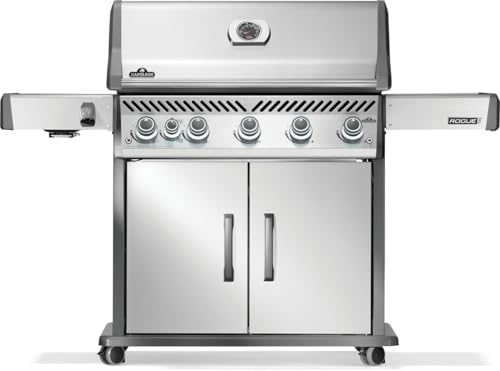
Napoleon Rogue PRO 625 5-Burner Propane Grill with Infrared Side Burner — Best Premium Even Cooker
Napoleon’s Rogue PRO 625 attacks unevenness with abundance: five burners across 988 sq in, stainless grates, and an infrared side burner, so every food gets the zone it needs instead of competing for the good spot.
Strengths
- Huge 988 sq in area with five burners means zones for every stage of a mixed cook
- Stainless grates conduct and hold heat smoothly across a very wide surface
- Infrared side burner isolates searing heat from the main box entirely
Trade-offs
- Premium pricing and a very large footprint — measure the patio first
- Five burners reward a cook who plans zones; run flat-out, any big grill is uneven
- More burners and parts mean more annual maintenance time
| Spec | Detail (from listing) |
|---|---|
| Burners | 5 burners with infrared side burner (per listing) |
| Output | 74,000 BTU, 988 sq in area (per listing) |
| Grates | Stainless steel grates; SafetyGlow/backlit knobs, folding shelf, locking casters |
There are two philosophies of even cooking. One engineers a single surface to be uniform; the other gives the cook so many well-behaved zones that unevenness stops mattering. This Napoleon is the second philosophy executed at a premium level. With five main burners, you can run a gradient across the grill — searing heat at one end, gentle holding at the other, a true off-zone in between — and stainless grates smooth the transitions. The infrared side burner removes the highest-heat work from the box altogether, so steaks sear in their own station while chicken finishes undisturbed under the lid. The honest caveat is that abundance requires intention: light all five burners on high, crowd the grate, and you have built a very expensive uneven grill. Use the zones as designed, preheat fully, and this is the most capable mixed-load cooker in the guide — the one a serious host grows into rather than out of.
Best for: serious hosts who cook varied loads at once and will use a five-zone layout / Not suited for: casual grillers who want one knob and no decisions
Check the current price on Amazon
Comparison Table
| Pick | Badge | Key spec | Best for |
|---|---|---|---|
| Charbroil Pro Series Amplifire Infrared 4-Burner with Side Burner | Best Overall for Even Cooking | Amplifire infrared technology (per listing) | mixed-load cooks who grill chicken, vegetables, and burgers together and want them done together |
| Weber Spirit E-325 Gas Grill (Liquid Propane) | Best Conventional Even Cooker | 3 burners with Sear Zone and Boost burners (per listing) | cooks who want predictable, even results from a conventional burner grill |
| Weber Genesis E-415 Gas Grill (Propane) | Best Large Even Cooker | 4 PureBlu burners (per listing) | hosts and large families who need capacity without giving up even results |
| Charbroil Pro Series Amplifire 2-Burner Gas Grill and Griddle Cabinet 463676724 | Best Compact Infrared Option | Amplifire infrared technology (per listing) | small households wanting infrared evenness plus griddle versatility |
| Cuisinart Chef's Style Portable Propane Tabletop Gas Grill (CGG-306P) | Best Two-Zone Tabletop | Twin burners, 10,000 BTU each (per listing) | small-space cooks who want genuine two-zone technique from a tabletop |
| Napoleon Rogue PRO 625 5-Burner Propane Grill with Infrared Side Burner | Best Premium Even Cooker | 5 burners with infrared side burner (per listing) | serious hosts who cook varied loads at once and will use a five-zone layout |
How to Choose the Best Gas Grills for Even Cooking Results
Learn the three heat-spreading systems before comparing brands. Heat tents and flavorizer-style bars shield burners and vaporize drippings, spreading heat moderately. Heavy grates add thermal mass that smooths what the burners deliver. Infrared emitters go furthest, radiating from a broad surface and largely eliminating burner stripes and flare-ups — at the cost of cleaning discipline, since a clogged emitter is an uneven emitter.
Match burner count to box size, not to ego. The failure mode is a wide cooking area stretched over two burners, which guarantees cold corners. As a working rule from this guide’s picks: compact boxes do well with two or three burners, mid-size boxes want three or four, and genuinely large grates need four or five to stay honest edge to edge.
Grate material is an evenness feature. Porcelain-enameled cast iron and stainless rod grates store heat and conduct it laterally, averaging out the flame pattern beneath. Thin wire or lightweight plated grates transmit every stripe directly to the food. If two grills differ mainly in grates, the heavier grate cooks more evenly, full stop.
Value a deliberate hot zone over an accidental one. A sear zone or infrared side burner gives you controlled high heat where you choose it, which keeps the main grate calm and predictable. Grills without one force you to exploit their worst hot spot for searing — the same hot spot that burns your chicken the rest of the time.
Finally, price your own habits honestly. Infrared systems reward owners who clean monthly. Zone-rich multi-burner grills reward cooks who plan. Heavy conventional grills reward anyone who simply preheats properly. The most even grill for you is the one whose discipline you will actually keep.
Thickness is the hidden variable in every even-cooking complaint. A grill can only deliver the heat; the food’s geometry decides whether that heat arrives at the center in time. Mixed loads cook evenly when pieces are matched — chicken thighs of similar size, burgers of similar thickness, vegetables cut to a common scale. The cooks whose food ‘mysteriously’ finishes together are usually the cooks who portioned it that way before the grill was lit. Hardware sets the stage; the cutting board writes the script.
Lid discipline is the other half of surface temperature. Every lid opening dumps the box’s accumulated heat and restarts the climb, and it restarts unevenly — the areas over burners recover first, the corners last. Even-cooking technique is therefore partly a patience technology: arrange the food, close the lid, and let the system you bought do its work, opening to turn food in planned, brief interventions rather than continuous supervision. If you must watch, watch through the thermometer’s story and the first planned opening.
Temperature tools deserve a buyer’s note. A lid thermometer tells you the air near the lid — useful for roasting, nearly useless for judging the grate. If even cooking matters enough to bring you to this guide, an inexpensive infrared thermometer pointed at the grate, or a probe left in the food that matters, closes the information gap that causes most ‘uneven grill’ complaints. Half of evenness is knowing where you stand; instruments are how you know.
Fuel consistency is the last quiet variable. A tank running low in cold weather delivers sagging pressure, and a grill judged ‘uneven’ at a February cookout is sometimes just a grill being starved. Keep the tank reasonably full for big cooks, and if a natural gas conversion exists for your model and your home has the line, it removes the variable entirely. Even heat begins at the supply, not the burner.
How to Cook Evenly on Any Gas Grill
Preheat like you mean it: lid down, all burners on high, ten minutes for a compact grill and fifteen for a large one. The grates and heat system need to saturate before the surface temperature means anything. An infrared thermometer is a luxury; a consistent preheat routine is the necessity it substitutes for.
Build a two-zone fire as your default, even on even grills. One side hotter, one side gentler gives every piece of food an escape route and a finishing area, and it turns ‘even cooking’ from a hope into a method: sear where it is hot, finish where it is not, serve everything together.
Load the grate with intention. Similar foods together, similar thicknesses together, and leave breathing room — a crowded grate steams, traps flare-ups, and cooks unevenly no matter what hardware is underneath. Two calm batches beat one chaotic one.
Maintain the system you bought. Brush grates after cooking, scrape heat tents or bars monthly, and clean infrared emitters exactly as the manual directs — gently, and on schedule. Evenness is a maintained condition, not a permanent property, and the cooks who keep it are the ones whose grills ‘just cook evenly’ year after year.
Map your grill once, deliberately, with the bread test: cover the preheated grate with slices of plain white bread, run two minutes, and photograph the browning pattern. It is the oldest diagnostic in grilling because it works — the toast prints your grill’s heat map in edible form. Repeat it after a deep clean or a burner replacement to see what changed. Cooks who have done this once stop arguing with their grills and start arranging food by knowledge: delicate items to the pale corners, sturdy items to the dark center.
Calibrate doneness by zone rather than by clock. Once you know the map, the finishing order becomes a system: food that needs the most color starts over the strongest zone, everything migrates toward gentler heat as it cooks, and the last item off is the one that started in the coolest spot. Even cooking, practiced this way, is less about the grill being perfect and more about the cook running a small, calm rotation — a skill that transfers to every grill you will ever own.
Diagnosing Hot Spots and Fixing Uneven Heat
Every grill has a heat map; the only question is whether you know yours. The bread test described in the how-to section reveals it in two minutes, and the pattern it prints falls into a few classic shapes, each with its own cause and remedy. Stripes that mirror the burners point to a heat-spreading system that is clogged, degraded, or too light for the box. A racing center with pale corners suggests a wide box on too few burners, or a preheat cut short. One cold side almost always means a partially blocked burner or a failing tube on that side — a maintenance event, not a personality trait.
Work the remedies in order of cost. First, clean: carbon and grease on heat tents, bars, or emitters are the most common cause of a grill turning uneven, and a thorough scrape-and-brush restores more grills than any part. Second, inspect the burners with the grates off — blocked ports clean with a port tool or soft wire, and flames should return to an even blue row. Third, check the grates themselves: warped, thinned, or rusted grates transmit heat erratically, and a grate upgrade is the highest-value hardware change an uneven grill can receive.
If the map is still striped after cleaning and inspection, the grill is telling you its design limit — and technique is the bridge. Rotate food a quarter-turn halfway through for cross-hatched, averaged exposure. Run a permanent two-zone fire so finishing never depends on the bad corner. Cook in smaller, calmer batches. These are not consolations; they are how professionals handle imperfect equipment, and they will carry a mediocre grill surprisingly far while you plan its replacement using this guide’s criteria.
When replacement time comes, the diagnosis writes the shopping list. Stripes demand a better spreading system — infrared or heavier grates. Cold corners demand more burners per inch of box. A cold side that cleaning could not fix demands a brand whose burners you can reorder in year six. The picks in this guide were chosen against exactly those failure modes, so the grill you buy next is the answer to the map you printed this season.
One last diagnostic habit separates even cooks from frustrated ones: change one variable at a time. Clean first, cook, observe. Replace one part, cook, observe. The grill is a system, and systems confess their problems to people who test them methodically. Keep the bread test as your baseline and every change becomes measurable — which is to say, even cooking stops being a mystery and becomes a maintained condition, like everything else worth having in a backyard.
Common Buying Mistakes
Mistake one is judging evenness on an empty, cold grill in a showroom. Evenness appears after a full preheat under a real load. Judge by burner layout, spreading system, and grate mass — the listing facts this guide used.
Mistake two is buying the widest grill on two burners because the area number looked generous. Area without burners is a map of cold spots. Match the burner count to the box.
Mistake three is running every burner on high for everything. Full blast maximizes gradients and flare-ups. Most foods want a hot zone and a moderate zone, not a uniform inferno.
Mistake four is neglecting the heat system until food sticks and stripes appear. Carbon-clogged tents and emitters are the leading cause of a grill ‘becoming’ uneven — and the most reversible one, with a brush and twenty minutes.
Cooking a Full Mixed Load Without the Shuffle
Here is the dinner this guide is really about: chicken thighs, corn, a tray of peppers and onions, and burgers for the two people who always want burgers — all to land within the same ten minutes, none of it burnt, none of it pale. On a poorly chosen grill this menu is a juggling act with casualties. On the systems in this guide, it is a sequence, and the sequence is the same regardless of which pick you own.
It starts twenty minutes before anyone is hungry. Full preheat, zones established — the hottest lane for the chicken’s first sear, the middle for steady cooking, the gentle edge for holding. Chicken goes on first because it takes longest and forgives the most. Corn follows into the middle zone, vegetables onto the area that matches their sugar content — peppers tolerate heat, onions reward patience — and the burgers, fastest of all, wait for the final minutes on the hot lane the chicken has vacated, finishing in the space the chicken left as it moved to hold.
The landing is the point. Because the zones were honest and the food was portioned evenly, everything converges: chicken rested and crisp, corn blistered, vegetables sweet, burgers done when the rest is. No frantic rotation, no piece sacrificed to a cold corner, no early food going cold while a straggler finishes. That convergence — boring, repeatable, weeknight-proof — is the product this category sells, and it is why the hardware details in the reviews, the emitters and burner counts and grate materials, are worth the attention this guide gives them.
Even Cooking for Delicate Foods: Fish, Fruit, and Dough
Everything in this guide so far has been tested, implicitly, on forgiving foods — chicken, burgers, sturdy vegetables. Delicate foods grade the same systems more harshly, and they are worth a section because they are where evenness stops being a preference and becomes the whole dish. Fish fillets cook in minutes and scorch in seconds over a burner stripe; on an even system — an emitter’s broad radiation, a heavy grate’s averaged heat, or a calm zone honestly held — they cook through with their surfaces intact and their timing predictable.
Fruit and dough make the same point from the sweet side. Halved peaches or pineapple over a hot spot caramelize into bitterness while their neighbors stay raw; over even heat they blister uniformly and come off as dessert instead of a lesson. Flatbreads and grill-top pizzas — the gateway to the pizza guide in this batch — demand a surface with no cold quadrant, because dough cannot be shuffled the way chicken can. If your cooking ambitions run delicate, weight this section heavily in your choice: the infrared and heavy-grate picks are not luxuries for you, they are the correct tools.
The technique transfers with one adjustment: delicate foods get the grill’s most even real estate and the cook’s full attention, in small batches, with the lid’s help used briefly rather than constantly. Preheat as always, oil the food rather than the grate, and let the system’s evenness do what you bought it for. A grill that can land a fillet perfectly can land anything; that is why this section sits near the end of the guide, as the examination the earlier sections were studying for.
Evenness Across a Grill’s Lifetime: Keeping the Map Stable
A grill’s heat map is not fixed at purchase; it drifts as the machine ages, and even-cooking ownership is largely the art of noticing the drift early. Burner ports narrow with corrosion products, heat tents thin and warp, emitters accumulate the carbon that no single cleaning fully removes, and each change redraws the map a little. The cooks who report that a grill ‘still cooks like new’ at year five are not lucky — they are running the maintenance in this guide on schedule, which holds the map still by holding the system still.
Build the drift check into the seasonal deep clean: after cleaning, run the bread test again and compare the pattern with your memory of the grill when it was new — or with the photograph you took then, which is the better instrument. A map that has shifted after cleaning is naming a part: the burner whose stripe has faded, the tent whose section has thinned. Replace that part and the map returns. This is the same repair logic as the durability guide, aimed at a different symptom: evenness is durability, measured at the grate instead of the firebox.
Accept, finally, that perfect uniformity is neither available nor necessary. Every system in this guide has a personality — a slightly proud center, a calmer corner — and mastery is knowing yours well enough to arrange food by it without thinking. The goal was never a laboratory surface. The goal is a grill whose behavior you can predict, dinner after dinner, year after year. Predictability is the grown-up form of evenness, and it is entirely achievable with the hardware and habits in this guide.
Final Recommendation
For the simplest path to even results, the Char-Broil Amplifire four-burner is the guide’s answer — its emitter system does the spreading for you, provided you keep it clean. Conventional-grill loyalists should take the Spirit E-325 for small loads or the Genesis E-415 for large ones. The Cuisinart tabletop proves the principle in miniature, the compact Amplifire adds a griddle, and the Napoleon Rogue PRO 625 is the zone-rich premium ceiling.
Whichever system you choose, pair it with the method: full preheat, two zones, unhurried loading, scheduled cleaning. Hardware sets the ceiling on even cooking. Habit decides how close to it you eat.
- Charbroil Pro Series Amplifire Infrared 4-Burner with Side Burner — check price on Amazon
- Weber Spirit E-325 Gas Grill (Liquid Propane) — check price on Amazon
- Weber Genesis E-415 Gas Grill (Propane) — check price on Amazon
- Charbroil Pro Series Amplifire 2-Burner Gas Grill and Griddle Cabinet 463676724 — check price on Amazon
- Cuisinart Chef's Style Portable Propane Tabletop Gas Grill (CGG-306P) — check price on Amazon
- Napoleon Rogue PRO 625 5-Burner Propane Grill with Infrared Side Burner — check price on Amazon
Best Gas Grills Best Infrared Gas Grills Best 4 Burner Gas Grills Best 3 Burner Gas Grills Best Gas Grills For Home Use Best Gas Grills For Searing
Frequently Asked Questions
Why does my gas grill have hot and cold spots?
Burners are lines of flame, so heat concentrates above them and fades between and beyond them. Heat tents, heavy grates, and infrared emitters spread that heat; wide boxes on few burners, clogged heat systems, and skipped preheats make the pattern worse.
Is infrared really more even than conventional burners?
Yes, when maintained. An infrared emitter radiates from a broad surface instead of discrete flame jets, which removes burner stripes and most flare-ups. A carbon-clogged emitter loses that advantage, so cleaning is part of the technology.
How many burners do I need for even cooking?
Enough that no part of the grate is far from a burner: two to three for compact boxes, three to four for mid-size, four to five for large grates. Zone control matters as much as the count — independent burners let you build a finishing area.
Do cast-iron grates cook more evenly?
They help significantly. Cast iron stores heat and conducts it sideways, averaging the flame pattern before it reaches the food. Porcelain enamel over cast iron adds rust protection. Thin wire grates offer neither benefit.
What is a two-zone fire and why does it help?
One side of the grill runs hot, the other gentle or off. You sear on the hot side and finish on the gentle side, so everything reaches doneness together without burning — the practical technique behind most ‘even’ results.
My grill used to cook evenly and now does not. Why?
Usually buildup: carbon and grease clog heat tents, flavorizer bars, or infrared emitters, and burner ports block unevenly. A deep clean of the heat system and burner ports restores most grills. If burners are corroded through, replacement is the fix.
Do heat tents or flavorizer bars really make heat more even?
Yes — they shield the burners, spread flame heat over a wider area, and vaporize drippings that would otherwise flare in spots. Their effect fades as they clog or corrode, which is why cleaning or replacing them restores evenness on older grills.
How often should I repeat the bread test?
Once when the grill is new, after every deep clean, and whenever results change unexpectedly. It takes two minutes and a few slices of bread, and it converts vague impressions about hot spots into a current, accurate map.


