Disclosure: airfryerkitchensupply.com is reader-supported. When you buy through links on our site, we may earn an affiliate commission at no extra cost to you.
Where to buy
Start here if you are comparing the best gas grills and smokers options that are actually worth buying. Combo grills live or die on whether both halves are real, so every unit below was matched to a live Amazon listing, with its layout — gas side, charcoal side, firebox or dedicated smoker — confirmed from the listing itself. Follow the links to check price on Amazon, and read the layout line in each spec box before anything else.
- Best Overall Combo: Char-Griller Texas Trio 3-Burner Gas & Charcoal Grill and Smoker — check price on Amazon
- Best for Serious Smoke: Oklahoma Joe’s Canyon Combo Dual Fuel Smoker and Grill — check price on Amazon
- Best Compact Combo: Char-Griller Dual-Function 2-Burner Gas and Charcoal Combination Grill E5030 — check price on Amazon
- Best Offset Smoker Combo: Sophia & William 3-Burner Gas and Charcoal Grill Combo with Offset Smoker — check price on Amazon
- Best Dedicated Propane Smoker: Masterbuilt 40-Inch ThermoTemp Propane Vertical Smoker — check price on Amazon
- Best Oil-Less Smoker-Roaster: Char-Broil The Big Easy TRU-Infrared 3-in-1 Smoker, Roaster & Gas Grill — check price on Amazon
Read this before the picks, because it shapes all of them: a gas grill with a smoker box sprinkled on top is not the same machine as a true combo. The honest hierarchy is dedicated smoker chamber or offset firebox first, charcoal side that doubles as a smoker second, and smoker tray or tube on a gas grate a distant third. This guide is built from the first two categories, plus one dedicated propane smoker and one infrared smoker-roaster — and the reviews say plainly how much smoke each design can really deliver.
The best gas grills and smokers promise the two great outdoor cooking modes in one footprint: weeknight gas speed — light it, grill, done in twenty minutes — and weekend smoke, where a pork shoulder spends eight hours becoming something no weeknight can produce. It is a genuinely useful combination, and a genuinely easy one to fake, which is why this category needs more honesty than most.
So here is the honest physics up front. Gas burners are poor smoke engines: they burn clean, run hot at grate level, and a smoker box on a gas grate flavours food lightly rather than smoking it in the barbecue sense. Real smoke in these combos comes from the charcoal side — a firebox, an offset chamber, or a charcoal grate where wood chunks smoulder under controlled air. Every combo in this guide earns its place through that charcoal side, and we say so in each review.
The six picks cover the real design space: a three-chamber Texas-style trio with a side firebox, an Oklahoma Joe’s dual-fuel with serious smoker intent, a compact dual-function unit for small patios, an offset-smoker combo, a dedicated vertical propane smoker for purists who still want gas convenience, and Char-Broil’s infrared smoker-roaster for the oil-less route. Choose by how much smoke you truly intend to make.
In this guide
Quick Picks
If smoke is your main event, read the first three badges carefully — they mark the combos with genuine smoker chambers. If smoke is a sometime thing, the later picks trade depth for simplicity. Badges match the reviews and the comparison table exactly.
Best Overall Combo — Char-Griller Texas Trio 3-Burner Gas & Charcoal Grill and Smoker: Char-Griller’s Texas Trio runs a 3-burner gas grill, a charcoal grill and a side firebox smoker across 1,390 sq. in. Check price on Amazon
Best for Serious Smoke — Oklahoma Joe’s Canyon Combo Dual Fuel Smoker and Grill: Oklahoma Joe’s Canyon Combo pairs a 3-burner propane side with a charcoal smoker side across 1,031 sq. in. Check price on Amazon
Best Compact Combo — Char-Griller Dual-Function 2-Burner Gas and Charcoal Combination Grill E5030: Char-Griller’s Dual-Function E5030 splits 870 sq. in. between a 2-burner gas side and a charcoal grill-smoker side. Check price on Amazon
Best Offset Smoker Combo — Sophia & William 3-Burner Gas and Charcoal Grill Combo with Offset Smoker: Sophia & William’s combo adds an offset smoker to a 3-burner gas and charcoal layout with 840 sq. in. of area. Check price on Amazon
Best Dedicated Propane Smoker — Masterbuilt 40-Inch ThermoTemp Propane Vertical Smoker: Masterbuilt’s 40-inch ThermoTemp is a vertical propane smoker with thermostat-style control and 960 sq. in. of racks. Check price on Amazon
Best Oil-Less Smoker-Roaster — Char-Broil The Big Easy TRU-Infrared 3-in-1 Smoker, Roaster & Gas Grill: Char-Broil’s Big Easy TRU-Infrared is a smoker, roaster and gas grill in one — famous for oil-less infrared turkey frying. Check price on Amazon
How These Picks Were Chosen
We filtered the verified Amazon catalogue for units whose listings describe both functions in their own words: a propane gas grill side and a charcoal or smoker side, a side firebox, an offset smoker, or a dedicated propane smoker design. Single-function grills with a marketing mention of ‘smoker flavour’ were excluded, as were pellet units, which belong to a different category entirely.
Each survivor was matched brand-and-model against Amazon listing data, and we recorded the layout exactly as the listing states it — burner count on the gas side, total cooking area, and the smoker mechanism. That layout, more than any number, predicts your experience: offset fireboxes smoke best, split charcoal chambers smoke well and grill with charcoal too, and vertical propane smokers trade the grill entirely for controlled, thermostat-style smoking.
Finally we weighed the gas side on its own merits, because a combo whose gas half is feeble fails its weeknight job. The picks below all grill credibly on gas; they differ in how far into real barbecue their smoke side can go, and the reviews grade that distance honestly rather than pretending every combo is a competition pit.
A word on what did not make this list, because the exclusions teach the category. Pellet grills were excluded as a different fuel philosophy with its own dedicated roundups; electric smokers likewise. Gas-only grills with bolt-on smoker boxes were excluded for the reason stated in the guide — the smoke is a garnish, not a capability. And a number of very wide three-chamber imports were cut on verification: if a combo’s exact layout and ASIN could not be confirmed against its listing, its firebox could not be trusted either. What remains is smaller than the internet’s combo universe and, we believe, considerably more honest.
The 6 Best Gas Grills and Smokers for Both Jobs
For each unit we grade two jobs separately: the gas grilling, and the smoking — how it generates smoke, how well it holds low temperatures, and what food it can honestly handle. The verdict line then tells you the split personality in one sentence.

Char-Griller Texas Trio 3-Burner Gas & Charcoal Grill and Smoker — Best Overall Combo
The Texas Trio is the fullest expression of the combo idea: three cooking chambers sharing one frame. Gas for Tuesday, charcoal for Saturday’s steaks, and the side firebox for Sunday’s ribs — with a side burner besides. It suits the enthusiast household that genuinely cooks all three ways, has the patio width for a long unit, and wants one purchase to end the ‘which cooker’ debate for years.
Strengths
- Side firebox gives true offset-style smoking, not a smoker-box gesture
- 1,390 sq. in. total cooking area (per listing) across the chambers
- Gas side has three burners plus a side burner for complete weeknight duty
Trade-offs
- It is a very wide unit — measure the patio and the storage spot carefully
- Three chambers mean three grates and three ash/grease systems to clean
- Offset smoking demands fire-tending; this is a hobby, not an appliance setting
Key specs (from the verified listing):
- Layout: 3-burner gas grill + charcoal grill + side firebox smoker
- Cooking area: 1,390 sq. in. (per listing)
- Ignition: Push-button
- Extras: Side burner, dual temperature gauges
- Model: 3070
The firebox is why this grill tops the guide. An offset fire lets you burn real wood splits or charcoal-and-chunk fires beside the food, drawing smoke across the chamber at barbecue temperatures — the mechanism behind genuine bark and smoke ring, not a flavour suggestion. The Texas Trio’s firebox is sized for home-scale cooks: ribs, chickens and a modest brisket are realistic; a competition load is not, and pretending otherwise would be dishonest.
The gas side, meanwhile, is a proper three-burner grill with a side burner, so the weeknight job is fully covered. The ownership reality is surface area: this is the most grill in the guide to clean, season and protect, and the steel asks for a cover and occasional high-heat paint touch-ups where the firebox runs hottest. For the cook who will use all three chambers, that is a fair and satisfying trade.
Owning the Texas Trio is owning a small fleet: three chambers to season, three grates to keep oiled, an ash routine for the firebox and charcoal side, and a grease routine for the gas side. Enthusiast owners build it into a Saturday rhythm — cook, brush hot, empty ash cold the next morning — and report that the unit ages like a workshop tool, gaining character rather than problems. The cover must be the big one, fitted for the full width, and the firebox exterior will want an occasional touch of high-heat paint where it works hottest. That is the honest tax on the guide’s most complete cooker.
Best for: enthusiasts who want real offset smoking plus gas convenience / Not suited for: small patios or anyone seeking a low-maintenance single-chamber grill
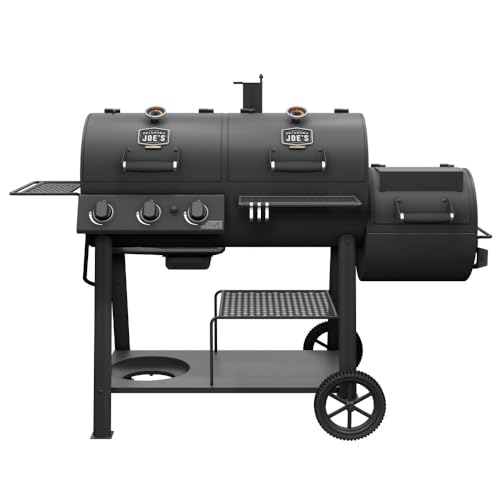
Oklahoma Joe’s Canyon Combo Dual Fuel Smoker and Grill — Best for Serious Smoke
The Canyon Combo comes from a brand built on smokers, and it shows in the priorities: the charcoal side is a genuine smoker-grill chamber, while the propane side — three burners — handles the fast work. It suits the barbecue-first household: your identity is ribs and brisket, but you still want burgers on a Wednesday without building a fire. Of the combos here, this is the one a smoking enthusiast would choose.
Strengths
- Smoker-first design from a dedicated barbecue brand
- 1,031 sq. in. total cooking area (per listing) across both fuels
- Gas side frees weeknight cooking from fire-building entirely
Trade-offs
- Two full chambers still cannot match a dedicated offset for capacity
- Heavy unit; assembly and positioning are a two-person job
- Charcoal side needs ash management after every smoke
Key specs (from the verified listing):
- Layout: 3-burner propane gas side + charcoal smoker side
- Cooking area: 1,031 sq. in. (per listing)
- Fuel: Propane and charcoal
Oklahoma Joe’s heritage matters in the details a listing cannot photograph: damper control that actually meters air, a charcoal chamber deep enough for a real fire, and steel that holds smoking temperatures without constant correction. Low-and-slow on the Canyon is a managed cook, not a fight — you will still tend it, because that is smoking, but the tool cooperates.
The gas side is deliberately the supporting act: three burners, honest heat, no theatre. That is the correct allocation for this buyer. If your cooking is 70 percent gas and 30 percent smoke, the Texas Trio’s balance may suit you better; if it is the reverse, the Canyon is the combo that respects your priorities instead of splitting them evenly.
Canyon ownership suits the methodical smoker: ash out after every charcoal cook, the chamber wiped while warm, dampers exercised so they never seize, and the gas side kept to the standard grill routine. Oklahoma Joe’s owner community is deep and practical — damper settings, gasket tweaks and fire layouts for this exact format are documented by people who cook on it weekly — which makes the learning curve a shared one. Keep it covered and the steel will hold temperatures season after season, which is the entire point of buying a smoker-first combo.
Best for: smoke-first cooks who still want weeknight gas speed / Not suited for: gas-first households that smoke twice a year

Char-Griller Dual-Function 2-Burner Gas and Charcoal Combination Grill E5030 — Best Compact Combo
The E5030 is the combo for normal-sized patios and normal-sized households: a two-burner gas side for quick dinners, a charcoal side that grills with real fire and smokes smaller loads, and 870 sq. in. in total. It suits couples and small families who want both fuels without a three-chamber monument, and first-time combo buyers who want to learn smoking on forgiving, smaller cooks.
Strengths
- Both fuels in a footprint a modest patio can actually hold
- Charcoal side doubles as a charcoal grill and a small-load smoker
- 870 sq. in. total area (per listing) is well judged for households of two to five
Trade-offs
- Gas side is 24,000 BTU (per listing) — adequate, not fast, on cold evenings
- Smoker capacity suits ribs and chicken; whole packer briskets are a squeeze
- Two fuel systems still mean two cleaning routines
Key specs (from the verified listing):
- Layout: 2-burner gas + charcoal combination grill and smoker
- Total output: 24,000 BTU gas side (per listing)
- Cooking area: 870 sq. in. (per listing)
- Model: E5030
Combos fail small households by being enormous; the E5030 succeeds by being honest about scale. Its charcoal chamber handles a couple of racks of ribs or a pork butt with real wood smoke, which is the correct training ground — and, for many households, the permanent requirement. The gas side covers the weekly rotation without the ceremony of charcoal.
Expect the physics of its size: smaller chambers swing temperature more in wind, and the gas side’s output is tuned for its grate, not for a banquet. Cook within its design and it is a likeable, instructive machine that teaches both crafts. Outgrow it, and you will know exactly which dedicated cooker to buy next — which is its own kind of value.
The E5030’s smaller chambers are its ownership gift: less ash, less steel to season, a cover of manageable size, and a footprint that lets it winter in a garage corner. The discipline is the standard Char-Griller one — charcoal side emptied cold every time, grates oiled, gas burners brushed each season — scaled down to a unit one person can deep-clean in an hour. Owners who learn smoking on it consistently say the same thing: the grill taught them fire management on forgiving loads, and everything they later cooked on bigger pits used those lessons.
Best for: small households wanting both fuels in a sane footprint / Not suited for: brisket-for-a-crowd ambitions or high-output gas grilling
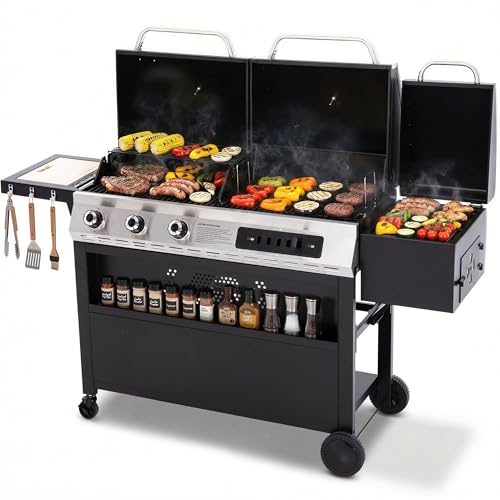
Sophia & William 3-Burner Gas and Charcoal Grill Combo with Offset Smoker — Best Offset Smoker Combo
This combo is for the buyer whose eye goes straight to the offset smoker: a dedicated offset chamber fed by its own fire, alongside a three-burner gas grill and charcoal capability. It suits learners who want to practise true offset technique — fire management, damper control, smoke quality — inside a single unit that still grills the weeknight burgers on gas when the lesson is over.
Strengths
- True offset smoker configuration for authentic low-and-slow technique
- Three gas burners plus charcoal give three cooking modes in one frame
- 840 sq. in. total cooking area (per listing)
Trade-offs
- Newer brand: long-term parts and support are less proven than the legacy names
- Offset chambers on value combos seal less tightly — expect to learn gasket tweaks
- Three modes is three maintenance routines; budget the time honestly
Key specs (from the verified listing):
- Layout: 3-burner gas + charcoal with offset smoker
- Cooking area: 840 sq. in. (per listing)
- Fuel: Propane and charcoal
Offset smoking is the craft form of barbecue, and having it attached to a gas grill is a fine way to learn: the firebox teaches you clean smoke — thin and blue, not white and bitter — while the gas side guarantees dinner even when a practise cook runs long. The 840 sq. in. total is split sensibly, and the charcoal capability means the main chamber can grill over real fire on weekends too.
The value-brand caveats are the standard ones, sharpened by the offset format: door seals and damper fit decide how well any offset holds temperature, and on a combo at this tier you may add a gasket or a latch tweak as your first project. Enthusiasts treat that as part of the hobby; appliance-minded buyers should choose the Big Easy below instead.
Ownership of a newer-brand offset combo includes one project the legacy picks do not: sealing. Check the chamber and firebox doors after the first cooks; if smoke leaks at the seams, a food-safe gasket or a latch adjustment — standard offset-owner craft — transforms temperature control. Beyond that, the routine is the combo standard across three modes, and the brand’s support runs through its seller channels, so documentation and the model plate photograph matter. Enthusiasts treat the sealing project as initiation; it is fairly priced into this pick’s position.
Best for: learners committed to true offset smoking technique / Not suited for: buyers who want smoking to be a set-and-forget appliance task

Masterbuilt 40-Inch ThermoTemp Propane Vertical Smoker — Best Dedicated Propane Smoker
The ThermoTemp breaks the combo pattern deliberately: it does not grill at all. It is a vertical propane smoker whose thermostat-style control holds smoking temperatures the way an oven holds heat, across 960 sq. in. of rack space. It suits the cook who already owns a grill, wants serious smoke capacity with gas convenience, and values walking away from a brisket for an hour at a time. If you need one unit to do both jobs, choose a combo above.
Strengths
- ThermoTemp control holds set smoking temperatures with minimal tending
- 960 sq. in. of vertical rack space (per listing) — huge capacity per footprint
- Propane fuel: no cords, no pellet auger, works anywhere outdoors
Trade-offs
- It cannot grill — no searing, no burgers; it is a smoker only
- Vertical format limits very wide items; briskets may need trimming or rack planning
- Analog control is steady but less precise than digital pellet systems
Key specs (from the verified listing):
- Type: Dedicated propane vertical smoker (no grill grates)
- Cooking area: 960 sq. in. (per listing)
- Control: ThermoTemp analog temperature control
- Model: MB20051316
Including a dedicated smoker in this guide is an honesty decision: for many households, ‘gas grill and smoker’ is best answered by a gas grill they already own plus this. Propane vertical smokers are the easiest route to real smoke volume — wood chunks in the tray, water pan for moisture, racks for four levels of food — and the ThermoTemp’s control loop removes the vent-fiddling that defines cheaper gas smokers.
The results are proper barbecue: ribs, shoulders, whole chickens and jerky in quantity, with a learning curve measured in one cook rather than one season. Pair it with any decent gas grill and you have a two-unit setup that outperforms every combo here at both jobs — at the cost of storing two units. For smoke-serious buyers with the space, that is the professional answer hiding in a combo guide.
The ThermoTemp is the lowest-maintenance serious smoker in this guide: no ash, no fire-tending burns, just a water pan to wash, a chip tray to empty, racks that clean like oven shelves and a door seal to wipe. Propane logistics are its only chore — a tank gauge habit and a spare for long cooks — and the cabinet should live covered, with the interior dried after wet cooks to keep the steel sweet. Owners who smoke monthly describe it as the appliance that made barbecue a weeknight possibility, which for a dedicated smoker is the highest praise available.
Best for: smoke-focused cooks who already own a grill / Not suited for: anyone who needs a single unit that also grills

Char-Broil The Big Easy TRU-Infrared 3-in-1 Smoker, Roaster & Gas Grill — Best Oil-Less Smoker-Roaster
The Big Easy is the combo for the cook whose smoking ambitions are really roasting ambitions: whole turkeys and chickens cooked fast in infrared heat, with wood chips adding a genuine smoke note, and no vat of oil anywhere. It grills and roasts in a compact drum format, suiting holiday cooks, tailgaters and anyone whose ‘smoker’ use case is poultry, ribs and roasts rather than fourteen-hour briskets.
Strengths
- TRU-Infrared cooking: fast, even roasting with no oil to buy, heat or dispose of
- Smoker capability via wood chips in a purpose-built roaster format
- Compact footprint and a long-proven design with a big owner community
Trade-offs
- It is not a low-and-slow brisket machine — the format favours roasting temperatures
- Drum capacity is poultry-and-roast sized, not party-tray sized
- Infrared drum cooking has its own learning curve versus grate grilling
Key specs (from the verified listing):
- Type: TRU-Infrared smoker, roaster and gas grill in one
- Model: 14101550
- Cooking style: Oil-less infrared roasting plus smoke capability
Judge the Big Easy by its own genre and it is brilliant: infrared walls radiate heat evenly around a turkey or chicken, chips smoulder for real smoke flavour, and the bird emerges crisp-skinned in a fraction of oven time — the reason these units appear at so many holiday gatherings and tailgates. Ribs and roasts ride the same physics happily.
The limit is temperature philosophy. This is a roaster that smokes, not a smoker that roasts: long, low, heavy-smoke cooks are outside its design centre. If your barbecue dreams are specifically brisket-and-bark, the Texas Trio or Canyon above serve them. If your dreams are the best roast chicken and holiday turkey of your life with a whisper of smoke, this odd, proven drum is the pick.
Big Easy ownership is famously simple: no ash, no oil disposal, a drum that wipes out after roasts, and a chip tray to empty when cold. The infrared interior wants a burn-off after fatty cooks to keep flavours clean, and the unit stores in a fraction of the combos’ footprint. Its owner community is enormous and recipe-obsessed, which matters more than it sounds — every holiday bird question has been answered a hundred times. Keep it covered, keep the interior burned clean, and this odd drum will out-serve grills with three times its parts count.
Best for: poultry and roast lovers wanting smoke flavour without oil frying / Not suited for: low-and-slow brisket purists
Comparison Table
The decisive column here is the layout: it tells you where smoke comes from in each design. Firebox and offset entries smoke in the barbecue sense; the vertical smoker is a dedicated chamber; the Big Easy roasts with smoke. Match the layout to your menu before comparing anything else.
| Pick | Badge | Key spec | Best for |
|---|---|---|---|
| Char-Griller Texas Trio 3-Burner Gas & Charcoal Grill and Smoker | Best Overall Combo | 1,390 sq. in. (per listing) | enthusiasts who want real offset smoking plus gas convenience |
| Oklahoma Joe’s Canyon Combo Dual Fuel Smoker and Grill | Best for Serious Smoke | 1,031 sq. in. (per listing) | smoke-first cooks who still want weeknight gas speed |
| Char-Griller Dual-Function 2-Burner Gas and Charcoal Combination Grill E5030 | Best Compact Combo | 24,000 BTU gas side (per listing) | small households wanting both fuels in a sane footprint |
| Sophia & William 3-Burner Gas and Charcoal Grill Combo with Offset Smoker | Best Offset Smoker Combo | 840 sq. in. (per listing) | learners committed to true offset smoking technique |
| Masterbuilt 40-Inch ThermoTemp Propane Vertical Smoker | Best Dedicated Propane Smoker | 960 sq. in. (per listing) | smoke-focused cooks who already own a grill |
| Char-Broil The Big Easy TRU-Infrared 3-in-1 Smoker, Roaster & Gas Grill | Best Oil-Less Smoker-Roaster | 14101550 | poultry and roast lovers wanting smoke flavour without oil frying |
How to Choose a Gas Grill and Smoker Combo
Where the smoke comes from decides everything
Real barbecue smoke is wood smoke, made by smouldering wood at controlled temperatures. In combos, that means a charcoal fire: an offset firebox (Texas Trio, Sophia & William) gives the purest smoke path; a charcoal chamber (Canyon, E5030) gives excellent smoke with direct-grilling versatility; a dedicated propane smoker (Masterbuilt) burns wood chips over a gas flame under thermostat control — real smoke, easier management. A smoker box placed on a gas grate gives the lightest smoke of all, which is why no pick here relies on one.
Be sceptical of any gas-only grill that advertises itself as a smoker without naming its smoke source in the listing. If the listing cannot tell you where the wood goes and how its temperature is controlled, the smoking function is a garnish, not a capability. Every pick in this guide passed that listing test.
Size the two halves independently
A combo is two appliances sharing a frame, and each half must fit your life. Gas side: count burners and imagine Tuesday — two burners suffice for couples, three for families. Smoker side: imagine your biggest realistic cook. Ribs and a chicken fit almost anything here; a full packer brisket wants the larger chambers or the vertical smoker’s racks. Total area figures combine both halves, so mentally split the number before comparing.
Footprint is the third size. Combos are the widest grills in this programme — the Texas Trio especially — and they are awkward to move. Measure the patio, the cover size and the winter storage spot, and plan for the unit to live where it is assembled.
Fuel logistics and the real cost of both worlds
Combos ask you to stock two fuels and two skill sets: propane and match-light convenience on one side; charcoal, wood chunks, fire management and ash disposal on the other. That is the pleasure of the format for enthusiasts and the burden of it for everyone else. If your honest forecast is smoking four times a year, a good gas grill plus an occasional dedicated effort beats a combo whose charcoal side rusts unused — or the Masterbuilt route, adding a dedicated smoker to a grill you already own.
Maintenance doubles too: two fireboxes to season, two grease and ash systems to empty, more seams for weather to find. None of it is hard, but it is weekly. Buy the combo because you will cook both ways monthly, and it will be the best-used appliance on your patio.
Smoke Craft on a Combo: Fire, Wood and Patience
Clean smoke is a skill, not a setting
Every combo in this guide will make two kinds of smoke, and the difference decides whether dinner is memorable or medicinal. Clean smoke is thin, pale blue and nearly invisible; it comes from a small fire burning hot with generous air. Dirty smoke is thick, white and billowing; it comes from a large fire choked for air, smouldering unburnt fuel into bitter compounds that coat food. New smokers instinctively build the second kind, because more smoke feels like more flavour. It is the opposite.
The practice that fixes it: build smaller fires than you think you need, keep vents more open than your instinct suggests, and add wood in single chunks, waiting for each to catch cleanly before adding another. On a combo’s charcoal side or firebox, temperature is controlled by fire size first and dampers second. Master that order and your barbecue will taste of wood and meat. Reverse it, and no rub or sauce will rescue the bitterness.
Choosing wood like choosing seasoning
Wood is an ingredient, and the combo format lets you dose it precisely. Hickory is the assertive classic for pork and beef — a little goes far. Oak is the steady background burn, clean and long. Fruitwoods — apple, cherry — are the gentle end, made for poultry, fish and anything delicate, with cherry adding a deep mahogany colour prized on ribs. Mesquite is the strongest voice in the room: magnificent in small doses on beef, overwhelming everywhere else, and best treated as a spice rather than a fuel.
Form matters as much as species. Chunks, fist-sized, are the combo cook’s staple: they catch, smoulder steadily and last through long cooks. Chips burn fast and suit short smokes or the propane smoker’s tray. Green or unseasoned wood smokes dirty no matter the species; dry, seasoned wood is non-negotiable. Buy wood like you buy coffee — from a source that knows what it is, in quantities you will use while it is fresh.
The stall, the wrap and other patience tests
Long cooks on the smoker side will introduce you to barbecue’s famous stall: somewhere in the middle hours, a pork shoulder’s temperature simply stops rising, sometimes for hours, as evaporating moisture cools the meat as fast as the fire heats it. New cooks panic, raise the fire and dry the meat. Experienced cooks recognise the stall as the process working — collagen rendering, bark setting — and either wait it out or wrap the meat in paper or foil to push through, accepting a softer bark as the trade.
Combos teach this patience at home scale, which is their deepest value. The gas side feeds everyone while the smoker side finishes its slow work; nobody starves, nobody rushes the fire. Plan smokes backwards from serving time with hours of slack, rest meat properly — an hour for big cuts is not excessive — and let the combo’s two personalities cover for each other. That hand-off, patience on one side and speed on the other, is the format’s whole philosophy served on a plate.
How to Smoke Ribs on a Combo Grill’s Charcoal Side
This walkthrough uses the charcoal or firebox side of any combo in this guide — the side that makes real smoke. The method is spare ribs, the most forgiving teacher in barbecue, and every step transfers to the other chambers with only timing changes.
- Build a small, clean fire: light a chimney of charcoal, and when the coals are ashed over, arrange them in the firebox or charcoal chamber with two or three wood chunks (hickory or apple) on top. You want a small hot fire with good airflow, not a big smouldering one.
- Stabilise before the meat goes on: vents partly open, chamber temperature settled in the low-to-mid smoking range and holding for 15 minutes. Thin, pale-blue smoke is the goal; thick white smoke means the fire needs air, not more wood.
- Prepare the ribs while the fire settles: remove the membrane from the bone side, season evenly with your rub, and let them stand at room temperature only while the cooker stabilises.
- Smoke bone-side down, lid closed, and do not peek for the first hour. Every opening dumps heat a combo chamber rebuilds slowly. Spritz with apple juice or water hourly after the bark sets, usually around the second hour.
- Use the bend test, not the clock: ribs are done when the rack bends deeply and the meat cracks at the surface when lifted from one end — typically after four to six hours depending on the rack and the day’s fire.
- Rest wrapped for 20 to 30 minutes while you light the gas side for sides or a quick sear on vegetables. This is the combo’s party trick: smoke on one side, speed on the other, one serving time.
- Clean the ash once fully cold, every time. Ash holds moisture against steel, and combo chambers live longer in direct proportion to how empty they are kept.
Two lessons hide in that cook. First, smoke quality beats smoke quantity: a clean small fire flavours better than a choked big one, every time. Second, the combo format shines at the hand-off — gas speed finishing what charcoal patience started. Plan menus around that hand-off and the format justifies itself at every gathering.
Common Buying Mistakes
Believing a smoker box makes a gas grill a smoker. A chip box on a gas grate adds a smoke note, not barbecue. If real smoking matters to you, the smoke must come from a charcoal fire or a dedicated smoker chamber — as it does in every pick here.
Buying the widest combo for a small patio. Three-chamber units are furniture-sized. Measure first, including the cover and your walking space around a hot firebox.
Judging total area without splitting the halves. A 1,000 sq. in. combo might be 500 of grill and 500 of smoker. Check the split against the meals you actually plan, on both sides.
Making thick white smoke. Billowing white smoke is unburnt fuel and it tastes bitter. A small, well-aerated fire with barely visible blue smoke is the mark of a cook who has learned the craft.
Neglecting ash and grease in two systems. Combos double the residue. Ash left in a chamber plus rain equals lye paste eating the steel. Empty both sides on a routine, not a whim.
Smoking with the gas side’s thermometer as your only guide. Lid gauges on any combo read the air where they sit, not the chamber’s working temperature. An inexpensive probe thermometer at grate level on the smoker side transforms control of long cooks — buy one before your second smoke, not your tenth.
Final Recommendation
For the complete brief — gas speed, charcoal grilling and genuine offset smoking in one frame — the Char-Griller Texas Trio is the combo to buy. Its side firebox is the real thing, and its gas side asks for no apologies on weeknights.
Weight the smoke higher and the Oklahoma Joe’s Canyon is the enthusiast’s split; shrink the patio and the Char-Griller E5030 keeps both fuels in a footprint that fits real life. The Sophia & William serves offset learners, the Masterbuilt ThermoTemp is the professional’s shortcut for anyone who already owns a grill, and the Big Easy owns the roast-poultry niche outright.
Choose by your honest ratio of gas nights to smoke days, buy the cover, and learn the clean-fire lesson in the how-to. A combo used both ways, monthly, is the hardest-working cooker a patio can hold.
Ready to move on best gas grills and smokers? Start with the three most-chosen picks in this guide: Char-Griller Texas Trio 3-Burner Gas & Charcoal Grill and Smoker (Best Overall Combo); Oklahoma Joe’s Canyon Combo Dual Fuel Smoker and Grill (Best for Serious Smoke); Char-Griller Dual-Function 2-Burner Gas and Charcoal Combination Grill E5030 (Best Compact Combo) — check price on Amazon for each and compare the exact configuration before you decide.
Keep researching around best gas grills and smokers with the sibling guides in this cluster: Best Gas Grills 4 Burner Best Gas Grills And Smokers Best Gas Grills Charcoal Smoker Best Gas Grills 5 Burner Infrared Best Gas Grills Affordable Best Gas Grills For Tailgating
Frequently Asked Questions
Can a gas grill really smoke meat?
A gas grill alone smokes lightly at best: a chip box or tube adds flavour, but gas burners run too hot and clean for true low-and-slow barbecue. That is why every combo in this guide makes its smoke on a charcoal side, a firebox or a dedicated smoker chamber, with gas providing the grilling speed. Judge any ‘smoker’ claim by where the wood burns.
What is the difference between an offset smoker and a combo’s charcoal side?
An offset smoker cooks food in a chamber fed by a separate firebox, so food never sits over the fire — pure indirect heat and smoke. A split charcoal chamber cooks over or beside the coals in the same space, which grills brilliantly and smokes well with careful fire placement. Offsets smoke purer; split chambers are more versatile per square inch.
How long does smoking take compared with grilling?
Different universe: grilling is minutes, smoking is hours. Ribs run four to six hours, pork shoulder eight or more, brisket longer still. The combo format helps because the gas side handles everything else — sides, starters, the emergency burgers for impatient guests — while the smoker side takes its time.
Do I need wood chunks, chips or pellets for a combo?
Chunks for charcoal chambers and fireboxes — they smoulder steadily for hours. Chips for the propane vertical smoker’s tray and for short smokes. Pellets belong to pellet grills and to smoker tubes used on gas grates. Match the wood form to the chamber, and favour chunks for any cook over two hours.
Is a dedicated smoker plus a separate grill better than a combo?
At the jobs themselves, yes — dedicated units are deeper specialists, which is why the Masterbuilt ThermoTemp appears in this guide. A combo wins on footprint, purchase simplicity and the gas-charcoal hand-off in a single session. The right answer depends on your patio space and how seriously you smoke.
How do I stop smoked food tasting bitter?
Fix the fire, not the recipe. Bitter smoke comes from a choked, smouldering fire producing thick white smoke. Build a smaller, hotter fire with good airflow, wait for thin blue smoke before the food goes on, and add wood in small amounts. Clean smoke is nearly invisible — and it is the whole craft.
What wood should a beginner use first in a combo smoker?
Start with oak or apple chunks. Oak burns clean and steady for long cooks; apple is gentle enough that over-smoking is hard to do while you learn fire control. Add hickory once your fires burn clean — it rewards skill and punishes dirty smoke. Avoid mesquite until you have several cooks behind you; its strength turns small mistakes into strong flavours.
Can I use wood pellets in a combo’s charcoal side?
Pellets are engineered for auger-fed pellet grills; loose in a charcoal chamber they burn fast and unevenly. The right fuels here are charcoal with wood chunks for the firebox and charcoal-side models, and wood chips for the propane vertical smoker’s tray. A pellet tube can add a smoke note on a gas grate, but as this guide argues throughout, that is flavouring rather than smoking — fine for a weeknight shortcut, not a substitute for the charcoal side.


