Disclosure: airfryerkitchensupply.com is reader-supported. When you buy through links on our site, we may earn an affiliate commission at no extra cost to you.
Where to buy
Start here if you are comparing the best gas grills 5 burner infrared options that are actually worth buying. Infrared claims are easy to print and hard to verify, so this buy box only lists grills whose own Amazon listing names the infrared, ceramic or sear burner outright. Follow a link to check price on Amazon, and re-check the burner description on the listing — if it does not say infrared or ceramic there, it is not one of these picks.
- Best Overall Infrared: Napoleon Rogue PRO 625 5-Burner Propane Grill with Infrared Side Burner — check price on Amazon
- Best Infrared Side Burner: Broil King Baron S 590 Pro IR 5-Burner Propane Gas Grill — check price on Amazon
- Best Ceramic Sear Value: Nexgrill Deluxe 5-Burner Gas Grill with Ceramic Side Burner — check price on Amazon
- Best Searing Zone: Kenmore 5-Burner Propane Gas Grill with Searing Zone — check price on Amazon
- Best Built-In Sear Burner: Feasto 5-Burner Propane Gas Grill with Side Burner — check price on Amazon
- Best Built-In Infrared: Blaze LTE PRO 40-Inch 5-Burner Built-In Natural Gas Grill — check price on Amazon
Set expectations correctly before you shop: in the five-burner class, ‘infrared’ almost always means one dedicated high-heat burner — a side sear station, a rear rotisserie burner, or a built-in sear burner — sitting alongside five conventional main burners. Full-infrared main boxes exist but are rare and costly. Every pick below has its infrared or sear element stated in its verified listing, and each review says exactly where that element lives.
The best gas grills 5 burner infrared models sell a simple promise: ordinary grilling space for the crowd, plus one patch of violent, steakhouse heat for the crust. Five main burners give you the wide, zoned grate a big family or party needs; the infrared element — running far hotter than a tube burner and heating food by radiation rather than hot air — sears in a fraction of the time and with fewer flare-ups.
We were strict about admission to this list. Plenty of five-burner grills wear ‘sear’ language loosely, so we only included models whose verified listing explicitly names an infrared side burner, a rear infrared burner, a ceramic sear burner or a built-in sear burner. That rule produced a genuinely varied six: two premium carts with infrared side stations, a ceramic-sear value play, two mid-priced searing-zone grills, and a built-in natural gas head with a rear infrared burner for outdoor kitchens.
The honest caveat: infrared heat is a specialist tool. It will char a delicate fish fillet while you blink and it demands preheating discipline. The reviews below are frank about who should pay for it — and the buying guide explains the difference between infrared, ceramic and plain high-BTU ‘sear zone’ marketing so you can audit any listing yourself.
In this guide
Quick Picks
Six five-burner grills, six different places to put the infrared heat. Find the layout that matches how you cook, then read its full review — badges stay identical from here to the comparison table.
Best Overall Infrared — Napoleon Rogue PRO 625 5-Burner Propane Grill with Infrared Side Burner: Napoleon’s Rogue PRO 625 combines five burners, an infrared side burner, 74,000 BTU and a huge 988 sq. in. area in stainless. Check price on Amazon
Best Infrared Side Burner — Broil King Baron S 590 Pro IR 5-Burner Propane Gas Grill: Broil King’s Baron S 590 Pro IR stacks an infrared side burner and a rear rotisserie burner on a stainless five-burner cart. Check price on Amazon
Best Ceramic Sear Value — Nexgrill Deluxe 5-Burner Gas Grill with Ceramic Side Burner: Nexgrill’s Deluxe five-burner puts a ceramic side burner — the infrared-style sear — beside 65,000 BTU of main-box capacity. Check price on Amazon
Best Searing Zone — Kenmore 5-Burner Propane Gas Grill with Searing Zone: Kenmore’s five-burner builds the sear into the main box as a dedicated searing zone, with 644 sq. in. and 66,000 BTU. Check price on Amazon
Best Built-In Sear Burner — Feasto 5-Burner Propane Gas Grill with Side Burner: Feasto’s five-burner hides a built-in sear burner in a 686 sq. in. stainless cabinet grill with a side prep table. Check price on Amazon
Best Built-In Infrared — Blaze LTE PRO 40-Inch 5-Burner Built-In Natural Gas Grill: Blaze’s LTE PRO 40-inch built-in runs five burners on natural gas with a rear infrared burner, rotisserie kit and 304 stainless construction. Check price on Amazon
How These Picks Were Chosen
Admission to this guide required two verified facts from Amazon listing data: five main burners, and an infrared, ceramic or dedicated sear burner named in the listing itself. Models that merely claimed ‘high heat’ or a big BTU total without a named sear element were excluded, however good they are as ordinary grills — they belong in a different roundup.
Within that pool we balanced formats and tiers: freestanding propane carts for most buyers, one natural-gas built-in for outdoor-kitchen builders, infrared placed at the side, at the rear and inside the box, so the comparison is really about layout. We also weighed grate material, total cooking area where the listing states it, cabinet storage and the realism of the tier — premium, mid-range or value — judged qualitatively.
Every ASIN in this article was matched brand-and-model against the API before writing. Where a number appears in a spec box — BTU, cooking area — it is quoted from that grill’s own listing and labelled as such. No output figures were borrowed from other models in a range, because five-burner line-ups often share names across different burner configurations.
A final selection note on fuel: five of these six picks burn propane and one — the Blaze built-in — is a natural-gas unit, and that split reflects the category honestly. Infrared stations consume fuel at a rate that makes tank discipline a real ownership topic on carts, while plumbed gas suits the permanence of a built-in. We did not treat fuel as a ranking factor, because the right answer is set by your patio’s infrastructure, not by the grill. What we did require is that each listing state its fuel plainly, so no buyer discovers a mismatch in the delivery box.
The 6 Best Gas Grills 5 Burner Infrared Shoppers Can Buy
For each grill we pinpoint where the infrared or sear burner sits and what it is actually good for, alongside the usual strengths, trade-offs, verified specs and verdict. Layout, not brand, is the decision in this category — read for the layout first.
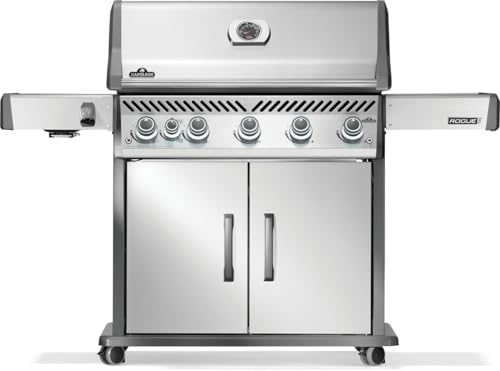
Napoleon Rogue PRO 625 5-Burner Propane Grill with Infrared Side Burner — Best Overall Infrared
The Rogue PRO 625 is the complete answer for the serious home griller: five main burners under a very large grate, and an infrared side burner that works as a dedicated sear station. It suits households that grill for eight to fourteen people, steak lovers who want the sear kept separate from the main cook, and buyers who want one premium cart to end the search. The folding shelf helps it live on real-world patios despite its size.
Strengths
- Infrared side burner sears without occupying main grate space
- 988 sq. in. total cooking area (per listing) — the largest cart here
- Stainless steel grates and body, backlit knobs, folding shelf for storage
Trade-offs
- Premium tier and a big footprint, even with the shelf folded
- Infrared side station is a one-or-two-steak workspace, not a crowd tool
- 74,000 BTU appetite means propane tanks empty faster on long cooks
Key specs (from the verified listing):
- Burners: 5 main burners + infrared side burner
- Total output: 74,000 BTU (per listing)
- Cooking area: 988 sq. in. (per listing)
- Grates: Stainless steel
- Extras: Backlit knobs, folding shelf
The side-station layout is the smartest way to add infrared to a family grill. Your five burners run the main event — chicken, vegetables, a tray of burgers — at civilised temperatures, while the infrared burner waits at full fury for the two minutes a ribeye needs. Nothing competes for space, nothing waits, and the sear does not steam in the juices of everything else on the grate.
As a conventional grill the 625 is equally convincing: the area figure is not marketing padding but genuine two-tray capacity, and stainless grates shrug off the wire-brush routine that porcelain coatings dislike. It is a lot of grill — measure your patio and your gate width before ordering — but for the buyer with the space, this is the most complete infrared five-burner in the guide.
Ownership of the Rogue PRO 625 is premium ownership in the practical sense: stainless grates that forgive hard brushing, a firebox that wants a seasonal deep clean rather than weekly worry, and an infrared side burner whose ceramic surface should be burned clean and never quenched. Napoleon supports the grill through a real dealer network, and the folding shelf — the feature owners mention most — makes a very large grill park like a medium one. Keep the cover fitted and the grease tray on a schedule, and this is a decade-class appliance that happens to sear like a steakhouse.
Best for: large households wanting a separate infrared sear station / Not suited for: small patios or buyers who sear only occasionally

Broil King Baron S 590 Pro IR 5-Burner Propane Gas Grill — Best Infrared Side Burner
The Baron S 590 Pro IR is the maximalist’s five-burner: infrared on the side for searing, a rear burner for rotisserie, and five main burners between them. It suits the cook who genuinely uses every station — searing steaks, spinning a chicken, and grilling sides simultaneously is a normal Saturday for this grill’s owner. If your cooking is simpler, its talents are wasted; if it is not, nothing else here matches the combination.
Strengths
- Infrared side burner plus rear rotisserie burner — two specialist stations
- Five main burners in a stainless Broil King firebox
- Built for simultaneous multi-technique cooking
Trade-offs
- The most feature-dense grill here also has the most parts to clean
- Premium tier; occasional grillers will not amortise it
- Rear burner and side station both need covers kept in good order
Key specs (from the verified listing):
- Burners: 5 main burners
- Sear burner: Infrared side burner
- Extra burner: Rear rotisserie burner
- Body: Stainless steel
Broil King’s fireboxes are known for even heat, and the S 590 layers its specialists intelligently: the infrared side burner is a true sear tool, small and ferocious, while the rear rotisserie burner provides the gentle, even radiant heat a spit needs — two opposite kinds of ‘infrared thinking’ on one cart. Cooking a rotisserie chicken while searing starters on the side and holding vegetables over low main burners is a realistic single-session menu.
The cost of versatility is maintenance surface. More burners, more grease paths, more seals to wipe. Owners who cook this ambitiously usually accept the trade happily, and Broil King’s parts support is strong. But be honest about your real menu: if the rotisserie would run twice a year, the Rogue PRO above gives you the infrared sear with a simpler life.
The S 590 asks the most of its owner in this guide and gives the most back. Two specialist burners mean two extra end-of-session rituals: run the infrared station briefly to burn it clean, and do the same for the rear rotisserie burner after a spit session. Neither takes three minutes; both decide whether the stations perform in year five as they did in week one. Broil King’s support culture suits this grill — it is a brand accustomed to owners who cook seriously and maintain deliberately, and parts for flagship Barons are a supported expectation, not a favour.
Best for: ambitious cooks running sear, rotisserie and grill at once / Not suited for: minimalists who want the fewest possible components
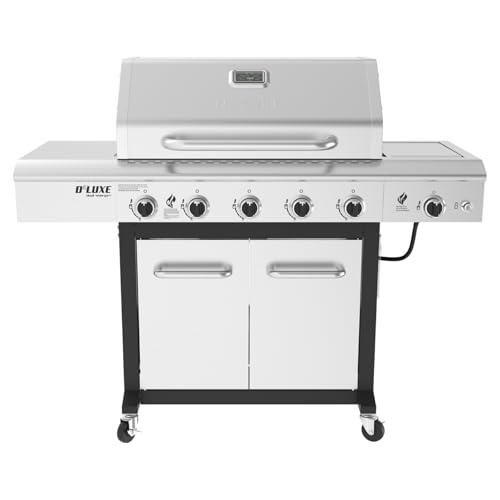
Nexgrill Deluxe 5-Burner Gas Grill with Ceramic Side Burner — Best Ceramic Sear Value
The Nexgrill Deluxe 5-burner is how value buyers get into this category. Its ceramic side burner delivers the same class of radiant searing heat as infrared stations on premium carts, and the main box offers five burners and a listed 65,000 BTU with a side table and built-in thermometer. It suits growing families, first-time five-burner owners, and anyone who wants the sear-station layout without a premium-tier commitment.
Strengths
- Ceramic side burner provides genuine high-heat searing at a value tier
- 65,000 BTU total output (per listing) across five main burners
- Side table and built-in thermometer included
Trade-offs
- Materials and finish are a clear step below the Napoleon and Broil King
- Ceramic burner tiles are fragile if knocked during cleaning
- Value-brand support network is thinner for long-term parts
Key specs (from the verified listing):
- Burners: 5 main burners
- Sear burner: Ceramic side burner
- Total output: 65,000 BTU (per listing)
- Extras: Side table, built-in thermometer
Ceramic burners and ‘infrared’ burners are close cousins: gas heats a ceramic tile until it glows, and the tile radiates intense, even heat onto the food. Nexgrill putting one on a five-burner at this tier is the story of this grill — the sear you get is not a diluted version of the premium experience, it is the same physics, mounted on a lighter cart.
Grade the rest accordingly. The main box is spacious and willing, preheating fast and cooking family loads without complaint, but the steel is thinner, the grates lighter, and windy-day heat retention weaker than the premium picks. Covered, cleaned and treated as a three-to-five-season appliance, it is arguably the smartest buy in this guide. Treated as a buy-it-for-life grill, it will disappoint — that is the tier talking, not a defect.
The Nexgrill’s ownership contract is written in its tier: the ceramic side burner is a genuinely premium component riding on a value cart, so protect the star and accept the frame. Keep the ceramic tile clean with heat alone, never knock it with tools, and keep the whole grill covered so the lighter steel underneath is not asked to fight the weather unarmed. Owners who do this report the delightful outcome this grill promises — years of steakhouse searing from a value purchase. Owners who treat it like a premium cart in every respect will find the frame’s limits first.
Best for: value buyers who want a real ceramic sear station / Not suited for: buyers expecting premium longevity from a value cart

Kenmore 5-Burner Propane Gas Grill with Searing Zone — Best Searing Zone
The Kenmore 5-burner suits the cook who wants searing heat inside the main grate rather than at a side station: its dedicated searing zone lets you crust steaks and then slide them across the same grate to finish, with no moving food between stations. With a listed 644 sq. in. of cooking area and a side burner for pans, it fits families who cook mixed loads and like one continuous workspace.
Strengths
- Dedicated searing zone inside the main box for a sear-and-slide workflow
- 644 sq. in. cooking area and 66,000 BTU (per listing)
- Side burner included for sauces and sides
Trade-offs
- A searing zone is high-output conventional heat, not a true infrared emitter — crust is excellent, physics differ
- Zone layout means one section of grate always runs hotter; learn the map
- Kenmore grill support runs through retail channels rather than a grill-specialist network
Key specs (from the verified listing):
- Burners: 5, plus side burner
- Total output: 66,000 BTU (per listing)
- Cooking area: 644 sq. in. (per listing)
- Sear feature: Dedicated searing zone
We include the Kenmore with its terminology stated plainly: the listing promises a searing zone, and that is what you get — a concentrated, high-output section of the main box. For most cooks the practical result is what matters: a hard, fast crust with the convenience of sliding food sideways to finish. Side-station infrared runs hotter still, but it also forces you to ferry steaks across the grill; the Kenmore’s workflow is arguably smoother for a full tray of chops.
Around that zone sits a well-proportioned family grill: real area, a side burner, stainless presentation. It is the middle path of this guide — more searing intent than a plain five-burner, less hardware theatre than the twin-specialist Broil King, and a tier that undercuts both premium carts. If your searing is frequent but your rotisserie ambitions are nil, start here.
Kenmore ownership runs through big-retail channels, which cuts both ways: documentation, covers and common spares are easy to find, while specialist advice lives in owner communities rather than a dealer network. The grill itself asks for standard care with one emphasis — the searing zone’s section of grate works hardest and should be brushed hot after every session to stop carbon building into a permanent crust map. Keep the model number photographed and the manual saved; with retail brands, your own records are the fastest route to the right part in year four.
Best for: sear-and-slide cooks who want the hot zone in the main box / Not suited for: purists who want a true infrared emitter specifically
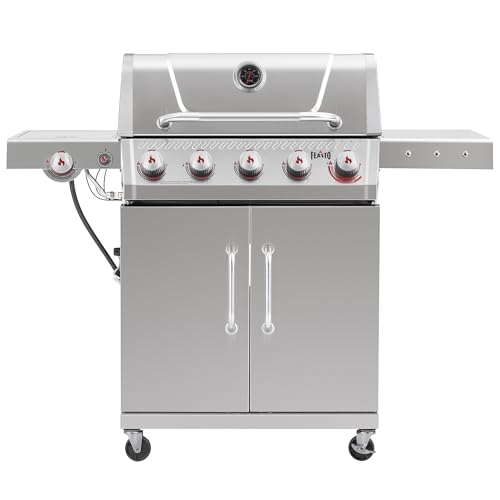
Feasto 5-Burner Propane Gas Grill with Side Burner — Best Built-In Sear Burner
The Feasto 5-burner is the quiet overachiever of this list: a built-in sear burner inside the main box, a listed 686 sq. in. of cooking space, a storage cabinet and a side prep table, at a tier below the big-name carts. It suits practical families who want the sear function without side-station choreography and who value prep and storage space as much as raw heat.
Strengths
- Built-in sear burner inside the main cooking area
- 686 sq. in. cooking space (per listing) with storage cabinet
- Side prep table and side burner round out a complete station
Trade-offs
- Newer value brand — long-term parts availability is less proven
- 58,000 BTU total is the lowest headline figure in this guide
- Cabinet and table add width; measure the patio before ordering
Key specs (from the verified listing):
- Burners: 5 main burners + side burner
- Total output: 58,000 BTU (per listing)
- Cooking area: 686 sq. in. (per listing)
- Sear feature: Built-in sear burner
- Storage: Storage cabinet, side prep table
Feasto’s layout recognises how people actually cook a weeknight mixed grill: the sear burner handles the steaks in the middle of the action while the surrounding burners run vegetables and chicken at their own pace, and the prep table keeps raw and cooked trays separated — a small food-safety luxury that side-shelf grills rarely offer. The cabinet swallows the tank and tools, keeping the station tidy.
The compromises are brand-deep rather than grill-deep. Feasto does not yet have the decades-long parts trail of the legacy names, so a burner needed in year six is a research project rather than a phone call. Buyers comfortable with that — and many value buyers are, at this tier — get a genuinely well-thought-out infrared-adjacent grill for family-scale cooking.
Feasto ownership is the newer-brand routine done properly: buy the fitted cover at purchase, record the grate and burner dimensions in your phone, and keep the purchase documentation somewhere findable. The grill rewards it with the guide’s most practical daily layout — prep table, cabinet, in-box sear — and family cooking that feels a tier above its position. The sear burner’s grate section wants the same hot-brush discipline as any hard-working zone. Treat the brand’s youth as a documentation task rather than a risk, and the value maths of this pick keeps working for seasons.
Best for: practical families wanting an in-box sear burner plus prep space / Not suited for: buyers who prioritise a long-established parts network

Blaze LTE PRO 40-Inch 5-Burner Built-In Natural Gas Grill — Best Built-In Infrared
The Blaze LTE PRO is not a cart and does not pretend to be: it is a 40-inch built-in head for an outdoor kitchen island, fuelled by natural gas, with a rear infrared burner and rotisserie kit for slow roasting. It suits homeowners building a permanent outdoor kitchen who want five-burner capacity and infrared where it does the most good on a built-in — at the rear, bathing a spit in even radiant heat.
Strengths
- Rear infrared burner with rotisserie kit included
- 304 stainless steel construction — the outdoor-kitchen standard
- Natural gas fuel: no tanks, no mid-cook runouts, internal lights for evening cooking
Trade-offs
- Requires a built island and a professional gas connection — a project, not a purchase
- Premium built-in tier, and the island build adds its own cost
- Natural gas fixes the grill’s position permanently
Key specs (from the verified listing):
- Burners: 5 main burners
- Sear burner: Rear infrared burner
- Fuel: Natural gas
- Body: 304 stainless steel, built-in 40-inch
- Extras: Rotisserie kit, internal lights
In built-in grills, rear infrared is the configuration that makes sense: island grills are entertaining machines, and a rotisserie over a rear infrared burner produces the most reliable roast chicken and prime rib in outdoor cooking, with drippings falling to a pan instead of the burners. Blaze builds the LTE PRO from 304 stainless — the grade that resists coastal and poolside corrosion — and adds internal lighting because island cooking happens at dusk.
Judge it as infrastructure, not appliance. The right buyer is mid-way through an outdoor kitchen design, comparing built-in heads on steel grade, burner warranty and service access. For that buyer this is a legitimate premium answer with infrared exactly where it earns its keep. For everyone else, the carts above deliver the same dinner with a cover and a propane tank.
A built-in Blaze is maintained like infrastructure, because it is: the island’s access panels exist so burners and the rear infrared unit can be serviced without surgery, and the owner’s job is the seasonal deep clean plus keeping ventilation paths clear. The rotisserie kit should live clean and dry, ready for the cooks that justify the whole installation. Blaze’s built-in support culture assumes exactly this owner — one building for the long term — and 304 stainless rewards the arrangement by shrugging off weather that would retire a cart. This is the lowest-drama ownership in the guide, purchased with the highest upfront commitment.
Best for: outdoor kitchen builders wanting rear infrared rotisserie power / Not suited for: anyone without an island build planned
Comparison Table
Note the ‘Key spec’ column carefully in this category: it records where each grill’s infrared or sear element lives, because that placement — side, rear or in-box — changes how you cook more than any BTU figure does.
| Pick | Badge | Key spec | Best for |
|---|---|---|---|
| Napoleon Rogue PRO 625 5-Burner Propane Grill with Infrared Side Burner | Best Overall Infrared | 74,000 BTU (per listing) | large households wanting a separate infrared sear station |
| Broil King Baron S 590 Pro IR 5-Burner Propane Gas Grill | Best Infrared Side Burner | Infrared side burner | ambitious cooks running sear, rotisserie and grill at once |
| Nexgrill Deluxe 5-Burner Gas Grill with Ceramic Side Burner | Best Ceramic Sear Value | Ceramic side burner | value buyers who want a real ceramic sear station |
| Kenmore 5-Burner Propane Gas Grill with Searing Zone | Best Searing Zone | 66,000 BTU (per listing) | sear-and-slide cooks who want the hot zone in the main box |
| Feasto 5-Burner Propane Gas Grill with Side Burner | Best Built-In Sear Burner | 58,000 BTU (per listing) | practical families wanting an in-box sear burner plus prep space |
| Blaze LTE PRO 40-Inch 5-Burner Built-In Natural Gas Grill | Best Built-In Infrared | Rear infrared burner | outdoor kitchen builders wanting rear infrared rotisserie power |
How to Choose a 5 Burner Infrared Gas Grill
Infrared, ceramic and ‘sear zone’ are not synonyms
A true infrared burner heats a ceramic plate, mesh or glass surface until it glows, then cooks by radiation. The surface runs far hotter than a conventional tube burner, sears in one to two minutes per side, and produces fewer flare-ups because drippings vaporise on the hot element instead of pooling and igniting. Ceramic side burners, like the Nexgrill’s in this guide, work on exactly this principle.
A ‘searing zone’, like the Kenmore’s, is different engineering: a conventional burner — or a cluster of them — with concentrated output in one area of the grate. It sears very well and costs less, but it heats by flame and hot air, tops out lower, and behaves like the rest of your grill, only hotter. Neither is a scam; they are different tools. What matters is that the listing names what you are getting, which is why every pick here was verified on that point.
Where should the infrared burner live?
Side station (Napoleon Rogue PRO, Broil King S 590, Nexgrill Deluxe): a small, separate searing deck. Best workflow for steaks — the main box stays free and the station reaches full fury fast. Capacity is one or two cuts at a time, so it suits quality-over-quantity searing. Rear burner (Blaze LTE PRO, and the Broil King’s rotisserie burner): radiant heat from behind a rotisserie spit. This is roasting infrared, not searing infrared — it exists for whole birds and roasts.
In-box sear (Kenmore’s zone, Feasto’s built-in sear burner): the hot patch is part of the main grate, so food slides from sear to finish without moving stations. It is the smoothest workflow for a tray of chops or a mixed grill, at the cost of some grate flexibility. Choose by menu: steaks for two, side station; roasts on a spit, rear; family mixed loads, in-box.
Five burners change the ownership maths
A five-burner grill is a wide appliance: check patio depth, door and gate widths, and cover size before falling in love. Fuel use scales too — five burners at full tilt empty a propane tank noticeably faster than a three-burner, which is one reason the natural-gas built-in exists. In practice you will run two or three burners for most meals and light the full line only for parties, so judge a five-burner by its zone flexibility at partial load, not only its maximum area.
Also price the ecosystem honestly: bigger covers, bigger grate replacements, more burners to service. None of it is prohibitive, but the step from four burners to five is a step in commitment as much as capacity. If your typical cook is six burgers, the four-burner guide linked at the end will serve you better and cheaper.
Infrared Ownership: Heat, Care and Honest Limits
What infrared does to your cooking repertoire
Adding a true infrared station changes more than steak night. The same ferocious, even radiation that crusts a ribeye will char corn in its husk beautifully, blister peppers in moments, sear scallops without the pan, and put a proper finish on skin-on chicken thighs started gently on the main burners. Cooks who learn the station tend to reorganise their menus around it: the main box becomes the gentle engine, the infrared deck the finishing school, and dishes that needed a cast-iron pan indoors migrate outside for good.
It also changes timing discipline across the whole cook. Because the sear now takes two minutes instead of ten, it moves to the end of the sequence: everything else cooks first and rests, and the steaks sear last, arriving at the table at their peak instead of declining under foil. That single reordering — sear last, serve immediately — is the quiet professional habit infrared makes possible, and for many owners it justifies the station on its own.
Ceramic care: the three rules that keep infrared alive
Rule one: heat cleans it. After cooking, run the infrared burner on high for several minutes; residue burns to ash on the glowing surface, which is the only cleaning the element wants while hot. Rule two: never add water. Spraying or wiping a hot ceramic element with anything wet risks thermal-shock cracks that no warranty conversation will enjoy. Let it cool completely — fully, not mostly — before touching it at all.
Rule three: touch it gently, cold, and rarely. A soft brush lifts ash from a cooled element; a wire brush, a scraper or a vacuum nozzle can crumble edges and clog the fine ports the gas depends on. Owners who follow the three rules measure ceramic life in many seasons. Owners who treat the element like a steel grate measure it in replacements. The physics is not negotiable, but it is entirely manageable.
When infrared is the wrong tool
Candour completes the picture: infrared is a specialist, and specialists have enemies. Sugar-heavy marinades and glazes carbonise almost instantly at infrared temperatures — apply them after the sear, on the main burners, or not at all. Delicate fish, thin asparagus and anything under a centimetre thick can pass from perfect to ruined inside a distracted minute; the main box at medium-high is their correct home. Fatty cuts render violently on some stations, so know your unit’s drip path before the first ribeye.
None of this diminishes the technology; it defines its lane. The five-burner format is the ideal chassis for infrared precisely because the main box remains a complete, gentle, conventional grill beside the specialist. Use each for what it is, and the combination covers a wider range of cooking than any single-burner philosophy can. Use the infrared for everything, and you will learn its limits at the table, in front of guests.
How to Sear a Steak on an Infrared Burner
Infrared searing rewards preparation and punishes hesitation: the burner is two to three times hotter than a normal grate zone, so everything must be ready before the steak lands. This routine works on a side infrared station, a ceramic burner or an in-box sear zone — just scale the timing down for thinner cuts.
- Dry the steak properly: pat it completely dry with paper towels and season with salt 40 minutes ahead, or immediately before cooking. Surface moisture is the enemy — on infrared it steams violently and delays the crust.
- Preheat the infrared burner on high for a full 5 to 10 minutes with the lid open or the station uncovered, until the ceramic or element glows evenly. Do not rush this; a half-lit element sears unevenly.
- Oil the steak, not the grate: a thin film of high-smoke-point oil on the meat prevents sticking on the intensely hot surface and seasons evenly.
- Lay the steak down once, at an angle, and do not touch it for 60 to 90 seconds. Infrared crust forms fast; moving the meat early tears it.
- Turn once, cook the second side 60 to 90 seconds, and check temperature with an instant-read thermometer — pull the steak 5 degrees below target, because carryover on a thick cut is real.
- Rest the steak on a warm rack over the main burners (turned off or lowest) for 5 to 10 minutes while you finish sides. Resting is not optional after heat this intense.
- Let the burner run two extra minutes to burn off residue, then shut down. Never spray water on a hot ceramic element to clean it — thermal shock can crack it.
Once you trust the timing, the same routine handles tuna steaks (30 to 45 seconds a side), lamb chops and thick pork chops. The universal rule of infrared is that your eyes are too slow — cook by the clock and the thermometer, not by colour, because by the time a crust looks dark on infrared it is often already too far.
Common Buying Mistakes
Buying ‘infrared’ that is not in the listing. If the product listing does not name an infrared, ceramic or sear burner, you are buying marketing. Verify the words on the listing itself before paying a premium for the badge — every pick in this guide passed that test.
Expecting the whole grate to be infrared. On five-burner grills the infrared element is one station. Buyers who imagine five infrared burners are disappointed; buyers who plan around one sear station are delighted.
Walking away during a sear. Infrared cooks in seconds, not minutes. The distance between perfect crust and charcoal is under a minute — stay at the grill, tongs in hand, for the entire sear.
Cleaning ceramic with water or a hard brush. Ceramic tiles crack under thermal shock and crumble under aggressive brushing. Burn off residue with heat, let everything cool fully, and use a soft brush only.
Oversizing the grill for the patio. Five-burner carts are wide and heavy. Measure the space, the storage spot and the route from the delivery point before ordering, not after.
Preheating the whole grill for a two-minute sear. When only the infrared station is needed, light only the station. Heat-soaking five main burners to sear two steaks wastes fuel, time and the station’s speed advantage — the entire point of a separate sear deck is that it works alone.
Final Recommendation
For most buyers, the Napoleon Rogue PRO 625 is the answer: five honest burners, a true infrared side station, stainless grates and the largest cooking area among the carts. It is the grill this category promises, executed without shortcuts.
If your cooking adds rotisserie to the sear, the Broil King Baron S 590 Pro IR is the twin-specialist choice; if your budget says otherwise, the Nexgrill Deluxe delivers the same ceramic sear physics at a value tier, and the Kenmore and Feasto keep the sear inside the box for mixed family loads. Building an outdoor kitchen instead? The Blaze LTE PRO is the infrared pick, in 304 stainless with the rotisserie kit included.
Whichever layout you choose, learn the infrared routine in the how-to section before the first steak. The burner will not forgive guesswork — but it will reward a prepared cook with the best crust a gas grill can make.
Ready to move on best gas grills 5 burner infrared? Start with the three most-chosen picks in this guide: Napoleon Rogue PRO 625 5-Burner Propane Grill with Infrared Side Burner (Best Overall Infrared); Broil King Baron S 590 Pro IR 5-Burner Propane Gas Grill (Best Infrared Side Burner); Nexgrill Deluxe 5-Burner Gas Grill with Ceramic Side Burner (Best Ceramic Sear Value) — check price on Amazon for each and compare the exact configuration before you decide.
Keep researching around best gas grills 5 burner infrared with the sibling guides in this cluster: Best Gas Grills 4 Burner Best Gas Grills Affordable Best Gas Grills Aside From A Weber Best Gas Grills Between 1000 And 2000 Best Gas Grills Between 500 And 1000 Best Gas Grills For High Searing Heat
Frequently Asked Questions
What does an infrared burner do that a normal burner cannot?
It cooks by intense radiant heat from a glowing ceramic or mesh surface rather than by flame and hot air. The surface temperature is far higher, so steaks crust in one to two minutes per side, and drippings vaporise on contact instead of pooling and flaring. The trade-off is delicacy: thin or sugary foods scorch quickly.
Is a ceramic side burner the same as infrared?
Functionally, yes for searing purposes. Gas heats the ceramic tile until it glows, and the tile radiates the heat — the same mechanism most ‘infrared’ side burners use. Listings may use either word; what matters is that a ceramic or infrared burner is explicitly named, as on the Nexgrill Deluxe in this guide.
Can I rotisserie over a rear infrared burner?
That is exactly what rear infrared burners are for. The radiant heat bathes the turning spit evenly, crisping skin without flare-ups from drippings. The Blaze LTE PRO includes a rotisserie kit; the Broil King S 590 pairs its infrared side burner with a separate rear rotisserie burner.
Are 5 burner grills expensive to run?
Only when you run all five. Most meals use two or three burners, at which point fuel use resembles a smaller grill. Full-line party cooking and long infrared preheats are where consumption climbs — a reason some buyers in this class choose natural gas and never think about tanks again.
How do I clean an infrared burner?
Heat is the cleaner: run the burner on high for several minutes after cooking to burn residue to ash, let it cool completely, then brush gently with a soft brush. Never quench a hot ceramic element with water, and never scrub it hard — cracked tiles mean a replacement burner.
Who should not buy a 5 burner infrared grill?
Small households that grill a few burgers a week, and anyone with a tight patio. You would be paying — in money, space and fuel — for capacity and sear power you rarely use. A four-burner with a sear zone, covered in the sibling guide linked above, fits that life better.
Can an infrared side burner replace a main grill for small meals?
For a steak or two, yes — many owners fire only the side station for a solo sear, which is fast and fuel-efficient. But the station is small by design and cannot zone-cook, roast or hold a family load. Think of it as a specialist burner that occasionally works alone, not as a second grill hiding on the side of the first one.
Does infrared cooking use more propane?
Per minute, an infrared burner at full output uses fuel briskly — but it cooks for far fewer minutes. A steak that needs ten minutes over conventional burners may need three over infrared, including in the total a preheat that is shorter than a cart grill’s full heat-soak. In practice, households find the station roughly fuel-neutral for searing duty, and noticeably thirsty only when it is left running as a general cooking burner, which is not its job.


