Disclosure: airfryerkitchensupply.com is reader-supported. When you buy through links on our site, we may earn an affiliate commission at no extra cost to you.
Where to buy
If you are shopping for the best gas barbecue grills — the propane cart grills that anchor most backyards — start with the verified shortlist below. Every grill on it was confirmed against a live Amazon listing before it earned a place here, and every link points at that exact listing.
This is the generalist guide in the programme’s grill family: three to five burners, open carts and cabinets, value through premium-leaning tiers, all propane, all freestanding. The specialist questions — two-person grills, dual-fuel combos, built-ins — have their own guides, and this one links to them where they belong. Here, the job is the mainstream decision most households actually face. Confirm the exact configuration on the listing before ordering, and check the current price on Amazon.
- Weber Spirit E-435 Gas Grill (LP) (Best Overall) — Check the current price on Amazon
- Charbroil Pro Series Amplifire Infrared 4-Burner Propane Gas Grill Cabinet (Best for Searing and Juicy Results) — Check the current price on Amazon
- Nexgrill Deluxe 5-Burner Gas Grill with Ceramic Side Burner (Best Value for Crowds) — Check the current price on Amazon
- Royal Gourmet 4-Burner BBQ Cabinet Style Gas Grill with Side Burner (Best Value Cabinet) — Check the current price on Amazon
- Kenmore 3-Burner Propane BBQ Grill, Azure Blue (Best Compact 3-Burner with Character) — Check the current price on Amazon
- Charbroil Classic 3-Burner Propane Gas Grill (Best Budget 3-Burner) — Check the current price on Amazon
The gas barbecue grill won the backyard by being the least demanding way to cook outside: turn a knob, wait ten minutes, cook dinner, turn it off, eat. No coals to light or ash to bury, no pellets to store, no cord to run. That convenience is real and it is why gas outsells every other fuel — but it has also made the category lazy, full of lookalike carts whose differences live in the details that decide whether a grill is a pleasure in year five or a rusting regret in year three.
Those details are knowable before you buy. Burner count decides your zones; grate material decides your sear and your cleaning; the firebox and lid construction decide your heat retention and your grill’s lifespan; the brand’s parts shelf decides whether a worn igniter in year six is a small order or a new grill. Price tier correlates with all of it, but loosely — the value end of this roundup contains genuinely sensible grills, and the premium end contains at least one feature you may not need.
The six picks below run from a benchmark four-burner with a sear zone, through the mid-tier’s cabinet and infrared variants, to the value models that feed families for sensible money. Each review names its tier honestly and says who should skip it — because with gas grills, the most expensive mistake is buying the wrong size or tier for your actual cooking, not buying a bad grill. Read the badges as a map of your own household and the right pick usually identifies itself before the detailed reviews even begin, which is exactly how good, well-matched buying should always feel in daily practice.
In this guide
Quick Picks
Weber Spirit E-435 Gas Grill (LP) — Best Overall. The complete mainstream package: four burners, a Sear Zone with Boost burners for steak work, a side burner for the rest of the meal, porcelain-enameled cast-iron grates, and the Weber Works rail system — all per its listing. If one grill in this guide answers the most households’ full list of requirements, it is this one. Check the current price on Amazon
Charbroil Pro Series Amplifire Infrared 4-Burner Propane Gas Grill Cabinet — Best for Searing and Juicy Results. The infrared answer: Char-Broil’s Pro Series puts its Amplifire infrared emitter system under four burners in a cabinet body with a side burner. Infrared grates cook with intense, even radiant heat and a physical barrier between food and flame — which means harder sears and dramatically fewer flare-ups, the two things its buyers are actually shopping for. Check the current price on Amazon
Nexgrill Deluxe 5-Burner Gas Grill with Ceramic Side Burner — Best Value for Crowds. The crowd feeder: five burners, a listed 65,000 BTU total, a ceramic side burner with its own side table, and a built-in thermometer. Nexgrill’s value formula at full stretch — the most burners and the most side-burner ambition in this guide’s value tier, aimed at households whose grill days involve a dozen people. Check the current price on Amazon
Royal Gourmet 4-Burner BBQ Cabinet Style Gas Grill with Side Burner — Best Value Cabinet. The value cabinet: four burners with a listed 54,000 BTUs, a side burner, a storage cabinet, and a warming rack, in silver. It packages the features families ask for — zones, a side burner, hidden tank, a rack for buns and finished food — at the tier where every one of them usually costs an upgrade. Check the current price on Amazon
Kenmore 3-Burner Propane BBQ Grill, Azure Blue — Best Compact 3-Burner with Character. The personality pick: a 3-burner in azure blue with cast iron cooking grates, folding side tables, wheels, and tool hooks — 30,000 BTUs per the listing. It is sized for smaller households and patios without surrendering the two things that matter: three-burner zoning and proper cast iron under the food. Check the current price on Amazon
Charbroil Classic 3-Burner Propane Gas Grill — Best Budget 3-Burner. The honest starter: three burners, a listed 30,000 BTU and 360 square inches, porcelain-coated grates, and side shelves, in Char-Broil’s long-running Classic line. It covers the fundamentals — zoning, family capacity, shelves to work on — at the budget tier, and it is the grill this guide hands to first-time buyers without reservation about the cooking. Check the current price on Amazon
How These Picks Were Chosen
Every pick was verified the same way: searched by brand and model on this site, matched against the returned listing title, and only then given a link. Burner counts, output totals, areas, and grate materials in the spec boxes come from those returned titles. Where a figure is a cross-burner total (every BTU number in this category is), the review says so and treats it accordingly.
The shortlist spans the mainstream deliberately: one benchmark do-everything grill, one infrared specialist, two value models at different sizes, one compact with real grates, and one budget starter — all propane, all freestanding carts, all in the three-to-five-burner heartland. Built-ins, portables, two-burner specialists, and dual-fuel combos were excluded by scope, not by quality, and each has a dedicated guide in this programme.
Badges follow each pick from Quick Picks into its review, so the grill you shortlist at the top is the one you read about in detail below. This guide prints no prices and no fixed ratings: gas grill pricing is promotion-driven, and durability is a property of construction and care, not of a captured number.
The 6 Best Gas Barbecue Grills: The Picks in Detail

Weber Spirit E-435 Gas Grill (LP) — Best Overall
The E-435 is what happens when a benchmark line stops leaving boxes unticked. Four burners give you a sear zone, a cooking zone, and a holding zone simultaneously; the Sear Zone with Boost burners (per the listing) adds concentrated heat for the steaks and chops that ordinary burners merely brown; the side burner moves sauces, corn, and sautés outdoors; and the porcelain-enameled cast-iron grates deliver the sear marks and the manageable cleaning that make people keep a grill for a decade. The Weber Works rails accept the line’s prep accessories if your routine grows into them.
Strengths
- The most complete feature set in the roundup: 4 burners, boosted sear zone, side burner
- Porcelain-enameled cast-iron grates — the home grilling sweet spot for sear and care
- Weber’s parts and support ecosystem underwrites a long ownership horizon
Trade-offs
- Premium-leaning tier: value brands undercut it with similar burner counts
- A full-size footprint — small patios should measure with the lid open and shelves up
- Accessory rails are an ecosystem invitation; the grill is complete without buying into it
| Specification | Detail (from the verified listing) |
|---|---|
| Burners | 4, plus side burner (per listing) |
| Sear | Sear Zone with Boost Burners (per listing) |
| Grates | Porcelain-enameled cast-iron (per listing) |
| Fuel | Liquid propane (per listing) |
Choose the E-435 when your grilling is whole meals, not just proteins: the side burner and the fourth burner stop being luxuries the first time burgers, onions, beans, and buns all need heat in the same ten minutes. Its real competition is not the value picks below but the question of tier — whether your household grills often enough, for long enough, to amortise the premium in years of supported service. Weekly grillers with a five-to-ten-year horizon: yes, comfortably. Seasonal grillers: the mid-tier picks will serve you honestly for less commitment.
As with all Weber picks in this programme, the unglamorous advantage is year-eight: grates, burners, igniters, and flavouriser bars remain orderable, which is what ‘buying a grill for a decade’ actually consists of.
Best for: Frequent family grillers wanting the complete mainstream feature set / Not suited for: Occasional grillers or tight patios — the mid and value tiers fit both better
Check the current price on Amazon

Charbroil Pro Series Amplifire Infrared 4-Burner Propane Gas Grill Cabinet — Best for Searing and Juicy Results
Conventional gas grills cook largely with hot air; infrared systems cook with radiant energy from a glowing emitter plate, and the difference is tangible: faster preheats, a more aggressive sear, and — because the emitter sits between burners and food — flare-ups that mostly never reach the food. Char-Broil has built its premium identity on this technology, and the Pro Series cabinet here is its mainstream flagship form: four burners, a side burner, and a closed cabinet body in black.
Strengths
- Infrared emitters deliver intense, even searing heat across the grate
- The emitter barrier all but eliminates the flare-ups that char food on open-flame grills
- Cabinet body and side burner complete a full-featured package
Trade-offs
- Emitter plates are a maintenance item: they need cleaning and eventual replacement to perform
- Infrared heat is intense — delicate foods need the cooler zones and a learning curve
- Premium-mid tier pricing for the technology
| Specification | Detail (from the verified listing) |
|---|---|
| Burners | 4, plus side burner (per listing) |
| System | Amplifire infrared technology (per listing) |
| Body | Cabinet (per listing) |
| Model | 463281024 (per listing) |
Buy infrared for the right reason: not as a novelty, but because your cooking is sear-led (steaks, chops, skin-on chicken) and your patience for flare-up management is thin. The emitter system genuinely changes both. Respect its one demand — keep the emitters clean, because a clogged emitter cooks unevenly and the technology’s whole point is evenness. Households whose grilling is mostly gentle (fish, vegetables, low-and-slow attempts) will use the infrared advantage least and might prefer the conventional benchmark above; steak households will wonder how they grilled without it.
The cabinet body suits finished patios, with the standard cabinet advice applying: cover it, keep the interior dry, and empty the grease management on schedule.
Best for: Sear-led cooks who want infrared heat and flare-up control in a cabinet grill / Not suited for: Gentle-heat cooks, or anyone unwilling to clean emitter plates
Check the current price on Amazon
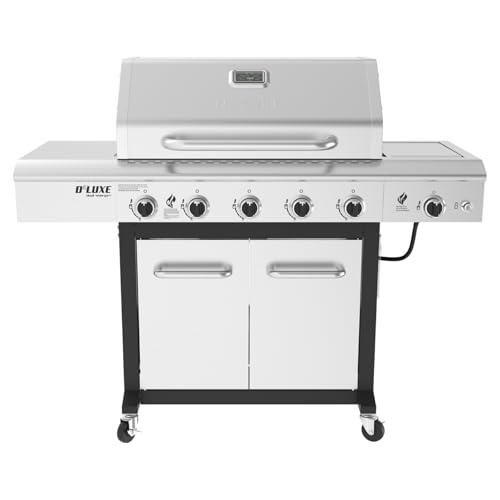
Nexgrill Deluxe 5-Burner Gas Grill with Ceramic Side Burner — Best Value for Crowds
Some households’ grilling is a spectator sport with a guest list, and this Nexgrill is built for them. Five main burners spread a wide grate into multiple zones — the only way to land burgers, dogs, chicken, and vegetables for a crowd in overlapping waves — and the ceramic side burner (a hotter, more wind-resistant style of side burner, and a genuinely premium touch at this tier) handles the big pot of corn or the wok. The listing’s 65,000 BTU total is the usual cross-burner sum; the practical meaning is headroom across a wide cooking surface.
Strengths
- Five burners: event capacity with real zoning, at a value tier
- Ceramic side burner — a premium feature, better in wind and for high-heat side dishes
- Built-in thermometer included per the listing
Trade-offs
- Wide and heavy: patio space and cover size need checking
- Value-tier materials ask for covering and grease discipline
- For households under six, most of this grill is unused most of the time
| Specification | Detail (from the verified listing) |
|---|---|
| Burners | 5, plus ceramic side burner (per listing) |
| Output | 65,000 BTU total (per listing) |
| Extras | Built-in thermometer, side table (per listing) |
The case for this grill is a calendar with recurring double-digit gatherings; the case against is every ordinary Tuesday, when a five-burner cart is a lot of metal to heat for four burgers. Both cases are honest, and the household’s real guest frequency should decide. Where it wins, it wins big: no batching, no apology waves of food, and a side burner that can actually boil a stockpot outdoors. Buy it with the cover in the same order and the grease tray on a schedule, and the value maths holds for years.
Against the Royal Gourmet below, the Nexgrill counters with the ceramic side burner and a fifth burner; the Royal Gourmet counters with its cabinet. Crowd size versus tidiness — pick your priority.
Best for: Hosts regularly cooking for ten or more who want value-tier capacity / Not suited for: Small households, who will heat empty grate all season
Check the current price on Amazon

Royal Gourmet 4-Burner BBQ Cabinet Style Gas Grill with Side Burner — Best Value Cabinet
Royal Gourmet’s cabinet grill is the value tier’s most complete checklist: the listing itself enumerates four burners, 54,000 BTUs of total output, a side burner, a storage cabinet, and a warming rack. In practice that means a family can run a two-zone cook, warm sauce on the side, hold finished burgers on the rack, and close the doors on the tank and tools afterwards — the full mainstream routine, without stepping into the premium tier that the benchmark pick occupies.
Strengths
- Complete mainstream package — cabinet, side burner, warming rack — at a value tier
- Four burners give genuine zoning for family meals
- Silver finish and closed body present tidily on a finished patio
Trade-offs
- Value-tier steel and components: cover and care decide its lifespan
- Cabinet assembly is a longer build than open carts
- Parts depth trails the heritage brands over a long horizon
| Specification | Detail (from the verified listing) |
|---|---|
| Burners | 4, plus side burner (per listing) |
| Output | 54,000 BTUs total (per listing) |
| Body | Cabinet style with storage cabinet (per listing) |
| Extras | Warming rack included (per listing) |
This is the pick for the household that wants the mainstream experience whole — not a stripped starter grill — while keeping the purchase in the value tier, accepting that care substitutes for some of the build depth money buys elsewhere. The maintenance bargain is explicit: cover on, tray emptied, cabinet dry, and a grill like this serves many seasons; skip those and any value grill ages fast. Judged on what it cooks, it will feed a family of six happily and hold its own at a gathering of ten with modest batching.
Silver finishes show heat tinting near the firebox over time on every brand at every tier — cosmetic, universal, and worth expecting rather than discovering.
Best for: Families wanting the full cabinet package at a value tier / Not suited for: Set-and-forget owners in harsh climates unwilling to cover and maintain
Check the current price on Amazon

Kenmore 3-Burner Propane BBQ Grill, Azure Blue — Best Compact 3-Burner with Character
Most compact grills apologise; this Kenmore decorates. The azure blue finish is the visible difference, but the substantive ones are the cast iron cooking grates — proper searing weight that compact grills usually skip — and folding side tables that let the grill shrink against a wall when the cook is done. Three burners at a listed 30,000 BTUs give the standard zone layout (hot, medium, hold) at a scale matched to households of two to five.
Strengths
- Cast iron grates at the compact tier — real sear marks, not coated-steel compromise
- Folding side tables: full working width while cooking, small footprint while stored
- Three-burner zoning in a household-scale grill, with tool hooks and wheels included
Trade-offs
- Cast iron grates need the oil-and-dry habit to stay rust-free
- Compact class: gatherings beyond six mean batching
- The colour is a commitment — azure blue is a patio statement, not a neutral
| Specification | Detail (from the verified listing) |
|---|---|
| Burners | 3 (per listing) |
| Output | 30,000 BTUs (per listing) |
| Grates | Cast iron (per listing) |
| Extras | Folding side tables, wheels, tool hooks (per listing) |
| Colour | Azure Blue (per listing) |
The Kenmore’s argument is that small households should not have to choose between a right-sized grill and a good one. The grate material is the tell: manufacturers cut compact grills at the grates first, and this one did not. Treat the cast iron properly — brush hot, oil lightly, keep dry under a cover — and it will out-sear grills costing more. The folding tables are the second tell, a feature that respects small patios as a design constraint rather than an afterthought. If the colour delights you, the decision is easy; if it does not, the same money buys plainer compact grills with lesser grates, which tells you where this one’s value sits.
Output-per-burner here is modest on paper; in a compact firebox, that translates to perfectly adequate searing heat with less propane drama. Judge it at the grate, not the spreadsheet.
Best for: Households of two to five wanting a compact grill with real grates and small-space manners / Not suited for: Crowd cooks, or anyone who wants their grill to disappear visually
Check the current price on Amazon

Charbroil Classic 3-Burner Propane Gas Grill — Best Budget 3-Burner
The Classic line is Char-Broil’s answer to the first-grill question, and its specification is correctly aimed: three burners (the zoning minimum that teaches real grilling), 360 square inches of cooking area per the listing (family dinner in one wave), porcelain-coated grates (easy cleaning while a new owner builds habits), and side shelves for plates and tools. Nothing here is exotic, and that is the point — a starter grill should disappear into the cooking while its owner learns.
Strengths
- Three burners at the budget tier — proper zoning from your first grill onward
- 360 sq in listed area covers a family dinner without batching
- Porcelain-coated grates clean easily while habits form
Trade-offs
- Budget-tier materials: this is a learn-and-enjoy grill, not a decade heirloom
- No side burner — sauces ride the kitchen stove
- Coated grates are a wear part; budget a replacement into long ownership
| Specification | Detail (from the verified listing) |
|---|---|
| Burners | 3 (per listing) |
| Output | 30,000 BTU (per listing) |
| Cooking area | 360 sq in (per listing) |
| Grates | Porcelain-coated (per listing) |
| Extras | Side shelves (per listing) |
The Classic’s role in a household’s life is usually one of two: the first grill that teaches grilling, after which its owner upgrades with knowledge; or the durable-enough family grill that simply keeps cooking while nobody thinks about grills. It serves both roles honestly at its tier. What it should not be asked to be is a premium object — keep it covered, keep the burners brushed, and judge it by dinners cooked rather than by comparison with grills at twice its tier. On that standard it is one of the soundest purchases in this guide.
New grillers: spend the savings versus the premium picks on a cover, a good spatula and tongs, and an instant-read thermometer. That kit improves your cooking more in year one than any grill upgrade would.
Best for: First-time buyers and budget-focused families wanting real 3-burner cooking / Not suited for: Decade-horizon buyers, who should start at the benchmark tier instead
Check the current price on Amazon
Comparison Table
| Pick | Badge | Key spec | Best for |
|---|---|---|---|
| Weber Spirit E-435 Gas Grill (LP) — Check price | Best Overall | 4 burners, Sear Zone with Boost, side burner, enameled cast-iron grates | Most families: full meals, guests, and a real sear |
| Charbroil Pro Series Amplifire Infrared 4-Burner Propane Gas Grill Cabinet — Check price | Best for Searing and Juicy Results | 4 burners, Amplifire infrared system, cabinet, side burner | Sear lovers and cooks tired of flare-ups |
| Nexgrill Deluxe 5-Burner Gas Grill with Ceramic Side Burner — Check price | Best Value for Crowds | 5 burners, 65,000 BTU per listing, ceramic side burner | Big gatherings at a value tier |
| Royal Gourmet 4-Burner BBQ Cabinet Style Gas Grill with Side Burner — Check price | Best Value Cabinet | 4 burners, 54,000 BTUs per listing, cabinet, warming rack | Tidy patios on a value budget |
| Kenmore 3-Burner Propane BBQ Grill, Azure Blue — Check price | Best Compact 3-Burner with Character | 3 burners, 30,000 BTUs per listing, cast iron grates, folding tables | Smaller households that still want three zones and real grates |
| Charbroil Classic 3-Burner Propane Gas Grill — Check price | Best Budget 3-Burner | 3 burners, 30,000 BTU, 360 sq in per listing, porcelain-coated grates | First-grill buyers and budget family cooking |
How to Choose a Gas Barbecue Grill
Strip the badges off and a gas grill is burners, grates, a firebox, and a cart. Choose those four well and the badge takes care of itself.
Burners and zones: the only size question that matters
Count zones, not burners, and meals, not marketing. Three burners is the flexible standard: sear, cook, hold. Four suits full-meal cooking and regular guests. Five is event equipment. Two burners serve couples well and have their own guide in this programme. Whatever the count, look for individual burner control with a usable low end — a grill that cannot hold a gentle heat cannot cook chicken through without burning its skin, whatever its headline output says. And treat total BTU as a weak signal: divide it by cooking area for a rough intensity sense, then forget it and think about zones.
Grates, ranked by what they ask of you
Porcelain-enameled cast iron (the benchmark pick) balances sear, heat retention, and forgiving care — the default recommendation for most households. Bare cast iron (the Kenmore) sears as well or better and asks for oiling discipline. Stainless rod is durable and easy to clean, with slightly softer sear marks. Porcelain-coated steel (the budget pick) cooks fine and is honestly a wear part. None of these is a wrong answer; they are different maintenance contracts. Sign the one you will actually honour, because a neglected premium grate rusts exactly like a neglected budget one.
Firebox, lid, and the build that decides lifespan
Press on the lid of any grill you can touch in a store; read the descriptions carefully for those you cannot. Heavier, better-sealed lids hold heat and weather better. Inside, look for burners in stainless or cast materials rather than thin aluminised steel, and for grease management that channels drippings to a removable tray rather than pooling them under the firebox — pooled grease is both a flare-up source and a corrosion engine. These unglamorous internals, more than any feature, separate the five-year grill from the ten-year one at every tier in this guide.
Side burners, sear zones, and warming racks: the extras audit
A side burner is worth it if your grill meals include sauces, boiled sides, or sautéed toppings — many do, weekly. A sear zone or infrared system is worth it if steak and chops are a ritual rather than an occasion. A warming rack quietly earns its keep at every single cook, holding buns and finished food. Rotisserie kits, lights, and smart features should each have to name the dish that justifies them. Run your real menu past the feature list before paying for any of it — the pattern of this entire guide, because it is the pattern of every satisfied grill owner.
Propane or natural gas, and the tank system
Every pick here is propane, the flexible default: no installation, the grill moves when you do. Natural gas versions exist for some lines and suit permanent patios with a stub-out — never convert a grill except with the manufacturer’s own kit. For propane households, the two-tank system (one on the grill, one full spare, stored upright outdoors) ends the mid-cook empty-tank disaster permanently, and a soap-bubble leak check at every tank change keeps the system honest. Fuel logistics sound dull until the first time they save a dinner party.
Gas versus charcoal versus pellet, in one honest pass
Gas: fastest to cook, easiest to control, cleanest to own, flavour from the food itself. Charcoal: slowest to start, a fire to manage, smoke flavour and searing theatre gas cannot match, ash as the price. Pellet: set-and-forget low-and-slow with real smoke, electricity required, weakest at high-heat searing in most designs. Households usually end up gas-first for the week and add a second fire for the weekend when the habit proves out — the programme’s gas-and-charcoal guides exist for exactly that second step. A gas grill chosen well, like the picks here, is not a compromise awaiting replacement; it is the backbone the other fires decorate.
How long will it last? A tier-by-tier reality check
With covering and basic care: budget grills serve a few seasons of regular use before grates and burners want replacing; mid-tier grills run longer with those parts replaced once; premium grills are built to have their wear parts replaced repeatedly across a decade or more, and their brands stock the parts to prove it. Without covering and care, subtract aggressively from every tier — weather is the great equaliser. The economic question is therefore not ‘which tier is cheapest’ but ‘which tier matches the years I will actually keep and maintain a grill’, and it has a different correct answer for a renter, a first-home buyer, and a settled household.
What a season of gas grilling actually costs to run
Ownership costs beyond the purchase are modest but real, and planning for them prevents the surprises that sour people on good grills. Propane is the main consumable: a standard tank exchange or refill cycle serves a weekly grilling household for a good stretch of the season, and the two-tank system smooths the cost into routine errands. Wear parts form the second line — grates, igniters, burner tubes, and (on infrared models) emitter plates — each a small order when the time comes, provided the brand stocks them, which is another reason this guide weights parts support so heavily. Covers, brushes, and a thermometer are one-time small purchases. Totalled honestly, a season of gas grilling costs a fraction of the grill itself; the expensive outcome is not running costs but premature replacement, which is why care outranks tier in every verdict in this guide.
Assembly and first-fire checklist
Most cart grills assemble in one to three hours; cabinets take the longer end. Work on flat ground, snug bolts before final tightening in sequence, and photograph the model plate when you finish — that photo is your key to every future part. Before the first food: connect the tank and soap-test the connections for leaks, then run the empty grill hot for fifteen to twenty minutes to burn off factory residues, cool, and oil the grates. First cooks should be forgiving ones — sausages, thighs, vegetables — while you map your grill’s hot spots with inexpensive food.
How to Grill on Gas: The Two-Zone Method and a Good Shutdown
Hardware varies; method compounds. These are the habits that make any pick in this guide cook above its tier.
- Preheat with the lid down, grates hot. Ten to fifteen minutes on high with the lid closed brings grates to searing temperature and burns off the last cook’s residue. Brush the hot grates clean with a suitable brush, then set your zones. Food on a cold grate sticks; food on a properly hot, clean grate releases.
- Build two zones every single cook. One side high, one side low or off. Sear where it is hot, finish where it is gentle, hold where it is warmest-safe. Two zones turn flare-ups from emergencies into relocations and let thick and thin foods share a grate and a finishing time.
- Oil the food, not the grate. A light coat of oil on the food itself smokes less, sticks less, and seasons better than oil burned onto hot metal. Pat proteins dry first — surface moisture is the enemy of the sear you preheated for.
- Use the lid as an oven, with intention. Lid down for thick cuts and even cooking; lid up for thin items you are watching closely. Every peek costs heat, so look with purpose. A reliable instant-read thermometer, used at the thickest point, replaces guesswork for anything thicker than a burger.
- Rest on the warm zone or a warm plate. Five to ten minutes of rest is part of the cook, not a delay. The holding zone you built in step two is the perfect rest station — warm, gentle, and out of the way of the next wave.
- Shut down like an owner, not a renter. Five minutes on high to burn off residue, brush the grates, burners off, tank valve closed. Empty the grease tray on a schedule, not when it overflows. Cover the grill when it is cool and dry. This ten-minute ritual, repeated, is the entire difference between the tiers’ lifespans in practice.
Wind deserves a mention in any gas method: a strong crosswind steals heat from one side of the firebox and makes liars of your zone settings. Angle the grill so the wind hits its back where the patio allows, keep the lid down more on gusty days, and give preheats an extra five minutes. Cooks who blame their grill for a windy evening’s unevenness are usually one repositioning away from the grill they thought they bought.
Keep a small log for the first season — what you cooked, which zones, what surprised you. Every grill has a personality map of hot and cool spots, and the cooks who learn theirs in month one grill better on a budget cart than strangers do on premium metal.
Common Buying Mistakes
Buying by total BTU. The headline number sums every burner and says little about searing. Zones, grate material, and heat evenness decide your food; a modest-output grill with three good zones out-cooks a hot, uneven one every week of the season.
Skipping the sear question. If steak matters to you, grate material and a sear option matter more than a fifth burner. Decide your protein priorities first and let them rank the feature list, instead of discovering the mismatch at the first ribeye.
Forgetting the cover and the second tank. The two cheapest ownership upgrades in grilling are a fitted cover bought with the grill and a spare propane tank bought before the first party. Both are routinely skipped, and both omissions are routinely regretted in public.
Cooking everything on high. Maximum heat is for preheating and searing, not for cooking chicken through or vegetables to tenderness. The low end of your burners is a feature; learn it early and your flare-ups and burnt skins largely disappear.
Letting the grease tray become a grease reservoir. A full tray is a fire risk and a corrosion source. Empty it on a rhythm — monthly in season, more for fatty menus — and check it before any big cook, when a flare-up would be most embarrassing.
Storing the grill with the tank valve open all winter. Close the tank valve at the end of every cook and disconnect the tank for long storage, keeping the tank itself upright and outdoors. An open valve across a season of temperature swings is how small leaks become empty tanks and stale surprises.
Judging a grill in its first month. New grills cook hot and unfamiliar; owners cook timidly. Give any pick here a season of the two-zone method before verdicts — most ‘bad grills’ are unmapped grills, and most mappings take five cooks, not fifty.
Final Recommendation
For most households, the Weber Spirit E-435 is the best gas barbecue grill: four zones, a boosted sear, a side burner, and the support to last. Sear-led cooks should take the Charbroil Amplifire infrared; crowd hosts the Nexgrill five-burner; tidy value buyers the Royal Gourmet cabinet; smaller households the Kenmore with its proper cast iron; and first-time buyers the Charbroil Classic, which teaches real grilling at a budget tier.
Buy the size your Fridays need, the grates your proteins deserve, and the tier your ownership horizon justifies — then cover it, keep a spare tank, and cook two-zone from the first night. That combination turns any pick on this page into the grill your household actually wanted, and keeps it that way for seasons.
- Weber Spirit E-435 Gas Grill (LP) (Best Overall) — Check the current price on Amazon
- Charbroil Pro Series Amplifire Infrared 4-Burner Propane Gas Grill Cabinet (Best for Searing and Juicy Results) — Check the current price on Amazon
- Nexgrill Deluxe 5-Burner Gas Grill with Ceramic Side Burner (Best Value for Crowds) — Check the current price on Amazon
Keep exploring the range with these related guides from the same programme: Best Gas Barbecue Grills For 2 People Best Freestanding Outdoor Grills Best Gas And Charcoal Combo Grills Best 4 Burner Gas Grills Best 3 Burner Gas Grills
Frequently Asked Questions
How many burners should a gas barbecue grill have?
Three is the versatile standard for most households — a sear zone, a cooking zone, and a holding zone. Four suits full-meal cooking and regular guests; five is for events; two suits couples and has a dedicated guide in this programme. Count the zones your typical meal needs, not the guests you host once a year.
What does BTU actually tell me?
Less than marketing suggests. The figure sums all burners at full power; divided by cooking area it gives a rough intensity sense, but evenness, grate material, and lid seal decide real cooking quality. Use it to compare within a brand’s line, never as the reason to buy across brands.
Are infrared gas grills worth it?
For sear-led cooking, yes: infrared emitters give intense, even heat and block flare-ups from reaching food, at the cost of cleaning and eventually replacing the emitter plates. For gentle, varied cooking, a good conventional grill is equally satisfying. The Amplifire pick in this guide is the mainstream infrared option.
How long should a gas grill last?
With a cover and basic care, budget models give a few seasons, mid-tier models longer with one round of wear-part replacement, and premium models a decade or more with parts support. Without covering and grease care, every tier’s life shortens sharply — care moves lifespan more than price does.
Do I need a side burner?
If your grill meals include sauces, boiled corn, beans, or sautéed toppings more than occasionally, yes — it keeps the whole meal outdoors and the kitchen clean. If your sides are salads and bread, skip it and spend the difference on grates or a cover. Your menu, not the feature list, should answer.
What should I do before the first cook on a new grill?
Assemble carefully, photograph the model plate, connect the tank and soap-test every connection for leaks, then run the empty grill hot for fifteen to twenty minutes to burn off factory residues. Cool it, oil the grates, and make the first cooks forgiving ones while you map the hot spots. The full checklist is in this guide’s assembly section.
Can I convert a propane grill to natural gas?
Only with the manufacturer’s own conversion kit and instructions, and only on models the manufacturer supports for it. Never improvise a conversion. If your patio has a gas stub-out, choose a grill sold in a natural gas configuration from the start.


