Disclosure: airfryerkitchensupply.com is reader-supported. When you buy through links on our site, we may earn an affiliate commission at no extra cost to you.
Where to buy
Shopping for the best cookware sets for glass top stoves starts with verified listings, not guesswork. Every set below was verified against live Amazon listing data before inclusion, so constructions and piece counts match the listings exactly. Buy through the linked Amazon listings to receive the precise set reviewed — and once it arrives, run the flatness check in this guide’s how-to section before the first meal.
Shop the verified picks on Amazon: All-Clad D3 Stainless Steel Cookware Set, 7-Piece; Cuisinart Chef’s Classic Stainless Steel Pots and Pans Set, 10 pc (77-10P1); Tramontina Boston 12-Piece Stainless Steel Cookware Set; Heritage Steel 10 Piece Cookware Set, Titanium Strengthened 316Ti; GreenPan Reserve 10-Piece Cookware Set, Taupe; Ninja C38000 NeverStick 8-Piece Cookware Set. Use the links to check price on Amazon for each model, because listings, included accessories and availability change over time.
A glass top stove is a beautiful, unforgiving surface. The best cookware sets for glass top cooking are chosen by one rule above all others: the base must be flat, smooth and clean-edged, because the pan and the glass are in full contact across the whole cooking surface — and anything rough, warped or gritty between them becomes a scratch, a hot spot or, in the worst case, a crack. This guide applies that rule strictly. Every pick is a set whose construction delivers machined-flat, smooth bases, and the guide explains how to verify flatness yourself before a pan ever meets your stove.
Two exclusions deserve stating plainly. Rough-bottomed cast iron — the kind with a raised heat ring and a sand-cast texture — is not recommended here: dragged across glass it scratches, and its weight concentrates risk if dropped. That is why the cast iron sets that star in the gas guides do not appear below, however good they are elsewhere. Likewise, pans with copper or aluminum exposed on the base can leave metallic marks on light glass; the picks favour stainless-clad and smooth-coated bases that sit kindly on the surface.
Every set was verified against live listing data. Read the picks for the shortlist, the buying guide for the glass-specific rules — including the sugar-spill emergency every glass owner should know — and the how-to for the flatness test that protects a very expensive piece of glass with a ten-cent coin.
One scope note before the picks: this guide covers radiant and induction glass tops in homes — the smooth black surface with printed rings that most modern kitchens have. It does not cover the pan logic for glass-top commercial ranges, and it assumes the manufacturer’s own care guidance for your specific stove as the final word on cleaners and scrapers. Where this guide’s advice and your stove manual ever differ, the manual wins: it knows your glass.
In this guide
Quick Picks
Best Overall — All-Clad D3 Stainless Steel Cookware Set, 7-Piece
The glass top benchmark: a focused 7-piece tri-ply set whose bases are machined flat and finished smooth — full, even contact with the glass, no rocking, no scratching texture — from the line that defined bonded cookware. Check price on Amazon
Best Budget — Cuisinart Chef’s Classic Stainless Steel Pots and Pans Set, 10 pc (77-10P1)
The budget glass-safe staple: a 10-piece stainless set whose smooth, flat bases sit properly on glass, heat evenly via their encapsulated aluminum cores, and cost a fraction of the flagship sets — the starter fleet for a first glass top kitchen. Check price on Amazon
Best Value Family Set — Tramontina Boston 12-Piece Stainless Steel Cookware Set
The family value pick: a 12-piece stainless set with smooth flat bases and family-scale vessels — the complete glass-safe fleet for a household that cooks in volume, at a value tier that leaves the budget for the rest of the kitchen. Check price on Amazon
Best Premium — Heritage Steel 10 Piece Cookware Set, Titanium Strengthened 316Ti
The premium glass top set: a 10-piece, 5-ply American-made set in titanium-strengthened 316Ti stainless — bases engineered flat and warp-resistant for life, on a steel grade chosen for corrosion resistance as well as cooking. Check price on Amazon
Best Ceramic Nonstick — GreenPan Reserve 10-Piece Cookware Set, Taupe
The smooth-gliding ceramic pick: a 10-piece Reserve set whose flat, smooth bases are kind to glass and whose ceramic surface releases the eggs and sauces that stainless makes you work for — the easy-clean half of a glass top kitchen, in a finish that suits the surface’s looks. Check price on Amazon
Best Compact Nonstick — Ninja C38000 NeverStick 8-Piece Cookware Set
The compact nonstick pick: an 8-piece NeverStick set with smooth, flat hard-anodized bases that sit safely on glass and a surface built to release for years — the smaller-footprint easy-clean option for couples and small glass top kitchens. Check price on Amazon
How These Picks Were Chosen
Candidates were verified through Amazon product listings: brand, construction and piece count had to match the listing exactly, and unverifiable sets were excluded rather than guessed. No prices, star ratings or review counts appear in this guide because all three change constantly and would mislead within months.
Glass-specific criteria overrode all others. Base finish came first: only sets whose construction implies smooth, machined bases — clad stainless with finished bottoms, quality nonstick with smooth exterior bases — were considered; rough cast textures, exposed rivet rings and ridged bottoms were excluded. Flatness came second: clad and heavy-gauge constructions that resist warping were favoured, because a warped pan on glass rocks, spins and heats in patches. Third, weight discipline: substantial enough for even contact, never so heavy that a tired lift becomes a dropped-pan risk over glass.
A note on sources for the glass-specific claims: the care and safety guidance in this guide follows the consistent published advice of glass top manufacturers — flat bases, lifted movement, sugar-spill urgency, diameter matching — applied to sets whose listings confirm the constructions described. Where a set’s base design could not be confirmed as smooth and flat from its listing data and construction class, it was left out, however strong its cooking reputation elsewhere.
The 6 Best Cookware Sets for Glass Top Stoves, Reviewed
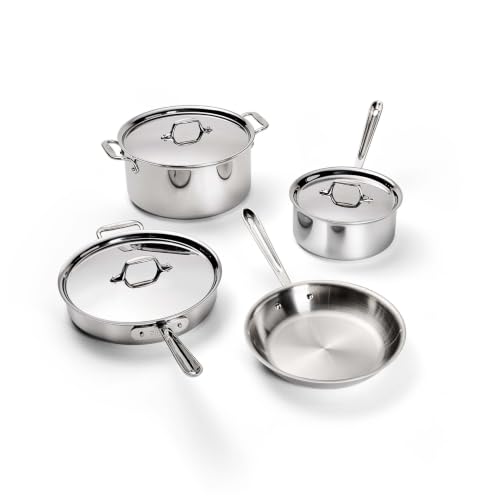
All-Clad D3 Stainless Steel Cookware Set, 7-Piece — Best Overall
Buy the D3 7-piece if your glass top is a serious cooking surface and you want the core fleet — fry pans, saucepans, stockpot — at flagship standard without buying pieces you will not use. It suits couples and small families who cook daily. Bigger households wanting more vessels should step to a 10- or 12-piece clad set in the same spirit, and nonstick-dependent cooks will add one coated pan for eggs.
Strengths
- Tri-ply bases are flat and smooth-finished: ideal full contact on glass
- Bonded construction resists the warping that makes pans rock and spin on glass
- Stainless base leaves no metallic transfer marks on the glass surface
Trade-offs
- Seven pieces is a core fleet, not a banquet arsenal
- Premium tier, as with all flagship clad
- Stainless technique rules for eggs and delicate fish still apply
| Configuration | 7-piece set (per listing) |
| Construction | D3 stainless steel, tri-ply (per listing) |
| Origin | Made in the USA (per listing) |
On glass, a clad pan’s virtues are physical. The tri-ply base is manufactured flat and stays flat, because the bonded layers resist the thermal cycling that cups thinner pans. Full contact across the element means the heat transfers evenly — no rocking saucepan of rice, no fry pan spinning when you stir, no hot crescent where a warped base touches and cold zone where it lifts. The D3 does this as a matter of construction, which is why it leads this guide.
The smooth stainless base is equally deliberate. Glass scratches from texture and grit, not from metal itself; a finished stainless bottom, kept clean, glides without marking. There is no exposed aluminum or copper on the cooking face to leave the grey transfer streaks that frighten glass owners (they polish off, but who needs the fright).
Seven pieces is the honest core: the pans a household uses daily, at the standard that protects the stove and elevates the cooking. For glass top owners buying once and buying right, this is the set.
A D3 habit for glass owners: because the bases are so flat, these pans can feel ‘grippy’ on the glass when a film of moisture sits beneath — dry the base and the element before cooking and the pan sits calmly instead of skating on steam.
The D3’s stockpot deserves a glass-specific note: its base diameter suits the large element found on most glass tops, so the biggest, heaviest pan in the fleet also makes the most efficient contact.
Best for: glass top owners wanting a flagship core set with perfectly flat, smooth bases / Not suited for: large households needing a bigger piece count in one box
Check on Amazon — check the current price on Amazon before you decide.

Cuisinart Chef’s Classic Stainless Steel Pots and Pans Set, 10 pc (77-10P1) — Best Budget
Choose the Chef’s Classic 10-piece if you have inherited or installed a glass top and need a safe, complete set without a flagship budget: first homes, rentals with glass stoves, and anyone replacing a warped old set that rocks. Cooks who sear daily at high heat will eventually want clad’s extra mass, but as the complete, glass-kind foundation it is hard to beat at its tier.
Strengths
- Smooth flat bases designed for full contact — glass-safe by construction
- Encapsulated aluminum base spreads heat evenly across the element
- Ten useful pieces at a genuinely budget-friendly tier
Trade-offs
- Disc-base construction is less responsive than fully clad rivals
- Bases must be kept clean underneath; baked-on grit under any pan threatens glass
- Lighter gauge means disciplined heat — avoid prolonged maximum settings
| Configuration | 10-piece set, model 77-10P1 (per listing) |
| Construction | Chef’s Classic stainless steel (per listing) |
The Chef’s Classic earns its glass top place on the strength of its bases. The encapsulated design — aluminum core sealed inside smooth stainless — presents the glass with exactly what it wants: a flat, finished surface with no texture, no exposed soft metal, no ridges. In contact terms it behaves like sets costing several times more, which is the only term that matters to the stove.
Cooking performance follows the same honest pattern as the line’s reputation: even heating from the aluminum core, comfortable handles, lids that fit, and a piece for every job in a normal kitchen. On glass, where the element’s heat is radiant and contact-dependent, that evenness is not a luxury — a pan that touches everywhere cooks everywhere.
Keep the bases wiped clean — a crumb of baked-on sugar or grit under a hot pan is the real glass enemy — and this set will serve a glass top kitchen faithfully for years at a starter price.
Chef’s Classic on glass has one care point: the encapsulated base’s edge seam should be kept clean, because a ring of baked-on residue at the seam is exactly the kind of grit ring that marks glass under heat and weight.
Chef’s Classic’s fry pans sit notably steady during the stir test — no spin when you work a risotto-style dish — which on glass is both a cooking and a confidence feature.
Best for: first glass top kitchens needing a complete, safe set on a budget / Not suited for: daily high-heat searing or cooks wanting fully clad response
Check on Amazon — check the current price on Amazon before you decide.

Tramontina Boston 12-Piece Stainless Steel Cookware Set — Best Value Family Set
The Boston suits families cooking on glass who need the full spread — multiple saucepans, a real stockpot, fry pans in working sizes — without flagship pricing. Its stainless bases are glass-kind and its count supports parallel cooking on a four-element top. Small households will store more than they use; the 7- and 10-piece picks fit that life better.
Strengths
- Twelve pieces cover family cooking on a multi-element glass top
- Smooth stainless bases are safe for full-contact glass cooking
- Value tier makes a complete fleet replacement affordable in one move
Trade-offs
- Family count needs family storage — measure the cupboard
- Stainless learning curve applies across all twelve pieces at once
- Not the thermal mass of flagship clad for the hardest searing
| Configuration | 12-piece set (per listing) |
| Construction | Boston stainless steel line (per listing) |
Families on glass tops face a compound problem: they need many vessels, and every vessel must be glass-safe. The Boston solves it in one box — twelve stainless pieces whose bases meet the flat-and-smooth rule, sized for family throughput. Pasta pot on the big element, sauce on the second, vegetables steaming on the third: a glass top’s zones used as designed.
The value logic is the same that makes Tramontina a recurring name in these guides: sound stainless construction, honestly finished, without the flagship surcharge. The bases sit flat — run the coin test in the how-to when it arrives, as with any set — and the smooth finish treats the glass kindly through daily sliding and lifting.
For a family replacing a tired, rocking old fleet in one decision, this is the sensible complete answer: safe for the stove, sized for the household, priced for real life.
Boston’s stockpot is its glass-top hero: a big, flat base centred on the large element brings family pasta water to the boil efficiently, and the smooth base means the heaviest pan in the set is also one of the kindest to the surface.
Boston’s saucepans nest inside its stockpot for storage, a small mercy in family kitchens where twelve pieces must disappear into one cupboard every night.
Best for: families needing a complete glass-safe fleet at a value tier / Not suited for: small households or flagship-build seekers
Check on Amazon — check the current price on Amazon before you decide.
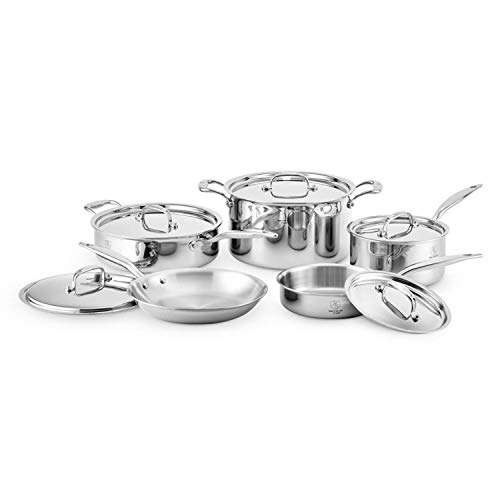
Heritage Steel 10 Piece Cookware Set, Titanium Strengthened 316Ti — Best Premium
Buy the Heritage Steel if the glass top is a long-term installation and the cookware should match its lifespan: this is the buy-once tier, with 5-ply evenness for the contact-dependent glass surface and a steel grade that shrugs off salty, acidic cooking. The premium is real; households still deciding whether they even like cooking on glass should start with the Cuisinart or Tramontina and upgrade when the answer is proven.
Strengths
- 5-ply construction delivers the most even contact heating in this guide
- 316Ti titanium-strengthened steel resists pitting and corrosion for decades
- Warp-resistant bases protect the glass and the cooking, year after year
Trade-offs
- The premium tier in this guide — a considered purchase
- Ten pieces of serious cookware is a storage commitment
- Stainless technique still required; no coating safety net
| Configuration | 10-piece set (per listing) |
| Construction | 5-ply, titanium-strengthened 316Ti stainless steel (per listing) |
| Origin | Made in USA (per listing) |
Glass tops punish warping more than any other surface, because contact is everything. Heritage Steel’s 5-ply construction is the strongest anti-warp engineering in this guide: thick, bonded layers that hold their flatness through years of thermal cycles, keeping every pan in full contact with the element and the cooking even from rim to rim. That is not a spec-sheet nicety on glass; it is the difference between a pan that cooks and a pan that rocks.
The 316Ti steel is the second, quieter premium. Titanium-strengthened and more corrosion-resistant than standard grades, it tolerates the salty pasta water, tomato sauces and dishwasher life of a real kitchen without pitting — and a pitted base is a rough base, which on glass is the enemy twice over, cooking and cosmetic.
Judge it as infrastructure. A glass top stove is a decade-scale appliance; this is the decade-scale set that belongs on it, and the per-year cost of that pairing is lower than replacing mid-tier sets on a cycle.
Heritage Steel’s flatness is verifiable at home: run the ruler test from this guide’s how-to on arrival and you will see what 5-ply engineering buys — a base that meets the straight edge along its whole diameter, year after year.
Heritage Steel owners report the bases stay true after years of induction use — the warp-resistance claim is the one that matters most on glass, and the 5-ply build is built around it.
Best for: committed glass top cooks buying a decade-scale set / Not suited for: renters or anyone unsure glass cooking is their long-term surface
Check on Amazon — check the current price on Amazon before you decide.

GreenPan Reserve 10-Piece Cookware Set, Taupe — Best Ceramic Nonstick
Choose the Reserve if your glass top cooking leans delicate — eggs, fish, pancakes, creamy sauces — and you want cleanup to be a wipe. Ceramic’s moderate-heat contract applies, and on glass that contract is easy to keep, since glass elements reward steady medium settings anyway. Hard-searing households should pair it with a clad set rather than push the ceramic beyond its design.
Strengths
- Flat, smooth bases glide on glass without texture or scratch risk
- Ceramic release makes the delicate menu effortless and cleanup a wipe
- Reserve-tier build is the sturdier end of ceramic cookware
Trade-offs
- Ceramic lifespan is finite and heat-sensitive — medium settings preserve it
- Not a searing surface; keep a clad pan for crusts
- Light exteriors show glass-top life honestly — expect patina
| Configuration | 10-piece set (per listing) |
| Line | Reserve ceramic nonstick (per listing) |
| Finish | Taupe (per listing) |
Glass and ceramic nonstick are natural allies. The set’s bases are flat and smooth — the glass rule — and the cooking surface handles the foods that make glass top owners dread stainless: the morning eggs, the fish fillets, the milk-based sauces that catch and scorch. Release is total, cleanup is a wipe, and the stove stays as clean as the pans, which matters on a surface that shows everything.
The Reserve line sits at ceramic’s serious end: sturdier bodies that hold their flatness — critical on glass — and a finish that looks deliberate next to the stove’s minimalism. On the element it heats evenly at the medium settings glass cooking prefers, because glass elements cycle and reward patience over brute force.
Used within its contract, it is the set that makes a glass top feel luxurious rather than precious: delicate food, no sticking, no scrubbing, no scratches. Pair it with one clad pan for the searing nights and the kitchen is complete.
Reserve’s taupe finish has a practical glass-top benefit: splashes and drips show immediately on both pan and stove, prompting the quick wipe that keeps a glass kitchen looking new — visibility as a cleaning system.
Reserve’s handles stay cool enough on glass elements for the slide-to-cool-zone move — done by lifting, always — without reaching for a towel mid-service.
Best for: delicate-food, easy-clean glass top cooking at steady medium heat / Not suited for: high-heat searing or maximum-setting cooking styles
Check on Amazon — check the current price on Amazon before you decide.
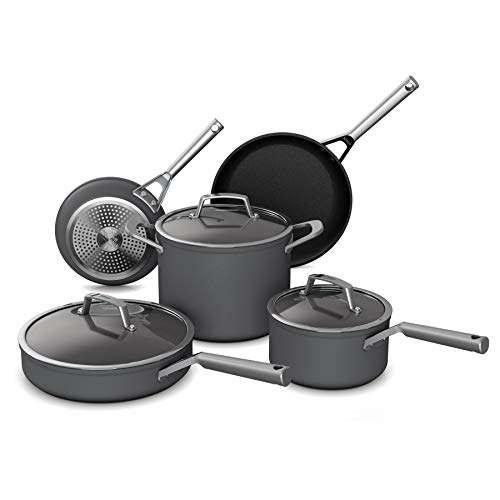
Ninja C38000 NeverStick 8-Piece Cookware Set — Best Compact Nonstick
The C38000 suits smaller households on glass: two people, a compact kitchen, a rotation of weeknight dishes that lean sticky. Its eight pieces are the core fleet, its bases meet the glass rule, and its surface is the durable end of nonstick. Families will outgrow the count — the Boston or a 12-piece set serves them — but for two-person glass cooking it is precisely sized.
Strengths
- NeverStick surface: durable release for the sticky weeknight rotation
- Hard-anodized bases are flat, smooth and glass-safe
- Eight-piece core fleet fits small kitchens and small households
Trade-offs
- Piece count limits parallel cooking for bigger meals
- Nonstick discipline still applies — medium heat, soft utensils
- No large stockpot ambitions: pasta for two, not for six
| Configuration | 8-piece set, model C38000 (per listing) |
| Construction | NeverStick hard-anodized nonstick (per listing) |
Not every glass top kitchen needs twelve pieces, and the C38000’s restraint is its virtue. Eight core vessels, each with the flat, smooth base glass demands, each surfaced with Ninja’s NeverStick — a coating system engineered for longevity rather than a single slick season. For a couple’s weeknight rotation it is the complete answer with nothing to store resentfully.
The hard-anodized bodies behave properly on glass elements: full contact, even spread, no rocking. The surface then does the easy-clean work — stir-fry glazes, cheese-topped bakes and egg mornings release and rinse, keeping both pan and glass top clean with minimal effort, which on a show-everything surface is a daily quality-of-life win.
As with all nonstick, the contract is heat discipline, and glass cooking’s steady-medium style makes that contract natural to keep. For small glass top households, this is the tidy, durable, right-sized choice.
The C38000’s compact vessels suit glass tops in smaller kitchens where the elements are closer together: two of its pans can share the surface without the overhang crowding that big fleets suffer on compact glass stoves.
The Ninja set’s smallest saucepan is the glass top’s friend for sauces for two: it centres on the small element precisely, where oversized pans waste the zone and heat unevenly.
Best for: couples and small households wanting durable nonstick on glass / Not suited for: families or batch cooking at volume
Check on Amazon — check the current price on Amazon before you decide.
Comparison Table
| Pick | Badge | Key spec | Best for |
|---|---|---|---|
| All-Clad D3 Stainless Steel Cookware Set, 7-Piece | Best Overall | 7-piece D3 stainless steel set, made in USA (per listing) | glass top owners wanting a flagship core set with perfectly flat, smooth bases |
| Cuisinart Chef’s Classic Stainless Steel Pots and Pans Set, 10 pc (77-10P1) | Best Budget | 10-piece stainless steel set, model 77-10P1 (per listing) | first glass top kitchens needing a complete, safe set on a budget |
| Tramontina Boston 12-Piece Stainless Steel Cookware Set | Best Value Family Set | 12-piece stainless steel set (per listing) | families needing a complete glass-safe fleet at a value tier |
| Heritage Steel 10 Piece Cookware Set, Titanium Strengthened 316Ti | Best Premium | 10-piece 5-ply set, 316Ti stainless, made in USA (per listing) | committed glass top cooks buying a decade-scale set |
| GreenPan Reserve 10-Piece Cookware Set, Taupe | Best Ceramic Nonstick | 10-piece ceramic nonstick set, taupe (per listing) | delicate-food, easy-clean glass top cooking at steady medium heat |
| Ninja C38000 NeverStick 8-Piece Cookware Set | Best Compact Nonstick | 8-piece NeverStick set, model C38000 (per listing) | couples and small households wanting durable nonstick on glass |
How to Choose the Best Cookware Sets for Glass Top Stoves
The glass rule comes before every other consideration: bases must be flat and smooth. Flat, because the element heats by contact and radiation across the whole base — a pan touching only at its rim cooks in a ring and rocks dangerously. Smooth, because glass scratches from texture and trapped grit. When any set arrives, run the flatness checks in the how-to section below before cooking; a pan that fails goes back, however good the deal was.
Material guidance follows from the rule. Clad stainless with finished bases is the gold standard — flat, smooth, durable, no transfer marks. Quality nonstick with smooth exterior bases is the easy-clean alternative, with the usual heat discipline. Avoid rough cast iron bottoms, pans with raised heat rings, and cookware whose bases expose soft aluminum or copper that can leave transfer marks on the glass. Enamelled cast iron with a smooth, flat base is the exception some owners use happily — lift it, never drag it.
Size to the elements. Glass tops print their element diameters on the surface; a pan base within roughly an inch of the element’s size heats efficiently and evenly. Oversized bases overhang and heat unevenly; undersized bases waste the element and concentrate heat in the glass beneath the pan’s footprint. Match the fleet to the rings you actually use.
- Flat and smooth bases are the non-negotiable glass rule — test on arrival
- Clad stainless for durability; smooth-based nonstick for easy release
- Avoid rough cast textures, raised heat rings and exposed soft-metal bases
- Match base diameter to the printed element size, within about an inch
- Lift pans to move them — never slide or drag across the glass
Protecting the Glass: The Habits That Prevent Scratches and Cracks
Most glass damage is a habit, not an accident. The first habit is lifting: a pan moved by lifting cannot scratch; a pan dragged with a grain of sugar or salt trapped beneath it engraves a line. The second is cleanliness underneath: wipe every base before it meets the glass, and keep the glass itself cleaned with its proper cleaner, because grit on either surface becomes the scratch under the next pan.
The sugar rule deserves its own paragraph. A spill of sugar or sugary sauce on hot glass, left to cool, can pit the surface as it contracts — manufacturers warn about it specifically. If sweet liquid lands on the hot top, move the pan, and once the area is safe to approach, remove the spill with a razor scraper while still warm, following your stove manual’s guidance. It is the one glass-top emergency worth knowing in advance.
Finally, respect weight and temperature shock. Do not drop heavy pans the last inch — set them down. Do not set a hot pan on a cold, wet patch of glass, and never use the top as extra counter for heavy storage. Treated this way, a glass top outlasts the cookware fleets that serve it.
Glass Top Elements, Pan Sizes and Heat Settings That Work
Glass top elements — whether radiant or induction beneath the glass — heat in cycles and zones, and cookware that matches the zone wins. A pan base close to the printed ring’s diameter receives the element’s full output evenly; a pan much smaller concentrates the element’s energy into a small footprint and can stress the glass with heat it cannot shed, while a much larger pan draws heat beyond the zone and cooks its edges by conduction alone. The printed rings on your stove are a sizing chart: measure them once and buy to them.
Heat settings behave differently on glass. The surface retains heat after the control is cut, so the responsive move is to slide the pan to a cool zone — lifting, always lifting — rather than waiting for the element to cool. Medium settings do more work on glass than cooks expect, because the contact is total; most glass top cooking lives between low and medium-high, and the maximum setting is a boiling-water tool, not a cooking gear.
Induction glass tops add one more check: the pan must be magnetic at the base. Clad stainless sets vary — many are induction-ready, some are not — so test with a fridge magnet on the base before assuming. Every other rule in this guide, flatness first, applies to induction glass exactly as to radiant glass.
Radiant vs Induction Glass: What Changes and What Does Not
On a radiant glass top, the element glows beneath the glass and heats the pan by contact and radiation; the pan’s flatness decides how much of that heat arrives evenly, and the glass retains heat after switch-off, so pans keep cooking gently on residual warmth. On an induction glass top, the pan itself is the heating element, energised by a magnetic field — which adds the magnet test for bases, heats faster, and cools the instant the pan lifts, but changes nothing about the physical contract with the glass.
What does not change between the two is everything in this guide’s core advice: flat smooth bases, lifted-not-dragged movement, grit discipline, sugar-spill urgency and diameter matching. Induction owners should add one habit: because induction heats the base so fast, thermal shock from an empty pan on a maximum setting is a real warp risk — bring pans up through the settings, especially the thin ones.
Owners switching from radiant to induction often find their old fleet half-compatible. Run the magnet and coin tests on every existing pan before buying anything: the sets below are the replacements for the pieces that fail, and most households discover they need fewer new pieces than the internet led them to fear.
How to Test a Pan’s Flatness Before It Touches Your Glass Top
Five minutes and a coin protect a very expensive surface. Run these checks on every new pan, and yearly on the old fleet — warping creeps up on cookware.
- The ruler test: lay a metal ruler or straight edge across the pan’s base in several directions. You should see no rocking gap; a sliver of light at the centre or edges means the base is domed or cupped.
- The coin test: set the pan on a flat counter and try to slide a thin coin under the rim at several points. A base that admits the coin at one side and not the other is not flat enough for glass.
- The spin test: on a smooth counter, give the pan a gentle twist. A pan that spins freely has a domed base — it will spin on the glass too, which is both an efficiency and a safety failure.
- The rock test: press opposite edges of the rim. Any rocking on a flat counter becomes rocking on the element, with boiling liquid aboard. Reject rockers for glass duty.
- The texture test: run your palm across the base. It should feel uniformly smooth. Raised rings, rough casting texture or exposed rivet patterns are disqualifiers for glass, however the pan performs elsewhere.
- The paper test for grit: wipe the base with a white paper towel. Dark gritty residue means the base needs a thorough clean before glass contact — and a reminder to repeat this wipe as a habit, not a one-off.
- Mark the pass/fail fleet honestly: failed pans can live a useful life on a grill, a camping stove or a relative’s gas hob — just not on your glass.
Manufacturers of glass tops publish the same advice in sterner language: the cookware warranty on your stove effectively lives or dies with base flatness. The coin in your pocket is the cheapest insurance in the kitchen.
Repeat the ruler and coin tests every year or so, and after any incident — a dropped pan, a boil-dry event, a suspicious new wobble. Cookware rarely warps dramatically in one day; it drifts, a fraction at a time, and the annual five-minute audit catches the drift while the pan can still be demoted gracefully to the camping box rather than discovered mid-boil on the glass.
Common Buying Mistakes
Dragging pans across the glass. One trapped grain of grit under a dragged pan cuts a permanent line. Lift, move, set down — every time, until it is reflex.
Using rough cast iron on glass. Sand-cast textures and raised heat rings scratch, and the weight risks impact damage. Keep raw cast iron for gas and the oven; on glass, use smooth-based sets.
Ignoring a warped pan. A rocking pan heats in patches, boils unevenly and can spin with hot contents. The coin test takes seconds — retire warped pans from glass duty.
Leaving a sugar spill to cool. Cooled sugar can pit glass as it contracts. Scrape sugary spills while warm, per your stove manual, instead of chipping at them cold tomorrow.
Oversizing every pan. A base far larger than the element heats unevenly and stresses the glass around the hot zone. Match diameters to the printed rings.
Using the glass top as a worktop. Hot pans set down ‘for a second’, heavy appliances parked on the rings, groceries staged on the surface — the glass tolerates cooking loads, not counter loads, and a point impact from a dropped tin can end it. Treat the top as a stove that happens to be flat, not as a counter that happens to heat.
Final Recommendation
For most glass top kitchens, the All-Clad D3 7-piece is the buy-right answer: flat, smooth, clad bases that treat the glass kindly and cook superbly. Budgets point to the Cuisinart Chef’s Classic 10-piece, families to the Tramontina Boston’s twelve pieces, and long-term owners to the Heritage Steel 5-ply set. For the easy-clean half of life, the GreenPan Reserve brings ceramic release and the Ninja C38000 brings durable nonstick in a compact fleet — both on smooth, glass-safe bases.
Whichever set arrives, run the coin and ruler tests before the first meal, wipe bases as a habit, and lift rather than drag. A glass top rewards those small disciplines with a decade of clean, even, beautiful cooking.
Keep the stove’s own manual with this guide’s checks and you hold the complete system: the manual knows your glass, this guide knows the pans. Together they are a decade of uneventful, even, scratch-free cooking — the most boring and most valuable outcome a kitchen can have.
There is also a resale-and-repair truth worth pocketing: glass tops are among the most expensive stove parts to replace, and every habit in this guide — the coin test, the wiped base, the lifted pan — is cheaper than the alternative by orders of magnitude. Protecting the glass is not preciousness. It is the highest-value five minutes in the kitchen, repeated quietly for years.
Buy once, test on arrival with the coin and ruler, and cook on it for a decade: that is the whole strategy in one sentence, and on a glass top it is the only one that has ever worked for anyone.
Start with the top pick here: All-Clad D3 Stainless Steel Cookware Set, 7-Piece — check price on Amazon, confirm the configuration on the listing, and order once you have matched it against the checks in this guide.
Keep researching within this cluster: Best Cookware Sets For Gas Ranges Best Cookware Sets For Gas Stovetop Best Cookware Sets For Gas Stove Top Best Cookware Sets For College Students Best Cookware Sets For Family Camping.
Frequently Asked Questions
What type of cookware is safest for a glass top stove?
Sets with flat, smooth, finished bases — clad stainless steel is the benchmark, and quality nonstick with smooth exterior bases is the easy-clean alternative. The base should make full contact with the element, have no rough texture, raised rings or exposed soft metal, and be kept clean underneath.
Can I use cast iron on a glass top stove?
Rough-bottomed cast iron is not recommended: its texture and heat ring can scratch the glass, especially if dragged, and its weight raises the stakes of a fumble. Some owners use enamelled cast iron with a smooth, flat base, lifting it carefully and never sliding it. This guide’s picks avoid the risk category entirely.
Why does my pan spin or rock on the glass top?
The base has warped — domed or cupped by heat over time — so it contacts the glass only at a point or a rim. On glass that means uneven heating and a genuine safety issue with hot liquids. Run the coin test in this guide; a spinning pan should be retired from glass duty.
How do I remove marks left by pans on the glass?
Grey metallic-looking streaks are usually transfer from pan bases or baked-on residue; a glass-top cleaner and a non-scratch pad, or a razor scraper used per the stove manual, removes most of them. True scratches — lines you can feel with a fingernail — are permanent, which is why the lift-don’t-drag habit matters.
What pan size should I use on each glass element?
Match the base to the printed element diameter, ideally within about an inch. A much smaller pan wastes heat and concentrates it in the exposed glass; a much larger one heats unevenly and can stress the surface around the element. Most sets include the spread of sizes a four-element top needs.
Are nonstick pans safe for glass tops?
Yes, provided the exterior base is smooth and flat, which quality nonstick sets are. Keep the heat at the low-to-medium settings nonstick prefers — which suits glass elements well — and lift rather than slide the pan. The combination is one of the easiest-clean setups a glass kitchen can run.

