Disclosure: airfryerkitchensupply.com is reader-supported. When you buy through links on our site, we may earn an affiliate commission at no extra cost to you.
Where to buy
Every linked pick in this guide to the best gauge fit kitchen stainless steel sinks is sold through Amazon, where you can check the current price on Amazon and confirm the gauge in the exact listing title before ordering. Gauge is the headline specification of this entire category — if the listing you are looking at does not state a gauge, it has not answered this guide’s first question, and you should treat that silence as information.
- KRAUS Standart Pro 30-Inch 16-Gauge Undermount Sink (KHU100-30) (Best Overall) — Check on Amazon
- SANYCASA 30-Inch Undermount Sink, 11-Gauge (3mm) Stainless Steel (Thickest Steel) — Check on Amazon
- Ruvati 32-Inch 16-Gauge 50/50 Double Bowl Undermount Sink (RVM4350) (Best 16-Gauge Double Bowl) — Check on Amazon
- KRAUS 25-Inch 18-Gauge Undermount Sink (KHU641-25) (Best 18-Gauge, Done Properly) — Check on Amazon
- Elkay Crosstown 18-Gauge Workstation Sink Kit, 31-1/2-Inch (Best 18-Gauge Workstation) — Check on Amazon
- KRAUS Fairlane 30-Inch 18-Gauge Undermount Workstation (KWU610-30) (Best Mid-Size 18-Gauge Workstation) — Check on Amazon
The best gauge fit kitchen stainless steel sinks start from a specification most sink shoppers never learn to read: gauge, the measure of the steel’s thickness. In stainless sheet, the gauge scale runs backwards — a lower number means thicker steel — so a 16-gauge sink is substantially heavier, quieter and more dent-resistant than an 18-gauge one, and both are in a different world from the 20- and 22-gauge bowls that fill the bottom of the market. ‘Gauge fit’ is the buyer’s shorthand for getting this right: the right thickness for how you cook, fitted correctly to your cabinet and counter, with no surprises in either direction.
This guide is organised as a gauge masterclass with products attached. The six picks span the honest range — an 11-gauge outlier that behaves like commercial equipment, three 16-gauge benchmarks in different formats, and two 18-gauge designs from top-tier makers that show what the lighter gauge should look like when it is done properly — because the real lesson of this category is not ‘always buy 16’. It is that gauge interacts with steel grade, bowl forming, sound treatment and fit, and a well-made 18-gauge sink from a serious brand will out-serve a sloppy 16-gauge one. Every gauge figure quoted here comes from the pick’s own verified Amazon listing; where a listing states the gauge, we print it, and where brands play games with the number, the guide sections teach you to spot it.
Fit is the search’s second half, and it is not decoration. A stainless sink must fit three things at once: the cabinet (minimum cabinet size is a real specification), the counter cut-out (for undermounts, templated to the physical bowl), and your cooking (bowl depth and layout against your largest pans). A perfectly gauged sink in the wrong size is a wrong sink. So each review covers its pick’s format and fit story alongside its steel, and the how-to section is a measuring protocol, not an afterthought.
One pick, the Kraus KHU100-30, carries a full verified specification from our earlier API fetch, quoted in its spec box; the others quote the gauge and format their listings state, and nothing beyond it.
In this guide
Quick Picks
If you only read one section, make it this one. These are the six best gauge fit kitchen stainless steel sinks we would shortlist first, each chosen for a different kind of buyer rather than ranked by a single score.
- KRAUS Standart Pro 30-Inch 16-Gauge Undermount Sink (KHU100-30) — Best Overall. The benchmark 16-gauge undermount: TRU16 T-304 steel, a 30-inch single bowl with a full verified kit — grid, drain, hardware, template and towel in the box. — Check on Amazon
- SANYCASA 30-Inch Undermount Sink, 11-Gauge (3mm) Stainless Steel — Thickest Steel. The gauge extremist: 11-gauge (3mm) steel — commercial territory — in a 30-inch workstation with an integrated ledge and a superior-drain design. — Check on Amazon
- Ruvati 32-Inch 16-Gauge 50/50 Double Bowl Undermount Sink (RVM4350) — Best 16-Gauge Double Bowl. For two-bowl households who refuse to drop to thin steel: a 32-inch 50/50 double in 16-gauge T-304 with a brushed, scratch-camouflaging finish. — Check on Amazon
- KRAUS 25-Inch 18-Gauge Undermount Sink (KHU641-25) — Best 18-Gauge, Done Properly. The case for 18 gauge, argued by a serious maker: a 25-inch undermount with rounded corners, drain grooves and NoiseDefend soundproofing. — Check on Amazon
- Elkay Crosstown 18-Gauge Workstation Sink Kit, 31-1/2-Inch — Best 18-Gauge Workstation. Elkay’s Crosstown workstation in 18 gauge: a 31-1/2-inch single bowl with a prep ledge, from the maker whose sinks furnish half the institutions you have ever visited. — Check on Amazon
- KRAUS Fairlane 30-Inch 18-Gauge Undermount Workstation (KWU610-30) — Best Mid-Size 18-Gauge Workstation. A 30-inch 18-gauge workstation with accessories included — the Fairlane splits the difference between the benchmark’s steel and the Crosstown’s ledge. — Check on Amazon
How These Picks Were Chosen
Gauge honesty was the entry ticket: the pick’s own verified listing had to state its steel gauge in the title or feature data. That single rule removed the entire anonymous tier of the market, where ‘premium stainless’ language substitutes for a number, and it is a rule you can apply yourself in thirty seconds on any listing — no number, no purchase. Within the qualifying pool, we then balanced gauge classes deliberately (11, 16 and 18) so the guide demonstrates the trade rather than preaching one answer.
Format coverage came second: undermount singles in the standard 25-to-33-inch classes, a 16-gauge double bowl for parallel-work households, an 18-gauge workstation, and an 18-gauge mid-size undermount from a heritage maker — because gauge advice that only exists in one format is not advice, it is a coincidence. Fit data (cabinet minimums, bowl dimensions) is quoted only where our verified records state it, and the measuring how-to teaches you to confirm the rest on your chosen listing.
Finally, we scored the things gauge interacts with: sound treatment (pads and coatings that decide whether a thin bowl drums), corner radius (tight handmade corners vs pressed radii, with their cleaning and capacity consequences), and the brand’s pattern of publishing full specifications — because a maker who prints gauge, steel series and cabinet minimums on the listing is telling you how they will behave about everything else too.
The 6 Best Gauge-Fit Kitchen Stainless Steel Sinks

KRAUS Standart Pro 30-Inch 16-Gauge Undermount Sink (KHU100-30) — Best Overall
If this guide had to be one sink, it would be this one — not because 16 gauge is magic, but because the KHU100-30 is what full specification honesty looks like. Our listing-verified record for this model is complete: TRU16 16-gauge T-304 construction, external dimensions of 30 x 18 x 10.5 inches over a 28 x 16 x 10-inch bowl, a 33-inch minimum cabinet, rounded corners for cleaning, channel grooves in the bowl floor for drainage, NoiseDefend sound pads, and a box that includes the bottom grid, drain assembly with strainer, mounting hardware, cutout template and even the towel. That is the entire purchase, specified, in one listing.
Strengths
- Complete verified specification — nothing left to guess
- True 16-gauge T-304 with sound treatment
- Grid, drain, hardware and template included
Trade-offs
- Rounded corners trade a little bowl area for easy cleaning
- 30-inch bowl needs a 33-inch cabinet — measure first
- Undermount install discipline still applies
| Gauge | 16-gauge TRU16 T-304 steel (verified via API) |
| External size | 30 x 18 x 10.5 in (verified via API) |
| Bowl | 28 x 16 x 10 in (verified via API) |
| Minimum cabinet | 33 in (verified via API) |
| Kit | Bottom grid, drain assembly with strainer, mounting hardware, cutout template, towel (verified via API) |
In service, 16-gauge T-304 in a pressed bowl of this size delivers the gauge promise in full: a sink that does not flex when a full stockpot lands, that takes dropped cutlery as noise rather than damage, and whose sound pads keep the drumming that plagues thin bowls out of your evenings. The 10-inch depth swallows roasting pans; the rounded corners — a deliberate contrast to the zero-radius handmade style — wipe clean without the corner-scrubbing ritual, at the cost of a little bowl-floor area.
Fit it correctly and it disappears into twenty years of service: 33-inch minimum cabinet, templated undermount cut from the included template (confirmed against the physical bowl), drain and grid already in hand. For the mainstream family kitchen, this is the gauge-fit answer against which the rest of this guide is commentary.
Best for: Most family kitchens wanting the benchmark 16-gauge sink / Not suited for: Cabinets under 33 inches or drop-in-only counters
Check on Amazon — check price on Amazon for the current configuration and delivery terms.
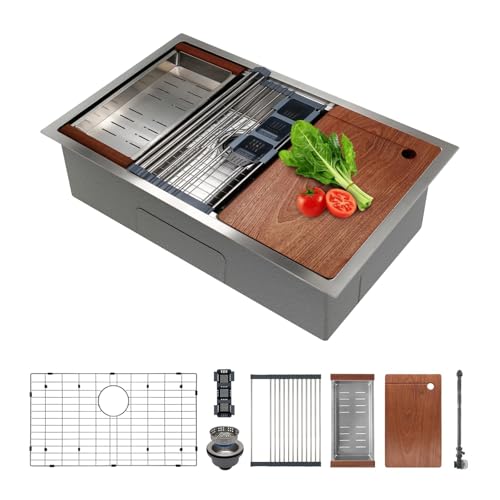
SANYCASA 30-Inch Undermount Sink, 11-Gauge (3mm) Stainless Steel — Thickest Steel
Every category has an overachiever, and in gauge terms it is this SANYCASA: 11-gauge steel, which the listing helpfully translates as 3mm — roughly half again as thick as 16 gauge and nearly double 18. At that thickness the conversation changes: the bowl stops behaving like sheet metal and starts behaving like equipment. Dents become a theoretical concept, the sink’s sound is a thunk rather than a ring, and the whole object carries the mass of a commercial prep sink that happens to wear a workstation ledge and a domestic 30-inch footprint.
Strengths
- 11-gauge/3mm steel — effectively dent-proof in home use
- Workstation ledge makes the mass functional
- Commercial-grade feel in a 30-inch domestic format
Trade-offs
- Heaviest sink here — support and handling are real work
- More steel than most kitchens can justify
- Premium-for-thickness pricing logic
| Gauge | 11 gauge / 3mm (per listing) |
| Size class | 30 inch (per listing) |
| Layout | Single bowl workstation, integrated ledge (per listing) |
The workstation format (integrated ledge, multifunctional set per the listing) makes the thickness usable rather than merely impressive: prep over the bowl, drain into it, and let the ‘superior drain’ positioning do its quiet work. The honest costs are weight — this is the heaviest install in the guide, and cabinet support and a second pair of hands are assumed — and the simple fact that most households do not need 3mm of steel. Need is not the only purchasing logic, though; some buyers keep a sink for thirty years and enjoy overbuilding it once.
Choose it if you are the household that drops cast iron, runs a near-commercial cooking pace, or simply wants the thickest answer to the gauge question that the domestic market offers. Everyone else should read its existence as calibration: this is what the top of the gauge scale looks like, and 16 gauge is closer to it in spirit than to the bargain tier.
Best for: Heavy-use, cook-hard households and overbuilders / Not suited for: Light-use kitchens or weak cabinet structures
Check on Amazon — check price on Amazon for the current configuration and delivery terms.
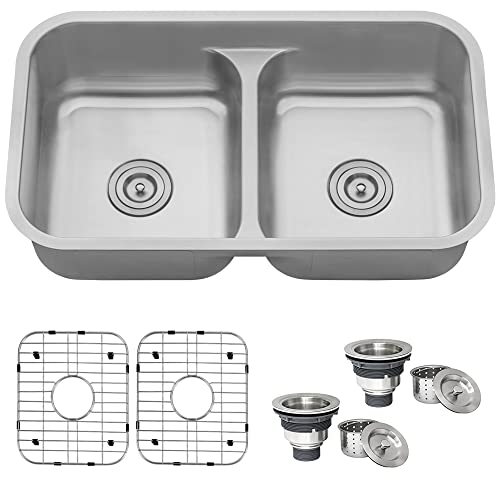
Ruvati 32-Inch 16-Gauge 50/50 Double Bowl Undermount Sink (RVM4350) — Best 16-Gauge Double Bowl
Double-bowl buyers are usually offered a quiet downgrade — the format they want, in steel a gauge or two thinner than the flagship singles. The RVM4350 refuses that trade: a 32-inch 50/50 undermount double in 16-gauge T-304, per its verified listing, with the brushed finish Ruvati notes is chosen to hide scratches. For households whose workflow is genuinely parallel — soak left, wash right; disposal side, prep side — this is the pick that respects both the workflow and the gauge standard this guide exists to defend.
Strengths
- Full 16-gauge T-304 in a true double bowl
- Brushed finish camouflages daily scratches
- Equal bowls suit genuine parallel workflows
Trade-offs
- Divided bowls angle the largest pans
- 32-inch class needs its cabinet verified
- Heavier than single bowls of the same gauge
| Gauge | 16 gauge (per listing) |
| Steel | T-304 stainless (per listing) |
| Layout | 50/50 double bowl, 32 inch (per listing) |
| Finish | Brushed, hides scratches (per listing) |
The 50/50 split is the traditionalist’s layout: two equal bowls, each big enough for a serious pan at an angle, neither a token rinse cup. Sixteen-gauge construction matters doubly in a double bowl, because the divider and the larger span are where thin steel flexes and drums; here the bowls keep the solid, padded feel of the Kraus benchmark while doubling the stations. The brushed finish is the pragmatic choice for a hard-working double — it ages as a patina rather than a collection of visible insults.
Fit notes: a 32-inch double wants its cabinet measured with the same rigour as any undermount (confirm the minimum cabinet on the listing against your tape), and the biggest sheet pans will sit at an angle, as in every divided bowl. If your household’s rhythm is two-bowl, this is your 16-gauge answer; if it is not, the singles above give you the same steel with an uninterrupted floor.
Best for: Two-bowl households unwilling to accept thin steel / Not suited for: Sheet-pan-first single-bowl cooks
Check on Amazon — check price on Amazon for the current configuration and delivery terms.

KRAUS 25-Inch 18-Gauge Undermount Sink (KHU641-25) — Best 18-Gauge, Done Properly
This pick exists to prove the guide’s central nuance: 18 gauge is not a synonym for cheap. Kraus builds the KHU641-25 in stated 18-gauge steel with the details that decide whether the lighter gauge works — NoiseDefend soundproofing to kill the drum effect thin bowls suffer, channel grooves to move water to the drain, and rounded corners that resist the buildup tight corners collect. In a 25-inch bowl — a size for smaller kitchens, bars and prep stations — the span is short enough that 18-gauge rigidity is entirely adequate, and the weight saving makes the undermount install noticeably easier.
Strengths
- 18 gauge engineered properly — soundproofed and grooved
- 25-inch size suits small kitchens and prep stations
- Same specification honesty as the flagship Kraus
Trade-offs
- 25-inch bowl is small for family cookware
- 18 gauge still yields before 16 under point abuse
- Undermount-only format
| Gauge | 18 gauge (per listing) |
| Size class | 25 inch (per listing) |
| Features | Rounded corners, channel grooves, NoiseDefend (per listing) |
That size context is the honest heart of gauge-fit thinking: thickness requirements scale with span. A 25-inch bowl in 18 gauge is a stiffer object than a 36-inch bowl in 16, because flex lives in the span, not just the sheet. Buyers furnishing a small kitchen, a wet bar or a secondary prep sink get Kraus-grade specification honesty and sound manners here without paying the 16-gauge premium for capacity they do not have.
Choose it for compact kitchens and secondary sinks, or as the main sink in a household of one or two whose cooking is pan-scale rather than roaster-scale. Choose up a size and a gauge when the bowl must swallow family cookware nightly — the guide’s first two picks are waiting.
Best for: Small kitchens, bars and prep sinks / Not suited for: Family kitchens with roaster-scale washing-up
Check on Amazon — check price on Amazon for the current configuration and delivery terms.

Elkay Crosstown 18-Gauge Workstation Sink Kit, 31-1/2-Inch — Best 18-Gauge Workstation
Elkay is the institutional name in American sinks, and the Crosstown line is its modern domestic flagship — this workstation version pairs an 18-gauge single bowl (31-1/2 x 18-1/2 x 9 inches, per the verified listing) with the integrated ledge that carries boards and racks over the sink. It is the second 18-gauge pick in this guide on purpose: between Kraus and Elkay, the lighter gauge’s respectability is established by the two makers least likely to embarrass it, and the Crosstown shows what 18 gauge buys when the design budget goes to the workstation instead of the sheet.
Strengths
- Workstation ledge from an institutional-grade maker
- 31-1/2-inch family size at a 9-inch ergonomic depth
- Plumbing-channel parts and accessory availability
Trade-offs
- 18 gauge — know the trade you are making
- Workstation accessories ecosystem is a further spend
- Ledge narrows the open bowl slightly
| Gauge | 18 gauge (per listing) |
| Size | 31-1/2 x 18-1/2 x 9 inch (per listing) |
| Layout | Workstation single bowl undermount (per listing) |
| Brand | Elkay Crosstown |
The 9-inch depth is a deliberate middle — deep enough for serious pans, shallow enough to spare shorter cooks the shoulder-deep reach a 10.5-inch bowl demands — and the workstation ledge converts the bowl into the kitchen’s prep bay, which in smaller homes is worth more than a gauge step. Elkay’s distribution is the ownership bonus: Crosstown accessories, grids and parts move through ordinary plumbing channels, a convenience that compounds over a long service life.
Choose the Crosstown when the workstation workflow leads your decision and you accept 18 gauge as the considered trade for it; choose the KHU100-30 when steel thickness leads and a plain bowl suffices. That fork — format first or gauge first — is the most useful question this entire guide can leave you with.
Best for: Prep-heavy kitchens wanting a workstation from a heritage brand / Not suited for: Gauge maximalists or plain-bowl traditionalists
Check on Amazon — check price on Amazon for the current configuration and delivery terms.

KRAUS Fairlane 30-Inch 18-Gauge Undermount Workstation (KWU610-30) — Best Mid-Size 18-Gauge Workstation
The Fairlane KWU610-30 is the compromise pick in the best sense: a 30-inch undermount workstation in stated 18-gauge steel, with accessories in the box per the verified listing. It answers the buyer who read the KHU100-30 review, wanted the workstation ledge, read the Crosstown review, and wanted Kraus’s kit-included completeness instead. Compromises have a reputation problem, but in sinks the middle specification is often the lived optimum — enough steel, the right format, no second order for the essentials.
Strengths
- Workstation format with accessories included
- 30-inch family size in honest 18 gauge
- Kraus specification transparency
Trade-offs
- 18 gauge where the benchmark offers 16
- Ledge accessories define the workflow — like it or skip it
- Undermount install discipline applies
| Gauge | 18 gauge (per listing) |
| Size class | 30 inch (per listing) |
| Layout | Undermount workstation single bowl (per listing) |
| Included | Accessories (per listing) |
Gauge-wise it sits in the honest 18 class alongside the other two picks here, and the same logic applies: at a 30-inch span with proper forming and sound treatment, 18 gauge serves a family kitchen well, trading the 16-gauge benchmark’s ultimate dent margin for the ledge and the lighter install. The workstation format then pays the household back daily — prep, drain and dry over the bowl — which is a benefit you feel more often than the difference between 1.2mm-class and 1.5mm-class steel (the approximate sheet thicknesses these gauges represent in sink practice).
Choose the Fairlane when the workstation is non-negotiable and the budget prefers its gauge step go to format rather than thickness. Choose the KHU100-30 when the reverse is true. Both are Kraus-specified, both are honest listings, and the choice between them is the gauge-fit philosophy in miniature.
Best for: Families wanting a workstation without the 16-gauge premium / Not suited for: Buyers whose first priority is maximum steel
Check on Amazon — check price on Amazon for the current configuration and delivery terms.
Comparison Table
| Pick | Badge | Key spec | Best for |
|---|---|---|---|
| KRAUS Standart Pro 30-Inch 16-Gauge Undermount Sink (KHU100-30) | Best Overall | 16-gauge T-304, 30 x 18 external, min cabinet 33 in | Most family kitchens wanting the benchmark 16-gauge sink |
| SANYCASA 30-Inch Undermount Sink, 11-Gauge (3mm) Stainless Steel | Thickest Steel | 11-gauge (3mm) steel, 30-inch workstation undermount | Heavy-use, cook-hard households and overbuilders |
| Ruvati 32-Inch 16-Gauge 50/50 Double Bowl Undermount Sink (RVM4350) | Best 16-Gauge Double Bowl | 16-gauge T-304, 32-inch 50/50 double bowl undermount | Two-bowl households unwilling to accept thin steel |
| KRAUS 25-Inch 18-Gauge Undermount Sink (KHU641-25) | Best 18-Gauge, Done Properly | 18-gauge, 25-inch undermount, NoiseDefend soundproofing | Small kitchens, bars and prep sinks |
| Elkay Crosstown 18-Gauge Workstation Sink Kit, 31-1/2-Inch | Best 18-Gauge Workstation | 18-gauge workstation, 31-1/2 x 18-1/2 x 9, undermount kit | Prep-heavy kitchens wanting a workstation from a heritage brand |
| KRAUS Fairlane 30-Inch 18-Gauge Undermount Workstation (KWU610-30) | Best Mid-Size 18-Gauge Workstation | 18-gauge, 30-inch undermount workstation, accessories included | Families wanting a workstation without the 16-gauge premium |
Read this table as the gauge ladder made physical, and notice what it does not contain: a single anonymous listing. Every row’s key spec can be checked against its own listing in seconds, which is the habit this entire category rewards: 11 gauge (SANYCASA) at the extreme, 16 gauge (Kraus benchmark, Ruvati double) as the heavy-duty standard, and 18 gauge (Kraus 25, Elkay Crosstown, Kraus Fairlane) as the engineered lighter class. The badge column tells you which variable each pick optimised — thickness, format, size or workflow — because gauge-fit buying is choosing your optimisation, not maximising one number.
How to Choose the Best Gauge Fit Kitchen Stainless Steel Sinks
Learn the scale first, because everything else is commentary: gauge measures stainless sheet thickness on an inverse scale — lower is thicker. In kitchen sinks the meaningful classes are 16 gauge (the heavy-duty standard, roughly 1.5mm-class sheet), 18 gauge (the quality mainstream, roughly 1.2mm-class), and the 20–22 gauge tier below them, which this guide does not recommend for a primary kitchen sink: it flexes, drums and dents in ways no sound pad fully hides. The 11-gauge SANYCASA pick exists to show the scale’s far end — commercial thickness that reframes what ‘heavy duty’ can mean.
Then apply the span rule: thickness needs scale with bowl size and flatness. A small, well-formed 18-gauge bowl (the Kraus 25) is a rigid object; a huge flat-bottomed 18-gauge bowl can oil-can under a stockpot. Tight-radius handmade bowls gain stiffness from their geometry; large pressed bowls lean on their gauge. So choose gauge by the combination — size first, gauge second, and treat any listing that hides its gauge as a 20-gauge listing until proven otherwise.
Steel grade: the specification next to gauge
Gauge says how much steel; grade says which steel. T-304 (18/8 or 18/10 chromium-nickel) is the kitchen standard our Kraus and Ruvati picks state — it resists corrosion and staining across decades. Cheaper 200-series steels save money with manganese in place of nickel and can tea-stain or pit in hard, salty or coastal water. A listing that states both gauge and T-304 is a listing you can buy from; one that states neither is a lottery ticket with a drain hole.
Sound treatment and corner radius
Two sinks of identical gauge can sound completely different. Full-coverage sound pads and undercoatings (Kraus’s NoiseDefend appears in two picks’ listings) decide whether the disposal’s growl and the cutlery’s clatter stay polite. Corner radius is the other feel specification: tight, handmade-style corners maximise bowl floor and look architectural but need a corner brush; generous radii (the Kraus benchmark’s choice) wipe clean in one pass. Neither is wrong — but choose consciously, because you will live with both decisions daily.
Fitting the Sink: Cabinet Minimums, Cut-Outs and Bowl Geometry
Fit begins with the minimum cabinet size, a real specification (our benchmark pick’s verified record states 33 inches for a 30-inch bowl) that accounts for the bowl’s flanges, clips and plumbing. Measure your cabinet’s interior, not its face frame, and respect the minimum even when the bowl ‘almost’ fits — undermount clips and disposal bodies need the room the spec is protecting. For undermounts, the counter cut-out is templated from the physical sink or its included template, confirmed against the bowl before the stone is cut; for drop-ins, the cut-out tolerance is kinder but the rim must land on sound counter all around.
Bowl geometry is the fit you feel: depth (9 inches is the ergonomic middle; 10-plus swallows roasters and taxes shorter cooks), layout (single for pans, double for parallel work, workstation when counter space is scarce), and drain position (rear drains free the bowl floor and the cabinet below). Run your largest pan’s measurements against the bowl’s interior dimensions on the listing — flat, angled or impossible is a thirty-second check that prevents the most common sink regret there is.
Gauge Games: How Listings Mislead, and How to Read Them
The gauge specification attracts three specific games. The first is silence — ‘premium stainless steel’ with no number anywhere, which in practice means the number would not help the sale. The second is selective truth: quoting the deck or flange thickness (where a drop-in’s rim is folded and thick) instead of the bowl’s sheet gauge, which is the number that decides denting and drumming. The third is unit fog — mixing gauge with millimetres selectively, since the two scales move in opposite directions (lower gauge, higher millimetres = thicker).
The defences are mechanical. Require the gauge in the title or specifications, as every pick here provides. Prefer listings that pair gauge with steel grade (T-304) and a minimum cabinet size — the specification cluster honest makers publish together. And translate any millimetre claim before comparing: roughly, 16 gauge ≈ 1.5mm, 18 gauge ≈ 1.2mm, and the SANYCASA’s stated 3mm shows why it sits in a class of its own. A maker playing none of these games is telling you how the whole ownership experience will go.
16 vs 18 Gauge, Settled With Scenarios
Choose 16 gauge if: your household cooks daily at family scale, cast iron moves in and out of the sink, the bowl is 30 inches or larger, a disposal will vibrate beneath it for a decade, or you simply buy fixtures once and keep them. The extra sheet buys dent margin, silence and a solid hand-feel that registers every single day, and in a primary sink the price step over 18 is usually the smallest line in the renovation.
Choose 18 gauge if: the bowl is compact (the Kraus 25 logic), the format budget matters more (the two workstation picks), the household is one or two people, or the maker is a Kraus- or Elkay-grade engineer of the lighter sheet with real sound treatment. Avoid the false middle of an anonymous 18-gauge listing with no grade, no pads and no cabinet spec — that is where the gauge’s bad reputation is manufactured. And avoid 20-plus gauge for a primary sink under any scenario this guide can imagine.
Stainless Care That Keeps the Gauge Honest
Stainless rewards a light routine: rinse and wipe with the grain after heavy use, lift grey water-spots with a soft cloth and mild cleaner, and never leave steel wool pads, cast iron or bleach-based cleaners sitting in the bowl — the sink is stainless, not stain-proof, and its enemies are chlorides and neglect rather than work. A bottom grid prevents the point impacts that even 16 gauge remembers, and it keeps the bowl floor’s finish even across the years.
Scratches deserve a philosophy rather than a panic: a brushed stainless sink accumulates fine scratches into a uniform patina within the first year, after which new marks disappear into it — the Ruvati pick’s listing makes exactly this point about its finish. The sinks that look worst at year five are the mirror-polished bargains; the ones that look best are brushed, gridded, and wiped with the grain. Buy the finish that ages the way your household actually lives.
Handmade vs Pressed Bowls: The Construction Behind the Gauge
Two sinks can share a gauge and a grade and still be different objects, because construction is the third variable. Pressed (drawn) bowls are formed from one sheet in a die: the steel stretches thinnest at the corners, the radii are generous, and the result is light, consistent and easy to clean — the Kraus benchmark’s philosophy. Handmade (fabricated) bowls are cut, folded and welded from sheet: the gauge stays true across the bowl, corners can be near-square for maximum floor area, and the result is heavier, more architectural and more expensive — the style the SANYCASA’s mass belongs to.
Neither wins in the abstract. Pressed bowls forgive cleaning and budget; handmade bowls maximise capacity and hold their stated gauge everywhere, including the corners where pressed bowls thin. When you compare two listings at the same gauge, ask which construction you are buying — and if the listing will not say, the pressed, honest answer is the safer assumption at mainstream prices, while true handmade construction announces itself because it is a selling point worth printing.
Workstation Ledges and Accessories in a Gauge-First Buying Plan
Two of this guide’s 18-gauge picks are workstations, which raises a fair question: does the ledge change the gauge calculus? Slightly, and in the buyer’s favour. A workstation’s ledge adds formed edges and structure to the bowl’s rim zone, and its daily value — prep, draining and drying over the sink — is delivered by accessories that ride on that ledge. The gauge question remains about the bowl’s floor and walls, where pots land and disposals vibrate, and there the span rule still governs: a 30-inch workstation in engineered 18 gauge is a sound family sink, while a 36-inch one deserves a harder look at 16.
Budget the accessories into the same decision. A workstation without its boards, racks and grid is a ledge in search of a purpose, so prefer listings (like the Fairlane’s) that include accessories, or price the set before comparing against a plain 16-gauge bowl. The correct comparison is always system against system: steel, format, box contents and fit, all four on the table at once.
How to Measure for a Stainless Steel Sink That Actually Fits
Gauge decides how a sink feels; measuring decides whether it fits at all. This protocol takes ten minutes and prevents every size regret in the category — run it before ordering, with the tape on the real cabinet, not on the renovation mood board.
- Measure the cabinet’s interior width and depth (inside the face frame), and its height clearance under the counter; write down the cabinet’s nominal size too, since listings key their minimums to it.
- Find the minimum cabinet size on your chosen listing and check it against your interior measurement — if the listing does not publish one, treat that as a specification-honesty data point in itself.
- Measure your largest pan or roaster and compare it with the bowl’s interior dimensions (not the external size) on the listing: flat is ideal, angled is workable, impossible is a different sink.
- Decide depth by household: around 9 inches for ergonomic all-round use, 10 inches or more for stockpot-and-roaster households, checking that depth plus drain plus disposal fits your cabinet’s height.
- For undermounts, confirm the counter material suits undermounting and that the cut-out will be templated from the physical sink or its template; for drop-ins, confirm sound counter bearing all around the rim.
- Check the drain position and your disposal plan together — rear drains change the plumbing geometry under the bowl — and order the grid sized to the measured bowl in the same order as the sink.
Keep the measurement sheet with the sink’s paperwork. If the kitchen is ever re-countered, the bowl re-mounted, or a grid reordered in year seven, that single page is the difference between a phone call and an archaeology project.
Common Buying Mistakes
Buying gauge by the headline alone. Gauge without grade, span and sound treatment is half a specification. A Kraus or Elkay 18 can out-serve an anonymous 16 — the cluster of specs is the product.
Trusting a listing with no gauge stated. Silence is a specification too, and it never means 16. Require the number in the title or spec table, as every pick here provides.
Measuring the cabinet’s outside instead of its inside. Minimum cabinet sizes refer to the interior the bowl, clips and disposal must share. Face-frame measurements are how 30-inch sinks meet 30-inch disappointments.
Ignoring the span rule. The bigger and flatter the bowl, the more gauge it needs. A 36-inch bowl deserves 16 (or the SANYCASA’s enthusiasm); a 25-inch bowl is honestly served by engineered 18.
Skipping the bottom grid. Grids prevent the point-load dents that make owners curse their gauge unfairly. Most ‘my 16-gauge dented’ stories are ungridded cast-iron stories.
Polishing across the grain. Wipe and clean with the brushed grain, or you will engrave a crosshatch that collects soil and looks like wear. Direction is the whole technique.
Final Recommendation
For the mainstream answer, take the Kraus KHU100-30: true 16-gauge T-304, fully specified, fully kitted, correctly sized for the standard family cabinet. Take the SANYCASA if thickness itself is your love language; the Ruvati double if your workflow is parallel; the Kraus KHU641-25 for compact kitchens; and the Elkay Crosstown or Kraus Fairlane if the workstation ledge is the feature your cooking actually needs — both are 18-gauge done by makers who know how.
Whatever you choose, buy the specification cluster, not the slogan: gauge stated, grade stated, cabinet minimum stated, sound treatment stated. A maker who prints all four has already told you the sink will fit, feel solid and serve quietly — which is all ‘gauge fit’ ever meant.
The shortlist to act on first: KRAUS Standart Pro 30-Inch 16-Gauge Undermount Sink (KHU100-30) (Best Overall), SANYCASA 30-Inch Undermount Sink, 11-Gauge (3mm) Stainless Steel (Thickest Steel), Ruvati 32-Inch 16-Gauge 50/50 Double Bowl Undermount Sink (RVM4350) (Best 16-Gauge Double Bowl). Open each listing, confirm the configuration matches your space and fuel supply, and check price on Amazon before you decide.
Keep researching the cluster: Best Fireclay Kitchen Sinks Best Fireclay Undermount Kitchen Sinks Best Freestanding Kitchen Sinks Best Undermount Kitchen Sinks Best Stainless Steel Kitchen Sinks Best Kitchen Sinks
Frequently Asked Questions
Is 16 gauge or 18 gauge better for a kitchen sink?
16 gauge is thicker, quieter and more dent-resistant, and it is the right default for a primary family sink of 30 inches or more. 18 gauge from a serious maker — with T-304 steel, sound pads and a sensible bowl size — is a legitimate, lighter choice for compact bowls, workstations and smaller households. Below 18, for a primary sink, we would not go.
What does gauge actually measure?
The thickness of the stainless sheet the bowl is formed from, on an inverse scale: lower gauge, thicker steel. In sink practice, 16 gauge is roughly 1.5mm-class sheet and 18 gauge roughly 1.2mm-class; the 11-gauge pick in this guide states 3mm, which is why it behaves like commercial equipment.
Does gauge affect noise?
Yes, significantly. Thicker steel rings less, and sound pads or undercoating (such as the NoiseDefend treatment in two picks’ listings) absorb what remains. The quietest sinks combine both: real gauge plus full sound treatment. A thin bowl with a token pad still drums under a disposal.
What steel grade should I look for alongside gauge?
T-304, the 18/8 or 18/10 chromium-nickel stainless our Kraus and Ruvati picks state. It is the kitchen standard for corrosion resistance. Listings that state gauge but not grade have answered only half the material question; listings that state neither should be skipped entirely.
How do I know what cabinet size a sink needs?
The listing should publish a minimum cabinet size — our benchmark pick’s verified specification states 33 inches for its 30-inch bowl. Compare it with your cabinet’s interior measurement. If a listing omits the minimum, measure the bowl’s external dimensions and allow for clips, flanges and plumbing — or choose a maker who publishes the number.
Do thicker sinks resist scratches better?
Not meaningfully — scratching is a finish and hardness story more than a thickness one, and all stainless scratches in use. What changes the outcome is the finish: brushed surfaces fold fine scratches into a uniform patina, while polished surfaces display every mark. Gauge protects against dents and drumming; finish decides how the years look.
Can a stainless sink dent even at 16 gauge?
A determined point impact — a cast-iron pan dropped corner-first — can mark any domestic gauge, which is why a bottom grid is standard advice. What 16 gauge changes is the threshold: everyday drops, pot loads and disposal vibration that would oil-can or dent thin steel simply do not register. Gauge raises the bar; the grid guards the exceptions.


