Disclosure: airfryerkitchensupply.com is reader-supported. When you buy through links on our site, we may earn an affiliate commission at no extra cost to you.
Where to buy
Full-cube machines are plumbed appliances, so confirm the water line, drain type (gravity or pump) and ventilation clearance at your install site before ordering anything. Every pick below was verified against its live Amazon listing, and output and storage figures are quoted from those listings. Prices are not printed — check price on Amazon on the listing, and budget the plumbing alongside the machine.
- Scotsman CU0920MA-1 Cube Undercounter Ice Maker, 100 lbs/Day (Best Overall) — check price on Amazon
- EUHOMY Commercial Ice Maker Machine, 100 lbs/24H (Best Value Commercial) — check price on Amazon
- Uthfy Commercial Ice Maker, 170 lbs/24H (Best High Output) — check price on Amazon
- Scotsman CU50GA-1 Undercounter Gourmet Cube Ice Maker (Best for Home Bars) — check price on Amazon
- EUHOMY 15-inch Under Counter Ice Maker, 90 lbs/24H (Best for Home Kitchens) — check price on Amazon
- Coolski 15-inch Under Counter Ice Maker, 130 lbs/Day (Best High-Capacity Built-In) — check price on Amazon
The best full cube ice makers exist because of a melt curve. A solid, full-size cube — frozen hard and clear on a commercial evaporator — has the least surface area for its weight of any everyday ice format, so it chills a drink or a cooler for hours where hollow bullet ice fades in minutes and nugget ice, for all its chewable charm, dilutes as fast as it delights. Shoppers who land on this search usually already know the countertop formats are not what they want; they want the bar and café standard: a plumbed undercounter machine that keeps a bin of real cubes ready around the clock. This guide verifies six of them — from Scotsman’s commercial benchmark and its gourmet-cube specialist to value and high-output undercounter models — and explains the drainage, ventilation and output arithmetic that decide which one belongs under your counter. Read the format section first if you are still deciding whether full cube is your ice at all; read the picks first if you already know it is and simply need the right machine named.
In this guide
Quick Picks
Six verified full-cube machines, from the commercial benchmark to the output-density specialist:
- Best Overall: Scotsman CU0920MA-1 Cube Undercounter Ice Maker, 100 lbs/Day — a true commercial full-cube machine — 100 lbs a day into a 57 lb bin, NSF listed — Check on Amazon
- Best Value Commercial: EUHOMY Commercial Ice Maker Machine, 100 lbs/24H — the same 100 lb class at a value tier — 45 cubes a cycle into a 33 lb bin — Check on Amazon
- Best High Output: Uthfy Commercial Ice Maker, 170 lbs/24H — the output leader of this guide — 170 lbs a day, 50 cubes in 14 minutes, 55 lbs stored — Check on Amazon
- Best for Home Bars: Scotsman CU50GA-1 Undercounter Gourmet Cube Ice Maker — Scotsman’s gourmet cube — a large, slow-melting cube from a compact undercounter cabinet — Check on Amazon
- Best for Home Kitchens: EUHOMY 15-inch Under Counter Ice Maker, 90 lbs/24H — a 15-inch built-in that replaces a dishwasher-width slot with 90 lbs of daily cubes — Check on Amazon
- Best High-Capacity Built-In: Coolski 15-inch Under Counter Ice Maker, 130 lbs/Day — 130 lbs a day from a 15-inch cabinet — the most output per inch in this guide — Check on Amazon
How These Picks Were Chosen
Verification followed the program’s standard: brand and model searched, the returned listing title matched to the exact machine, and only then an ASIN linked — with the results cached from this program’s earlier ice-maker verification sessions where the same models were confirmed. The selection rule specific to this search was format honesty: a pick qualifies only if it produces solid full cubes — commercial dice or gourmet cubes frozen on an evaporator grid. That rule excluded machines from the same verified shortlist that make crescent ice, nugget ice or hollow bullets, however good they are, because they are answers to different keywords. Output and storage figures are quoted only from verified titles. Ranking weighed cube format first, then the production-to-storage balance, then installation fit — width, drain type, ventilation — then the service story behind the brand. Prices were excluded from ranking; plumbed ice is a project purchase, and the listing plus the plumbing quote together are the real cost.
The 6 Best Full Cube Ice Makers

1. Scotsman CU0920MA-1 Cube Undercounter Ice Maker, 100 lbs/Day — Best Overall — Check on Amazon
Scotsman invented much of the modern ice machine industry, and the CU0920MA-1 is what ‘full cube’ means when a commercial maker says it: solid dice cubes frozen on a vertical evaporator, harvested in sheets, stored in a 57-pound bin, at a rated 100 pounds per day, in an NSF-listed undercounter cabinet. It suits serious home bars, small cafés, offices and any household whose ice demand has graduated from countertop batches to a plumbed appliance. There is no pour-in reservoir and no basket to harvest — this is a water-line-and-drain machine, and that permanence is exactly what its buyers are purchasing.
Strengths
- Genuine commercial full-cube production — solid, slow-melting dice
- 57 lb storage bin ends the harvest-and-bag routine
- Scotsman’s dealer and service network is the industry’s deepest
Trade-offs
- Requires water line and drain — a real installation project
- Commercial tier pricing and a utilitarian cabinet
- Air-cooled unit needs ventilation clearance under the counter
| Output | 100 lbs/day (per Amazon title) |
| Storage | 57 lbs (per Amazon title) |
| Type | Air-cooled cube undercounter |
| Certification | NSF (per Amazon title) |
| Power | 115v (per Amazon title) |
The full cube’s virtue is physics: a solid cube has the lowest surface-area-to-volume ratio of any common ice format, so it melts slowly, dilutes drinks gently, and keeps a cooler cold for hours rather than minutes. Scotsman’s cube machines earn their premium by making that cube consistently — clear, hard, uniform — cycle after cycle, in a cabinet engineered for a decade of commercial duty and serviceable by any ice-machine technician in the country. Compare the ownership proposition with every countertop machine in our other guides: no reservoir to fill, no basket to empty, no batches to babysit. The machine simply keeps 57 pounds of ice ready, forever, provided you keep its water clean and its condenser breathing. For the right household or small business, that is not an appliance purchase; it is the end of ice as a chore.
Best for: serious home bars, small cafés and offices wanting permanent full-cube supply / Not suited for: renters or anyone without a water line and drain at the install site
Check the current price on Amazon before you commit — finish and configuration change what you pay, and the listing is the only place the live figure is accurate.

2. EUHOMY Commercial Ice Maker Machine, 100 lbs/24H — Best Value Commercial — Check on Amazon
EUHOMY’s commercial 100-pound machine is the value route into plumbed full-cube ice: a stainless undercounter or freestanding cabinet producing 45 cubes per cycle into a 33-pound bin, rated at the same 100 pounds per day as the Scotsman above. It suits home bars, small restaurants and cafés whose ice math demands a real machine but whose budget does not stretch to the commercial aristocracy. The format is the same — solid cubes from a grid evaporator, stored frozen-ready in an insulated bin — and the compromises live where value machines always put them: in long-term parts depth and the finesse of the harvest cycle, not in the ice itself.
Strengths
- Full commercial output class at a value-tier position
- 45-cube cycles refill the bin quickly after a rush
- Freestanding or undercounter installation flexibility
Trade-offs
- 33 lb bin is smaller than the Scotsman’s — heavy days need a freezer overflow plan
- Value-brand service network is thinner than the commercial majors’
- Fit and finish are workmanlike rather than premium
| Output | 100 lbs/24H (per Amazon title) |
| Cycle | 45 pcs per cycle (per Amazon title) |
| Storage | 33 lbs (per Amazon title) |
| Body | Stainless steel (per Amazon title) |
The honest comparison between this EUHOMY and the Scotsman is a decade-long one. On day one, both fill a bin with solid cubes, and a blind taste test of the ice would find nothing to choose between them. The Scotsman’s premium buys the service ecosystem — technicians who know the machine, parts on a shelf in every city, documentation measured in decades — while the EUHOMY buys the same daily function and asks you to accept a thinner safety net. For a home bar or a small business that can tolerate a few days’ downtime if a pump ever fails, that trade is rational and the savings are real. For a business whose Friday night depends on the bin, it is not. Know which buyer you are; the machine is honestly built for the first kind.
Best for: home bars and small venues wanting commercial output on a value budget / Not suited for: businesses that cannot tolerate any ice downtime
Check the current price on Amazon before you commit — finish and configuration change what you pay, and the listing is the only place the live figure is accurate.

3. Uthfy Commercial Ice Maker, 170 lbs/24H — Best High Output — Check on Amazon
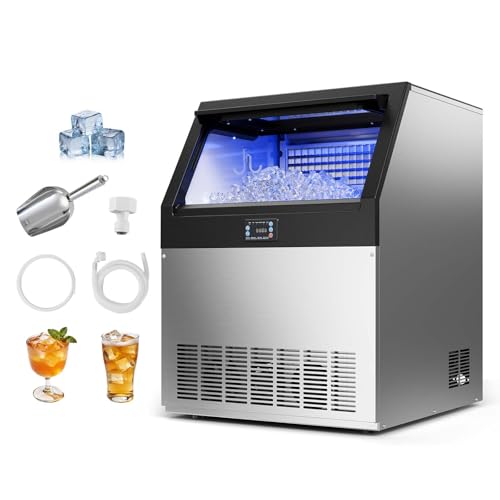
The Uthfy tops this guide’s output table by a wide margin: 170 pounds per day, delivered 50 cubes at a time in roughly 14-minute cycles, into a 55-pound storage bin, with a self-cleaning function and a water filter in the box per its verified listing, and ETL certification. It suits busy cafés, bars, bakeries and event-heavy households — anywhere ice is consumed by the tub rather than the glass. Output at this level changes the planning: instead of banking ice ahead of a rush, the machine recovers during it. The cabinet is a freestanding or undercounter stainless unit, sized and plumbed like the rest of this plumbed class.
Strengths
- 170 lbs/day is in another league from the 90–100 lb class
- 55 lb storage matches the production with real reserve
- Self-cleaning cycle and included filter simplify the maintenance contract
Trade-offs
- Output this size needs the water and drainage to match — plan the plumbing
- Larger appetite for space and ventilation than the 15-inch machines
- Value-brand service depth, as with the EUHOMY picks
| Output | 170 lbs/24H (per Amazon title) |
| Cycle | 50 cubes in 14 mins (per Amazon title) |
| Storage | 55 lbs (per Amazon title) |
| Features | Self-clean, water filter (per Amazon title) |
| Certification | ETL (per Amazon title) |
Output ratings deserve the same skepticism everywhere in this guide, and the Uthfy’s numbers should be read as a class claim rather than a promise: in a hot room with warm inlet water, every machine in this article produces less than its badge. What survives that discounting is the ranking — a machine rated at 170 will out-produce machines rated at 100 in the same kitchen on the same day, and its 55-pound bin gives the surplus somewhere to live. The self-cleaning cycle is the feature to weight most heavily at this size, because a high-output machine mineralizes its water path faster than a small one, and the machines that get cleaned are the ones whose cleaning is a button. If your ice life is measured in tubs and your venue cannot pause, this is the guide’s answer.
Best for: busy cafés, bars and event-heavy homes needing maximum recovery speed / Not suited for: modest households, whose demand the 90–100 lb class covers for less
Check the current price on Amazon before you commit — finish and configuration change what you pay, and the listing is the only place the live figure is accurate.

4. Scotsman CU50GA-1 Undercounter Gourmet Cube Ice Maker — Best for Home Bars — Check on Amazon
The CU50GA-1 makes Scotsman’s other famous cube: the gourmet cube, a large, crystal, bell-shaped cube prized by bars precisely because it melts even more slowly than a standard dice and looks like it in the glass. The machine wraps that cube in a compact undercounter cabinet with its own storage bin, in stainless, NSF listed. It suits home bars, cocktail households and small lounges where the ice is part of the drink’s presentation and a 100-pound dice machine would be industrial overkill. A pump-drain sibling (the CU50PA-1A) exists in the same line for installs where gravity drainage cannot reach — the configuration to ask about if your bar sink sits above the drain line.
Strengths
- Gourmet cubes are the slowest-melting, best-looking format in this guide
- Compact undercounter footprint sized for residential bars
- Scotsman build and service backing at a home-friendly scale
Trade-offs
- Gourmet format trades raw output for cube quality
- Plumbed install, like every machine in this article
- Premium tier for its size class
| Ice type | Gourmet cube (per Amazon title) |
| Configuration | Undercounter with bin |
| Body | Stainless steel (per Amazon title) |
| Certification | NSF (per Amazon title) |
| Power | 115 volts (per Amazon title) |
Cocktail ice is a hierarchy, and the gourmet cube sits near its top for a reason any bartender can demonstrate: drop one into a measured pour beside a standard cube and time the dilution. The gourmet cube’s size and density keep a drink cold and composed through a long conversation, which is why bars that could buy cheaper ice choose this format. The CU50GA-1 is the residential doorway into that world — Scotsman’s commercial cube-making in a cabinet that fits a home bar’s undercounter run, with a bin that keeps a weekend’s worth of cubes ready. Buy it when the drink matters more than the volume; the dice machines above win every contest measured in pounds, and lose this one measured in minutes per cube.
Best for: home bars and cocktail households prioritizing cube quality over volume / Not suited for: high-volume venues or cooler-filling duty
Check the current price on Amazon before you commit — finish and configuration change what you pay, and the listing is the only place the live figure is accurate.

5. EUHOMY 15-inch Under Counter Ice Maker, 90 lbs/24H — Best for Home Kitchens — Check on Amazon
The 15-inch format is the home kitchen’s doorway into plumbed ice: a cabinet the width of a trash compactor or wine fridge, built in under the counter, producing a rated 90 pounds of cubes a day into a 24-pound bin. EUHOMY’s version adds gravity drainage, a 24-hour timer and auto-cleaning per its verified listing, in stainless. It suits kitchen remodels that can surrender one 15-inch cabinet run, households graduating from a countertop machine, and anyone who wants refrigerator-independent ice without a commercial footprint. Ninety pounds a day is more ice than any household uses — the real product here is the bin: a permanent, self-refilling reserve where the countertop basket used to be.
Strengths
- 15-inch width fits standard kitchen cabinet runs
- 90 lbs/day with a 24 lb always-ready bin
- Auto-cleaning and timer functions suit residential ownership
Trade-offs
- Gravity drainage must be planned — the drain has to be below the machine
- 24 lb bin is a household reserve, not a party warehouse
- A remodel-grade purchase: cabinet, water and drain in one project
| Width | 15 inches (per Amazon title) |
| Output | 90 lbs/24H (per Amazon title) |
| Storage | 24 lbs (per Amazon title) |
| Drainage | Gravity (per Amazon title) |
| Features | 24H timer, auto-cleaning (per Amazon title) |
Judge this machine against what it replaces. Against a countertop unit, it trades a Saturday of plumbing for a lifetime of not filling reservoirs, not harvesting baskets and not surrendering counter space — the trade every owner in this category eventually makes or wishes they had. Against its 100-pound commercial siblings, it concedes bin size and some duty rating in exchange for a residential width, a timer and a gentler ownership rhythm. The gravity drain is the one specification to plan around: without a drain below the unit, this model is the wrong choice and a pump-drain model — the Scotsman CU50PA-1A configuration in this guide’s wider family — is the right one. Get the drain question answered before the cabinet is cut and this is the most livable full-cube purchase a home can make.
Best for: kitchen remodels adding permanent ice in a 15-inch cabinet run / Not suited for: installs without a drain below the machine, or renters
Check the current price on Amazon before you commit — finish and configuration change what you pay, and the listing is the only place the live figure is accurate.

6. Coolski 15-inch Under Counter Ice Maker, 130 lbs/Day — Best High-Capacity Built-In — Check on Amazon
The Coolski squeezes the comparison’s second-highest output into its joint-narrowest cabinet: 130 pounds per day and a 30-pound bin in a 15-inch stainless built-in, with auto-cleaning and an LCD control panel per the verified listing, rated for commercial, home and outdoor use. It suits compact commercial spaces — food trucks, small cafés, office kitchens — and serious home bars where the cabinet run is 15 inches but the demand is not small. Output density is its whole argument: where the Uthfy spreads 170 pounds across a larger footprint, the Coolski delivers 130 through a slot that fits where a dishwasher’s narrower cousin would.
Strengths
- 130 lbs/day from a 15-inch width — unmatched output density here
- 30 lb bin is generous for the footprint
- Auto-cleaning and LCD panel simplify daily management
Trade-offs
- High output in a small cabinet means ventilation discipline matters
- Lesser-known brand — service network is the standing value-tier caveat
- Commercial appetite needs commercial-grade water and drainage planning
| Width | 15 inches (per Amazon title) |
| Output | 130 lbs/day (per Amazon title) |
| Storage | 30 lbs (per Amazon title) |
| Features | Auto-cleaning, smart LCD panel (per Amazon title) |
Output density is a real engineering achievement and a real responsibility. A 15-inch cabinet making 130 pounds a day is rejecting the heat of those pounds into a small space, so the installation’s ventilation clearances — the boring lines in the manual — are the difference between a machine that hits its stride and one that throttles itself on a hot afternoon. Grant it the clearances, feed it filtered water, and the Coolski is the answer to a specific and common problem: a serious ice demand in a serious space constraint. It will not out-serve the Uthfy in an open floor plan and it will not out-last the Scotsman’s service network in a twenty-year ledger, but in a 15-inch slot with a crowd to serve, nothing else in this guide is close.
Best for: compact commercial spaces and serious home bars with a 15-inch limit / Not suited for: installs that cannot guarantee ventilation clearance
Check the current price on Amazon before you commit — finish and configuration change what you pay, and the listing is the only place the live figure is accurate.
Comparison Table
| Pick | Badge | Key spec | Best for |
|---|---|---|---|
| Scotsman CU0920MA-1 Cube Undercounter Ice Maker, 100 lbs/Day | Best Overall | Full cube, 100 lbs/day, 57 lb storage, NSF (per Amazon title) | serious home bars, small cafés and offices wanting permanent full-cube supply |
| EUHOMY Commercial Ice Maker Machine, 100 lbs/24H | Best Value Commercial | 100 lbs/24H, 45 pcs/cycle, 33 lb bin (per Amazon title) | home bars and small venues wanting commercial output on a value budget |
| Uthfy Commercial Ice Maker, 170 lbs/24H | Best High Output | 170 lbs/24H, 55 lb storage, self-clean + filter, ETL (per Amazon title) | busy cafés, bars and event-heavy homes needing maximum recovery speed |
| Scotsman CU50GA-1 Undercounter Gourmet Cube Ice Maker | Best for Home Bars | Gourmet cube, undercounter with bin, NSF (per Amazon title) | home bars and cocktail households prioritizing cube quality over volume |
| EUHOMY 15-inch Under Counter Ice Maker, 90 lbs/24H | Best for Home Kitchens | 15in built-in, 90 lbs/24H, 24 lb bin, auto-cleaning (per Amazon title) | kitchen remodels adding permanent ice in a 15-inch cabinet run |
| Coolski 15-inch Under Counter Ice Maker, 130 lbs/Day | Best High-Capacity Built-In | 15in, 130 lbs/day, 30 lb bin, auto-cleaning (per Amazon title) | compact commercial spaces and serious home bars with a 15-inch limit |
What ‘Full Cube’ Actually Means — and What It Excludes
Ice formats form a spectrum of density. At one end, nugget ice is compressed flakes: soft, chewable, fast-chilling and fast-melting. Bullet ice, the countertop standard, is a hollow shell frozen around a finger — quick to make, quick to vanish. Crescent ice, from refrigerator and some undercounter machines, is a solid half-moon of middling density. The full cube sits at the far end: a solid, full-size cube — commercial dice or the larger gourmet format — frozen in a mold or on a grid until it is hard and clear through. The physics is unforgiving and simple: melt rate tracks surface area, and the full cube minimizes it. That is why bars serve it, why coolers packed with it outlast coolers packed with anything else, and why the machines that make it are plumbed appliances rather than countertop toys — freezing water solid, in quantity, and storing it frozen takes a refrigeration system with a water line, a drain and a bin, not a reservoir and a basket. When a listing says ‘cube’, check which cube it means; this guide’s picks were each confirmed to mean the solid one.
How to Choose a Full Cube Ice Maker
Start with the site, because plumbed ice is an installation before it is an appliance. You need a water supply, a drain — gravity if a floor or sink drain sits below the machine, a pump model if it does not — power, and ventilation clearance for an air-cooled condenser. Measure the cabinet run: 15-inch machines fit residential remodels, wider commercial cabinets need their own space plan. Next, size by storage before output: the bin is what you actually serve from, so a household or bar should size the bin to its biggest evening, then confirm the daily output refills that bin between events — the picks here span 24 to 57 pounds of storage and 90 to 170 pounds of daily production, and the right pairing depends on whether your demand is steady or spiky. Then the cube itself: dice for general and cooler duty, gourmet for cocktail service where dilution is measured in minutes. Finally, the service question, asked honestly: a commercial Scotsman can be repaired by any ice technician in America, while value brands trade that network for price — a trade that suits a home bar and worries a business.
Output and Storage: Reading the Two Numbers Together
Every machine in this guide advertises two numbers, and they are routinely misread as one. Output — pounds per day — is a production rate measured under favorable conditions: cool room, cold inlet water. Warm rooms and warm water cut it substantially, on every brand, without exception. Storage — the bin’s pounds — is a snapshot of readiness: how much ice exists at the moment the rush begins. Service capacity across an evening is storage plus whatever production adds during the event, which is why a 57-pound bin on a 100-pound machine (the Scotsman) serves a long night better than a 24-pound bin on a 90-pound machine, while the 90-pound machine wins the daily rhythm of a household that never draws the bin to empty. The planning rule: size storage to your peak hour, size output to your peak day, and distrust any purchase made by comparing one machine’s output against another’s storage. The spec boxes in this guide print both numbers side by side precisely so the comparison is made correctly.
Gravity Drain vs Pump Drain: The Installation Fork
More undercounter ice installs fail on drainage than on any other detail, so the fork deserves its own section. A gravity-drain machine needs its drain outlet above a drain that flows away downhill — a floor drain, or a sink drain positioned lower than the machine’s outlet. Where that geometry exists, gravity is simpler, quieter and has no pump to fail. Where it does not — a bar counter far from a drain, a basement below the sewer line, an island installation — a pump-drain model lifts the meltwater to the drain for you, at the cost of a pump’s price and maintenance. Scotsman’s line in this guide’s wider family illustrates the split exactly: the CU50GA drains by gravity, its CU50PA sibling adds the pump. Decide the drain before the model, because the prettiest machine in this article is a fountain without one — literally: an undrained ice maker overflows its bin meltwater onto your floor. If you are unsure which geometry your site has, that is the one question worth a plumber’s visit before any purchase.
Water, Scale and the Maintenance Contract
A plumbed ice machine is a water appliance that runs every hour of its life, and its maintenance contract is written in your water. Scale is the chronic condition: minerals deposit on the evaporator, insulating it, slowing production and eventually deforming the harvest, which is why output quietly fades on neglected machines of every brand. Filtration is the prevention — several picks here include or support filters, and in hard-water areas a filter is not an accessory but a condition of the warranty of your own satisfaction. Cleaning is the cure on a schedule: the self-cleaning cycles on the EUHOMY, Uthfy and Coolski picks exist because commercial practice proved that machines with a cleaning button get cleaned, and Scotsman’s service model assumes periodic professional descaling. Add the condenser to the rhythm — an air-cooled machine breathing dusty undercounter air through a clogged filter runs hot and slow. None of this is weekly work; it is quarterly attention that separates a machine making its rated ice in year five from one making half of it in year two.
Budget Tiers for Full-Cube Machines, in Words
No static prices are printed here, so read the field in tiers. The value tier — EUHOMY’s pair and the Coolski — buys real full-cube production and storage at positions the commercial majors do not contest, accepting thinner service networks as the trade. The high-output value tier, the Uthfy, buys production headroom that embarrasses pricier machines on the spec sheet, with the same service caveat. The commercial tier — both Scotsmans — buys the cube quality benchmark, NSF-listed commercial construction and the deepest technician network in ice, at the tier’s customary premium. Underneath all three sits the alternative this site covers elsewhere: countertop machines, bullet and nugget, which need no plumbing and serve smaller demands for a fraction of the project cost — see the Frigidaire guide linked below for that world’s best brand story. Full-cube plumbed ice earns its tiers when the demand is daily, the drinks are slow or the coolers are large; it is over-engineering, honestly labeled, for a household that ices a pitcher on Sundays.
Full Cube vs Nugget vs Bullet: The Melt Test You Can Run at Home
If the format argument in this guide feels abstract, settle it empirically before you spend anything. Buy or make three glasses’ worth of each format — nugget from a drive-through, bullet from a friend’s countertop machine, full cubes from a bar or a bag of commercial ice — and pour the same measured drink over the same weight of each. Taste at ten-minute intervals and note two things: when the drink tastes watered, and how much ice remains at the half hour. The full cube’s advantage stops being a claim and becomes a measurement, and so does its one honest cost: it chills a warm drink more slowly at first contact than the fast-melting formats, because the same low surface area that resists dilution also resists heat transfer. That trade — slower first chill, far slower dilution — is the whole format decision. Drinks consumed quickly and casually forgive any format. Drinks nursed, coolers hauled and cocktails composed do not, and they are the reason this category of machine exists at plumbed-appliance prices.
Where Full-Cube Machines Earn Their Keep: Four Settings
The home bar is the obvious setting — a permanent bin of bar-grade cubes behind the counter where the drinks are made. The second is the entertaining house, where the machine’s bin quietly absorbs the demand curve that used to mean emergency ice runs: the cooler at noon, the punch bowl at six, the nightcap at ten. The third is the small commercial venue — café, bakery, salon, office — where a 100-pound class machine is the difference between ice as infrastructure and ice as a daily errand, and where an NSF-listed unit like the Scotsman answers the health inspector’s question before it is asked. The fourth is the serious hobby kitchen: home brewers crashing wort, canners blanching, anglers and hunters icing a catch, all of whom consume ice by the tub on a schedule and benefit from production that recovers overnight. Notice what unites the four: the demand is recurrent, not occasional. Occasional demand belongs to bags and countertop machines; recurrent demand is what repays a water line, a drain and a bin.
Sound, Heat and Living Next to a Plumbed Ice Machine
Two ownership realities rarely make the brochure. The first is sound: an ice machine cycles a compressor, a pump and a harvest that drops a sheet of cubes into a bin with a small avalanche, several times an hour at full demand. Under a bar counter or in a café that soundtrack is ambience; under the counter of an open-plan kitchen beside the sofa, it is a presence — site the machine with your ears as well as your tape measure, and prefer a cabinet run away from quiet rooms. The second is heat: every pound of ice is heat removed from water and rejected into the room through the condenser, so a hard-working machine warms its corner and wants the ventilation this guide keeps mentioning. Neither reality is a defect, and commercial owners never notice either. Residential buyers should simply plan for them the way they would for a wine fridge or a second dishwasher — appliances with cycles, placed where their cycles belong.
How to Install an Undercounter Full Cube Ice Maker
Plan the install as three trades in one morning: cabinetry, plumbing and power. Before the machine arrives, confirm the cabinet opening’s width and height against the model’s dimensions, confirm a water supply with a shutoff within reach of the machine’s inlet, and settle the drainage — gravity fall to a drain, or a pump model if the drain is not below. Confirm the electrical outlet and the ventilation path: air-cooled machines exhaust heat, usually through the front grille, and the manual’s clearances are requirements, not suggestions. On the day, slide the machine out of its packaging and let it stand upright before connecting anything if it was transported on its side. Connect water first and check for leaks at every fitting before the machine goes into the cabinet — a leak found in the open is a fitting; a leak found after installation is a floor. Connect the drain with a continuous downhill run (or prime the pump per the manual), level the cabinet on its feet so the bin door seals and the water distributes evenly across the evaporator, then power on and discard the first full bin of ice: new lines and a new water path season the first production, as with every ice machine. Run one full day before judging output, then set the cleaning and filter reminders in your calendar while the manual is still open. If any step involves cutting a water line you cannot shut off confidently, that step belongs to a plumber — the machine’s price includes no floor repairs.
Common Buying Mistakes
The full-cube mistakes are installation mistakes wearing a shopping costume. First is buying before the drain is solved — the gravity-versus-pump question decides which models are even eligible, and discovering it afterward means returns or floods. Second is comparing output numbers across brands as if they were measured in the same kitchen; they are laboratory maxima, useful for ranking within a guide like this one and useless as promises. Third is starving ventilation: a machine shoehorned into a sealed cabinet throttles itself and ages early. Fourth is neglecting filtration in hard-water country, then blaming the machine for the scale your water delivered. Fifth is sizing by output and ignoring the bin — the evening is served from storage, not from the production rate. Sixth is forgetting the first-bin rule and serving seasoning ice to the guests the machine was bought for. Every one of these is prevented by the site survey in the install section, which is why this guide puts the plumbing before the podium.
Final Recommendation
The shortlist by situation: for the commercial benchmark with the deepest service network, the Scotsman CU0920MA-1. For the same output class on a value budget, the EUHOMY 100-pound commercial machine. For maximum production and recovery, the Uthfy 170. For cocktail service where the cube is part of the drink, the Scotsman CU50GA-1 gourmet machine. For a home kitchen remodel with a 15-inch run and a gravity drain, the EUHOMY 15-inch; for that same slot with commercial demand, the Coolski 130. If the plumbing survey kills the project, the countertop world is not a consolation prize — start with our best frigidaire ice makers guide for the strongest brand range there, and the best ice makers overview for the whole field.
Best Frigidaire Ice Makers Best Ice Makers Best Freezer Ice Makers Best French Door Refrigerator With Dual Ice Makers
Frequently Asked Questions
What is a full cube, compared with other ice types?
A full cube is a solid, full-size cube of ice — commercial dice or the larger gourmet format — frozen hard and clear. It melts more slowly than hollow bullet ice, crescent ice or nugget ice because it has the least surface area for its weight, which makes it the standard for bars, slow drinks and coolers that must stay cold for hours.
Do full cube ice makers need a water line and drain?
Yes — the plumbed machines in this guide connect to a water supply and discharge meltwater to a drain. Gravity-drain models need a drain below the machine; pump-drain models can lift water to a higher drain. That installation requirement is the main dividing line between this category and countertop machines, which use a pour-in reservoir instead.
How much ice do I need per day?
Work from the bin outward: size storage to your biggest evening’s draw, then confirm daily output refills it before the next event. A household’s daily drinking might use five to ten pounds; a party with a cooler can draw forty. The machines here span 90 to 170 pounds of daily output and 24 to 57 pounds of storage — most homes are served by the bin size, not the output headline.
Are commercial brands like Scotsman worth it for a home?
For a home bar that will keep the machine a decade, the case is service: any ice technician can repair a Scotsman, and parts depth is unmatched. Value brands deliver the same ice on day one for less, with thinner support. The right answer depends on your downtime tolerance and your horizon, and this guide’s reviews argue both sides openly.
Why does my ice maker’s output drop over time?
Usually scale and airflow, not age. Mineral deposits insulate the evaporator and slow the freeze cycle, and a clogged condenser filter makes an air-cooled machine run hot. Filtration prevents most of it; the self-cleaning cycles several picks include, or a professional descale for commercial units, reverses it. Output fade is a maintenance report, not a death sentence.
Gourmet cube or regular dice cube — which should I choose?
Gourmet cubes are larger and slower-melting, made for drinks where dilution control and presentation matter — spirits, cocktails, anything sipped slowly. Dice cubes are the general-purpose standard: faster to produce in volume, right for coolers, blended drinks and service speed. Bars with both needs sometimes run both formats; homes should pick by the glass they fill most.