Disclosure: airfryerkitchensupply.com is reader-supported. When you buy through links on our site, we may earn an affiliate commission at no extra cost to you.
Where to buy
Freezer ice makers are model-specific parts, not appliances, and the right unit for your refrigerator is decided by your fridge’s model number — not by a ranking. Every pick below was verified against its Amazon listing, and each is named by the exact kit it is. What a ranking cannot do is fit the part for you: confirm the kit against your full model number on the product page before ordering, and check the current price on Amazon through the links.
- Frigidaire IM116000 Ice Maker Assembly Kit — Best Overall.
- GE WR30X10093 Ice Maker Kit (KITCHEN BASICS 101) — Best Complete Refresh for GE Refrigerators.
- Upgraded 4317943 Ice Maker Kit for Whirlpool and Kenmore — Best Budget Repair.
- Samsung DA97-15217D Refrigerator Ice Maker Assembly (OEM) — Best for Premium French Door Models.
- Frigidaire IM117000 Top-Mount Ice Maker Kit — Best for Classic Top-Freezer Layouts.
- Whirlpool 1129313 Genuine OEM Add-On Ice Maker Kit — Best Factory Add-On for Whirlpool Refrigerators.
The best freezer ice makers answer a question countertop machines cannot: how does the ice get made inside the refrigerator you already own? For a large share of households the answer is that it already can. Millions of refrigerators left the factory “ice maker ready” — the freezer compartment has the mounting points, the wiring harness and the water path prepared, and a knockout or blank plate where the ice maker belongs. What is missing is simply the kit: the ice maker unit itself, and in complete kits the storage bin, the water inlet valve and the hardware to connect them. A freezer ice maker kit is therefore less an appliance purchase than the completion of a feature your refrigerator was built to have.
The category has a second, larger population: households whose factory ice maker has died. In-freezer ice makers live a hard life — cycling in sub-zero air, flexing a mold heater and ejector arm thousands of times, sipping water through a small valve — and they are among the most commonly replaced refrigerator parts. The replacement market answers with everything from bare maker modules to complete refresh kits, and the economics are compelling: a kit costs a fraction of a refrigerator, installs with hand tools, and returns a dead ice dispenser or a silent freezer bin to full service.
What this category is not matters as much. It is not the countertop ice maker — the portable appliance that sits beside the fridge making soft bullet ice; those are reviewed elsewhere in this cluster and are deliberately excluded here, because they solve a different problem for a different kitchen. It is not the undercounter machine either. Everything in this guide lives inside a refrigerator or freezer compartment, plumbed to the household water line, making hard freezer ice in the background. If that is the ice you want — and for drinks at home it is the ice most people actually mean — the six classes below are the complete map of how to buy it.
In this guide
Quick Picks
- Frigidaire IM116000 Ice Maker Assembly Kit — Best Overall: the manufacturer’s own kit for ice-maker-ready Frigidaire-family refrigerators — the highest-confidence fit in the category, because it was designed for your exact model. — check price on Amazon
- GE WR30X10093 Ice Maker Kit — Best Complete Refresh: the full replacement kit for a long list of GE refrigerator models — the right answer when a GE installation needs its maker renewed properly. — check price on Amazon
- Upgraded 4317943 Ice Maker Kit for Whirlpool and Kenmore — Best Budget Repair: the replacement maker in one of the category’s most common patterns — the economical fix when the bin and valve are still healthy. — check price on Amazon
- Samsung DA97-15217D Ice Maker Assembly (OEM) — Best for Premium French Door Models: the genuine Samsung assembly that replaces DA97-15217A — a dealer-grade part for a dealer-grade fridge. — check price on Amazon
- Frigidaire IM117000 Top-Mount Ice Maker Kit — Best for Classic Layouts: Frigidaire’s own kit for the top-freezer fridges that fill rentals, garages and second kitchens — simple, proven, widely stocked. — check price on Amazon
- Whirlpool 1129313 Genuine OEM Add-On Ice Maker Kit — Best Factory Add-On: Whirlpool’s genuine add-on kit for its own refrigerator families — the factory route for the largest fleet of ready fridges in the category. — check price on Amazon
How These Picks Were Chosen
This guide is organized by the decision rather than by a league table, deliberately. A kit that ranks first for one refrigerator does not fit another at all, and a buying guide that pretends otherwise sends readers to returns desks. What can be ranked honestly is which verified kit solves which household’s problem — the OEM add-on, the complete refresh, the budget module, the french door assembly, the top-freezer kit and the second factory route — what each costs in money and effort relative to the others (described in tiers, never invented figures), and what to verify before any of them is ordered.
The classes below were chosen to cover the real shape of the market: adding a maker to a fridge that never had one, replacing a maker that died, refreshing a whole aging installation, serving the french door models whose makers are complete assemblies rather than simple modules, the classic top-freezer fleet, and the high-demand household whose problem is output rather than absence. Compatibility rules, failure diagnosis and installation reality are covered in the buying and how-to sections, because in this category the knowledge is worth more than the link.
Verification followed the program standard: each kit was searched by brand and part number, the returned title was matched against the intended kit, and the ASIN was taken from the listing response. That process is what allows this guide to name exact kits — a Frigidaire IM116000 is a specific part with a specific fit list, not a category — and it is also why no other kits appear here: several searches returned ice trays, water-line kits and countertop machines wearing this search, and all of them were excluded as off-intent.
The 6 Best Freezer Ice Makers

Frigidaire IM116000 Ice Maker Assembly Kit — Best Overall
If your Frigidaire-family refrigerator is ice-maker-ready and has never made ice, the manufacturer’s own add-on kit — the IM116000 assembly kit, verified here in its genuine Frigidaire listing — is the closest thing this category has to a guaranteed outcome. The kit is engineered for a defined list of models: the maker mounts to prepared points in the freezer, its harness plugs into the refrigerator’s own connector, and the water path — through the inlet valve the kit includes or the one the fridge already carries — follows the route the designers intended. There is no measuring, no adapting and no hoping; the compatibility question is answered by matching your model number against the kit’s stated list.
Strengths
- Exact-fit engineering — mounting, wiring and water path all designed for your model family
- Complete by design: the kit includes what the installation needs rather than assuming it
- The strongest support position — the fridge maker documents and stands behind its own kit
Trade-offs
- Premium tier within its class — you pay for the badge and the certainty
- Strictly model-bound: the kit fits its list and nothing else, so the model number check is unforgiving
- Availability follows the fridge’s age; kits for discontinued models thin out over time
The ownership experience is the point. An OEM kit’s maker speaks the refrigerator’s own language — cycle timing, harvest temperature, water fill duration — because the same engineering organization specified both. Ice quality and bin-fill behavior match what the fridge would have done had the maker been installed at the factory, and if anything misbehaves, one manufacturer owns the whole conversation. For a fridge you intend to keep for a decade, that coherence is worth the tier difference over a universal module.
The one discipline this pick demands is the model number. Find it on the label inside the fresh-food compartment — the full number, including any suffix letters — and match it character for character against the kit’s compatibility list. “Fits most models of the brand” is not a match; the list is the match.
Best for: owners of ice-maker-ready Frigidaire, Kenmore and Electrolux-family refrigerators who want the factory result / Not suited for: models outside the kit’s stated list, or bargain-first repairs
Check the current price on Amazon
GE WR30X10093 Ice Maker Kit (KITCHEN BASICS 101) — Best Complete Refresh
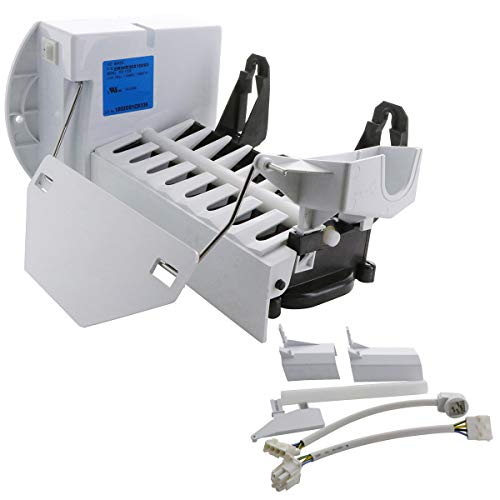
When an ice maker dies in a GE refrigerator that has served for years, the maker is often only the first failure — and the WR30X10093 is the part number GE households meet first, because it serves a long list of GE, Hotpoint and Kenmore models. The verified kit here is the KITCHEN BASICS 101 WR30X10093 replacement, whose listing names the GE model families it fits. Treat it as the complete-refresh route for those models: the maker renewed as a proper kit rather than a bare module of uncertain pattern.
Strengths
- One purchase renews maker, bin and valve — no second failure waiting a month behind the first
- Components are matched to work together, including bin-to-maker fit that piecemeal buying gets wrong
- The single installation session does the whole job while the freezer is empty and warm
Trade-offs
- Highest parts cost of the repair classes — justified by scope, wasted if only the maker failed
- The valve replacement adds a water-line step that a maker-only swap avoids
- More parts to verify against the model list before ordering
Judge this class by the age and symptoms of the installation. A fridge whose maker died at year three needs a maker. A fridge at year ten with a slow fill, a stained bin and a valve that has cycled a hundred thousand times is telling you the system is old, and renewing it as a system is the economical reading of that message — one session of labor, one shipping box, and an ice system that starts its life over together. The valve deserves its reputation in this decision: it is the second most common failure in the system, it is inexpensive inside a kit, and replacing it while the water is already off is the cheapest insurance in appliance repair.
Best for: GE, Hotpoint and Kenmore owners whose model appears on the WR30X10093 fit list / Not suited for: other brands, or young fridges with a single, clearly isolated maker failure
Check the current price on Amazon

Upgraded 4317943 Ice Maker Kit for Whirlpool and Kenmore — Best Budget Repair
The workhorse pattern of the category is the 4317943 — a replacement maker built to the mounting and connector pattern shared by a wide range of Whirlpool and Kenmore refrigerators, sold for the household whose maker has died inside an otherwise healthy system. The verified listing here is the upgraded 4317943 kit, which names the part numbers it replaces — W10122496, 833701 and W10281545 among them. A large share of in-freezer makers follow a common design language — a modular unit with a mold, ejector and motor in one housing, mounted by a few screws, fed by a standard harness — and the universal module exists because that commonality lets one part revive a long list of models at the friendliest tier in this guide.
Strengths
- The most economical route back to ice — you buy only the part that failed
- Broad cross-brand coverage in the common mounting patterns
- The simplest installation in the category: out with the old module, in with the new
Trade-offs
- “Universal” means pattern-matched, not magical — connector type, mounting and cube size must still be verified against your old unit
- No bin or valve included; a tired valve will undermine a new maker
- Support is the seller’s, not the fridge maker’s
The verification ritual for this class is physical and quick: photograph your old maker’s connector, mounting points and label before ordering, and compare them against the listing’s photographs and stated pattern. Match the cube count and style your old maker produced, because the bin and dispenser downstream were built around it. Done carefully, the universal module is the smartest money in the category — the repair that returns a working ice system for the price of a modest grocery run, and the reason so many twenty-year-old refrigerators are still making ice.
Best for: confident DIY repairers with a healthy bin and valve and a Whirlpool/Kenmore pattern maker / Not suited for: first-time repairers facing a model with a non-standard assembly
Check the current price on Amazon

Samsung DA97-15217D Refrigerator Ice Maker Assembly (OEM) — Best for Premium French Door Models
French door refrigerators changed the ice maker’s address. In many designs the maker lives in the fresh-food door or a dedicated compartment, making slim cubes for the through-door dispenser, sometimes alongside a second maker in the freezer drawer. These are complete assemblies — housing, maker, sometimes ducting and electronics — engineered for one model family. The verified example here is the genuine Samsung DA97-15217D assembly, an original-equipment part that replaces DA97-15217A — the exact-assembly route, bought by part number.
Strengths
- The only correct route for in-door and dual-maker designs — the assembly is the part
- Restores through-door dispensing, the feature these fridges are bought for
- Model-family specificity removes the pattern-guessing of universal parts
Trade-offs
- The premium tier of the category, reflecting the assembly’s complexity
- Installation is the most involved here — trim panels and multiple connectors reward patience or a technician
- Zero interchangeability: a near-match assembly is a wrong part
The honest advice for this class is twofold. First, diagnose before ordering: in-door makers suffer frozen fill tubes and failed fans as often as failed makers, and an assembly will not cure a frozen tube. Second, respect the job’s scale — a handy owner with the model’s service documentation can do it, and an owner who is not sure should price a technician’s visit against the assembly’s cost and decide with open eyes. Either way, the alternative to the correct assembly is not a cheaper part; it is a fridge without dispensed ice.
Best for: Samsung french door owners whose model calls for the DA97-15217 family assembly / Not suited for: freezer-compartment makers (use the module picks above) or the uncommitted DIYer
Check the current price on Amazon

Frigidaire IM117000 Top-Mount Ice Maker Kit — Best for Classic Layouts
The top-freezer refrigerator is the fleet vehicle of American kitchens — rentals, garages, break rooms, second fridges — and a great many of them are ice-maker-ready with the maker never installed. Frigidaire’s own answer is the IM117000 top-mount kit, verified here in its genuine listing: the maker and its installation hardware in a package refined over decades of identical installations.
Strengths
- The most mature kit class in the category — installation is documented everywhere and forgiving
- Transforms the hardest-working fridges in the house for a modest tier
- Parts remain widely stocked because the fleet is enormous
Trade-offs
- Bin ice only — no through-door dispensing in this layout, ever
- The freezer is small; the bin takes a real share of it
- Garage installations must respect the fridge’s ambient temperature limits in winter
For landlords and second-fridge households this class is close to a formality: check readiness, match the model, spend an hour, and a fridge that froze ice in trays for a decade starts filling a bin on its own. The garage caveat deserves its sentence — a freezer in an unheated garage in a cold climate can stop cycling correctly, maker included, when the ambient air approaches freezing; that is a refrigerator limitation, not a kit defect, and it decides placement rather than purchase.
Best for: rentals, garages and second refrigerators with ice-maker-ready Frigidaire top freezers / Not suited for: anyone expecting dispenser ice from this layout
Check the current price on Amazon

Whirlpool 1129313 Genuine OEM Add-On Ice Maker Kit — Best Factory Add-On
The second factory route in this guide belongs to the largest ready-fridge fleet of all: Whirlpool’s own 1129313, a genuine OEM add-on kit for Whirlpool refrigerators that left the factory prepared for a maker they never received. It plays the same role for Whirlpool households that the IM116000 plays for Frigidaire ones — the kit the manufacturer itself specifies, with the fit list to match — and its long production life means it is among the most documented installations in the category.
Strengths
- Genuine Whirlpool part — the add-on the manufacturer specifies for its own models
- Decades of production make instructions, videos and parts support exceptionally deep
- The factory result: cycle timing and fit exactly as the fridge was designed to receive
Trade-offs
- Whirlpool-family only — Kenmore and Maytag owners must confirm their model on the kit’s list rather than assume
- OEM tier pricing against the compatible-pattern modules
- Like every add-on, it presumes a ready fridge and a water line; it supplies neither
Choose between this and the upgraded 4317943 module by the age of the job: adding a maker to a ready Whirlpool fridge for the first time is the 1129313’s home ground, while replacing a dead maker in a working system is the module’s. Both are verified above; the model list decides.
Best for: Whirlpool owners adding a maker to a ready fridge for the first time / Not suited for: other brands without a confirmed fit-list match
Check the current price on Amazon
Comparison Table
| Pick | Badge | Key Spec | Best For |
|---|---|---|---|
| Frigidaire IM116000 Ice Maker Assembly Kit | Best Overall | maker + valve + bin matched to a stated model list | ice-maker-ready fridges that have never made ice |
| GE WR30X10093 Ice Maker Kit | Best Complete Refresh | maker, bin, inlet valve and fittings in one box | older systems with multiple symptoms |
| Upgraded 4317943 Ice Maker Kit | Best Budget Repair | bare maker in the common mounting patterns | a dead maker inside a healthy system |
| Samsung DA97-15217D Ice Maker Assembly (OEM) | Best for Premium French Door Models | complete in-door / in-compartment assembly | restoring through-door dispensing |
| Frigidaire IM117000 Top-Mount Ice Maker Kit | Best for Classic Layouts | maker, shelf bin, valve and fill tube | rentals, garages and second fridges |
| Whirlpool 1129313 Genuine OEM Add-On Kit | Best Factory Add-On | genuine Whirlpool add-on kit for ready fridges | Whirlpool owners adding a maker for the first time |
How to Choose a Freezer Ice Maker Kit: Compatibility Before Everything
Every other appliance guide on this site starts with features. This one starts and nearly ends with compatibility, because a freezer ice maker is a part, and a part either fits your refrigerator or is an expensive paperweight. The first check is the model number — the full number from the label inside the fresh-food compartment, suffix letters included. Kit listings state compatibility by model or model family; match yours exactly, and treat “fits most” language as a prompt to find the actual list, not as an answer.
The second check is readiness, for add-on buyers. An ice-maker-ready freezer shows its preparation: mounting points or a cover plate where the maker belongs, a wiring connector waiting behind a cap, and a marked route for the fill tube at the back. If your freezer shows none of these, your refrigerator was not built for a maker, and no kit in this guide changes that — your honest options are the countertop machines this guide excludes, or trays. Manufacturers’ support pages confirm readiness by model; check before money moves.
Third, for replacement buyers: identify what actually failed. A maker that stopped with a full mold points one way; an empty mold points at water supply — the valve, the line, a frozen fill tube. Replacing a healthy maker because its valve died is the category’s most common wasted purchase, and the diagnosis section below exists to prevent it. Fourth, match the physical pattern of any universal part: connector, mounting, and the cube size and count your bin and dispenser were built around, verified against photographs of your old unit.
Finally, the water itself. Every kit in this guide presumes a household water line reaching the refrigerator with reasonable pressure and a shutoff you control. Homes without a line need the plumbing conversation first — a saddle valve on a nearby cold line is the traditional route, a proper tee and valve the better one — and a filter, inline or in-fridge, is the difference between ice that tastes like water and ice that tastes like the pipes. Budget the line and filter into the project; the kit is only the last third of it.
The Water Line and the Filter: The Half of the System Nobody Sees
Every ice maker in this guide is the visible end of an invisible system, and most ice complaints trace back along it. The line itself should be a proper cold-water supply with its own shutoff — copper or braided stainless where budgets allow, with the thin plastic tubing of old installations treated as a replacement candidate rather than a fixture, because aged plastic lines are the source of both off-tastes and the category’s rare but memorable leaks. The shutoff’s location should be known to the household before installation day, not discovered during it.
Filtration decides what the ice tastes like and how the valve ages. An in-refrigerator filter, where the fridge has one, serves the maker as well as the water dispenser and wants replacing on the maker’s schedule — a clogged filter starves the maker into small, hollow cubes long before it stops the dispenser noticeably. Fridges without internal filtration take an inline filter on the supply line, installed where it can actually be reached for its own replacements. In hard-water country the filter is also the valve’s bodyguard: mineral scale is what slows inlet valves into the weak-fill failures described in the diagnosis section, and every year of filtered water is a year added to the valve and the maker’s fill consistency. None of this is glamorous, and all of it is the difference between an ice system that is forgotten for a decade and one that is a recurring weekend project.
One last readiness nuance: some refrigerators were sold with the maker as a dealer-installed option, so a fridge whose twin sits in a showroom making ice may still need the kit in yours. Readiness is a property of your individual unit and its build sheet, not of the model line’s advertising — one more reason the physical checks inside your own freezer outrank every brochure.
Diagnose Before You Buy: Is It the Maker, the Valve or the Tube?
Fifteen minutes of diagnosis saves the price of the wrong part. Start with the obvious: is the maker’s control arm or switch in the on position, and is the freezer actually at freezing temperature — a warm freezer makes no ice and imitates every failure in this guide. Then look at the mold. Ice or water sitting in the mold that never harvests implicates the maker itself — its motor, heater or thermostat. An empty, dry mold with a working freezer implicates supply: feel the fill tube at the back of the maker for an ice blockage, the classic silent failure, which a hair dryer on low and patience will clear. If the tube is clear and the mold is dry, the inlet valve — the small electric valve where the water line meets the fridge — is the suspect, and it is a cheaper part than the maker.
Weak, small or hollow cubes tell a third story: restricted water — a clogged filter, a kinked line, a valve opening poorly. Cloudy ice is usually dissolved air and minerals, a water question rather than a maker question. And a maker that cycles but drops nothing may simply have a bin sensor or arm obstructed by the ice it already made. Diagnose in that order — temperature, position, mold, tube, valve, filter — and the part you order will be the part that was broken.
Bin, Auger and Dispenser: The Other Half of the System
A freezer ice maker does not work alone. In bin-only layouts its partner is simply the bin and the sensing arm or sensor that tells it when to rest. In dispenser layouts the system grows: an auger motor turns a helix in the bin to move ice to the chute, a crusher may intervene for cubed-or-crushed choice, and a flap seals the chute against warm air. When a household reports that “the ice maker stopped working,” a meaningful share of the time the maker is innocent and the failure lives here — a stripped auger coupling, a bin cracked by a dropped scoop’s years of service, a sensor arm frozen in the off position by the ice it made.
This is why the complete refresh kit class exists, and why diagnosis in this guide insists on separating maker failures from system failures before money moves. It is also why bin care matters: never use the bin as a cooler for bottles and cans, which contaminate the ice and jam augers; never reach into a dispenser bin with the fridge powered if fingers near the auger are the plan; and when a bin is removed for washing — warm soapy water, fully dried before it returns, because a wet bin refreezes into a single sculpture of itself — the maker should be switched off so it does not cycle into an empty space.
How to Install a Freezer Ice Maker Kit
The standard installation, common to the add-on and replacement classes, is an hour of careful hand-tool work. Unplug the refrigerator and close the water shutoff first — every later step assumes both. Empty the freezer and remove the shelf and any cover plate where the maker belongs. On a replacement, photograph the old unit’s wiring and mounting before touching a screw; on an add-on, find the prepared mounting points and the capped connector the factory left for you.
Mount the maker loosely, connect its harness until the connector seats fully, then tighten it level — a tilted maker fills its mold unevenly and makes lopsided cubes. Route the fill tube so it aims into the maker’s fill cup without kinks or contact with the ejector’s path. If the kit includes the inlet valve, mount it at the back of the refrigerator, connect the household line and the tube to the freezer, and check every compression fitting twice before the water goes on. Restore water, watch the first fill for leaks with the fridge still pulled out, then restore power. The maker’s first cycles are a purge — discard the first two or three bins of ice, which carry the taste of new plastic and disturbed lines — and full production settles within a day. Keep the manual’s lever or switch positions in mind: the bin arm or sensor is the maker’s only way of knowing it can stop.
Post-installation checks close the job properly. Within the first hour, confirm the maker has filled once without dripping at the fill cup and that no fitting at the valve weeps — a dry paper towel pressed to each joint is the honest test. Within the first day, confirm the bin is filling at a steady rhythm and that the sensing arm or sensor stops production when the bin is full; a maker that cannot tell it is done will bury itself in its own ice. Recheck the valve area once more at a week, because slow seeps announce themselves late. Keep the old unit, if it was replaced, until the new one has run a full week — it is the reference for every pattern question the next repair will ask, and it costs one shelf of storage.
Ice Quality: What Comes Out of the Mold
In-freezer makers produce crescent or cube ice depending on the mold design your refrigerator family uses, and the shape is not a free choice — the bin, auger and dispenser were built around it, which is why replacement matching in this guide insists on the same cube pattern as the original unit. What is in your control is quality. Hard, solid cubes come from a freezer at proper temperature, a full and unhurried fill, and water that is not carrying excess air; small or hollow cubes are the signature of a restricted fill, and cloudy cubes are usually frozen dissolved air and minerals — harmless, and cured more by filtration and a freezer that is not opened every ten minutes than by any part.
Taste follows the water and the freezer’s other tenants. Ice absorbs odors from an open freezer over its days in the bin, so a bin that turns over quickly tastes cleaner than one that sits — another quiet argument for matching maker output to household demand rather than maximizing it. The discipline that keeps freezer ice at its best is boring and complete: filter changed on schedule, first bins after any work discarded, bin washed when it is emptied for other reasons, and food near the bin kept sealed.
Repair or Replace the Refrigerator? The Honest Arithmetic
Because ice maker kits attach to refrigerators, every buyer in this category is implicitly answering a bigger question, and it deserves an explicit answer. A kit — even the premium assembly class — costs a small fraction of a refrigerator, and the failure of an ice maker says almost nothing about the health of the machine around it: compressors, sealed systems and cabinets routinely outlive two makers. When the fridge cools well and suits the kitchen, replacing its maker is not a sunk cost; it is the cheapest feature restoration in the appliance world.
The calculus flips only when the ice failure arrives with company — uneven cooling, a compressor that runs constantly, a cabinet at the end of its second decade. Then the kit money is better held toward the replacement refrigerator, ideally one with the maker factory-installed. Judge the fridge, not the ice: a sound fridge with a dead maker is a repair; a dying fridge with a dead maker is a coincidence.
Cube Styles and Bin Sizes: The Small Choices That Follow You
Two quiet specifications shape daily life with a freezer ice maker more than any headline. The first is cube style: crescent ice from the classic mold design drops reliably, stacks loosely and suits bins and basic dispensers; the cubed styles of many french door systems feed crushers and through-door chutes. Because the dispenser hardware is built around one style, a replacement maker must reproduce the original — a fact this guide repeats because it is the compatibility detail most often missed after the model number itself.
The second is bin capacity. A bin is a buffer between a maker that works in cycles and a household that drinks in bursts, and its size relative to demand decides whether ice feels unlimited or rationed. Small bins in compact freezers serve couples well and punish party hosts; large bins in big french door freezers forgive a weekend of guests. When choosing between kit classes, count your household’s worst normal day — not its average — and let the bin that survives that day make the decision.
What Each Route Commits You To: Tiers and Effort
Without printing prices — which move, and which differ by model too much to quote responsibly — the category’s tiers rank clearly. The universal module is the budget repair: one part, one hour, the smallest commitment in the guide. The OEM add-on kit and the complete refresh kit sit in the middle tier, buying certainty and scope respectively. The french door assembly is the premium tier, priced by its complexity and justified only by the dispenser it restores. Around every tier sit the same supporting costs, small but real: a filter, possibly a section of line and a shutoff, and the hour or two of your own labor — or a technician’s visit, which for the assembly class can rival the part and should be quoted before, not after, the box is opened.
Effort ranks differently from money and should be planned separately. Module swaps are well within a careful beginner’s reach. Add-on kits add the valve and water path. Refresh kits add scope but not new skills. Assemblies add trim, connectors and consequence, and are the one class where this guide’s advice tilts professional for most owners. Choose the class by the failure, then choose the installer by the class.
Common Buying Mistakes
Ordering by brand alone is the founding mistake — every brand sells multiple incompatible patterns, and the model number, not the badge, decides fit. Second: buying a maker for a refrigerator that was never ice-maker-ready; readiness is built in at the factory or not at all. Third: replacing the maker when the valve or a frozen fill tube was the failure, then replacing the valve a month later at twice the total cost. Fourth: assuming a countertop or undercounter machine belongs in this category — they are fine appliances and entirely different purchases, excluded here on purpose. Fifth: ignoring the water line until installation day, when the kit is open and the nearest shutoff is a surprise. Sixth: keeping the first bins of ice, which taste of the installation, instead of discarding them as every maker manual instructs.
Final Recommendation
Match the kit to the situation and this category becomes simple. A ready Frigidaire-family fridge that never made ice wants the IM116000, matched by model number; a ready Whirlpool wants the 1129313. A GE system failing with age wants the WR30X10093 kit. A single dead maker inside a healthy Whirlpool or Kenmore system wants the 4317943 module and a careful photograph. A Samsung french door fridge wants its exact DA97-15217D assembly and an honest look at whether the job is yours or a technician’s. A top-freezer workhorse wants the proven IM117000. When you are ready to compare the standalone alternatives this guide deliberately set aside, the cluster continues at Best Ice Makers, Best Frigidaire Ice Makers, Best Built Ice Makers and Best Electric Ice Makers — and the fridges these kits serve are covered at Best French Door Refrigerator With Dual Ice Makers.
Frequently Asked Questions
Can any refrigerator accept an ice maker kit?
No — only models built ice-maker-ready, with the mounting points, wiring and water path prepared at the factory. Check your model on the manufacturer’s support pages before buying; if the freezer shows no preparation points, a kit cannot be added and a countertop machine is the honest alternative.
What is the difference between a freezer ice maker and a countertop ice maker?
A freezer ice maker is a part installed inside your refrigerator, plumbed to the water line, making hard ice continuously into a bin. A countertop ice maker is a standalone appliance you fill with water by hand, making softer ice that must be used or moved to the freezer. They solve different problems and are covered in separate guides in this cluster.
How long does a kit installation take?
About an hour for a standard add-on or module replacement with hand tools, longer for a complete kit with a valve swap, and longest for french door assemblies with trim work. The water checks before and after take the time they take; rushing them is how small leaks become floor damage.
Why did my new ice maker produce bad-tasting ice at first?
New plastic, disturbed lines and a long-idle filter season the first batches. Discard the first two or three bins, replace an old filter, and the ice clears. If taste persists beyond that, the water line itself — especially an old plastic line — is the usual culprit.
How much ice does an in-freezer maker produce?
Enough for ordinary households by design: the maker cycles whenever the bin has room, keeping a standing supply rather than producing on demand. Heavy households — parties, coolers, big families — should choose the largest-bin configuration their model supports and keep expectations honest: beyond that case sits the separate undercounter category, not a bigger kit.
My ice maker stopped suddenly. What should I check first?
Freezer temperature, the maker’s on/off arm or switch, and the fill tube for an ice blockage — in that order. Most sudden stops are one of the three, and none of them requires a part. The full diagnostic sequence is in the diagnosis section above.
Do I need a plumber to add the water line?
Not always. If a line with a shutoff already reaches the refrigerator, kit installation is a hand-tool job. If no line exists, the work is basic plumbing — a tee and valve on a nearby cold line — that a confident homeowner can do and a plumber does quickly. What you should not do is skip the shutoff or use a self-piercing saddle valve as a permanent answer where codes or sense prefer a real valve; the line you install once serves every maker the fridge will ever have.