Disclosure: airfryerkitchensupply.com is reader-supported. When you buy through links on our site, we may earn an affiliate commission at no extra cost to you.
Where to buy
Every linked pick in this guide to the best freestanding grills is sold through Amazon, where you can check the current price on Amazon and confirm the fuel, format and included stand or cart on the exact listing before ordering. This category is polluted with built-in heads and tabletop units wearing freestanding keywords, so the listing check matters: if the photos show an island or a picnic table, the support furniture is probably not in the box.
- Weber Spirit E-325 Gas Grill (LP) (Best Overall) — Check on Amazon
- Weber Original Kettle Charcoal Grill, 22-Inch (Best Charcoal) — Check on Amazon
- Traeger Ironwood 885 Wood Pellet Grill & Smoker (Best Pellet) — Check on Amazon
- Kamado Joe Classic Joe I, 18-Inch (Best Kamado Value) — Check on Amazon
- Char-Broil Patio Bistro TRU-Infrared Electric Grill (Best Electric for Balconies) — Check on Amazon
- Monument Grills Mesa Series 4+1 Propane Gas Grill (Best Large Value Gas) — Check on Amazon
The best freestanding grills are defined by one practical freedom: they stand on their own. No island to build, no table to supply, no masonry to commit to — a cart, a set of legs or a stand that lets the grill live on a patio, a deck, a rental balcony where rules allow, or the corner of a yard, and move when your life does. This is the master guide for the format, spanning every mainstream fuel: gas for speed, charcoal for flavour, pellets for hands-off smoke, kamado ceramic for range, and electric for the spaces where open flame is not allowed at all.
Because this guide covers all fuels, it is organised differently from our fuel-specific companions. If you already know you want gas, our freestanding gas guide goes deeper on burners and carts; if you want the barbecue brief specifically, our BBQ guide argues the smoke case. Here, the job is comparison at the format level: which fuel’s weekly routine fits your household, which size class fits your patio and headcount, and which specific freestanding model is the strongest verified example of each path. Six picks, six genuinely different answers — because “best grill” with no fuel attached is a question about your life, not about hardware.
Every pick below stands on its own support as sold and was matched, brand and model, against Amazon’s own catalogue data through this site’s Amazon product listings. Specs in the mini boxes quote only what those verified listings state. We have excluded built-in heads, tabletop-only units and any model whose freestanding format we could not confirm — a discipline that removed several famous names and kept this list honest.
One sizing truth before the picks: most households should buy the grill for their Tuesday, not their Fourth of July. A mid-size freestanding grill that lights fast and cleans easily will cook three hundred dinners a year; the party happens twice. Size for the routine, borrow or batch for the party, and let the fuel decision — the one you will live with daily — carry the budget.
A note on prices, since this category spans from a kettle that costs less than a family grocery run to a kamado that costs like an appliance: we print no prices, because grill pricing swings with seasons and sales more than almost any category we cover. Instead, each pick is positioned by tier — budget, mid-range, premium — and the check-price links take you to the live figure. Judge value by cost per year of expected service, not by the number on the tag this week: the cheapest grill here may be the best value in the guide, and so may the most expensive, depending on how long each serves.
In this guide
Quick Picks
If you only read one section, make it this one. These are the six best freestanding grills we would shortlist first, each chosen for a different kind of buyer rather than ranked by a single score.
- Weber Spirit E-325 Gas Grill (LP) — Best Overall. Three burners with a boosted sear zone in Weber’s compact cart — the freestanding grill we would hand to the widest range of households. — Check on Amazon
- Weber Original Kettle Charcoal Grill, 22-Inch — Best Charcoal. The original freestanding icon: a 22-inch enamelled kettle on wheeled legs with the One-Touch cleaning system — the cheapest route to real fire flavour. — Check on Amazon
- Traeger Ironwood 885 Wood Pellet Grill & Smoker — Best Pellet. 885 square inches of WiFi-controlled, wood-fired cooking with Super Smoke mode — the freestanding pellet flagship for people who entertain and multitask. — Check on Amazon
- Kamado Joe Classic Joe I, 18-Inch — Best Kamado Value. The entry point to ceramic kamado cooking, cart and side shelves included per the listing: one freestanding grill for smoking, roasting, baking and fierce searing. — Check on Amazon
- Char-Broil Patio Bistro TRU-Infrared Electric Grill — Best Electric for Balconies. A freestanding electric grill on its own stand, using TRU-Infrared cooking — the format that apartment and condo rules actually allow, that still cooks like a grill. — Check on Amazon
- Monument Grills Mesa Series 4+1 Propane Gas Grill — Best Large Value Gas. Four burners plus a side burner and 62,000 BTU in a stainless cart — the big-grill specification for buyers who measure value in capacity. — Check on Amazon
How These Picks Were Chosen
We chose by format first: each pick had to be genuinely freestanding as sold, with its cart, legs or stand included, and sized for a household rather than a campsite. Then we took the strongest verified representative of each fuel class — the gas cart most families should buy, the charcoal kettle that defines its category, the pellet grill with the best control package, the kamado that balances price and range, the electric that apartment rules actually permit, and one large value gas cart for hosts — so the six together map the whole decision space.
Grill listings are notorious for variant soup — the same nameplate in three fuels, two sizes and a retailer-exclusive trim — so we linked only the exact configuration each review describes, and the review text states that configuration plainly. If you shop from these links, the listing title is your final confirmation of fuel and format before checkout.
Finally, we scored the ownership pattern: parts availability, cover availability, consumable logistics (tanks, charcoal, pellets, electricity), and the cleaning burden each fuel quietly imposes. A freestanding grill is a five-to-fifteen-year household appliance, and the right one is the one whose chores you will still be doing cheerfully in year four.
The 6 Best Freestanding Grills

Weber Spirit E-325 Gas Grill (LP) — Best Overall
If one freestanding grill has to represent the whole category, it is this one. The Spirit E-325 pairs the three-burner layout that suits most families with the feature gas grills historically lacked: a Sear Zone with Boost burners, per the verified listing, which concentrates extra heat on one patch of grate so steaks get a real crust instead of a grey tan. The rest of the time it behaves like the ideal weeknight appliance — push-button ignition, ten-minute preheat, zones for chicken and vegetables, and a cart compact enough for ordinary patios.
Strengths
- Boost sear zone fixes the classic gas-grill weakness
- Compact cart with decade-grade parts support
- Fast, zone-capable weeknight cooking
Trade-offs
- Smoke flavour stays subtle
- Three burners crowd for big parties
- Propane tank logistics included
| Fuel | Liquid propane |
| Burners | 3 |
| Sear zone | Sear Zone with Boost burners (per listing) |
| Format | Freestanding cart |
The Spirit formula’s strength is what it refuses to be. It is not the largest grill here, not the smokiest, not the cheapest. It is the one with the fewest bad days: burners that light individually, grates and heat tents that are catalogue parts years later, a grease system that behaves, and a lid that seals well enough for confident roasting. Households upgrading from a dying big-box cart feel the difference in the first week — mostly as an absence of drama.
Its limits are the fuel’s limits. Smoke is a garnish, not a headline, even with a smoker box; and three burners crowd at eight burgers plus sides. If your cooking is smoke-led, the pellet and kamado picks below exist for you. If your cooking is life-led — dinners, deadlines, homework — the E-325 is the freestanding grill that fits around it.
Best for: Most households wanting one dependable all-round grill / Not suited for: Smoke-first cooks or regular hosts of ten-plus
Check on Amazon — check price on Amazon for the current configuration and delivery terms.

Weber Original Kettle Charcoal Grill, 22-Inch — Best Charcoal
Every fuel debate ends here, at a black enamelled bowl that has barely changed in decades because it did not need to. The Original Kettle is freestanding in the purest form — three legs, two wheels, an ash pan — and it cooks with a directness no gas or pellet grill fully imitates: real coals, real smoke, searing heat that costs almost nothing to achieve. The One-Touch cleaning system sweeps ash into the catcher with a lever, which is the difference between charcoal as a pleasure and charcoal as a chore.
Strengths
- Deepest fire flavour per dollar of any pick
- One-Touch ash sweeping keeps charcoal tidy
- Legendary durability and parts availability
Trade-offs
- Chimney lighting adds lead time to every cook
- Fully manual temperature control
- Ash and coal storage are part of the deal
| Fuel | Charcoal |
| Format | Kettle on wheeled legs (freestanding) |
| Cleaning | One-Touch cleaning system (per listing) |
As a household’s only grill, the kettle asks for two honest commitments: time (a chimney takes fifteen to twenty minutes to be ready) and technique (dampers are your thermostat). In exchange it grills, roasts, and — with coals banked to one side — slow-cooks ribs and whole birds with a flavour depth that justifies the ritual for millions of owners. It is also the most repairable object in this guide: every part, down to the leg sockets’ hardware, is a catalogue item, and the enamel bowl routinely outlives the house paint around it.
Buy it as a first grill if you want to learn fire, as a second grill if your gas cart lacks soul, or as the only grill if budget is tight and flavour is the priority. The Premium trim in our BBQ guide adds a better ash catcher and hinged grate; this base model remains the value benchmark of the entire freestanding category.
Best for: Flavour-first cooks and learners on any budget / Not suited for: Ten-minute weeknight dinner schedules
Check on Amazon — check price on Amazon for the current configuration and delivery terms.

Traeger Ironwood 885 Wood Pellet Grill & Smoker — Best Pellet
The Ironwood 885 is what a pellet grill becomes when it stops apologising: a big freestanding barrel on a proper cart, with the D2 drive system and WiFIRE control named in the verified listing, so the grill holds its set temperature and reports to your phone from the couch, the store or the school run. Super Smoke mode leans into the fuel’s strength at low temperatures, and 885 square inches swallows a party’s worth of ribs or a couple of briskets without stacking anxiety. The 500°F ceiling, also per the listing, extends it beyond smoking into roasting and baking territory that older pellet grills could not reach.
Strengths
- WiFi control and Super Smoke for repeatable barbecue
- 885 sq in handles crowds and whole briskets
- 500°F ceiling adds roasting and baking range
Trade-offs
- Needs mains power and dry pellet storage
- Searing still trails live charcoal
- Largest footprint and a premium price tier
| Fuel | Hardwood pellets + electricity |
| Cooking area | 885 sq in (per listing) |
| Max temp | 500°F (per listing) |
| Control | D2 controller with WiFi app control (per listing) |
Pellet cooking’s social contract is different from charcoal’s: you trade tending for trust. The machine feeds the fire; your jobs are keeping the hopper full of dry pellets, the grease system clean, and the cover on between cooks. Do those, and the Ironwood produces the most repeatable barbecue in this guide — the same ribs, the same bark, cook after cook — which is why caterers and big families gravitate to this class.
It is the largest and most power-dependent pick here, needing an outdoor outlet and dry pellet storage, and its sear, while improved at 500°F, still trails a kettle over live coals. As the centrepiece freestanding grill for a household that entertains and loves smoked food, nothing else in the six does its job.
Best for: Entertainers who want set-and-monitor smoked food / Not suited for: Off-grid sites or small balconies
Check on Amazon — check price on Amazon for the current configuration and delivery terms.

Kamado Joe Classic Joe I, 18-Inch — Best Kamado Value
The Classic Joe I is the kamado for buyers who want the ceramic experience without the flagship invoice. The verified listing confirms the freestanding essentials — cart and side shelves included, with a grill gripper and ash tool in the box — around an 18-inch ceramic firebox that does the kamado party trick: hold a gentle smoking temperature for hours on a modest load of lump charcoal, then open the vents and climb to pizza-and-steak temperatures no gas grill here can touch.
Strengths
- Full kamado temperature range at the entry price
- Cart, shelves and tools included — freestanding out of the box
- Ceramic fuel economy for long, cheap slow cooks
Trade-offs
- Heavy lid without air-lift assistance
- 18-inch grate limits crowd throughput
- Ceramic demands careful moving and no thermal shock
| Fuel | Lump charcoal |
| Format | Ceramic kamado with cart and side shelves (per listing) |
| Cooking area | 250 sq in (per listing) |
Generation I means you lift the full weight of the ceramic lid (no air-lift hinge) and manage a simpler gasket and top vent than the Series II in our BBQ guide. Those are comfort differences, not cooking differences — the ceramic, the fuel economy and the temperature range are the real product, and they are all present. For many households this is the smarter buy: the money saved against Series II funds a cover, a bag of good lump and a season of cooks.
Respect the format’s two rules and it will serve for decades: never shock hot ceramic with cold water or rain, and move it like the heavy ceramic object it is, casters notwithstanding. Within those rules it is the most versatile single freestanding grill in this guide — the one cooker that genuinely covers weeknight chicken, Saturday ribs and Sunday pizza without a supporting cast.
Best for: Enthusiasts wanting one grill for every cooking style / Not suited for: Frequent movers or high-volume party cooking
Check on Amazon — check price on Amazon for the current configuration and delivery terms.
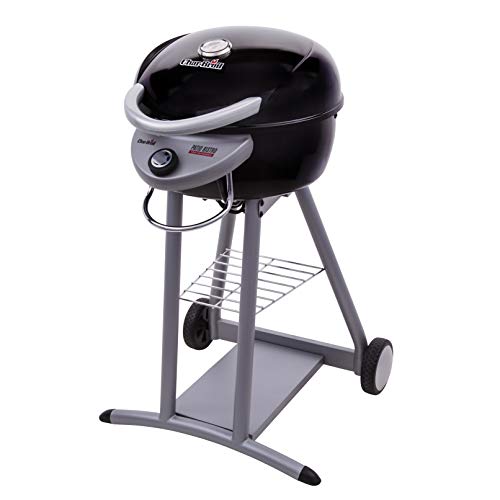
Char-Broil Patio Bistro TRU-Infrared Electric Grill — Best Electric for Balconies
For a large class of households, the fuel debate is settled by the lease: no charcoal, no propane, no open flame on the balcony. The Patio Bistro exists for exactly that clause. It is a genuinely freestanding electric grill — its own stand, its own lid, a real grate — and Char-Broil’s TRU-Infrared system puts an emitter plate between the electric element and the food, which evens the heat, tames flare-ups and produces more convincing grill behaviour than a bare-element electric has any right to. Plug it into an outdoor outlet and dinner is a ten-minute preheat away, in buildings where every other pick in this guide is prohibited.
Strengths
- Permitted where flame fuels are banned
- Infrared plate evens heat and cuts flare-ups
- Zero fuel storage, ash or tank chores
Trade-offs
- Outlet-limited power slows searing and recovery
- Must live within cord reach of power
- Small grate suits couples, not crowds
| Fuel | Electricity |
| System | TRU-Infrared (per listing) |
| Format | Freestanding patio bistro with stand |
Set expectations by physics: an outlet delivers a fraction of a gas burner’s energy, so recovery after loading cold food is slower and hard searing is a patience game — preheat fully, cook in smaller batches, and let the infrared plate do its work. Within those limits it grills burgers, chicken, vegetables and fish entirely respectably, with no fuel to store, no ash to sweep and no tank to exchange — a running-cost profile apartment dwellers genuinely love.
It is also a legitimate second grill for houses: the winter-weeknight, two-burger solution that does not justify lighting charcoal. But as a primary grill for a household with no restrictions, the gas and charcoal picks above it are simply more capable. Buy the Bistro because your rules require electric, or your life rewards plug-in simplicity — both are good reasons.
Best for: Apartments, condos and balconies with flame bans / Not suited for: Unrestricted yards wanting maximum performance
Check on Amazon — check price on Amazon for the current configuration and delivery terms.

Monument Grills Mesa Series 4+1 Propane Gas Grill — Best Large Value Gas
Monument’s Mesa 4+1 is the specification maximalist’s pick: the verified listing counts four main burners plus a side burner at 62,000 BTU total, wrapped in a stainless cart with the broad grate that hosts and big families actually use. Monument has built its name on giving this class of buyer more visible hardware per dollar — backlit controls, wide shelves, viewing windows on some trims — and the Mesa delivers the core of it: capacity, zones and a side burner, without entering premium-brand money.
Strengths
- Four burners, side burner and high total output for the tier
- Wide grate suits families and hosts
- Strong visible specification per dollar
Trade-offs
- Value-gauge stainless needs cover discipline
- Assembly is a substantial flat-pack session
- Wear parts cycle sooner than premium brands
| Fuel | Propane |
| Output | 62,000 BTU (per listing) |
| Burners | 4 + 1 side burner (per listing) |
| Body | Stainless steel (per listing) |
The ownership proposition mirrors other value carts in our guides: assembly rewards patience, the stainless is a presentational gauge that wants a cover and a wipe-down, and burners and heat plates should be treated as mid-life service items with parts ordered from the brand’s channel. None of that is a scandal at the price; it is simply the contract. Kept covered and cleaned, the Mesa cooks family dinners and full parties with the same zone map as grills costing far more.
Choose it over the Spirit E-325 when your headcount regularly exceeds what three burners serve gracefully, and over the Genesis when the budget is the binding constraint. Choose the Webers over it when daily use and a decade horizon make firebox weight the smarter spend. That is the honest fork, and different households should take different branches.
Best for: Capacity-first buyers on a firm budget / Not suited for: Decade-horizon daily grillers
Check on Amazon — check price on Amazon for the current configuration and delivery terms.
Comparison Table
| Pick | Badge | Key spec | Best for |
|---|---|---|---|
| Weber Spirit E-325 Gas Grill (LP) | Best Overall | 3 burners, Sear Zone with Boost, propane cart | Most households wanting one dependable all-round grill |
| Weber Original Kettle Charcoal Grill, 22-Inch | Best Charcoal | 22-inch charcoal kettle, One-Touch cleaning system | Flavour-first cooks and learners on any budget |
| Traeger Ironwood 885 Wood Pellet Grill & Smoker | Best Pellet | 885 sq in, WiFIRE WiFi control, Super Smoke, 500°F max | Entertainers who want set-and-monitor smoked food |
| Kamado Joe Classic Joe I, 18-Inch | Best Kamado Value | 18-inch ceramic kamado, cart with side shelves, 250 sq in | Enthusiasts wanting one grill for every cooking style |
| Char-Broil Patio Bistro TRU-Infrared Electric Grill | Best Electric for Balconies | Electric, TRU-Infrared system, freestanding stand format | Apartments, condos and balconies with flame bans |
| Monument Grills Mesa Series 4+1 Propane Gas Grill | Best Large Value Gas | 4 burners + side burner, 62,000 BTU, stainless cart | Capacity-first buyers on a firm budget |
The table is a fuel map as much as a product list, and its key-spec column deliberately mixes the numbers each fuel is honestly judged by — burners for gas, inches for charcoal, area and control for pellet, and permission for electric. Gas (Spirit, Mesa) is the speed path, charcoal (kettle) the flavour path, pellet (Ironwood) the automation path, kamado (Classic Joe) the range path, and electric (Patio Bistro) the permission path. Pick the path first; the model follows almost automatically.
How to Choose the Best Freestanding Grills
Confirm the format before anything else, because search results will not do it for you. Freestanding means the grill includes its own cart, legs or stand and finished exterior panels. Built-in heads need an island; tabletop units need your furniture; both appear under freestanding searches with photography designed to blur the distinction. On any listing, find the assembled dimensions and the words for the included stand or cart — all six picks here pass that check as sold.
Then choose fuel by routine, in this order of questions. Are any fuels banned where you live? That decides electric for many renters instantly. Do you cook on weeknights under time pressure? That argues gas or pellet. Is smoke flavour the point of the exercise? That argues charcoal, kamado or pellet. Do you want one grill to bake pizza and smoke brisket? That is the kamado’s whole case. Answer honestly and the six picks sort themselves.
Size classes, translated into dinners
Compact freestanding grills (kettle 22-inch, three-burner carts, the Bistro) serve two to six people and fit real balconies and patios. Mid-size (four-burner carts, Pro-class pellet barrels) serve six to ten and are the family default. Large (Ironwood-class barrels, five-burner carts) serve parties and meal-prep households, and earn their footprint only if used. When torn between sizes, choose the smaller with the better firebox — grate crowding is an occasional annoyance, but a cheap firebox is an everyday one.
The cart is part of the cooker
Judge wheels against your surface (large wheels for decking and pavers, casters for smooth concrete), shelves against a full tray’s weight, and storage against your tool habits. Then check the unglamorous specification: is a fitted cover sold for this exact model? If not, the manufacturer is telling you something about the grill’s intended lifespan.
Freestanding Grill Placement, Clearance and Safety Basics
Place any fuel’s grill on a level, non-combustible surface, with the manufacturer’s clearance from siding, railings and overhangs, and never under a low combustible ceiling. Keep charcoal and pellet grills where ash and embers cannot reach mulch or decking boards, keep gas hoses routed away from hot firebox panels and foot traffic, and keep electric cords on outdoor-rated outlets without daisy-chained extension leads. These basics are identical across fuels and prevent nearly every incident this category produces.
Wind is the silent variable: a grill backed into a wind corridor preheats slowly and cooks unevenly whatever its brochure says. Use the cart’s mobility — the core freestanding advantage — to find the sheltered corner, and mark the spot. Finally, plan the cover and the cleaning kit into the same purchase, and store fuel correctly: propane upright outdoors, charcoal dry, pellets sealed and dry, and nothing combustible stacked against a hot firebox after a cook.
One Grill or Two? The Freestanding Pairing Strategy
Serious outdoor households often end up with two smaller freestanding grills instead of one giant one, and the maths is better than it sounds. A kettle beside a three-burner gas cart covers flavour nights and weeknights with no compromise in either direction, costs less than one flagship pellet or kamado setup, and provides a backup when one grill is mid-cook, mid-clean or mid-repair. The freestanding format is what makes pairing practical — both units wheel, both store under covers, and neither required construction.
The classic pairings: gas plus kettle (speed plus smoke), pellet plus kettle (automation plus sear), electric plus anything (the balcony-safe weeknight option for restricted homes with a yard grill elsewhere). If you are replacing a dead grill and hesitating between fuels, consider whether the hesitation is actually a pairing trying to happen — buy the one you will use most first, and let the second join it when the budget and the patio agree.
Reading Grill Listings Like an Inspector
Three listing habits separate honest products from photography. First, the cooking-area number: check whether it includes the warming rack (secondary area) or counts only the primary grate, and compare primary-to-primary across brands. Second, the material words: ‘stainless steel’ without a grade or gauge is decoration language, while listings that name cast-iron grates, enamelled fireboxes or ceramic bodies are telling you where the money went. Third, the box contents: carts, stands, covers, probes and tools are each sometimes included, sometimes accessories — the verified listings for our picks state inclusions like the Kamado Joe’s cart, shelves, gripper and ash tool explicitly, and your chosen listing should too.
Finally, search the replacement parts before you buy the grill. A model with a priced, orderable burner, grate and igniter is a maintainable appliance; a model with none is a consumable with a long fuse. This five-minute check predicts ownership satisfaction better than any feature comparison we know.
Freestanding Grills for Renters and Small Spaces
Renters and small-space households are the freestanding format’s natural constituency, and their checklist is specific: confirm the lease and local rules on fuel and balcony use before choosing (electric exists precisely for flame bans), measure the balcony door and the storage corner as carefully as the cooking spot, and prefer compact carts and kettles whose covers keep them presentable as semi-permanent residents of a small space.
Weight and wheel size decide whether a grill can be repositioned for cleaning day or a move; a kettle or compact cart is a one-person move, a ceramic kamado is a planned operation. And when the tenancy ends, the freestanding grill is the rare appliance that simply comes with you — no island to abandon, no built-in to leave behind. Buy the size your current space serves, from a brand whose parts will still exist at the next address.
What Each Fuel Really Costs to Run
Charcoal is pay-per-cook: a chimney of briquettes or lump per session, plus ash disposal and the chimney itself as a one-off. Lump costs more per bag, burns hotter and leaves less ash; briquettes burn longer and steadier for slow cooks. Gas is pay-per-tank: an exchange habit, or cheaper refills if you own a sound tank, plus a spare tank as a one-off insurance purchase. Pellets are pay-per-bag with a storage requirement — the fuel must stay dry, so a sealed bin is part of the system cost, and heavy smokers go through bags at a pace that surprises first-time owners.
Electric is pay-per-bill at household rates, which for grilling-sized loads is modest, and it is the only fuel with zero storage and zero trips. Kamado charcoal deserves its own line: the ceramic’s efficiency means a load of lump can often be shut down and relit for a second cook, making it the cheapest fire to run per dinner despite the premium hardware. None of these running costs should scare anyone — all are small next to the food — but the household that hates errands should notice that gas and pellets both involve a consumable supply chain, and charcoal involves a smaller one.
Seasonal Care Calendar for Any Freestanding Grill
Spring: deep-clean the firebox, inspect burners, dampers, igniters and gaskets, clear pellet augers and hoppers of winter fines, oil cast-iron grates, and check gas hoses and connections with soapy water before the first cook. Summer: keep the rhythm light — brush grates hot after cooks, empty ash and grease on schedule, and keep the cover on between sessions; mid-season, check heat tents and flavouriser bars for holes while they are still a cheap order rather than a flare-up.
Autumn: if the grill winters outdoors, clean it thoroughly before the cold (grease and ash hold moisture and invite corrosion and pests), shut down pellet systems with the hopper emptied per the manual, and confirm the cover fits snugly with vents positioned to shed water. Winter cooks are a pleasure on kamado and kettle especially — ceramic and enamel shrug at cold — but every fuel appreciates a preheat allowance and a wind-sheltered spot. One calendar, four light touches a year, is the whole secret behind the decade-old grills you see still cooking in other people’s yards.
How to Measure Your Space and Set Up a Freestanding Grill
Freestanding grills forgive many things, but not a patio they do not fit. Twenty minutes of measuring and a careful first setup prevent the category’s two classic regrets: the grill that blocks the door, and the grill assembled in the wrong place and too heavy to move gracefully.
- Measure the intended spot: floor footprint plus lid-opening arc (check the listing’s depth with lid open), side clearance for shelves and your own elbow room, and the manufacturer’s clearance from walls and railings.
- Measure the route, not just the spot: door widths, gate widths, steps and turns between the delivery point, the assembly area and the final position. Assemble where the grill will live whenever the route is tight.
- Level the ground or shim the surface before assembly; a cart built on a slope keeps the slope. Confirm all wheels or feet contact evenly and the frame does not rock.
- Assemble with frame bolts finger-tight until the unit stands square, then tighten in sequence; fit grates and shelves last, and register the warranty while the paperwork is out.
- Run the fuel-specific first-fire from the manual: leak-test gas connections with soapy water, burn off manufacturing oils on any fuel, season cast-iron grates, and (for pellet) prime the auger per instructions.
- Cook a forgiving first meal, map the hot and cool zones, note them in the manual’s margin, and fit the cover once everything is cool — the habit starts on day one or not at all.
Revisit placement after a month of real cooking. The freestanding advantage is that the grill can move six feet for better wind shelter or a shorter kitchen run — use it. The perfect spot is the one your habits reveal, not the one the first afternoon guessed.
Keep the assembly hardware you did not use, the manual and a photo of the model plate in one kitchen drawer. Freestanding grills are long-lived, movable appliances; their paperwork should be as easy to find in year seven as the grill is easy to wheel in year one. When you eventually order a grate, a burner or a cover, that drawer turns a research project into a two-minute task.
Common Buying Mistakes
Assuming ‘freestanding’ from the photos. Islands and tables in listing photography are staging. Confirm the included cart, legs or stand in the box contents, or you will be shopping for furniture with a grill head in your hallway.
Choosing fuel by flavour alone. Flavour matters on Saturdays; routine matters on Tuesdays. The grill that fits your week gets used, and a used mid-tier grill out-cooks a neglected flagship every time.
Buying party size for a household of two. Oversized grills preheat slower, burn more fuel per burger and crowd small patios. Batch-cook for the annual party instead.
Ignoring the power question for pellet and electric picks. Both need a proper outdoor outlet within reach. Discovering the cord is short after assembly is a solvable but annoying surprise — check first.
Skipping the cover to save money. Weather is the top lifespan variable for every fuel and tier. A fitted cover is the cheapest years-of-service you can buy.
Storing fuel carelessly. Wet pellets jam augers, damp charcoal will not light, and indoor propane storage is a safety violation. Each fuel’s storage rule is simple; follow the one your grill uses.
Final Recommendation
For the single safest recommendation in this guide, take the Weber Spirit E-325: it is the freestanding grill with the fewest bad days for the most households. Flavour-first buyers should take the Original Kettle and learn fire happily; entertainers who love smoked food should take the Ironwood 885; range-seekers the Classic Joe I; balcony households the Patio Bistro; and capacity-per-dollar hosts the Monument Mesa.
If two of those descriptions sound like you, reread the pairing section above — the freestanding format makes the two-grill answer unusually practical. Whatever you choose, verify fuel and format on the listing, buy the cover in the same order, and cook on it the first weekend. A grill’s value is measured in dinners, not specifications.
And if you are still torn between two fuels after all of this, choose the one your household’s busiest cook prefers. The grill that the primary cook enjoys lighting is the grill that gets used, and usage — not specification sheets — is what turns any of these six picks into the best freestanding grill for your home.
The shortlist to act on first: Weber Spirit E-325 Gas Grill (LP) (Best Overall), Weber Original Kettle Charcoal Grill, 22-Inch (Best Charcoal), Traeger Ironwood 885 Wood Pellet Grill & Smoker (Best Pellet). Open each listing, confirm the configuration matches your space and fuel supply, and check price on Amazon before you decide.
Keep researching the cluster: Best Freestanding Bbq Grills Best Freestanding Gas Grills Best Freestanding Natural Gas Grills Best Charcoal Grills Best Pellet Grills Best Electric Grills
Frequently Asked Questions
What is the difference between freestanding and built-in grills?
A freestanding grill includes its own cart, legs or stand and finished sides, and can be placed and moved as a complete appliance. A built-in is a firebox head designed to drop into an outdoor kitchen island; it has no support structure and often unfinished sides. Built-ins suit permanent outdoor kitchens; freestanding suits everyone else, including future movers.
Which fuel is best for a first freestanding grill?
Gas, for most first-time buyers: it lights instantly, forgives timing, and teaches zone cooking without fire management. Charcoal is the better teacher of flavour and fire, and the cheaper buy, if you have the time it asks. Pellet suits buyers who already know they love smoked food; electric suits restricted spaces.
How big a freestanding grill do I need?
Plan on roughly 70–100 square inches of primary grate per regular eater, plus indirect space if you slow-cook. That puts most households of four on a 22-inch kettle or a three-to-four-burner cart, and regular hosts of eight-plus on the larger pellet barrels or five-burner carts.
Can a freestanding grill stay outside all year?
Yes, with a fitted cover and fuel-appropriate care: ash removed from charcoal grills, grease managed on gas and pellet, pellets kept dry, and ceramic kamados protected from freeze-thaw water in the body. Coastal and snowy climates shorten every interval — inspect in spring, whatever the fuel.
Are electric grills worth it if I have no restrictions?
As a primary grill, gas or charcoal will outperform one. As a second grill for quick, small cooks — or for households that value zero fuel storage — an infrared electric like the Patio Bistro earns its outlet. Buy electric for a reason, and it will satisfy; buy it by accident, and it will not.
Can I use a freestanding grill on a wooden deck?
Generally yes, with conditions: a level, stable position, a grill mat under charcoal and pellet models to catch embers and grease, full manufacturer clearances, and never leaving any grill unattended. Check local codes and, for renters, the lease — deck rules vary, and charcoal is the fuel most often restricted after balcony bans.
How long do freestanding grills last?
An enamelled kettle or a kamado can serve for decades with parts support; quality gas carts run around ten years with burner and heat-tent swaps; pellet grills depend on their electronics and auger, typically many years with clean, dry operation; value carts give several good seasons. Covers and cleaning decide which end of each range you get.


