Disclosure: airfryerkitchensupply.com is reader-supported. When you buy through links on our site, we may earn an affiliate commission at no extra cost to you.
Where to buy
If you are shopping for the best folding charcoal grills for rv travel, start with the verified shortlist below. Every model on it was confirmed against a live Amazon listing before it earned a place here, and every one was chosen for RV realities: compact or folding forms that ride in a storage bay, lids that lock for transport, and ash that stays inside the grill until you are ready to deal with it.
- Weber Go-Anywhere Portable Charcoal Grill (Best Overall for RV) — Check the current price on Amazon
- Weber Jumbo Joe Charcoal Grill, 18-Inch (Best Capacity for RV Groups) — Check the current price on Amazon
- Cuisinart 14-Inch Portable Charcoal Grill, CCG-190RB (Best Budget with Locking Lid) — Check the current price on Amazon
- Royal Gourmet CC1619 Portable Charcoal Grill, 284 Sq. In. (Best Tabletop Barrel for RV Sites) — Check the current price on Amazon
- Weber Smokey Joe 14-Inch Portable Charcoal Grill (Best Ultralight Backup) — Check the current price on Amazon
- Royal Gourmet CD1519 Portable Charcoal Grill with Warming Rack (Best with Warming Rack) — Check the current price on Amazon
This guide never prints a fixed price for any product, because grill pricing and stock move constantly. Use the links above to check price on Amazon when you are ready to buy, and read the budget language here as tier guidance — where a model sits in the market — rather than a promise about a specific listing on a specific day. Confirm the exact dimensions on the listing before ordering; with RV gear, an inch is the difference between a bay door that closes and one that does not.
The best folding charcoal grills for rv life are chosen by a storage bay, not a showroom. An RV grill must ride clean in a compartment with your chairs and hoses, set up on a campsite picnic table or a folding stand, cook dinner over real fire, and — the step everyone forgets — hold its ash securely until it is stone cold and legal to dispose of. This guide is written around that full cycle, because a charcoal grill that fails the transport or the ash test fails the RV test, however beautifully it sears.
An honest word about the category name: truly fold-flat charcoal grills are rare. What the RV market actually offers — and what experienced RV cooks actually carry — are compact charcoal grills with folding or locking features: legs that pivot up to lock the lid, lids with latches and carry locks, and tabletop barrels that close into a contained box. This guide names each pick’s actual mechanism rather than pretending every unit folds like a camp chair, and it weights containment — lid locks, latches, ash retention — as heavily as cooking area, because in an RV the journey is half the product.
Every pick was verified against a live Amazon listing, and every specification in the spec boxes comes from those verified listings. Models that could not be confirmed with certainty were excluded rather than guessed at. There are no printed prices and no fixed ratings in this article, because both change too fast to print honestly; check price on Amazon at purchase time and use the tier language to place each model.
Campground reality shapes the list too. Many parks restrict charcoal to designated grills or prohibit it in dry conditions, most require ash to be fully cold before disposal, and all of them frown on a grill stored with yesterday’s ash smelling up a bay. The picks below are the compact charcoal grills that handle those rules gracefully — small footprints for picnic tables, lids that seal for transport, and sizes that cool down on a reasonable evening schedule.
In this guide
Quick Picks
Six picks for six RV situations. Each model was verified against a live Amazon listing, and each badge names the RV job it does best.
- Weber Go-Anywhere Portable Charcoal Grill — Best Overall for RV. The rectangular charcoal briefcase whose legs fold up to lock the lid — ash, grate, and coals contained in one flat-packing box that was seemingly designed for storage bays. Check price on Amazon.
- Weber Jumbo Joe Charcoal Grill, 18-Inch — Best Capacity for RV Groups. An 18-inch kettle with a Tuck-N-Carry lid lock — the biggest cooking circle that still packs like portable gear, for RV sites where the neighbors join dinner. Check price on Amazon.
- Cuisinart 14-Inch Portable Charcoal Grill, CCG-190RB — Best Budget with Locking Lid. A compact 14-inch kettle with a dual-vent system and three lid locks for one-handed carrying — the affordable charcoal that travels sealed. Check price on Amazon.
- Royal Gourmet CC1619 Portable Charcoal Grill, 284 Sq. In. — Best Tabletop Barrel for RV Sites. A compact barrel whose lid converts to a second grill zone, with a latch buckle to close it for travel — 284 square inches that ride latched in the bay. Check price on Amazon.
- Weber Smokey Joe 14-Inch Portable Charcoal Grill — Best Ultralight Backup. The 14-inch original portable kettle with a Tuck-N-Carry lid lock — the smallest, simplest charcoal that rides along almost free and cooks for two. Check price on Amazon.
- Royal Gourmet CD1519 Portable Charcoal Grill with Warming Rack — Best with Warming Rack. A 303-square-inch tabletop charcoal with a warming rack, side handles, and a bottle opener in the design — the site-dinner grill that holds finished food like a home grill does. Check price on Amazon.
How These Picks Were Chosen
Verification for this guide ran through the airfry site’s own Amazon listing data, and it was strict: a model was written up only when its live listing matched the product named here, and the spec boxes quote those listings and nothing else. In RV gear this is not a formality — a listing’s dimensions decide whether a bay door closes — so any model that could not be confirmed with certainty was dropped rather than guessed at.
The six picks were chosen against RV criteria first and grilling criteria second: packed shape and bay fit, lid security in transport, ash containment and cool-down time, setup on a picnic table or stand, and only then cooking area and fire control. A pick earned its badge by being the strongest verified option for its RV situation — the sealed traveler, the group kettle, the budget companion, the latched barrel, the backup, and the batch-cooking station.
Screening also respected campground reality: charcoal restrictions that appear in dry seasons, ash that must be cold before disposal, and quiet hours that make a two-hour cool-down a planning item. Models with known safety recalls were excluded. Where the market’s ‘folding’ claim was really a locking or latching claim, this guide says so plainly — RV buyers deserve mechanisms described as they are.
Best Folding Charcoal Grills for RV: The 6 Picks in Detail

Weber Go-Anywhere Portable Charcoal Grill — Best Overall for RV
If one grill in this guide seems purpose-built for an RV bay, it is this one. The Go-Anywhere’s plated legs pivot up over the lid and lock it shut, turning the grill into a sealed rectangular box — the verified listing confirms the lightweight portable format and two-piece cooking grate — that slides into a compartment like a book into a shelf. It suits RV couples and small families who cook over charcoal a few nights a week on the road. It does not suit cooks feeding a rally’s worth of neighbors; the grate is a two-to-four-person surface, and its virtues are containment and shape, not acreage.
Strengths
- The folding locking legs are the RV feature: lid sealed, grate captive, ash contained — the grill travels as a closed box, not as a sooty assembly of parts.
- The rectangular footprint wastes none of a bay’s corners and stacks predictably against bins and chair bags.
- No fuel system at all: charcoal stores in a small bin, never leaks, never freezes, and is sold at every campground store in the country.
Trade-offs
- Capacity is couples-scale; a potluck night means cooking in waves and holding food warm at the grate’s edge.
- Charcoal discipline applies in full — lighting time before dinner, and ash that must be cold before the bay door closes on it.
- The two-piece grate is a transport blessing and a cooking compromise: mind the seam when sliding food across the surface.
| Spec | Detail (from the verified listing) |
|---|---|
| Format | Portable charcoal grill, rectangular box |
| Grate | 2-piece cooking grate (listing description) |
| Design | Lightweight, for camping, tailgating, and outdoor cooking (listing description) |
| Transport | Legs fold to lock the lid for carrying |
RV veterans judge gear by what it does to the bay, and the Go-Anywhere is the rare grill that improves it. Because the box seals, the bay stays clean; because the shape is rectangular, the space it takes is the space it advertises; because there are no valves, hoses, or canisters, there is nothing to inspect before a travel day. Slide it out at the site, pivot the legs down, light a chimney of charcoal, and the evening runs on rails.
Cooking is classic Weber charcoal work in miniature: a two-level coal bed gives a sear side and a finish side, the rectangular grate takes kebabs, corn, and asparagus spears in tidy rows, and the lid makes it a small oven for finishing chicken or warming rolls. For the way RV couples actually cook — a protein, a vegetable, something in foil — it is not a compromise grill at all. It is the reference design for charcoal on the road, and the pick the rest of this guide is measured against.
Best for: RV couples and small families who cook over charcoal regularly / Not suited for: rally-scale group cooking or cooks who want knob-controlled heat
Check the current price on Amazon

Weber Jumbo Joe Charcoal Grill, 18-Inch — Best Capacity for RV Groups
RV cooking is social: the site next door becomes the dinner table, and a couples’ grill starts batching. The Jumbo Joe answers with an 18-inch kettle — family capacity — in a portable body whose lid locks with Weber’s Tuck-N-Carry system for transport, per the verified listing. It suits RV families and sociable campers who host at the site. It does not suit minimal bay space as gracefully as the rectangular pick above; a kettle’s round bowl claims rounder, less stackable room, and that shape tax is the honest price of its capacity.
Strengths
- Eighteen inches of kettle cooks a family’s burgers or a whole spatchcocked chicken in one session — no waves, no holding pattern.
- The Tuck-N-Carry lid lock keeps lid, grate, and ash together in transit, the kettle world’s answer to the briefcase’s sealed box.
- Kettle cooking is the most forgiving charcoal format there is: banked coals, lid on, and dinner roasts while you sit with your guests.
Trade-offs
- The round bowl packs awkwardly beside rectangular bins; it wants its own corner of the bay or a dedicated tote.
- More charcoal per cook and a longer cool-down than the compact picks — plan the evening’s ash timeline accordingly.
- Legs are short and portable rather than folding-flat; it rides assembled, so its packed height is what it is.
| Spec | Detail (from the verified listing) |
|---|---|
| Size | 18-inch kettle charcoal grill |
| Lid | Tuck-N-Carry lid lock (listing description) |
| Design | Lightweight and portable, for camping and tailgating (listing description) |
| Fuel | Charcoal |
The Jumbo Joe is the capacity answer to the RV charcoal question, and its shape is the classic trade: a kettle’s round grate cooks more per session and roasts better with the lid down than any box of similar weight, while asking the bay for a round hole in a rectangular world. Experienced RV cooks solve it the same way — the kettle rides in its own spot, often in a tote with the charcoal bin and chimney nested in the bowl — and in exchange, site dinners scale to six without drama.
As a cooker it is the most versatile in this guide: direct grilling, indirect roasting, and lid-on finishing all work the way a backyard kettle’s do, because that is what it is, in portable form. If your RV cooking life includes guests — and for most full-timers and weekenders it reliably does — this is the pick that keeps you from cooking in shifts at your own party.
Best for: RV families and hosts cooking for four to six at the site / Not suited for: the tightest storage bays or solo travelers
Check the current price on Amazon

Cuisinart 14-Inch Portable Charcoal Grill, CCG-190RB — Best Budget with Locking Lid
The little Cuisinart kettle earns its RV place on transport manners: the verified listing describes a 14-inch portable charcoal grill with a dual air vent system and three lid locks that secure it for one-handed carrying. Three locks matter — the lid, grate, and ash ride as one sealed unit, lifted by its handle like a bucket. It suits solo RVers, couples, and anyone adding a charcoal option to a rig whose main grill is gas. It does not suit group cooking; fourteen inches is a two-person grate, and pretending otherwise just schedules disappointment.
Strengths
- Three lid locks make it the most securely sealed budget kettle here — exactly what a storage bay wants to hear.
- Dual vents give genuine temperature control for its size: damp one side, and the fire obeys surprisingly well.
- One-handed carry by its handle is the realistic trip from bay to picnic table, with the other hand free for the charcoal bin.
Trade-offs
- Fourteen inches cooks for two, three at a friendly squeeze; it is a personal grill wearing a portable’s clothes.
- Budget-tier enamel and hardware ask for gentle handling and dry storage to stay ahead of rust.
- Short legs mean picnic-table duty; ground-level cooking without a table is a crouch, not a posture.
| Spec | Detail (from the verified listing) |
|---|---|
| Size | 14-inch portable charcoal grill |
| Vents | Dual air vent system (listing description) |
| Lid | 3 lid locks for carrying (listing description) |
| Model | CCG-190RB |
Judge this grill as an RV accessory rather than a main cooker and it shines. It is the second grill — the charcoal option that rides along sealed and silent, deployed when the evening calls for fire flavor on a couple of steaks or a few skewers, while the rig’s gas grill handles the volume work. Its locks make that role possible: a kettle that can be trusted not to shed its lid or its ash in the bay is a kettle that gets brought along.
The dual vents deserve their praise: cheap small kettles often vent so poorly that temperature control is fiction, but a working two-vent system lets this one run a respectable two-speed fire — ripping for a sear, damped for finishing. For one or two travelers, it may be all the charcoal grill the road requires. For families, it is the companion, not the answer, and it is priced like one.
Best for: solo and couple RVers, and as a sealed second grill beside a gas main / Not suited for: family or group cooking as the only grill
Check the current price on Amazon

Royal Gourmet CC1619 Portable Charcoal Grill, 284 Sq. In. — Best Tabletop Barrel for RV Sites
The CC1619 thinks like an RV engineer: a compact tabletop barrel with 284 square inches of cooking area, a lid that converts to an additional grill zone, and — per the verified listing — a latch buckle that secures it closed. It suits RV families who cook on the site picnic table and want more area than the kettles offer in a contained, latched package. It does not suit cooks who want kettle-style indirect roasting; a barrel’s shallow firebox is a direct-grilling tool first, and its talents run that way.
Strengths
- The convertible lid doubles as a second cooking zone — a genuinely useful trick when the site’s dinner outgrows one grate.
- The latch buckle closes the whole unit for transport: grate, firebox, and ash ride as one latched box in the bay.
- 284 square inches is family area in a tabletop footprint — burgers for five without the kettle’s round storage tax.
Trade-offs
- Barrel geometry favors direct heat; low-and-slow and indirect work are possible but not its home ground.
- Tabletop format means the picnic table is the stand, with the usual heat-protection care that implies.
- More seams and hinges than a kettle means more crevices for ash — budget an extra minute with the brush at clean-out.
| Spec | Detail (from the verified listing) |
|---|---|
| Cooking area | 284 sq. in. (listing figure) |
| Lid | Convertible lid-to-grill zone (listing description) |
| Closure | Lid with latch buckle (listing description) |
| Format | Compact tabletop barrel grill |
The convertible lid is the feature to understand. Open flat, it becomes a second, shallower grill zone — perfect for vegetables, buns, and the second wave of burgers — effectively giving a compact barrel a split-level personality at exactly the moment a site dinner expands. Closed and latched, the same lid seals the unit for the bay. Few portable charcoal grills offer a feature that works this hard in both halves of the RV cycle, cooking and transport.
On the table it cooks like a barrel should: direct, hot, and honest, with the fire close under the grate. Manage it with coal placement — a fuller bed under the mains, a thinner one under the vegetables — and it feeds a family without fuss. If your RV table is your kitchen counter and your dinners are grilled rather than roasted, this is the most area you can latch shut and carry, and that is a compelling sentence in this category.
Best for: RV families cooking grilled dinners on the site picnic table / Not suited for: low-and-slow cooks or kettle-style roasting
Check the current price on Amazon
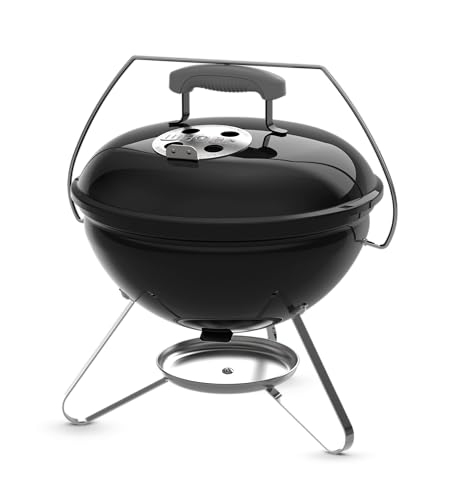
Weber Smokey Joe 14-Inch Portable Charcoal Grill — Best Ultralight Backup
The Smokey Joe is the grill RV cooks throw in ‘just in case’ — and end up using constantly. The verified listing confirms the 14-inch portable kettle format with the Tuck-N-Carry lid lock. It suits solo travelers, couples, and any rig that wants a charcoal capability at near-zero storage cost: it nests in a tote, rides in a bay corner, and asks for a handful of charcoal per cook. It does not suit groups, full stop — and it makes no pretense otherwise. Its badge is about presence: the best backup is the one that is actually aboard.
Strengths
- Near-zero storage argument: it fits the corners and totes that bigger grills cannot, so it is always aboard when wanted.
- The locking lid keeps its small ash load contained for transport once fully cold.
- A handful of charcoal per cook makes it the most fuel-frugal fire in this guide — kind to the charcoal bin on long trips.
Trade-offs
- Fourteen inches is two burgers and a vegetable, or four burgers and optimism — plan the menu to the grate.
- No meaningful indirect zone: this is a direct-fire grill, and thick cuts need a finish plan elsewhere.
- Its legs and bowl are light-gauge portable parts; treat it as the consumable-grade classic it is, not as heirloom iron.
| Spec | Detail (from the verified listing) |
|---|---|
| Size | 14-inch portable charcoal grill |
| Lid | Tuck-N-Carry lid lock (listing description) |
| Design | Lightweight and portable (listing description) |
| Fuel | Charcoal, small loads |
Every RV has a weight and space budget, and the Smokey Joe is how charcoal fits inside both. Its real competition is not the other picks here — it is the decision to carry no charcoal grill at all, and it wins that argument by being smaller than the tote of camp chairs it rides beside. For the solo traveler grilling a chop and corn at a lakeside site, it is not a compromise; it is the entire requirement, met exactly.
Owners develop a fondness for its honesty: light six briquettes’ worth of fire, cook a simple dinner directly over it, let it cool while you eat, lock the lid, done. On long trips, that frugality compounds — a small charcoal bin lasts the season. Keep a second, bigger grill for company if your road life includes it; keep this one aboard always, because the evening it saves is never the one you planned.
Best for: solo RVers, couples, and as an always-aboard charcoal backup / Not suited for: any group larger than two at one sitting
Check the current price on Amazon

Royal Gourmet CD1519 Portable Charcoal Grill with Warming Rack — Best with Warming Rack
Most portable charcoal grills have nowhere to put finished food, so the first batch cools on a plate while the second cooks. The CD1519 fixes that with a warming rack over its 303 square inches of tabletop charcoal cooking, with two side handles for the bay-to-table carry and a bottle opener built in, per the verified listing. It suits RV families whose site dinners run in batches and hosts who cook for the neighboring site too. It does not suit bay minimalists — a warming-rack tabletop is a bigger ride than the kettles — nor cooks who need a sealed lid-lock system for transport.
Strengths
- The warming rack is a genuine workflow upgrade: batch one holds warm and safe while batch two sears — potluck pacing, solved.
- 303 square inches plus the rack is the most working area in this guide, in a tabletop that still carries by two handles.
- Side handles make the loaded carry realistic — bay to table in one trip, without a juggling act.
Trade-offs
- It rides as a tabletop unit rather than a sealed box; ash must be emptied before travel rather than locked in.
- The open rack design is a fair-weather friend — wind cools exposed finished food faster than a lidded hold would.
- More area means more charcoal per cook and a longer cool-down before the bay door closes.
| Spec | Detail (from the verified listing) |
|---|---|
| Cooking area | 303 sq. in. (listing figure) |
| Rack | Warming rack included (listing description) |
| Handles | Two side handles (listing description) |
| Extras | Built-in bottle opener (listing description) |
The warming rack sounds like a spec-sheet garnish until you host at a campsite. Then it is the difference between serving everyone hot food together and serving in shifts from a cooling plate. Buns warm on it, finished chicken rests on it, vegetables hold on it while the last burgers sear — the rack turns a portable into a small station, and station cooking is what group site dinners actually require.
The transport honesty matters too: this grill asks to be emptied of ash before it rides, because it does not seal like the locking-lid picks. For many RV cooks that is a fair trade — ash goes into the site’s disposal the same evening anyway, once cold — but if your routine is to close the grill and deal with ash tomorrow, choose a locking pick above. Match the grill to your ash habits and the CD1519’s area and rack make it the group cook’s tabletop.
Best for: RV hosts and families cooking in batches at the site / Not suited for: cooks who store the grill with ash locked inside
Check the current price on Amazon
Comparison Table
Compare these by transport behavior first — sealed, latched, or emptied before travel — and by cooking area second. In an RV, the ride decides as much as the cook does.
| Pick | Badge | Key spec | Best for |
|---|---|---|---|
| Weber Go-Anywhere Portable Charcoal Grill | Best Overall for RV | Folding locking legs, sealed rectangular box, 2-piece grate | Bay-friendly RV standard |
| Weber Jumbo Joe Charcoal Grill, 18-Inch | Best Capacity for RV Groups | 18-inch kettle, Tuck-N-Carry locking lid | Group capacity on the road |
| Cuisinart 14-Inch Portable Charcoal Grill, CCG-190RB | Best Budget with Locking Lid | 14-inch, dual vents, 3 lid locks | Sealed budget companion |
| Royal Gourmet CC1619 Portable Charcoal Grill, 284 Sq. In. | Best Tabletop Barrel for RV Sites | 284 sq. in., convertible lid zone, latch buckle | Tabletop family area |
| Weber Smokey Joe 14-Inch Portable Charcoal Grill | Best Ultralight Backup | 14-inch kettle, locking lid, minimal footprint | Always-aboard backup |
| Royal Gourmet CD1519 Portable Charcoal Grill with Warming Rack | Best with Warming Rack | 303 sq. in. plus warming rack, side handles | Batch cooking for groups |
How to Choose a Charcoal Grill for RV Travel
Measure the bay, then shop
Your storage bay’s door opening — not its interior volume — is the first specification. Measure height, width, and depth at the door’s narrowest point, then shop against those numbers with the grill’s own dimensions from its listing. Rectangular, sealed grills use bay space honestly; round kettles need a dedicated corner or tote. A grill that fits ‘almost’ fits never, and it will be left home by the third trip — the most expensive outcome of all.
Decide your ash system before your grill
Ash is the charcoal RV cook’s logistics. Locking-lid grills can hold cold ash securely until a disposal point; open tabletops must be emptied the same evening, once cold. Campgrounds typically require ash to be completely cold and disposed of in designated containers or packed out. Choose the grill whose ash behavior matches your habits: seal-it-and-deal-later cooks need locks and latches; tidy-up-tonight cooks can enjoy the bigger open formats. Never — under any schedule pressure — store a grill with warm ash in a bay.
Size the grate to the site table, not the rally
Most RV charcoal cooking happens for two to four people on a picnic table. A 14-inch kettle feeds two; an 18-inch kettle or a 284–303 square inch tabletop feeds four to six. The rally cookout is real but rare; batching with a warming rack handles it better than a permanently oversized grill that taxes every travel day. Buy for the Tuesday dinner, borrow capacity from batching for the Saturday crowd.
Know the park rules before the fire
Charcoal rules vary by park, season, and drought conditions: some sites restrict grills to provided equipment, some ban charcoal during fire weather, and many require grills to stay on the pad or table rather than the ground. A folding stand or a heat mat keeps a tabletop grill legal and welcome in more places. Carry the rules in your trip planning, and keep a no-fire dinner in the pantry for the evenings the sign at the gate says no.
Budget tiers for RV charcoal grills
This guide prints no product prices, but the tiers are friendly: compact kettles are the entry tier and among the cheapest cooking appliances an RV can carry; mid-size kettles and latched barrels sit in the middle; larger tabletop stations top the category without reaching gas-cart money. The real costs are consumables and care — charcoal, chimneys, and the occasional grate. Spend on lid security and build quality first; a sealed, well-made compact beats a flimsy large grill on every travel day. Check price on Amazon for the current figure on your shortlist.
Charcoal on the Road: Fuel, Fire, and Cool-Down Discipline
Charcoal is the RVer’s most forgiving fuel: it stores indefinitely in a sealed bin, sells at every camp store, and asks for no valves, hoses, or inspections. The road kit is small — a chimney starter, a bag or bin of briquettes, a lighter, and a metal ash container — and it covers a season. Briquettes earn their place on the road for their predictability: consistent size, consistent burn time, and a cool-down curve you can plan an evening around. Lump burns hotter and faster with more character and less schedule discipline; many RV cooks carry briquettes for routine and lump for steak nights.
Cool-down is the discipline that governs everything. A small kettle’s ash is typically safe to handle after a few hours closed down with vents shut; a big tabletop load takes longer. The rule that admits no exceptions: ash goes into a metal container or the site’s designated disposal only when it is cold to the back of a careful hand near — never in — the ash, and the grill enters the bay only when the whole unit is at ambient temperature. Build the evening around it — cook, eat, close the vents, enjoy the fire’s last hour socially, and deal with ash in the cool of the routine, not the rush of departure morning.
Cooking for the Site: Menus That Suit Small Charcoal
Small charcoal grills reward menus built on sequence rather than simultaneity. Start with what holds well — sausages, corn in husks, foil-packet vegetables — bank them at the grate’s edge or on a warming rack, then sear the stars last: steaks, chops, skewers, burgers. The lid is your oven for finishing chicken and warming rolls, and a small cast-iron pan on the grate turns the grill into a two-burner camp stove for onions, mushrooms, or a pan sauce.
Dessert is the small grill’s secret encore: as the coals fade to their gentle hour, grilled peaches, pineapple, or a foil banana boat cook in the residual heat while the site settles. Plan menus in this order — holders first, stars last, dessert on the embers — and a 14-to-18-inch charcoal grill feeds a site of friends with the ease of a grill three times its size. The constraint was never really the grate; it was the sequence, and sequence is free.
How to Set Up, Cook, and Pack Away Charcoal at an RV Site
The RV charcoal routine is a loop that starts at the bay and ends back at it. Run it in this order and both the cooking and the campground stay happy.
- Place before you light. Set the grill on the site’s picnic table with a heat mat beneath, or on a stable stand on the pad — level, clear of awnings, slide-outs, and dry grass, and within the site’s rules.
- Light with a chimney. A chimney starter gives lit coals in about twenty minutes with no lighter-fluid taste, and it doubles as a measure: a full chimney for a kettle session, half for a small grill.
- Build a two-level fire. Bank coals thicker on one side for searing, thinner on the other for finishing. Small grills live and die by this gradient.
- Cook in sequence. Holders and vegetables first, proteins last, lid on for finishing. Keep a spray bottle and tongs at hand; keep the bay door closed and the charcoal bin sealed nearby.
- Close it down when done. Lid on, vents shut. The fire starves and begins its cool-down while you eat — the clock starts at the table, not after it.
- Dispose cold, store cold. When the unit is fully at ambient temperature, empty ash into the site’s designated container or your metal ash bin, wipe the grate, lock or latch the lid, and return the grill to its bay spot.
Two habits distinguish the RV charcoal veterans. First, they keep the whole system — grill, chimney, charcoal bin, ash container — in one bay zone, so setup and pack-away are a single trip each way. Second, they check the destination’s fire rules during trip planning, not at the gate, and carry a no-cook dinner for restricted nights. The grill is the easy part; the system around it is the craft.
Common Buying Mistakes
Storing the grill with warm ash ‘just this once.’ A storage bay is an enclosed box of gear and fabrics. Warm ash has no acceptable version of this story. Cold means cold — at ambient temperature — before the door closes.
Buying a kettle too big for the bay door. Interior volume is a liar; the door opening is the truth. Measure the opening, compare the listing’s dimensions, and let the tape measure vote before the heart does.
Assuming every campground allows charcoal everywhere. Rules vary by park and by week. A grill that can only cook illegally is cargo, not equipment — check rules in planning, and favor tabletop formats that satisfy ‘on the table or pad’ requirements.
Using lighter fluid because the chimney was left home. The chimney is part of the grill system, not an accessory. Pack it in the bowl or the bin, and dinner never tastes of petroleum again.
Cooking everything at once on a small grate. Small charcoal is a sequence game. Crowd the grate and you steam dinner in its own traffic jam; sequence it and the same grill serves a table of friends.
Dumping ash in the trash or the woods while it ‘looks cold.’ Ash insulates live embers for many hours beneath a grey surface. Designated metal containers, fully cold ash, or pack it out in your ash bin — those are the whole list of options.
Final Recommendation
For most RV cooks, the Weber Go-Anywhere is the answer: it seals, it packs flat and rectangular, and it cooks classic charcoal dinners for two to four without a single transport worry. Sites that host should step up to the Jumbo Joe’s 18-inch kettle, and families who live on the picnic table should take the latched Royal Gourmet barrel or the warming-rack CD1519 for batch nights.
The Cuisinart 14-inch is the sealed budget companion, and the Smokey Joe is the always-aboard backup that asks almost nothing of the bay. Every pick was verified against a live listing; check price on Amazon for the current figure, measure your bay door before ordering, and build the ash routine into your evenings. Do those three things and charcoal — the oldest RV cooking fire there is — becomes the easiest system on the rig.
Related guides in this series: Best Foldable Camping Grills; Best Folding Grills; Best Foldable Gas Grills; Best Flatop Outdoor Grills; Best Flat Top Griddle Grills.
Frequently Asked Questions
Do RV parks allow charcoal grills?
Many do, with conditions that vary by park and season: grills may need to stay on the picnic table or pad, charcoal may be banned during dry or high-fire periods, and ash almost always must be fully cold and placed in designated containers. Private parks, state parks, and national parks each set their own rules, and they change with conditions. Check the specific park’s rules when you book, and favor compact tabletop or locking-lid grills, which satisfy the widest range of requirements.
How do I store a charcoal grill in an RV storage bay?
Only when it is completely cold. Empty the ash into a metal container or the site’s designated disposal, wipe the grate, close and lock or latch the lid, and place the grill in its measured spot — rectangular sealed models pack most efficiently. Keep the charcoal itself in a sealed bin, the chimney nested with the grill, and never store a grill with warm ash or a fuel smell in an enclosed bay. A dedicated tote for the whole charcoal system keeps the bay clean and the routine fast.
How long does charcoal ash take to cool down?
Longer than it looks. Ash insulates embers, and a closed-down small grill typically needs several hours before the ash is safe to handle and dispose of; larger loads take longer still. The reliable test is time plus temperature: the grill body at ambient temperature, and no warmth detectable when a hand is held near the ash. Plan the cook so the cool-down runs during your evening, not during departure morning, and when in doubt, leave the ash in the grill, closed, until the next stop’s disposal point — never in a trash bag.
What size charcoal grill is best for an RV?
For most rigs, the sweet spot is compact: a 14-inch kettle for one or two travelers, an 18-inch kettle or a roughly 284–303 square inch tabletop for families and hosts. The binding constraint is usually the storage bay door, not appetite — measure the opening first. Bigger grills batch less but tax every travel day; smaller grills ride free and batch occasionally. A warming rack or a convertible second zone is the smart way to buy capacity without buying bulk.
Can I use a charcoal grill on an RV picnic table safely?
Yes, with the standard precautions: a heat-resistant mat under the grill, the table stable and level, the grill never left unattended, and clearance from awnings, slide-outs, and overhanging branches. Many RVers use a small folding metal stand instead, which keeps heat off the table entirely and satisfies stricter parks. Keep water or a spray bottle at hand, and let the site’s own rules override any general advice — if the park says pad only, the pad it is.
Is charcoal or gas better for RV grilling?
Charcoal wins on flavor, fuel storage, and simplicity: no canisters, no hoses, nothing to inspect, and briquettes are sold everywhere. Gas wins on speed, control, and pack-up — light, cook, close, and the grill is cool while dessert is served. Many experienced RVers carry a compact charcoal grill for the evenings that are about the fire and use gas for travel-day dinners. If you carry one, carry the one whose routine matches your evenings: charcoal’s cool-down discipline or gas’s canister management.


