Disclosure: airfryerkitchensupply.com is reader-supported. When you buy through links on our site, we may earn an affiliate commission at no extra cost to you.
Where to buy
Start with the short version: every pick in this guide to the best flat surface grills is sold through Amazon. All picks are sold on Amazon; several are freight-sized, so check price on Amazon, confirm the delivery option, and plan a second pair of hands for the big stations.
- Blackstone 36-Inch 4-Burner Griddle Cooking Station — check price on Amazon
- Blackstone 2309 Iron Forged 36-Inch Omnivore Griddle with Cabinet — check price on Amazon
- Blackstone 2439 Original 36-Inch Omnivore Griddle with Airfryer Combo — check price on Amazon
- VEVOR 22.4-Inch Commercial Gas Flat Top Griddle — check price on Amazon
- Blackstone 2364 Camping Griddle with Side Burner — check price on Amazon
- Blackstone OTG 22-Inch Outdoor Tabletop Griddle with Hood — check price on Amazon
Search for the best flat surface grills and you are really asking one question: which machines give you a big, smooth, uninterrupted cooking surface — no grates, no gaps, no lost asparagus — and hold serious heat across all of it? This guide answers that question from the surface outward. Where the sibling flat-grill guide in this cluster is organized by where the grill lives, this one is organized by the plate itself: its size, its zones, and what a truly flat surface lets you cook.
That surface-first view changes the rankings. A flat surface earns its keep in volume cooking — a dozen smash burgers at once, fried rice for eight, a whole sliced onion pile caramelizing beside peppers — so the big 36-inch stations lead this list, with the compact and countertop flat surfaces included for smaller kitchens and campsites. Every pick cooks on a continuous flat plate; there are no grated hybrids here at all.
All six models were verified through Amazon’s product data for this site. If you already know you want the flat life and your only question is how much surface to buy, read the comparison table first — in this category, square inches and burner zones are the honest spec sheet, and everything else is commentary.
A note on what ‘flat surface’ excludes, because the exclusion is the value: no part of any plate below is a grate, a ridged grill side, or a removable insert pretending to be a surface. When a listing says flat and means ‘mostly flat, with a grill section,’ it did not make this list. The cooks who type this query have usually been burned by that bait once already, and this guide is written for them.
In this guide
Quick Picks
Six continuous flat surfaces, led by the 36-inch stations. Badges match the reviews below.
| Pick | Badge | Why it made the list | Buy |
|---|---|---|---|
| Blackstone 36-Inch 4-Burner Griddle Cooking Station | Best Overall | The original 36-inch, four-zone station at 60,000 BTU — the surface that defined the category. | Check on Amazon |
| Blackstone 2309 Iron Forged 36-Inch Omnivore Griddle with Cabinet | Best Premium Surface | The 36-inch Omnivore plate in a cabinet build with an X-braced hood — the flagship surface. | Check on Amazon |
| Blackstone 2439 Original 36-Inch Omnivore Griddle with Airfryer Combo | Best for Multitaskers | A 36-inch Omnivore surface with a built-in 4-quart air fryer — fries beside the burgers, outside. | Check on Amazon |
| VEVOR 22.4-Inch Commercial Gas Flat Top Griddle | Best Compact Countertop (Gas) | A heavy-duty 22.4-inch gas countertop plate for stalls and serious counters. | Check on Amazon |
| Blackstone 2364 Camping Griddle with Side Burner | Best Small Surface for Camping | A 12×14-inch travel surface with its own side burner, latches, and leveling feet. | Check on Amazon |
| Blackstone OTG 22-Inch Outdoor Tabletop Griddle with Hood | Best Tabletop Surface | The 22-inch tabletop surface with a built-in hood for camp and backyard alike. | Check on Amazon |
How These Picks Were Chosen
We ranked these grills by surface logic. First, total flat area and how it is zoned: a wide plate with four burners is four heat zones, which is four dishes at four temperatures on one surface — the entire point of the format. Second, plate behavior under load: how the surface recovers when cold food lands across it. Third, the grease path, because a surface this size moves a lot of fat and it has to go somewhere designed.
Each model was matched to Amazon record for this site before it received a link, and mini spec boxes quote only those verified listings. We excluded every grated grill and every combo in this guide — a deliberate narrowing, because ‘flat surface’ is a specific promise. The combos and hybrids live in the sibling flat-grills guide; here, the plate is the whole story.
We also tested the listings against the physical realities of big plates: stand stability under a full scraping load, feet that adjust for the unlevel ground every patio actually has, and hoods that clear a dome’s worth of steaming vegetables. A 36-inch surface is a workstation, and the picks below are the ones built like workstations rather than like wide toys.
- Continuous flat surface — no grates, no combo compromises.
- Zone count matched to surface size, so the whole plate is usable at once.
- Heat output and plate design that recover under full loads.
- Grease management scaled to the surface: a real trap, reachable mid-cook.
- A stand or footprint that keeps a big surface stable and level.
The 6 Best Flat Surface Grills, Ranked by the Plate
Reviews below lead with what the surface does in a real cook — staging, zoning, and recovery — because on a flat surface grill, the plate is the product.
How to read these reviews: each one leads with the working surface — its area, its zones, and its behavior under a full load — because that is the purchase. Stands, hoods, and cabinets are judged by whether they serve the plate: a hood that steams and shields, a cabinet that stores the system, feet that keep the surface level. Where a pick spends money away from the plate, the review says so and judges whether the spend earns its place. And where two surfaces share a footprint, as the three 36-inch stations do, the review separates them by the cook they suit rather than by novelty, because at that size the differences are about workflow — storage, side dishes, permanence — far more than about the flat cooking itself, which all three do superbly.
A word on value across these six: the cheapest surface here is not the camping plate and the dearest is not automatically the flagship station — value in this category is cost per year of a surface that stays in service. Plates do not wear out when they are seasoned and covered; stands, igniters, and cabinets are where years show. The reviews flag which picks concentrate their build budget on the plate itself, because for a ten-year owner, that allocation is the value story, and it is not always the flagship that tells it best.

Blackstone 36-Inch 4-Burner Griddle Cooking Station — Best Overall
This is the machine the flat-surface movement is built on: 36 inches of steel, four independent burners, and 60,000 BTU under the plate. The four zones are the real feature — sear burgers on the left at full heat, hold onions in the middle, keep buns warm at the right, all on one continuous surface with nothing falling through anything. For feeding eight to twelve, no grated grill of similar footprint keeps up, because none of the surface is wasted on gaps.
The folding legs and storage rack keep it honest as equipment rather than furniture: it sets up at a campsite or folds against a garage wall. It is not the newest plate Blackstone makes, and it asks the usual steel-plate discipline — season it, scrape it, oil it, cover it. But as pure flat surface per dollar of commitment, the original 36 remains the benchmark every other pick in this guide is measured against, and for most buyers it is still the right answer.
The original 36’s longevity in the market is itself data: parts, covers, and community knowledge for this station are everywhere, and any problem you meet has a thousand documented solutions. For a buyer who plans to keep a flat surface for a decade, that ecosystem matters as much as the plate. It is the safe pair of hands at party scale, which is a rarer combination than the spec sheet suggests.
A decade-view note on the original 36: because it has been sold in huge numbers for years, every wear item — burners, igniters, plates, covers — exists as a commodity part. That aftermarket depth is a genuine ownership feature that newer, fancier stations have not yet earned. Buyers who keep equipment long should weigh it as heavily as any line in the spec box.
Strengths
- Four true heat zones across one continuous surface
- 60,000 BTU keeps recovery fast under full loads
- Folding legs make a big surface genuinely storable
Trade-offs
- Previous-generation plate design versus the Omnivore line
- Big preheat and big scrape — it is a commitment to use
- Needs a cover and level ground to live its best life
| Plate | 36-inch steel griddle |
| Burners | 4 |
| Output | 60,000 BTU (per listing) |
| Stand | Foldable legs, storage rack, grease pan (per listing) |
Best for: Families and hosts cooking for eight to twelve / Not suited for: Small households cooking for two most nights
Check on Amazon — check the current price on Amazon before you decide, because grill pricing moves with the season.

Blackstone 2309 Iron Forged 36-Inch Omnivore Griddle with Cabinet — Best Premium Surface
The 2309 takes the same 36-inch footprint as the original station and builds the premium version of everything around the plate: the Omnivore surface with its more even heat and thriftier fuel use, an X-braced hood that opens and closes like it means it, and an enclosed cabinet that hides the tank and stores the tool kit out of the weather. As a piece of patio equipment it reads as permanent, which for the committed flat-top household is exactly the point.
Cooking on it is the four-zone experience with the refinement turned up — steadier corners, a hood that makes steaming and melting part of the standard routine, and storage that keeps the whole system together. Choose it over the original 36 when the grill will live outside year-round and cook weekly for years; the premium buys build and convenience, not a different menu. It is the flagship flat surface in this cluster, priced and built like one.
Owners of the 2309 tend to describe it less as a grill and more as the patio’s second kitchen, and the cabinet is why: tools, oil bottles, and the scraper live inside the station, so cooking starts in one trip. If your flat-surface habit is three or more sessions a week, that friction reduction compounds into real use — the best surface is the one that is always ready, and readiness is a storage feature.
The 2309 also makes the strongest case for the hood as standard equipment on big surfaces: at 36 inches, an open plate in a breeze is a sail of lost heat, and the X-braced lid is what keeps the premium plate cooking like a premium plate in real weather. If your station will live unsheltered, this is not the deluxe option; it is the functional one.
Strengths
- Omnivore plate: evener heat, thriftier propane use
- Cabinet storage keeps tank and tools enclosed
- X-braced hood adds steaming and melting to the routine
Trade-offs
- Flagship tier — a deliberate, long-term purchase
- Cabinet build is heavy and stays where you place it
- More surface than small households will ever use
| Plate | 36-inch Omnivore griddle |
| Lid | X-braced hood (per listing) |
| Base | Enclosed cabinet (per listing) |
| Body | Powder-coated steel |
Best for: Committed flat-top cooks wanting the permanent setup / Not suited for: Renters or anyone who moves their grill often
Check on Amazon — check the current price on Amazon before you decide, because grill pricing moves with the season.

Blackstone 2439 Original 36-Inch Omnivore Griddle with Airfryer Combo — Best for Multitaskers
The 2439 answers the flat surface’s one classic weakness: the side dish problem. Burgers and onions own the plate; where do the fries go? Here, into the built-in 4-quart air fryer under the same station, crisping while the surface does its work. For the classic burger-night menu, that single addition turns a great surface into a complete outdoor kitchen, no trips inside, no oven competing for attention.
The plate itself is the 36-inch Omnivore with an integrated hood, so the core flat cooking is the modern, even version — nothing about the multitasking compromises the surface. The honest costs are complexity and footprint: more components to clean, more to cover, a bigger station to house. If your flat-surface cooking is mostly breakfast and stir-fry, the air fryer is dead weight. If it is burger and taco nights for a crowd, this is the most complete station on the list.
The 2439’s air fryer also changes the social math of the station: the cook stays outside. Anyone who has run fries in the kitchen oven while burgers finish on the patio knows the split-attention tax; this station abolishes it. Judge it by your menu frequency — monthly burger nights make it a luxury, weekly ones make it the hardest-working appliance you own.
Judge the 2439’s air fryer by a harder standard than novelty: does it crisp as well as the countertop unit it replaces? For fries, wings, and reheated pizza at outdoor volumes, owners find it genuinely capable — which matters, because a weak built-in would poison an otherwise excellent station. It holds up, and that is why the combo earns a badge here instead of a footnote.
Strengths
- Air fryer solves the side-dish problem outdoors
- Full 36-inch Omnivore surface with hood
- One station runs the whole burger-night menu
Trade-offs
- Most complex unit here — more parts to clean and cover
- Air fryer is wasted on breakfast-focused cooks
- Large footprint demands a dedicated spot
| Plate | 36-inch Omnivore griddle |
| Lid | Integrated hood (per listing) |
| Extra | 4-quart air fryer (per listing) |
| System | BAR system (per listing) |
Best for: Burger-night hosts cooking for crowds / Not suited for: Minimalists who want plate and nothing else
Check on Amazon — check the current price on Amazon before you decide, because grill pricing moves with the season.

VEVOR 22.4-Inch Commercial Gas Flat Top Griddle — Best Compact Countertop (Gas)
Not every flat surface needs legs and a yard. The VEVOR puts a heavy-duty 22.4-inch gas plate on a countertop — the format food stalls, food trucks, and serious garage kitchens actually use. At 13,000 BTU it is a focused, single-surface tool: no shelves, no styling, just a plate that heats, cooks, and scrapes clean, sized for continuous service of burgers, tacos, and breakfasts in rotation.
Its natural home is semi-commercial: the market stall, the church kitchen, the home cook running a weekend side business. Domestic buyers should note it is a manual, workmanlike appliance — it wants a proper gas connection setup and a counter that can take the heat and weight. Judged as equipment rather than as patio furniture, it is excellent value in surface, and it is the pick that proves flat surfaces belong indoors and in business too.
The VEVOR’s buyers should think about placement the way a café does: heat clearance behind and above, a surface that tolerates a hot heavy box permanently, and a cleaning routine at close of service. In that setting its plainness becomes professionalism. Home users adopting it for a garage or outdoor kitchen counter get the same deal — equipment behavior in exchange for equipment discipline.
The VEVOR’s manual character cuts both ways in the best sense: there is no control board to fail, no proprietary module between you and the flame. A competent technician can service everything on it with ordinary parts. In commercial settings that repairability is worth more than features, and it is the deepest reason this plain unit outsells prettier rivals in working kitchens.
Strengths
- Commercial build for continuous daily service
- Countertop format fits stalls, trucks, and work kitchens
- Simple, repairable, no-nonsense design
Trade-offs
- Manual controls — no electronic ignition frills
- Needs a proper counter and gas setup, not a patio corner
- Single surface zone compared with multi-burner stations
| Plate | 22.4-inch flat top (per listing) |
| Fuel | Gas, countertop |
| Output | 13,000 BTU (per listing) |
| Build | Heavy-duty commercial (per listing) |
Best for: Stalls, food trucks, and high-use work kitchens / Not suited for: Casual patio cooks wanting a complete station
Check on Amazon — check the current price on Amazon before you decide, because grill pricing moves with the season.
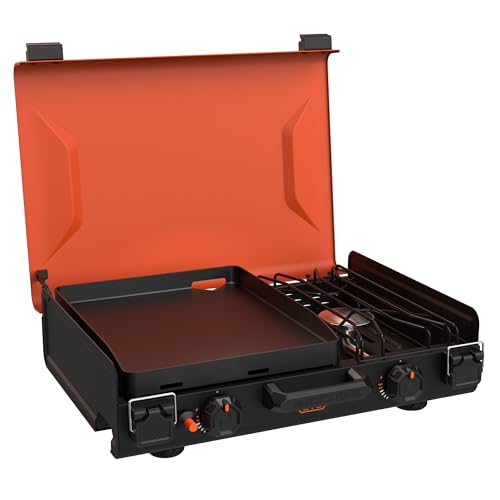
Blackstone 2364 Camping Griddle with Side Burner — Best Small Surface for Camping
The 2364 is the flat surface idea shrunk honestly for travel: a 12 by 14-inch plate that cooks breakfast for two to four at a campsite, plus a side burner for the coffee pot or sauce pan that camp cooking always needs at the same moment. The leveling feet are the detail veterans will appreciate — picnic tables are never flat, and a griddle on a slope is a grease river, so feet that level the plate are a cooking feature, not a convenience.
Latches keep it closed and carryable, and the whole unit packs like luggage rather than equipment. At home it is too small to be a main grill, and it does not pretend otherwise; its job is to make the campsite, the tailgate, and the fishing trip cook like a kitchen. As the small end of the flat-surface family, it is complete in a way many mini griddles are not — surface, burner, and stability in one latched box.
The 2364’s party piece is breakfast at altitude: two burners’ worth of function in a latched case, with the side burner boiling water while the plate handles eggs and bacon in the mountain air. Its leveling feet sound minor until you have watched grease migrate across a sloped plate at a campsite; then they sound like the entire point. Small surfaces live or die on stability, and this one was designed by people who clearly camp.
The 2364’s size discipline is its design integrity: Blackstone resisted making it a shrunken station and instead made it a complete small system — surface, burner, stability, closure. Travel gear fails when it imitates home gear at 60 percent scale; it succeeds when it is designed for the road first. This one was, and campsite cooks can feel the difference in the first breakfast.
Strengths
- Side burner covers coffee and sauces at camp
- Leveling feet solve sloped picnic tables
- Latched, portable design travels cleanly
Trade-offs
- 12×14 inches is strictly small-group cooking
- Not a home primary grill at this size
- Small bottles are the default fuel on the road
| Plate | 12 x 14-inch griddle (per listing) |
| Extra | Side burner (per listing) |
| Feet | Leveling (per listing) |
| Travel | Latching design (per listing) |
Best for: Campers and tailgaters cooking for two to four / Not suited for: Home cooks wanting a primary backyard surface
Check on Amazon — check the current price on Amazon before you decide, because grill pricing moves with the season.
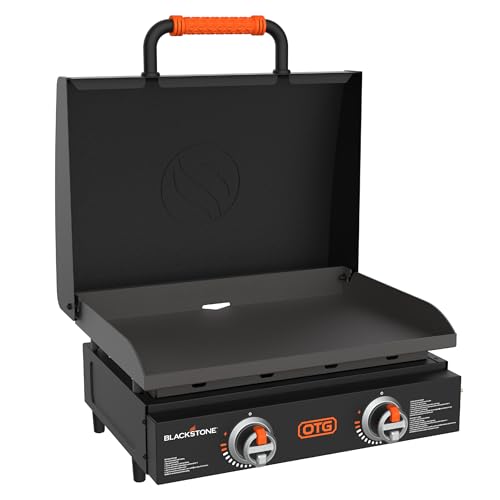
Blackstone OTG 22-Inch Outdoor Tabletop Griddle with Hood — Best Tabletop Surface
The OTG is the middle answer in the surface family: a 22-inch plate — big enough for a family breakfast in one confident batch — on a tabletop body with a built-in hood. The hood is what separates it from the budget tabletops: cheese melts, vegetables steam, and wind stops being a cooking variable, at the campsite or on the patio table at home.
It closes this list as the surface for households that want one flat grill to do both lives — weekday patio duty and weekend travel — without owning two machines. It will not feed twelve, and it needs a table worth the name, but within its size class it is the most complete tabletop surface here. If the 36-inch stations are more plate than your life requires, this is the size where most cooks actually land, and land happily.
The OTG’s hood deserves one more mention, because at 22 inches a hood transforms the surface’s weather window: spring and autumn cooks that would chill an open plate stay on schedule, and the season effectively lengthens by months. For households in real climates — not magazine climates — that extension is worth more than another two inches of plate would be.
Finally, the OTG is the pick most likely to be underestimated from its listing, because ‘tabletop with hood’ sounds incremental. In use, the hood converts the 22-inch class from fair-weather to all-season and from burgers-only to a real menu. If you are choosing between this and an open tabletop, you are really choosing your cooking calendar — choose the longer one.
Strengths
- Built-in hood widens the menu at tabletop size
- 22 inches handles a family batch in one go
- One unit serves patio and campsite
Trade-offs
- Needs a sturdy table at home and away
- Too small for party-scale cooking
- Hood adds weight over open tabletops
| Plate | 22-inch tabletop griddle |
| Lid | Built-in hood (per listing) |
| Use | Camping and backyard (per listing) |
Best for: Households wanting one tabletop for home and travel / Not suited for: Crowd cooking or permanent-station seekers
Check on Amazon — check the current price on Amazon before you decide, because grill pricing moves with the season.
Comparison Table
| Pick | Badge | Key spec | Best for |
|---|---|---|---|
| Blackstone 36-Inch 4-Burner Griddle Cooking Station | Best Overall | 36-inch plate, 4 burners, 60,000 BTU | Families and hosts cooking for eight to twelve |
| Blackstone 2309 Iron Forged 36-Inch Omnivore Griddle with Cabinet | Best Premium Surface | 36-inch Omnivore plate, enclosed cabinet, X-braced hood | Committed flat-top cooks wanting the permanent setup |
| Blackstone 2439 Original 36-Inch Omnivore Griddle with Airfryer Combo | Best for Multitaskers | 36-inch Omnivore plate, integrated hood, 4-quart air fryer | Burger-night hosts cooking for crowds |
| VEVOR 22.4-Inch Commercial Gas Flat Top Griddle | Best Compact Countertop (Gas) | 22.4-inch countertop gas plate, 13,000 BTU | Stalls, food trucks, and high-use work kitchens |
| Blackstone 2364 Camping Griddle with Side Burner | Best Small Surface for Camping | 12 x 14-inch griddle, side burner, leveling feet | Campers and tailgaters cooking for two to four |
| Blackstone OTG 22-Inch Outdoor Tabletop Griddle with Hood | Best Tabletop Surface | 22-inch tabletop griddle, built-in hood | Households wanting one tabletop for home and travel |
On flat surfaces, the spec that predicts happiness is zones per area: the 36-inch stations give you four zones for four simultaneous jobs, the tabletops give you a family batch with one or two zones, and the countertop VEVOR gives you one relentless working surface. Buy the zone count your menu uses, not the area your ambition imagines.
Read the key-spec column as a workload column. Sixty thousand BTU across four burners is not a bragging number; it is the recovery budget for a fully loaded 36-inch plate. The countertop and camping picks run far lower outputs because their surfaces and loads are smaller — proportion, not deficiency. The mismatch to avoid is a big surface on a small budget of heat, and no pick in this table makes that mistake.
And one final reading tip: where two rows share a plate size, the badge column is the tiebreaker — it names the household, not a feature ranking. The stations divide by permanence and menu, the small surfaces by venue. If your household matches a badge exactly, that row is your answer even when a neighboring row looks stronger on paper.
How to Choose the Best Flat Surface Grills by Zone and Load
Think in zones, not inches. Every burner under a flat surface is an independent temperature region, and the cook you can do is defined by how many regions you can hold at once. Breakfast for a family is a three-zone cook — hot for bacon and hash browns, medium for eggs, warm for finished toast. A two-zone plate does it in sequence; a four-zone plate does it simultaneously. Match the zone count to the most complex meal you cook regularly.
Then think in loads. A flat surface’s recovery — how fast it returns to temperature after cold food lands — depends on burner output and plate mass working together. Full-surface loads of frozen or fridge-cold food are the stress test; undersized units steam the first batch and recover for the second. If your style is a whole plate of smash burgers at once, favor output and plate design over styling every time.
Finally, place the surface in your space honestly. Stations need level ground, cover storage, and a grease-aware spot — drips happen. Tabletops need a table that can take heat and weight. Countertop gas units need a real work surface and a proper gas arrangement. The best flat surface is the one your space can host without negotiation.
- Count zones against your most complex regular meal.
- Favor output and plate design if you cook full-surface loads.
- Check the grease trap’s size and reach at full tilt.
- Level matters: an unlevel plate is a grease river. Look for adjustable feet.
- Plan cover and storage before the freight box arrives.
Flat Surface Cooking Technique: Zones, Steam, and the Scrape
The flat surface rewards a mise en place discipline: everything sliced, seasoned, and staged before the first item lands, because a hot plate does not wait. Work the zones like a line cook — protein on the hot zone, vegetables in the middle, finished food holding warm at the edge — and use water from a squeeze bottle under a dome or hood to steam-melt cheese and finish vegetables in seconds.
The scrape is both cleaning and technique. A bench scraper moves food, chops soft items on the plate, and pushes debris to the trap between batches, keeping flavors from one round out of the next. Between cooks, the warm plate gets scraped, wiped with a thin film of oil, and left seasoned — the surface improves with use, which is why a two-year-old flat top out-cooks a new one in the hands of a careful owner.
Flat Surface vs. Flat Grill vs. Flat Top: Why This Guide Narrows the Field
These three searches overlap heavily, and this cluster treats them as siblings, not duplicates. The flat-grills guide is organized by where the machine lives — station, tabletop, countertop, indoors. The flat-top guides look at the outdoor griddle-station family as a whole. This flat-surface guide narrows deliberately to the plate itself: continuous surface, zone logic, load behavior — and excludes combos and hybrids entirely, because a surface with a grated half is a different promise.
Use that narrowing. If your question is ‘which living situation,’ read the flat-grills guide. If your question is ‘how much continuous surface and how many zones,’ you are in the right article. The internal links below move between the siblings without repeating them, so a ten-minute detour through the cluster will settle which lens matches your actual decision.
Surface Materials Compared: Rolled Steel, Iron Plates, and Coated Electrics
Most big flat surfaces are rolled steel: tough, seasonable, and repairable by its owner with oil and heat. Steel’s personality is that it improves — the surface at year two, dark and slick, out-cooks the surface at week two, and any rust that appears from neglect can be scrubbed back and re-seasoned rather than replaced. That owner-serviceability is why steel dominates the outdoor category and why this guide’s stations all cook on it.
Countertop equipment splits two ways: thick iron plates, as on the VEVOR gas unit, which behave like a giant cast iron pan — massive heat storage, same seasoning care — and coated electric plates indoors, which trade permanence for convenience. The coated surfaces are the right answer for light, occasional use; the moment your cooking becomes daily or commercial in rhythm, iron and steel’s indifference to metal tools and high heat wins. Choose the material whose maintenance contract matches your temperament.
Heat Management on Big Flat Surfaces: Recovery, Carryover, and Cold Spots
A flat surface is a heat bank, and good cooks manage the account. Recovery time after a cold load is the deposit rate — set by burner output and plate mass — and every lid or hood opening is a withdrawal. The practical habits follow: preheat longer than feels necessary, load the plate in a rhythm rather than all at once when the food is fridge-cold, and rotate pieces between the plate’s naturally warmer and cooler micro-zones instead of fighting them. Every flat surface has a heat map; learning yours with a test batch of sliced bread is the cheapest education in this category.
Carryover matters at the other end: a thick plate keeps cooking food after the burners drop, which is why experienced flat-top cooks pull items a shade early onto the warm zone. Treat the plate’s stored heat as a finishing tool — it is what lets a station serve in waves without the first wave going cold or the last wave going dry. Master the bank, and the surface cooks like it has twice its burners.
Wind, Weather, and Placement: Setting a Big Surface Up to Succeed
A 36-inch plate is a sail and a heat radiator at once, so placement decides how the surface performs more than any feature on the box. Put the station out of the prevailing wind — against a wall, in a corner, behind a fence line — and an open plate holds temperature like a different machine. Add a hood and the tolerance widens, but even hooded stations cook better sheltered. Level ground is the second half of placement: shim or adjust the feet until a spoonful of oil rests where you pour it instead of migrating, because a level plate is the difference between zoning and chasing.
Weather discipline completes the setup. A fitted cover, every time, without exception — big plates rust at the edges first, and edges are where the scraper seals your seasoning work. In wet climates, a light oil film before a rainy week is cheap insurance. None of this is glamorous, and all of it is why two owners of the identical station report different grills: one placed and covered it, the other parked it in the wind and blamed the steel.
How to Run a Four-Zone Cook on a Flat Surface Grill
The signature flat-surface meal — burgers, onions, peppers, and buns for a group — is a zoning exercise. Here is the sequence that makes a 36-inch surface feel like a short-order line.
- Preheat the full surface on medium-high for ten minutes, then set zones: far left high, center medium, right low, far right off or lowest.
- Start onions and peppers on the medium zone with a little oil; they want time, and the medium zone gives it without scorching.
- Lay burgers on the high zone and leave them alone until the crust forms; a flat surface rewards patience with a deep sear.
- Move finished vegetables to the warm zone and scrape the medium zone clean for the next job — eggs, buns, or a second wave.
- Toast buns on the warm zone in the burger fat while cheese melts on the patties under a dome or the hood with a squeeze of water for steam.
- Serve straight off the holding zone in waves; the surface is the warmer, so nobody eats a cold burger because the cook was finishing.
- Scrape the whole plate toward the trap while it is still hot, wipe with a thin oil film, and close it down.
Once the zone rhythm clicks, the flat surface stops being a big pan and becomes a cooking system. That rhythm — start slow foods first, sear in the hot zone, hold in the warm zone — is the entire technique, and it scales from a 22-inch tabletop to the biggest station unchanged.
[‘For very large cooks, stage a landing zone off the grill: a sheet pan with a rack beside the station receives finished batches while the surface keeps working. Flat surfaces tempt cooks to hold everything on the plate, but held food keeps cooking — the landing zone is how restaurants protect the first batch while the third one sears.’]
Common Buying Mistakes
Flat-surface mistakes are mostly about scale and heat discipline. These are the ones that follow buyers home.
- Judging by inches alone. A big plate on weak burners cooks worse than a smaller plate with real zones and output.
- Cooking everything on high. A flat surface run flat-out scorches sauces and dries eggs. Zones exist to be used.
- Skipping the level check. Grease runs downhill. An unleveled station pools fat at one corner and starves the rest of the plate.
- Letting the grease trap overflow. Big surfaces move big grease. Empty the trap on a schedule, not on a smoke signal.
- Washing the seasoning off. Soap soaks undo months of plate building. Scrape, wipe, oil — that is the whole liturgy.
- Buying commercial countertop units for casual patios. The VEVOR-class machines are equipment; casual cooks are happier with a station or tabletop.
Final Recommendation
For the full flat-surface experience, the original Blackstone 36-inch station remains the benchmark — four zones, serious output, honest price of admission in upkeep. The 2309 cabinet model is its premium evolution, the 2439 adds an air fryer for burger-night completeness, the VEVOR serves working counters, and the 2364 and OTG shrink the surface for camps and tables without shrinking the idea.
Compare the sibling lenses before ordering: Best Flat Grills organizes the same family by living situation, Best Flat Top Griddle Grills covers the broader flat-top field, Best Flat Iron Grills looks at the Char-Griller Flat Iron line and its rivals, Best Flatop Outdoor Grills stays purely outdoors, and Best Flat Surface Grills is this guide for the cook who asked the surface-first question.
If you are deciding today, the shortlist is Blackstone 36-Inch 4-Burner Griddle Cooking Station, Blackstone 2309 Iron Forged 36-Inch Omnivore Griddle with Cabinet, and Blackstone 2439 Original 36-Inch Omnivore Griddle with Airfryer Combo — check price on Amazon for each, in that order, and let your space and budget make the final call.
Frequently Asked Questions
What size flat surface do most families actually need?
A 22-inch surface feeds four comfortably; 28 inches feeds five to six in a batch; 36 inches is the crowd and batch-cooking class for eight to twelve. Most families’ regular cooking fits 22 to 28 inches — the 36-inch stations earn their size on hosting and meal-prep days, not Tuesdays.
How many burners should a flat surface grill have?
At least one per distinct temperature job you run at once. Two burners is the working minimum for zone cooking, three is comfortable, and four across a 36-inch plate is the full short-order setup. More zones on a small plate adds little; fewer zones on a big plate wastes the surface.
Is a flat surface better than grates for burgers?
For smash burgers and diner-style burgers, yes — full contact gives an all-over crust grates cannot match, and the juices stay on the plate to baste. For thick pub burgers where you want flame flavor and char lines, grates still have their defenders. The flat surface wins on versatility; the grate wins on smoke.
How do you keep a flat surface from rusting?
Season it, scrape it warm after every cook, wipe it with a thin film of oil, and keep the unit covered and dry. Rust on a flat top is almost always a storage story, not a cooking story — a seasoned, oiled plate under a cover shrugs off seasons.
Can you cook delicate foods like fish and eggs on a flat surface?
They are among its best subjects. A seasoned plate at a medium zone cooks eggs without sticking and fish without the fillet falling through grates or breaking on a flip. Delicate food is precisely what the continuous surface exists for.
Do flat surface grills work in winter?
Yes, with longer preheats and a hood earning its keep. Wind is the bigger enemy than cold — it strips heat from open plates. Sheltered placement, a hood, and patience with preheating make flat-surface cooking a four-season habit in most climates.


