Disclosure: airfryerkitchensupply.com is reader-supported. When you buy through links on our site, we may earn an affiliate commission at no extra cost to you.
Where to buy
Every linked pick in this guide to the best fireclay kitchen sinks is sold through Amazon, where you can check the current price on Amazon and confirm the size, mount style and included accessories on the exact listing before ordering. Fireclay sinks are heavy, fragile-in-transit freight: read the listing’s delivery and inspection notes, and plan to open the crate and inspect the glaze before your installer is booked, not during the install.
- TUKTUK White Farmhouse Sink, 33-Inch Fireclay Apron Front (Best Overall) — Check on Amazon
- Miuara Farmhouse Sink 33 x 18 Inch White Fireclay (Best Value Farmhouse) — Check on Amazon
- Ruvati 33×20-Inch White Reversible Fireclay Farmhouse Sink (RVL2300WH) (Best Premium Apron Front) — Check on Amazon
- Elkay Fireclay SWUF28179WH Single Bowl Farmhouse Sink, 30-Inch (Best for Smaller Kitchens) — Check on Amazon
- Kraus Gloss White 33-Inch Fireclay Workstation Sink (KFDW1-33GWH) (Best Workstation) — Check on Amazon
- Sinkology Parker 34-Inch Fireclay Farmhouse Kitchen Sink (Best Double Bowl) — Check on Amazon
The best fireclay kitchen sinks earn their place the old-fashioned way: a clay body fired at extreme temperature until the glaze and the body fuse into a single, dense, glass-hard surface. The result is a sink that shrugs off stains, resists chipping better than ordinary ceramic, ignores heat that would mark other materials, and carries that deep, slightly soft farmhouse gloss that stainless steel will never imitate. If your kitchen design leans farmhouse, traditional or warm-modern, fireclay is usually the material the whole room is quietly organised around.
This guide covers fireclay in all its mainstream mounts — apron-front farmhouse models that sit proud of the cabinet, drop-in and undermount-capable bowls, a workstation with an integrated ledge, and a double-bowl option for households that wash and prep in parallel. Our companion guide goes deeper on the undermount-only subset, where the rim engineering and cabinet work differ enough to deserve their own read. Here, the question is broader: which fireclay sink, in which format, for which kitchen — and what does living with this heavy, beautiful material actually involve?
Every pick was matched, brand and model, against Amazon’s own catalogue data through this site’s Amazon product listings, and the mini spec boxes quote only what the verified listings state — dimensions and features named in the listing itself. Fireclay is a category full of lookalike listings and optimistic photography, so that verification discipline matters: the sink that arrives must be the sink the review describes, in the size your cabinet was cut for.
It is worth pausing on why fireclay, specifically, became the farmhouse material when cheaper ceramics exist. The firing is the answer: at temperatures ordinary ceramic never sees, the glaze does not sit on the body as a coating but fuses with it, so there is no layer to peel, craze or wear through at the drain and the rim — the two places lesser sinks show their age first. That is the property your money buys, and it is invisible in photographs, which is exactly why this guide verifies products rather than admiring pictures.
One truth before the picks, because fireclay marketing rarely mentions it: these sinks are heavy, and they are not perfectly dimensionally uniform. A fireclay bowl can weigh several times what a stainless sink of the same size weighs, needs a cabinet and support structure built for it, and — being a fired clay product — can vary slightly from its nominal dimensions. Professional templating on the actual sink, not the brochure, is the professional norm. None of that should scare a prepared buyer; all of it should be known before the crate arrives.
In this guide
Quick Picks
If you only read one section, make it this one. These are the six best fireclay kitchen sinks we would shortlist first, each chosen for a different kind of buyer rather than ranked by a single score.
- TUKTUK White Farmhouse Sink, 33-Inch Fireclay Apron Front — Best Overall. The complete farmhouse package: a 33-inch reversible fireclay apron front, deep single bowl, and a luxury accessory kit in the box per the listing. — Check on Amazon
- Miuara Farmhouse Sink 33 x 18 Inch White Fireclay — Best Value Farmhouse. A 33 x 18 reversible fireclay apron front that keeps the essential specification — and the stain, crack, heat and scratch resistance claims — at a friendlier tier. — Check on Amazon
- Ruvati 33×20-Inch White Reversible Fireclay Farmhouse Sink (RVL2300WH) — Best Premium Apron Front. The established premium name: a full 33×20 reversible fireclay farmhouse bowl from a brand whose sink support owners actually praise. — Check on Amazon
- Elkay Fireclay SWUF28179WH Single Bowl Farmhouse Sink, 30-Inch — Best for Smaller Kitchens. A 30-inch fireclay farmhouse from Elkay — the plumbing-fixture institution — for kitchens whose cabinets cannot take the 33-inch class. — Check on Amazon
- Kraus Gloss White 33-Inch Fireclay Workstation Sink (KFDW1-33GWH) — Best Workstation. Italian-made fireclay with an integrated workstation ledge, cutting board and colander included — prep happens over the sink, not beside it. — Check on Amazon
- Sinkology Parker 34-Inch Fireclay Farmhouse Kitchen Sink — Best Double Bowl. A 34-inch double-bowl farmhouse in Sinkology’s SureFire fireclay, with a Quick-Fit drop-in install aimed at 36-inch cabinets. — Check on Amazon
How These Picks Were Chosen
We chose for glaze quality and body construction first — a true fireclay sink (not thin ceramic wearing the name) with a fused, non-porous glaze — then for format coverage across the ways kitchens actually use these sinks: reversible apron fronts that let you choose a smooth or detailed face at install, workstation ledges for accessories, double bowls for parallel work, and sizes spanning the standard 30-inch and 33-inch cabinet classes plus a 34-inch statement option.
Specs quoted in the mini boxes come from the verified listings. Where a well-known fireclay name could not be matched cleanly to a current listing, it was left out rather than linked on reputation — the crate that arrives at your house has to be the product in the review.
We also excluded a seductive category error: apron-front sinks in ordinary ceramic or porcelain that borrow fireclay’s silhouette at half the weight and a third of the price. They are not bad sinks, but they are not this guide’s subject, and their glaze behaviour over a decade is a different, shorter story. Every pick here is fireclay as verified in its own listing.
We also scored the ownership details fireclay owners actually report: whether the listing includes a bottom grid (close to essential over a hard glaze), a drain assembly matched to the thick fireclay drain hole, and accessory kits that save a second order. A sink is a twenty-year fixture; the grid and drain decisions made on day one are still visible in year ten.
The 6 Best Fireclay Kitchen Sinks

TUKTUK White Farmhouse Sink, 33-Inch Fireclay Apron Front — Best Overall
The TUKTUK 33 is the pick that makes the fewest people compromise. Its verified listing describes the format most fireclay buyers actually want — a 33-inch apron-front farmhouse bowl, reversible so you can face the smooth side or the detailed side out at install, deep enough for roasting pans and stockpots — and then removes the category’s usual second order by including a luxury accessory kit. In a market where the sink, grid and drain are often three separate purchases, a complete box is a genuine buying argument.
Strengths
- Reversible apron lets you choose the face at install
- Accessory kit included — no second order for essentials
- Deep single bowl swallows roasting pans flat
Trade-offs
- Heavy — cabinet support frame is mandatory
- Inspect the crate on arrival for transit damage
- Single bowl means wash-and-rinse juggling for some
| Material | Fireclay (per listing) |
| Size class | 33 inch (per listing) |
| Style | Apron front, reversible (per listing) |
| Mount | Drop-in / undermount capable (per listing) |
As a working sink, the deep single bowl is the right call for households that cook with big vessels: sheet pans lie flat, a turkey roaster soaks without tilting, and the apron front brings the bowl’s edge closer to your body, which tall and short cooks alike feel in their backs by the end of a washing-up session. The fireclay body gives the format its substance — a solid, quiet, thermally calm bowl that feels like furniture rather than an appliance.
The cautions are fireclay’s own: weight that demands a proper support frame in the cabinet, a crate to inspect on arrival for transit chips, and dimensions to template from the actual sink. Accept those, and this is the fireclay sink we would install first in our own farmhouse kitchen — the complete, mainstream, well-judged answer.
Best for: Farmhouse kitchens wanting a complete 33-inch package / Not suited for: Cabinets not built or braced for fireclay weight
Check on Amazon — check price on Amazon for the current configuration and delivery terms.

Miuara Farmhouse Sink 33 x 18 Inch White Fireclay — Best Value Farmhouse
Miuara’s 33 x 18 is the fireclay farmhouse for buyers who want the material and the silhouette without paying for the accessory bundle. The verified listing states the essentials plainly: a reversible single bowl in true fireclay, resistant — in the maker’s words — to stain, crack, heat and scratch, installable as an apron front or drop-in/undermount configuration. That flexibility is worth money by itself in renovations, where the final mount decision sometimes waits on the countertop fabricator’s advice.
Strengths
- True fireclay bowl at a value tier
- Reversible face and flexible mount options
- 18-inch depth suits older, shallower cabinets
Trade-offs
- Grid and drain are separate purchases
- Same weight and templating demands as any fireclay
- Accessory ecosystem is buy-your-own
| Material | Fireclay (per listing) |
| Size | 33 x 18 inch (per listing) |
| Style | Apron front, reversible (per listing) |
The 18-inch front-to-back depth suits slightly shallower cabinet runs than the full 20-inch class, a detail that matters in older kitchens whose cabinet boxes predate the farmhouse era. In use it behaves like its pricier siblings — hard glaze, quiet body, big-bowl practicality — with the savings taken in the box contents rather than the bowl: budget separately for a bottom grid and the correct drain assembly, both of which we consider non-optional over fireclay.
Choose it when the sink budget competes with the countertop budget and something must give — give on accessories, not on the bowl. Choose the TUKTUK when you want the complete kit in one crate and the deeper workstation-style spec.
Best for: Renovators who want fireclay without the bundle price / Not suited for: Buyers wanting everything in one box
Check on Amazon — check price on Amazon for the current configuration and delivery terms.

Ruvati 33×20-Inch White Reversible Fireclay Farmhouse Sink (RVL2300WH) — Best Premium Apron Front
Ruvati occupies the tier where fireclay stops being a listing and starts being a product line: the RVL2300WH is a full-size 33×20 reversible farmhouse bowl from a maker that sells sinks as its whole business, with the support channel and accessory range that implies. The 20-inch front-to-back dimension is the full farmhouse footprint, giving the deepest working bowl in this roundup and an apron presence that anchors a kitchen island or a run of shaker cabinets exactly as the design magazines promise.
Strengths
- Full 33×20 footprint and deep working bowl
- Reversible smooth/fluted faces for two looks
- Sink-specialist brand with real support
Trade-offs
- Premium price tier
- Largest, heaviest install in this guide
- Needs the cabinet run to match its presence
| Material | Fireclay (per listing) |
| Size | 33 x 20 inch (per listing) |
| Model | RVL2300WH (per listing) |
| Style | Reversible farmhouse apron front |
Reversibility here is a real design decision, not a gimmick: one face is smooth and architectural, the other carries a fluted, traditional detail, and you choose at install — which also means a change of heart in a future remodel is a remount, not a replacement. The bowl’s glaze and body are the premium expression of the material: dense, even, and made to be looked at as much as washed in.
The premium buys finish, support and presence rather than a different material — the Miuara and TUKTUK are honest fireclay too. If your kitchen is a long-hold, design-led renovation, the Ruvati is the pick whose details repay the difference every day; if the renovation is a rental refresh, it is more sink than the project needs.
Best for: Design-led, long-hold kitchen renovations / Not suited for: Budget refreshes or small galley kitchens
Check on Amazon — check price on Amazon for the current configuration and delivery terms.
Elkay Fireclay SWUF28179WH Single Bowl Farmhouse Sink, 30-Inch — Best for Smaller Kitchens
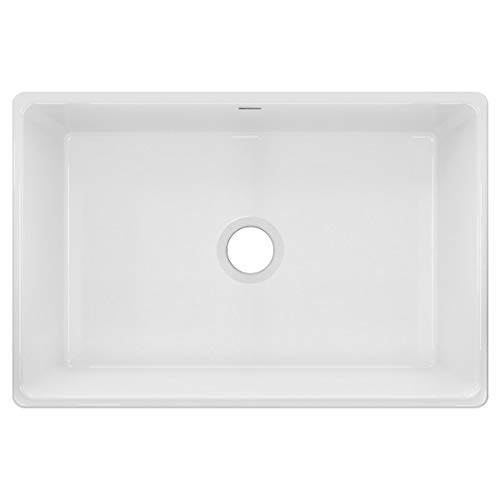
Not every kitchen can take a 33-inch farmhouse sink, and forcing one into a 30-inch cabinet run is how renovations go wrong. Elkay’s SWUF28179WH answers with the same material and silhouette in a 30-inch class: a single-bowl fireclay farmhouse from one of the oldest names in American sinks, sized for the cabinet most smaller kitchens actually have. That brand matters in this category — Elkay’s distribution means drains, grids and support are findable through ordinary plumbing channels, not just marketplace listings.
Strengths
- 30-inch class fits standard smaller cabinets
- Institutional brand with plumbing-channel support
- Same fireclay benefits in a gentler footprint
Trade-offs
- Less bowl room than the 33-inch picks
- Accessories are separate purchases
- Still requires fireclay-grade cabinet support
| Material | Fireclay (per listing) |
| Size class | 30 inch (per listing) |
| Model | SWUF28179WH (per listing) |
| Brand | Elkay |
The smaller bowl still works like a farmhouse sink: apron front, deep single basin, room for pans that a divided stainless bowl refuses. What you give up against the 33-inch picks is elbow room for two-person washing-up and the sheer visual mass of the big apron; what you gain is a sink that fits the kitchen you have, installed without cabinet surgery beyond the apron cut-out and support every fireclay needs.
Choose it for galley kitchens, cottages, and any renovation where the tape measure has already voted. It is also the gentlest introduction to fireclay ownership in this guide — same material lessons, smaller crate, smaller commitment.
Best for: Smaller kitchens wanting the farmhouse format / Not suited for: Hosts who wash for a crowd nightly
Check on Amazon — check price on Amazon for the current configuration and delivery terms.

Kraus Gloss White 33-Inch Fireclay Workstation Sink (KFDW1-33GWH) — Best Workstation
The workstation idea — a ledge inside the bowl that carries a cutting board, colander and drying rack over the sink — transformed stainless sinks, and Kraus brings it to fireclay with the KFDW1-33GWH. The verified listing describes Italian-made fireclay with the ledge integrated, and the cutting board and colander in the box. In a kitchen short on counter space, prepping over the bowl is not a gimmick: scraps sweep straight down, colanders drain where they sit, and the board bridges the sink into extra worktop exactly when a big cook demands it.
Strengths
- Integrated ledge turns the bowl into a prep station
- Cutting board and colander included
- Italian-made fireclay with a gloss finish
Trade-offs
- Manufacturer heat guidance (300F) means trivets for hot pans
- Ledge slightly reduces open bowl width
- Drop-in format only per listing
| Material | Fireclay, made in Italy (per listing) |
| Size class | 33 inch (per listing) |
| Workstation | Integrated ledge; cutting board and colander included (per listing) |
| Heat note | Heat-safe to 300F per listing — see review |
One listing detail deserves the honest spotlight we give it in the spec box: Kraus states heat-safe to 300F for this model. Fireclay as a material is famously heat-tolerant, but the manufacturer’s own figure for this sink is the one to respect — use trivets for roasting pans straight from a hot oven, as you honestly should over any sink, and this workstation will serve beautifully. We quote it because a guide that only repeats the flattering numbers is not a guide.
Choose the Kraus when your kitchen’s constraint is counter space rather than budget, and when the workstation workflow — prep, drain, dry, all over the bowl — matches how you actually cook. Traditionalists who want an uninterrupted bowl should take the farmhouse picks above instead.
Best for: Small-counter kitchens and prep-heavy cooks / Not suited for: Purists wanting a plain, uninterrupted bowl
Check on Amazon — check price on Amazon for the current configuration and delivery terms.

Sinkology Parker 34-Inch Fireclay Farmhouse Kitchen Sink — Best Double Bowl
Double-bowl households exist and are unmoved by single-bowl evangelism: they soak on one side and wash on the other, or keep a disposal side and a prep side, and they want that workflow in fireclay. The Parker is their pick — a 34-inch apron-front double bowl in Sinkology’s SureFire fireclay, with the brand’s Quick-Fit drop-in installation designed around a 36-inch cabinet, per the verified listing. The drop-in emphasis matters: it is the most forgiving mount in this guide for renovators whose cabinets and counters are already set.
Strengths
- True double-bowl workflow in fireclay — a rare format
- Quick-Fit drop-in suits existing cabinets and counters
- Sink-specialist brand and warranty
Trade-offs
- Needs a 36-inch cabinet run
- Each bowl is smaller than a single-bowl expanse
- Heaviest class of install in this guide
| Material | SureFire fireclay (per listing) |
| Size | 34 inch, for 36-inch cabinet (per listing) |
| Layout | Double bowl, apron front (per listing) |
| Install | Quick-Fit drop-in (per listing) |
Sinkology sells fireclay as a speciality, and the Parker shows it in the proposition: the material has its own name (SureFire), the warranty is the brand’s everyday promise, and the double-bowl farmhouse format — genuinely rare in fireclay — is the entire point. Two bowls in a fired-clay body is a manufacturing flex, and it gives parallel-work kitchens a farmhouse answer that does not ask them to change how they cook.
The trade-offs are size and division: a 34-inch sink wants its 36-inch cabinet, and each bowl is smaller than a single bowl’s expanse, so the biggest roasting pans may sit at an angle. If your household’s rhythm is genuinely two-bowl, that is a price you already know you are willing to pay — and this is the fireclay sink built for you.
Best for: Two-bowl households wanting the farmhouse look / Not suited for: Single-bowl cooks or 33-inch cabinets
Check on Amazon — check price on Amazon for the current configuration and delivery terms.
Comparison Table
| Pick | Badge | Key spec | Best for |
|---|---|---|---|
| TUKTUK White Farmhouse Sink, 33-Inch Fireclay Apron Front | Best Overall | 33-inch fireclay apron front, reversible, deep single bowl | Farmhouse kitchens wanting a complete 33-inch package |
| Miuara Farmhouse Sink 33 x 18 Inch White Fireclay | Best Value Farmhouse | 33 x 18 fireclay apron front, reversible single bowl | Renovators who want fireclay without the bundle price |
| Ruvati 33×20-Inch White Reversible Fireclay Farmhouse Sink (RVL2300WH) | Best Premium Apron Front | 33×20 fireclay, reversible apron front, model RVL2300WH | Design-led, long-hold kitchen renovations |
| Elkay Fireclay SWUF28179WH Single Bowl Farmhouse Sink, 30-Inch | Best for Smaller Kitchens | 30-inch fireclay single bowl farmhouse, model SWUF28179WH | Smaller kitchens wanting the farmhouse format |
| Kraus Gloss White 33-Inch Fireclay Workstation Sink (KFDW1-33GWH) | Best Workstation | 33-inch fireclay workstation, integrated ledge, accessories included | Small-counter kitchens and prep-heavy cooks |
| Sinkology Parker 34-Inch Fireclay Farmhouse Kitchen Sink | Best Double Bowl | 34-inch fireclay double bowl, Quick-Fit drop-in, 36-inch cabinet | Two-bowl households wanting the farmhouse look |
Format is the first sort, and weight is the silent column: every pick here needs the cabinet support the guide sections describe, so read the table together with your cabinet measurements rather than as a beauty parade: apron-front singles (TUKTUK, Miuara, Ruvati, Elkay) for the classic farmhouse workflow, the Kraus for prep-over-the-sink kitchens, and the Parker for committed two-bowl households. Size is the second sort — 30, 33 and 34/36-inch cabinet classes are not interchangeable, so let your cabinet measurement, verified twice, make that decision before style does.
How to Choose the Best Fireclay Kitchen Sinks
Start with the cabinet, because fireclay chooses you back. Measure the cabinet’s interior width and the countertop run honestly: 30-inch sinks suit 30–33-inch cabinets, the 33-inch class wants a 36-inch cabinet in most installations, and the Parker’s 34-inch double bowl is built for 36. Then decide the mount with your fabricator: apron-front models need the cabinet’s front cut and a support frame built inside; drop-in models (the Parker, and the Kraus per its listing) sit on the counter and forgive more; undermount fireclay is its own discipline, covered in our companion guide.
Then judge the bowl by your largest object. The sheet pan, the roasting tin, the stockpot you actually own — measure the biggest, and require the bowl to take it flat or at a workable angle. Single bowls win this test almost always; double bowls win the workflow test for households that soak-and-wash in parallel. Neither is correct in the abstract, which is why this guide carries both and refuses to pretend one layout suits every kitchen.
What ‘fireclay’ should actually mean
True fireclay is a refined clay fired at very high temperature until body and glaze fuse; the result is denser, harder and less porous than ordinary ceramic or porcelain sinks, which are the lookalikes to watch for at suspicious prices. Signals of the real thing: substantial weight (a 33-inch bowl is a two-person lift), a maker’s willingness to name the material and its properties, and a price that reflects a kiln, not a mould. If a listing will not say fireclay plainly, it is not fireclay.
Grids, drains and the accessories that are not optional
Over a hard glaze, a bottom grid is protection, not decoration: it keeps heavy pans off the surface, prevents the point-load chips that come from a dropped cast-iron corner, and lifts dishes for drainage. Fireclay drain holes sit in a thick body, so use the drain assembly specified for the sink or confirmed for fireclay thickness. Order both with the sink — retrofitting a grid to a bowl you have measured from memory is how wrong sizes happen.
Fireclay vs Stainless Steel vs Granite Composite
Stainless (the subject of our gauge guide) wins on weight, price, impact forgiveness and installation simplicity; it loses on noise, water-spotting and the industrial look some kitchens are escaping. Granite composite wins on colour range and scratch camouflage; it can feel gritty, and light colours stain with enthusiastic curry and wine. Fireclay wins on gloss, stain resistance, silence and sheer presence; it loses on weight, install effort and the small but real risk of chipping if heavy iron falls badly. None of these is the ‘best material’ — they are three different kitchens asking to happen. Choose fireclay when the room’s design leads and the budget can fund the cabinet work it honestly requires.
Longevity tilts fireclay’s way in one specific sense: the glaze does not dull, peel or corrode, so a twenty-year-old fireclay sink that has been gridded and respected looks close to new, while stainless accumulates a decade of fine scratches into a patina you either love or do not. If your renovation horizon is long and your style is settled, that ageing curve is fireclay’s quiet argument.
Installing a Fireclay Sink: What Your Installer Wishes You Knew
Three facts organise a smooth fireclay installation. First, the sink must be on site before templating: fired clay varies slightly from nominal dimensions, and countertops cut to the brochure rather than the bowl are the category’s classic expensive error. Second, support is structure, not suggestion — a frame or platform inside the cabinet carries the bowl’s full loaded weight (add water and a cast-iron pot to the mental picture), built to the sink maker’s instructions, before the countertop conversation even starts. Third, inspect the crate immediately on delivery, in good light, running a hand over rims and apron: transit chips are a carrier claim on day one and an argument on day thirty.
Sequencing matters too. Apron-front installs set the sink’s height against the cabinet and counter in a specific order that your installer will know — the apron must sit flush and proud correctly, and shimming after the counter is set is misery. Book the installer after the sink is in your garage and inspected, not against a delivery estimate, and the whole project breathes easier.
Living With Fireclay: Cleaning, Chips and Twenty-Year Care
Daily care is the easiest in the sink world: the fused glaze is non-porous, so most soils rinse or wipe away, and a paste of bicarbonate of soda handles the grey metal marks that pots leave on white glaze (they sit on the surface; they are not scratches). Avoid steel wool and harsh abrasive powders — not because the glaze is fragile, but because twenty years of micro-abrasion is how gloss dies. A bottom grid, as the guide section insists, is the main chip prevention; the second is a household habit of not dropping cast iron from height into the bowl, which no sink material truly forgives.
If a chip does happen, it is cosmetic, not structural — the body is solid fireclay throughout, and touch-up kits exist for exactly this. That repairability, plus a glaze that does not stain or corrode, is why fireclay sinks routinely outlast the kitchens around them and get reinstalled into the next renovation. Buy it once, support it properly, grid it, and it is plausibly the last kitchen sink you purchase.
Single Bowl vs Double Bowl in Fireclay, Settled Honestly
The single-bowl case: modern cooking vessels are large, and a single deep fireclay bowl takes sheet pans, roasters and stockpots flat, which is the daily reality of washing up for anyone who cooks seriously. Add a basin insert or a small tub when you need a second compartment, and the single bowl becomes two on demand — flexibility the fixed divider can never offer in reverse. This is why five of our six picks are singles, and why the farmhouse revival is a single-bowl revival.
The double-bowl case: some households genuinely work in parallel — soaking crusty pans while washing glasses, keeping raw-meat prep away from salad washing, running a disposal side and a soak side. For them the divider is not a compromise but the workflow itself, and the Sinkology Parker exists because that household in fireclay had almost no options. Judge by your last twenty washing-up sessions, not by an idealised version of your cooking: the bowl layout you reach for unconsciously is the one to buy in clay.
White, and Only White? Fireclay Colour and Style Notes
Fireclay’s classic colour is gloss white, and most of this guide wears it, because white fireclay does specific work in a kitchen: it brightens the sink zone, shows soil honestly (you can see when it is clean), and pairs with every cabinet colour from navy shaker to raw oak. The glaze’s depth — a soft, slightly warm white rather than a clinical one — is part of what buyers are paying for over ceramic lookalikes.
Coloured fireclay exists in smaller ranges (biscuit, grey and black appear in some makers’ lines), and it can be beautiful, but buy it with open eyes: colour ranges are thinner, matching accessories scarcer, and a coloured apron front is a strong design commitment that will outlast several cabinet repaints. White is the conservative choice in the best sense — it has been continuously manufactured for a century, which means grids, drains and even replacement bowls in the same language will exist for the life of your kitchen.
What Fireclay Costs to Own Over Twenty Years
The purchase price is the loud number; the ownership ledger is quieter. Fireclay asks for a support frame at install (carpentry, once), a grid (once, plus a replacement if it ever wears), and the correct drain assembly (once). It does not ask for the stainless routine of water-spot management, the composite routine of stain vigilance, or any refinishing — the glaze is the finish, fused at firing. Set against a twenty-year horizon, fireclay’s total cost frequently lands below ‘cheaper’ sinks that were replaced once in that span.
The risk column is equally specific: one bad drop of cast iron can chip an edge (touch-up territory, not replacement), and a botched install — poor support, brochure templating — is the expensive failure mode, which is why this guide spends so many words on preparation. Fund the install properly and the ledger stays boring for decades, which is the highest compliment a sink can earn.
How to Measure Your Cabinet and Prepare for a Fireclay Sink Install
Fireclay rewards preparation more than any sink material, because its weight and handmade dimensions punish improvisation. This measuring and preparation sequence is the difference between a one-day install and a renovation story told with sighs.
- Measure the cabinet’s interior width, depth and the height available under the counter; record the cabinet’s nominal size too, and confirm your chosen sink’s cabinet class against both numbers.
- Measure your largest pan or roaster and check it against the bowl’s interior dimensions on the listing — flat is ideal, a slight angle is workable, perched is a deal-breaker.
- Order the sink early and inspect it on arrival: check the apron, rims and bowl for transit chips, and measure the actual bowl in three places — this physical sink is what gets templated.
- Plan the support: a frame or platform inside the cabinet built to the maker’s instructions, rated for the bowl’s weight plus water and cookware, installed before the countertop is templated.
- Confirm the drain assembly suits fireclay’s thick drain hole and your disposal or basket-strainer plan, and order the bottom grid sized to the actual bowl at the same time.
- Book templating and installation only once the inspected sink is on site; agree with your installer who handles the apron cut-out (for farmhouse models) and the mount sequence before work begins.
On install day, be present for the dry-fit: check the apron’s reveal and the bowl’s level before anything is sealed. Ten minutes of attention at that moment protects twenty years of looking at the result.
Photograph the installed support frame and the drain assembly before the cabinet doors go back on. If you ever sell the house, remodel around the sink, or brief a plumber in year nine, those two photos answer questions that are otherwise answered by removing a very heavy sink. Preparation is this material’s love language; the camera roll counts.
Common Buying Mistakes
Cutting the countertop from the brochure dimensions. Fired clay varies. Template from the physical sink, on site, or pay for the lesson in stone.
Underbuilding the cabinet support. A fireclay bowl plus water plus a full stockpot is a serious static load. The support frame is structure; build it like it matters, because it does.
Skipping the bottom grid to save money. The grid is the cheapest insurance over a hard glaze. Most chips trace back to ungridded bowls and dropped iron.
Assuming the standard drain assembly fits. Fireclay’s thick body needs the correct drain specification. Confirm it with the sink, not at the install, with the counter already cut.
Choosing the mount after the counter is ordered. Apron-front, drop-in and undermount each demand different cabinet and counter work. The mount decision is an architectural decision — make it first.
Ordering the countertop before the sink arrives. Even with a perfect support plan, the counter cut waits for the physical bowl. Delivery first, inspection second, templating third — any other order is gambling with stone.
Judging fireclay by a ceramic lookalike’s price. Thin ceramic sinks wearing farmhouse styling chip and stain like their price suggests. If the listing will not commit to fireclay, believe its silence.
Final Recommendation
For most farmhouse kitchens, the TUKTUK 33 is the fireclay sink to buy: reversible apron, deep bowl, accessories in the box, no drama beyond the material’s honest demands. Renovators on a firmer budget should take the Miuara and add a grid; design-led projects the Ruvati; smaller kitchens the Elkay 30; counter-space-starved cooks the Kraus workstation; and two-bowl households the Sinkology Parker, gratefully, because it exists.
Whichever bowl you choose, honour the material’s three requests — real support, real templating, a real grid — and fireclay will repay you with the rarest thing in kitchen renovation: a fixture that looks better in year ten than the day it was installed is even plausible.
A final word on sequencing the purchase: order the sink before the countertop is templated, inspect it the day it lands, and let every other trade — cabinet support, counter cut, plumbing — work from the physical bowl in your garage. That order of operations, more than any brand decision in this guide, is what separates the fireclay kitchens that glide from the ones that stall.
The shortlist to act on first: TUKTUK White Farmhouse Sink, 33-Inch Fireclay Apron Front (Best Overall), Miuara Farmhouse Sink 33 x 18 Inch White Fireclay (Best Value Farmhouse), Ruvati 33×20-Inch White Reversible Fireclay Farmhouse Sink (RVL2300WH) (Best Premium Apron Front). Open each listing, confirm the configuration matches your space and fuel supply, and check price on Amazon before you decide.
Keep researching the cluster: Best Fireclay Undermount Kitchen Sinks Best Freestanding Kitchen Sinks Best Gauge Fit Kitchen Stainless Steel Sinks Best Farmhouse Kitchen Sinks Best Undermount Kitchen Sinks Best Kitchen Sinks
Frequently Asked Questions
Is fireclay better than stainless steel for a kitchen sink?
Better at some things: stain resistance, silence, gloss and long-term appearance. Worse at others: weight, installation effort and upfront cost. Stainless wins for rentals, tight budgets and anyone who drops heavy pans often; fireclay wins for design-led, long-hold kitchens. Our gauge guide covers the stainless case in full.
Can a fireclay sink chip?
Yes — a hard, heavy impact (a cast-iron pan dropped on an edge) can chip the glaze, which is why a bottom grid is close to mandatory. Everyday use does not chip it: the fused glaze is harder than the ceramic of ordinary sinks, and normal pots, pans and cutlery are not a threat. Chips are cosmetic and touch-up kits exist.
How heavy is a fireclay sink, really?
Substantially heavier than steel — a 33-inch fireclay bowl is a two-person lift and several times the weight of a stainless equivalent. That weight is why cabinet support is structural, why the sink should be on site before templating, and why ‘free delivery’ listings still deserve a delivery-day plan with a second pair of hands.
Does fireclay stain or yellow over time?
The fused, non-porous glaze resists staining from the usual culprits — wine, coffee, tomato, turmeric — and wipes clean without the water-spotting routine stainless demands. Grey marks from metal pots are surface deposits, lifted with bicarbonate paste. Yellowing is not a fireclay behaviour; the white you install is the white you keep.
Can I put a garbage disposal on a fireclay sink?
Generally yes, with the drain assembly specified for fireclay’s thicker drain hole and the disposal manufacturer’s guidance followed — and sensible bracing, since a disposal adds weight and vibration under an already heavy bowl. Confirm both with your installer before the countertop is cut, not after.
How do I clean metal marks off a white fireclay sink?
Those grey streaks are metal deposited on the glaze by pots and cutlery, not damage to it. A paste of bicarbonate of soda on a soft cloth lifts them with gentle rubbing; rinse and the gloss returns. Avoid steel wool and scouring powders as a habit — the glaze is hard, but decades of abrasion is how any gloss eventually dulls.
Apron front or drop-in: which fireclay mount is easier?
Drop-in is the most forgiving install (the Parker and Kraus in this guide), sitting on the counter with the rim visible. Apron front is the classic farmhouse look and needs the cabinet front cut plus support framing. Undermount is the sleekest and the most demanding — it has its own guide in this cluster for exactly that reason.


