Disclosure: airfryerkitchensupply.com is reader-supported. When you buy through links on our site, we may earn an affiliate commission at no extra cost to you.
Where to buy
This guide’s picks are verified cast-iron Dutch ovens chosen for the full bread-making workflow — mixing-day versatility, proofing-friendly shapes and bake performance. Check price on Amazon from any pick link and confirm capacity and variant on the listing before ordering.
- Cuisinart Chef’s Classic Cast Iron Dutch Oven, 7 Qt (CI670-30BG) (Best Overall for Bread Making) — check price on Amazon
- Lodge Essential Enamel Dutch Oven, 7.5 Quart, Storm Blue (Best for Batch Baking) — check price on Amazon
- Crock-Pot Artisan 7-Quart Round Enameled Dutch Oven, Sapphire Blue (Best Kitchen-to-Table) — check price on Amazon
- Lodge Enameled Cast Iron Oval Dutch Oven, 7 Quart, Oyster White (Best Oval for Shaped Loaves) — check price on Amazon
- Amazon Basics Pre-Seasoned Cast Iron Dutch Oven, 7-Quart (Bare Iron) (Best Budget Bare Iron) — check price on Amazon
- Lodge Pre-Seasoned Cast Iron Dutch Oven with Bail Handle, 7 Quart (Camp) (Best for Outdoor Bread Making) — check price on Amazon
Best Dutch Ovens for Bread Making: Equip the Whole Process, Not Just the Bake
The best dutch ovens for bread making are chosen differently from pots bought for a single bake, and this guide takes the wider view on purpose: bread making is a process that runs from mixing and bulk fermentation through shaping, proofing and the bake itself, and the right pot supports the baker across that whole arc — as a mixing-day workhorse for enriched doughs, a steady thermal mass on bake day, and a daily braising and soup pot that earns its storage space between loaves. If the crust-first companion guide is about steam physics, this one is about building a sustainable home bread practice.
That process lens changes the ranking. Forgiveness matters more than peak performance: a pot whose size tolerates dough-weight variation, whose handles make loaded oven lifts feel safe on your five-hundredth bake, and whose surface cleans without ceremony on a weeknight will produce more good bread over a year than a temperamental thoroughbred. Every pick below is a pot a working home baker can build a routine around — including one genuine camp-and-kitchen crossover for bakers whose bread making happens outdoors.
It also changes who should buy what. Beginners need a pot that makes the second loaf easy to attempt, not just the first one impressive. Batch bakers need volume for back-to-back bakes and doughs proofing in rotation. Enriched-dough bakers — brioche, milk bread, cinnamon swirls — need enamel that laughs at sugar and acid. Read the picks through your actual weekly routine; the best bread-making pot is the one that fits the process you will still be running in six months.
In this guide
Quick Picks
Cuisinart Chef’s Classic Cast Iron Dutch Oven, 7 Qt (CI670-30BG) — Best Overall for Bread Making. A 7-quart enameled workhorse whose own listing names bread first — sized to forgive dough-scaling variation, shaped for everyday loaves, and priced for real kitchens rather than showrooms. — check price on Amazon
Lodge Essential Enamel Dutch Oven, 7.5 Quart, Storm Blue — Best for Batch Baking. The largest enamel chamber in this guide at 7.5 quarts — for bakers who proof two doughs while one bakes, run holiday production, or simply bake loaves sized for a crowd. — check price on Amazon
Crock-Pot Artisan 7-Quart Round Enameled Dutch Oven, Sapphire Blue — Best Kitchen-to-Table. A 7-quart enameled round in a table-ready finish — the bread-making pick for bakers whose loaf goes from oven to table in the pot, and whose kitchen values the serve as much as the bake. — check price on Amazon
Lodge Enameled Cast Iron Oval Dutch Oven, 7 Quart, Oyster White — Best Oval for Shaped Loaves. The workflow oval: 7 quarts of enameled Lodge iron in the shape that proofing baskets for batards and sandwich loaves are actually shaped like — with dual handles sized for loaded lifts. — check price on Amazon
Amazon Basics Pre-Seasoned Cast Iron Dutch Oven, 7-Quart (Bare Iron) — Best Budget Bare Iron. Pre-seasoned bare iron at the lowest tier in this guide: the starter pot for a bread-making practice — forgiving of beginner mistakes, indifferent to preheat temperatures, and cheap enough to dedicate to bread alone. — check price on Amazon
Lodge Pre-Seasoned Cast Iron Dutch Oven with Bail Handle, 7 Quart (Camp) — Best for Outdoor Bread Making. The bail-handle camp original: bread making that leaves the kitchen — hearth, fire pit and campsite baking with coals on the lid, in the format that invented the genre. — check price on Amazon
How These Picks Were Chosen
Picks were verified in this site’s Amazon catalog cache and selected for workflow virtues: capacities in the versatile 7-to-7.5-quart band that forgives dough scaling errors, both round and oval chambers for shaping variety, enamel families that tolerate enriched and acidic doughs, and one bare-iron bail-handle model for outdoor bakers. The set deliberately differs from this program’s crust-focused bread guide — different models, chosen on different criteria — so bakers can read both without meeting the same list twice.
General Dutch oven fame was not a criterion; process fit was. A pot that is magnificent for a Sunday braise but awkward for weekly bread — wrong chamber, fussy upkeep, timid handles at full load — did not make this list, while honest workhorses from Cuisinart, Crock-Pot’s Artisan line, Lodge’s larger enamel family and Amazon Basics’ bare-iron line did.
The 6 Best Dutch Ovens for Bread Making

Cuisinart Chef’s Classic Cast Iron Dutch Oven, 7 Qt (CI670-30BG) — Best Overall for Bread Making
Bread making rewards the pot you reach for without thinking, and Cuisinart’s Chef’s Classic is built to be that pot: 7 quarts of enameled iron, a bread callout in its own listing, and a shape that handles boules, braises and big soup nights in rotation.
Strengths
- 7-quart versatility forgives dough-weight variation
- Listing itself names bread as a primary use
- Enamel handles enriched and acidic doughs easily
Trade-offs
- Heavier daily-driver feel than heritage pots
- Lid fit good rather than exceptional
- Finishes are workmanlike, not heirloom jewelry
| Specification | Detail |
|---|---|
| Capacity | 7 quart |
| Material | Enameled cast iron |
| Model | CI670-30BG |
Process bakers scale dough imperfectly — a starter that ran vigorous, a recipe doubled on a whim — and the 7-quart chamber absorbs those variations gracefully, springing a slightly-too-big loaf without a lid collision and supporting a slightly-small one better than cavernous pots do. That forgiveness, across hundreds of bakes, is worth more than any single-loaf peak performance, and it is why this pot anchors the bread-making list.
The enamel earns its keep on enriched dough days: brioche and milk-bread residues, sugary swirls and tomato-based shakshuka breakfasts all clean out without a seasoning thought. A bread-making pot that also runs the household’s braises gets preheated, handled and understood constantly — and familiarity is a genuine performance feature in a weekly routine.
Best for: weekly bakers wanting one forgiving, do-everything pot / Not suited for: minimalists who want the lightest possible bake-day tool
Check on Amazon — check price on Amazon.

Lodge Essential Enamel Dutch Oven, 7.5 Quart, Storm Blue — Best for Batch Baking
Batch baking is a logistics exercise, and chamber volume is its enabling spec. Lodge’s 7.5-quart Essential Enamel takes the biggest standard doughs, double focaccia-style bakes and the holiday loaf queue without breaking the rotation.
Strengths
- 7.5-quart capacity — the batch baker’s chamber
- Enamel rated in its listing to 500°F oven use
- Lodge value across a very large pot
Trade-offs
- Big and heavy — full-load lifts demand care
- Oversized for small daily loaves
- Takes serious storage space
| Specification | Detail |
|---|---|
| Capacity | 7.5 quart |
| Material | Enameled cast iron |
| Note | Listing states oven-safe to 500°F |
A batch workflow looks like this: dough one bakes while dough two finishes proofing and dough three bulks on the counter. The pot cycles hot all afternoon, and its mass and volume determine whether loaf four bakes like loaf one. The 7.5-quart Lodge’s iron bulk holds the thermal line across that rotation, and its chamber swallows the oversized holiday loaves that production days are actually for.
Between production days it moonlights as the household’s big-soup and braising pot — the role that justifies a vessel this size in a real kitchen. Bakers whose routine is a single modest boule should look at the smaller picks; bakers feeding families, freezer-stocking or selling at a cottage scale have found their chamber.
Best for: batch bakers, big families and freezer-stockers / Not suited for: single small-loaf routines
Check on Amazon — check price on Amazon.

Crock-Pot Artisan 7-Quart Round Enameled Dutch Oven, Sapphire Blue — Best Kitchen-to-Table
Some bread making is theater in the best sense: the pot arrives at the table, the lid lifts, and the loaf (or the stew around it) is the centerpiece. The Artisan 7-quart is the process pick for bakers who host — enameled, handsome and sized for sharing.
Strengths
- Table-presentable enameled finish
- 7-quart sharing size for gatherings
- Round format suits classic boules and pot meals alike
Trade-offs
- Presentation finish rewards gentler utensils
- Slow-cooking heritage — check knob rating for top preheats
- Mid-tier enamel versus heritage brands
| Specification | Detail |
|---|---|
| Capacity | 7 quart |
| Material | Enameled cast iron |
| Shape | Round |
Workflow includes the serve more often than gear guides admit. A pot that travels oven-to-table removes a transfer step for bread-adjacent meals — the bean pot that accompanies the loaf, the braise the slices mop up — and keeps food hot through a long table conversation in a way a plated dish cannot. For bakers whose bread making is woven into hosting, that continuity is the feature.
Bake performance is honest mid-field: real iron mass, a serviceable seal, and enamel that handles the repertoire. It will not out-crust the dedicated thoroughbreds across a hundred competition bakes, but bread making as a household practice is measured in shared meals, and on that metric this pot’s process fit is exact.
Best for: hosting bakers who serve from the pot / Not suited for: pure performance-per-dollar shoppers
Check on Amazon — check price on Amazon.
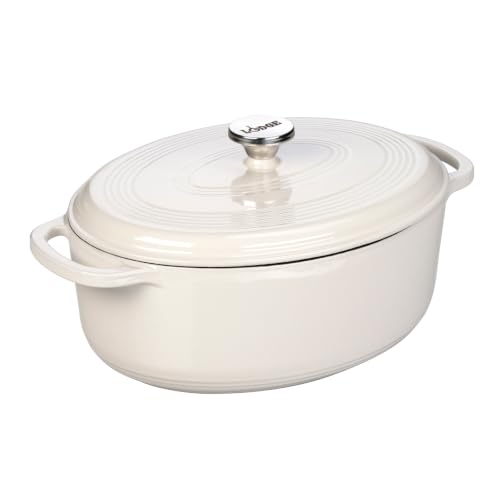
Lodge Enameled Cast Iron Oval Dutch Oven, 7 Quart, Oyster White — Best Oval for Shaped Loaves
Shaping is half of bread making, and oval doughs deserve an oval bake. Lodge’s 7-quart enameled oval aligns the whole process — banneton shape, proofing shape and baking chamber finally agree with each other.
Strengths
- Oval chamber matches batard proofing geometry
- Dual handles for confident loaded lifts
- Lodge enamel value in a family size
Trade-offs
- Oval footprint — confirm oven width
- Round-loaf bakers gain nothing from the shape
- Enamel preheat care applies
| Specification | Detail |
|---|---|
| Capacity | 7 quart |
| Material | Enameled cast iron |
| Shape | Oval, dual handles |
Process friction hides in mismatched geometry: an oval-proofed loaf lowered into a round pot slumps at the ends, scores unevenly and bakes into a shape that slices inconsistently for sandwiches. The oval chamber removes that friction entirely — the loaf springs along its length, the single slash opens end to end, and slices come off the cooled loaf in uniform ovals that toast and sandwich properly.
Dual handles matter more in ovals than rounds because the load is longer and the oven maneuver is a rotation as much as a lift. Lodge’s handle sizing here is process-aware design: mitts get purchase, the pot turns without drama, and bake day stops including the one anxious moment every oval owner knows from lesser pots.
Best for: batard and sandwich-loaf workflows / Not suited for: boule-only bakers
Check on Amazon — check price on Amazon.

Amazon Basics Pre-Seasoned Cast Iron Dutch Oven, 7-Quart (Bare Iron) — Best Budget Bare Iron
Starting a bread practice in bare iron has a hidden curriculum advantage: the pot teaches heat, seasoning and handling fundamentals while costing little enough that early mistakes are tuition, not tragedy. This 7-quart Amazon Basics is that starter pot, dual-handled and ready-seasoned.
Strengths
- Lowest-cost entry into real cast-iron bread making
- Pre-seasoned and ready for a first bake
- No enamel ceiling on preheat temperature
Trade-offs
- Seasoning discipline is part of the practice
- Bare iron and acidic doughs need care
- Fit and finish are budget-grade
| Specification | Detail |
|---|---|
| Capacity | 7 quart |
| Material | Pre-seasoned bare cast iron |
| Handles | Dual handles |
Dedicating a pot to bread is a process upgrade in itself — no braise residues, no scheduling conflicts with dinner, seasoning tuned by dry heat alone — and the budget tier is what makes dedication realistic for most kitchens. A year of weekly bakes on this pot builds both a deep seasoning and a baker’s instincts; if the practice sticks, it remains the second pot forever, and if it graduates, nothing was wasted.
Beginner forgiveness is real: scorched flour, a loaf that stuck during the parchment-free experiment, an over-long preheat — bare iron shrugs off the whole syllabus. The maintenance ritual (wipe, warm, whisper of oil) becomes part of the bread rhythm rather than a chore appended to it, which is precisely how durable kitchen practices form.
Best for: beginners starting a dedicated bread pot / Not suited for: cooks who want zero seasoning upkeep
Check on Amazon — check price on Amazon.

Lodge Pre-Seasoned Cast Iron Dutch Oven with Bail Handle, 7 Quart (Camp) — Best for Outdoor Bread Making
Bread making does not have to be an indoor practice. Lodge’s bail-handle 7-quart is the camp Dutch oven archetype: it hangs, it takes coals on its lid, and it bakes genuine loaves wherever there is a fire — while still working in a home oven between trips.
Strengths
- Bail handle for hearth and tripod cooking
- Campfire-ready — coals on lid bake like an oven
- Pre-seasoned bare iron, fully durable outdoors
Trade-offs
- Camp format is overkill for pure kitchen bakers
- Bail handle maneuvering differs from kitchen pots
- Bare iron outdoor storage needs rust vigilance
| Specification | Detail |
|---|---|
| Capacity | 7 quart |
| Material | Pre-seasoned cast iron |
| Handle | Bail handle, campfire ready |
Outdoor bread is a distinct discipline: heat comes from counted coals, more above than below, rotated in quarter turns against hot spots. The bail handle and coal-ready lid are the enabling hardware, and a well-run camp bake produces crust and crumb that silence the picnic-table skeptics. For bakers whose weekends live outside, this pot does not compromise the practice — it relocates it.
At home it remains a fully capable oven pot, so the purchase is not single-purpose: it is the kitchen’s bare-iron baker that also travels. The honest caveat is ergonomic — bail handles and camp lids are less graceful in a tight home oven than dual-handled kitchen designs — so indoor-only bakers should take the Amazon Basics or Cuisinart instead and leave this one to the fire-cooking faithful.
Best for: camp, hearth and outdoor bread makers / Not suited for: indoor-only bakers wanting kitchen ergonomics
Check on Amazon — check price on Amazon.
Comparison Table
| Pick | Badge | Key spec | Best for |
|---|---|---|---|
| Cuisinart Chef’s Classic Cast Iron Dutch Oven, 7 Qt (CI670-30BG) | Best Overall for Bread Making | 7 qt enameled, bread-named listing | weekly bakers wanting one forgiving, do-everything pot |
| Lodge Essential Enamel Dutch Oven, 7.5 Quart, Storm Blue | Best for Batch Baking | 7.5 qt enameled, batch capacity | batch bakers, big families and freezer-stockers |
| Crock-Pot Artisan 7-Quart Round Enameled Dutch Oven, Sapphire Blue | Best Kitchen-to-Table | 7 qt enameled round, table-ready | hosting bakers who serve from the pot |
| Lodge Enameled Cast Iron Oval Dutch Oven, 7 Quart, Oyster White | Best Oval for Shaped Loaves | 7 qt enameled oval, dual handles | batard and sandwich-loaf workflows |
| Amazon Basics Pre-Seasoned Cast Iron Dutch Oven, 7-Quart (Bare Iron) | Best Budget Bare Iron | 7 qt bare iron, budget tier | beginners starting a dedicated bread pot |
| Lodge Pre-Seasoned Cast Iron Dutch Oven with Bail Handle, 7 Quart (Camp) | Best for Outdoor Bread Making | 7 qt bail-handle camp oven | camp, hearth and outdoor bread makers |
How to Choose a Dutch Oven for a Bread-Making Practice
Choose for the routine, not the highlight reel. Write down your actual pattern — how many loaves a week, which shapes, what dough weights, enriched or lean, indoor or partly outdoors — and let that pattern rank the picks. A weekly two-loaf household needs forgiveness and easy cleaning; a monthly showpiece baker can prioritize peak crust; a camper needs a bail handle more than a beautiful enamel. The pot that matches the pattern gets used, and used pots bake better bread than admired ones.
Capacity planning for a practice differs from single-bake sizing: leave headroom. Doughs get doubled for guests, starters overflow into bonus loaves, and holiday production stacks bakes back to back. The 7-to-7.5-quart band dominates this guide because it absorbs that variation — big enough for ambition, not so big that a standard loaf drowns. If your routine is strictly one modest loaf, size down confidently; headroom you never use is just weight you always lift.
Handles and lids are workflow specs. Loaded pots are at their heaviest exactly when they are hottest and the baker is wearing mitts: handle purchase, lid grip and the choreography of your oven door all belong in the buying decision. Read the picks’ handle notes as seriously as their capacities — a decade of bread making is a decade of those lifts.
Building the Rest of the Bread-Making Kit Around the Pot
The pot is the thermal heart, but the practice runs on a small supporting cast: a proofing basket matched to your chamber’s shape (round banneton for round pots, oval for oval), parchment or a reusable sling for loading, a lame or razor for scoring, and a scale — bread making by weight is the single habit that most improves consistency, and it costs less than any other upgrade in the kitchen.
Starter care is the other half of the system: a healthy, predictably-fed starter makes the pot look good, while a neglected one makes every pot look bad. Bakers troubleshooting ‘the pot’ are usually troubleshooting fermentation — dough temperature, starter vigor and proofing judgment move results more than the difference between any two picks in this guide. Invest attention there before investing money twice.
Storage and rhythm close the loop: the pot should live where bake day starts without a treasure hunt, the basket where dough is shaped, and a simple bake log — date, dough, timing, result — where you will actually write in it. Bread making compounds like interest: small recorded lessons, applied weekly, turn a decent pot into a bakery-grade output within a season.
Enriched, Seeded and Everyday Doughs: Matching Pot to Repertoire
Enriched doughs — brioche, milk bread, cinnamon swirls — are enamel’s home turf: sugars caramelize onto the surface, eggs and butter enrich the residue, and a soak-and-wipe cleanup beats re-seasoning a bare pot that just hosted a sticky swirl loaf. If your repertoire leans sweet and rich, weight the enameled picks heavily and treat bare iron as the lean-loaf specialist.
Seeded and whole-grain doughs are the opposite temperament: dry, lean, and baked hard at full preheat — bare iron’s favorite assignment, where its seasoning deepens and its thermal indifference shines. High-hydration doughs of any kind reward the tightest lid you can get, because their steam is their structure; match a wet-dough habit to the picks whose seals are praised, and handle loading with a parchment sling as standard practice.
Everyday sandwich loaves close the repertoire: oval chambers, moderate temperatures, and a pot that slices-friendly geometry comes from. The meta-lesson of the whole guide is that repertoire decides equipment — which is why this bread-making list, chosen on process, looks different from a crust-first list, and why both are honest answers to slightly different questions.
How to Run a Weekly Bread-Making Rhythm With One Pot
A sustainable practice beats an heroic one. This weekly rhythm assumes one pot, one starter and a standard work week — adapt the days, keep the structure.
- Feed the starter the night before mix day, at a ratio that peaks when you plan to mix — predictability here makes every later step calmer.
- Mix and bulk ferment with the pot free: the pot’s only mix-day job is staying clean and available; dough lives in a bowl or tub where you can watch it rise.
- Shape into the basket that matches your pot’s geometry, and proof — counter or cold retard — according to the week’s schedule, not the recipe’s optimism.
- Preheat the pot fully while the oven comes to temperature; score the loaf straight from proofing, load on parchment, and bake lidded then uncovered by your logged timings.
- Cool the loaf completely, then reset the pot the same day: wipe or wash, dry, oil bare iron lightly, and note the bake in the log while memory is fresh.
- Feed the starter back to its holding rhythm and stage the next mix — the practice continues because the reset was part of the bake, not a separate chore.
After a month of this rhythm, read the log before changing anything. Patterns — a recurring pale bottom, a score that seals — point to one adjustment at a time. Bread making improves by single variables, and the log is what keeps a practice honest about which variable actually moved.
Common Buying Mistakes
Buying for the fantasy loaf. A pot sized and shaped for a loaf you bake twice a year will frustrate the loaf you bake weekly. Equip the routine you have; ambition can borrow parchment and patience.
Neglecting the starter and blaming the pot. Most ‘pot problems’ are fermentation problems. A vigorous starter and honest proofing transform results in any pick on this list.
Skipping the bake log. Memory edits itself; logs do not. Three lines per bake — dough, timing, result — compound into mastery faster than any equipment upgrade.
One pot, conflicting duties. Scheduling bread around last night’s braise residue degrades both. A dedicated or promptly-reset pot keeps bake day frictionless.
Forgetting the serve and the store. A pot too awkward to lift loaded or too large for its shelf quietly ends practices. Ergonomics and storage are buying criteria, not afterthoughts.
Troubleshooting the Practice: Flat Loaves, Pale Crusts, Stuck Bottoms
Flat loaves in a good pot are almost never the pot: under-proofed dough lacks the gas, over-proofed dough lacks the structure, and a tired starter lacks both. Run one bake with meticulous fermentation — dough temperature logged, starter at peak, proof judged by the poke test rather than the clock — before touching equipment conclusions. Nine times in ten the ‘pot problem’ retires itself in that single disciplined bake.
Stuck bottoms respond to process too: a parchment sling as default, a light dusting of rice flour or semolina under the loaf, and a pot preheated fully but not excessively for your flour type. Pale crusts want more uncovered time or a modest temperature lift in the second phase. Each symptom maps to a process lever — which is the entire philosophy of bread making as a practice rather than a purchase.
Scaling Up: From Weekly Loaves to Cottage Production
When a practice outgrows one pot, the scaling bottleneck is rarely the bake — it is proofing space, starter volume and the baker’s schedule. A second pot (often the oval sibling to a round original) doubles bake throughput only if doughs are staggered so proofing finishes in rotation; otherwise two pots wait on one dough and nothing speeds up. Plan the pipeline, then buy the iron.
Cottage-scale bakers also learn to love the big chambers in this guide: the 7.5-quart class runs the oversized loaves that slice into saleable portions, and enamel’s easy cleanup matters when the pot cycles three times in a day. Scale is a process design problem wearing an equipment costume — solve the design, and the picks here will carry the production.
Fermentation Is the Senior Partner: A Process Manifesto
Every bread-making disappointment eventually traces to one of three process variables — starter vigor, dough temperature or proofing judgment — and almost never to the pot, which is why this guide insists on process before equipment. A starter fed on a rhythm, peaking predictably, turns any pick here into a bakery tool; a starter rescued from the fridge’s back corner an hour before mixing turns the finest cocotte into an alibi. Bread making as a practice is mostly the discipline of keeping the living ingredient in the condition the schedule assumes.
Dough temperature is the lever beginners discover last and masters use first: the same recipe at a warm dough temperature ferments in a different hour than at a cool one, and a two-degree difference quietly rewrites the day’s schedule. Warm water in the mix, a proofing spot chosen deliberately rather than by counter default, and the log to record it — these free practices move results further than any upgrade between the pots in this guide, which is exactly why a process-first guide spends its authority telling you so.
Shaping and Scoring: The Hand Skills the Pot Rewards
A well-shaped loaf enters the pot with its surface tension built like a drum skin: the shaping folds have created a taut exterior that directs expansion upward and along the score. A slack-shaped loaf in the finest pot spreads and tears randomly, because the pot can only amplify the structure it is given. Practice shaping on the same dough formula until the motions are boring — pre-shape, rest, final shape, seam down into the basket — and the pot’s contribution becomes visible precisely because yours stopped varying.
Scoring is the controlled weak point where expansion is invited to happen: depth matters (a shallow slash seals, a confident one blooms), angle matters (an angled lame cut creates the ear), and timing matters (score cold dough straight from retard for the cleanest cut). In the steam-rich first phase the pot provides, a good score opens into the grigne that signals a loaf firing on all cylinders — the visual receipt that shaping, scoring and steam all did their jobs in sequence.
From Practice to Ritual: Keeping Bread Making Alive for Years
Bread practices die of friction, not of failure: the pot stored behind the roasting pan, the starter feeding that drifts, the bake that takes over a whole Saturday until Saturdays revolt. The bakers still baking in year three have engineered the friction out — cold retard schedules that bend around work weeks, a pot with a permanent home, a starter rhythm tied to an existing habit like morning coffee. Equipment serves this engineering when it is chosen for the routine, which has been this guide’s thesis from its first paragraph to this one.
The ritual end of the spectrum is real too, and worth naming without embarrassment: the weekly loaf is for many households a small ceremony of competence — flour, water, salt, time and iron producing something no store in the neighborhood matches. A pot that feels good in the hands, ages gracefully and carries the household’s bread history in its seasoning or its patina is not an indulgence in that light; it is the altar of a practice that feeds people. Choose the pot your ritual deserves, then keep the ritual.
The Economics of a Bread Practice: Cost per Loaf, Honestly Counted
A bread practice justifies its equipment with arithmetic any household can run: a bakery-quality loaf costs several times its flour’s price at retail, while the home version’s ingredients — flour, water, salt, a whisper of energy — are among the cheapest inputs in the kitchen. Against that gap, even a premium pot amortizes across a year or two of weekly loaves, and the value picks in this guide amortize across a single season. The pot is not the practice’s expense; it is the practice’s entire capital budget, and it is remarkably small for the output it enables.
The honest ledger includes the failures: the learning loaves, the forgotten salt, the proof that ran long during a phone call. Count them as tuition — every baker pays it, in ingredients measured in cents — and note that a forgiving pot reduces the tuition by rescuing marginal doughs that a lesser vessel would have wasted entirely. By the second season, the practice’s economics are not close: the household eats better bread than it can buy locally, at ingredient cost, with a pot that will still be baking when the baker’s grandchildren argue over inheriting it.
There is also the unpriced column: the bread given away. A practice that produces a spare loaf for a neighbor, a colleague, a new parent — that social output is the real return most bakers cite when asked why the rhythm stuck. Equipment chosen for a sustainable practice keeps producing that column; equipment chosen for a fantasy produces a shelf ornament and a story about the month you baked. Choose for the practice, and the economics — priced and unpriced alike — take care of themselves.
Teaching the Next Baker: Bread Making as a Household Skill
A bread practice compounds when it is shared, and the pot is the practice’s natural teaching vessel: one loaf, start to finish, shows a child or a friend the entire arc — the starter’s life, the dough’s transformations, the score, the steam, the sound of the crust. Households that bake with their kids report the same discovery restaurants make with apprentices: teaching the process is what finally makes the teacher precise, because every step must survive being explained. The forgiving, process-chosen pots in this guide are better teaching tools than temperamental thoroughbreds for exactly that reason.
Document the household’s version as you go: the flour your town sells, your oven’s offset, your starter’s name and feeding rhythm, written where the next baker will find them — many families keep the log inside the pot’s storage spot, a small archive of loaves. Bread making survived millennia as transmitted practice long before it was content; a household that treats it as a skill to hand over, with the pot as its heirloom instrument, is participating in the oldest version of the craft. The equipment decision, seen from that distance, is simple: buy the pot worth handing over, at the tier your practice honestly supports today.
Adapting the Practice to Small Kitchens and Shared Spaces
Bread making’s footprint is smaller than its reputation: the pot stores where any large pot stores, the basket in a cupboard, the starter in a jar’s worth of fridge. Small kitchens run excellent practices by sequencing rather than sprawling — bulk fermentation in the same bowl the dough was mixed in, the pot preheating while the counter is wiped for shaping, the baked loaf cooling on the stove’s back while dinner uses the front. The practice is a rhythm, and rhythms fit in small rooms better than equipment collections do.
Shared households add a social layer to the sequencing: the bake’s timetable posted where housemates can see it, the hot-pot landing zone agreed, the starter’s feeding owned by one named human (shared ownership of a living culture is how cultures die). None of this requires space; all of it requires the same thing the dough does — a little structure, honestly maintained. The reward is a household that smells like a bakery on schedule, which reconciles most housemates to most inconveniences.
Whole Grains, Seeds and the Practice’s Second Year
Most practices begin with white loaves and migrate: freshly milled whole wheat, seeded multigrains, rye blends with their different fermentation tempo. The migration changes the pot’s demands subtly — whole grains’ sugars brown faster (a gentler second phase), rye’s structure leans harder on steam (the tightest lid earns its keep), seeded doughs reward the easy-release surfaces. A pot chosen for versatility in year one proves itself in year two, when the repertoire it must serve has tripled and its chamber, seal and surface are suddenly the variables that matter.
Keep the log through the migration and the patterns teach the baker: which flours want which preheat, which doughs want the oval, which scores bloom on which blends. This is the stage where bread making stops being a recipe followed and becomes a craft practiced — and where the equipment, chosen on process from the start, quietly disappears into competence. That disappearance is the highest compliment kitchen equipment can earn, and the true destination of every recommendation in this guide.
A Note Before You Buy: The Pot Is the Easy Part
Everything this guide recommends can be delivered to your door within days; the practice it serves takes a season to build and a lifetime to deepen, and that asymmetry is the best news in bread making. Buy the pot that fits your routine from the picks above — forgiving, right-sized, honest about its care — and then invest the real budget, which is attention, in the starter, the log and the weekly rhythm. A year from now the pot will be seasoned, stained and utterly familiar, the loaves will be the neighborhood’s quiet benchmark, and the purchase decision that felt so large today will have shrunk to its proper size: the small, correct beginning of a practice that feeds people. That is what the best Dutch ovens for bread making are actually for.
The Starter Jar Beside the Pot: A Word on Companions
Look at any long-running bread kitchen and the pot has a companion: the starter jar, crooked label and all, living its rhythm beside the iron. The pairing is worth honoring in a buying guide because it reframes what is being purchased — not a pot, but a small domestic system in which a living culture and a heavy vessel cooperate across years. Choose the vessel with the seriousness the culture deserves: sized to the loaves the starter will raise, gentle or rugged in the ways your kitchen is gentle or rugged, and priced so that its loss would be mourned rather than merely replaced. Systems thinking is the whole of bread making; the shopping is simply where the system starts.
Final Recommendation
Build the practice on the Cuisinart Chef’s Classic if one pot must do everything well; scale up to the Lodge 7.5-quart when batches and big loaves define your weeks. Hosts should take the Crock-Pot Artisan to the table, shaped-loaf bakers the Lodge oval, and beginners the Amazon Basics bare iron as a dedicated, forgiving first pot. Outdoor bakers already know their answer — the bail-handle Lodge. Read alongside this program’s crust-first bread guide for the steam-and-geometry view; between the two, every home bread maker can equip a routine that lasts — which is the only kind of bread making worth equipping.
Shop the picks: Cuisinart Chef’s Classic Cast Iron Dutch Oven, 7 Qt (CI670-30BG) · Lodge Essential Enamel Dutch Oven, 7.5 Quart, Storm Blue · Crock-Pot Artisan 7-Quart Round Enameled Dutch Oven, Sapphire Blue · Lodge Enameled Cast Iron Oval Dutch Oven, 7 Quart, Oyster White · Amazon Basics Pre-Seasoned Cast Iron Dutch Oven, 7-Quart (Bare Iron) · Lodge Pre-Seasoned Cast Iron Dutch Oven with Bail Handle, 7 Quart (Camp) — check price on Amazon for each.
Keep exploring: Best Dutch Ovens For Bread Best Dutch Ovens Best Oval Dutch Ovens Best Enameled Cast Iron Cookware Best Bread Baking Tools Best Cast Iron Cookware
Frequently Asked Questions
How is this guide different from a ‘best Dutch ovens for bread’ list?
Angle and selection. This guide chooses pots for the whole bread-making process — routine, forgiveness, repertoire and workflow — with a different model set, while crust-first guides rank by steam and geometry for a single bake. Both are useful; they answer slightly different questions.
What capacity suits a weekly bread practice?
The 7-to-7.5-quart band suits most practices: headroom for doubled doughs and big loaves, without drowning a standard loaf. Strictly single small-loaf bakers can size down; batch bakers should not size below 7 quarts.
Should a beginner start with enamel or bare iron?
Either works. Enamel minimizes upkeep while you learn fermentation; bare iron minimizes cost and tolerates every beginner experiment, at the price of a simple seasoning ritual. The budget bare-iron pick exists so beginners can dedicate a pot to bread from day one.
Can one Dutch oven handle bread and everyday cooking?
Yes — the enameled picks here are chosen for exactly that dual duty. The process tip is scheduling and reset: clean and dry the pot the same day, and bread never inherits last night’s braise.
Do I need a proofing basket too?
Strongly recommended, matched to your pot’s shape: round basket for round pots, oval for oval. It supports the dough’s final shape so the loaf enters the pot with its structure already set.
Can I make bread outdoors in a Dutch oven?
Yes — that is the bail-handle camp oven’s native craft, using coals above and below and quarter-turn rotations for even heat. It also works in a home oven, making it the dual-environment pick.


