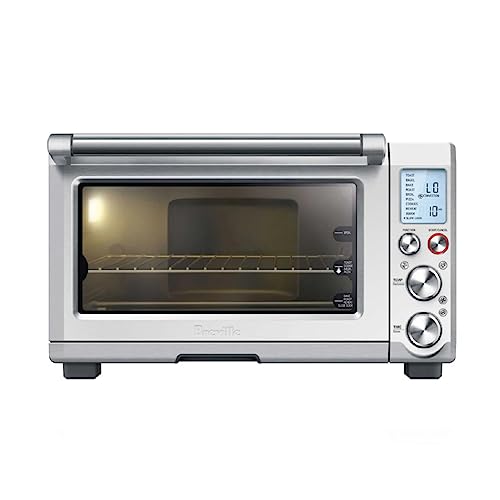
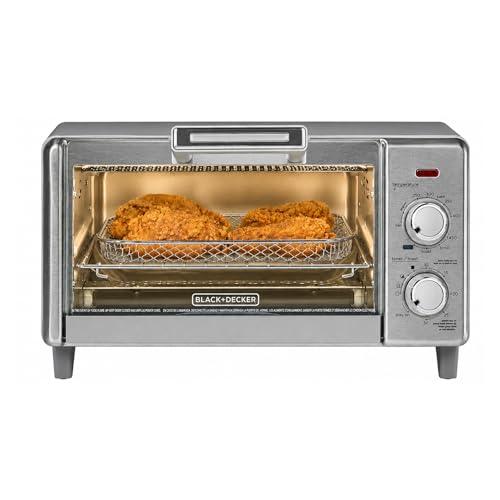
Disclosure: airfryerkitchensupply.com is reader-supported. When you buy through links on our site, we may earn an affiliate commission at no extra cost to you.
Where to buy
Every pick in this guide to the best countertop toaster convection ovens is a real model sold on Amazon, verified against Amazon’s own catalog before it earned a place here — and every pick’s convection capability is stated in its verified listing, because this guide’s entire subject is the fan. Use the links in this box to check the current price on Amazon for each one:
- Breville BOV900BSS Smart Oven Air Fryer Pro — Check the current price on Amazon
- Cuisinart TOB-260N1 Convection Toaster Oven — Check the current price on Amazon
- Ninja Prestige Smart XL DT501 — Check the current price on Amazon
- KitchenAid KCO255 Dual Convection Countertop Oven — Check the current price on Amazon
- Toshiba 10-in-1 Convection Toaster Oven, 6-Slice — Check the current price on Amazon
- BLACK+DECKER TO3250XSBD 8-Slice Extra Wide Convection Toaster Oven — Check the current price on Amazon
Convection ovens multiply into near-identical variants — finishes, accessory bundles, regional twins of one oven. The exact model links above cut through it: the capacity and function set on your counter will be the ones reviewed below.
What the Fan Actually Does Inside a Toaster Oven
Shopping for the best countertop toaster convection ovens means shopping for one component above all others: the fan. A conventional toaster oven heats still air with elements, and still air is a lazy heat carrier — it stratifies, pools hot near the elements, and leaves the far corners of a tray to catch up on their own schedule. Convection adds a fan that keeps that air moving, and moving air transfers heat to food faster and far more evenly. The practical results are the ones this guide is built around: roasted vegetables that brown across the whole tray instead of at its hot edge, chicken skin that crisps uniformly, cookies that bake in one tone, and cooking times that commonly drop by roughly a quarter — the figure two of this guide’s verified listings state outright as up to 30 percent — alongside the option to lower the temperature slightly for the same result.
But a fan is not magic, and an honest convection guide has to say where it stops helping. Convection does little for toast, which is a radiant-heat job finished in minutes; it can dry delicate bakes and blow loose toppings around if used carelessly; and a fan in a badly sealed, unevenly elemented oven merely circulates mediocrity faster. The ovens below earned their places because their convection systems sit inside well-designed cavities — with the capacity, rack positions, and controls to exploit moving air — not merely because a fan appears in their feature lists. Each pick’s convection claim comes from its verified listing, quoted in its spec box, so you can see exactly what the manufacturer itself promises.
This guide is the convection member of a family: its sibling articles in this cluster judge the same broad category through digital controls, French doors, and easy cleaning. The overlap in brands is real — good ovens are good in several ways — but the analysis here never leaves the fan: how each oven moves air, what that does to the foods convection serves best, and when you should turn the fan off and let still air cook. If your cooking is roasting, reheating, and tray-baking at family scale, this is your lens, and these are its six best instruments.
In this guide
Quick Picks
Six verified countertop convection ovens, ordered by the kind of convection cooking each does best — the badge you see here is the badge its full review opens with.
- Breville BOV900BSS Smart Oven Air Fryer Pro — Best Overall Convection. The convection benchmark: 13 functions in brushed stainless, with a listing that quantifies its convection promise — cooking time reduced by up to 30% — inside the largest, most capable cavity in this guide. — Check price on Amazon
- Cuisinart TOB-260N1 Convection Toaster Oven — Best for Big Trays and Whole Chickens. A 15-function, 1800W convection oven whose listing promises room for a 13-inch pizza and a full-size chicken, with a nonstick interior — the capacity pick for convection roasting at family scale. — Check price on Amazon
- Ninja Prestige Smart XL DT501 — Best XL Family Convection. An XL 10-in-1 convection oven whose listing measures capacity in events — 20 cookies, a 12 lb turkey — at 1800W: the family-scale pick for batch cooking and holiday overflow. — Check price on Amazon
- KitchenAid KCO255 Dual Convection Countertop Oven — Best Dual Convection. KitchenAid’s dual convection oven — two fans working one cavity, per its name and listing — for cooks who bake and roast demanding, evenness-critical loads and want the fan system doubled down on. — Check price on Amazon
- Toshiba 10-in-1 Convection Toaster Oven, 6-Slice — Best Mid-Size All-Rounder. A 6-slice, 10-in-1 convection oven at 1500W with rotisserie among its listed functions and six accessories included — the mid-size all-rounder, and the guide’s only rotisserie pick. — Check price on Amazon
- BLACK+DECKER TO3250XSBD 8-Slice Extra Wide Convection Toaster Oven — Best Budget Wide Convection. An extra-wide 8-slice convection oven with bake pan, broil rack, and toasting rack included — the budget tier’s proof that convection and casserole-dish width do not require premium money. — Check price on Amazon
How These Picks Were Chosen
The admission ticket for this guide was a sentence in a listing. Each oven was searched in Amazon’s catalog through the site’s product-verification system, its title matched to the model under review, and its convection claim copied from that matched title — a convection setting with a stated time reduction on the Breville picks, dual convection on the KitchenAid, a named convection function on the Cuisinart and Toshiba, and a convection designation on the extra-wide Black+Decker. An oven whose listing did not support a convection claim was not eligible for this guide, however good a toaster oven it might be; the fan is the assignment.
Selection then weighed what makes convection succeed. Cavity size and rack geometry came first, because moving air needs room to move: ovens that fit a 13-inch pizza or a full chicken, as two listings here state, give the fan a working volume instead of a wind tunnel. Second was function breadth around the fan — air fry modes are convection with the intensity turned up, so ovens pairing both, as most picks here do, cover more cooking with one cavity. Third was control quality: convection rewards precise temperatures, since its speed makes overshoot arrive sooner. Fourth was the honest tier spread, from a budget extra-wide convection box to a premium smart oven, so the guide serves a first countertop oven and an upgrade alike.
What did not decide the picks: raw function counts treated as quality, novelty features unrelated to cooking, and any popularity measure. Convection is a physical process, and the picks were judged as physical tools — cavity, fan, elements, controls — in that order. Prices appear nowhere, per this program’s standing rule; tiers are described qualitatively so you can place each oven before you check its current price on Amazon.
The 6 Best Countertop Toaster Convection Ovens, Reviewed
Stay inside the fan’s story as you read: each oven below is introduced by its right household and its wrong one, scored on three strengths and three trade-offs, boxed with only the specs its verified listing states, and closed with a verdict — with the analysis in between devoted to how its convection actually cooks.
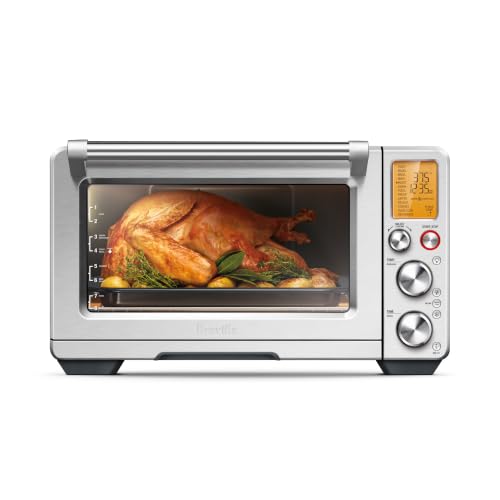
Breville BOV900BSS Smart Oven Air Fryer Pro — Best Overall Convection
The Smart Oven Air Fryer Pro suits the household ready to let a countertop oven genuinely share main-oven duty: family roasts, tray bakes, air frying, dehydrating, and holiday overflow, all in one cavity. Its 13 functions per the listing are a real working set for varied cooks. If your counter is small or your cooking is toast-and-reheat, this oven’s capability and footprint are both surplus — the compact convection picks below will serve you at a fraction of the commitment.
Strengths
- A quantified convection claim in the verified listing — up to 30% faster cooking — which is the honest headline benefit of the fan, stated by the maker
- 13 functions per the listing spanning roast, bake, air fry, and dehydrate, so the convection system is exercised across the whole cooking repertoire
- The guide’s most capable all-round cavity and build, in brushed stainless that suits permanent counter residence
Trade-offs
- Premium tier and a large countertop footprint: measure your counter and your under-cabinet clearance before falling for it
- Thirteen functions mean a learning curve; cooks who use three modes forever are paying for range they will not touch
- Convection this capable still cannot match a full-size oven for very large items — it shares main-oven duty, it does not abolish it
| Functions | 13, incl. roast, bake, dehydrate, air fry (listing) |
| Convection | Reduces cook time by up to 30% (listing claim) |
| Finish | Brushed stainless steel (listing) |
Breville’s oven earns the top badge because its convection is engineered as a system rather than added as a mode. Moving air only evens a cavity if the elements and sensors cooperate — heating in anticipation, holding temperature steady while the fan runs — and this oven’s reputation rests on exactly that integration. In practical terms, it is the pick whose tray of vegetables browns most uniformly edge to edge and whose roast chicken skins most evenly, because the air arriving at every surface has been kept at the set temperature instead of oscillating around it. The listing’s up-to-30-percent figure is the standard convection dividend, and this oven collects it most reliably.
It is also the convection pick for households whose cooking keeps expanding. Air frying is convection at high intensity with a mesh basket; dehydrating is convection at low intensity over hours; roasting and baking live between. One well-built cavity that spans that whole intensity range replaces a parade of single-purpose appliances, which is the economic argument for its premium tier. Buy it as infrastructure, learn its modes in the first month, and it will quietly become the oven you preheat by default — with the big oven reserved for the turkey and the sheet-pan Sundays.
Best for: Families and serious cooks who want the most capable convection system and will use its full function range / Not suited for: Small counters, toast-only households, or anyone who will use three modes and resent the rest
Check on Amazon — check the current price on Amazon, confirming the finish and accessory set match this review.

Cuisinart TOB-260N1 Convection Toaster Oven — Best for Big Trays and Whole Chickens
The TOB-260N1 suits the roaster: households whose countertop oven must handle a whole chicken, a 13-inch pizza night, and wide trays of vegetables, with convection keeping those big loads even. Its 15 functions per the listing give it the broadest menu in this guide. If your loads are small — two slices, one mug cake, a single fillet — its cavity heats a lot of air for a little food, and the smaller convection picks are the proportionate choice.
Strengths
- Capacity stated plainly in the listing — fits a 13-inch pizza and a full-size chicken — which is the working volume convection needs to shine
- 15 functions at 1800W per the listing: the broadest function set and full power for fast preheats and strong browning
- Nonstick interior per the listing, so the inevitable roast splatter of big-load convection cooking wipes out instead of baking on
Trade-offs
- A big cavity is a big footprint; apartment counters should measure twice
- Fifteen functions include overlap most cooks never separate in practice — breadth is only value if your cooking is broad
- Convection at this scale is powerful enough to dry a lean roast if used carelessly; the fan wants watching on delicate loads
| Functions | 15 (listing) |
| Power | 1800W (listing) |
| Capacity | Fits 13-inch pizza & full-size chicken (listing) |
| Interior | Nonstick (listing) |
Capacity is a convection specification, not just a convenience, and this oven is the guide’s clearest illustration. A fan in a cramped cavity mostly blows the food’s own steam back at it; a fan in a roomy cavity circulates genuinely hot, dry air around a chicken’s every surface, which is how skin crisps all over instead of only where an element glares. Cuisinart’s listing makes the two promises that matter — the pizza diameter and the whole bird — and the 1800W behind them means the oven recovers temperature quickly after a cold, heavy load goes in, the moment lesser ovens sag and steam instead of roast.
The nonstick interior, also in the listing, is the capacity pick’s necessary companion: big roasts splatter, convection distributes the splatter enthusiastically, and an interior that wipes clean keeps a high-use oven from becoming a smoked relic. (The easy-clean lens gets its own article in this cluster; here it is enough that the biggest convection workload does not create the biggest cleaning debt.) For households whose countertop oven is a true second oven — holiday overflow, weeknight roasts, pizza Fridays — this is the convection pick sized to the job.
Best for: Roasting households, pizza nights, and anyone needing whole-chicken capacity with convection evenness / Not suited for: Small-load cooks or tight counters
Check on Amazon — check the current price on Amazon, confirming the finish and accessory set match this review.

Ninja Prestige Smart XL DT501 — Best XL Family Convection
The DT501 suits batch cooks and big households: the listing’s own yardsticks — a full cookie batch, a small turkey — describe a family appliance, and its 10-in-1 set covers the air fry, bake, toast, pizza, and reheat rotation such kitchens live on. If you cook for one or two, its XL cavity is mostly heated air and counter rent; the guide’s smaller picks will preheat faster for your loads and sit lighter on the counter.
Strengths
- Event-sized capacity claims in the listing — 20 cookies, a 12 lb turkey — translate convection volume into meals a family recognizes
- 10-in-1 function breadth at 1800W per the listing, so the big cavity is matched by full power and a complete mode set
- Purpose-built for batch work: sheet-style loads are exactly where convection’s evenness pays for itself in one tray instead of three rotations
Trade-offs
- XL means XL: the largest domestic footprint class in this guide, demanding real counter commitment
- Big cavities preheat slower and use more energy for a single small item — the wrong tool for one toast-and-go breakfast
- Its breadth overlaps the Breville’s territory; households choosing between them are choosing ecosystems and interfaces as much as ovens
| Functions | 10-in-1 incl. air fry, bake, toast, pizza, reheat (listing) |
| Power | 1800W (listing) |
| Capacity | Bakes 20 cookies; fits 12 lb turkey (listing claims) |
Batch cooking is convection’s home turf, and the DT501 is specified like Ninja knows it. Twenty cookies in still air means the back row browns first and the front row waits; twenty cookies in well-managed moving air come out as one batch with one tone — the difference between a bake sale and a sorting exercise. The same physics scales to the turkey claim: a 12-pound bird in a countertop cavity is a convection problem (even heat in a tight space around an irregular object) far more than it is a size problem, and an oven listing the bird is an oven whose fan was designed with it in mind.
For the household that cooks in this register — weekend batch prep, team-sized snacks, holiday side dishes while the main oven holds the roast — the DT501’s value is throughput: fewer rotations, fewer watched trays, fewer ‘the middle ones are pale’ apologies. It asks for counter space the way a stand mixer does, as a permanent resident, and like a stand mixer it justifies the residence only in kitchens whose cooking volume is real. Measure both your counter and your actual batch habits; if both are large, this is your convection pick.
Best for: Large households, batch bakers, and holiday-overflow cooking / Not suited for: Singles, couples with small loads, or minimal counters
Check on Amazon — check the current price on Amazon, confirming the finish and accessory set match this review.
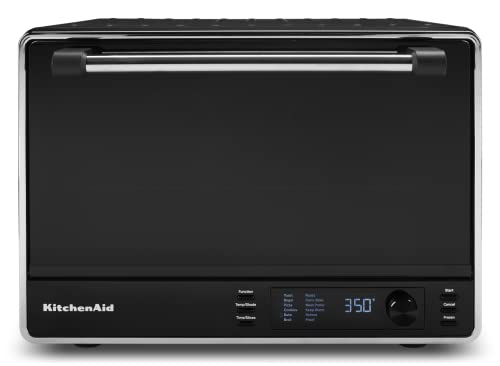
KitchenAid KCO255 Dual Convection Countertop Oven — Best Dual Convection
The KCO255 suits the evenness perfectionist: bakers whose trays must match corner to corner, roasters tired of turning trays halfway, and KitchenAid households that value the brand’s build language. Dual convection is a specific answer to a specific complaint — single-fan ovens still have a calm side — so if your cooking has never made you rotate a tray, you are paying for a solution to a problem you do not have, and the guide’s simpler convection picks will satisfy you completely.
Strengths
- Dual convection per its listing title: two fans address the dead spots a single fan leaves, the most evenness-focused design in this guide
- KitchenAid build and design language — a countertop resident that looks and feels like a permanent appliance, not a seasonal gadget
- A convection-first brief: this oven’s identity is its airflow, which suits cooks whose loads are browning-critical
Trade-offs
- The listing is terse — it states dual convection and little else — so buyers wanting a long function menu should compare the 13- and 15-function picks
- Premium positioning: dual-fan evenness is a specialist’s upgrade, priced like one in qualitative terms
- Evenness cannot rescue overcrowding: pack any convection cavity wall-to-wall and the air stops moving, fans or no fans
| Convection | Dual convection (listing title) |
| Model | KCO255 (listing) |
| Maker | KitchenAid (listing) |
Why would an oven need two fans? Because a single fan, wherever it sits, creates a gradient: the air moves hardest near the fan and laziest at the far wall, and in a small cavity that gradient is the difference between the back cookies and the front ones. Dual convection attacks the gradient itself, stirring the cavity from two sources so the calm side disappears. For the tray-baking, multi-rack, browning-critical cooking where that gradient has always been the tax, this is the most direct engineering answer in the guide — and the reason this oven, with the briefest listing of the six, still earns a specialist badge.
The KitchenAid context matters too: this is a brand whose countertop appliances are bought as decade-long residents, and a convection oven in that register is a considered purchase rather than a seasonal experiment. Pair the dual-fan brief with that build expectation and the KCO255 becomes the pick for the cook who has already owned a single-fan oven, knows exactly which corner ran pale, and is upgrading with intent. First-time convection buyers can start happily with any pick here; this one is for the second purchase, made knowingly.
Best for: Evenness perfectionists, tray bakers, and upgraders who know their old oven’s pale corner by heart / Not suited for: First-time buyers or function-count shoppers
Check on Amazon — check the current price on Amazon, confirming the finish and accessory set match this review.

Toshiba 10-in-1 Convection Toaster Oven, 6-Slice — Best Mid-Size All-Rounder
The Toshiba suits the mid-size household that wants one oven to do a bit of everything — bake, broil, pizza, toast — plus the one party trick nobody else here offers: rotisserie, stated in its listing. Six-slice capacity is the classic family-counter compromise. If your loads run to whole large chickens and 13-inch pizzas, step up to the capacity picks; if you want the last word in convection engineering, the premium picks are a tier up. For the broad middle, this is the balanced buy.
Strengths
- Rotisserie among its listed functions — convection plus rotation is the classic self-basting roast chicken formula, unique in this guide
- 10-in-1 breadth with six accessories included per the listing, so the oven arrives equipped for its modes rather than upselling them
- 6-slice mid-size footprint at 1500W: proportionate power and size for the average family counter
Trade-offs
- Mid-size is mid-size: a 6-slice cavity will not take the 13-inch pizzas and full birds the capacity picks advertise
- 1500W is a step below the 1800W picks, so preheats and recovery after big cold loads run a little slower
- Rotisserie is a delight used monthly and a storage question used yearly — be honest about which cook you are
| Functions | 10-in-1 incl. bake, broil, rotisserie, pizza, toast (listing) |
| Power | 1500W (listing) |
| Capacity | 6-slice (listing) |
| Controls / extras | LCD knob controls; 6 accessories (listing) |
Rotisserie deserves its moment, because it reframes what a countertop convection oven can be. A rotating bird in moving hot air bastes itself continuously and browns with a uniformity no static roast matches — it is the technique delis build windows around — and Toshiba’s listing puts it in a mid-size, mid-tier box with the accessories included. For the household whose Sunday chicken is a ritual, that single function can justify the oven; for everyone else it rides along inside a competent 10-in-1 set that covers the daily rotation without fuss.
The rest of the package is balance as a philosophy: enough power, enough functions, enough capacity, in stainless, with knob-and-LCD controls that stay usable with greasy hands. In a guide topped by specialists — the benchmark, the capacity king, the dual-fan perfectionist — the Toshiba is the reminder that most households are generalists, and that the best convection oven for a generalist is the one sized to their counter and their actual week. It will not win a spec-sheet duel with the premium picks; it will win Tuesday.
Best for: Mid-size households wanting one balanced convection oven — with a rotisserie bonus for Sunday chickens / Not suited for: Maximum-capacity seekers or premium-tier upgraders
Check on Amazon — check the current price on Amazon, confirming the finish and accessory set match this review.

BLACK+DECKER TO3250XSBD 8-Slice Extra Wide Convection Toaster Oven — Best Budget Wide Convection
The TO3250XSBD suits the value-minded household whose signature load is a wide one: 9×13-style casseroles, family toast rounds, and sheet loads that narrow ovens refuse. Its listing leads with extra-wide convection and the included pan-and-rack set. If your cooking is precision baking or small-batch finesse, a budget wide box is the wrong shape of good; if your counter cannot spare the width, it is literally the wrong shape. For wide loads on a budget, it stands alone in this guide.
Strengths
- Extra-wide 8-slice cavity per the listing — the budget tier’s answer to casserole dishes and family-size trays
- Convection included at this tier, with bake pan, broil rack, and toasting rack in the box per the listing: no accessory shopping before first use
- A long-running, proven model family from a mainstream maker — the safe, serviceable budget choice
Trade-offs
- Budget tier shows in refinement: controls and feedback are simpler than the digital, sensor-led picks above
- Width is the footprint: it trades counter depth problems for counter width problems
- Convection evenness at this tier is good, not benchmark — the premium picks exist because the difference is real on demanding bakes
| Capacity | 8-slice, extra wide (listing) |
| Type | Convection countertop toaster oven (listing) |
| Included | Bake pan, broil rack & toasting rack (listing) |
Width is an underrated capacity axis. Most countertop ovens grow by getting taller or deeper, which helps turkeys and hurts casseroles; family cooking, though, is wide and shallow — the 9×13 dish, the row of eight toast slices, the flat tray of nachos. An extra-wide convection cavity is shaped like the food, and the fan then does its evenness work across a single layer instead of around a stacked one. Black+Decker’s long-lived model makes that shape the budget pick, and includes the three accessories the shape needs, which at this tier is a genuinely complete offer.
Set expectations by tier and it will not disappoint: this is honest, mainstream convection — meaningfully more even than a still-air box, a step behind the benchmark ovens on demanding pastry — with simple controls that anyone in the household can run without a manual. For renters, first kitchens, and family workhorses, that is the correct allocation of money: width and a fan first, finesse later if life ever demands it.
Best for: Budget buyers with wide loads — casseroles, family toast, flat trays / Not suited for: Precision bakers or narrow counters
Check on Amazon — check the current price on Amazon, confirming the finish and accessory set match this review.
Comparison Table
The six convection picks side by side. The fan is common to all; what differs is the cavity it serves, the power behind it, and the tier of refinement around it.
| Pick | Badge | Key spec | Best for |
|---|---|---|---|
| Breville BOV900BSS Smart Oven Air Fryer Pro | Best Overall Convection | 13 functions, convection up to 30% faster | Whole-repertoire convection cooking |
| Cuisinart TOB-260N1 Convection Toaster Oven | Best for Big Trays and Whole Chickens | 15 functions, 1800W, 13-inch pizza capacity | Big-load convection roasting |
| Ninja Prestige Smart XL DT501 | Best XL Family Convection | 10-in-1 XL, 1800W, 12 lb turkey capacity | Batch cooking at family scale |
| KitchenAid KCO255 Dual Convection Countertop Oven | Best Dual Convection | Dual convection fans | Browning-critical, evenness-first cooking |
| Toshiba 10-in-1 Convection Toaster Oven, 6-Slice | Best Mid-Size All-Rounder | 10-in-1, 6-slice, rotisserie included | Everyday family all-round cooking |
| BLACK+DECKER TO3250XSBD 8-Slice Extra Wide Convection Toaster Oven | Best Budget Wide Convection | 8-slice extra wide convection, racks included | Wide family loads on a budget |
How to Choose the Best Countertop Toaster Convection Ovens
Start with the physics you are buying. Convection’s dividend — commonly up to about 30 percent faster cooking, as two listings in this guide state — comes with a rule of use: reduce the temperature by roughly 25 degrees, or shorten the time by roughly a quarter, when converting still-air recipes, and expect to adjust by observation over your first few cooks. Choose an oven whose controls make that adjustment painless: precise temperature setting and a clear convection mode you can toggle per dish, because some foods want the fan and some — delicate cakes, soufflé-style bakes, anything with loose light toppings — want still air. An oven that forces convection always-on is less versatile than one that treats it as a tool.
Size the cavity to your signature load, in the load’s own units. Pizza households think in inches — 12-inch and 13-inch capacities are both claimed in this guide’s listings. Roast households think in birds — a full-size chicken, a 12-pound turkey. Tray households think in batches — 20 cookies, eight slices, a 9×13 dish. Buy the cavity that swallows your weekly reality with air space to spare, because convection needs clearance: food packed to the walls blocks the airflow you paid for, and a slightly larger oven cooking a loose load will always beat a crammed smaller one, whatever their spec sheets say.
Power and recovery are the third check. Wattage in this guide runs from 1500W to 1800W, and the difference shows when a cold, heavy load drops the cavity temperature: higher-powered ovens climb back to roasting temperature quickly, while weaker ones linger in the steaming zone where skin softens instead of crisping. If your convection cooking is mostly heavy roasts and frozen-to-crisp loads, weight power heavily; if it is vegetables, reheats, and bakes, any pick here has enough.
Finally, be honest about function breadth. Air fry modes are convection’s high-intensity form and dehydrate its low-intensity form, so a wide function list is really a wide fan range — valuable if your cooking roams, dead weight if it does not. The premium tier buys integration and refinement: steadier temperatures while the fan runs, better preheat discipline, quieter operation. The budget tier buys the fan and the box. Both are rational; the mistake is buying either tier for a fantasy repertoire instead of the meals your household actually repeats.
Cooking With Convection: When to Fan and When to Rest the Air
Reach for the fan when browning and evenness are the point: roast vegetables, chicken pieces and whole birds, potatoes in every form, tray bakes, cookies in batches, reheating anything that should crisp rather than steam — pizza, fries, yesterday’s roast potatoes. Moving air strips the cool, moist boundary layer off food surfaces, which is the entire mechanism of crisping, and it forgives imperfect rack placement by evening the cavity. For mixed trays — the weeknight sheet-pan dinner — convection is the difference between one tray cooked as one dish and a gradient from done to raw that you manage with tongs and apologies.
Rest the fan when the food is delicate, wet-surfaced, or light enough to move. Soufflés and delicate cakes can lean or set unevenly under a blast; custards skin over; loose herbs, grated cheese, and spice dustings can migrate off the food and onto the elements. Very lean fish and thin items dry faster in moving air and need shorter times and closer watching. The skill is not loyalty to a mode but matching: fan for browning jobs, still air for setting jobs, and the fan again for the finish when a set dish wants color. The ovens in this guide all let you choose per cook — use the choice.
One conversion habit ties it together: when you switch a familiar recipe to convection, change one variable — drop the temperature about 25 degrees or cut the time about a quarter — and observe. Two cooks with the same oven will land on slightly different conversions because their loads differ; what matters is that your oven, your trays, and your recipes reach a truce you can repeat. Convection rewards that small calibration effort with the most consistent results a countertop cavity can give.
How to Roast a Whole Chicken With Countertop Convection
A whole chicken is the convection oven’s examination piece — it tests capacity, airflow, and temperature recovery at once — and the capacity picks in this guide list it explicitly. The method below assumes an oven whose listing fits a full-size chicken.
- Dry the bird. Pat the skin thoroughly dry and, if time allows, salt it and rest it uncovered in the refrigerator for several hours. Convection crisps skin by moving air over it; starting dry is half the result.
- Truss loosely and season under the skin where you can. Keep the cavity from gaping — a compact bird roasts more evenly in moving air.
- Preheat with convection on. A fully preheated cavity matters more for a large cold load than for any other countertop cook; give the oven its full preheat, not a hopeful approximation.
- Set the bird on a rack over a pan, breast up, with air space on all sides. Clearance is the method: do not wedge the bird against walls or cover it.
- Roast at a moderately high temperature, reduced slightly for convection — the standard conversion of roughly 25 degrees below your still-air recipe — and resist opening the door; the fan’s evenness is your reward for trusting it.
- Check temperature in the thigh’s thickest part near the expected end, and judge by temperature, never by time alone. Rest the bird, tented, before carving so juices settle.
- While it rests, use the pan. The drippings under a convection roast are concentrated and clean — gravy or a pan sauce is the cook’s dividend.
If the skin browns faster than the interior cooks — the classic big-bird imbalance — lower the temperature a step and give it time rather than foiling the whole bird, which steams the skin you worked for. A small foil shield over the breast alone, late in the cook, is the surgical version. And note the rotisserie alternative from this guide’s Toshiba pick: rotation plus convection removes the imbalance by moving the bird instead of only the air, which is why that function, where fitted, is more than a novelty.
Common Buying Mistakes
Cramming the cavity. Convection is airflow, and airflow needs gaps. A tray wall-to-wall with vegetables steams its own center no matter how good the fan is. Cook in a single loose layer, in two batches if needed — two crisp batches beat one soggy one every time.
Skipping the recipe conversion. Running still-air times and temperatures under a fan overcooks exteriors and dries lean meats. Drop the temperature roughly 25 degrees or cut the time roughly a quarter, then calibrate by observation.
Using convection for everything. Delicate bakes, custards, and loose toppings suffer under moving air. The fan is a tool with an off position; ovens in this guide let you choose, and choosing is the skill.
Judging doneness by the clock after a cold load. A frozen or fridge-cold heavy load drops cavity temperature and delays everything. Temperature of the food, checked properly, is the only verdict — especially in an oven whose speed you are still learning.
Blocking the fan’s intake with foil or a pan. Lining and oversized pans can obstruct the very airflow you bought. Keep coverings to the manufacturer’s intended accessories and leave the cavity’s air paths open.
Buying width when you needed height, or the reverse. Casserole households and bird households need different cavities. Match the oven’s shape to your signature load’s shape — the listings in this guide state both kinds plainly.
Final Recommendation
The short version: the Breville Smart Oven Air Fryer Pro is the convection benchmark and the default recommendation for serious, varied cooking. The Cuisinart TOB-260N1 is the capacity pick for 13-inch pizzas and whole chickens with a nonstick interior; the Ninja DT501 is its XL batch-cooking rival, sized in turkeys and cookie batches. The KitchenAid KCO255 is the evenness specialist, with dual fans for browning-critical bakers. The Toshiba is the balanced mid-size all-rounder with a rotisserie flourish, and the Black+Decker TO3250XSBD proves convection and casserole width exist at a budget tier.
Whichever you choose, cook with the fan deliberately: convert your recipes, leave the air its room, and rest the fan for delicate work. A convection oven used with that much intention is not a toaster oven with a bonus feature — it is the most capable small oven most kitchens will ever own.
- Breville BOV900BSS Smart Oven Air Fryer Pro (Best Overall Convection) — Check price on Amazon
- Cuisinart TOB-260N1 Convection Toaster Oven (Best for Big Trays and Whole Chickens) — Check price on Amazon
- Ninja Prestige Smart XL DT501 (Best XL Family Convection) — Check price on Amazon
Sibling guides in this toaster oven cluster: Best Toaster Ovens Best Digital Toaster Ovens Best Double Door Toaster Ovens Best Easy To Clean Toaster Ovens Best Air Fryer Toaster Ovens.
Frequently Asked Questions
What is the difference between a convection toaster oven and an air fryer oven?
Intensity and accessories, not principle. Air frying is convection cooking run hot and fast with a perforated basket that exposes food to moving air on all sides; a convection toaster oven uses the same fan principle across a wider, gentler range for roasting and baking. Most picks in this guide do both, which is why one cavity can cover both jobs for most households.
How much faster is convection, really?
A common figure — stated in two verified listings in this guide — is up to about 30 percent faster, and the standard recipe conversion is to cut time by roughly a quarter or drop temperature by about 25 degrees. Real results vary with load size and how full the cavity is; a loose single tray collects the full dividend, a crammed one does not.
Does convection use more electricity than a regular toaster oven?
The fan itself draws little; the savings come from shorter cooking times and from using a small cavity instead of heating a full-size oven. For small and medium loads, a countertop convection oven is typically the economical choice — one more reason the capacity should match your loads rather than exceed them wildly.
Can I bake a cake in a convection toaster oven?
Yes, with the fan treated as an option rather than a default. Many bakers rest the fan for delicate cakes and custards, or use it at a reduced temperature for sturdy bakes like traybakes and fruit crumbles. The ovens in this guide let you choose the mode per dish, which is exactly the versatility cake asks for.
Why did my roast vegetables steam instead of crisp?
Almost always crowding or moisture: a packed tray traps the vegetables’ own steam faster than the fan can clear it. Use a single loose layer with gaps, dry the vegetables before oiling them, preheat fully, and give the batch room — or cook two batches. Convection crisps by moving air across surfaces; it cannot crisp a surface it cannot reach.
Is a countertop convection oven big enough to replace my main oven?
For many households, for most meals, nearly: picks in this guide fit 13-inch pizzas, full chickens, and in one case a 12 lb turkey. What it cannot do is a full-size turkey, multiple large dishes at different temperatures at once, or a baker’s sheet pan. Most owners end up using the countertop oven daily and the main oven for events — which is a replacement in practice, if not in theory.